Reconciling New Perspectives: the Tug-of-War between Familiar and Unfamiliar

More so than American vs. Austrian culture, I have observed and experienced a tug-of-war between the familiar and the unfamiliar.

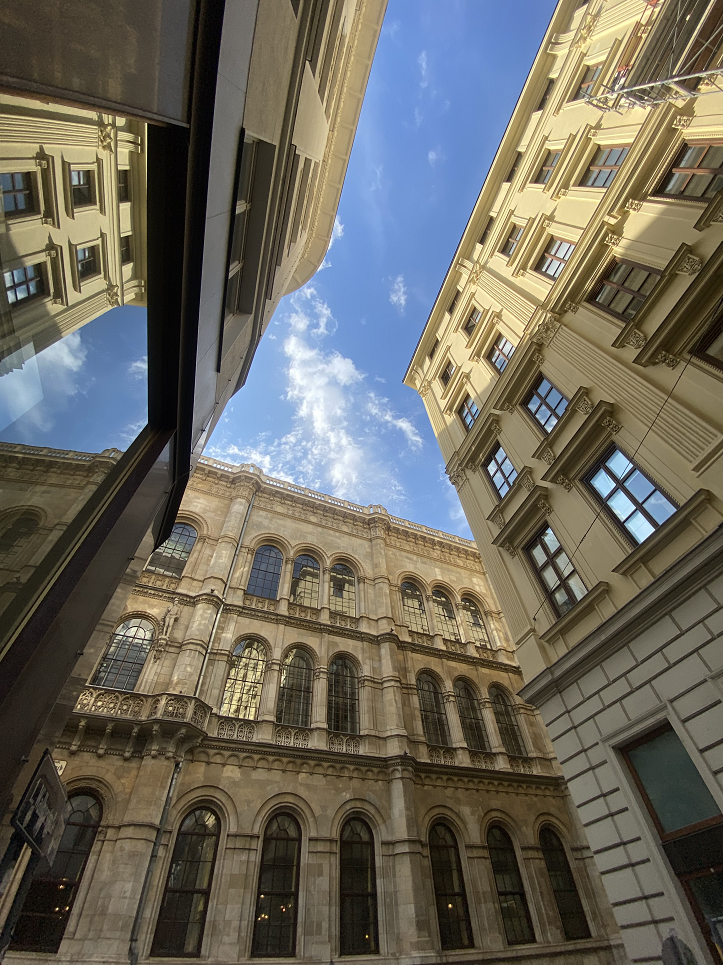
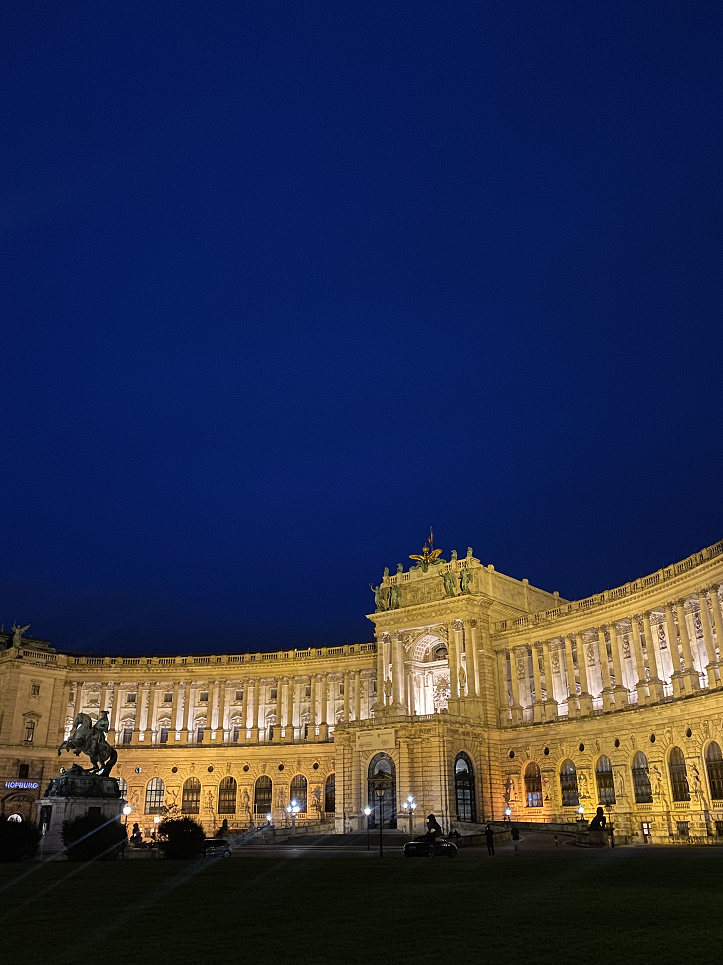
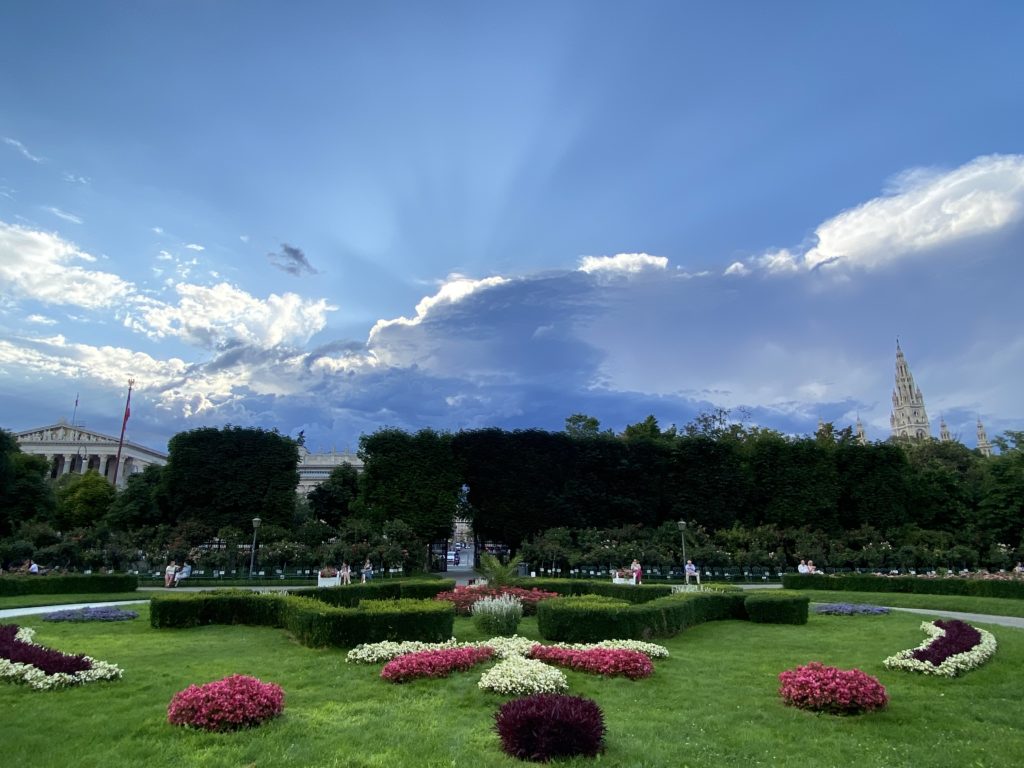
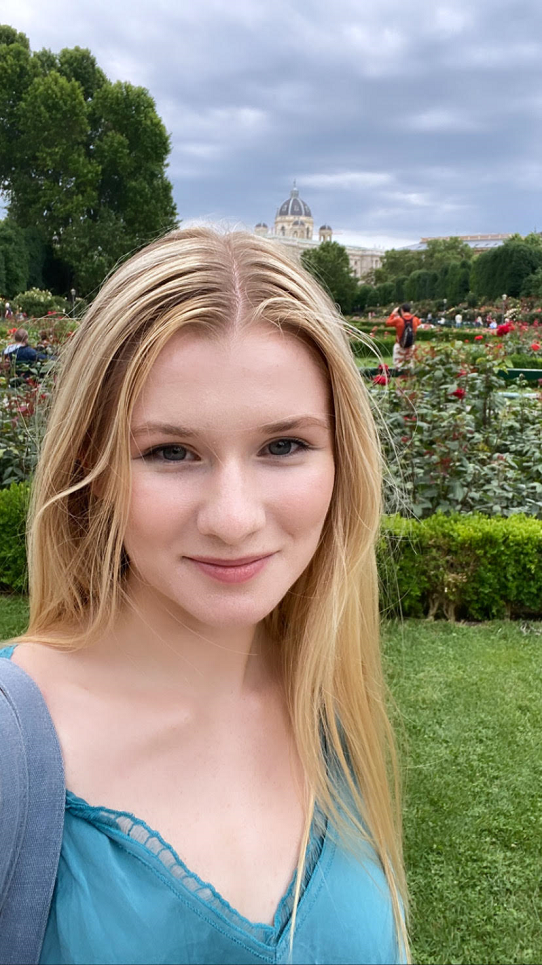
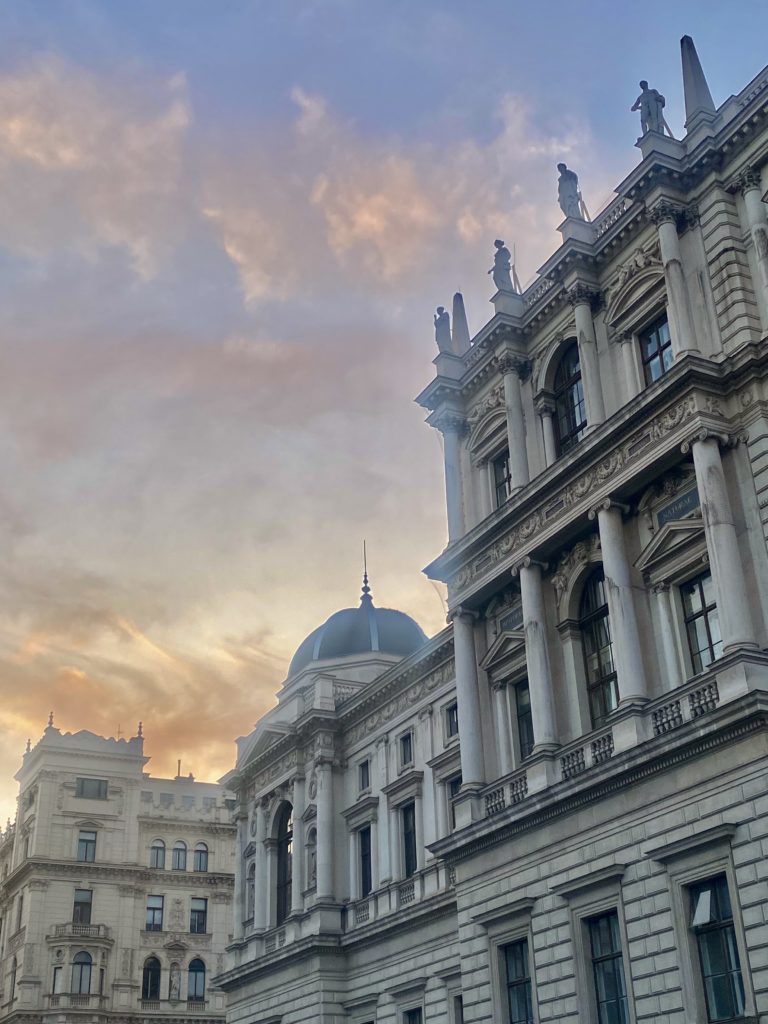
Having now been in Vienna for a month, I find myself both welcoming and rejecting the sense of familiarity and routine that I have developed. The picturesque streets, grand sights, and cosmopolitan atmosphere—especially in the gorgeous district where I live (pictured below)—have become less dazzling and more predictable, although nonetheless beautiful. In more familiar areas of Vienna, I can navigate with ease and calculate short-cuts and scenic routes, walking with purpose. Simultaneously, in less familiar areas of Vienna, I feel once again new to the city, trying to conceal my lack of local knowledge and uncertainty.

This simultaneous welcome and resistance to familiarity also applies to culture.

With my cultural identity being a mishmash of German and American cultures, my persona coincides with some expectations of Americans and contradicts other expectations. For me, some of the familiar is unfamiliar, while the unfamiliar has become familiar.

For instance, when interacting with many of my coworkers or friends, cultural and linguistic barriers do not hinder communication. These interactions are less like a ‘cultural exchange’ and more so just simple, everyday conservations due to the level of integration and language that I have been able to achieve after many years of effort (and with great help from ND’s and CSLC’s language offerings!). Many people I meet automatically assume I’m Austrian (or German) and demonstrate visible surprise or outright disbelief when I clarify that I’m American.

One humorous example occurred at a summer barbecue for university students. Coincidentally, I met an American studying at an Austrian university, and when her Austrian boyfriend joined our conversation, she suddenly prompted him to guess my nationality/ethnicity. Her stance was more or less calculated, as she later revealed that she meant to use me as an example to contradict her boyfriend’s assumptions about Americans. Before giving up and directly asking me, the boyfriend incorrectly guessed 6 different countries: Austria, Germany, Switzerland, Poland, France, and Romania. This brief—and slightly odd—encounter solidified the extent to which my language and cultural identity (or at least persona) has developed to elicit so much surprise from acquaintances when they learn I’m American.

Another humorous example occurred at a local café, where a friend of mine (also coincidentally met at the summer barbecue) was celebrating his admission into a music conservatory—with a group of about 10 friends, including me. While we were all chatting along in German, one of the other women in the group mentioned something very specific about the Northeastern United States. Surmising that she may have studied abroad in the US, I expressed my surprise and curiosity that she knew such a specific fact. She then asked about my familiarity with the US, and I revealed that I’m American. Switching out of her perfect German and specifically Viennese accent, she exclaimed, “NO WAY! I’m American, too!” We both honestly mistook each other for an Austrian; however, after our laughter subsided at this surprise, we proceeded to speak in German, for it simply felt more natural in the context. These moments, though fleeting and ‘everyday,’ constitute milestones in the process of learning, refining, and mastering a language, while also becoming integrated into another culture.

However, many American cultural tendencies or preferences remain with me. For example, usually around 14:00 at ZJP2, employees will congregate around the Zentrum’s exquisite espresso machine—but beforehand, I will dig out some ice trays from the freezer. It is more unusual here for drinks to be iced, even if it’s warm outside. An “Eiskaffee” (which many foreigners misunderstand to be an iced coffee) is actually coffee mixed with ice cream, a popular and delicious summer treat. Thus, my colleagues make their Eiskaffee or Verlängerter Kaffee (like an americano), while I make my iced latte. Due to this regular occurrence, some coworkers will often joke along the lines of, “Ah, there’s the American!” when they see my delight about an iced coffee.

Thus, not only does the constant flux of unfamiliar and familiar characterize my time in Vienna, but my subsequent reactions either reinforce or contradict people’s perceptions of Americans.

Meanwhile, many Austrians have expressed their wishes to visit well-known American states, such as California, Florida, Texas, or New York. To an American, the allure of these states is a bit more nuanced, with less romanticism and instead perhaps even jadedness. Or, the perceptions of American states from abroad solely rely upon clichés, generalizations, and stereotypes. For example, upon revealing that I am from Florida, the discussion usually trends toward Disney World, Ron DeSantis, alligators, Miami, hurricanes, beaches, and—of course—the notorious “Florida Man.” On one hand the clamor and enthusiasm about Florida is entertaining and endearing; on the other hand, misconceptions or half-truths can be frustrating.

Overall, it seems that we generally yearn for the unfamiliar, although we find identity in and hold onto our familiar roots. We romanticize the unfamiliar, and then it transforms into reality as familiarity increases. And ironically enough, sometimes when immersed in completely unfamiliar territory, we cling to the familiar like a lifeline. And conversely, when we live bound to the familiar, we wish to reject the familiar and venture into the unfamiliar. In my opinion, this tug-of-war seems to lead one into a unique range of familiarity vs. unfamiliarity, and this range depends on how the person approaches, regards, and values familiarity versus unfamiliarity.


Side note: Another very interesting aspect of my time in Vienna is the (young) Catholic community. I’m planning to detail this more in a subsequent blog, so stay tuned!

Cultural Incidents: “Mahlzeit”

Flight delays, lost luggage, 36+ hours awake, and becoming sick—needless to say, my travel to Vienna was not the most glamorous transatlantic journey! However, my excitement and gratitude helped me endure these physically exhausting challenges with a positive mental state.

Upon arriving, I attended a staff meeting at the Zentrum Johannes Paul II (ZJP2); for many of the paid staff and volunteers, this meeting marked the first occasion in several months where all came together for a catch-up and a briefing of organizational matters. Already from my first impression of ZJP2 and its staff, I felt a sense of peace and purpose. The center has a young and exciting atmosphere, with many of the staff in their late twenties, who are tremendously welcoming, fun, and enthusiastic. Already, I know that this summer will develop me not only professionally and linguistically (with my German), but also spiritually. I have this intuition and deep knowledge that „big things“ will occur during my summer here—and already as I write this, numerous unexpected blessings, professional connections, and friendships have arisen.

Despite my turbulent arrival and falling ill, each day brought more familiarity and orientation to Vienna. In a way, the initial few days of exhaustion, sickness, and challenge shortened my “adjustment period” and presented a personal challenge to intentionally set the tone of how I would react to difficulty during these next two months.

However, on the cultural front, the most unexpected „Auseinandersetzung“ (something to reckon with) was my cultural knowledge of Germany and applying this knowledge to Austria, specifically in Vienna. Most of my prior experience and knowledge has stemmed from my time in Germany, both as a military kid growing up in Stuttgart and during my SLA last summer in Radolfzell.

For instance, I wrongly assumed that most, if not all, of the stores would be the same as in Germany—Kaufland, Lidl, DM, Aldi, Rewe, etc. This false expectation led me wandering around Vienna while sick to find a variety of necessities—like cold medicine—all offered at different stores at different times. Now looking back, it’s somewhat amusing, but in the moment, it was rather defeating and exhausting. But all the more was the triumph to simply find Ibuprofen, groceries, and clothes hangers!

Similarly disproving my expectations—several words or slang differ between Germans and Austrians, and the use of the “German” words immediately will mark you as a foreigner, often with a bit of disdain from locals. For instance, here just a few of the Austrian words I quickly picked up and substituted:

Bag: “die Tüte” → “ein Sackerl”
Bread: “Brötchen → Semmel”
Stairs/Staircase: “Treppe” → “Stiege”
Streetcar: “Straßenbahn” → “Bim”
Tomato: “die Tomate” → “der Paradeiser”

….And so on!

To illustrate the often overlooked and often comical differences between Austrians and Germans, I’ll offer a short story from my first day at the staff meeting. Some food (bread) was passed around, during which I told a fellow coworker “Guten Appetit,” the custom German phrase to wish someone a good meal. Up to this point, my coworker and I were happily chatting, but then the coworker’s expression immediately turned serious and he made a point of correcting me with “Mahlzeit,” the alternative Austrian phrase. Just as quickly, we returned to our joking and lighthearted conversation.

This small encounter encapsulates a bit of the friendly or not-so-friendly (depends on the Austrian you ask) tension between Austrians and Germans: although the standard language is the same, the cultures nevertheless significantly differ, which presents an adventure for me to learn and navigate. Nevertheless, after about a week or two of picking up these phrases and becoming more familiar with Vienna, I’ve been able to pass by as a local: the rewarding experience of simply blending in. With each day, I have felt increasingly “at home” in Vienna and at ZJP2, especially due to the Zentrum’s warm welcome to me.

These little everyday triumphs—navigating the city, interactions with locals, tackling unforeseen challenges—can be glossed over as familiarity and routine develop. However, it is still rewarding for me to note these “little triumphs” when they arise and reflect upon my growth in the past couple weeks, not taking my adjustment for granted.


First Post

May 23, 2023

This internship abroad is an absolute blessing…. So why do I feel this nervous? 

Upon completing exams and staying for ND’s senior week as a member of ND Folk Choir, I returned home (Pensacola, FL) for a few short days. Less than a week from now, I will fly to Vienna, Austria to work at the Zentrum Johannes Paul II, a Catholic parish and community. My short week at home includes a flurry of unpacking and repacking, appointments and preparation for travel, and cherished time with my family. 

With the months-long process of applying for this wonderful grant, locating and securing a suitable internship, and figuring out logistics, somehow I am counting down the days for an adventure that does not yet seem my own. As if I were a travel agent or administrator to someone else’s plans, I feel somewhat disconnected—the realization has not yet sunk in. As the days in Pensacola pass, my anxiousness transforms into excitement for what is to come. 

Last summer, I had the blessing to intensively study German for 6-7 weeks in Radolfzell, Germany through the CSLC’s SLA Grant. Though very similar, the new aspect of working in a foreign, professional environment presents new challenges and, admittedly, gnaws at some insecurities. Will my professional skills be enough? Will my professional German be sufficient to communicate effectively? How long will it take for my German to „bounce back“ to its near-fluent proficiency from the immersion environment? 

At Zentrum Johannes Paul II, the parish is rapidly growing, and thus the administration and ministry operations function similarly to a start-up: an extremely collaborative environment and multidisciplinary roles, altogether requiring flexibility and fast learning. From what I understand through my communications with the Zentrum, I will be able to contribute in everything from management to music ministry to fundraising for the renovations. This prospect not only excites me but also counteracts the expectations or assumptions I would otherwise rely upon to mentally and logistically prepare. So while radically freeing, the lack of expectations leaves room for some anxiousness to seep in. 

Well, enough pondering for now—it’s time for more packing! 

Alles Gute und bis bald!