Dear Friends,
I write with less-than-pleasant news, though in the interest of public health, by now hardly unexpected: we will postpone the 2020 season of the Notre Dame Shakespeare Festival. We will still produce “The Two Noble Kinsmen” (July 18-August 23, 2021) and “A Midsummer Night’s Dream” (August 17-29, 2021). Scotty Arnold and Lavina Jadhwani will still direct.
We will not merely go dark and disappear. The Shakespeare family will adjust our 20th Anniversary Season celebration by enlisting NDSF artists, staff, and volunteers to create online content in three main categories: Education, Training, and Performance.
Classes or workshops we are considering include Shakespeare and Musical Theatre, Acting Shakespeare, Costume Design, Resume Review, and Intimacy Direction. Look too for readings, special adaptations of scenes, and even new live concerts of NDSF music from recent productions.
There will be no charge to participate or view any of these classes or offerings, and we’ll be sure to include how long they will be available. The full schedule will be published May 15.
For those of you who hold tickets to “A Midsummer Night’s Dream,” you may reschedule with us to 2021, receive a refund, or hold as a credit with the ticketing office. Reach them from 12-6pm EDT., at 574-631-2800 or by email at performingarts@nd.edu. If you leave a voicemail, we will return your call within 24 hours.
Patrons may also be interested in the Paul Rathburn fund, which helps compensate artists who’ve already invested time and effort in the 2020 season.
We believe fervently in the power of theatre to help us see ourselves — and the world — anew. Until we can share these offerings together in the same room, we will look forward to seeing you on our screens.
On behalf of the entire Shakespeare team, our very best wishes to you each and all,
– Grant Mudge, Ryan Producing Artistic Director, Notre Dame Shakespeare Festival
Category Archives: Shakespeare
The Journey Begins
by Wela Mbusi
An epic journey is underway for five actors creating a magical piece of theatre from scratch; using nothing but our skills, imagination, and the love of theatre. Did I also mention without the all seeing eye of a director?
AHHHHHHH!!!

The first two weeks of rehearsals have been about shelling out the play for its meaning, not only for clarity of storytelling, but for us to really grasp such a complex and rich play as Measure for Measure. After the initial shock of being left alone in the room with nothing but the text and our collective training, we managed to slowly, but surely, decipher the scenes one unit at a time. It has been a tremendous learning curve for all of us in the company so far as we’re coming to terms with different ways of working. On top of that, there’s the added responsibility of being all of the other figureheads responsible for the creation of a piece of theatre. However, not having the constant objective eye of a director, it has also meant enjoying the freedom of playing with the text in many ways that a ‘normal’ rehearsal wouldn’t allow us to. We’ve been paraphrasing our lines together and that has helped us not only understand our own lines but the other actors as well.
The breadth and depth of understanding that the process has given us has and hopefully will continue to enrich the play. Foursquare seems to be a regular pre-rehearsal pressure reliever and we are constantly enthused by the epic journey that we’re about to take in the States.
Blizzards, blobs, and beer | Ursinus welcomes AFTLS
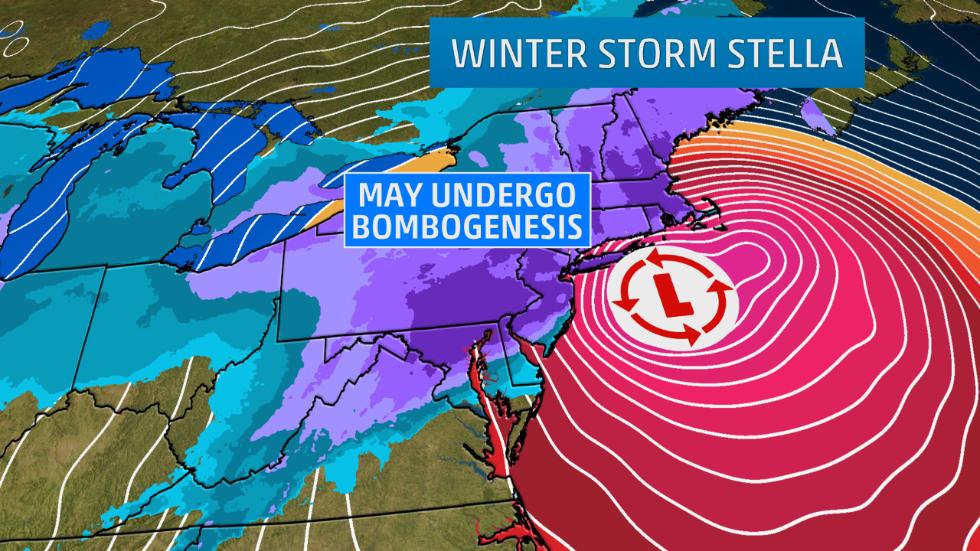 And so we reach our final week, heading for Collegeville, Pennsylvania and Ursinus College. The college, pronounced Yer-sigh’-nus, was founded in 1869 and is located 30 miles from Philadelphia. It’s the first time we have even got near to a coast – unless you count Lake Michigan, which does indeed look like an ocean. It’s a bit of a shock, this two-flight journey, as we go from 25 degrees Celsius to -4 (77 to 25F). The frisbee will not be coming out again. Actually we get here just in time; by Monday evening Winter Storm Stella has arrived, bringing with it 18 inches of snow. We were warned about this and there was a quick panic-buy trip to the supermarket when we arrived. Beer, cereal, crisps, all those essentials, you understand…
It also means I’m back in electric shock land. I’m not quite sure why, but Will and I seem to be more susceptible to the shocks, in colder weather, from light switches, from door handles, from each other sometimes. A couple of days ago Jas looked accusingly at me after I had made her jump, as if I was suddenly Marvel’s new creation of Electric Shock Man and doing it just for my own amusement. I’m getting scared to turn the light off at bedtime…
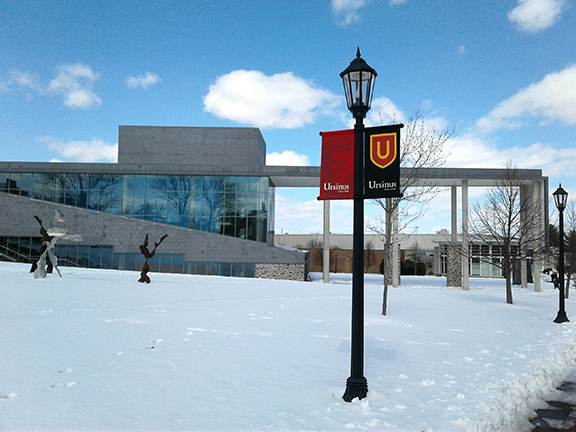
The Kaleidoscope, home of Ursinus College’s departments of Theater and Dance.
Tuesday saw a late start because of the snow, and Sarah and I had to dig the car out of the hotel car park to make it to the first class. We were asked to go in a directors’ class and do a couple of mock auditions for them. So Sarah went in as Nervous-Auditioner, stumbling and drying [click HERE to learn all about “drying”] her way through a speech, and I followed that with Mr. Know-It-All, who refused to redo his speech when asked to try it more melodramatically. “You don’t understand,” I spat back, “I’ve just played this part at the Royal Shakespeare Company!” Thankfully, Sarah and I got a chance to go back in (this time as Ms. Couldn’t-Care-Less and Mr. Couldn’t-Care-More) and make them realize that we weren’t really like that. Honest.
Meanwhile, on Friday, after we had done our first show the previous evening, Will went in to do his class and was promptly asked four times, by different people, to give a rendition of one of our songs in the round, “Rose, Rose, Rose, Red” – I think, having agreed to sing it the first time, it was hard to get out of it after that. Arise Jukebox Willy. Interesting how popular the use of song in the show has been over here.
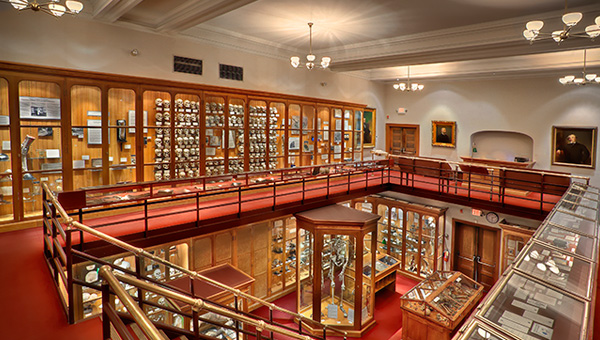 As for outings this week, the weather put paid to the first half of the week, and I’m afraid none of us made it to the Liberty Bell – the closest I got, in fact, was a full-size replica back in Houston. Interesting that it and the original were both made in London. Sarah and Waggy (her husband, who came out to join us this week, along with Jas’ boyfriend Kieran) did get to Philadelphia on Friday and visited such oddities as the Mütter Museum (shown on the right), a collection of medical artefacts and brains and colons, apparently. I think I might have been even more scared to turn the light off after that…
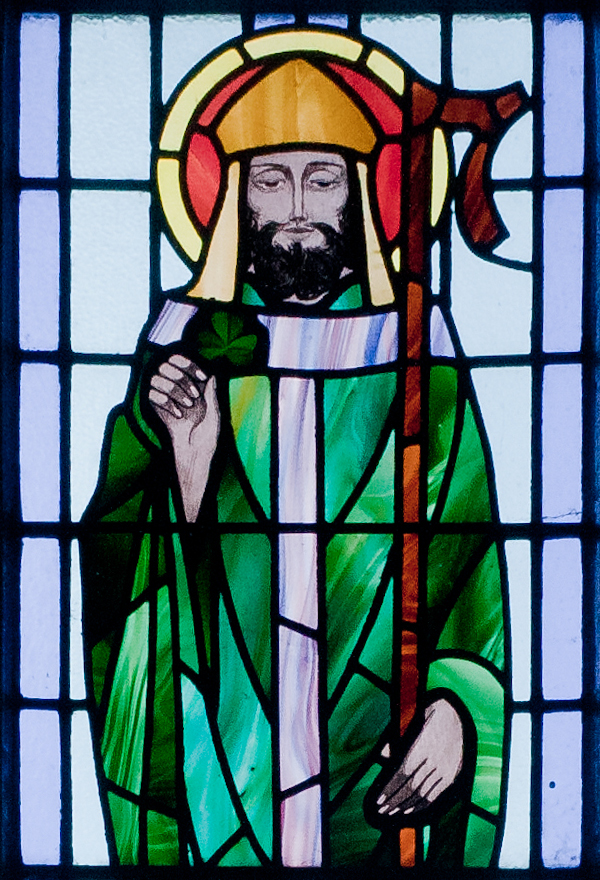 I did make it as far as Phoenixville, a small town nearby, which has a peaceful charm about it, a few streets of Victorian wooden-slatted houses made all the more picturesque by the snow and the clear blue skies. I stopped to help a man in a very little car get out of a very lot of snow and just enjoyed the chance to wander and take in the numerous iconic yellow school buses dotted about the place, all ready to chug into action. It was less peaceful downtown, where Molly Maguire’s was already doing a roaring trade at 3pm on St. Patrick’s Day. I squeezed my way in past the kilts, the bagpipes, the fiddlers and the sea of green that covered all three floors, and sipped a little Guinness. One has to fit in, don’t you know…
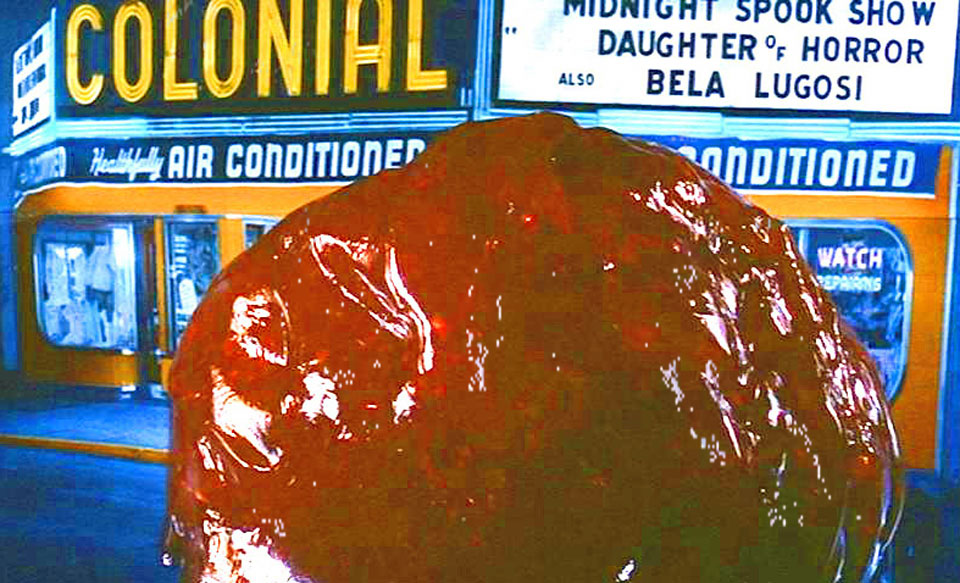 One oddity about Phoenixville: it has a cinema there, the Colonial, where a famous scene from The Blob, a horror B-movie starring Steve McQueen, took place. Apparently in June they hold a BlobFest every year, where they recreate that scene. Look, I’ve told you, I’m scared enough about turning the light out as it is…
There’s been a bit of reminiscing in the hotel bar this week. The line dancing, the snow, Mission Control, Indian Forest Mountain, the Hancock Tower, skimming stones on Lake Michigan; all in all we feel pretty lucky. Not only that, but I it’s been a rewarding challenge, both in the classrooms and out. We seem to be in a time, on both sides of the Atlantic, of Arts funding cuts and pushing the money into more quantifiable, more headline-grabbing areas. All I would say is that I know, by seeing it on students’ faces and from feedback from them and their professors, that we have made a difference here – for some of them, a tangible and long-lasting difference. That is the joy of this job, and long may it continue. I know, by seeing it on students’ faces and from feedback from them and their professors, that we have made a difference here – for some of them, a tangible and long-lasting difference. That is the joy of this job, and long may it continue.
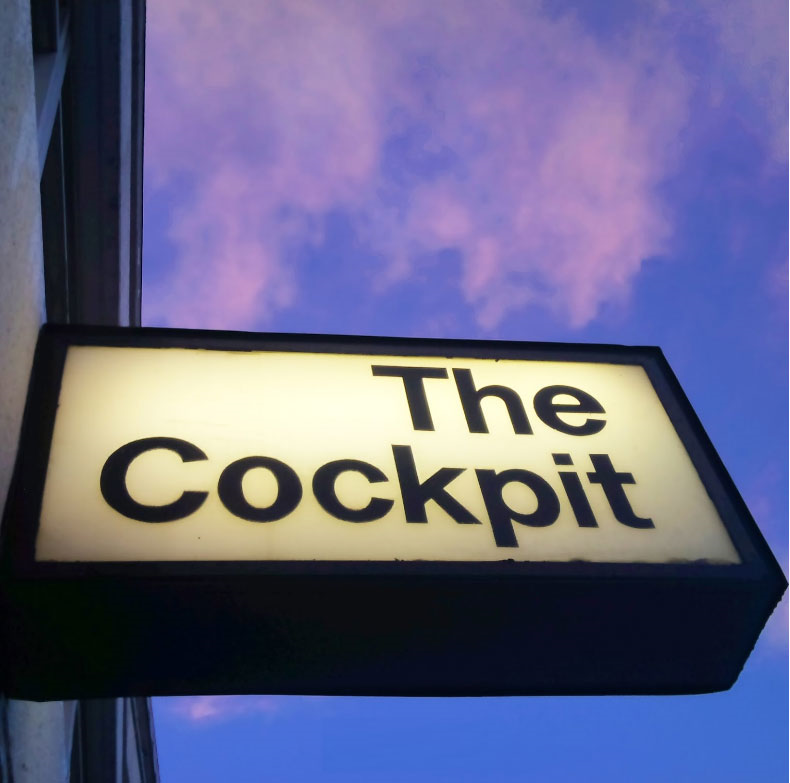 So tomorrow the adventure comes to an end. Well, sort of; we will be doing two performances of the show in London on April 2nd (5pm) and April 3rd (7.30pm), so please do come to the Cockpit Theatre in Marylebone if you can. We’d love to see you.
And now it really is time to turn the light off. Thank you America. Good night and good luck.
— Roger May (March 19, 2017)
Shakespeare at Notre Dame to host First Folio in 2016

The title page of Shakespeare’s First Folio published in 1623 and coming to Notre Dame in January 2016.
One of the world’s rarest and most treasured books, the First Folio is the first collected edition of Shakespeare’s plays. It will be displayed in the Hesburgh Libraries at Notre Dame January 4 through January 29 during a nationwide traveling exhibition entitled “First Folio! The Book that Gave Us Shakespeare,” sponsored by the Folger Shakespeare Library in partnership with the Cincinnati Museum Center and the American Library Association and hosted by Shakespeare at Notre Dame.
The exhibition, announced by the Folger Shakespeare Library on Thursday (April 23), Shakespeare’s 451st birthday, is one of numerous events planned worldwide for 2016, the 400th anniversary of Shakespeare’s death.
“We are honored to partner with the Hesburgh Library’s Rare Books Collection and the Folger Shakespeare Library in serving as the sole Indiana venue for the First Folio exhibition,” said Scott Jackson, executive director of Shakespeare at Notre Dame. “Our mission is to directly engage our audiences with the works of Shakespeare both on the page and on the stage. This once-in-a-lifetime opportunity to host the First Folio in a venue as iconic as Notre Dame’s Hesburgh Library will provide the wider Michiana community with an entirely new way to experience one of the world’s greatest dramatists.”
When it was published in 1623, the First Folio could be purchased for 20 shillings, roughly $200 today. Since then it has become one of the most valuable printed books in the world; a First Folio sold for $6.2 million in 2001 at Christie’s and another one for $5.2 million in 2006 in London.
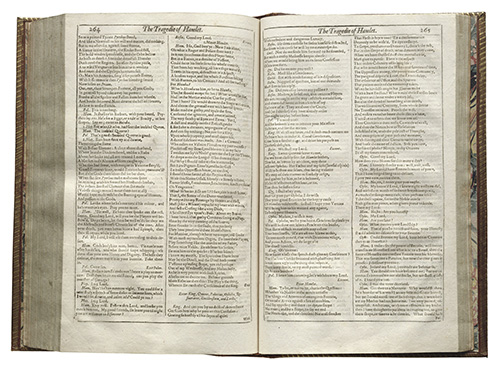 In the Notre Dame exhibition of the First Folio, the book’s pages will be opened to the most familiar of all Shakespearean lines; “To be or not to be” from Hamlet’s soliloquy. The exhibition will include digital and interactive features on Shakespeare’s life, times and work, and several public events presented by Shakespeare at Notre Dame.
As You Like It – Actors’ Blog #8
As You Like It Blog – Valparaiso University

Jen guards our exponentially expanding collection of luggage.
Here we are in week 8 of our 11 week tour…still just about managing to squeeze our belongings into suitcases that fit the airline luggage allowance!
This week we were back in Indiana at Valparaiso University. When we left the mid-west, back in Feb, it had been a covered in snow and extremely cold…so it was a pleasant surprise on Monday, to find that the snow had largely melted and that Spring was starting to make its presence felt. Friday was so Spring-like that I even took the opportunity to take a running tour of the campus with Theatre student Chrissie. This would have been impossible a month ago without getting stuck in a snow drift. Now the only limitations were my speed and fitness levels.
This is the third time that “Valpo” has been host to AFTLS, and it was great to see this experience reflected in the diversity of the classes we attended. I spent Tuesday visiting a session in the Law department. Final year students had all written a personal paper on a particular legal angle in one of Shakespeare’s plays and the breadth of their research was fascinating. I lead various exercises encouraging them to explore the role of the audience in Merchant of Venice and especially enjoyed having them experience connection to an audience while standing in the middle of the room on a large wooden boardroom table…I recommend it to executives snoozing through meetings everywhere.
One of the great things about the American college system is the opportunity for studying such a range of subjects, and nowhere is this more the case than Valpo. I met so many students with dual majors across disciplines. Even those students following a single major in theatre will study design, acting, costume making, lighting design, stage management and so on. Many of the students acting or working in shows on campus are not majoring in theatre but are nonetheless making it an integral part of their college experience. We were very well looked after by a Kari-Anne and her team of students studying for a Masters in Arts Administration, many of whom had travelled from China to study the course in Valpo. I also spoke to a number of other students who were taking opportunities to study abroad during the course of their programmes, several of whom are off to Cambridge this Autumn.
The Faculty responsible for teaching the broad range of classes on offer are of course multi-talented. I would love to have been able to attend the Tap class, taught by Ann (who also teaches costume design) and we spend Sunday admiring faculty member Alan Ernstein’s beautiful hand-made furniture (and amazing Black Bean Soup!).
Being back in our home state meant this week offered a lovely opportunity to catch up with familiar faces from earlier in the tour. We had visits from colleagues at Notre Dame and also from Saint Joseph’s College in Rensselaer and Saturday night brought members from all three institutions together as we toasted the closing night of the show in Stacks…from the outside a seemingly humble office block but inside a terrific bar and restaurant full of books with an encyclopaedic drinks menu to match.
Next week we are staying put in Valpo (giving our suitcases another week to mysteriously expand!) as we will be working at Westville Correctional Facility a few miles down the road.
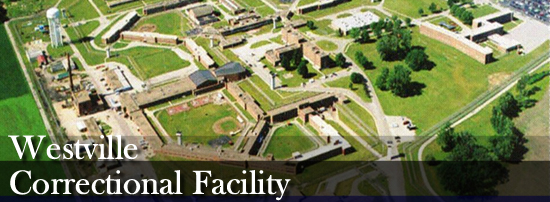
Westville Correctional Facility (Westville, Indiana)