Collection highlights, acquisition news, events, exhibits, and behind-the-scenes looks at the work and services of Rare Books & Special Collections (RBSC) at Notre Dame.
“Life springs from death, and from the graves of patriot men and women spring living nations.” — P.H. Pearse, August 1915
In 1803, Robert Emmet led a failed rebellion to overthrow British rule in Ireland. In 1848, a group called Young Ireland staged a brief revolt that was hastily crushed. The Fenian Brotherhood invaded British North America in 1866, and the Irish Republican Brotherhood organized a series of unsuccessful raids in Ireland the following year. On Easter Monday, 1916, a small group of Irish insurgents launched a rebellion in Dublin that was quashed in under a week. While these four attempts to create an independent Ireland may have failed, they each gave rise to a powerful romantic narrative that captivated the spirits of the Irish at home and abroad. Out of sacrifice and tragedy sprang patriotic verse, defiant journalism, cultural revival, and eventually, Irish freedom from British rule.
This exhibit features items from Rare Books and Special Collections and the University Archives that document the heroes, martyrs, and idealistic men and women who forged modern Ireland.
This and other exhibits within the Hesburgh Libraries are generously supported by the McBrien Special Collections Endowment.
All exhibits are free and open to the public during business hours.
RBSC will be open regular hours during the University of Notre Dame Fall Break, October 17 – 25.
In 1803, Robert Emmet led a failed rebellion to overthrow British rule in Ireland. In 1848, a group called Young Ireland staged a brief revolt that was hastily crushed. The Fenian Brotherhood invaded British North America in 1866, and the IRB organized a series of unsuccessful raids in Ireland the following year. On Easter Monday, 1916, a small group of Irish insurgents launched a rebellion in Dublin that was quashed in under a week. While these four attempts to create an independent Ireland may have failed, they each gave rise to a powerful romantic narrative that captivated the spirits of the Irish at home and abroad. Out of sacrifice and tragedy sprang patriotic verse, defiant journalism, cultural revival, and eventually, Irish freedom from British rule.
This exhibit features items from Rare Books and Special Collections and the University Archives that document the heroes, martyrs, and idealistic men and women who forged modern Ireland.
The exhibit is curated by Matthew Knight (Irish Studies Librarian and Curator).
Related Events
September 24-7, 2026 | The ACIS Midwest + South Regional Conference will be hosted by the Keough-Naughton Institute for Irish Studies and held on the University of Notre Dame campus. The theme of the meeting will be “Irish Studies On The Ground: Place, Presence and Community.” Please visit the conference website to view details.
October 2026 | Special Collections will host a lecture by curator Matt Knight, exact date and time TBD. Check back for more information.
Tours of the exhibit may be arranged for classes and other groups by contacting rarebook@nd.edu.
All exhibits are free and open to the public during business hours.This and other exhibits within the library are generously supported by the McBrien Special Collections Endowment.
In honor of Labor Day, Rare Books and Special Collections is pleased to highlight the recent acquisition of a set of real-photo postcards documenting the 1928 Labor Sports Union’s (LSU) second annual “Labor Sports Olympics” held in Brooklyn, New York. Sponsored by the Communist Party of the United States, the Labor Sports Union brought together working-class, labor-union, and other left-wing sporting organizations that promoted physical activity to build camaraderie among workers, improve the physical health of laborers, and offer a more inclusive alternative to mainstream profit-seeking capitalist sports ventures. The Labor Sports Union Athletic Meet Postcards Collection (MSSP 10181) includes 10 images of participants in the event.
An article in the August 16, 1928, edition of the Daily Worker, the official newspaper of the Communist Party of the United States, described the coming athletic meet. The “worker athletes and their friends” in the Labor Sports Union, the newspaper recounted, “showed a spirit of cooperation that cannot be found in the bourgeois organizations” like the “Amateur Athletic Union, the official capitalist sport organization” (1). The Daily Worker reported that more than 650 athletes from 70 affiliated athletic clubs and 24 cities were represented at Brooklyn’s Wingate Field. (2)
The Labor Sports Union intentionally opened its athletic events to all worker athletes and welcomed the participation of non-white and women athletes at a time when many sporting organizations had more restrictive rules. The Labor Sports Olympics included more than thirty track and field and swimming competitions for men, women, and children; a soccer tournament; and a mass drill exercise. The Daily Worker reported that “women and junior athletes, turning out in unprecedented numbers, contributed largely to the colorful pageant quality of the huge sports meet.” (3)
Participants in the men’s 200 meter race at the 1928 LSU Labor Sports Olympics. Arthur Kirton is probably standing second from the left (MSSP10181-01).
One of the stars of the competition was Arthur Kirton, an African-American runner from Brooklyn. Kirton captured first place in both the 100- and 200-meter dashes, and the Daily Worker described Kirton as the “outstanding sprint performer of the Labor Sports Olympics” (4).
During the interwar years, the Communist Party was at the forefront of attacking racial segregation, and the Labor Sports Union actively sought to provide opportunities for Black athletes. The constitution and principles of the organization affirmed that “the Labor Sports Union is unalterably opposed to race prejudice and separation in sports.” Before the 1928 meet, the Amsterdam News, a local New York Black newspaper, reported that “far from putting up any restrictions against the participation of Negro athletes in its athletic meets, the Labor Sports Union is making special efforts to secure entries from colored sports clubs.” (5)
After the event, Arthur Kirton, described his experiences at the Labor Sports Olympics for the Amsterdam News: “I found the audience very agreeable and undiscriminatory in their ways of paying tribute to the participants regardless of color or creed.” And, he elaborated, the meet organizers were “particularly courteous in seeing that I was perfectly comfortable.” (6)
Participants in the men’s 200 meter race at the 1928 LSU Labor Sports Olympics. Arthur Kirton is probably standing second from the right (MSSP10181-02).
The 1928 Labor Sports Olympics also featured numerous events for women athletes, including track & field and swimming competitions. The relay team from Sisu, a Finnish-American athletic club in Worcester, Massachusetts, won the women’s 4X100-meter relay. “Sisu,” a Finnish word translated as stoic determination or tenacity of purpose, was a common name for Finnish-American sporting clubs.
Members of the victorious women’s 4X100-meter relay team from Sisu at the 1928 LSU Labor Sports Olympics. Pencil notations on the back indicate that Esther Allen and Sigrid Mentukoski stand on the left (MSSP10181-08).
Paul Ahola, nicknamed the “Flying Finn,” was the only athlete featured on his own postcard in this collection. A recent high school graduate from Jamaica, New York, Ahola performed well in many events and won the discus and javelin throws.
Paul Ahola won first prize in the men’s javelin throw at the 1928 LSU Labor Sports Olympics (MSSP10181‑10).
Most of the competitions at the LSU meet were individual events, but the program also included a soccer tournament. During the 1920s, the Labor Sports Union sponsored Workers Soccer Leagues in many large cities, and the New York-area featured particularly vibrant competitions. The postcard collection contains one image of the “Hungarian Soccer League” team that competed in the Labor Sports Olympics.
Hungarian Soccer League Team at the 1928 LSU Labor Sports Olympics (MSSP10181‑09).
The Labor Sports Union Athletic Meet Postcards Collection is open and available to researchers. Rare Books and Special Collections welcomes donations of additional materials documenting the long history of workers and labor union sports organizations.
Sources:
(1) “Hold Labor Sports Olympics August 25,” Daily Worker 16 August 1928, p. 4 (2) “650 Athletes at Big Labor Sport Meet Today,” Daily Worker 25 August 1928, p. 1. (3) “Many Records Fall at Labor Sports Meet,” Daily Worker 28 August 1928, p.1 (4) “Many Records Fall at Labor Sports Meet,” Daily Worker 28 August 1928, p.1 (5) “Sports Union to Stage Meet,” [New York] Amsterdam News 22 August 1928, p. 7. (6) Arthur Kirton, “Sports Union Meet, [New York] Amsterdam News 29 August 1928, p. 10.
RBSC recently acquired a collection of early Soviet candy wrappers from various Soviet Republics, spanning from the early 1920s through the mid-1930s. This period encompasses the crucially important years of the New Economic Policy (NEP, 1921-1928) and the First Five Year Plan (1928-1932). Because caramel candies were relatively inexpensive and widely available, their wrappers—much like posters and other forms of mass-produced graphic ephemera—played a vital role in the Soviet effort to integrate art and propaganda into everyday life. This collection captures a brief yet dynamic period of innovation and exploration for the emerging proletarian visual culture. Its breadth and diversity of styles and subjects highlights the coexistence of different traditions and creative practices that defined the era. By the mid-1930s, however, Joseph Stalin rejected the avant-garde experimentations in favor of a standardized visual language, asserting absolute state control over cultural life and establishing a new official doctrine of Soviet art: Socialist Realism.
Reading candy wrappers
Candy wrappers combined texts and imagery for identification and promotional purposes, utilizing lithographic and chromolithographic printing techniques. In addition to naming the confection, the text frequently detailed a product’s production and distribution. Many wrappers featured the names of large, nationalized factories such as Roza Luxemburg in Odesa, Karl Marx in Kyiv, and Krasnyi Oktiabr’ (Red October) in Moscow. Others named cooperative enterprises that marketed and distributed products—including Mosselprom (Moscow Association of Enterprises Processing Agro-Industrial Products)—and regional lithographic presses. Candy wrappers also frequently incorporated the names of local censorship organizations. Following the Bolshevik takeover in October 1917, the state exercised full control over all publishing and printing activities, including consumer advertisements. While wrappers rarely printed their creation dates or designers’ names, production dates can be determined primarily through visual and material analyses, archival sources, and historical research on producers and distributors. Identifying the designers, however, proves far more challenging. Although large cooperative enterprises like Mosselprom employed numerous designers and collaborated with prominent avant-garde artists such as Aleksandr Rodchenko and Vladimir Mayakovsky, the specific creators behind the wrappers in this collection remain unidentified.
MSEREE0051-21″Karamel Traktorist” [Tractor Driver caramel], Odesa, circa 1925-1930.
The scene depicts a peasant riding a tractor. To modernize agricultural production, the Soviet state imported its first tractors from the United States, including tractors produced by Ford, such as the one featured in this image.
This caramel candy was produced in Odesa, Ukraine, by the Roza Luxemburg factory. The factory was nationalized in 1919. In 1922 it was named after the famous German Communist leader Roza Luxembourg. The candy was distributed by KharchoTrest (Odesa district Food Industry Trust). During the NEP, trusts were state-owned organizations responsible for overseeing food production and distribution. The lithographic image was printed by “Odespoligraph, 3 gostip” (lower right) which was a state publishing house. It was approved for publication by “Okralit” (lower left) – Odesa District Inspectorate for Literature and Publishing, which operated between 1925-1930 and acted as a local censorship authority.
Design
The design of candy wrappers from this period reflects the coexistence of varied artistic styles, ranging from the popular print traditions of Lubok, Realism and Art Nouveau to the emerging avant-garde aesthetics of Constructivism.
MSEREE0051-17 – “Karamel Orach” [Ploughman’s caramel], Odesa, circa 1925-1930.
This lubok-style scene depicts a farmer plowing the land with a simple wooden plow and a horse.MSEREE0051-66 “Karamel Minon” [ Mignon caramel], Odesa, circa mid 1920s.
The wrapper depicts a decorative Art Nouveau-style portrait of an idealized young woman framed by an ornamental composition. The candy’s name derives from the French “mignon”, meaning “little” or “cute”. During the NEP period, such imagery appealed to more prosperous consumers (or the so-called NEPmen).MSEREE0051-40 [Untitled candy wrapper], Kharkiv, March 13, 1930.
The wrapper blends the striking geometry of Constructivism and its signature three-color palette (red, black, and white) with a popular caricature-style image of a Black man holding a bottle and raising a glass, all framed by black and cream checkboard pattern. It was most likely used as a wrapper for a liquor-filled caramel. The confection was produced and distributed by Goskontrest (State Confectionary Trust) in Kharkiv, Soviet Ukraine. The design was approved for publication by the local censorship authority Misklyt (on the right) on March 13, 1930.MSEREE0051-38 “No. 3 po osobomu zakazu Tsentrosoiuza” [Number 3 candy made by special order of the Central Union of Consumer Cooperatives], Leningrad, circa 1930-1932.
A single-color lithographic print produced by “Lenselprom” (Leningrad Agricultural Industrial Trust), featuring hammer and sickle. By naming the candy simply “No. 3” in a series of goods produced by the special order of Tsentrosoiuz, the design embodied Constructivist aesthetics characterized by geometric simplicity and abstraction.
Subjects
Although disposable and ephemeral by nature, candy wrappers served a role that extended far beyond their practical purpose of protecting confectionary products. Through playful names and engaging designs, they provided visual entertainment for both adults and children, while simultaneously acting as vehicles for state propaganda and promoting the emerging values of Soviet life.
Factories issued new candy varieties under such names as “Narodnaia” (People’s Candies), decorated with images of Soviet insignia.
MSEREE0051-2 “Karamel Narodnia” [People’s caramel], Kharkiv, produced and distributed by the State Confectionary Trust, circa early 1930s.MSEREE0051-3 “Narodnaia” [People’s candy], circa early 1920s.
Also popular were candy wrappers featuring idealized portraits of Soviet workers and youth, including peasants, factory workers, liberated working women, and Young Pioneers.
MSEREE0051-16 “Smes’ Krestianka” [Peasant woman blend], Moskva, circa 1920s.
Produced by “Mosselprom”, it features a peasant woman holding a child and a sickle. Marked as “Made in the USSR” indicates that this candy was made for export.MSEREE0051-10 “Pioner” [Pioneer candy], Kherson, circa 1920s.
Candy wrappers documented the rapidly changing political and cultural landscape of Soviet Russia, often capturing major events in near real time. Depicted subjects included public monuments, popular theatrical and circus performances, famous actors, and the transition to the new Soviet currency, the chervonets. Ultimately, these images reflected and celebrated socio-cultural transformations taking place across Soviet society.
MSE/REE0006-1204.7 “Karamel Chervonets” [Chervonets caramel], Moskva, circa 1920s.
The name of caramel candy refers to the Soviet currency, the chervonets, introduced in 1922 to combat hyperinflation and stabilize the economy after the 1917 Revolution and Civil War (1917-1922).MSEREE0051-36 “Krasnaia Moskva” [Red Moscow candy], Moskva, circa late 1920s.
The candy wrapper features a monument to the Soviet Constitution in front of the Lenin Institute and the Central Communist Party Archive located in the heart of Moscow on Soviet (Tverskaia) Square.MSEREE0051-56 “Salto Mortalles” Odesa, circa 1920s-1930s.
The name of the candy refers to a popular but very risky circus acrobatic somersault act.MSEREE0051-71 “Rozita Mary Pikford” [Rosita Mary Pickford candy], circa 1926.
Mary Pickford (1892-1979) was a Canadian-American actress and one of the most famous Hollywood silent-film stars. This candy wrapper was most likely issued to commemorate her visit to the Soviet Union in July 1926. The name of the candy denotes her 1923 film “Rosita”.
Wrappers from the First Five-Year Plan (1928-1932) joined a massive visual propaganda effort to advance Stalinist collectivization of agriculture and industrialization.
Left: MSEREE0051-18 “Udarnik” [Shock worker candy], circa 1929-1931. Right: MSEREE0051-19 “Udarnaia” [Shock workers candy], Staryi Oskol, circa 1930s.
Two candy wrappers celebrate workers participating in the shock-brigade state sponsored competitions aimed at surpassing official production targets.MSEREE0051-20 “Chervona Balka” [Red Convoy], Kyiv-Stalinka, circa 1930s.
The name of this candy refers to the massive Soviet campaign to seize grain from Ukrainian peasants. The wrapper depicts a patriotic procession of carts carrying the first grain of the harvest to the state distribution centers. The candy was produced by the Karl Marx confectionery in Kyiv, most likely in the years immediately preceding the Holodomor of 1932-1933. Forced collectivization of agriculture and Stalin’s brutal grain requisitioning policies led to the catastrophic famine in Ukraine, which ruined farming and killed millions.
Candy wrappers also functioned as collectible items, with some issued in thematic series that continued the pre-revolutionary tradition of collecting decorative packing of confectionary and tobacco products. Recurring subjects included known literary figures, representations of people from around the world in traditional costumes, and illustrations of fruits and animals.
MSEREE0051-78-81 “Karamel Zoologicheskaia” [Zoological caramel], Leningrad, circa early 1930s.
Four candy wrappers from the “Zoological” series produced by Lenselprom, featuring different animals.
Conclusion
The early Soviet candy wrappers collection complements the Hesburgh Libraries’ strong holdings in early Soviet visual culture and the performing arts. By drawing attention to candy wrappers as an overlooked form of mass-produced printed ephemera, this collection broadens our understanding of how popular Soviet visual culture circulated outside familiar formats like illustrated books, posters, stamps, and prints.
Rare Books and Special Collections welcomes students, faculty, staff, researchers, and visitors back to campus for Fall 2026! We want to let you know about a variety of things to watch for in the coming semester.
“Life springs from death, and from the graves of patriot men and women spring living nations.” — P.H. Pearse, August 1915
In 1803, Robert Emmet led a failed rebellion to overthrow British rule in Ireland. In 1848, a group called Young Ireland staged a brief revolt that was hastily crushed. The Fenian Brotherhood invaded British North America in 1866, and the Irish Republican Brotherhood organized a series of unsuccessful raids in Ireland the following year. On Easter Monday, 1916, a small group of Irish insurgents launched a rebellion in Dublin that was quashed in under a week. While these four attempts to create an independent Ireland may have failed, they each gave rise to a powerful romantic narrative that captivated the spirits of the Irish at home and abroad. Out of sacrifice and tragedy sprang patriotic verse, defiant journalism, cultural revival, and eventually, Irish freedom from British rule.
This exhibit features items from Rare Books and Special Collections and the University Archives that document the heroes, martyrs, and idealistic men and women who forged modern Ireland.
All exhibits are free and open to the public during business hours.
Special Collections’ Classes & Workshops
Throughout the semester, curators will lead instructional sessions related to our holdings for undergraduate and graduate students from Notre Dame, Saint Mary’s College, and Holy Cross College. Curators may also be available to show special collections materials to visiting classes, from preschool through adults. If you would like to arrange a group visit and class with a curator, please contact Special Collections.
Some of the recent acquisitions highlighted on the blog in the past year.
Anticipated Closures
Rare Books and Special Collections is regularly open 9:30am to 4:30pm, Monday through Friday. The department will be closed for the following holidays and events:
August 20, closing early at 1:45 pm for a Library event (Thursday)
September 7, for Labor Day (Monday)
November 26–27, for Thanksgiving (Thursday and Friday)
Our last day open before the campus closure for Christmas Celebration will be Wednesday, December 23. We will reopen on Monday, January 4, 2027.
Rocío showing her exhibition work to family during Notre Dame’s 2026 commencement weekend.
A few weeks ago, I took what was likely the most delightful rideshare of my young adult life. To be sure, it wasn’t because of the quality of my steed (the black car was small and a bit, well, scuffed). Instead, it was because of a conversation with my driver, one which deepened my appreciation for a manuscript I recently studied at Notre Dame’s Rare Books and Special Collections (RBSC).
When I set foot in the teeny black car, things initially followed the usual script: I gave Ashraf, my assigned chauffeur, my four-digit security code, said my quiet “hello!”, and scrolled on my phone mindlessly for a few minutes. However, that morning there was some magic in the dullness of Chicago traffic, and after a few minutes, I began bonding with the stranger in front of me.
In a span of 40 minutes, Ashraf and I chatted about anything and everything. He told me about his two sons, his path to Chicago, and his cultural roots; I told him about my parents, the story behind my name, and my undergraduate adventures. While it was a memorable and enjoyable conversation throughout, there was one moment that I kept coming back to days after I exited the car door: when Ashraf shared with me that “Humans are memories.”
That sole sentence fueled my brain’s thoughts the rest of the week. Specifically, it got me thinking differently about archives and historical documents. As I reflected, I came up with the following claim:
“If humans are memories, and objects are our memory-keepers, then within every material object there exists the essence of at least one person.”
Thus, I concluded that historical objects transcend the simple category of “valuable artifact”; indeed, they become material vessels of human life. Considering this, an object’s materiality must not only be examined through the context of history and science, but also through that of philosophy.
Manuscript cover with gilded flower motifs. Gold on leather.Holy Family with St. John the Baptist. Pigments on parchment. Folio 1, verso.Alonso de Resa Patent of Nobility, 12.6 x 9.1 in. University of Notre Dame Hesburgh Libraries, Rare Books and Special Collections, MSH/LAT 0117.
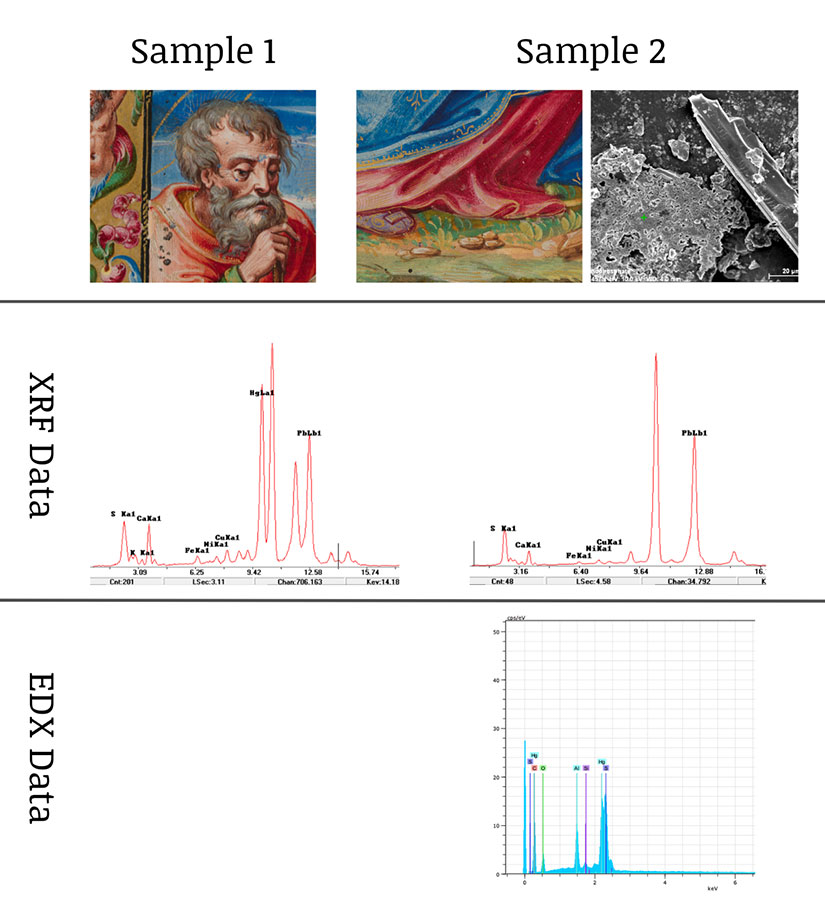
This past year, I collaborated with RBSC to craft a spotlight exhibit on a carta ejecutoria de hidalguía, a beautiful 16th-century Spanish illuminated manuscript which legally certified an individual’s noble status. The investigation used scientific and historical research to understand how the manuscript materially communicated the noble identity of its owner, don Alonso de Resa. Throughout my investigation, I encountered many interesting findings, the most exciting of which was the possible presence of cochineal red, an extremely valuable pigment made from crushed insects in Latin America.
Rocío standing next to the Magellan 400 FESEM Microscope (left), where tiny manuscript pigment samples were analyzed (some results shown on right). Photo taken by Dr. Khachatur Manukyan.
After my conversation with Ashraf, however, I realized there is much more to the carta ejecutoria’s pigment that I have yet to consider, primarily how it implies the human agency behind the manuscript—namely the labor of artists, manufacturers, and merchants. This is not to say that any of my previous research is inconsequential: it is still true that the likely presence of the cochineal physically demonstrates don Alonso’s wealth and noble status. It is also true that the use of the pigment in this manuscript shows how the Spanish articulated the concept of nobility via a product of global trade.
Harvest and preparation of cochineal.
Sahagún, Bernardino de, et al. Historia general de las cosas de Nueva España (Códice florentino). 1577. Ms. Mediceo Palatino 218–20, Biblioteca Medicea Laurenziana. Códice Florentino Digital / Digital Florentine Codex, edited by Kim N. Richter et al., bk. 11, fol. 216v, Getty Research Institute, 2023.
That said, the artist’s potential use of cochineal begs us to consider the role of those who made it, as well as its path towards its place in the manuscript. Before that pigment was part of don Alonso’s carta, it was crushed by laborers in Latin America, packaged and sent via boat on an overseas journey to Spain, where it was sold and then used by our artist. As such, the pigments I researched were not only a part of my undergraduate life at Notre Dame, but also that of many other people of the past, all of whom contributed to the making and the history of this manuscript. With renewed understanding, those reds, blues, and greens from don Alonso’s carta passed from being meager pigments to material remnants of humanity, tiny little specks of incalculable value. Amazing how color can carry so much memory and significance, right?
With this in mind, next time you find yourself in RBSC, I encourage you to take a moment. As you touch a book’s old bindings and trace its ink with your eyes, think of the hands and stories that have helped shape it and which have brought it to you in that moment. Truly give yourself time to pause and imagine at least one person who might have touched, created, or used the object before you. With this act, you deepen your connection with history by intentionally engaging with the remnants of our past. In this sense, each visit to RBSC is not unlike a memorable rideshare—a brief encounter that leaves a lasting impression, reframing our understanding of how human memory transcends mere space and time.
Hesburgh Libraries has recently acquired Giacomo Castellani’s Tractatus Nouus de Canonizatione Sanctorum (M. Silber, 1521), an extremely rare and early work by an Italian canon lawyer on the process of canonization in the Catholic Church. Introduced in the early Middle Ages as the formal procedure to add new saints, the process continues to be used today with its essential elements largely unchanged.
The author divides the subject into various chapters, such as how to investigate the authenticity of miracles attributed to the candidate and the role of the Pope in declaring new saints. Although in recent times works on this subject have become more prolific, it is unusual to find any this early and this one is of special interest because it effectively coincides with the beginning of the Protestant Reformation. The preface is addressed to the Pope at the time of publication, Leo X, whose pontificate spanned the years 1513-1521.
We have identified only one other North American library holding this title.
As fans around the world watch the 23rd World Cup this summer hosted by Canada, Mexico, and the United States, RBSC recently browsed the stacks for World Cup history. We are pleased to highlight these sources from the collection documenting the first two World Cup tournaments in 1930 and 1934.
The inaugural World Cup was held in Uruguay in 1930, and the host nation ended up winning the championship. After the tournament, the Uruguayan Football Association published an illustrated history of the event, Primer Campeonato Mundial de Football = La Coupe du monde : Montevideo, julio de 1930(The First World Football Championships – The World Cup: Montevideo, July 1930). This oversized book commemorates and documents the tournament in more than 120 pages and hundreds of photographs.
Printed in both Spanish and French, the book contains plentiful information about the teams, players, and games. This page devoted to the runner-up Argentinian team is typical of the coverage of the participating countries (page 26). The book also includes images and descriptions of every tournament match, like this two-page spread about the United States’ 3-0 opening round victory over Belgium (pages 42-43).
The book gave extensive coverage to the semifinals and the finals, intricately documenting each goal in the championship game. Here we see a description of Uruguay’s third goal by Santos Iriarte in the 68th minute that gave Uruguay the lead for good en route to its 4-2 victory (page 96).
Four years later, Italy, under dictator Benito Mussolini, hosted the second World Cup, and, again the home team came away victorious. In advance of the tournament, the Italian National Tourism Board published this 26-page English-language pamphlet, See Italy and the World’s Football Championship, to entice visitors to come to Italy despite the continuing Great Depression.
The competition took place in eight different locations, which, as the pamphlet pointed out, “are most attractive, as only Italian cities can be” (page 6). The finals were held in Rome, which the Tourism Board declared, “embraces every attraction in Italy and is unsurpassed by any other city in the world” (page 20).
Mussolini Stadium of Turin (left) and San Siro Stadium of Milan (right).
The booklet featured photographs, descriptions, and simple maps of each of the host cities and stadiums, including the Mussolini Stadium of Turin and the San Siro Stadium of Milan. The championship game, which would see Italy defeat Czechoslovakia 2-1, was held in the Stadium of the National Fascist Party at Rome.
Rome and the Stadium of the National Fascist Party.
Title page of Lo Sport in Regime Fascista featuring Mussolini.
The following year, the Italian Olympic Committee in collaboration with the popular magazine Lo Sport Fascista jointly published Lo sport in regime fascista : 28 ottobre 1922-I 28 ottobre 1935-XIII (Sport in the Fascist Regime: 28 October 1922 I – 28 October 1935 XIII). This book recounted and celebrated Italian athletic achievements across a myriad of sports, including Italy’s recent World Cup title. The book’s frontispiece, which included a large image of Mussolini, demonstrated the close relationship between Italian sports and the ruling Fascist regime.
Calcio—or soccer—was featured in the fifth chapter, and the book revelled in Italy’s 1934 World Cup success. “Only in Fascist Italy could one seriously think about organizing the Second World Cup tournament” the book contended. “Only Italy could have taken on such a massive amount of work and responsibility. And it was a magnificent, beautiful, unforgettable event. Our beautiful sports fields, modern and superbly equipped; endless streams of foreigners who enjoyed our intelligent and truly affectionate hospitality; the battles between great champions, fought in an ideal atmosphere of serenity, discipline, and understanding” (page 40).
Original Italian: “Solo nell’Italia Fascista si poteva seriamente pensare all’organizzazione del II Torneo per la disputa della Coppa del Mondo…. Solo l’Italia poteva accettare un simile cumulo di lavoro e di responsabilità. E fu una cosa grandiosa, bellissima, indimenticabile. I nostri bei campi sportivi, moderni e mirabilmente attrezzati; interminable carovane di stranieri che godettero la nostra intelligente e veramente affettuosa ospitalità; battaglie di grandi campioni combattute in un clima ideale di serenità, di disciplina, di comprensione.”
Commemorative Italian postage stamps printed for the World Cup, or the Campionato del Mondo (page 34).
The book celebrated the victorious Italian national team, writing that “great goals, in truth, still await our formidable army of footballers. They will be achieved in the name of Fascism and for the glory of a sport that has truly brought Italy unparalleled satisfaction. The path already traveled and the conquests achieved, give the march of Italian footballers the rhythm and air of the inevitable” (page 40).
Original Italian: “Grandi mète, in verità, ulteriormente attendono il formidabile esercito dei nostri calciatori. Saranno raggiunte, nel nome del fascismo e per la gloria di uno sport che veramente diede all’Italia impareggiabili soddisfazioni. Il cammino percorso, le conquiste fatte, danno alla marcia dei calciatori italiani il ritmo ed il significato dell’ineluttabile.”
The Italian National Team that won the 1934 World Cup (page 35).
World Cup soccer has always been influenced by contemporary politics, and, like the Italian Fascists, national leaders have often sought to co-opt sporting success and athletic achievements for their own partisan reasons.
But, for just as long, many fans, spectators, athletes, and other observers have believed that global sporting events like the World Cup could serve a larger purpose and help to bridge the differences and conflicts between people. In his speech at the welcoming banquet for the delegations at the inaugural 1930 World Cup, for example, Dr. Raoul Jude, President of the Uruguayan Football Association, expressed his hope that the tournament could be a unifying event:
“Welcome, you travelers who arrive from all points of the compass, bringing us the message of solidarity and cordiality from different peoples and races, united nevertheless, above all differences and all of life’s hardships, within the higher fellowship of a lofty purpose aimed at the betterment of all mankind.
We read the clear message you bring us; and though some parts are not written in a language familiar to us, we instantly grasp their meaning through the frank gestures and the serene, united gaze of those who bear them” (Primer Campeonato Mundial de Football, pages 33-34).
Original Spanish: Bien venidos vosotros, viajeros que llegáis de todos los puntos cardinales trayéndonos el mensaje solidario y cordial de pueblos y razas diferentes, hermanadas no obstante, por encima de todas las diferencias y de todas las miserias de la vida, en la comunidad superior de un alto designio en el sentido del mejoramiento de todos los hombres de la tierra.
Leemos el claro mensaje que nos traéis, y aunque algunos de ellos no están escritos en la lengua que nos es familiar, descubrimos en seguida su sentido en el gesto franco y en la mirada serena y unánime de sus portadores.”
Players from the Uruguayan National Team celebrate the 1930 World Cup title on the pitch after the game (Primer Campeonato Mundial de Football, page 98).
With the 2026 World Cup soon coming to a close, we hope all teams, players, and fans have experienced a taste of La alégria del triunfo—the joy of victory—like the jubilant 1930 Uruguayan team seen here.
To commemorate the 250th anniversary of the United States, Rare Books and Special Collections offers a look at a series of copies of the Declaration of Independence held in our collections. The process of creating the Declaration of Independence has been written about widely and even celebrated on Broadway (1776 [1969; revivals in 1997 and 2022]). But what happened after Congressional delegates agreed on the text and consented to sign the document? How did Congress disseminate the Declaration?
During the late eighteenth century, news was broadcast through broadsides (posters) and newspapers, as well as orally. The first copies of the Declaration of Independence were designed and printed by John Dunlap, a Philadelphia printer and newspaper publisher. He typeset a large broadside version of the document on the night of July 4th and had printed at least several hundred copies by late morning on July 5th. Today, only 25 copies of Dunlap’s broadside exist.
It took time for the Declaration of Independence to reach all of the newly united states. RBSC holds a facsimile copy of one such later printing: the July 26, 1776 issue of the Virginia Gazette, which published the Declaration in full. The Virginia Gazette was published in Virginia’s capital, Williamsburg, and the paper published official news and business of the colony, and the state, of Virginia.
The same Virginia Gazette issue also reported on where the Declaration of Independence had been read publicly. Between early July and mid-August 1776 the document was printed and proclaimed across the United States, which was news in itself. The first public reading occurred on Monday, July 8th, in Philadelphia and other cities in Pennsylvania, and in New Jersey, using Dunlap’s broadside copy. In most places, the reading took on trappings of a ceremony. The local sheriff would read the Declaration on the steps of the courthouse, the gathered crowd would cheer, bells would ring, and soldiers would fire a salute. Coats of arms and other symbols of the British crown were also removed from buildings and burned.
By the middle of August 1776 the Declaration of Independence had reached London, where its text was changed by newspaper publishers worried about the document’s seditious content. Publishers excerpted, censored, and suppressed the text. These changes were reprinted in turn by printers and publishers beyond London to Europe, where the Declaration appeared in local newspapers by the end of August.
Rare Books and Special Collections holds a London printing of the Declaration of Independence. The Gentleman’s Magazine, a widely-read, general interest periodical, published the Declaration in its August issue. The magazine’s editor followed the pattern of some London newspapers, censoring words that criticised the monarch. As a result, “King,” “tyranny,” “Prince” and “tyrant” have been suppressed in this copy.
Some British editors altered the text of the Declaration to soften its criticism of George III. This might explain the marginal annotation in Hesburgh Library’s copy of the Gentleman’s Magazine. The handwritten note moderates Jefferson’s language to make the monarch appear less negligent. In referring to laws for which colonists petitioned the king, the annotator changed “he [the king] has utterly neglected to attend to them” to “he has utterly neglected to assent to them.” Did the editor believe that George III preferred to have denied rather than ignored his subjects?
Copies of the Declaration of Independence also circulated within the United States. As the United States expanded during the first decades of the nineteenth century, citizens needed to be informed about their government and the state of the nation; publishers and booksellers supplied. Hesburgh Libraries holds a number of these early nineteenth-century copies, including this 1811 copy published by Robert Harper, a printer in south central Pennsylvania. He published the nation’s founding documents—the Declaration of Independence and the Constitution—along with the constitutions of all 17 states. Among the purchasers was a bookseller in Pittsburgh that ordered 500 copies—a huge supply that the seller believed they could sell to newcomers to the frontier city.
Rare Books and Special Collections also holds a copy of the Declaration of Independence that was reprinted by the National Archives in 1952, along with the Constitution and the Bill of Rights. Published together as The Charters of Freedom and at the height of the Cold War, it celebrates the inauguration of the documents’ shared, permanent exhibition at the National Archives in Washington, D.C. In this publication, the National Archives reproduced the Declaration of Independence in its most formal and famous form: the engrossed copy of the Declaration that was completed and signed on August 2, 1776. An engrossed copy is text written on parchment in a large hand.
All of these copies are different—in format and sometimes in content. Yet in aggregate they represent Americans’ adherence—for two and a half centuries–to the idea that “all men are created equal, that they are endowed by their Creator with certain unalienable Rights.”
Happy Fourth of July!
Bibliography
Sneff, Emily. When the Declaration of Independence Was News. New York: Oxford University Press, 2026.
Students are typically surprised to learn that there is a long history of Spanish-language publishing in the United States. This history even includes cities, like New York and Philadelphia, that were never part of the vast geographies of the Spanish Empire or the Mexican Republic (which now constitute more than one third of the territory of the U.S.’s 48 contiguous states). Rather than being simply presented with this information, they are often prompted to make this “discovery” on their own through their examination of printed books: an opportunity, during a class visit or an appointment in the Reading Room, to thoughtfully explore not just the intellectual content but also the individual histories of books, as objects.
Special Collections has recently acquired, through both purchase and donation, a number of publications that serve this exercise well; texts that, like the Caribbean Sea, cross geopolitical boundaries, complicate national narratives, and question literary canons, all while connecting cultures, histories, and geographies in the process. One of those publications is highlighted here.
Lecciones orales sobre la Historia de Cuba, pronunciadas en el Ateneo Democrático Cubano de Nueva York, por Pedro Santacilia. Nueva-Orleans: Imprenta de Luis Eduardo del Cristo, 1859.
Cuba sits at the crossroads of the Gulf of Mexico, the Atlantic Ocean, and the Caribbean Sea; and the story of this book, like the story of the island, is shaped by those waters, and by the peoples and polities that those waters have touched. The title of the book provides its first lesson in the Americas’ interconnected geographies of empire and independence, slavery and freedom, exile and return: Lectures on the History of Cuba, Pronounced in the Cuban Democratic Society of New York, by Pedro Santacilia. At the time of its publication in 1859, Santacilia (1834, Santiago de Cuba – 1910, Mexico City) had twice lived in Spain in forced exile, once as a child, due to his father’s political activities, and once as an adult, due to his own; escaped Spain via Gibraltar and moved to New York, where these lectures were given, and where he wrote and published alongside other Cuban exiles; moved to New Orleans, which was another refuge for Latin American exiles, and where this book was published; and, finally, settled in Mexico.
Copyright page, from the District of New Orleans.
Santacilia was always a fierce proponent of Cuban independence, but his ideas about how independence should look, including how it should be achieved, evolved over time. He presented and published his Lectures during a period in which many Cubans, himself included, viewed U.S. military intervention, and even U.S. annexation of Cuba, as the most expeditious route to liberation from the Spanish empire. In fact, he dedicated this book to Domingo de Goucuría, and published it through the press of Luis Eduardo del Cristo, both of whom were prominent filibusteros: they supported and fought alongside Venezuelan-born Narciso López and Tennessee-born William Walker in their attempts to invade, colonize, and establish slave states in parts of Mexico, Central America, and the Caribbean.
However, it was also in New Orleans where Santacilia met Mexican President Benito Juárez, a staunch abolitionist who himself spent two stints in the city as an exile, first during the dictatorship of Antonio López de Santa Anna, and then during the War of Reform. Santacilia ended up following Juárez back to México, married one of his daughters, witnessed the Mexican Republic’s resistance to the Second French Empire, fostered Mexican support for Cuban independence, and ultimately rejected U.S. interventionism in favor of a fully sovereign Cuban state.
Bookstore stamp for “Librería Martí” in Habana, Cuba.
RBSC’s copy of Santacilia’s Lectures followed a trajectory befitting its history. Published in New Orleans, it eventually made its way to Cuba, the subject of its pages. While we don’t know how or when it arrived on the island, a stamp, and accompanying handwritten note, tell us that it was sold by the famous Habana bookshop, Librería Martí — which itself was named after the great Cuban politician, author, and anti-imperialist, José Martí, who Santacilia befriended in Mexico. The purchase had to have taken place at some point between the mid-1920s, when the shop opened, and 1960, when it closed in the wake of the Revolution. RBSC’s copy, however, was not acquired from any agent in Cuba, but rather from a second-hand bookseller in Mexico City, where Santacilia built his life and legacy, and where he died and was buried.
Scholar Rodolfo J. Cortina once asked, “Cuban literature, Cuban exile literature, Cuban-American literature: where does one end and the other begin?”1 In answering this question, he posited that Santacilia’s Lectures, like other 19th-century texts — poems, plays, newspapers, novels, etc. — published in the United States, by Cuban authors living and writing in the U.S., should absolutely be included in the Cuban-American literary canon, just as they should be included in the island’s own history of letters. The context and content of the Lectures, and the movement of RBSC’s particular copy through Caribbean and North American geographies, certainly supports this view.
1 See the Introduction to Cortina’s chapter, “Cuban Literature of the United States: 1824–1959,” in the openly accessible, digital volume, Recovering the U.S. Hispanic Literary Heritage, edited by Ramón Gutiérrez and Genaro Padilla, first published by Arte Público Press in 1993. https://artepublicopress.manifoldapp.org/projects/recovery-vol-1