Collection highlights, acquisition news, events, exhibits, and behind-the-scenes looks at the work and services of Rare Books & Special Collections (RBSC) at Notre Dame.
Rocío showing her exhibition work to family during Notre Dame’s 2026 commencement weekend.
A few weeks ago, I took what was likely the most delightful rideshare of my young adult life. To be sure, it wasn’t because of the quality of my steed (the black car was small and a bit, well, scuffed). Instead, it was because of a conversation with my driver, one which deepened my appreciation for a manuscript I recently studied at Notre Dame’s Rare Books and Special Collections (RBSC).
When I set foot in the teeny black car, things initially followed the usual script: I gave Ashraf, my assigned chauffeur, my four-digit security code, said my quiet “hello!”, and scrolled on my phone mindlessly for a few minutes. However, that morning there was some magic in the dullness of Chicago traffic, and after a few minutes, I began bonding with the stranger in front of me.
In a span of 40 minutes, Ashraf and I chatted about anything and everything. He told me about his two sons, his path to Chicago, and his cultural roots; I told him about my parents, the story behind my name, and my undergraduate adventures. While it was a memorable and enjoyable conversation throughout, there was one moment that I kept coming back to days after I exited the car door: when Ashraf shared with me that “Humans are memories.”
That sole sentence fueled my brain’s thoughts the rest of the week. Specifically, it got me thinking differently about archives and historical documents. As I reflected, I came up with the following claim:
“If humans are memories, and objects are our memory-keepers, then within every material object there exists the essence of at least one person.”
Thus, I concluded that historical objects transcend the simple category of “valuable artifact”; indeed, they become material vessels of human life. Considering this, an object’s materiality must not only be examined through the context of history and science, but also through that of philosophy.
Manuscript cover with gilded flower motifs. Gold on leather.Holy Family with St. John the Baptist. Pigments on parchment. Folio 1, verso.Alonso de Resa Patent of Nobility, 12.6 x 9.1 in. University of Notre Dame Hesburgh Libraries, Rare Books and Special Collections, MSH/LAT 0117.
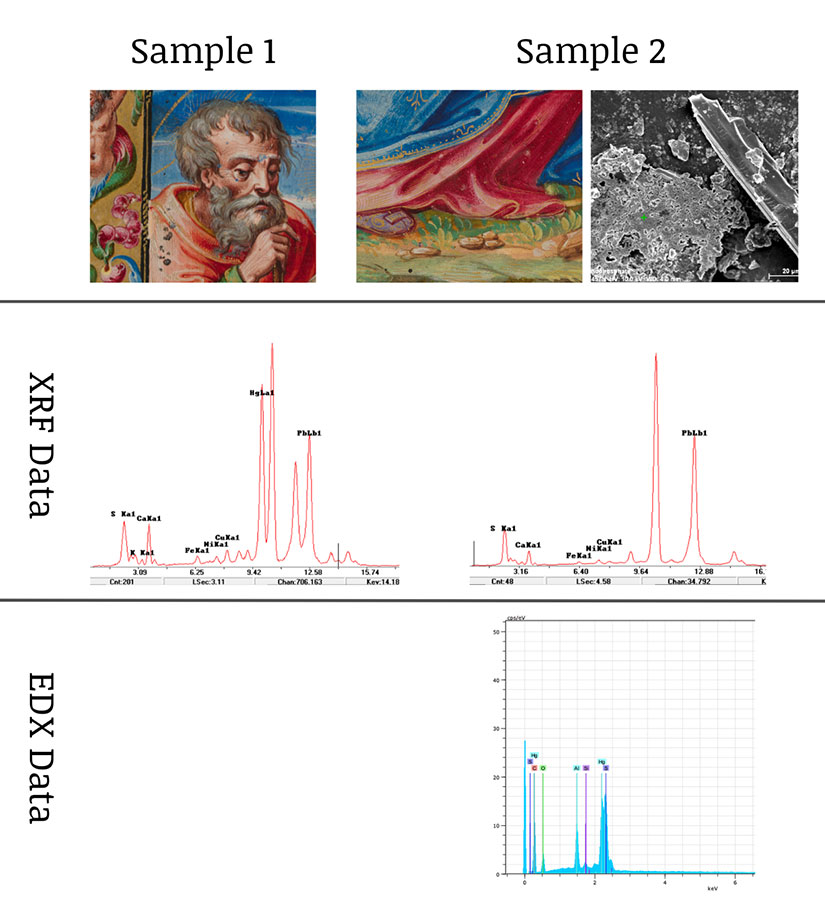
This past year, I collaborated with RBSC to craft a spotlight exhibit on a carta ejecutoria de hidalguía, a beautiful 16th-century Spanish illuminated manuscript which legally certified an individual’s noble status. The investigation used scientific and historical research to understand how the manuscript materially communicated the noble identity of its owner, don Alonso de Resa. Throughout my investigation, I encountered many interesting findings, the most exciting of which was the possible presence of cochineal red, an extremely valuable pigment made from crushed insects in Latin America.
Rocío standing next to the Magellan 400 FESEM Microscope (left), where tiny manuscript pigment samples were analyzed (some results shown on right). Photo taken by Dr. Khachatur Manukyan.
After my conversation with Ashraf, however, I realized there is much more to the carta ejecutoria’s pigment that I have yet to consider, primarily how it implies the human agency behind the manuscript—namely the labor of artists, manufacturers, and merchants. This is not to say that any of my previous research is inconsequential: it is still true that the likely presence of the cochineal physically demonstrates don Alonso’s wealth and noble status. It is also true that the use of the pigment in this manuscript shows how the Spanish articulated the concept of nobility via a product of global trade.
Harvest and preparation of cochineal.
Sahagún, Bernardino de, et al. Historia general de las cosas de Nueva España (Códice florentino). 1577. Ms. Mediceo Palatino 218–20, Biblioteca Medicea Laurenziana. Códice Florentino Digital / Digital Florentine Codex, edited by Kim N. Richter et al., bk. 11, fol. 216v, Getty Research Institute, 2023.
That said, the artist’s potential use of cochineal begs us to consider the role of those who made it, as well as its path towards its place in the manuscript. Before that pigment was part of don Alonso’s carta, it was crushed by laborers in Latin America, packaged and sent via boat on an overseas journey to Spain, where it was sold and then used by our artist. As such, the pigments I researched were not only a part of my undergraduate life at Notre Dame, but also that of many other people of the past, all of whom contributed to the making and the history of this manuscript. With renewed understanding, those reds, blues, and greens from don Alonso’s carta passed from being meager pigments to material remnants of humanity, tiny little specks of incalculable value. Amazing how color can carry so much memory and significance, right?
With this in mind, next time you find yourself in RBSC, I encourage you to take a moment. As you touch a book’s old bindings and trace its ink with your eyes, think of the hands and stories that have helped shape it and which have brought it to you in that moment. Truly give yourself time to pause and imagine at least one person who might have touched, created, or used the object before you. With this act, you deepen your connection with history by intentionally engaging with the remnants of our past. In this sense, each visit to RBSC is not unlike a memorable rideshare—a brief encounter that leaves a lasting impression, reframing our understanding of how human memory transcends mere space and time.
This exhibition highlights stories of survival, contemplation, competition, protest, and learning, from six distinct collections in Rare Books and Special Collections. Each section, presented by a different subject curator, focuses on an example of how people over time and in different places, construct community and cultivate hope.
This exhibition highlights examples of survival, contemplation, competition, protest, and learning. Showcasing narratives spanning centuries and continents, each story demonstrates that the power of constructing community and cultivating hope transcends time and place.
The exhibition features six distinct collections housed in the Rare Books & Special Collections, and is curated by Hesburgh Libraries faculty members. Click below to learn more about each of the individual exhibits within the exhibition:
Curated by Payton Phillips Quintanilla, Ph.D. (Curator, Latin American and Iberian Studies)
Tours of the exhibit may be arranged for classes and other groups by contacting rarebook@nd.edu.All exhibits are free and open to the public during business hours.This and other exhibits within the library are generously supported by the McBrien Special Collections Endowment.
This exhibition highlights stories of survival, contemplation, competition, protest, and learning, from six distinct collections in Rare Books and Special Collections. Each section, presented by a different subject curator, focuses on an example of how people over time and in different places, construct community and cultivate hope.
A Community of Solidarity Natasha Lyandres (Curator, Russian and East European Studies)
Transnational Communities of Resistance during El Salvador’s Civil War Payton Phillips Quintanilla, Ph.D. (Curator, Latin American and Iberian Studies)
This and other exhibits within the Hesburgh Libraries are generously supported by the McBrien Special Collections Endowment.
This St. Patrick’s Day and in the March–April spotlight exhibit, Rare Books and Special Collections celebrates the youth of Ireland, who were seen in the late nineteenth and early twentieth centuries as the true soul of the Irish Nation. After all, if Irish independence were to be achieved, nationalists would first have to win the hearts and minds of the next generation.
In 1842, a group known as Young Ireland founded a newspaper called The Nation to advocate for a politically independent Ireland. The Nation envisioned an Irish identity undivided by race or religion; united by Irish language and culture; and forged from a romanticized version of Irish history. To achieve these ends, Young Ireland sought a legion more formidable than a thousand men clad in steel: The young intellect of the country.1
One of our prized collections is a series of draft songs composed for The Nation newspaper by one of the founders of Young Ireland, Thomas Davis (Thomas Davis Collection, MSE/IR 1001). Although Davis tragically died of scarlet fever at age thirty, many of his compositions (“A Nation Once Again,” “The West’s Asleep,” and “Lament for Owen Roe O’Neill”), intended to inspire the Irish youth of his time, are still sung today.
Although the British banned the speaking of Irish and the teaching of Ireland’s history from the national school system, associations inspired by the Young Ireland Movement began to encourage children to study the Irish language, play Gaelic sports, and perform Irish drama and music. This alternative education included journals such as Young Ireland (1875-1891) and groups like the Irish Fireside Club (founded 1887), which helped foster a new national identity among the nation’s youth.
These activities served as training grounds for future nationalists and paved the way for the formation of Connradh na Gaedhilge (The Gaelic League) in 1893. This organization continued to solicit the support of Irish youth, and published numerous books, pamphlets, and broadsides intended to ensure children remained at the forefront of the revival of Irish language and culture.
First published by Connradh na Gaedhilge in 1902, An tÁilleán was written by Tadhg Ó Donnchadha (‘Torna’) with illustrations of the ideal country life by Seoirse Ua Fágáin.
‘Torna’ dedicated the book to the youth of Ireland, saying, “Cuimhnighidh air gur i nÉirinn do rugadh sibh, gur ceart dúinn ár ndícheall do dhéanamh ar son Éireann; maireamhaint agus bás d’fhágháil i nÉirinn; agus ó’s í an Gaedhilg ár dTeanga féin, í labhairt í comhnuidhe.” [Remember that you were born in Ireland, and we must do our best for Ireland; to live and die in Ireland; and since Irish is our own language, speak it always.]
Fuínn na Smól (Songs of the Thrushes) is a collection of Irish tunes drawn from manuscripts, oral tradition, and shorter printed works. An tAthair Pádruig Breathnach (1848–1930), a Catholic priest and member of the Gaelic League, collected Irish songs from his parishioners in his youth. He later published them in a series of works like this one, with each tune printed in the Gaelic typeface and set to a melody in tonic solfa.
Although dedicated to children learning Irish in school, these songbooks had much to offer adults committed to the de-anglicization program of the Gaelic League. Sales ran into the tens of thousands, and they had a lasting influence on the Irish oral tradition.2
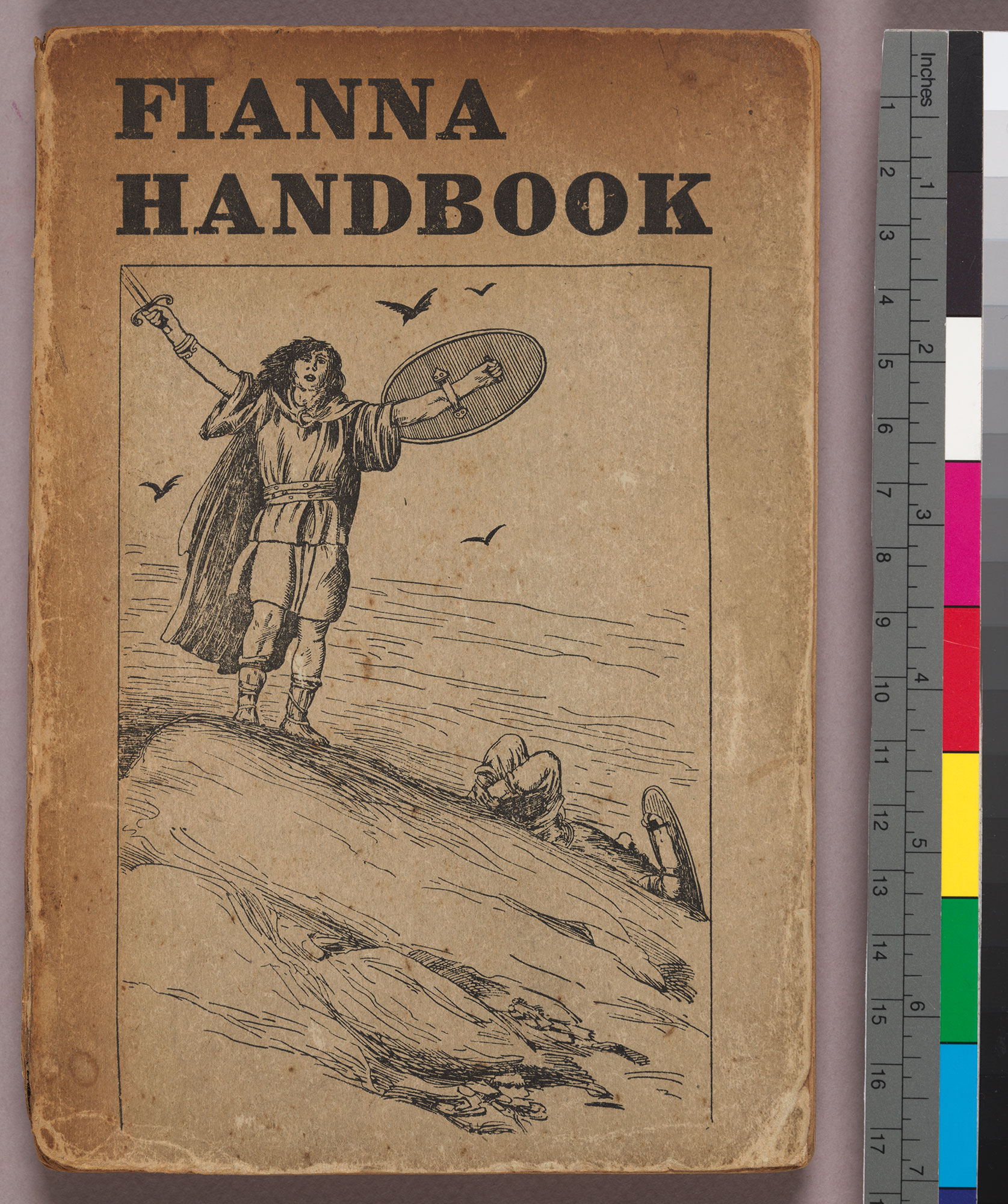
When Gaelic revivalism became more political, groups like Na Fianna Éireann (Boy Scouts of Ireland), founded in 1909, emerged to support a future military insurrection. First published in 1914, the Fianna Handbook served as the official guide and training manual for Na Fianna Éireann. The Fianna Handbook was the Irish nationalist alternative to the Baden-Powell Boy Scout handbook, with the Fianna portrayed holding rifles, in contrast to the Baden-Powell Scouts, who carried walking sticks.
The guide featured training in signaling, first aid, camping, and military drill, but also contained chapters devoted to a cultural nationalist education. Patrick Pearse contributed a chapter on the legendary Fianna; Countess Markievicz, the group’s founder and ‘Chief,’ wrote an inspiring foreword and designed the cover; Roger Casement penned an essay on chivalry; and Douglas Hyde submitted a chapter in the Irish language.
Current and former Fianna participated in the 1916 Easter Rising, and the organization later worked alongside the Irish Republican Army (IRA) in the Irish War of Independence (1919-21).
Eighty years after Young Ireland founded The Nation newspaper, the Irish Free State was declared, and Irish Independence followed soon after. The Gaelic revival survived largely because it recognized that nobody was too young to serve their country, and the new Irish state found many former “Firesiders” and Fianna members serving in leadership roles. These once pint-sized radicals ensured that their dream of a free, Gaelic Ireland would pass to the next generation of Irish children.
Please join us for the following public events and exhibits being hosted in Rare Books and Special Collections:
Monday, March 5 at 5:00pm | Italian Research Seminar: M.A. Student Presentations (University of Notre Dame) — This semester’s speakers are: Giorgia Buscema and Madeline Grossman.
This exhibition highlights stories of survival, contemplation, competition, protest, and learning, from six distinct collections in Rare Books and Special Collections. Each section, presented by a different subject curator, focuses on an example of how people over time and in different places, construct community and cultivate hope.
Women Religious in Male Spaces David T. Gura, Ph.D. (Curator, Ancient and Medieval Manuscripts)
Ireland’s Idealized Community Matthew Knight, Ph.D. (Curator, Irish Studies)
A Community of Solidarity Natasha Lyandres (Curator, Russian and East European Studies)
Transnational Communities of Resistance during El Salvador’s Civil War Payton Phillips Quintanilla, Ph.D. (Curator, Latin American and Iberian Studies)
This and other exhibits within the Hesburgh Libraries are generously supported by the McBrien Special Collections Endowment.
Join Professor Guyda Armstrong (University of Manchester) and Dr Giles Bergel (University of Oxford) for an interactive workshop showcasing new digital methods for studying early modern printing. This session will introduce the research questions and first findings of Envisioning Dante c. 1472-1630: Seeing and Reading the Early Printed Page, funded by the UK government (c. £1 million; 2022-25). Participants will be given practical, hands-on demonstrations of the techniques and new digital tools developed by the project for analyzing and comparing early printed books.
This exhibition highlights stories of survival, contemplation, competition, protest, and learning, from six distinct collections in Rare Books and Special Collections. Each section, presented by a different subject curator, focuses on an example of how people over time and in different places, construct community and cultivate hope.
Curated by Rachel Bohlmann, Ph.D. (Curator, American History and American Studies), Gregory Bond, Ph.D. (Curator, Joyce Sports Research Collection), David T. Gura, Ph.D. (Curator, Ancient and Medieval Manuscripts), Matthew Knight, Ph.D. (Irish Studies Librarian and Curator), Natasha Lyandres (Curator, Rare Books & Special Collections), and Payton Phillips Quintanilla, Ph.D. (Librarian and Curator for Latin American and Iberian Studies).
This and other exhibits within the Hesburgh Libraries are generously supported by the McBrien Special Collections Endowment.
Rare Books and Special Collections welcomes students, faculty, staff, researchers, and visitors back to campus for Spring ’26! Here are some things to watch for in Special Collections during the coming semester.
Special Collections Welcomed a New Postdoctoral Research Associate during the Fall 2025 Semester
Ruben Celani (Photo by Matt Cashore / University of Notre Dame)
Ruben Celani, Ph.D., joined the Hesburgh Libraries in October as a postdoctoral research associate in Italian Studies and Zahm Dante Collection curatorial fellow. He works in Rare Books & Special Collections as a subject liaison for Italian studies and curator of the Libraries’ extensive rare Italian collections, while also pursuing his own academic research.
Prior to joining the Hesburgh Libraries, Celani served as an adjunct lecturer in the Department of Literary Studies at Ghent University in Belgium. He holds a Ph.D. from Ghent University in Literary Studies with specialization in Italian Studies, as well as a bachelor’s and a master’s degree in Archival and Library Sciences from the University of Rome “La Sapienza.” Ruben has experience working in libraries in Rome, The Hague, and Antwerp.
This exhibition highlights stories of survival, contemplation, competition, protest, and learning, from six distinct collections in Rare Books and Special Collections. Each section, presented by a different subject curator, focuses on an example of how people over time and in different places, construct community and cultivate hope.
Curated by Rachel Bohlmann, Ph.D. (Curator, American History and American Studies), Gregory Bond, Ph.D. (Curator, Joyce Sports Research Collection), David T. Gura, Ph.D. (Curator, Ancient and Medieval Manuscripts), Matthew Knight, Ph.D. (Irish Studies Librarian and Curator), Natasha Lyandres (Curator, Rare Books & Special Collections), and Payton Phillips Quintanilla, Ph.D. (Librarian and Curator for Latin American and Iberian Studies).
In honor of Dr. Martin Luther King Day (January 19th), the birthday of Jackie Robinson (January 31st), and Black History Month (February), Rare Books and Special Collections is pleased to highlights examples from its collection of souvenir fan pennants from the Negro Baseball Leagues. The colorful collectible felt souvenir pennants represent leading Black baseball teams of the 1930s and 1940s and feature large screen-printed graphics of African American baseball players in action.
Curated by Gregory Bond (Curator of the Joyce Sports Research Collection).
Created across multiple centuries, geographies, and cultures, pre-Hispanic clay sellos (flat and cylindrical stamps and seals) are celebrated as the earliest manifestation of Mesoamerican print culture. This cross-repository Spotlight Exhibit presents a selection of sellos stewarded by the Raclin Murphy Museum of Art; two emblematic publications of sello designs, preserved in the Hesburgh Libraries’ Rare Books and Special Collections; and contemporary examples of sello-inspired visual arts.
Curated by Payton Phillips-García Quintanilla (Librarian and Curator for Latin American and Iberian Studies).
These and other exhibits within the Hesburgh Libraries are generously supported by the McBrien Special Collections Endowment.All exhibits are free and open to the public during regular hours.
Special Collections’ Classes & Workshops
Throughout the semester, curators will teach sessions related to our holdings to undergraduate and graduate students from Notre Dame, Saint Mary’s College, and Holy Cross College. Curators may also be available to show special collections to visiting classes, from preschool through adults. If you would like to arrange a group visit and class with a curator, please contact Special Collections.
Since July 2015, when we first welcomed readers to the Rare Books and Special Collections blog, we have enjoyed using this forum to tell readers about recently acquired and newly described items, as well as well-known materials and hidden gems. We publish posts to help you—our readers—better know who we are and what we do, and we provide regular updates on exhibitions and events hosted by RBSC.
To mark the ten-year anniversary of our blog, we have selected a few of the 471 posts we have published so far, written by a variety of curators, librarians, and guest authors. Continue scrolling to find a sample of interesting topics from our second five years.
The tag “RBSC scholars” gathers posts relating to, and sometimes by, the people who do their research within Notre Dame’s Special Collections. (A sometimes related category are posts in the Category “Instruction and Class Visits.”)
In her speech to celebrate the opening of Christine Dunlap Farnham’s Archive at Brown University, feminist historian Joan Wallach Scott reflected on the lack of attention to women’s personal collections and archives that memorialize their lives.1 The exhibit “Social Media Networks in the 19th and 20th Centuries: The Albums of Esmeralda Cervantes, Teresa Puelma de Orrego, Luz de Sagaceta, María Enriqueta Camarillo,” recently installed in Rare Books and Special Collections (Hesburgh Libraries, University of Notre Dame), seeks to build on Scott’s insights by highlighting women’s friendship albums and scrapbooks as vital historical documents that deserve a place on display.
Curated by members of the upper-level Spanish course “Women’s Culture in 19th Century Latin America” at the University of Notre Dame, this exhibit focuses on preserving and showing the importance of women’s stories through material culture. In this course, we explore the cultural and intellectual contributions of women in 19th- and early 20th-century Latin America, examining how gender shaped ideas of citizenship, sexuality, and education in post-independence societies. Among our study of literature, periodicals, and other women’s public interventions, albums emerge as a novel object for understanding 19th- and 20th-century sociability.
19th century albums were typically blank books that served as repositories for various collectible objects and writings. For women, in particular, albums were a crucial medium for engaging with writing and visual culture, shaping identity, and creating bonds outside the domestic sphere. Pages within the albums vary in content, including personal letters, poetry, pieces of artwork, and autographs, among others. Each album serves as a tangible representation of the illustrious life of the woman who curated it.
As part of the coursework, we were also introduced to the fascinating world of Rare Books and Special Collections, a space that allowed us to work hands-on with the friendship albums and scrapbooks of four women from the 19th and early 20th century Hispanic world held at the Notre Dame’s archives: Esmeralda Cervantes, Luz de Sagaceta, Maria Enriqueta Camarillo, and Teresa Puelma de Orrego.
Researching them revealed a challenging but fruitful journey. We found that women’s stories were poorly cataloged or entirely absent from historical archives, while the information on similar works of male counterparts from their time were easily accessible through a simple Google search. This lack of documentation is not accidental but rather revealing of a greater theme: the historical discrimination of women in academic spaces and historical accounts, even among elite women. Traditional academia has undervalued their work, and left it outside of the literary canon. Our research, however, reveals the profound importance of their activities in shaping the culture and politics of their era. By reconstructing women’s stories through their friendship albums and scrapbooks, objects often dismissed as trivial or not relevant outside the private sphere, we engage in an act of recovery and critical analysis. Each page becomes evidence of an intellectual world that has always existed but was never fully recognized. Our goal is not simply to display their work but to restore women’s historical presence by centering the very objects and writings that belonged to them.
Album coverFirst page of the album signed by Argentine writer Adolfo Mitre during Cervantes’s visit to Buenos Aires.Letter signed by Spanish writer and feminist Emilia Serrano, who was also traveling in Latin America during Cervantes’s tour.Album amicorum de Esmeralda Cervantes, 1875-1877 (MSH/LAT 0094)
The album belonging to Clotilde Cerdá (1861–1926), better known by her artistic name, Esmeralda Cervantes, meticulously documents her highly publicized Latin American tour between 1875 and 1877. Born in Barcelona, she had achieved renown across Europe as a prodigious harpist by the age of fourteen. The prominent selection of “Esmeralda” rather than “Clotilde” to be hand-embroidered on the album’s center signifies her wish to delineate her professional trajectory from her private identity, asserting that she be primarily remembered for her musical accomplishments. Though the velvet cover has faded with time, the enclosed collection of drawings, poems, and dedicatory letters—all paying homage to her—preserves the intellectual and artistic worldview she cultivated through her art.
Album coverPoem in English with botanic motifs adorning the page. Albums were usually multilingual and spoke of the transnational connections of their owners.Album amicorum de Teresa Puelma de Orrego, 1851-1893 (MSH/LAT 0119)
The album of Teresa Puelma de Orrego, who was born in Santiago de Chile in 1861, offers a glimpse into the upper-class world of Chile during the 19th century. She was the daughter of an aristocratic family and lived most of her life in Chile. Her album contains a collection of letters and signatures from prominent politicians and generals, family mementos, and prayers in French, English, and Spanish. Notable entries include a condolence letter from Chilean President Jorge Montt and a hand-drawn map of the War of the Pacific (1879–1884), fought between Chile and an alliance of Peru and Bolivia and originated from a territorial dispute. The album itself is highly ornate: the cover is made of thick dark green fabric with her name embroidered in gold thread on the front. There is little information about her other than what exists in this album, inviting us to “read” the silences surrounding her as part of the historical record itself, and work to fill in those silences with our own original research.
Album coverPainting by Roberto MontenegroPoem by Jesús Valenzuela, 1904Album de recuerdos de la Señorita Luz Sagaceta, 1904-1905 (MSH/LAT 0095)
Luz Sagaceta was born in 1886 in Mexico City and was eighteen years old when her album was assembled. Through newspapers and the works in her album, we know that she was part of Mexico’s Porfirian elite. As members of this social class, she and her family were well-known enough to be noted in print culture and had the means to travel. Her album reveals the privilege she possessed, a privilege few women enjoyed: the opportunity to create an album, a subtle space of authorship. Luz’s album includes contributions from authors such as Jesus E. Valenzuela, Amado Nervo, Ruben M. Campos, and Jesus Urueta. These authors dedicated poems to her; some were inspired by Luz’ beauty, while others addressed topics of personal significance, such as the important women in their lives. This demonstrates that Luz had sufficient significance for them to offer genuine, personal tributes.
Album coverTitle page of the first volumeClippings of portrait and literary profile of the author published in the literary journal Album de Damas, Mexico, 1908.Juicios de prensa acerca de María Enriqueta y de sus libros: recortes y copias de opiniones publicadas en diarios y revistas de varios países, 1897-1940 (MSH/LAT 0118, t. 1-3)
Maria Enriqueta Camarillo, a celebrated Mexican novelist, poet, translator, and educator, used her meticulously kept albums to showcase her multifaceted talents, intellectual collaborations, and commitment to community, offering an analogue to contemporary social media. These collections, filled with her work, scholarly praise, sketches, and photographs, functioned as social connectors, highlighting her versatility, her international image, and the significant professional and personal relationships that were central to her life and Mexican culture. For the modern reader, engaging with Camarillo’s scattered yet beautiful albums provides an invaluable perspective—a welcome into a 19th-century life that otherwise might not have been fully told—and serves as a formative lesson in accepting historical complexity and narrative ambiguity rather than seeking immediate, structured answers.
Exploring the lives of these women through their albums was an enlightening experience. As a class, we were able to travel back in time to learn about their lives and gain insight into the society of the late nineteenth and early twentieth centuries. The first step of this process was reading about our albums from materials provided in class. Then, we had the chance to step outside of the classroom and into Special Collections to work with the physical albums. Working closely with library staff, curators, and specialists allowed us to fully immerse ourselves in the materiality of women’s archives. We gained tangible access to the lives of these women, feeling the texture of the album fabrics and carefully turning their pages.
Curating the physical exhibit proved equally enriching, as we took ownership of every step: from item selection and display design to writing introductory texts and labels—a long process requiring intensive collaboration with library specialists. This hands-on experience transformed us from simple student observers into the main actors of a historical recovery project, contributing to something larger that the audience would later enjoy.
The influence of these albums is still evident today in the digital tools and platforms we use to curate and preserve our own memories. Digital content, including posts on Instagram and videos on YouTube, effectively creates a personal digital archive—a collection of memories that visually represents an individual’s most significant social ties and interests, essentially acting as a form of “writing with scissors,” as coined by Ellen Gruber Garvey. While the medium has transformed from handwritten cursive to the digital scrapbook, the fundamental purpose—to preserve selfhood and community—endures, allowing these personal archives to leave a lasting impact on all who encounter them.
The project extended this hands-on approach to a general audience through the “Create Your Own Album Page” activity held on specific dates. This initiative has been a great source of direct and immediate feedback from visitors, including library staff, faculty, and students. Their most frequent reaction has been surprise and delight that the archives are not only part of an undergraduate class but also the inspiration for a collective and participatory project.
With this activity, the archives are truly brought to life. Our proposal of thinking of the albums as the precedent of social media creates a more direct, intimate connection with every visitor: guests are invited to contribute their own unique page to a communal album. Contributions have spanned songs, original poems, verses by renowned writers in various languages, thoughtful collages, dedications to loved ones, and letters—mirroring the rich and diverse content found in the 19th- and 20th-century albums we studied. Visitors of this exhibit become active participants in the enduring legacy of “writing with scissors,” experiencing firsthand the fundamental human impulse to curate and share selfhood.
Bella Barraza, Isabella Cioffi, Ryan Farrell, Meghan Garrity, Luke Grantz, Sophia Hohman, Marshall Horton, Ella Johnson, Kate Kirwan, Elizabeth Larsen, Felipe Nino, Thomas Phillips, Monica Schleg and Jhoseline Trejo, enrolled in ROSP 40790, Women’s Culture in 19th-Century Latin America, taught byVanesa MiseresPh.D. (Associate Professor, Romance Languages and Literatures).