GCGP paper published in Molecular Systems Design & Engineering

We are excited to announce the publication of a joint paper between the Maginn and Dowling groups:

B. Agbodekhe, M. N. Carlozo, D. O. Abranches, K. D. Jones, A. W. Dowling and E. J. Maginn, “Enhanced Thermophysical Property Prediction with Uncertainty Quantification using Group Contribution-Gaussian Process Regression“, Mol. Syst. Des. Eng., 2025, DOI: 10.1039/D5ME00126A.

Led by Barnabas Agbodekhe, with contributions from Montana Carlozo, Dinis Abranches, and Kyla Jones, this work shows how estimations from simple, first-order group contribution (GC) methods can serve as input features (along with molecular weight) to Gaussian process models for accurate property prediction. This can be used to rapidly estimate physical properties of compounds with much greater accuracy than GC models alone.

Efficient and reliable thermophysical property prediction sits at the heart of any high-throughput computational molecular discovery and design campaign. Thermophysical property predictions from a simple first-order group contribution (GC) model, along with molecular weight (MW), are used as the only two input features to Gaussian process (GP) regression models for enhanced thermophysical property predictions with reliable uncertainty quantification (UQ). Accurate property predictions are obtained with only two input feature dimensions, instead of the tens or hundreds typically used in the literature. The method, known as the GCGP method, provides a state-of-the-art balance of speed, ease of implementation, predictive accuracy, parsimoniousness, and reliable uncertainty quantification. It is especially suited to systems that can be modeled using GC methods, and its scope of applicability can be extended by incorporating other GC methods and/or input features into the GP models. Potential applications of the GCGP method include efficient and enhanced prediction of thermophysical properties with uncertainty quantification for materials discovery via database screening or computer-aided molecular design campaigns.
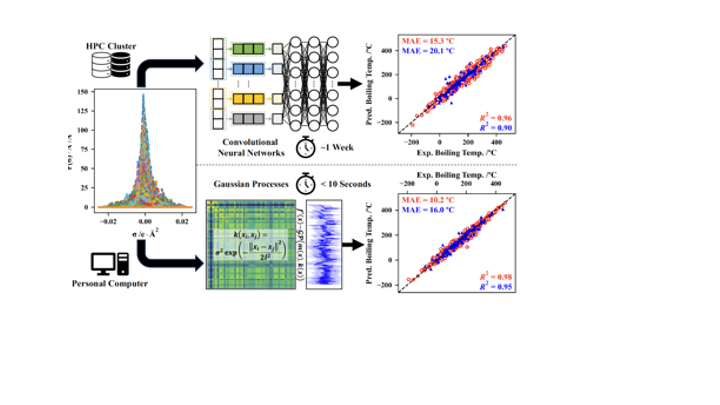
PNAS paper led by Dinis shows how sigma profiles can be used to create a searchable digital space

This paper, in collaboration with the Colón group, demonstrates the capability of Gaussian processes to correlate and predict physicochemical properties from sigma profiles. The new approach outperforms state-of-the-art neural networks from earlier studies and, most importantly, can be navigated using standard algorithms to find compounds having desired properties. Check it out here! https://doi.org/10.1073/pnas.2404676121

Ning’s first paper in the group was published in the Journal of Ionic Liquids

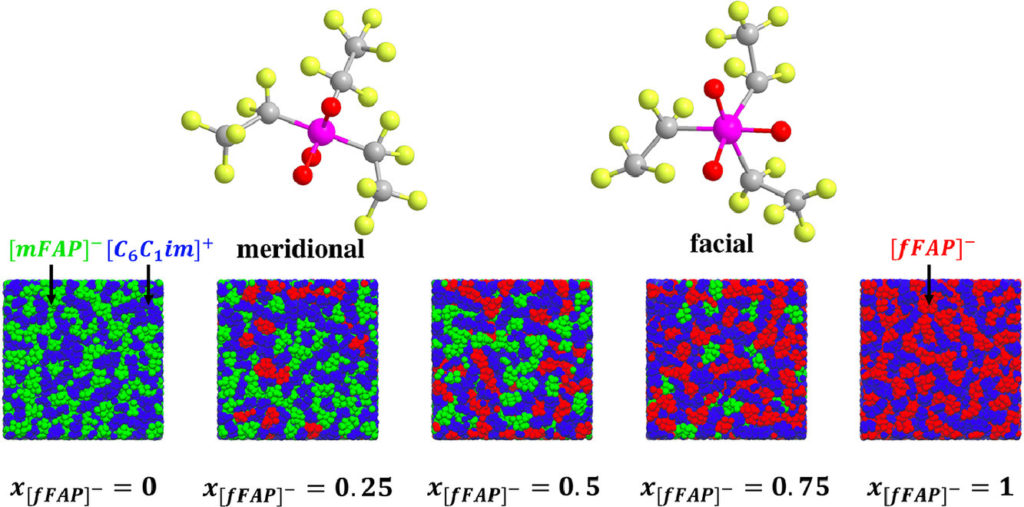
Ning Wang’s first publication from our group was just published in the Journal of Ionic Liquids. In collaboration with Yong Zhang, Ning developed a force field for the two isomers of the FAP anion and then performed simulations of the ionic liquid [C6C1im][FAP]. She looked at the effect the relative concentration of the two [FAP] isomers has on properties (not much) and calculated several other physical properties. Nice work, Ning!

ACS Green Chemistry and Engineering Conference

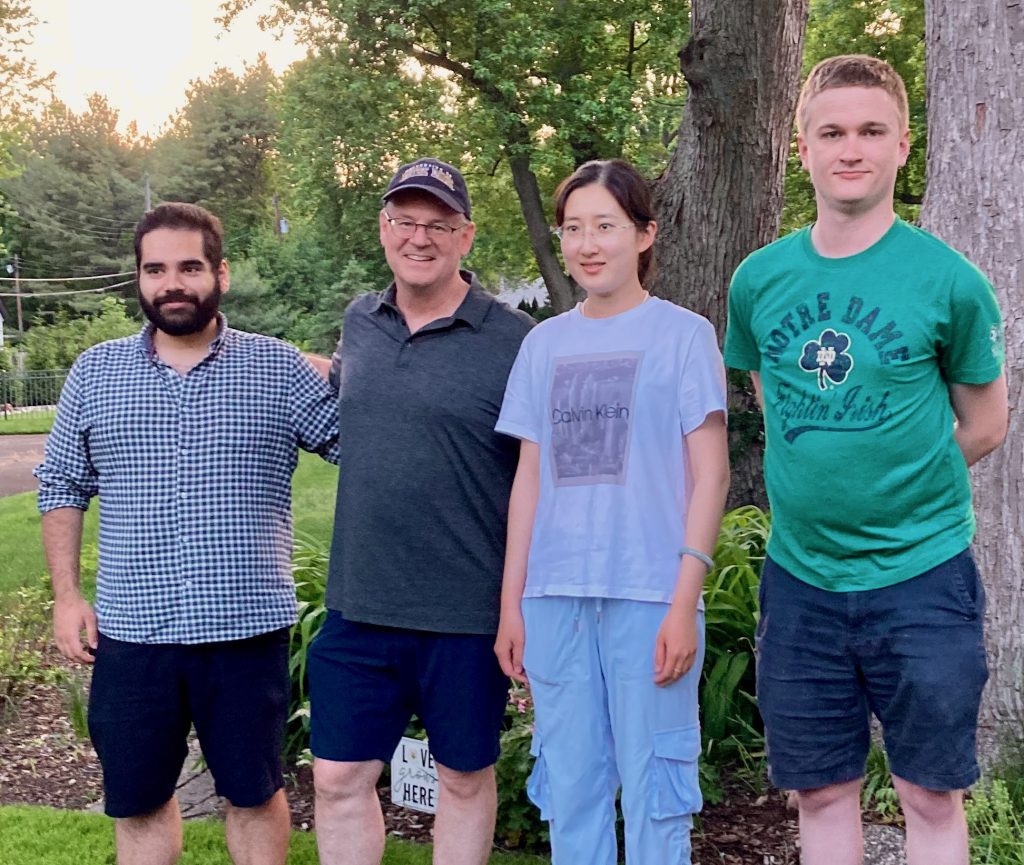
Several participants in our NSF ERC planning grant for Project EARTH shared lunch during the ACS GC&E meeting.

Ning Wang, Ryan Smith, and Ed Maginn traveled to Reston, VA in June to present at the ACS Green Chemistry and Engineering Conference. We presented in a special symposium dedicated to various aspects of refrigeration and cooling technologies. Many members of our team planning for an NSF ERC project gathered to work on the proposal. The photo above shows some of us at lunch during a break in the meeting.

Two new PhD graduates!

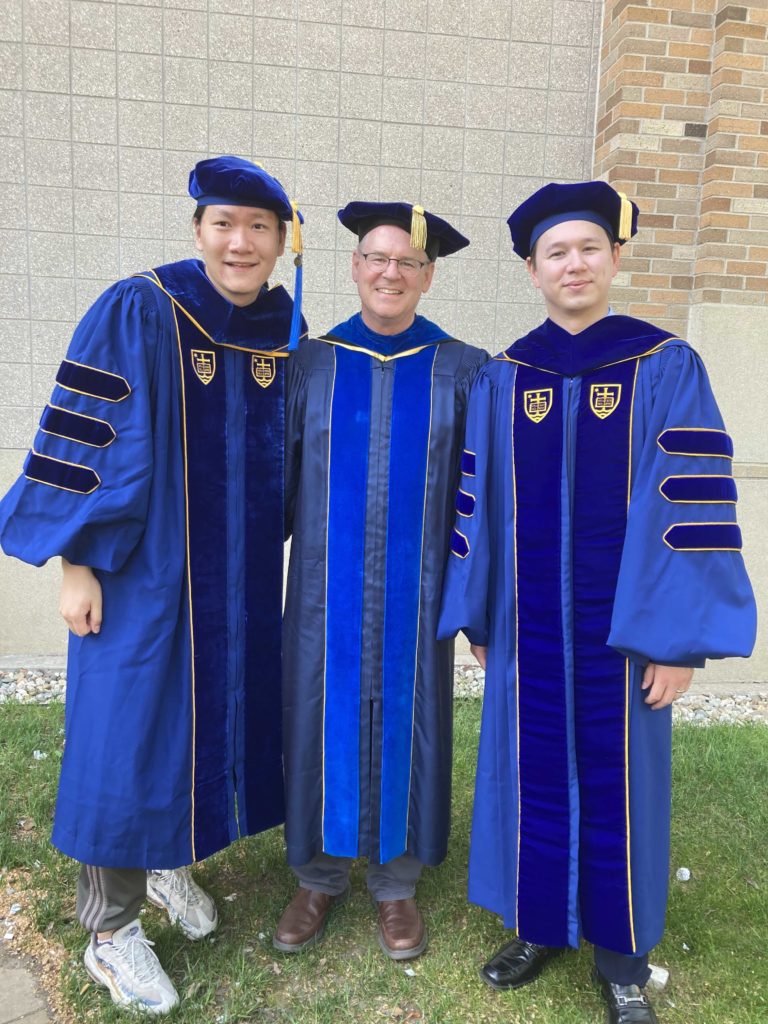
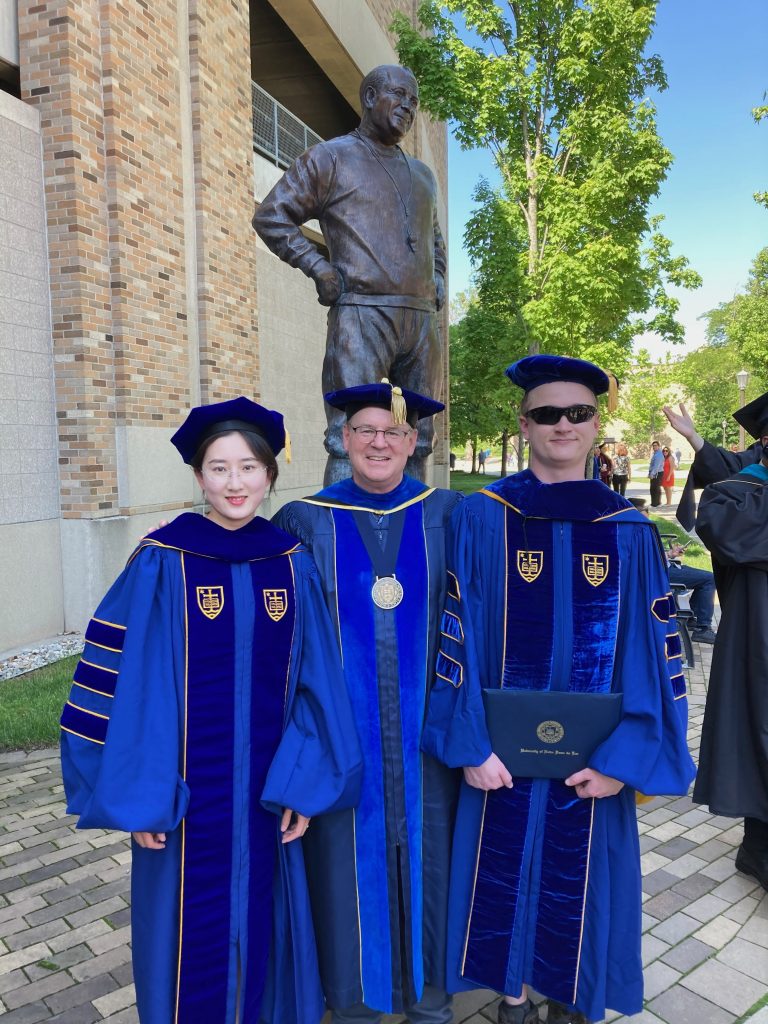
The two latest PhD graduates of the group officially received their degrees. Congratulations to Dr. Haimeng Wang and Dr. Derrick Poe!

Haimeng Wang, Ed Maginn, and Derrick Poe at Notre Dame Commencement, May 14, 2022

Dinis has his first group paper published in Chem. Comm.

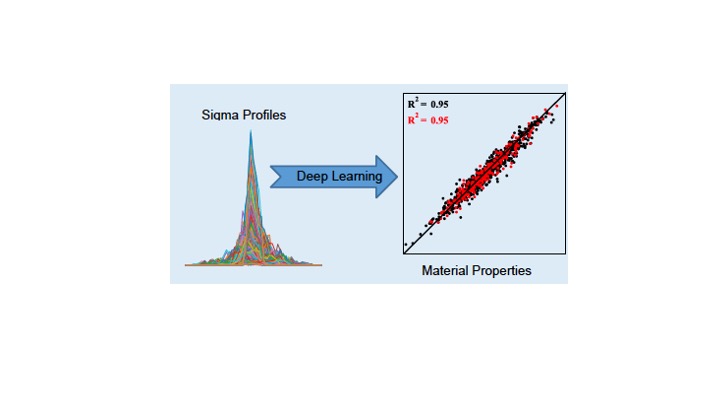
Dinis Abranches published his first paper in our group in Chemical Communications. The paper shows how sigma profiles can be used as a powerful and general molecular descriptor in deep learning. The sigma profiles of 1432 compounds are used to train convolutional neural networks that accurately correlate and predict a wide range of physicochemical properties. The architectures developed are then exploited to include temperature as an additional feature. The work is a joint effort between our group and Prof. Colón’s. Congratulations Dinis!

Derrick defends his PhD thesis!

Derrick Poe successfully defended his PhD thesis entitled “Modeling Deep Eutectic Solvents: Linking Macroscopic Behavior and Molecular Level Features”. He will be leaving soon to take a postdoc position at Argonne National Lab. Congratulations, Derrick!

Opening the traditional bottle of bubbly proved to be difficult.