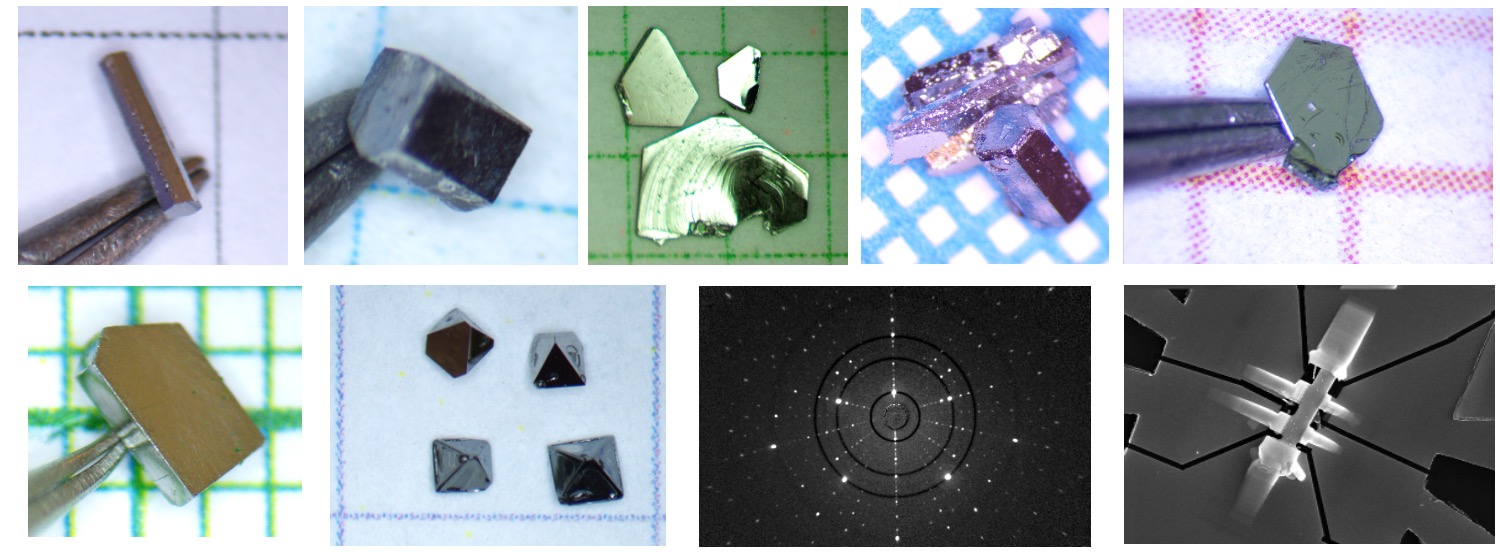
Most modern computers and microelectronics rely on silicon semiconductors, which utilize the electron’s charge to store, transmit, and process information. While silicon has driven technological advancements for decades, leveraging the electron’s intrinsic spin in addition to its charge offers potential for creating thinner, faster, and more energy-efficient devices. Our research group focuses on materials synthesis as a key approach to discovering and investigating new quantum materials, with the goal of understanding their fundamental physics to identify materials that could power the next generation of technology beyond silicon. The current materials of interest include:
Kagome Magnets

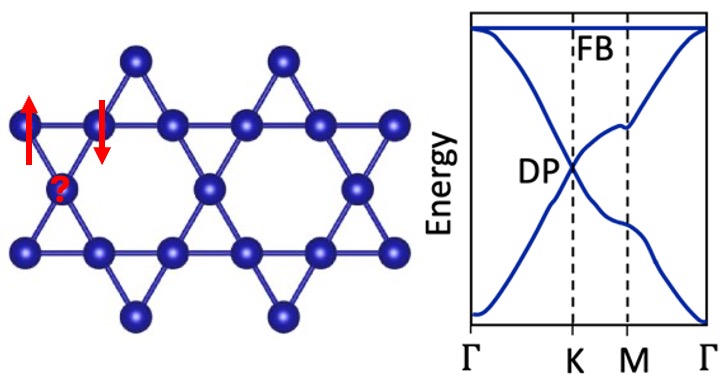
Kagome materials are of great interest both in terms of magnetism as well as electronic band structure. In the late 1980s it was realized, building on earlier work, that the antiferromagnetic kagome lattice may be the most frustrated two-dimensional (2D) magnetic system that one can construct. In fact, it was thought that it may never order at any temperature, and it was later realized that this is not just a disordered paramagnet, but a new state called a spin liquid. For a long time, it was this potential for hosting a quantum spin liquid that drove interest in the kagome lattice. However, more recently it was noted that the kagome lattice may be a host to both topologically protected bands as well as non-dispersing or flat bands in its electronic band structure. Thus, kagome lattice magnets provide a fertile ground to look for new properties emerging from the interplay of the complex magnetic structure and the electronic band features within a single material.
Recent Publications
- Crystal Growth and Physical Properties of Orthorhombic Kagome Lattice Magnets RFe6Ge6 (R=Y, Tb, Dy). Preprint arXiv:2511.17398
- Anisotropy, frustration and saddle point in the twisted kagome compound ErPdPb. Phys. Rev. Mater.10, 065001 (2026)
- Uncovering the Timescales of Spin Reorientation in TbMn6Sn6. Physical Review B 114, 074439 (2026).
- High-frequency electron spin resonance in Kagome-lattice YMn6Sn6. J. Phys.: Condens. Matter 38, 095801 (2026).
- Doping-induced Spin Reorientation in Kagome Magnet TmMn6Sn6. Physical Review Materials 9, 114414 (2025). Preprint: arXiv:2505.02936
- Three-dimensional nature of anomalous Hall conductivity in YMn6Sn6-xGax, x~ 0.55. npj Quantum Materials, 10, 99 (2025)
- Tunable topological transitions in the frustrated magnet HoAgGe. Communications Materials 6, 52 (2025).
- Geometrical Nernst effect in the kagome magnet YMn6Sn4Ge2. Physical Review B 110, 195125 (2024).
- Origin of spin reorientation and intrinsic anomalous Hall effect in the kagome ferrimagnet TbMn6Sn6. Physical Review B 110, 115134 (2024).
- Magnetism and fermiology of kagome magnet YMn6Sn4Ge2. npj Quantum Materials 9, 6 (2024).
- Orbital character of the spin-reorientation transition in TbMn6Sn6. Nature Communications 14, 2658 (2023).
- Magnetization-driven Lifshitz phase transition and charge-spin coupling in the kagome metal YMn6Sn6. Communications Physics, 5 58 (2022).
- Isotropic Nature of the Metallic Kagome Ferromagnet Fe3Sn2 at High Temperatures. Crystals, 11, 307 (2021).
- Chiral properties of the zero-field spiral state and field-induced magnetic phases of the itinerant kagome metal YMn6Sn6. Physical Review B, 103, 094413 (2021).
- Competing magnetic phases and fluctuation-driven scalar spin chirality in the kagome metal YMn6Sn6. Science Advances 6, eabe2680 (2020).
Altermagnets
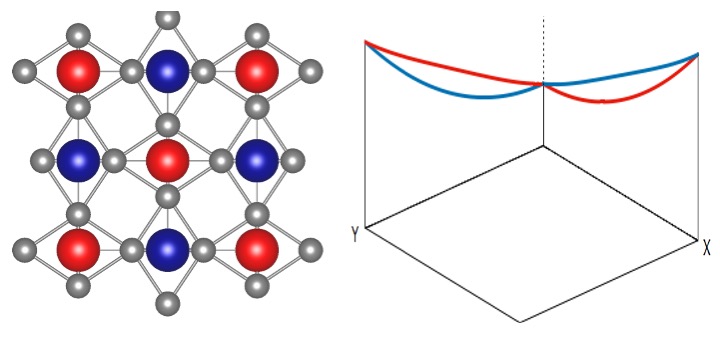
An altermagnet is a recently discovered fundamental class of collinear magnetic order with zero net magnetization but with unconventional spin-polarized band structure. This new magnetic phase class combines the favorable spintronics properties of ferromagnets and antiferromagnets while also having unique properties of its own, originating from local sublattice anisotropies in direct space connected by spin symmetries. Altermagnets, via their novel functionalities may provide the long anticipated viable path towards THz tunneling magnetoresistance technology (THz-TMR), leading to a thousandfold increase in efficiency over the present ferromagnetic based devices.
Recent Publications
- Coherent Magnons Driven by Photomodulated Anisotropy in Altermagnetic MnTe. Preprint: arXiv:2607.18421v1
- Raman spectroscopy of the van der Waals altermagnet Co1/4NbSe2. Preprint: arXiv.2607.05616
- Orbital Selective Dirac-like States in EuAgAs Revealed by Polarization Dependent ARPES and DFT. Preprint: arXiv:2605.23836
- Near-degenerate competing magnetic orders in EuAgAs: A tunable route to altermagnetism. Preprint: arXiv:2605.16242
- Strain continuously rotates the Néel vector in altermagnetic MnTe . Preprint: arXiv:2604.07653
- Conductivity scaling of the anomalous Hall effect in the altermagnetic semiconductor α-MnTe. Preprint: arXiv:2603.00242
-
Electronic structure of a layered altermagnetic compound CoNb4Se8. Preprint: Nature Communications (2026).
- Chiral Altermagnon in MnTe. Preprint: arXiv:2501.17380
- Non-relativistic spin splitting above and below the Fermi level in a g-wave altermagnet. Preprint: arXiv:2411.1876
- Observation of altermagnetic spin splitting in an intercalated transition metal dichalcogenide. Preprint: arXiv:2508.12985
- Local probe evidence supporting altermagnetism in Co1/4NbSe2. Phys. Rev. Res.8, 023361 (2026).
- Altermagnetism in the layered intercalated transition metal dichalcogenide CoNb4Se8. Nature Communications, 16, 4399 (2025)
Topological magnetic textures
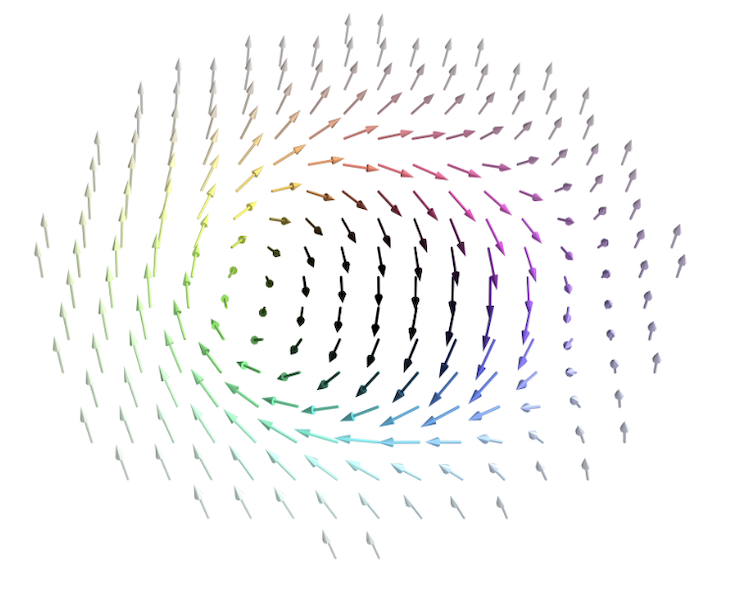
Topological magnetic textures like skyrmions have attracted significant interest for their potential use in spintronic devices. Beyond that, they also offer exciting opportunities to explore new physical phenomena when combined with other properties, such as topological electronic bands (like Dirac or Weyl crossings) or superconductivity. Traditionally, skyrmions are stabilized by Dzyaloshinskii-Moriya interactions in materials that lack a center of symmetry. However, recent discoveries have shown that skyrmions can also form in materials with symmetric crystal structures, greatly expanding the range of possible host materials. Despite this progress, deliberately designing skyrmions remains difficult. Our research focuses on finding ways to reliably create skyrmionic magnetic textures, with the goal of eventually coupling them to topological bands and superconductivity.
Recent Publications:
-
Domain wall induced topological Hall effect in the chiral-lattice ferromagnet FexTaS2. Preprint:arXiv:2510.20181
- Skyrmion Bubbles by Design in a Centrosymmetric Kagome Magnet. Preprint: arXiv:2504.19045
- Topological magneto-optics in the non-coplanar antiferromagnet Co1/3NbS2: Imaging and writing chiral magnetic domains. Physical Review Letters, 135, 196702 (2025). Editor’s Highlight.
Topological Superconductors
Two and Quasi-Two Dimensional Magnets
Research Tools
Materials synthesis include polycrystalline sample growth by solid state reaction, and arc melting. Single crystal growth includes molten-metal flux, chemical vapor transport and Bridgman techniques. Characterization of materials include x-ray powder diffraction, x-ray single crystal diffraction, energy dispersive x-ray spectroscopy (EDS), and x-ray Laue diffraction. Magnetic property measurement are done using Quantum Design MPMS III. Transport and thermal property measurements are done using Quantum Design Dynacool PPMS. We use Lorentz TEM, and perform neutron powder diffraction and small angle neutron scattering to investigate magnetic structures. We also extensively collaborate with neutron scattering and DFT groups.
Recent Projects
Anisotropy, frustration and saddle point in the twisted Kagome antiferromagnet ErPdPb.
Phys. Rev. Mater. 10, 065001 (2026)
Preprint: arXiv:2602.08900

The kagome lattice, with its inherent geometric frustration, provides a rich platform for exploring intriguing magnetic phenomena and topological electronic structures. In reduced-symmetry structures, such as twisted kagome systems involving rare earth elements, additional anisotropy can arise, enabling intriguing properties including spin-ice states, magnetocaloric effects, noncollinear magnetic ordering, and the anomalous Hall effect. Here, we report the synthesis of single crystals of ErPdPb, which features a twisted kagome lattice net of Er atoms within the hexagonal ZrNiAl-type structure, and we investigate its magnetic, electronic, and thermal properties. The material exhibits a highly anisotropic, correlated magnetic state below 2.7 K, as evidenced by magnetic, transport, and heat capacity measurements. Density functional theory (DFT) calculations indicate strong easyaxis anisotropy, consistent with experiment and crystal-field expectations, as well as quasi-one-dimensional bands and a spin-split saddle point at the zone center. The coexistence of competing magnetic interactions along different crystallographic directions suggests an inherent degree of frustration. ErPdPb thus provides a promising platform for exploring the interplay of frustration, anisotropy, and electronic structure in a twisted kagome lattice..
Crystal Growth and Physical Properties of Orthorhombic Kagome Lattice Magnets RFe6Ge6 (R=Y, Tb, Dy)
Preprint: arXiv:2511.17398

Kagome magnets represent a promising class of materials that exhibit intriguing electronic and magnetic properties, and they have recently garnered significant attention. While most kagome-lattice compounds are hexagonal, we report here single-crystal growth and physical property measurements of RFe6Ge6 (R = Y, Dy, Tb) compounds, which crystallize in an orthorhombic structure. The structure can be derived from a hexagonal prototype RFe3Ge2 by replacing every other R atom with a covalent Ge2 dimer. Ordering of these dimers renders the structure orthorhombic, slightly distorts the kagome net, and makes the three Fe sites formally inequivalent. The iron and rare-earth sublattices order independently. Fe moments order above 400 K, forming ferromagnetic kagome planes stacked antiferromagnetically, while rare-earth moments order below 9 K. TbFe6Ge6 exhibits a single magnetic ordering transition associated with the Tb atoms, whereas DyFe6Ge6 shows two distinct magnetic phase transitions, strongly influenced by crystal electric field effects on the Dy3+ ions. Density functional theory (DFT) calculations indicate that the ferromagnetic ordering of the Fe planes is driven by a high density of states at the Fermi energy. They also reveal three dramatically different structural energy scales: R and Ge2 form alternating 1D chains perpendicular to the kagome planes, and violating this alternation incurs a large energy cost. Aligning these chains is less costly, and achieving a two-dimensional order of anti-aligned chains requires very little energy. These compounds represent a unique class of materials, offering new opportunities to investigate the interplay between the distinct crystal lattice geometry and the underlying electronic and magnetic properties.
Domain wall induced topological Hall effect in the chiral-lattice ferromagnet FexTaS2
Preprint: arXiv:2510.20181

Magnetic topology and its associated emergent phenomena are central to realizing intriguing quantum states and spintronics functionalities. Designing spin textures to achieve strong and distinct electrical responses remains a significant challenge. Layered transition metal dichalcogenides offer a versatile platform for tailoring structural and magnetic properties, enabling access to a wide spectrum of topological magnetic states. Here, we report a domain-wall-driven, large, and tunable topological Hall effect (THE) in a non-centrosymmetric intercalated transition metal dichalcogenides series FexTaS2. By systematically varying the Fe intercalation level, we exert precise control over the magnetic ground states, allowing manipulation of the topological Hall effect. Real-space magnetic force microscopy (MFM) provides direct evidence of periodic magnetic stripe domain formation, confirming the microscopic origin of the observed topological transport phenomena. Our findings establish a promising way for tuning the topology of domains to generate substantial electromagnetic responses in layered magnetic materials.
Skyrmion Bubbles by Design in a Centrosymmetric Kagome Magnet
Preprint: arXiv:2504.19045
 Topologically protected nanoscale spin textures, such as magnetic skyrmions, have attracted significant interest for spintronics applications. While skyrmions in noncentrosymmetric materials are known to be stabilized by Dzyaloshinskii−Moriya interaction (DMI), their deliberate design in centrosymmetric materials remains a challenge. This difficulty largely stems from the complexity of controlling magnetocrystalline anisotropy − a critical factor in the absence of DMI. Here, we demonstrate the chemical tuning of magnetocrystalline anisotropy in the centrosymmetric Kagome magnet TmMn6Sn6. The resulting compound exhibits a spin reorientation transition accompanied by an emergent skyrmion bubble lattice, confirmed by Lorentz transmission electron microscopy. Our findings overcome a key materials design challenge and open possibilities for deliberate design of skyrmionic textures in centrosymmetric systems.

LTEM imaging reveals that the skyrmion bubbles can spontaneously flip between two opposite helicities while preserving their overall structure. In centrosymmetric compounds, this behavior is especially important because, unlike in chiral magnets where the Dzyaloshinskii–Moriya interaction fixes the helicity, the two helicity states can remain nearly degenerate in energy. This gives skyrmion bubbles an additional internal degree of freedom that may be useful for future technologies. In particular, the ability to access two opposite helicity states raises the exciting possibility of using them as a two-state platform for skyrmion-based qubits. In the present case, however, the flipping appears to occur spontaneously rather than in a controlled way, so an important next step will be to learn how to switch the helicity deterministically using an external stimulus.
Doping-induced Spin Reorientation in Kagome Magnet TmMn6Sn6
Phys. Rev. Materials 9, 114414 (2025)

The kagome-lattice compounds RMn6Sn6 (R is a rare earth element), where the Mn atoms form a kagome net in the basal plane, are currently attracting a great deal of attention as they have been shown to host complex magnetic textures and electronic topological states strongly sensitive to the choice of the R atom. Among the magnetic R atoms, TmMn6Sn6 orders with the easy-plane magnetization forming a complex magnetic spiral along the c-axis. Previous neutron studies, carried on polycrystalline, samples found that Ga doping changes the magnetic anisotropy from easy-plane to easy-axis. Here we present magnetic and magnetotransport measurements on a single crystal and first principles calculations in the doping series of TmMn6Sn6-xGax. We find that the magnetic properties are highly sensitive even to a small concentration of Ga. With minimal Ga substitution, the easy-plane anisotropy is maintained, which gradually changes to the easy-axis anisotropy with increasing Ga. We discuss these observations with respect to the effect of Ga doping on magnetocrystalline anisotropy and Tm crystal field
Three-dimensional nature of anomalous Hall conductivity in YMn6Sn6−xGax, x ≈ 0.55
npj Quantum Materials 10, 99 (2025)
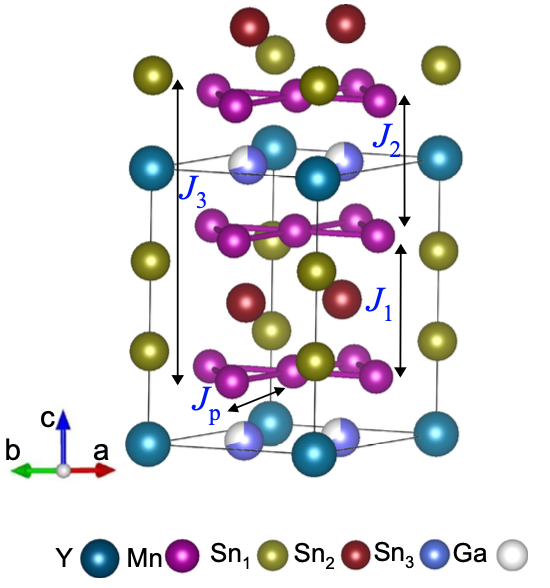
The unique geometry of kagome lattices leads to topological features such as flat bands and Dirac cones. When paired with ferromagnetism and a Fermi level near Dirac points, they offer a platform for realizing topological Chern magnetotransport. This prospect recently drew interest in the ferrimagnetic kagome metal TbMn6Sn6. However, density functional theory (DFT) calculations indicate that its 2D Chern gap lies well above the Fermi energy, raising questions about its role in anomalous Hall conductivity. Here, we study YMn6Sn5.45Ga0.55, a structurally and electronically similar material, and find that its intrinsic anomalous Hall effect is three-dimensional. This demonstrates that the Hall response in such compounds does not originate from 2D Chern gaps. Additionally, we confirm that the newly proposed empirical scaling relation for extrinsic Hall conductivity is universally governed by spin fluctuations.
Altermagnetism in the layered intercalated transition metal dichalcogenide CoNb4Se8
Nature Communications, 16, 4399 (2025)
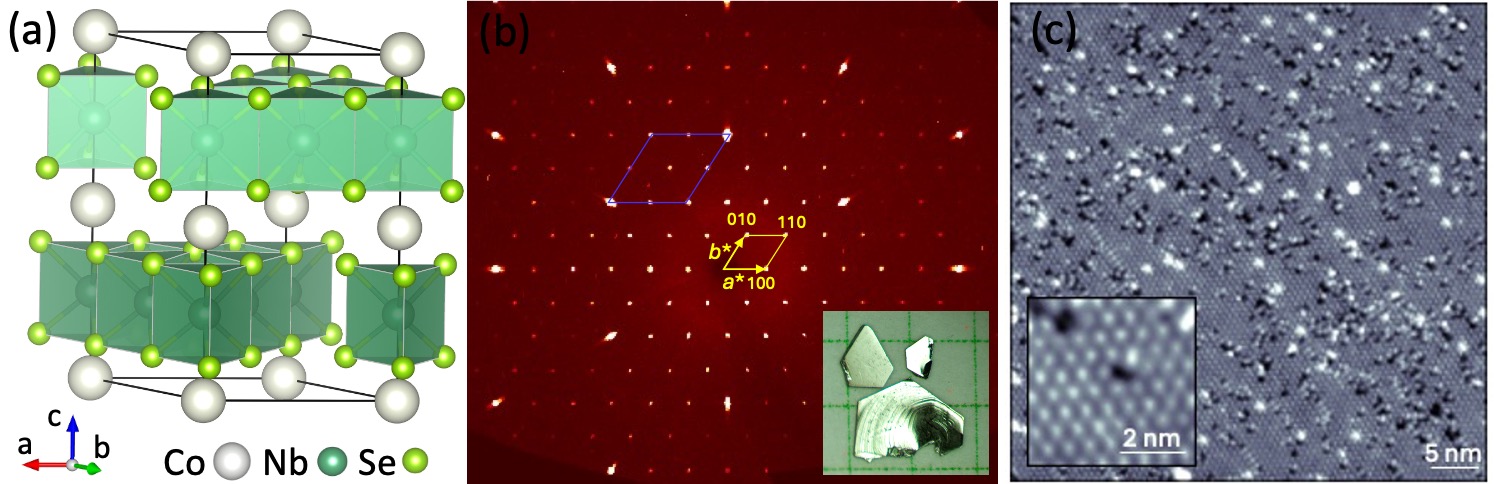
Altermagnets (AMs) are a new class of magnetic materials that combine the beneficial spintronics properties of ferromagnets and antiferromagnets, garnering significant attention recently. Here, we have identified altermagnetism in a layered intercalated transition metal diselenide, CoNb4Se8, which crystallizes with an ordered sublattice of intercalated Co atoms between NbSe2 layers. Single crystals are synthesized, and the structural characterizations are performed using single crystal diffraction and scanning tunneling microscopy. Magnetic measurements reveal easy-axis antiferromagnetism below 168 K. Density functional theory (DFT) calculations indicate that A-type antiferromagnetic ordering with easy-axis spin direction is the ground state, which is verified through single crystal neutron diffraction experiments. Electronic band structure calculations in this magnetic state display spin-split bands, confirming altermagnetism in this compound. The layered structure of CoNb4Se8 presents a promising platform for testing various predicted properties associated with altermagnetism.
Tunable topological transitions in the frustrated magnet HoAgGe
Communications Materials 6, 52 (2025)

The kagome lattice, known for its strong frustration in two dimensions, hosts a variety of exotic magnetic and electronic states. A variation of this geometry, where the triangular motifs are twisted to further reduce symmetry, has recently revealed even more complex physics. HoAgGe exemplifies such a structure, with magnetic and electronic properties believed to be driven by strong in-plane anisotropy of the Ho spins, effectively acting as a two-dimensional spin ice. In this study, using a combination of magnetization, Hall conductivity measurements, and density functional theory calculations, we demonstrate how various spin-ice states, stabilized by external magnetic fields, influence the Fermi surface topology. More interestingly, we observe sharp transitions in Hall conductivity without concurrent changes in magnetization when an external magnetic field is applied along a particular crystallographic direction, underscoring the role of strong magnetic frustration and providing a new platform for exploring the interplay between magnetic frustration, electronic topology, and crystalline symmetry. These results also highlight the limitations of a simple spin-ice model, suggesting that a more sophisticated framework is necessary to capture the subtle experimental nuances observed.
Magnetism and Fermiology of Kagome Magnet YMn6Sn4Ge2
npj Quantum Materials 9, 6 (2024)
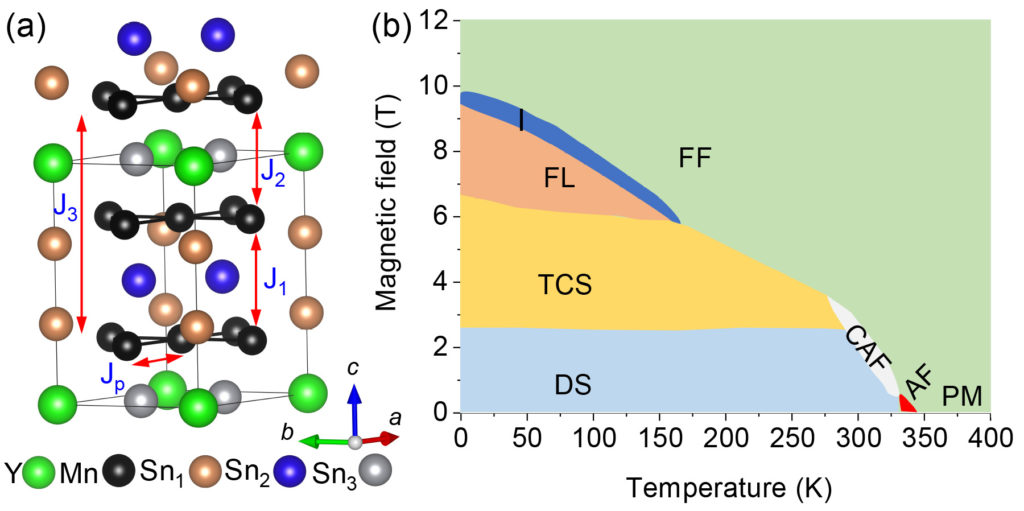
Kagome lattice magnets are an interesting class of materials as they can host topological properties in their magnetic and electronic structures. YMn6Sn6 is one such compound in which a series of competing magnetic phases is stabilized by an applied magnetic field, and both an enigmatic topological Hall effect and a Dirac crossing close to the Fermi energy have been realized. This material also shows a magnetization-induced Lifshitz transition and evidence of a unique charge spin coupling in one of the magnetic phases, namely the fan-like phase. Tuning the magnetism, and thus the interplay with the electronic states, opens new avenues for precise control of these novel properties. Here, we demonstrate the extreme sensitivity of the magnetic phases in YMn6Sn4Ge2 through the investigation of structural, magnetic, and transport properties. The high sensitivity to small doping provides great potential for engineering the magnetic phases and associated electronic properties in this family of rare-earth kagome magnets.
Origin of spin reorientation and intrinsic anomalous Hall effect in the kagome ferrimagnet TbMn6Sn6.
Physical Review B 110, 115134 (2024)
Preprint: arXiv:2203.17246
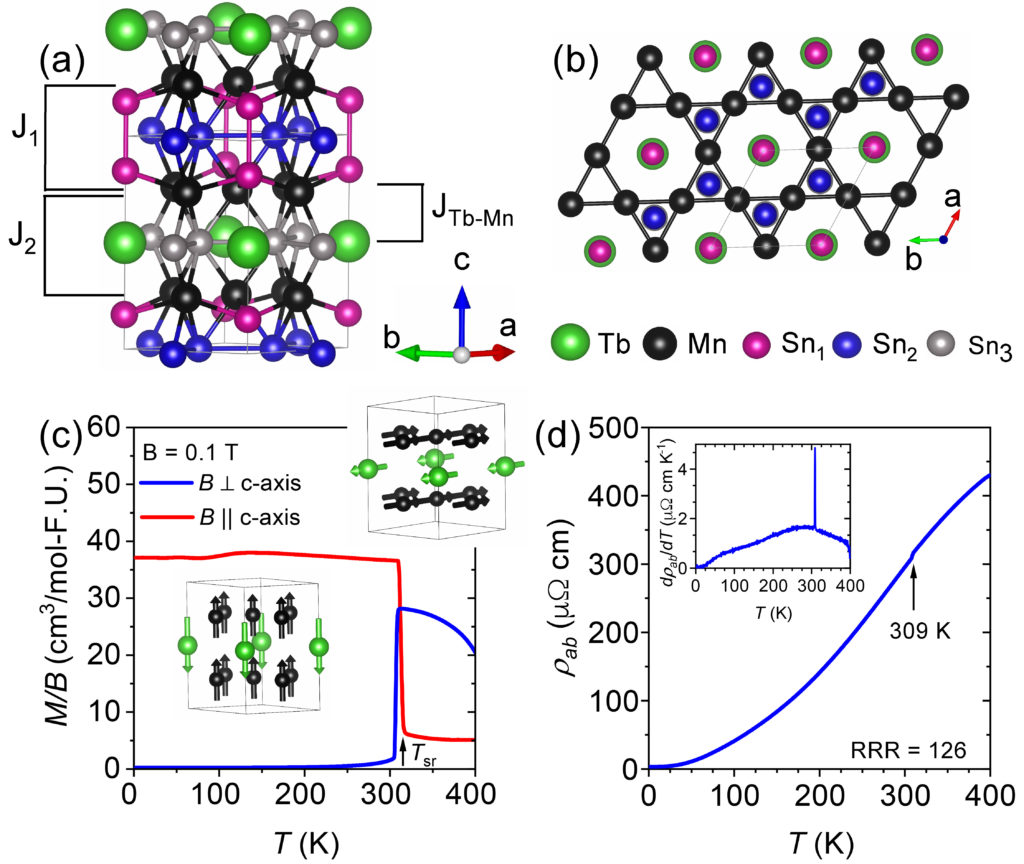
TbMn6Sn6 has attracted a lot of recent interest for a variety of reasons, most importantly, because of the hypothesis that it may support quantum-limit Chern topological magnetism, derived from the kagome geometry. Besides, TbMn6Sn6 features a highly unusual magnetic reorientation transition about 100 K below the Curie point, whereby all spins in the system, remaining collinear, rotate by 90∘. In this work, we address both issues combining experiment, mean-field theory and first-principle calculations. Both magnetic reorientation and the unusual temperature dependence of the anomalous Hall conductivity (AHC) find quantitative explanation in the fact that Mn and Tb, by virtue of the Mermin-Wagner theorem, have very different spin dynamics, with Tb spins experiencing much more rapid fluctuation. We were able to cleanly extract the intrinsic AHC from our experiment, and calculated the same microscopically, with good semiquantitative agreement. We have identified the points in the band structure responsible for the AHC and showed that they are not the kagome-derived Dirac points at the K-corner of the Brillouin zone, as conjectured previously.
CoTe2: A quantum critical Dirac metal with strong spin fluctuations
Advanced Materials 2300640 (2023) (open access)
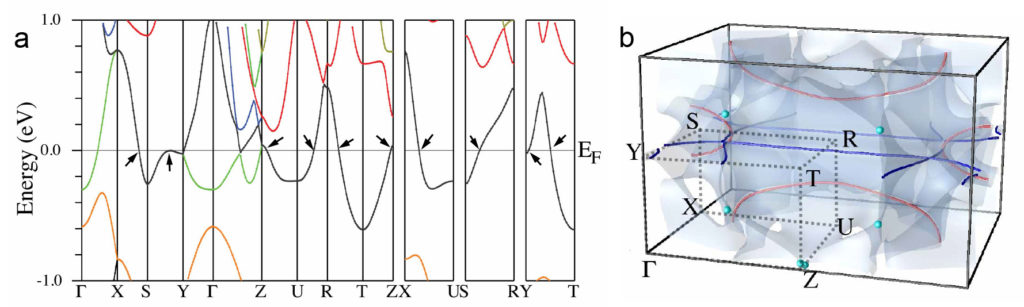
Quantum critical points separating weak ferromagnetic and paramagnetic phases trigger many novel phenomena. Dynamical spin fluctuations not only suppress the long-range order, but can also lead to unusual transport and even superconductivity. Combining quantum criticality with topological electronic properties presents a rare and unique opportunity. Here, by means of ab initio calculations and magnetic, thermal, and transport measurements, it is shown that the orthorhombic CoTe2 is close to ferromagnetism, which appears suppressed by spin fluctuations. Calculations and transport measurements reveal nodal Dirac lines, making it a rare combination of proximity to quantum criticality and Dirac topology.
Magnetization-driven Lifshitz phase transition and charge-spin coupling in the kagome metal YMn6Sn6
Communications Physics 5, 58 (2022)
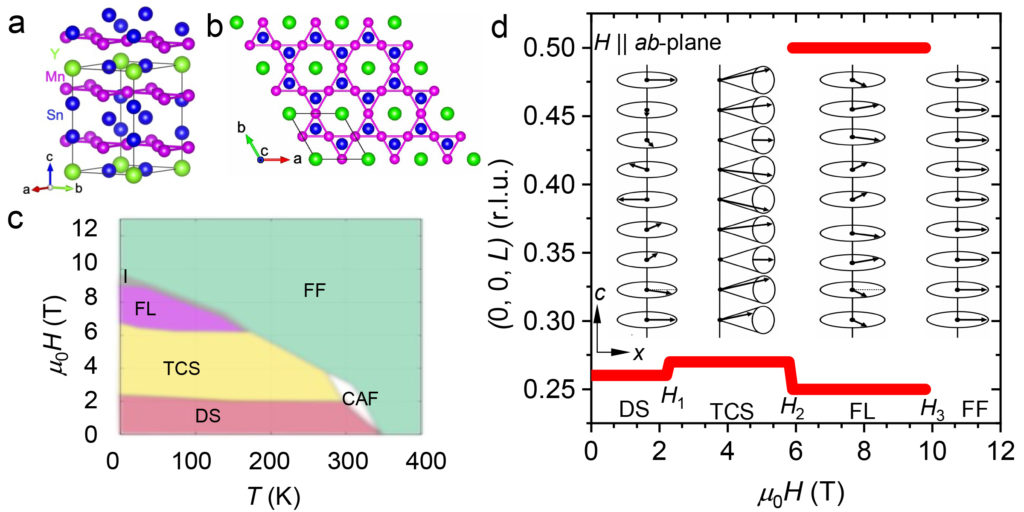
The Fermi surface (FS) is essential for understanding the properties of metals. It can change under both conventional symmetry-breaking phase transitions and Lifshitz transitions (LTs), where the FS, but not the crystal symmetry, changes abruptly. Magnetic phase transitions involving uniformly rotating spin textures are conventional in nature, requiring strong spinorbit coupling (SOC) to influence the FS topology and generate measurable properties. LTs driven by a continuously varying magnetization are rarely discussed. Here we present two such manifestations in the magnetotransport of the kagome magnet YMn6Sn6: one caused by changes in the magnetic structure and another by a magnetization-driven LT. The former yields a 10% magnetoresistance enhancement without a strong SOC, while the latter a 45% reduction in the resistivity. These phenomena offer a unique view into the interplay of magnetism and electronic topology, and for understanding the rare-earth counterparts, such as TbMn6Sn6, recently shown to harbor correlated topological physics.
Chiral properties of the zero-field spiral state and field-induced magnetic phases of the itinerant kagome metal YMn6Sn6
Physical Review B, 103, 094413 (2021)
Preprint: arXiv:2012.13010
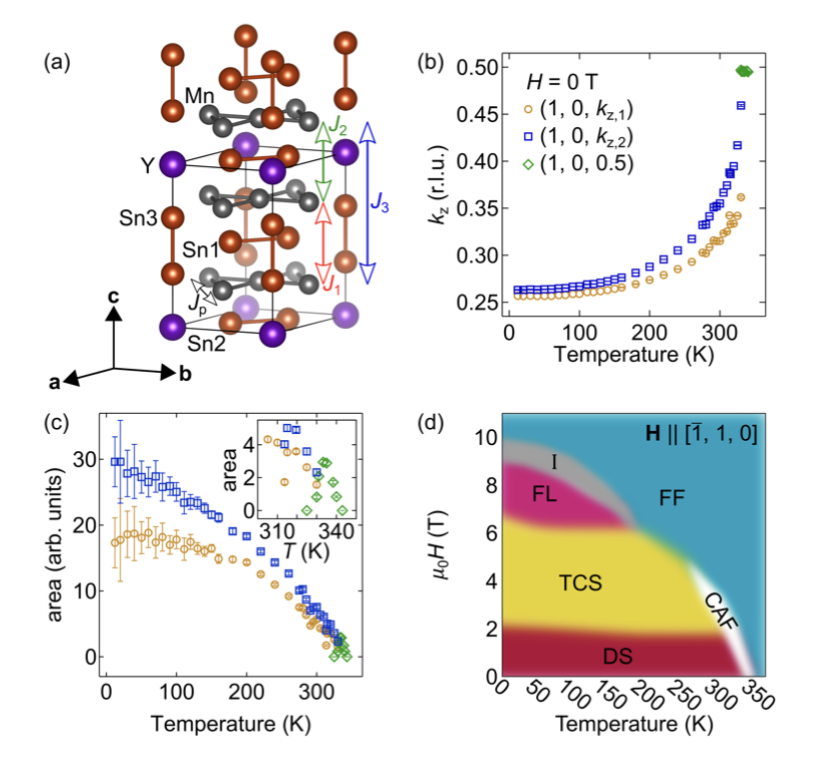
Applying a magnetic field in the hexagonal plane of YMn6Sn6 leads to a complex magnetic phase diagram of commensurate and incommensurate phases, one of which coexists with the topological Hall effect (THE) generated by a unique fluctuation-driven mechanism. Using unpolarized neutron diffraction, we report on the solved magnetic structure for two previously identified, but unknown, commensurate phases. These include a low-temperature, high-field fan-like phase and a room- temperature, low-field canted antiferromagnetic phase. An intermediate incommensurate phase between the fan-like and forced ferromagnetic phases is also identified as the last known phase of the in-plane field-temperature diagram. Additional characterization using synchrotron powder diffraction reveals extremely high-quality, single-phase crystals, which suggests that the presence of two incommensurate magnetic structures throughout much of the phase diagram is an intrinsic property of the system. Interestingly, polarized neutron diffraction shows that the centrosymmetric system hosts preferential chirality in the zero-field double-flat-spiral phase, which, along with the THE, is a topologically non-trivial characteristic.
Competing magnetic phases and fluctuation-driven scalar spin chirality in the kagome metal YMn6Sn6
Science Advances 6, eabe2680 (2020)
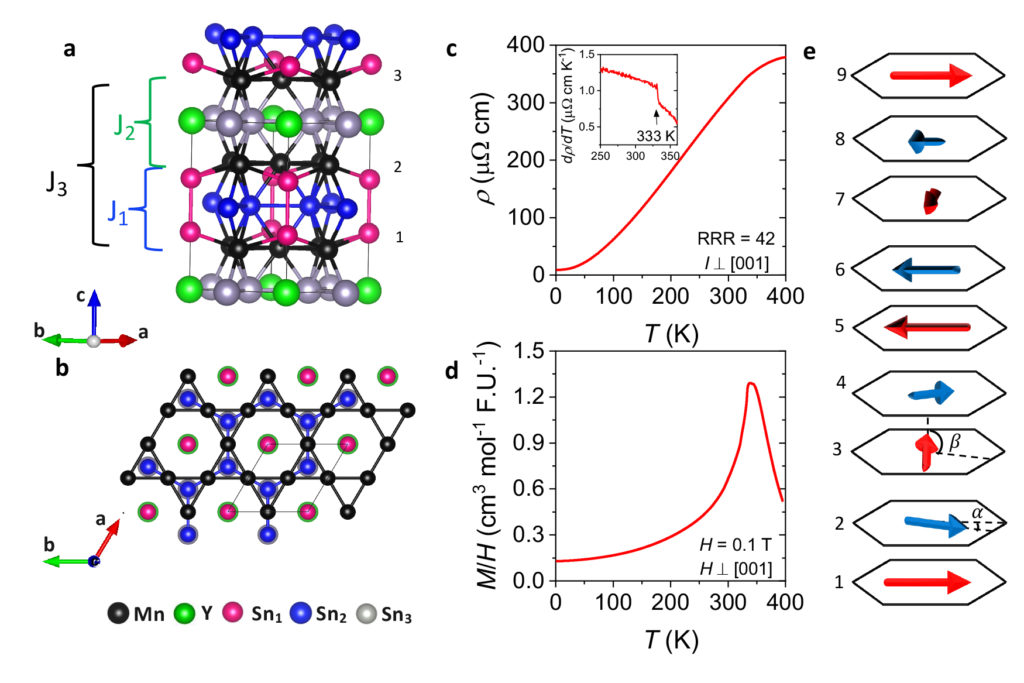
Identification, understanding, and manipulation of novel magnetic textures are essential for the discovery of new quantum materials for future spin-based electronic devices. In particular, materials that manifest a large response to external stimuli such as a magnetic field are subject to intense investigation. Here, we study the kagome-net magnet YMn6Sn6 by magnetometry, transport, and neutron diffraction measurements combined with first-principles calculations. We identify a number of nontrivial magnetic phases, explain their microscopic nature, and demonstrate that one of them hosts a large topological Hall effect (THE). We propose a previously unidentified fluctuation-driven mechanism, which leads to the THE at elevated temperatures. This interesting physics comes from parametrically frustrated interplanar exchange interactions that trigger strong magnetic fluctuations. Our results pave a path to chiral spin textures, promising for novel spintronics.