“Hamlet” Fall Tour — Week 4

by Grace Andrews

Week 4, and we propel into a new pace. We face the London Associates showing on Friday, and as this deadline looms we grasp the opportunity to tell this story with a feverish energy. The pressure of welcoming people into our space and embracing fresh eyes is daunting, as we have found a dynamic I feel protective of. We are direct, we challenge and provoke each other daily, all with nurture, support and championing our individuality at the forefront. Our occasional dysfunction often results in the most interesting discoveries. We push on.

Ophelia constantly throws up fresh challenges for me, and with the help of my fellow actors I continue to find new and surprising colours in her text. On first reading the part, I felt a confidence and affinity with her character, the words she chooses and her rhythm of speech. The clarity of her thoughts sung out, and I knew I could attempt to tell her story with truth – and enable her journey to support and fuel this play. I knew I could learn to tell her story with raw and fierce positivity.
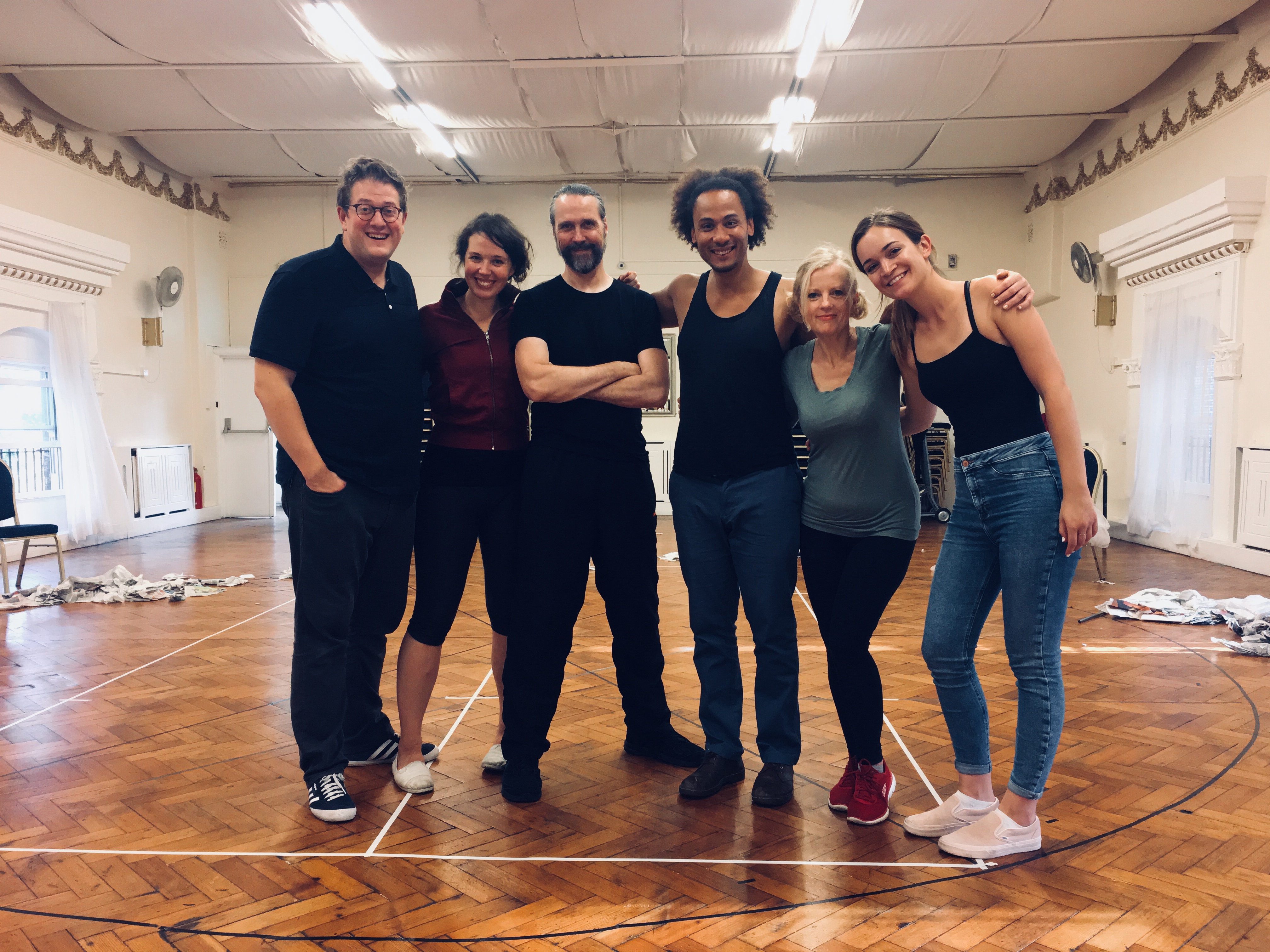
From L to R: Ben Eagle, Madeleine Hyland, fight director Philip d’Orléans, Peter Bray, Wendy Morgan, Grace Andrews.

But as the weeks have gone on, I feel I have lost some of that clarity to self-doubt, and I now feel a little at sea. Am I being too generalised? Painting her with too broad a brush? Will it ever be enough? Part of the magic of this process is the freedom of no director, but that is also a huge challenge as we lack an outside eye who can validate or critique our choices, and who rationally and objectively can keep a sense of the arc of the play. We are required to work alone, think big, and stand by our decisions – and at times it is hard to sustain the confidence to do so.

However, the brilliance of this company is that, more than ever, you are held up by the words. Shakespeare offers us everything we need, and the more trust that, and the more we mine this text the more beauty, pain and life we discover. Lines of verse you feel you have known your whole life suddenly jump out to arrest you with a searing honesty.

A particular challenge within my part is the doubling of playing both Ophelia and Laertes. As siblings, their relationship shares a tenderness and trust unlike any other in the play, and their direct and protective filial love is played out mainly through absence of each other in momentous life events; their father’s death, Ophelia’s heartbreak and loss of innocence, and Laertes’ violent revenge.
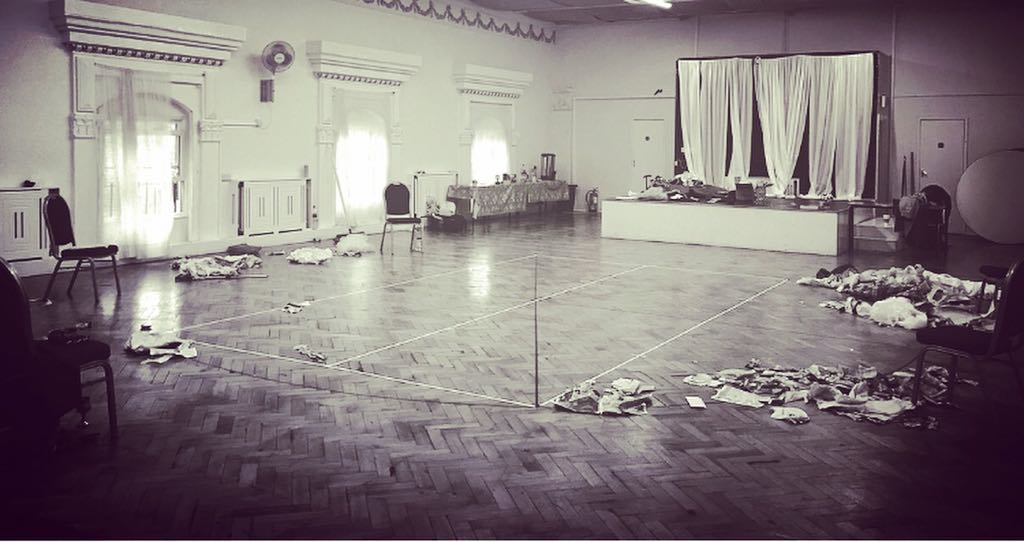
The rehearsal room.

On a rushed and frantic lunch break in Brixton, I came across some sheer and colour-less organza material, which looked and moved mysteriously like water. Something about it drew me in, and I bought a few meters, slightly amused at myself and thinking, ‘How on earth is this going to help?’ Back in the rehearsal room, as I was desperately folding it in different configurations in an attempt to resemble some kind of dress, we discovered a face forming. If you gathered the fabric in your fist, doubled it over and with a little twist and allowed her body to drape down to the floor, suddenly Laertes seemed holding Ophelia as a puppet. It is remarkable how quickly something comes alive if you endow it with breath and care. In small touches, mischievous exchanged looks, and a shared sense of play, I began to find their connection. The quality of the fabric offered me a softness and grace to match, both vocally and physically. It was moving to find her being passed between her brother and her father, who in a way see her less as a person with an identity, but as a shape they can master.

Whether we use it or not in the final production, by discovering this puppet, I feel like I have come closer to finding Ophelia’s spirit.
“Hamlet” Fall Tour — Week 3

By Grace Andrews

Week three has broken us into a new way of working, a fresh dynamic from which we are making bold new discoveries and mining deeper into this heady and huge expanse of text. The initial feeling of distance, the fear of not being able to reach the height of the words, or breadth of the ideas, begins to fade – and slowly we start to feel like we are closer to something real. With that growing sense of ownership, our appetite for the play now holds a confidence with a sense of focus – proven in the way we interact. We are more direct, more economic, and more passionate but perhaps less precious. We listen more. We systematically try things out, and equally throw things away.

One of the main challenges of this job is being able to operate on multiple levels. You play the part, you play the scene, you keep an outside eye on the space, you keep a sense of the arc of the story as a whole, and you think of set, you think of costume, multiple parts, appreciating and catering for the company and American audiences… the list goes on. There is a constant sense of zooming in and out, honing in and stepping back to keep the wheels turning over. Within this – the test is to remain in the moment, and never lose sight of the meaning and heart of the storytelling. As we work further into detail, our thoughts on design are contested with the question – what is important here? What do we want our audiences to experience? How much can we relinquish that control? The danger to prioritise style over substance can be tempting, but the harder choice is to ask ourselves, are we really telling this story?

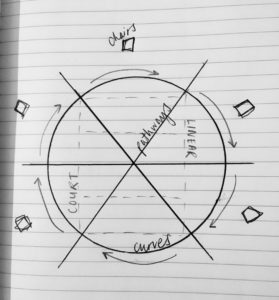
That said, we have had some major breakthroughs in terms of the space we create. Hecate is an Athenian goddess who represented as three-formed, associated with crossroads, entrance-ways, light, magic, and necromancy – used in Hamlet precisely in Act III, Scene II in the play within the play, ‘The Murder of Gonzago’. Her spirit is woven all throughout the writing, and subliminally creates strong impact with many references to ‘three’, and cyclical and swirling swings even within the verse line. She is known for her wheel, and we have marked out a wheel on the floor (left), which offers us a structure from which to play.

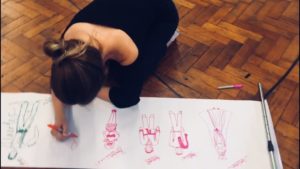
We work with a Complicité exercise, where we follow each other on a journey through the space and pause at the junctions marked, with suspension, and then move on together. The wheel gives us the freedom of curves, but a discipline of distance, and a chance to explore our relationships, and find specificity in the meaning of eye contact, breath, silhouettes and energies. We are forced to face up to the change each character creates in space. We draw our characters out on paper to explore and make tangible decisions (left).

Peter Bray offered a brilliant take on the world of the play this week that ignited a breakthrough in me. He said that the play was all about the death of intimacy in our closest relationships. In varying levels of intensity, each bond of any purity or worth is systematically, grievously, irrevocably and deeply destroyed – whether it be fierce young love, a mother to a son, a son to an uncle, a brother to a sister, a daughter to a father, a friend to a friend. The list is long, and the loss unites this story with a raw and feverish ache. I think about our wheel, and the spaces between us. The endless potential for love and loss between two humans in space. Shakespeare transcends time, cuts right to the heart, and cries out to be heard.

“Hamlet” Fall Tour — Week 2

By Grace Andrews

The second week of rehearsal often brings a sense of freedom, as you start to move past the initial tiptoeing and polite hesitation into a place of building momentum and trust. We begin to get used to our space and its eccentricities, as much as we get used to each other and our unique rhythms. We start to make bolder choices; and through learning how to empower each other to speak, how to rally together when something is tough, and how important it is to have a cup of tea (very) – our ensemble begins to form.

The second week also brings a slight undercurrent of chaos. Wonderful imaginative chaos, but chaos nonetheless. We are overflowing with ideas, and as they fall out of us and into the space it can sometimes feel like we can’t see the wood for the trees. We duck and dive through concepts, characters, creativity – and sometimes we get lost. We are linked by our fierce passion for this story, but there is a danger of running too fast before we can walk, and falling over. But we get back up, and there is a beauty in that. In failing, spectacularly, we begin to surprise ourselves with the courage to own this process. This is as thrilling as it is terrifying – because what if we fail? ‘We fail. But screw our courage to the sticking place and we’ll not fail…’ – (hold on, wrong play?)

We tumble through processes, methodologies, references, comparisons, and anecdotes. With no director, it can feel like we are five actors let loose and the rehearsal room is our playground. No rules. No watchful outside eye. There is a need to be clever, and an actor’s temptation to be interesting – both of which are healthy and inspiring – but when do we lose the story within the style?

A theme that keeps coming up to face us, head on – is gender. We cannot ignore that we have the Madeleine Hyland as our Hamlet, Wendy Morgan as our Horatio, myself as Laertes. Or can we? How important is it that we are women? Does it matter? Is it a strength? In a time where gender politics are hysterical and rife – is it enough that we speak the words, and we are human beings? Do we owe it this story to champion our feminine strength and experience?

My mind spins, and I take a moment to step back from the constant de-layering of this play. In our questions we share a sense of curiosity, which I believe to be an actor’s most vital tool.

We sadly have had Noel White leave us this week, due to family reasons, and we will miss him wholeheartedly. His energy, charisma and sense of humour lit up the room, and it is a testament to this work that after just two weeks, we felt a fondness and love for his unique spark and his Polonius.

We welcome in Peter Bray, who is wonderful, and so we look forward to Week 3 with a fresh dynamic and a new sense of play. Let the questions continue!

“Hamlet” Fall Tour — Week 1

By Grace Andrews

Rehearsals begin. The start of a new project always brings such anticipation, joy and hope for the weeks ahead – it’s a golden few hours where anything is possible. We have the freedom and power to take the enormity of this text, Hamlet, a play with such a powerful pulse – and make it live. What an opportunity! I walk through the hazy Brixton streets on Day 1, clutching the crutch of my morning coffee, and take a breath.

I’m there early, and wait in the stillness of the empty rehearsal room. A space we have to fill with words. I’m struck by the fact that, somehow, the five of us have found our way here – brought together by the task to tell this story. Our lives, professional and personal journeys are unique and unlike each others, and will each inform the way we approach this work – each having already made many small or huge conscious or unconscious decisions about the way we think it should be told. With no comforting outside eye of a director, we will each have to lead, yield, shift, surprise each other and join forces – it is our job to form an ensemble. The words bring us together. The play’s the thing.

We’re off, and we start with a read-through. There is an undeniable passion, drive and care in the room. I instantly feel supported – which helps, as to be honest, I began this process overwhelmed by the stretch of playing Ophelia. I have lost sleep over how to speak her words with truth and integrity, from a place of honesty, and do her justice. In the months leading up to this week, I have had moments of stark realisation of who she is. Lines have jumped out at me with gut-wrenching clarity. And then occasionally I lose the sense, and the arc of her journey and madness seems so far from anything I know. But I do know what it is to be misunderstood. I know what it is to have strong men in my family. I know what it is to be in love, and I know what it is to lose it. So I have to trust that. And in doing so, I suddenly I see her as the most sane of them all.

Throughout the week we work, hard, and begin to unlock this play and discover a dynamic between us. Sometimes it’s glorious. Sometimes it isn’t easy. There is an atmosphere of joy, fear, courage, and play. We are all different, and stronger together for it. We are polite, but we also challenge, provoke and inspire simultaneously as we find our way of working. We have conflict, we share the brilliance of breakthroughs, and we laugh a lot. I can’t get the image of Chinese bamboo out of my head – which you water for five years with only stillness in the soil. Then suddenly, BAM! – a strong and beautiful bamboo grows at an alarming rate, up and out.

We share a sense of the political, unable to ignore the world outside our little room in South London. We talk about America, Trump, gun-crime, gender politics, misogyny, #metoo, the male gaze, female empowerment, technology, the threat of terror, war, mental health, betrayal, revenge, fake-news, global warming… as all the while the streets of London get hotter and hotter. We share our fears and our hopes. We bang a drum, and imagine and play out an under-world of this story – what Hamlet really sees in his mother, in Ophelia, in his father’s ghost. I shudder in imagining this in our lives, how we live so close to hearing a drum beat and our worst fears being realised. I share a Janis Joplin quote, that we must ‘Dare to go for the underbelly.’

We face week 2. We have marked out a circle on the floor in tape, which is our playing space. It sometimes seems like a boxing ring as we take on this beast of a play. I look forward to the wrestle.

Exploring the outcast, the excluded, and the other.

The theme of this summer’s Notre Dame Shakespeare Festival is, unfortunately, quite timely. What does Shakespeare have to say about those on the margins of society? Those who are cast out, forgotten, pushed aside? Quite a lot, as it turns out. Through three of his most famous works, this NDSF season explores what it means to exist on the edges of an arbitrarily selective culture.

“Poison his delight.”
So much has changed since Shakespeare’s time, and yet, so much remains the same. The Tragedy of Othello, the Moor of Venice, one of Shakespeare’s most powerful (and famed) dramas, comes ready-made with controversial themes; race, duty, jealousy, prejudice, and manipulation all swirl about in its tragic story.

And yet the hope of all dramatists, excoriating though their material can be, is to help us move forward into a better world. As director Cameron Knight notes in his season essay, “Will we continue to seek safety and community in hate? Or can we have the hard conversations and take the strong actions to make a world we all can be proud of?”

Othello comes to life in a bold new Professional Company production here at Notre Dame beginning August 14th. Starring in the title role is Esau Pritchett, a powerful and dynamic actor seen often onscreen (Orange is the New Black, Luke Cage, The Night Of, The Blacklist) and onstage (Broadway’s Vivian Beaumont Theater, Alabama Shakespeare Festival, Orlando Shakespeare Festival, and Pennsylvania Shakespeare Festival, among many others). The cast also includes veteran stage actor Robert Ramirez as Iago, Delaney Feener as Desdemona, Paul Hurley as Roderigo, and Chicago actor Maggie Kettering as Emilia.

  • WHEN: August 14-26, 2018
  • WHERE: Patricia George Decio Theatre, Marie P. DeBartolo Performing Arts Center, Notre Dame, IN

Tickets for Othello are $15-$40 and can be purchased here.

Giving back to our community.
The mission of the Fremont Park Foundation is both simple and grand: To provide positive activities for young people and adults alike. Indeed, the Fremont Park Foundation has made a huge impact in areas of the city that have, until now, been overlooked or underserved. Fremont Park itself has been bestowed with transformative new additions, including a splash pad, new playground equipment, and new basketball courts. Why not add some Shakespeare into the mix as well?

To that end: Shakespeare in Fremont Park, a seven-week program involving community based organizations in South Bend. Focused on the city’s west side, the effort will allow young people to work directly with adults to create, rehearse, and perform a theatre production inspired by Shakespeare. Performing July 26 & 27 at 7pm, the Shakespeare in Fremont Park performance of A Midsummer Night’s Dream features a cast drawn from local neighborhoods, in a bouncy and vibrant new staging directed by upcoming talent Marlon Burnley.

  • WHEN: Thursday, July 26 & Friday, July 27, 2018 at 7:00pm
  • WHERE: Fremont Park, 1800 Fremont St. ad W. Hamilton St., South Bend, IN

For more information about Shakespeare in Fremont Park, click here.

Don’t forget…
The Notre Dame Shakespeare Festival’s Touring Company performance of The Merchant of Venice is on the road now! Check out an exclusive musical performance from the show below, and be sure to catch one of their shows, touring now through August 20 to multiple outdoor locations across Michiana.

Visit shakespeare.nd.edu for more information.