Past Student Projects
An Evaluation of the Effects of Travel Time and Gestational Age on Birth Type
By Avery Njau, Matthew Sisk, Ph.D., and Vania Smith-Oka, Ph.D. (Spring 2026)

Power, Mobility, and Memory: Examining the Impact of Social Background on the Birthing Process
By Aislinn Fernandes, Skylar Jones, and Vania Smith-Oka, Ph.D. (Spring 2025)
Abstract: The strongest of traditions extend beyond the physical, embedding a deep layer of heritage resistant to the passage of time and the decay of mobility. In Puebla, Mexico, the tradition of embroidery is passed from generation to generation of women, even as technology develops and societal ideals and goals shift–even as the processes of the art form change, because of the underlying core of the tradition: indigenous empowerment and independence. Interviews with women who shifted from traditional stoves to newer, more ergonomic stoves for dyeing and homemaking processes, revealed that the tradition of dyeing and embroidery can persevere even as society changes and advances, adapting to modernity while developing and maintaining cultural integrity. A number of women, in their interviews, spoke about the new stoves, mentioning how certain design and technological advances provided health benefits while also allowing them to continue the tradition of embroidery, while addressing and adapting to recent societal focus on health and wellness. Many women reflected on their own upbringing and the role embroidery played in their families and their development–the important role this art form had in their own feelings of empowerment and independence and the impact it will have on their families as the tradition continues. The women also brought up how the new stoves use less wood, allowing for the tradition to continue despite wood scarcity caused by deforestation and environmental concerns, further demonstrating how traditions can withstand the progression of time and the shifting practices of society. Ultimately, this research demonstrates the power of tradition tied with unity and empowerment, which can not be easily impacted by the forces of mobility.

COVID-19 in Mexico: An Analysis of Medical Supplies
By Kayla Bucci and Vania Smith-Oka, PhD. (Spring 2025)

An Analysis of the Effects of Communication on Maternal Care in Dandora, Nairobi, Kenya
By Kayla Bucci, Milan Booker, Kat Lauinger, Maggie Gazda, and Avery Njau (Spring 2024)
Abstract: Understanding women’s experiences during birth and labor is crucial for promoting maternal well-being and maintaining high-quality care for birthing women. This project studies the interview responses of women in Dandora, Nairobi, Kenya, in 2016 about their antenatal care and birthing experiences from various clinics and hospitals where they sought care and, instead, received mistreatment and inadequate care. It is important to investigate women’s perceptions of medical treatment to understand potential instances where their sense of neglect and pain is not taken seriously. Our analysis reveals that participating women often experienced poor communication, abusive language, and invalidation from their healthcare providers. The results demonstrate how this leads to women feeling neglected, scared to ask for help, in pain, and alone. We conclude that the language used by healthcare providers directly impacts patient care.

An Analysis of the Effects of Experience and Training on Mental Health and the Ability for Mexican Physicians to Cope During the COVID-19 Pandemic
By Katherine Brandin, Kayla Bucci, Elizabeth Horwitz, Julia Ruelle, Vania Smith-Oka, PhD. (Spring 2023)
Abstract: The COVID-19 pandemic has had significant impacts on all members of society, especially doctors and other healthcare workers, causing increased stress as a result of heavier workload and the severity of the emergency. Scholars suggest that younger doctors experience rising rates of stress and burnout; this stress can be exacerbated by the COVID-19 pandemic. This poster is based on a survey of doctors at public and private hospitals in Puebla, Mexico carried out in 2020 that investigated their stress levels within the pandemic. Results showed that older physicians tended to report a greater ability to cope with the difficulties brought about by the pandemic than middle aged and younger physicians. Secondly, the results showed that completing a residency does not have a clear relationship to the stress level and coping ability like age does. This investigation reveals the complexity of the effects of the COVID-19 pandemic and prompts further research into how to quell these effects.

“They Treated Us Like Chickens”: A Bioethical Approach to the Humanization of Mother and Baby
By Victoria Toledo, Annika Barron, Clare Pryor, and Vania Smith-Oka, Ph.D. (Spring 2022)
Abstract: A study in Mexican healthcare indicates that the hyper-medicalization of childbirth can lead to dehumanization during labor. Previous research on obstetric violence indicates that women can face mistreatment before, during, and even after delivery. Such mistreatment, to obstruct human dignity, strips away inherent, human uniqueness and patient autonomy. An analysis of keywords related to humanity and autonomy in midwife and patient interviews indicate that dehumanization of mothers and babies occurs in medical settings even while midwives attempt to combat these attitudes.
Why Mental Health is a Complicated Conversation for Mexican Doctors: The Social and Material factors that Impact Physician Well-being during Covid-19
By Kwesi Banafo Abbeyquaye, Juliana Couri, Rachel Dinh, Analie Fernandes, Megan Kendall, Vania Smith-Oka, PhD. (Spring 2022)
Abstract: Prior to Covid-19, a multitude of external and environmental stressors shaped the medical practice and mental well-being of doctors in Mexico. However, the pandemic incited drastic changes to medical practices and work environments that all healthcare workers were expected to immediately navigate. This study is an analysis of a survey completed by 52 doctors in Mexico between the months of June and September 2020 consisting of 33 questions about how Covid-19 has affected their personal and professional lives. Initial analysis of the results cultivated the research question, “what factors affect physician well-being and their self evaluation of coping during Covid-19?”. In this poster, we argue that access to supplies, and social support are key factors that influence physician well-being. Furthermore, we suggest that the disconnect between physicians’ negative evaluations of personal well being and positive perceptions of ability to cope relative to their colleagues can be attributed to the social context of Mexico during the pandemic. This project was presented at the 2022 Student Anthropology Research Forum (SARF) at the University of Notre Dame.
Mentorship and Medicine: Ethnography among Medical Interns in Mexico
By Analie Fernandes, Juliana Couri, Kaitlyn Cox, Rachel Dinh, Teagen Tibbot, Vania Smith-Oka, PhD. (Spring 2021)
Abstract: Mentorship plays an influential role in the personal formation of physicians and the development of medical culture. This ethnographic study examined the role of mentorship and relational experiences for Mexican medical interns working in both private and public hospitals. In analyzing the intern-mentor relationship of Mexican medical interns working in private and public hospitals, it was found that mentor approaches consisted of negative and positive verbal reinforcement, and varied levels of mentor involvement. This project was virtually presented at the Society for Applied Anthropology 2021 national conference.
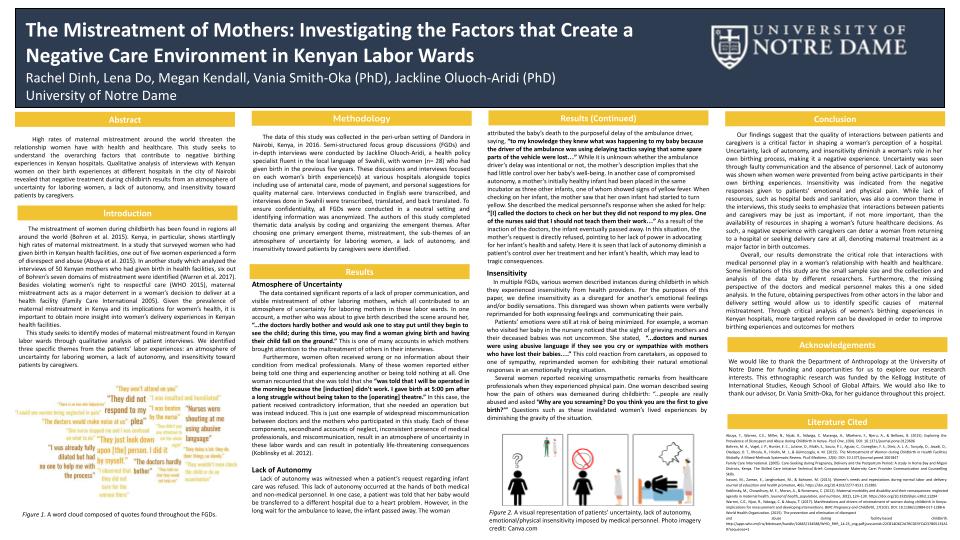
The Mistreatment of Mothers: Investigating the Factors that Create a Negative Care Environment in Kenyan Labor Wards
By Rachel Dinh, Lena Do, Megan Kendall, Vania Smith-Oka, PhD.
Abstract: Given the high rates of maternal mistreatment around the world that threaten the relationship women have with healthcare, this study aimed to understand the overarching factors that contribute to negative birthing experiences in Kenyan hospitals. Qualitative analysis of interviews with Kenyan women on their birth experiences at different hospitals revealed that negative treatment during childbirth results from an atmosphere of uncertainty for laboring mothers, a lack of autonomy, and emotional trauma. This project was virtually presented at the 2021 Student Anthropology Research Forum (SARF) at the University of Notre Dame.
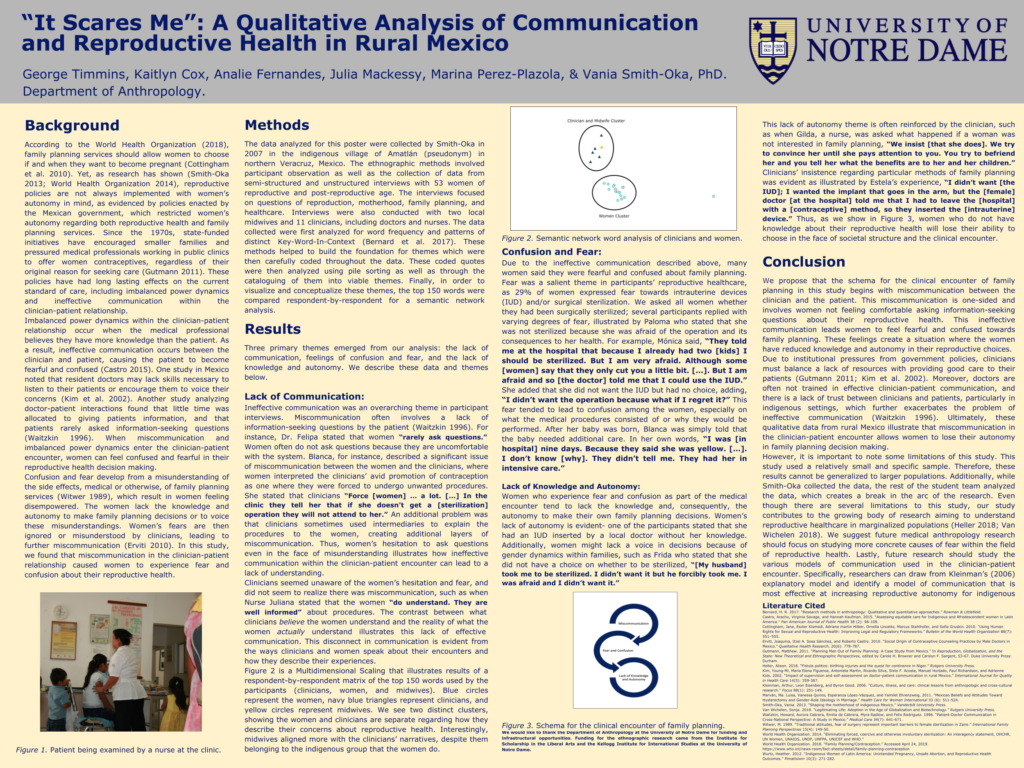
“It scares me”: A qualitative analysis of miscommunication and reproductive health in rural Mexico
By George Timmins, Kaitlyn Cox, Analie Fernandes, Julia Mackessy, Marina Perez-Plazola, Vania Smith-Oka, PhD. (Spring 2019)
Abstract: The relationship between clinicians and their patients in biomedicine has historically been fraught with ineffective communication, power differentials, and ambivalence. This ethnographic study involved the analysis of qualitative data from clinicians, midwives, and women using several qualitative analysis methods. It was found that ineffective communication surrounding family planning services resulted in confusion and fear in women’s reproductive health decision-making. This project was presented at the American Anthropological Association 2020 national conference and the 2020 Human Development Conference.
Reproductive Health Fears Present in Nahua Indigenous Women: An Analysis of Interactions with Biomedical Personnel
By Carolina Ponce, Vania Smith-Oka, PhD. (Summer 2018)
Abstract: Despite increasing access to biomedical care and traditional medicinal care, indigenous women in Mexico still face barriers to their optimal emotional and reproductive health wellbeing. The goal for this analysis was to develop an understanding of the complexities that arise when indigenous women receive local medical care and the tact clinicians use to treat or explain complex procedures. For Nahua indigenous women, clinicians, husbands, and local concepts about their bodies still hold a level of control over their decisions regarding their reproductive health, which, as this study demonstrates, furthers their anxieties when being attended by local clinicians.