Introduction
The Modeling Tools component focuses on data curation, creation of new metrics, and modeling and forecasting of democratization and autocratization trends using causal and machine learning (ML) approaches.
Our Approach
AIM-3D is an empirically grounded and theoretically informed effort to build an AI-based data, modeling, and knowledge hub that systematically analyzes the trajectories of democratization and autocratization across nations.
Leveraging recent advances in artificial intelligence, AIM-3D seeks not merely to automate analysis, but to integrate computational modeling with established theories of democratic change, enabling new forms of predictive and explanatory insight into political development and decline.
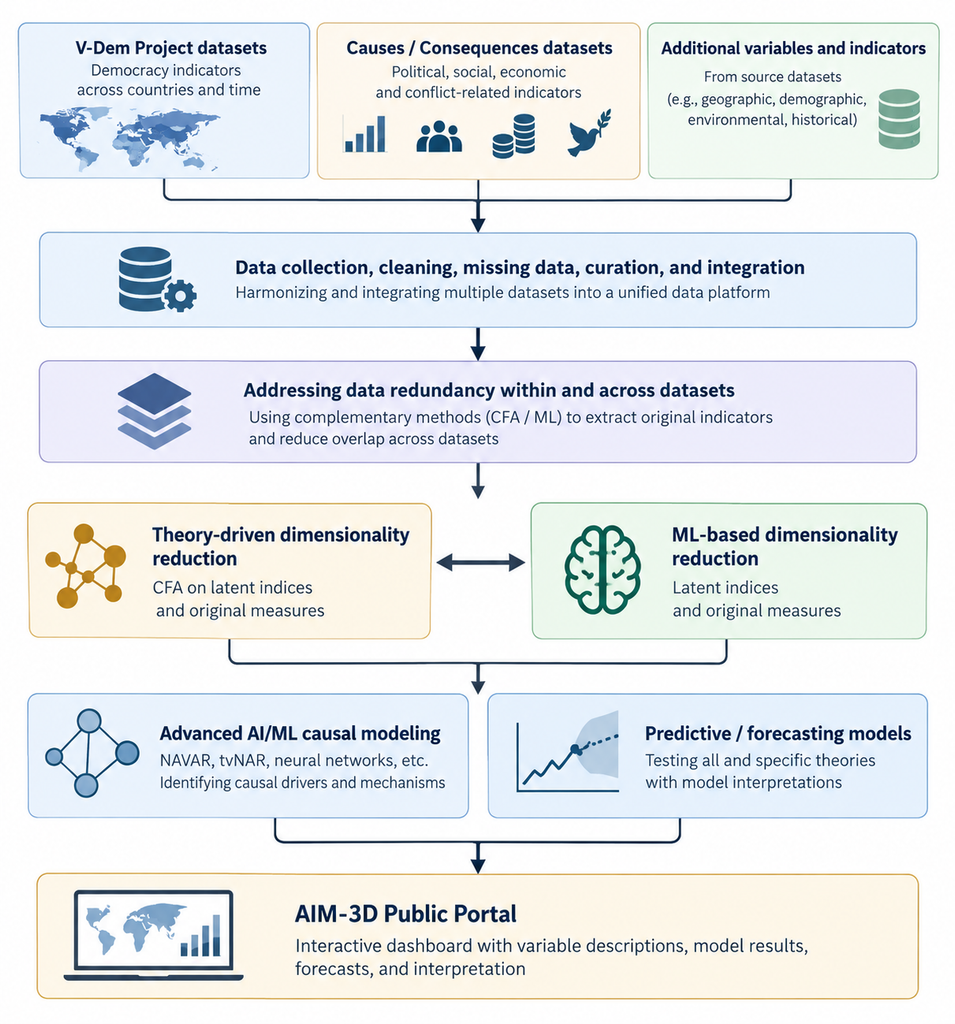
Take a look behind the scenes at the different tools included in our AIM-3D Public Portal Prototype.
NAVAR-Based Functional Relationship Matrix
At the core of the platform is the NAVAR Causal Score Matrix. It quantifies the learned directional relationships between democratic components, which variables exert influence on others over time, and at what relative strength. In the interactive heatmap, darker cells mark stronger inferred relationships and lighter cells mark weak or negligible relationships.

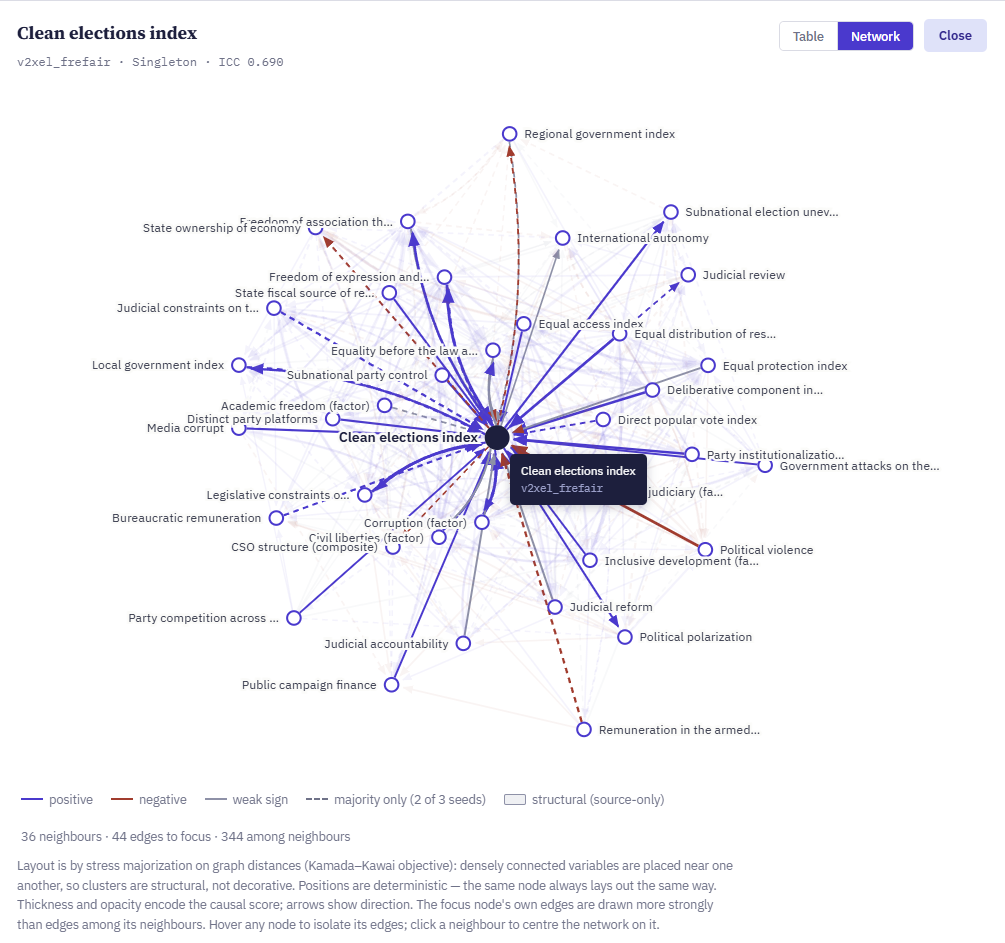
NAVAR Implied Causal Graph
The implied causal graph turns the matrix into a network of the Granger-causal relationships between variables. Directional arrows show which variable influences which. The thickness of each arrow and the value printed on it encodes the strength of the relationship.
Effect Curves
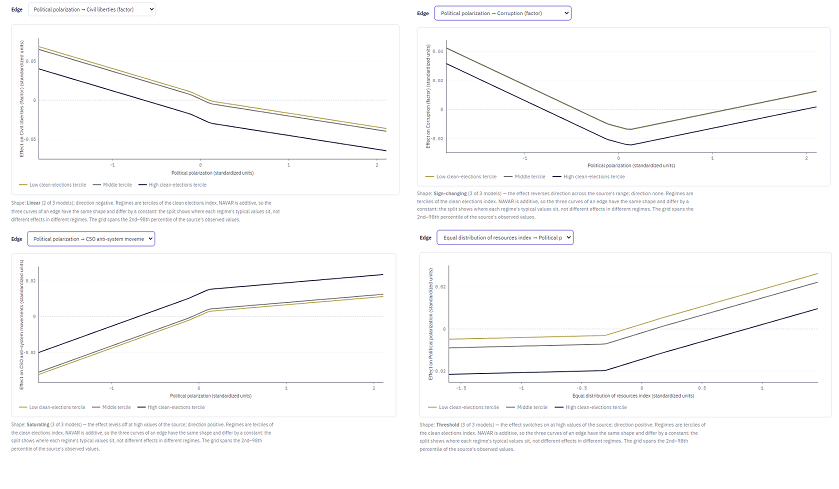
The Effect Curves tool visualizes how changes in one variable affect another, allowing users to explore nonlinear relationships and compare effects across different conditions.
Multi-Horizon Forecasting
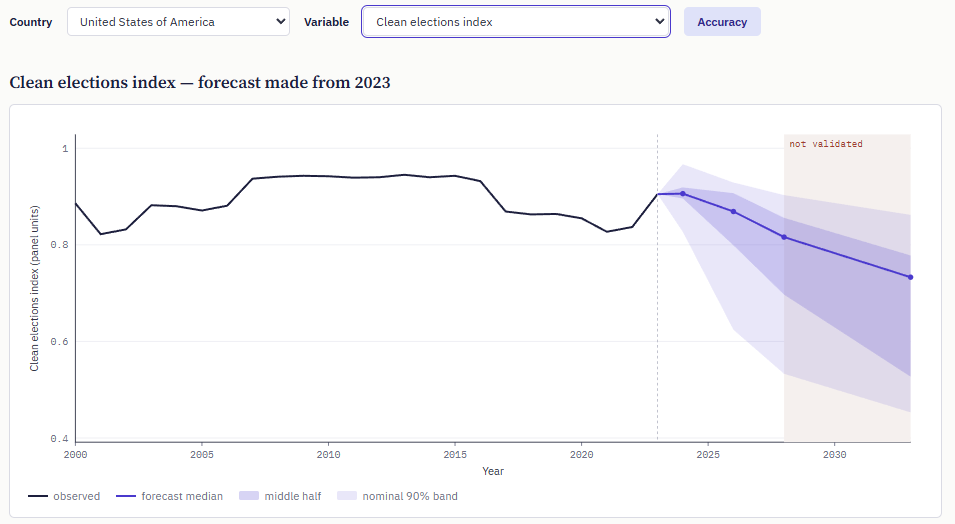
Due to the model’s predictive nature, it can forecast as well as explain. The multi-horizon forecasting tool charts an index’s historical trend and projects it 10 years forward, with uncertainty shown as nested prediction intervals. Users can select a country and index of interest to visualize the model’s forecasting at different intervals.
The development of these and other modeling tools became possible thanks to the generous support provided by the Franco Family Institute for Liberal Arts and the Public Good to the Research Innovation Collaborative and Strategic Team Lab – Modeling Democracy with AI.