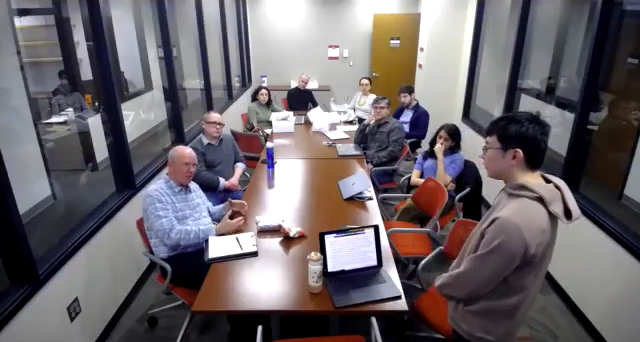

At the April 09, 2026 CPS4D Working Group session, Ziyi Wu presented ongoing research titled “Adaptive Transmission: How Dialogues Developed After the U.S.’s Proposal to Ban TikTok.” The talk examined how political and social discourse evolved in response to the temporary disruption of TikTok services in the United States in early 2025, focusing in particular on user migration to the Chinese platform RedNote.
Wu situates the project within broader debates on information flows across censored and uncensored environments. While much of the existing literature emphasizes how individuals access freer information by bypassing censorship (e.g., through VPNs), this study instead analyzes the reverse dynamic: what happens when users from a relatively open media environment move into a more constrained one. The TikTok ban created a rare and valuable empirical setting to observe this process in real time.
The study draws on a large-scale dataset of user interactions, over 500,000 posts and replies, capturing discussions among so-called “TikTok refugees” who transitioned to RedNote during the disruption. Wu’s analysis reveals a process of what he terms adaptive transmission, whereby political content is gradually reframed as it moves across platforms. Rather than maintaining explicitly political tones, users increasingly translate contentious topics into everyday, cultural, or relational language. Over time, overt political engagement diminishes, not necessarily because interest declines, but because expression adapts to the norms and constraints of the new environment.
A key finding is that this transformation is not driven solely by top-down censorship, but also by bottom-up social dynamics. As users interact and respond to one another, they collectively reshape the discourse, privileging forms of communication that are more likely to circulate and persist within the platform. This results in a subtle but significant depoliticization of discussions, even when the underlying issues remain politically salient.
The project contributes to ongoing conversations in computational political science about how platform environments shape not only the visibility of information, but also its form and meaning. By highlighting the interactive and adaptive nature of cross-platform communication, Wu’s work opens new avenues for understanding how digital publics evolve under shifting regulatory and technological conditions.
The discussion that followed engaged with both the methodological approach, particularly the use of large-scale interaction data, and the broader implications for studying information ecosystems in an era of increasing platform fragmentation and geopolitical tension.