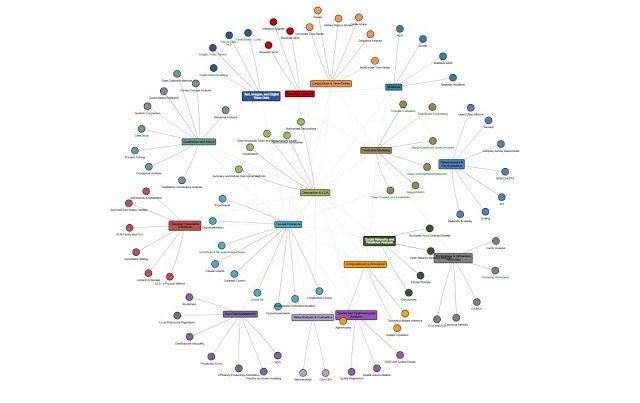

The Computational Political Science for Democracy Working Group (CPS4D) seminar series opened the semester with an introductory session led by Valya Kuskova and Dmitry Zaytsev from the Lucy Family Institute for Data & Society. After brief organizational announcements, the meeting centered on a clear, accessible roadmap to the wide range of techniques commonly grouped under the label “computational methods.” Given the rapid expansion of tools, from machine learning to agent-based modeling to natural language processing to artificial intelligence, the presenters emphasized the value of establishing shared definitions and conceptual boundaries, particularly for a community that draws together political scientists, methodologists, and data scientists.
They began by outlining what qualifies as artificial intelligence and how it differs from simpler forms of automation. Drawing on examples from the slides, Dr. Kuskova illustrated the distinction between systems that merely follow programmed rules and those capable of perception, learning, and adaptive decision-making. They then mapped the broader ecosystem of computational approaches used in the social sciences, including supervised and unsupervised machine learning, network and complexity analysis, digital trace data, and simulation models. They discussed how these tools extend, rather than replace, traditional qualitative and quantitative methods, enabling researchers to study emergent patterns, dynamic processes, and large-scale datasets that were previously inaccessible.
Together, the session provided an orienting framework for CPS4D participants at all levels of technical background. By clarifying overlaps and differences across methods, the speakers set the stage for deeper engagement with computational approaches throughout the semester. Their roadmap underscored a key theme of CPS4D: the importance of integrating cutting-edge techniques with rigorous theory-driven inquiry to advance political science research in the era of AI.