Author: syamanak

American Cold War Fears Becoming a Reality | By Chase Ouellette


As inter-state rivalry with China continues to grow, it is important to remember that the US is no stranger to this type of conflict. Throughout the Cold War, US national security decision-makers navigated the United States through tense, complicated scenarios that tested American political and economic security.1 While observers might view the collapse of the Soviet Union as an inevitable result of internal dysfunction, stagnation, and sloppy attempts at reform, there were various geopolitical scenarios American leaders feared could jeopardize US Cold War aims and tilt the global balance of power in the Soviets’ favor. Among the most prevalent of these fears was the formation of a unified Communist bloc capable of challenging the economic and military might of the West.2

A unified Communist bloc, particularly close alignment and collaboration between the USSR and China, was a serious concern plaguing American policymakers in the first decades of the Cold War. The probability of intimate collusion between the PRC and USSR was highest in the first years of the new Chinese government’s existence. In February of 1950, both nations signed The Treaty of Friendship, Alliance, and Mutual Assistance Between the People’s Republic of China and the Soviet Union – a charter obligating mutual defense in the event of an attack by Japan and its allies.3 The Sino-Soviet relationship remained strong for the next few years, with a 1954 US report stating: “In its most general features the Sino-Soviet Relationship may be compared to that between Great Britain and the US”.4 

Thankfully, ideological tensions, longstanding border disputes, Chinese resentment over Russian colonial treaties with China, and side effects of the Cultural Revolution provided the spark necessary to kick off the deadly Sino-Soviet border clashes that would mark the beginning of the 1969 border crisis and the conclusive Sino-Soviet split.5 American paranoia and concern regarding the preservation of the Sino-Soviet relationship can be seen by Nixon’s eagerness to open diplomatic relations with the nation in 1972.6 Such a definite reversal on decades-long US foreign policy displays how vital to US interests was the isolation of the USSR from the PRC, a belief that held until the collapse of the USSR. 

US fears regarding the formation of a unified Communist bloc are becoming a reality in today’s international arena. While the world left domino theory behind in 1991, if we substitute “Communist” for “Challenger”, we can see that there is an increasingly resolute axis of states in China, Russia, Iran, and North Korea (CRINK) who are striving to challenge the extent and depth of US influence across the world.7 China and Russia’s leading role in the foundation of BRICS demonstrate the desire of the ‘no limits’ partnership to construct international institutions that counter-balance traditionally western-dominated international institutions such as the G7, IMF, and WTO.8 China has also utilized its Belt and Road initiative to establish comprehensive infrastructure projects within both Iran and Russia, measures that further demonstrate China’s commitment to aiding its sanctions-stricken partners.910

The largest uptick in collusion between the states within CRINK has been seen during Russia’s war with Ukraine. China has forged an intimate military-technical partnership with Russia that has aided its sustained invasion of eastern Ukraine.11 China has accomplished this through the export of dual-use goods such as semiconductors, microchips, drones, lithium-ion batteries, and ATVs.12 These goods, while supposedly intended for civilian purposes, are easily converted into components that are vital for the production of Russian weapons systems. China has also helped Russia improve its satellite and space-based capabilities immensely. The identification and targeting of locations hundreds of miles away, a task necessary for Russia’s mass long-range drone strikes against Ukraine, has been greatly improved with Chinese technological transfers.13 China’s role in enhancing Iran’s defense capabilities rivals that of their involvement with Russia. Iran’s domestic surveillance systems, air defense network, and the solid fuel used to power its rockets are all sourced from China.14

While recent years have seen China supplying weapons technologies to Russia, Putin’s regime has long been a vital supplier of advanced military technology to China. Russia has supplied China with a wide array of technologies ranging from fighter jets and an aircraft carrier to advanced missile technologies and cutting-edge command and control systems.15 These arms transfers have played a prominent role in China’s stunning rise through the global military power food chain and are rooted in Russia’s desire to help China continue challenging American presence in the South China Sea.16

Russia has provided extensive assistance to North Korea’s armed forces. Recent North Korean military breakthroughs – the deployment of its first nuclear submarine, the new Hwasong-20 ICBM system, and the new Choe Hyon-class destroyers – have all been made possible through technological transfers from Moscow to Pyongyang.1718 These transactions have not exclusively benefitted North Korea. North Korean contributions to Russia’s war in Ukraine have been extensive. The DPRK has supplied millions of artillery shells to Russia over the course of the war, contributions that are essential to Russia’s war effort. North Korea has also contributed its own men to the fight, notably sending around 11,000 soldiers to the front in a mission to solidify ties between Russia and the DPRK and to provide North Korean soldiers with critical experience on a modern battlefield.19 

CRINK’s increasing levels of cooperation and collusion pose a potential challenge to the US-led international order that has defined the decades after the Cold War. While, short of war, it is impossible to plot and execute a grand strategy that breaks up this new axis of evil, there are a variety of measures the US could take to limit CRINK’s potential influence and power on the global stage. The first measure, which should be the most obvious to US leadership, is to hold on to the advantages we already have. 

One of the most impressive feats in world history has been the forging and maintenance of the modern US alliance system. Spanning across Europe, the Middle East, and the Western Pacific, the US has established intimate diplomatic relations with states of varying size, regime type, geography, and economic power. Looking to southeast Asia, China, the world’s fastest growing power who continually challenges US technological, economic, and military dominance, is boxed in by Japan, South Korea, Taiwan, the Philippines – all close US partners.20 Moving to Iran’s neighborhood, observers will find Saudi Arabia, Qatar, Jordan, Bahrain, and Israel cooperating closely with the United States.21 Egypt, Oman, and Turkey – states with vested interests in the Middle East – have also cooperated extensively with US policymakers in recent years.22 Finally, when Putin looks West from his bedroom window in the Kremlin, he sees two institutions in the horizon that are married to the US: The most formidable military alliance in world history and the world’s second-largest economic unit.23

This point of this detour in geography is the highlight that the US possesses innate advantages over the CRINK axis that its member states could only dream of. What would China give to be a signatory of mutual defense pacts among seven of the world’s ten largest economies?24 What would Iran give to have intense diplomatic sway over the affairs of the Arabian Peninsula and the Levant? What would Russia give to trade its rotting CSTO for NATO, an organization containing 3.5 million military personnel across 32 member states? 

With these advantages in place, I wonder why US leadership is behaving in ways to undercut and diminish them. President Trump’s tariffs, trade wars, hesitant commitment to the transatlantic partnership, and troubling negotiations with Russia all significantly strain our alliances and give our partners valid reasons to question the benefits of US alliance leadership. Our escalatory trade war with Canada and our vague threats pointing to its annexation only serve to foster disdain for the US amongst Canadian leadership. Straining a relationship with a neighboring country is generally a bad path to choose. However, straining a relationship with a country you share an integrated air defense command with and who controls vast swaths of territory bordering the Arctic Ocean is an error.25

US apprehensiveness regarding China is often anchored in observations of the PRC’s rapid industrial and technological development. Chinese developments in AI, auto manufacturing, steel production, clean energy infrastructure, and shipbuilding far outpace current US trends.26 With the US locked into an innovation race with China, protectionism is illogical. South Korea, Japan, and the EU are all home to advanced manufacturing industries, economic sectors US firms would benefit greatly from if there were minimal trade barriers between our market economies. 

President Trump’s faltering commitment to our European partners only weakens our global influence and posture. While our European allies undoubtedly freeload off of US security guarantees and have underinvested in their militaries over the past twenty years, the benefits of further involvement in European security affairs outweigh the drawbacks of carrying Europe on our shoulders. European dependence on an American security blanket allows the US to have intense influence over the policy decisions of the European powers.27 Furthermore, having access to fifty military bases across Europe allows the US to have an incredibly strong military presence across a distant continent, project force right on Russia’s doorstep, and support intricate combat operations in a post-US nation-building  Middle East.28

CRINK’s strategic coordination to undercut the US’s global standing presents a challenge the US has not seen for decades. China, Russia, and Iran specifically have made various maneuvers that have placed US policymakers in awkward positions and forced them to make tough decisions. Despite the behavior of these contenders, the US has what CRINK can only dream of: an intricate alliance network allowing privileged economic and military access across the world’s largest economies and most strategically important states. This network is something CRINK can never replicate. Having been developed over the past eighty years, the US has cemented its influence over the world’s leading states, boxing CRINK out of important partnerships and economies. 

With this innate advantage over our rivals, the US, particularly the Trump Administration, needs to stop weakening our alliances and partnerships through its spastic protectionism and imflammatory rhetoric. Yes, European states have neutered their militaries due to assumptions of a permanent American interest in Europe. Yes, the US holds trade deficits in industrial sectors with other states. Yes, it is not at all in the US’ interest to confront Russia directly over Ukraine. However, these grievances are not worth blowing up our alliance system over. CRINK can continue to make their leaps and bounds in technology and interoperability. However, they cannot recruit other leading states to their axis as long as the US maintains its relationships with the world’s largest advanced economies and militaries. 

  1. https://www.trumanlibrary.gov/sites/default/files/TrumanCIA_Timeline.pdf ↩︎
  2. https://www.jstor.org/stable/2539142?seq=1 ↩︎
  3. https://www.cia.gov/readingroom/docs/CIA-RDP80R01443R000300050007-8.pdf ↩︎
  4. https://history.state.gov/historicaldocuments/frus1952-54v14p1/d183?
    ↩︎
  5. https://nsarchive2.gwu.edu/NSAEBB/NSAEBB49/ ↩︎
  6. https://www.nixonlibrary.gov/nixons-trip-china ↩︎
  7. https://theweek.com/politics/crink-the-new-autocractic-axis-of-evil ↩︎
  8. https://infobrics.org/ ↩︎
  9. https://thesoufancenter.org/intelbrief-2025-june-25/ ↩︎
  10. https://www.aljazeera.com/economy/2025/4/25/iran-to-sign-4bn-oil-deal-with ↩︎
  11. https://www.uscc.gov/research/chinas-position-russias-invasion-ukraine#:~:text=The%20U.S.%20officials%20add%20that,to%20make%20propellants%20for%20weapons. ↩︎
  12. https://carnegieendowment.org/russia-eurasia/politika/2024/05/behind-the-scenes-chinas-increasing-role-in-russias-defense-industry?lang=en ↩︎
  13. https://www.reuters.com/world/china/china-provides-intelligence-russia-ukraine-targets-ukrainian-intelligence-says-2025-10-04/ ↩︎
  14. https://www.realcleardefense.com/articles/2025/10/15/china_and_iran_after_the_12-day_war_1140963.html ↩︎
  15. https://cepa.org/comprehensive-reports/partnership-short-of-alliance-military-cooperation-between-russia-and-china/ ↩︎
  16. https://www.rusi.org/explore-our-research/publications/commentary/how-russia-helping-china-prepare-seize-taiwan ↩︎
  17. https://en.yna.co.kr/view/AEN20251014006100315 ↩︎
  18. https://kyivindependent.com/russia-north-korea-warships-failed-launch-06-2025/ ↩︎
  19. https://www.rusi.org/explore-our-research/publications/commentary/brothers-arms-assessing-north-koreas-contribution-russias-war-ukraine ↩︎
  20. https://www.brookings.edu/articles/geostrategic-competition-and-overseas-basing-in-east-asia-and-the-first-island-chain/ ↩︎
  21. https://www.mei.edu/publications/us-policy-middle-east-third-quarter-2025-report-card ↩︎
  22. https://jstreet.org/securing-the-ceasefire-the-roles-of-egypt-qatar-and-turkey-as-guarantors/ ↩︎
  23. https://alcottglobal.com/infographic/gdp-shifts-for-japan-china-the-european-union-and-the-united-states-2000-vs-2025 ↩︎
  24. https://www.worldometers.info/gdp/gdp-by-country/ ↩︎
  25. https://www.thearcticinstitute.org/rising-tensions-shifting-strategies-evolving-dynamics-us-grand-strategy-arctic/ ↩︎
  26. ​​https://itif.org/publications/2025/09/23/how-china-is-outperforming-the-united-states-in-critical-technologies/ ↩︎
  27. https://chairestrategique.pantheonsorbonne.fr/themes/2019/why-america-us-role-european-defense-and-european-mind ↩︎
  28. https://www.war.gov/News/News-Stories/Article/Article/4240876/defense-agency-contributed-toward-operation-midnight-hammer-success/ ↩︎

Grabbing the Third Rail: Funding the Future of Social Security | By John Majsak

Social Security is commonly considered the “third rail” of American politics. As one of the most popular programs nationally, 87% of Americans indicate it as a priority regardless of the budget deficit.1 Maintaining Social Security is also a mainstay on the voting agenda of older Americans, who vote more often and thus have a greater effect on elections. Any mention of cutting or lowering Social Security benefits immediately receives backlash, as hard-working Americans do not want to be “cheated” out of the money they paid into social security throughout their lives. Given its popularity and effect on elections, politicians stay away from debates about reforming the current system. However, Social Security is facing a serious funding problem which needs to be addressed. According to the 2024 Annual Social Security and Medicare Trust Fund Report, the current tax level for funding Social Security is falling short of what the system needs to maintain current outputs, leading to the possibility of decreasing benefits and Social Security faltering over the next decade.2 In an attempt to alleviate the funding pressure and extend the life of Social Security, policymakers must jump on this political third rail and revise the current payment system if they want the current level of benefits to be around for future generations. Specifically, the federal government must raise or remove the cap on the payroll tax, which is the primary way Social Security is funded. The current tax is limited to the first $176,100 of earned wages, capping the amount of money that can feed into the system and disproportionately affecting lower wage earners.3 Although the cap increases slightly every year, adjusting to the average wage index, a raise or removal of the cap would provide more funding for Social Security benefits while also making the payroll tax proportional between low-wage and high-wage workers.4

The Current Social Security System, Its Shortfalls, and Its Importance

Social Security is an incredibly large program which is under significant stress and threat of decline. In fiscal year 2024 (when the tax was capped at $168,800), the federal government spent $1.5 trillion on Social Security for the elderly and people with disabilities, amounting to roughly 22% of the federal budget and making Social Security the single largest entity of federal spending.5 Retired workers and their dependents accounted for 78.5% of total paid Social Security benefits, paying out over 54.4 million people as of December 2024.6 To fund this massive program, roughly 184 million workers paid into the system, mainly through the payroll tax. Despite the pay going into Social Security, the funds supporting the program have consistently run a deficit – over the past three years, the assets that fund the retirement portion  of Social Security have declined by approximately $170 billion in aggregate, depleting cash reserves.7 A May 2024 report from the Social Security Administration projects the primary fund for Social Security will deplete its reserves by 2035, and the fund specifically for retirement will run out by 2033. After depletion in 2035, funding from tax and interest sources would only be able to pay for 83% of Social Security costs.8 The funding problem is exacerbated as an aging population coupled with lower birthrates in the U.S. results in fewer young workers paying into Social Security for a growing number of elderly recipients. 

Why the Government Must Act

It is important that the government responds to the financial problems Social Security faces and maintains its provision as Social Security provides a social safety net for individuals who fail to save for their own retirements. Although rational actors would typically save part of their wages for retirement without government intervention, this behavior is not observed historically or at the current time. Individual failures such as nearsighted savings behaviors, poor self-control, and lack of financial literacy and information lead people to poorly plan and save for their retirement. Nearsighted (defined by economists as myopic) savings behaviors occur when consumers think about short term desires and refuse to plan for the future. These individuals then choose to spend excessively in the present and forgo saving for tomorrow, leaving these individuals financially unprepared for retirement.9 Furthermore, many low-income households are forced to focus on day-to-day living and thus struggle to save for retirement.10 Poor self-control plays into this behavior as impulse spending in the present impedes future savings. Lack of financial literacy and information problems arise when individuals are unsure of how much to save for the future with one’s lifespan, future needs (especially medical needs for the elderly), and other factors being uncertain. The government stepping in to force savings through Social Security alleviates some of these economic failures of individual savings.11 According to a 2023 report, Social Security accounts for 50% of the income for 2/3 of retirees, while 1/3 of elderly households are almost entirely reliant on the program. In fact, without Social Security, 2/3 of the elderly would be considered in poverty.12 The safety net provided by Social Security protects these individuals who would otherwise be facing a financially uncertain retirement. Social Security is not a substitute for retirement savings, and the government could do a better job at encouraging individuals to save on their own. Additionally, one could argue a case for moral hazard in that Social Security itself incentivizes people to save less and that the government should take a hands-off approach on the issue of savings. Regardless, Social Security is already in place and has successfully protected some vulnerable populations, thus making it vital for the federal government to remedy its shortfalls in the interest of protecting these individuals.

The Payroll Tax and How Its Modification Can Help Social Security

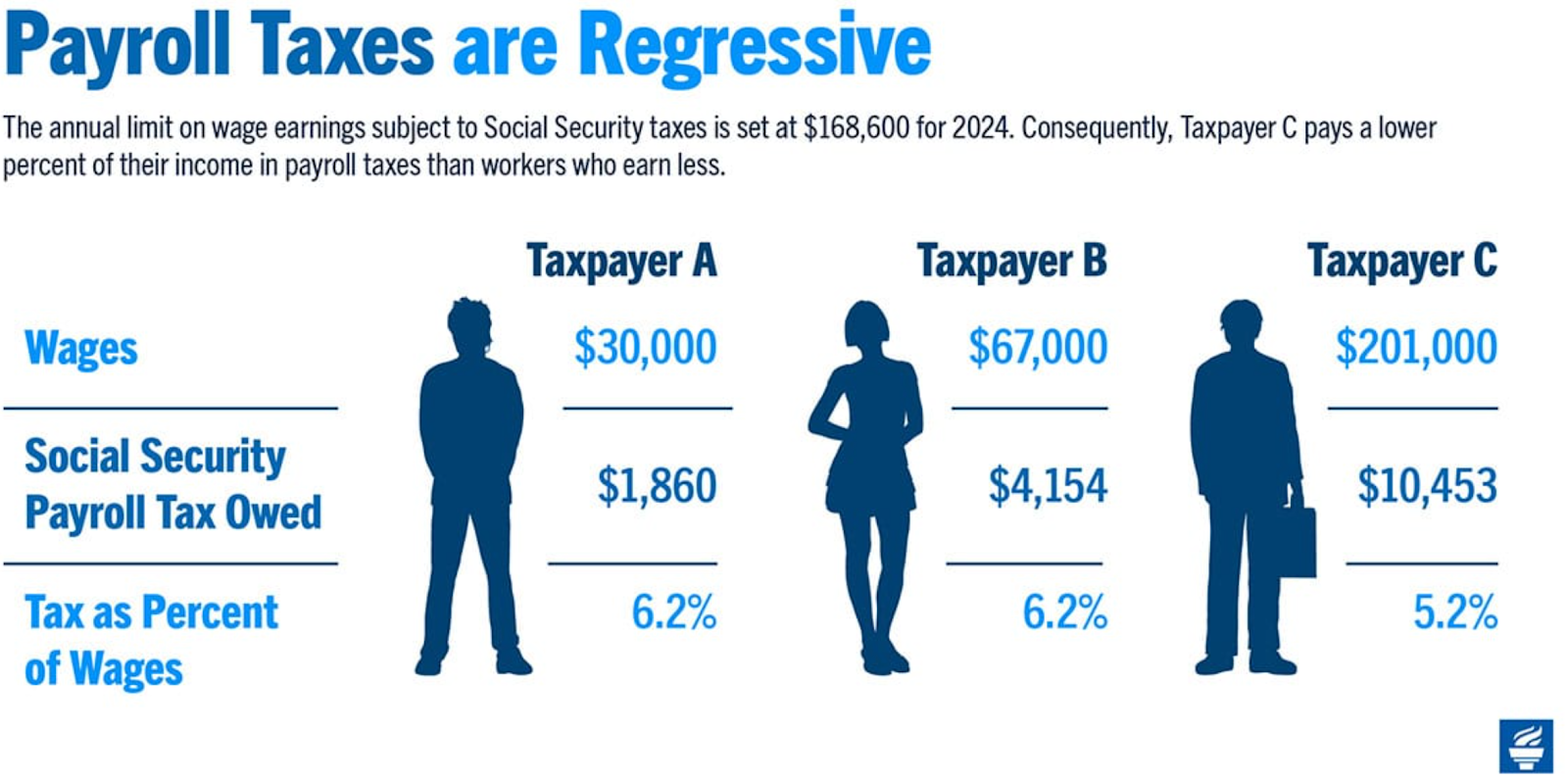
The primary funding for Social Security comes from a payroll tax through the Federal Insurance Contributions Act (FICA), which can be both progressive and regressive despite starting as a proportional tax. As part of FICA, employers and employees each pay a flat tax of 6.2% of the employee’s wage into Social Security funding, for a total of 12.4%.13 However, this tax structure does not apply to all of a person’s pay–a cap is applied which restrains the tax to the first $176,100 of wages (slightly adjusted each year), meaning someone making $176,100 a year pays the same payroll tax as someone making $1 million a year.14 By capping the taxable wage limit with a flat tax, the payroll tax shifts from being proportional to regressive, as high-wage earners above the cap pay proportionally less of their wages into Social Security than those earning below the cap (see Figure 1). Below the cap, the payroll tax is slightly progressive, as wages make up more of one’s income compared to other benefits as wages increase.15

Figure 1: The Regressive Nature of the Payroll Tax

A person and person silhouettes with tax percentages

Description automatically generated
Source: Peter G. Peterson Foundation (see endnote 11)

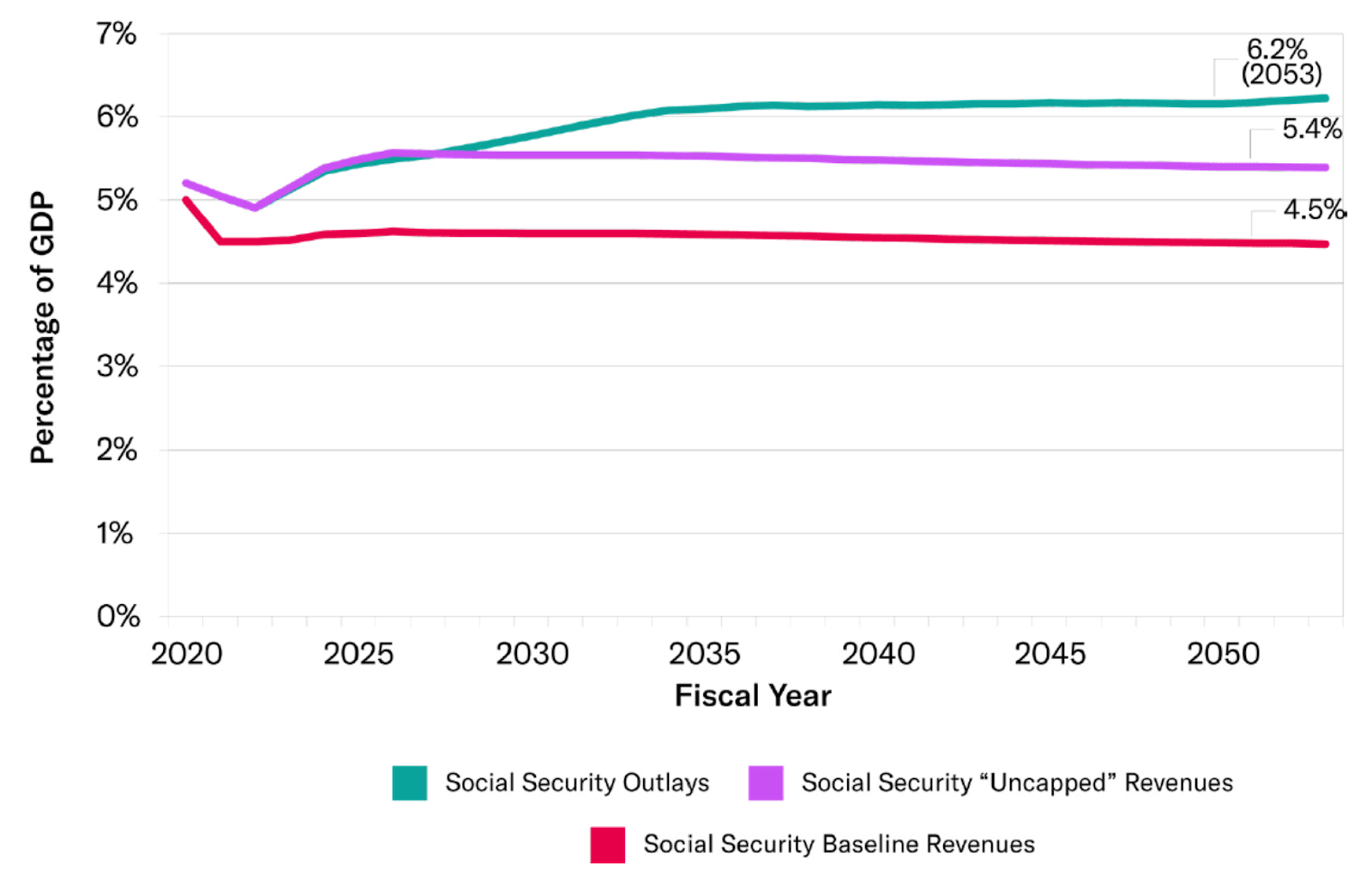
Modifying the payroll tax by either raising or fully removing the tax cap will expand the much-needed contributions to the Social Security fund and reduce the solvency issue. Since the 1980s, approximately 6% of workers consistently earn wages above the taxable maximum.16 In 2021, the top 5% of workers made up 29.9% of total wage earnings at an average of $322,349, more than 18 times the wages of the bottom 90%, and well above the payroll cap.17 Thus, with the current tax cap Social Security is losing out on a significant amount of potential revenue. Removing the cap would raise tax revenues from 4.5% to 5.4% of GDP, closing over half of the future gap of Social Security funding (See figure 2). Although not fully solving the financial gap, removing the cap would push back deficit spending to 2029 and reserve depletion from 2033 to 2055. If completely removing the cap may be too drastic a measure to undertake, even raising the cap would go a long way towards maintaining the future of Social Security.18

Figure 2: The effect of Uncapping the Payroll Tax

A graph showing different colored lines

Description automatically generated
Source: The Manhattan Institute (see endnote 17)

Tradeoffs and Economic Effects of Modifying the Payroll Tax Cap

As with any tax issue, modifying the payroll tax cap comes with tradeoffs and economic effects. First, the 6% of workers with wages above the current threshold would see a raise in taxes. The tax shift would lower these individuals’ take-home pay, changing their incentives and causing those affected by the tax to work less.. This shift away from work would lead to a decrease in supplied labor. However, since the tax increase would only affect 6% of workers, the overall effect on labor supply would be minimal, making this tradeoff less impactful. Furthermore, the decrease in take-home pay resulting from the tax would decrease current spending and overall economic output as workers adjust and lower their present spending habits. A cap raise also affects the employer’s behavior and tax incidence. As employers pay half of the payroll tax, removing the cap would also increase taxes on the employers of high-wage individuals. As a result, companies may pass some costs of the tax onto consumers. Raising the tax cap also affects the redistribution of Social Security funds. Part of the benefits structure of Social Security is that the more you pay into Social Security as a worker, the more you receive as a retiree. Therefore, raising the cap also raises the maximum amount of money Social Security can pay out. Thus, while raising the cap would provide more funding to Social Security, the increased payout of benefits would decrease the full effect of the extra funding.

The Future of Social Security

Clearly, Social Security is a vital part of the American social safety net that protects retirees and must be extended to provide for future generations. To do so, policymakers must stop fearing political backlash and take the important steps of reforming the current funding system. Raising or removing the payroll tax cap will not completely fix Social Security, but it is the first of many steps that can promote funding efforts and partially close the widening gap facing the program. Some in Congress are already starting to act on this idea: Senate Democrats led by Sen. Bernie Sanders (I-VT) have proposed the Social Security Expansion Act which, along with increasing benefits, would remove the tax cap on those making over $250,000. This “donut-hole” form of a cap raise would retain the existing payroll tax structure and then reintroduce taxes on wages for individuals earning more than $250,000.19 Proposed legislation like the Social Security Expansion Act are necessary considerations in order to remedy the funding structure before benefits are affected. 

  1. Kenneally, Kelly, and Tyler Bond. “Americans’ Views of Social Security.” National Institute on Retirement Security, 22 July 2024, www.nirsonline.org/reports/socialsecurity2024/. ↩︎
  2. Social Security and Medicare Boards of Trustees. “A Summary of the 2024 Annual Reports.” Social Security Administration, 2024, www.ssa.gov/OACT/TRSUM/index.html. ↩︎
  3. Cardman, Michael. “2025 Wage Cap for Social Security Payroll Taxes Going up 4.4%.” Brightmine US, 23 Apr. 2025, www.brightmine.com/us/resources/talent-management/2025-wage-cap-for-social-security/. ↩︎
  4. “Contribution and Benefit Base.” Social Security Administration, www.ssa.gov/oact/cola/cbb.html.  ↩︎
  5. “The Federal Budget in Fiscal Year 2024: An Infographic.” Congressional Budget Office, 20 Mar. 2025, www.cbo.gov/publication/61181. ↩︎
  6. “Social Security Fact Sheet.” Social Security Administration, www.ssa.gov/news/press/factsheets/basicfact-alt.pdf. Accessed 14 April 2025. ↩︎
  7. Williams, Sean. “Social Security Is Facing a $23 Trillion Funding Shortfall and Possible Benefit Cuts in 9 Years: Here’s How We Got Here.” The Motley Fool, The Motley Fool, 15 Dec. 2024, www.fool.com/retirement/2024/12/15/social-security-23-trillion-shortfall-benefit-cuts/. ↩︎
  8. Social Security and Medicare Boards of Trustees. “A Summary of the 2024 Annual Reports.” Social Security Administration, www.ssa.gov/oact/trsum/. Accessed 5 June 2025. ↩︎
  9. Kaplow, Louis. (2015). Government Policy and Labor Supply with Myopic or Targeted Savings Decisions. Tax Policy and the Economy 26(1), 159-193, https://www.journals.uchicago.edu/doi/full/10.1086/683367#_i1. ↩︎
  10. J.M. Jachimowicz, S. Chafik, S. Munrat, J.C. Prabhu, & E.U. Weber, Community trust reduces myopic decisions of low-income individuals, Proc. Natl. Acad. Sci. U.S.A. 114 (21) 5401-5406, https://doi.org/10.1073/pnas.1617395114 (2017). ↩︎
  11. Kaplow, Louis. Government Policy and Labor Supply with Myopic or Targeted Savings Decisions. ↩︎
  12. “Should We Eliminate the Social Security Tax Cap?” Peter G. Peterson Foundation, Peter G. Peterson Foundation, 13 Dec. 2023, www.pgpf.org/article/should-we-eliminate-the-social-security-tax-cap-here-are-the-pros-and-cons/. ↩︎
  13. “Topic No. 751” IRS ↩︎
  14. Ellison, Erin, and David Kindness. “What Is the FICA Tax? 2024 Tax Rates and Instructions.” OnPay, OnPay, Inc., 31 Oct. 2024, onpay.com/insights/what-are-fica-tax-rates. ↩︎
  15. “Are Federal Taxes Progressive?” Tax Policy Center, Urban Institute, Brookings Institution, and Individual authors, Jan. 2024, taxpolicycenter.org/briefing-book/are-federal-taxes-progressive.  ↩︎
  16. “Population Profiles: Taxable Maximum Earners.” Social Security Administration, May 2024, www.ssa.gov/policy/docs/population-profiles/tax-max-earners.html. ↩︎
  17. Gould, Elise, and Jori Kandra. “Inequality in Annual Earnings Worsens in 2021.” Economic Policy Institute, Economic Policy Institute, 21 Dec. 2022, www.epi.org/publication/inequality-2021-ssa-data/. ↩︎
  18. Riedl, Brian. “Don’t Bust the Cap: Problems with Eliminating the Social Security Tax Cap.” Manhattan Institute, Manhattan Institute for Policy Research, Inc., 11 Apr. 2024, manhattan.institute/article/problems-with-eliminating-the-social-security-tax-cap. ↩︎
  19. “Lawmakers Announce Bill to Remove Social Security Tax Income Cap.” Taxnotes, 27 Feb. 2025, www.taxnotes.com/research/federal/legislative-documents/congressional-news-releases/lawmakers-announce-bill-remove-social-security-tax-income-cap/7rbl3.  ↩︎