Research
Around the world, candidates committed to democratic competition increasingly face opponents who challenge the rules of that competition, or run under conditions that are free but not fair. In these challenging electoral environments, politics is no longer only a debate over policy: the democratic polity itself becomes part of the argument.
Our work develops three components on which campaign strategy depends: voter concerns, the range of voter types in a given electorate; pivotality, which voters are genuinely open to appeals from pro-democracy candidates; and messaging, which appeals reach them.
Cluster projects
The Accidental Democrats: How Ordinary Voters Save and Lose Democracy
Marc S. Jacob
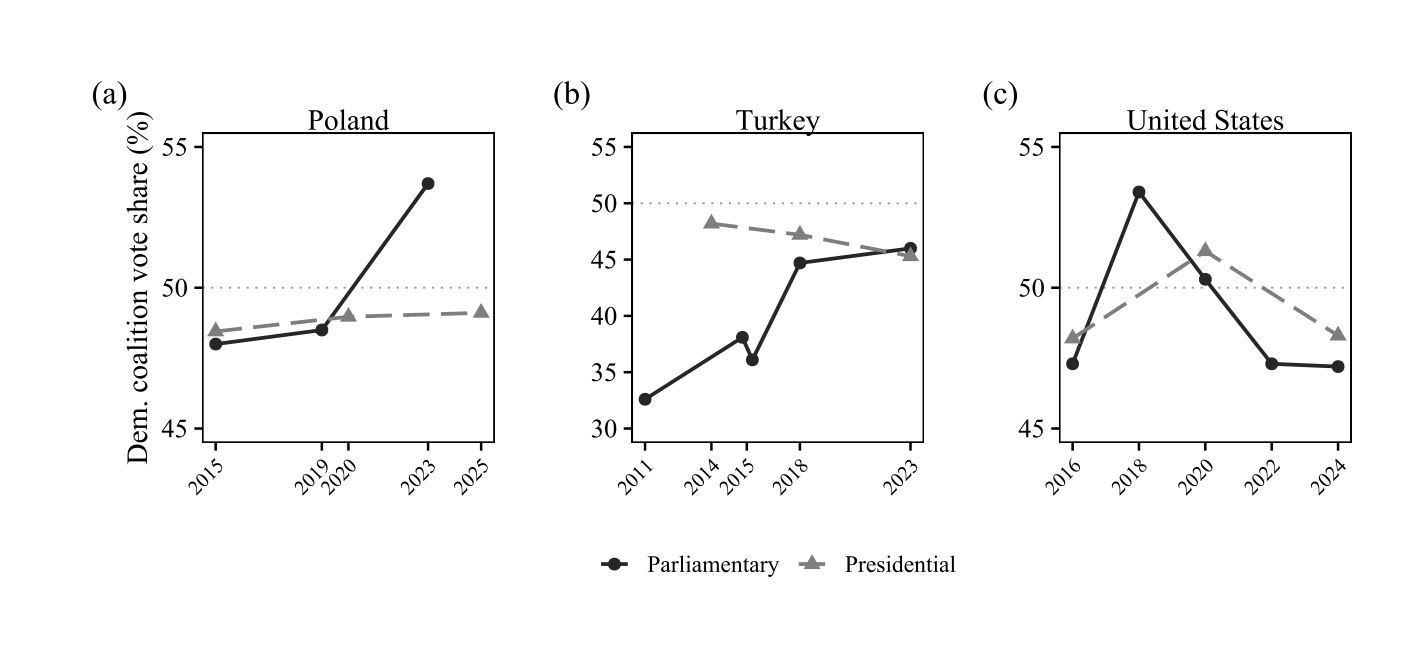
Ordinary voters participate in elections with implications not only for policy but for the trajectory of the political regime. In these regime elections, the electoral menu offers competing visions of the polity itself. Why do the vote shares for pro-democratic parties sometimes grow and at other times shrink? Contra narratives that read these outcomes as a collective choice for democracy over autocracy, I argue that the voters who make the difference, a segment I call democratic pivots, decide regime elections incidentally, by voting for the party that aligns most strongly with their own substantive preferences and happens to be pro-democratic. The book draws on evidence from Poland, Turkey and the United States, including subnational electoral shifts, panel data tracking pivotal voters, and survey experiments. Democratic survival or breakdown is far more a byproduct of ordinary politics than an intentional choice by those voters who decide it.
Counting the Wrong Switchers: Bias in Measures of Electoral Volatility
Thomas Mustillo, Tiffany M. Tang and Marc S. Jacob
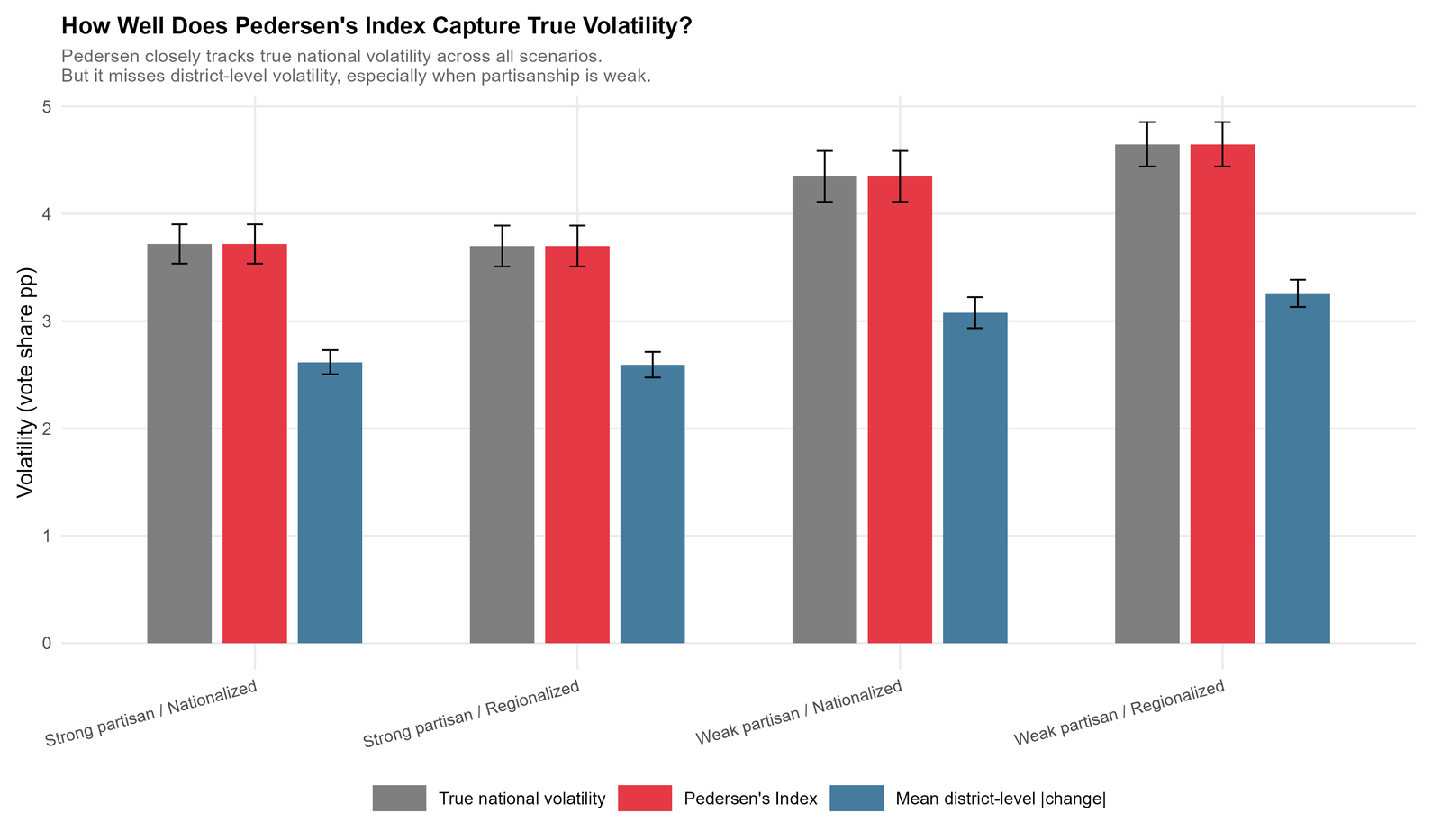
Electoral volatility is measured in several different ways, and the measures have never been fielded together on a single sample. This paper fields the major measures at once, estimates how far they agree, and asks which switchers each one misses.
Volatile but Not Available: Electoral Volatility and Democratic Choice in Brazil and the United States
Marc S. Jacob, Thomas Mustillo and Tiffany M. Tang
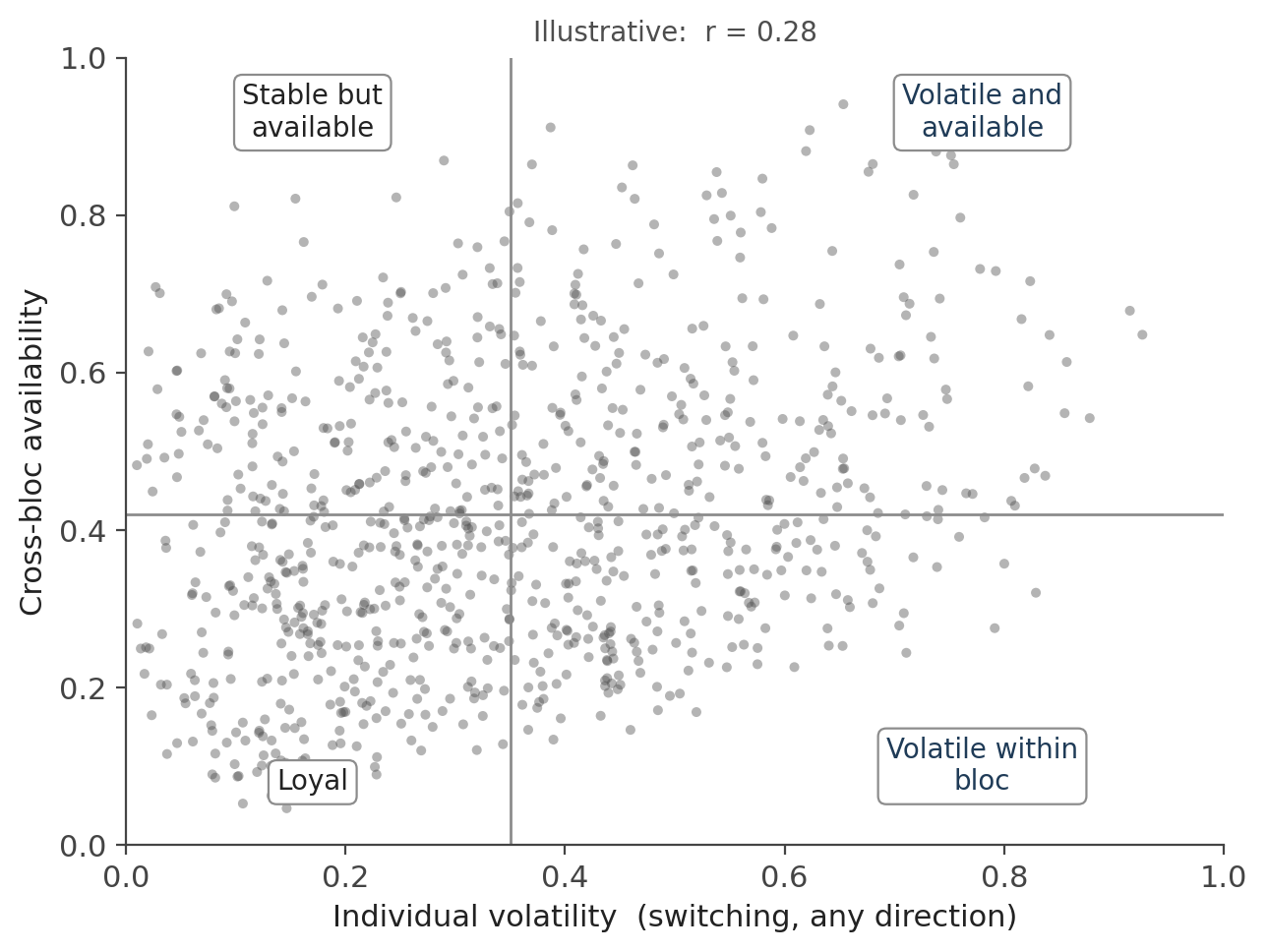
Multi-wave panels in Brazil and the United States record each respondent’s full preference structure before and after a randomized issue prime, so that volatility is observed directly rather than inferred from aggregate results.
Competing for the Populist Electorate: The Effectiveness of Populist Rhetoric and Oppositions’ Counter-Rhetoric
Adriana Pilar Ferreira Albanus
In this study, I ask: How do populist leaders build and sustain electoral support? And how can oppositions counteract their attempts and compete for the populist electorate? I aim to address these questions by comparing the cases of Brazil and the United States and, more specifically, Jair Bolsonaro and Donald Trump. First, I argue that, in order to build electoral support, populist leaders will tailor their rhetorical strategies to persuade distinct groups within the electorate. Although rhetoric can be effective in generating support, large coalitions are hard to achieve given the heterogeneity of voters’ preferences. As it follows, I argue that opposition actors can compete for the support of the populist electorate by assigning responsibility for the populist’s wrongdoings and highlighting their underperformance in power, in ways that match populist rhetoric. I aim to understand the extent to which the effectiveness of rhetoric and counter-rhetoric in affecting populist support varies among distinct groups within the electorate.
Related work by cluster members
Democratic Support and the Partisan Cost of Electoral Accountability
Bermond Scoggins (Australian National University) and Marc S. Jacob
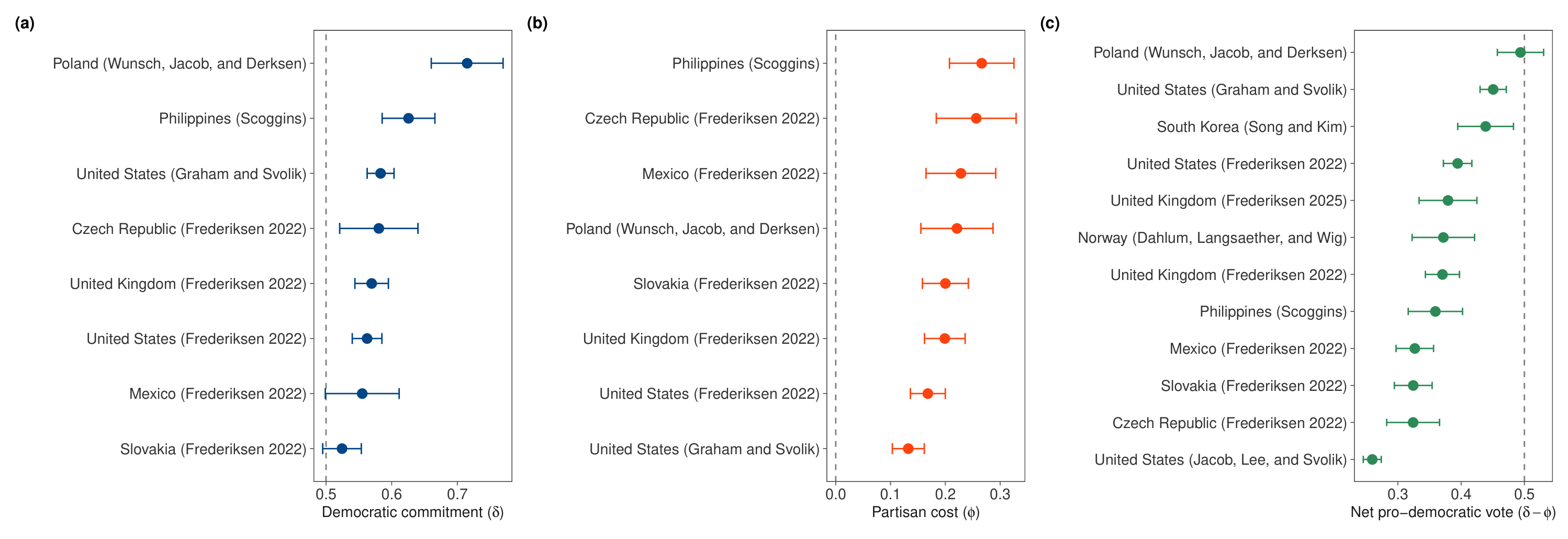
Why do electorates often fail to hold transgressing electoral officials accountable? Two leading explanations point either to weak democratic values or to the partisan costs of acting on those democratic values, but rarely separate these mechanisms. We develop a theoretical framework that distinguishes between normative preferences for democracy and the political costs of partisan defection. Conducting a meta-analysis of candidate choice experiments across thirteen democracies and over 45,000 respondents, we measure the levels of democratic support and of partisan costs by comparing intra- and inter-party candidate contests. We find that democratic support is sizable and varies at the society level, but that the partisan costs of sanctioning undemocratic candidates vary primarily between partisan groups within the same society rather than between societies at large. Weak accountability is thus often the result of asymmetric partisan polarization and party-system structures that provide no viable alternative electoral option to hold transgressing co-partisan elites accountable. Our framework offers a diagnostic for understanding citizen (in)action when democracy is under threat and yields implications for which strategies may most effectively strengthen electoral accountability.
When Do Autocratizing Incumbents Lose Elections?
Erin Accampo Hern (Syracuse University) and Marc S. Jacob
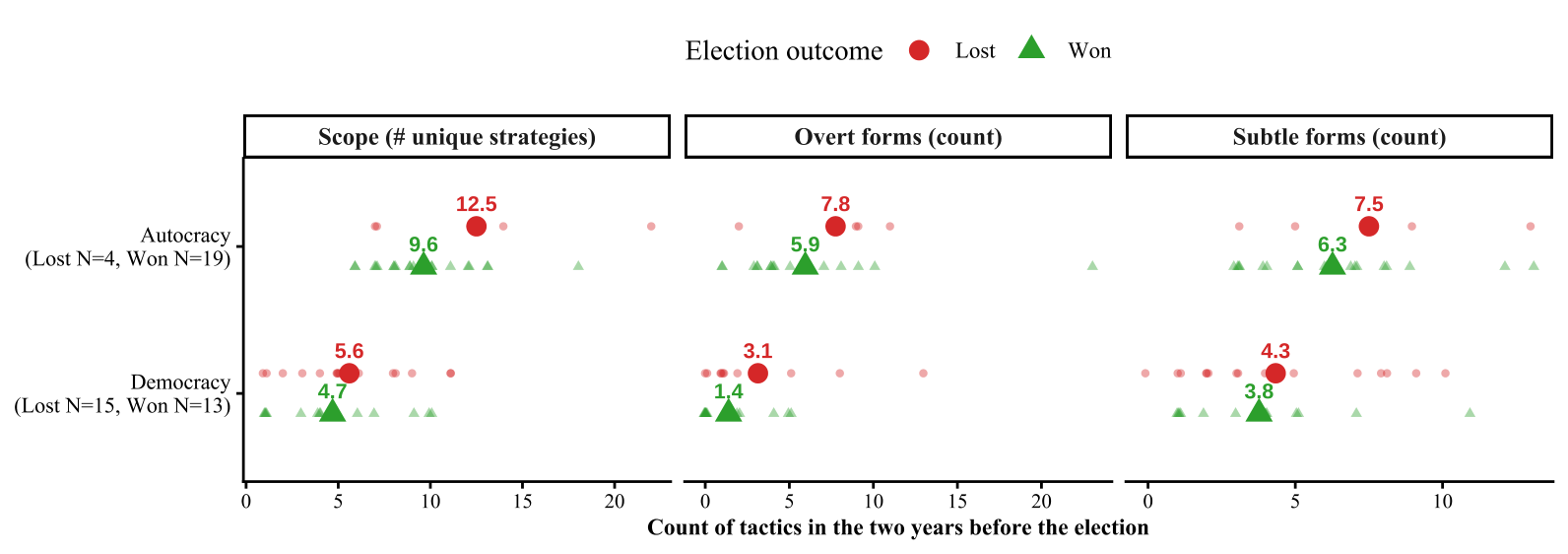
When do electorates remove incumbents who undermine democracy? Existing research offers accounts of why electorates tolerate autocratizing leaders, but has paid less attention to cases when they hold them accountable. We develop a framework of electoral accountability under autocratization to evaluate when attacks on democracy trigger electoral backlash, considering the scope of autocratization (i.e., the breadth of institutional erosion) and its overtness (i.e., whether autocratizing acts are carried out openly through coercion rather than through subtle institutional change), alongside preexisting institutional strength, economic performance, and political culture. Drawing on an original dataset of 105 elections since 1995 in which autocratizing incumbents sought re-election, hand-coded measures of autocratization scope and overtness in recent electoral contests, experimental evidence, and comparative analyses of Poland and Zambia, we find that overtness, but not scope, is systematically linked to incumbent defeat. Our findings have implications for the conditions under which citizens can disrupt episodes of autocratization through electoral channels.
Voting for Pre-Electoral Coalitions
Marc S. Jacob and Ugur Ozdemir (University of Edinburgh)

Pre-electoral coalitions can improve parties’ electoral prospects but may lose appeal when they combine affectively and ideologically diverse members. To understand when coalitions underperform electorally relative to their member parties, we develop a bounded-rational behavioral framework in which voters extend their evaluations from individual parties to coalitions that substitute for parties as electoral entities. Voters are modeled as applying simple heuristics based on their affective distance to the coalition’s closest, middle, or farthest member. Using original face-to-face survey and experimental data collected during the 2023 Turkish general election, we show that voters predominantly rely on the middle-party heuristic and are sensitive to relative affective distances between rival alliances. Economic, but not democratic, campaign appeals reduce defection by increasing the perceived distance to the alternative coalition. Our study contributes to understanding voter coordination within pre-electoral alliances and advances a general framework for evaluating set-based electoral choices under bounded rationality.