Rev. Edward Sorin Lost at Sea

On a beautiful November 13, 1875, the steamship L’Amerique left New York and set sail for Le Havre, France.  Aboard were Rev. Edward Sorin, making one of his many journeys between America and Europe, and Catholic artist Miss Eliza Allen Starr.  They were supposed to arrive on November 23, but their plans took a great detour.

Around 3:30am on Sunday, November 21, 1875, the shaft of the L’Amerique broke and left her stranded near the Scilly Islands in the Celtic Sea.  The nearby Royal Mail Steamship China was able to take on a few of L’Amerique’s passengers and cargo, but many stayed behind.  November 23rd newspaper reports claimed that “L’Amerique was proceeding under sail for Havre, all well” [The Patterson Weekly Press, November 25, 1875].  Scholastic reported similar news, not knowing yet that L’Amerique and many of her passengers were still stranded, although not sinking.

Father Sorin and Miss Starr were among the passengers left behind on the disabled steamer.  They hoped a rescue ship would come by that Friday.  The week’s weather was beautiful and calm:  “On Friday evening the ship seemed actually to stand on a sea of glass, so profound was the calm.  The sounds on board were as peaceful and domestic as those of a country-house.  In fact the stillness was so deep as to be solemn, and almost oppressive; for no ship had come, as we had so confidently expected” [Starr, “Pilgrims and Shrines”].  Then the weather turned and the sea became rough.

A German rescue boat finally found L’Amerique on Tuesday, November 29th.  However, “the roughness of the sea and the darkness preclude all thoughts of a transfer. She could only take our dispatches to Southampton, and go on her way” [Starr].  While the weather once again cleared, no ships arrived to the rescue.  Fortunately, there were enough provisions on board to sustain the crew and passengers the extra week at sea.  However, thoughts of not being rescued lingered in the minds of Starr and Sorin.  They were comforted by prayer and both vowed to keep the devotion of a Thousand Hail Marys.

On Sunday December 5th, L’Amerique was approached by a group of fishermen from Newfoundland.  Unfortunately, their boats were not capable of rescuing the steamer.  L’Amerique had no means of communication and they could only hope that a passing steamer would find them before it was too late.  Back home, the Notre Dame and Saint Mary’s students worried greatly:  “The non-arrival of the ‘Amerique’ causes great anxiety—
Telegraphic reports from Paris and London describe the ‘Amerique’ as going slowly but surely to the destined port.  But though these reports allay any extreme fears for the safety of our Venerated Very Rev. Father Sorin, and the other dear friends on board—still, the suspense and anxiety will be very painful till certain tidings of the safety of her passengers reach us” [Scholastic, 12/11/1875].

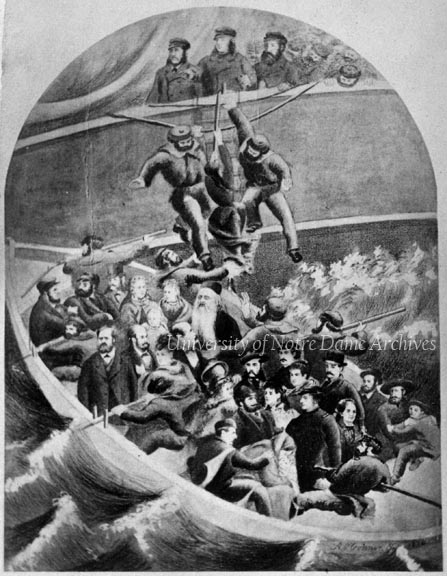
The Ville de Brest had gone in search of the incapacitated L’Amerique on November 24 and finally spotted her on December 5th and approached closer at midnight.  The weather and rough seas prevented a rescue for another week.  On December 12th, the crew of the Ville de Brest transferred the ninety passengers from L’Amerique and towed the disabled steamer back to Ireland.

Father Edward Sorin (in the center with the long, white beard and black cassock), Miss Eliza Allen Starr, and other passengers being transferred to the Ville de Brest, the steamer sent out by the French Transatlantic Steamship Company, which save passengers from the disabled steamer L’Amerique and which towed her into Queenstown harbor, and thence to Havre, 1875.

Father Sorin wrote to Scholastic about the ordeal and said that during the transfer to the Ville de Brest Miss Starr “went down bravely enough half the length of the rope ladder along the side of the big boat, but when she reached the lower boat I could see she was still alive by the sign of the cross she was making and repeating.  Ah! she is a Christian woman” [Scholastic, 01/08/1876].

After the Ville de Brest rescued L’Amerique, the continued storms prevented a swift return to port.  They wouldn’t arrive safely at Queenstown harbor until December 18, 1875, nearly three and a half weeks after their original anticipated arrival date in Le Havre.  Ville de Brest then took the passengers to Le Havre through more storms.  From there, the travelers took the train to Paris, arriving on Christmas Day.  They went to Mass at Notre Dame des Victoires, where prayers and Masses had been said for weeks earlier for their safe rescue.

In January of 1876, Fr. Sorin commissioned artist Luigi Gregori to paint a mural in the newly built Church of the Sacred Heart (now the Basilica) in thanksgiving of his rescue.  The mural depicted Christ walking on water with Saint Peter sinking below the waves while the other apostles remain in the boat.  Unfortunately, the murals on the southern wall on either side of the organ were painted over sometime between 1951 and 1977.


Sources:
Scholastic
“A Memorable Voyage” by Miss Eliza Allen Starr from “Pilgrims and Shrines,” as reprinted in Scholastic issues 01/31/1885 and 02/07/1885
“Accident to the Amerique,” The Patterson Weekly Press, 11/25/1875
 

Decoration Weekend

A lot of hoopla surrounded Football Homecoming during the 1920s through the 1960s.  Events for the weekend usually included alumni reunions, a dance, a pep rally and bonfire, a parade, and hall decorations.  The decorations were often elaborate, constructed solely by students on a very limited budget.  A healthy dose of competition with trophies hanging in the balance added to the excitement of the hall decorations.

Some years had a theme, such as “The Spirit of ’76” was used in 1964, celebrating 76 years of Notre Dame football.  Often, the themes revolved around the opponent for the Homecoming game, such as “Wreck Tech” when Notre Dame played Georgia Tech in 1953.  Below are some examples of Homecoming decorations through the years:

Students putting up decorations on Badin Hall for Football Homecoming Weekend, c1930s.
The decorations feature a drawing of coach Elmer Layden and text that reads “Notre Dame Fights.”


Football Game Week – Students constructing hall decorations for Morrissey and Lyons Halls for Homecoming, 1957


Football Game Day decorations on Sorin Hall with banners that read
“We Got Army’s Ass, Now We’ll Get Navy’s Goat,” 1965.


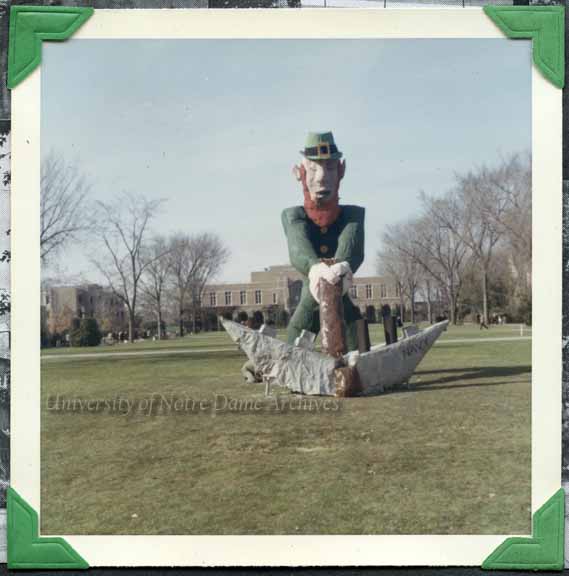
Students constructing a Leprechaun figure on South Quad for
Homecoming decorations, 1965. Below is the finished product.


Football Game Day decoration of a large Leprechaun on South Quad,
smashing a shillelagh through a Navy battleship, 1965.


Sources:
Scholastic

Dome yearbook
GBBY 45F/4958
GNDS 23/18-19
GPUB 47/62


Mock Political Conventions

From 1932 until 1988, Notre Dame held mock political conventions every four years to pick a presidential candidate.  The mock conventions were held before the national primaries had determined a presumptive candidate, which generated much excitement in the selection process among the Notre Dame and Saint Mary’s College student delegates.  In a 1976 South Bend Tribune interview, Bill Mapother, the 1960 Chairman, recalled, “We practically closed down the damn University that week.  The whole thing was covered on the campus radio.”  The article continued, “[Mapother] claimed that the convention was ‘a hell of a lot of work,’ noting that the job actually started almost two and a half years before the scheduled date of the convention” [“The Notre Dame Mock Convention — Will This Year’s Be Accurate Too?” by Gerald Lutkus, South Bend Tribune, February 29, 1976].

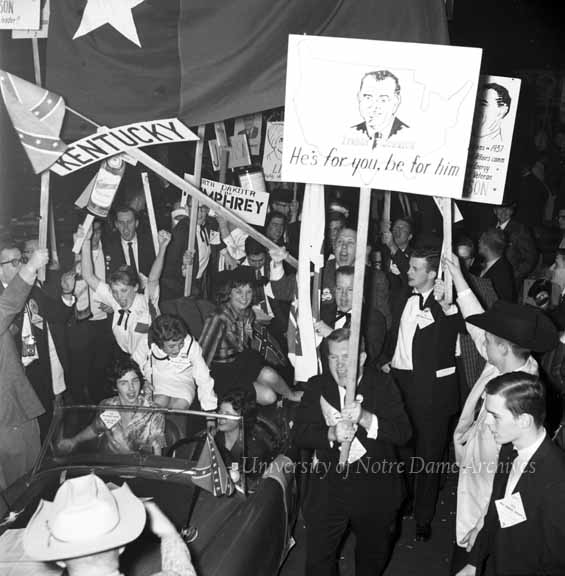
Student delegates supporting Adlai Stevenson at the Mock Democratic Convention, April 1956.

The Law School organized a mock convention in 1932, and the Department of Political Science took the reigns in 1940.  Post-World War II, the conventions quickly escalated to elaborate and often raucous three-day events.  Students from all colleges participated and Notre Dame’s historically geographically diverse population allowed students to represent their home states.  The addition of women from Saint Mary’s College in 1952 undoubtedly also added to the appeal of the event.  Paul C. Bartholomew acted as faculty adviser until his death in 1975.

The Mock Conventions closely followed the format of the national conventions, from preparing platforms, voting for candidates, and securing high-profile speakers.  The committee leaders often secured senators, representatives, governors, and mayors as speakers, including Chicago Mayor Richard Daley in 1960 and George W. Bush in 1980.

Student delegates supporting Lydon B. Johnson at the Mock Democratic Convention, April 1960.

“The purpose of the Mock Convention is to provide students with an opportunity to work within the political nominating process in order that they might learn about our current political systems and parties. …

Also, the Mock Convention gives us, as students, the opportunity to speak out on pertinent issues (i.e. the party platform) and the viability of different candidates.”

[1972 Mock Democratic Convention flyer]


Student delegates talking things over at the Mock Republican Convention in Stepan Center, 1980/0308.
Cigars were a staple for the mock conventions.

Sources:
Scholastic

PNDP 71-Mo-01
GPHR 35m/06283
GPHR 45/2761
GNDS 26/22

See also:
“Echos:  Mock political conventions at Notre Dame, 1940-1988,” by John Nagy, Notre Dame Magazine, Spring 2008


1928 Olympic Tour

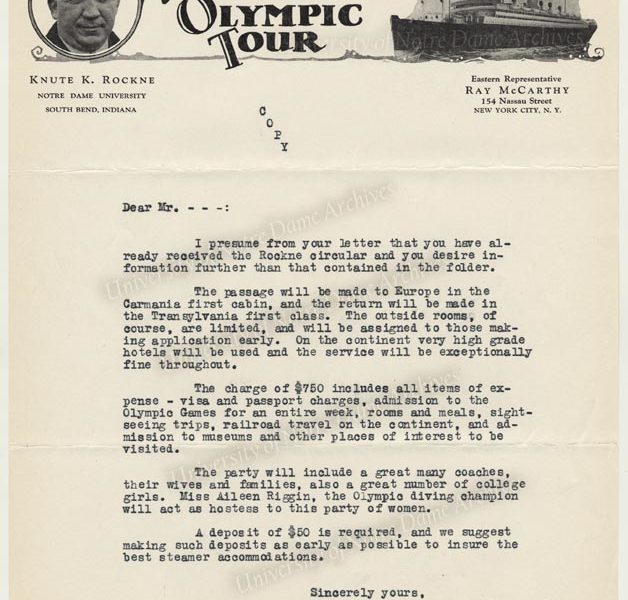
Ever the entrepreneur and marketing guru, Athletic Director Knute Rockne organized a six-week European tour with a stop over to watch the Track and Field events at the 1928 Olympic Games in Amsterdam.  He recruited friends, colleagues, and former Notre Dame athletes across the country to act as representatives to sell the tour within their social and professional circles and to the general public.  Many of these representatives held positions as coaches and athletic directors at colleges, high schools, and local athletic clubs.

According the Pittsburgh Post-Gazette, “The Rockne pilgrimage is expected to be the largest tour ever conducted by an individual to the continent, and it is the first time that an individual has arranged for the use of a boat of such great tonnage as the Carmania for a trip to the old world” [“Rockne to Conduct Olympic Tour,” January 30, 1928].

 Form letter regarding the details of Knute Rockne’s Olympic Tour, 1928

The nearly 200 participants were made up of Rockne’s friends and colleagues, including the likes of Pop Warner, Harry Stuhldreher, and Tom Lieb, college students, single men and women, and families.  The party departed New York City on July 20, 1928, and returned on September 2nd.  During the six-week summer trip, they visited England, Holland, Italy, Germany, Switzerland, and France.  Due to the success of the 1928 trip, it is likely that Rockne would have organized future Olympic excursions had he not met his untimely end on March 31, 1931.


Sources:
PATH 3-5-Ol Folder
UADR 22-23
“Rockne to Conduct Olympic Tour,” Pittsburgh Post-Gazette, January 30, 1928
“Many Will Journey with Rockne abroad for Olympic Events,” St. Petersburg Times, March 27, 1928

Corpus Christi

The Feast of Corpus Christi was once one of the most elaborately celebrated religious holidays at Notre Dame.  When the academic year ran through June, clergy, students, faculty, and community members celebrated the holy day with Mass, Vespers, and procession of the Eucharist through campus.  Students decorated the procession path with flowers, banners, flags, and arches.  They sang hymns and the band played as they processed around St. Joseph’s Lake in the 19th century or around the buildings of Main Quad in the 20th century.

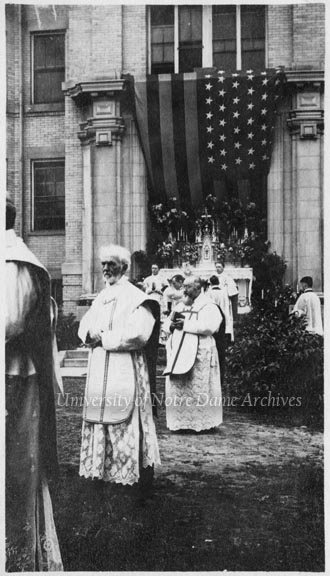
Corpus Christi Benediction in front of Walsh Hall –
Revs. T. Maher and Peter Franciscus, CSC, 1910

In the 19th century, the celebrations were so grand that they drew large crowds from the local community.  In 1876, three thousand people participated in the Corpus Christi celebrations, drawing people from as far as sixteen miles away (Scholastic, 06/17/1876).  Scholastic often reported details of the Corpus Christi festivities and below is the account from 1872:

Scholastic article detailing the Corpus Christi
celebrations at Notre Dame, 1872

Elaborate celebrations of Corpus Christi waned over the years.  However, Campus Ministry reinstated an annual Eucharistic Procession through campus several years ago.  These new processions accommodate the current academic calendar, as opposed to being held on the actual Feast of Corpus Christi.  Photos of Eucharistic Processions from the past few years can be found at photos.nd.edu.

Corpus Christi procession leaving the Basilica of the Sacred Heart, c1964
Sources:
Scholastic
GMWA 1/06
GPHR 45/4934

Memorial Day

Memorial Day began as Decoration Day to honor the dead soldiers from the Civil War.  However, it did not become a federal holiday until 1967.  When the academic year used to run through June at Notre Dame, students and faculty members participated in local parades and held ceremonies for the fallen military members of the Notre Dame community at the cemeteries.

Notre Dame Military Companies marching in a Decoration Day (Memorial Day) parade in South Bend, 1913/0530

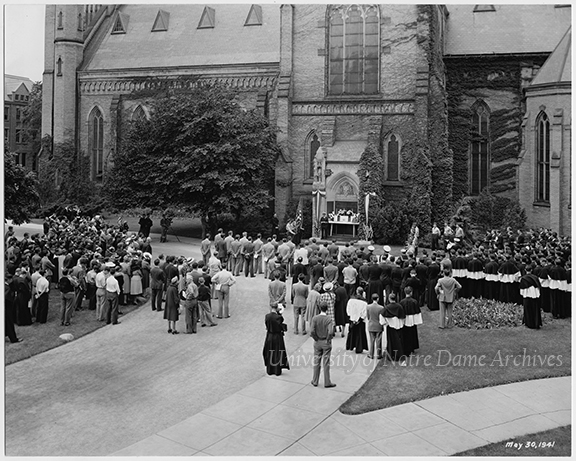
 The ceremonies at Notre Dame included the recitation of Abraham Lincoln’s Gettysburg Address, addresses by students and patriotic songs, and a requiem mass.  In 1925, Notre Dame created a memorial to her students who died in World War I at the east door of the Basilica of the Sacred Heart, which bears the epitaph “God, Country, Notre Dame.”  Through World War II, Memorial Day Masses and ceremonies were held outside of this door.

Memorial Day Ceremony held outside of the Basilica of the Sacred Heart’s World War I Memorial Door, view from above, 1941/0530

The change in the academic year to end in May and the observance of Memorial Day as a national holiday leaves campus rather quiet.


Sources:
Scholastic
PNDP 70-Me-01
GMIL 2/04
GDIS 29/02


Remember the Maine and Shilly

On the night of February 15, 1898, the USS Maine exploded and sank in the Havana, Cuba, harbor.  Tensions between the United States and Spain over the fate of Cuba led many to believe that Spain was behind the sinking of the Maine.  While multiple investigations have been unable to definitively identify the culprit, “Remember the Maine!  To hell with Spain!” became a rallying cry that helped to launch the Spanish-American War.  The Maine suffered 266 fatalities and most of the 94 survivors sustained some kind of causality.  Among the fatalities was John Henry Shillington, yeoman, third class.

Survivors of the USS Maine, 1898/0222.
Caption: “Roll Call of the Gallant Maine Boys at the Barracks Key West, Florida, Feb. 22, 1898. Washington’s Birthday. Maine blown up Feb. 15, 1898. Crew of 360 men, 266 perished, +L. Moriniere saved. Pennant of the Maine”

John Shillington of Chicago was a popular student at Notre Dame who was involved in many campus activities, including theater and athletics.  He played varsity baseball and was captain of the 1897 basketball team.  Rumor has it that Shillington was expelled for not returning to South Bend with the baseball team after playing at the University of Chicago in May 1897.  He then joined the Navy and ended up on the doomed Maine.

Portrait of John Henry Shillington, c1897

The February 19, 1898 issue of Scholastic reported on the death of their friend:

“John H. Shillington was of a nature which won him many friends, and when, last year, it was deemed necessary for him to sever his connection with the University he went away with the best wishes of all his friends and of all his professors.  He was a manly boy, and he did not complain. ‘I often think of Notre Dame,’ he wrote to a friend from the ill-fated Maine.  ‘I can picture her daily, and in my reminiscences of her a tear is often brushed away . . . . I suppose ‘Shilly’ is forgotten by people at the old college, and I don’t blame them.  Though forgotten, I shall always hold Notre Dame near and dear to me.’

“No; ‘Shilly’ is not forgotten at Notre Dame, but remembered with affection and mourned with sincere grief.  He shall have a share in the prayers of students and professors who will not fail in the only service which friendship can now render him.  God rest his soul!”

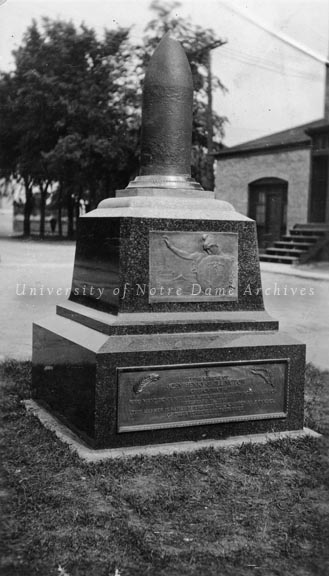
On Memorial Day 1915, a monument was dedication in the honor of Shillington just north of Science Hall (LaFortune Hall).  The Secretary of the United States Navy Josephus Daniels gave an address at the dedication and much fanfare surrounded the event.  The monument consists of a shell from the Maine on a base of red Wisconsin granite.

Shillington Monument, c1915-1916.
“To the memory of John Henry Shillington of Brownson [Hall] who went down with the battleship Maine in Havana Harbor, February 15, 1898. This marker is raised [1915] by the men of Brownson as a symbol of their sorrow and their pride. Requiescat in pace.”

Between 1925 and 1930, the monument was moved closer to the Bronson Hall wing of Main Building.  Many students had since forgotten Shillington or knew anything about the reason for the memorial.  In 1930, Scholastic reported that the Brownson Hall residents had taken to calling the monument “The Bullet,” as do some students even today.  The Shillington Memorial was moved further into obscurity to the south side of the Joyce Center near Gate 8 in 1989.  The Shillington Monument finally found a prominent home on the south side of the ROTC Pasquerilla Center in the 2000s.


Sources:
“The Destruction of the USS Maine,” Department of the Navy, Naval History and Heritage Command
Scholastic
PNDP 02-Sh-01
GSBB 2/05
GPOR 17/02
GMIL 1/03

Swim Team Bus Crash

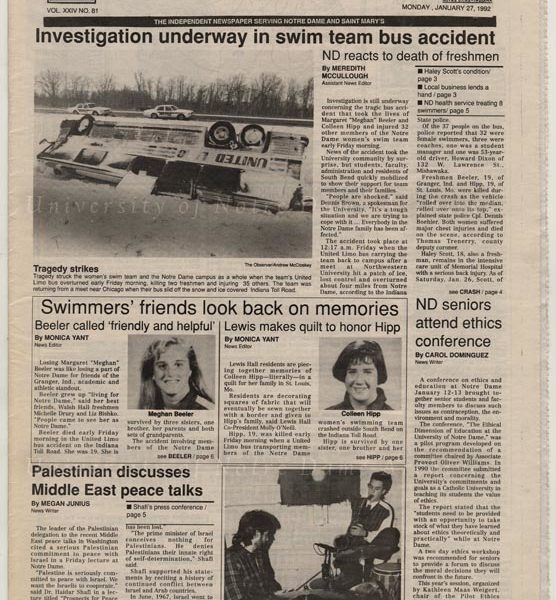
Early morning January 24, 1992, the Notre Dame women’s swim team was returning to campus from a meet at Northwestern University.  Just a few miles from the Notre Dame exit on the Indiana Toll Road, the bus carrying the team hit a patch of ice, skidded off the road, and flipped onto its side.

Front page of the 01/27/1922 issue of The Observer
after the Women’s Swim Team bus accident

Freshmen Margaret (Meghan) Beeler and Colleen Hipp died on the scene.  Fellow freshman Haley Scott sustained a severe spinal injury, which left her temporarily paralyzed.  Most of the swimmers and staff aboard the bus also suffered injuries, though not as severe as the three freshmen.  Scott recently wrote a book, What Though the Odds, recounting the tragic accident and her long, painful recovery.  Production of a movie of Scott’s story is currently underway.

A memorial mass for Beeler and Hipp will be said at the Basilica of the Sacred Heart on Tuesday, January 24, 2012, at 8:00pm.

September 11, 2001

Front page of the Observer after the September 11, 2001, terrorist attacks with the headline “Terror Hits Home” and a photograph of the New York World Trade Center buildings on fire. [Photo by Spencer Platt/Getty Images.]

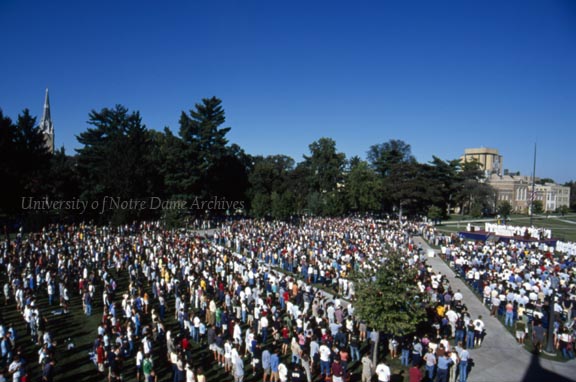
Mass on South Quad after the September 11, 2001, terrorist attacks
[Photo by Heather Gollatz]

Notre Dame Thomas Coleman Fire Station draped in black bunting
and with a firefighter coat and helmet outside on the bench in memorial of the firefighters in New York and Washington, D.C., 2001/0912
[Photo by Heather Gollatz]

Happy Fourth of July!

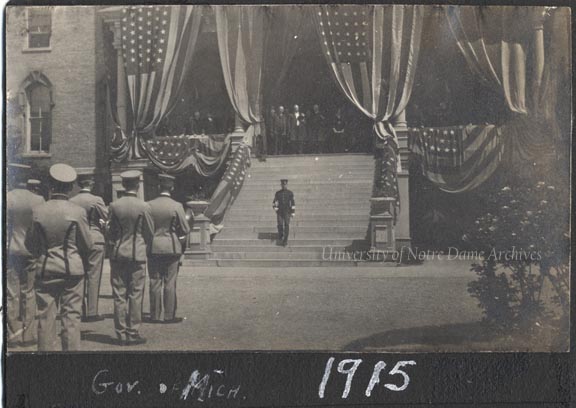
GNDS 2/11:  Main Building decorated with American flags for the visit of the Governor of Michigan, 1915.  In the foreground are SATC students in military uniforms.
[It is difficult to be certain, but this may have actually been the visit from
President Howard Taft on Decoration Day, 1914.  See the 1915
Dome yearbook, page 248 for other similar photographs from that event.]