In the collections of the University of Notre Dame Archives, references to weddings are scattered throughout. While these items don’t always have a personal connection with us today, they often provide an interesting insight into society, customs, and traditions.
A wedding party, c1860s-1870s
Some items are historically significant:
Newspaper illustration of the wedding of Minnie Sherman (daughter of General William Tecumseh Sherman) and Lieutenant Thomas Fitch, October 1, 1874, at St. Aloysius’ Church in Washington, D.C. (sketched by Harry Ogden). Among the numerous dignitaries in attendance were President and Mrs. Ulysses S. Grant; Rev. Edward Sorin, CSC, founder and president of the University of Notre Dame; and Mother Angela Gillespie, CSC, director of St. Mary’s Academy (now College), cousin of Ellen Ewing Sherman (wife of William Tecumseh Sherman), and namesake of Angela Boulevard in South Bend
Others show passé customs:
Pages 42-43 from “My Wedding Day” booklet by Louis LaRovoire Morrow, Bishop of Krishnagar, 1949. These pages outline the vows of the ceremony and the blessing of the rings in English and Latin
Pages from “Check List for Your Wedding” booklet by Msgr. James A. Magner, 1959. These pages outline what the bride, groom, parents, and attendants should wear to the ceremony. Gloves and hats are no longer required for Catholic weddings.
Some give insight to other cultures:
A country wedding in Jamaica, c1890s
While others demonstrate the fashions of the times:
Portrait of a bride, c1890s
(photo by McDonald Studios, South Bend)
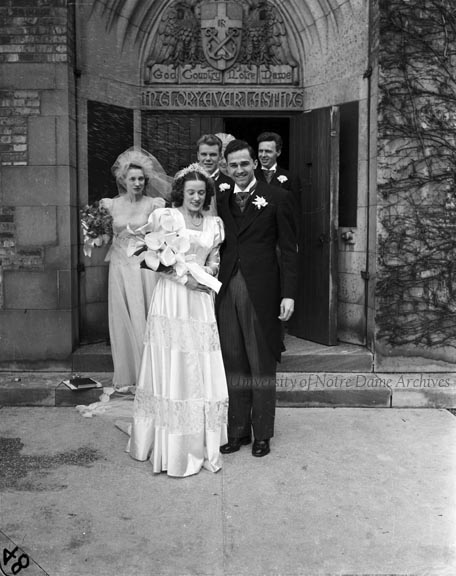
A wedding party leaving the Basilica of the Sacred Heart while being pelted with rice, c1930s
A bride with her father outside of the Basilica of the Sacred Heart, c1960
(photo by Walt Daly)
A wedding party, guests, and photographer at the Grotto, c1970s
Alumni have always been an important constituency of the Notre Dame family. They often return home to their Alma Mater independently and as part of organized groups. The first weekend in June has been designated as Alumni Reunion weekend, where Notre Dame welcomes back all her students, particularly those who celebrate their anniversaries on the fives and tens.
Alumni group (including many faculty members), c1880s. Includes Rev. Edward Sorin, Arthur Stace, William Ivers, Borzon (?), James (Jimmy) Edwards, Joseph Lyons, Thomas E. Walsh, Peter Cooney, Patrick Colovin, O’Connell, Kelly, Timothy Howard
The Society of the Associated Alumni first organized in 1868 and held many Reunions into the 1870s, but it faded near the turn of the century. In 1908, University President Rev. John W. Cavanaugh, CSC, sent invitations to all Alumni to return to their Alma Mater for Commencement, and thus reinstating the tradition of the annual Alumni Reunion.
Scholastic Alumni Issue, vol. 42, page 19: Alumni Reunion group posed on Main Building front steps, June 17, 1908. Scholastic lists all the returnees on a following page.
Alumni ribbon featuring an engraving on the new Main Building, 06/20/1888
Notre Dame Alumnus Class of 1910 Ribbon
Activities for this year’s Reunion will be similar to those in the past — meeting up with old friends and professors and their families, attending Masses and Class banquets, and ambling about an ever-changing campus.
Alumni Reunion – A group of alumni at a refreshment station outside of Howard Hall, c1960s-1970s
Class of 1917 Scenes from Alumni Reunion, 1947
Alumni walking around campus near the Hesburgh Library, which is under construction and does not have the Word of Life mural, June 1963
Alumni Reunion – “Still Crazy after All These Years,” including Suzzie and Jack McCabe and Paul Fox, 1989
2011 marks the 100th Anniversary of the Indianapolis 500 and a few items regarding the early years of the Motor Speedway exist in the University of Notre Dame Archives.
Indianapolis Motor Speedway, the Greatest Race Course in the World. This postcard is postmarked September 1910, a year before the first Indianapolis 500-Mile Race.
In 1913 and 1914, Notre Dame student Grover Miller and a group of friends (presumably other ND students) attended the Indianapolis 500 Races. Below are some of the photographs from his scrapbook:
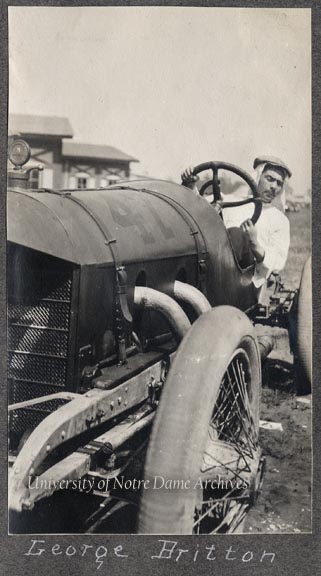
A straight-away on the track, 1913Entrance to the tunnel with the Grand Stand on the right, 1913Scoreboard, 1913George Britton in car #47, 1914
View of the Judges’ Stand, 1914
Notre Dame students? watching the races, including Bernie, Mike, Leos, and Mack, 1914
Racer Joe Dawson’s wrecked Marmon, car #26, 1914
Second-place winner Arthur Duray in his Peugeot, car #14, 1914
Mike and Grover Miller driving 61 miles per hour in a car, 1914Muh and Mike eating a box picnic lunch, 1914
An Tostal at Notre Dame began in 1967 by students Jimmy Brogan, David Ryan, and Ron Mastroni [Scholastic 1988/0414, page 14]. Its name comes from the spring festivals held in Ireland during the 1950s. At Notre Dame, it is a student organized event through the Student Union Board, and thus the events vary from year to year, but it is generally a week-long festival of games, prizes, music, and food. Other events such as the Fisher Hall Regatta and the Bookstore Basketball Tournament are held in conjunction with An Tostal.
An Tostal program cover featuring a leprechaun, 1970. The Hall Presidents’ Council (HPC) and the Saint Mary’s College (SMC) Social Commission organized the event.Map of some of the events near St. Mary’s Lake from the An Tostal Program, 1970An Tostal April 1973 – A student wearing a suit of armor and riding a horse
List of Scheduled Events from the An Tostal Program, 1992
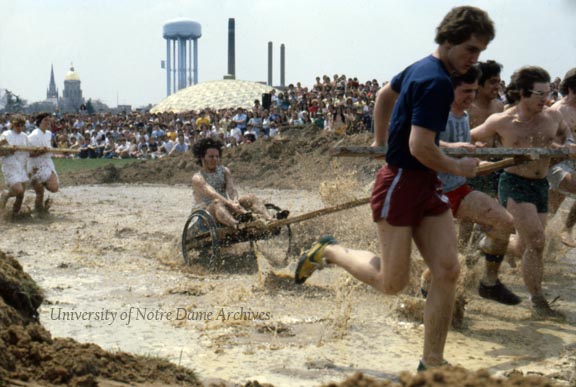
Events have included movies, concerts, picnics, pie-throwing contests, kissing marathons, tug-o-war contests, mattress races, chariot races, and lots of mud…
An Tostal Chariot Races through a mud pit near Stepan Center, Spring 1978An Tostal Tug-o-War, c1970sAn Tostal Pig Chase, c1970
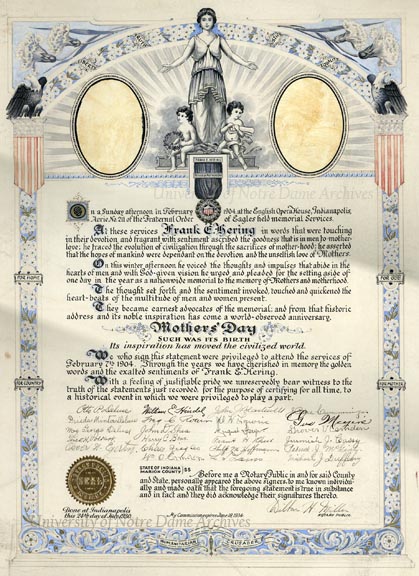
On February 7, 1904, Francis Earle Hering proposed the idea of “setting aside of one day in the year as a nationwide memorial to the memory of Mothers and motherhood” to an audience of the Fraternal Order of Eagles in Indianapolis [certificate below].
Certificate honoring Frank E. Hering, signed by those who were present at the English Opera House in Indianapolis on February 7, 1904, when Hering proposed a national day honoring mothers. This document was signed on 07/24/1930
Frank Hering first attended the University of Chicago, playing football under Amos Alonzo Stagg, from 1893-1894, then took a coaching job at Bucknell for a year, before coming to Notre Dame in 1896. That fall, Hering played quarterback and was the coach and captain of the football team. He also coached basketball, baseball, and track, and served as instructor of athletics. In 1898, Hering earned a bachelors in English (Litt.B.) and a bachelors in Law (L.L.B.) in 1902. He taught English from 1898-1902 and later served Notre Dame for many years as a Lay Associate of the Board of Lay Trustees and as President of the Notre Dame Alumni Association. He gave a speech at the dedication of Notre Dame Stadium in 1930 and was on the committee of the Rockne Memorial after Coach Knute Rockne’s death in 1931.
Varsity Basketball Team, 1897, with Frank E. Hering as coach (middle row, second from right). For an unknown reason, there is a frog on the knee of the player in front of him
Hering’s inspiration for a national Mother’s Day came from Notre Dame students writing home to their mothers: “[P]ractically every boy has as his sweetheart his mother – and that the surest way to appeal to him for his best efforts in building his character and his grades – those things greatly to be desired – was to remind him of the deep happiness his mother receives” [quoted in Scholastic, 05/09/1941, page 11].
Hering’s involvement with the Fraternal Order of the Eagles gave him an oratory platform to spread this idea of a day specially for mothers. Others were also campaigning the idea, including Anna M. Jarvis, and Congress passed a resolution in 1914, making Mother’s Day a national observance.
“Throughout history the great men of the world have given their credit for their achievements to their mothers. [The] Holy Church recognizes this, as does Notre Dame especially, and Our Lady who watches over our great institution” [Frank Hering, as quoted in Scholastic, 05/09/1941, page 11].
Many parents deny their children sugary cereals on a daily basis. Perhaps for this reason, the wide variety of cereal available in the dining halls has long been popular among the students, who are no longer under their parents’ watchful eyes. In February 1983, a couple dozen students protested the lack of Cap’n Crunch, the sugary cereal of choice, during dinner at South Dining Hall. This spurred Lee Brossard and his sophomore class running mate to make a campaign promise to hold a Cap’n Crunch party if elected.
The Quaker Oats’ mascot Cap’n Crunch meeting a fan at Notre Dame, October 1983
The sophomore class officers initially contacted Quaker Oats for just a few boxes of cereal for their party; however, Quaker Oats was intrigued by the idea. After some back and forth between Quaker Oats and the Notre Dame Administration, a week-long Cap’n Crunch festival was scheduled, which included a visit by the Cap’n himself, treasure hunts, and cereal eating contests.
A student participating in the Cap’n Crunch eating contest where neatness counted, October 1983.
This was one of the first major corporate-sponsored events at Notre Dame. Notre Dame is often approached by corporations to hold such events and the administration often denies such attempts. Crunch Fest became a reality because the students were so enthusiastic about the idea. This particular event itself was reigned in a bit as Fr. John Van Wolvlear, President of Student Affairs, eliminated Quaker Oats’ original idea to have the Cap’n bid the students farewell from a boat-shaped float in the Stadium during the USC game. No events were scheduled for that Saturday home football game day, nor was the Stadium a venue for any part of Crunch Fest.
Wall Street Journal newspaper article regarding the 1983 student protest over the lack of Cap’n Crunch cereal in South Dining Hall; published in Parade magazine, 01/29/1984
Skimming the entries for St. Patrick’s Day in a search of the finding aids and the Calendared collection, as well as some articles in Scholastic, it is apparent that St. Patrick’s Day in America was more than an ordinary saint’s feast day. St. Patrick’s Day celebrations could also be patriotic and political.
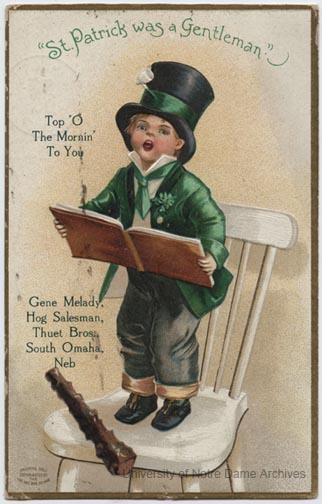
Postcard sent to James Edwards from Gene Melady, 1909
In 1846 the Society of the Friends of Ireland in New York sought “to improve the condition and degraded state of their countrymen both in America and in Ireland” [I-3-h, 1846 Mar. 2]. In 1847 they canceled their annual celebration in reverence to those in Ireland suffering from the great famine and diaspora [I-3-h, 1847 Mar. 2].
In 1892, J.M. McDonald stated in his Columbian oration, “To-day however we celebrate an anniversary that brings to Irishmen sorrow as well as joy; for we commemorate the name of the redeemer of a land that is not yet free. … surely, the recital of a struggle for human freedom will ever retain a peculiar charm to allure the American heart” [Scholastic, 03/19/1892, page 474]
Here at Notre Dame, it is said that Fr. Edward Sorin discouraged St. Patrick’s Day celebrations “in the interest of Americanism” [Notre Dame: 100 Years by Rev. Arthur J. Hope, CSC, page 140; however, no citation of source]. If this sentiment was true, Fr. Sorin was not very successful in squashing St. Patrick’s Day festivities as they became quite elaborate and popular in the second half of the 19th century.
The tradition of celebrating the University President’s feast day necessitated celebrations on St. Patrick’s Day for Revs. Patrick Dillon and Patrick Colovin, CSC [click here for the list of University Presidents]. An increase of students and faculty with Irish backgrounds, as well as the involvement of Notre Dame personnel including Rev. William Corby, CSC, in the Irish Brigade during the Civil War, probably also brought St. Patrick’s Day celebrations to prominence at Notre Dame.
Below is an 1883 letter from student Louis Pour to his parents, recounting the St. Patrick’s Day festivities at Notre Dame. Beneath the letter is the program of events hosted by the Columbian Literary and Orpheonic Societies from the same year.
Transcription: “Notre Dame, Ind., March 28, 1883. Dear Parents. I take the pleasure of writing to you those few lines to let you know that I am well at present and I hope those few lines will find you the same. The weather at present is not cold but it is snowing mostly ever day and melting nearly as fast as it falls. Dear Parents, I will tell you that we had reck [recreation] on St. Patrick day and the boys had a very lively time in the morning we went to church in which one of the fathers preached about 1 ½ hours on the life of St. Patrick and [page 2] The history of Ireland and when church was over the boys commenced playing the band in front of the college and in the afternoon Randolph and myself and four other boys went asked one of the Brothers to take us up in the steeple [of the Basilica of the Sacred Heart] to see the Bells which he did immediately so when we got up their three or four of the boys tapped to see how loud it would sound the bell weighs seventeen thousand pounds and, it takes four men to wring it and after he’d played two or three tones by chains. And still St. Patrick was not over yet in the evening they all assembled in the Rotunda of hear some of the boys speak in which George Clark delivered a very fine piece of poetry he is the best speaker of the students of Notre Dame and is a resident of Cairo, Illinois. This is all for the present, so when you receive this letter I suppose you will answer it with more latitude than the last, for I suppose that time are not so hard. Best regards, L. Pour.”
In 1941, John Lynch wrote an article for Scholastic, lamenting the lack of activities at Notre Dame for St. Patrick’s Day in comparison with those in the 19th century:
Lynch eventually got his request for a day off — because of the potential raucous nature of current St. Patrick’s Day celebrations, it is probably no coincidence that in recent history March 17th has fallen over Notre Dame’s spring break.
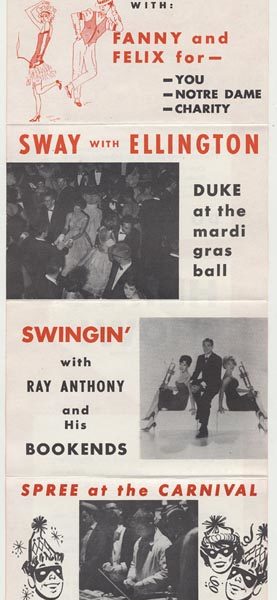
From the late 1940s until the early 1980s, the Notre Dame Mardi Gras celebration at one point ranked “as one of the top three college weekends in the nation.” [South Bend Tribune, 02/21/1963; PNDP 70-Ma-01]
The weekends were student-organized and over the years featured dances, carnivals, and jazz concerts, drawing big names such as Tony Dorset, Duke Ellington, Louis Armstrong, and the Four Tops.
Students also sold raffle tickets, whose profits went to support a number of charities, including foreign missions, scholarships for students in countries devastated by World War II, scholarships for Notre Dame students, and a number of Notre Dame social service organizations such as CILA and the Neighborhood Study Help Program.
By selling raffle tickets, students were eligible to win prizes, ranging from desk sets and radio transistors to sports cars and vacation trips.
In the early 1980s, the bishop of the Fort Wayne – South Bend Diocese encouraged Catholic churches and organizations in the diocese to comply with Indiana state law, which banned gambling. Carnival games replaced the casino element in 1982. Because of this and other intangible factors, extravagant Mardi Gras celebrations were no longer an annual campus-wide event at Notre Dame.
Although a French man, Fr. Edward Sorin, founder of the University of Notre Dame, was quick to embrace American patriotism. It is no coincidence that Washington Hall was named after the first President of the United States.
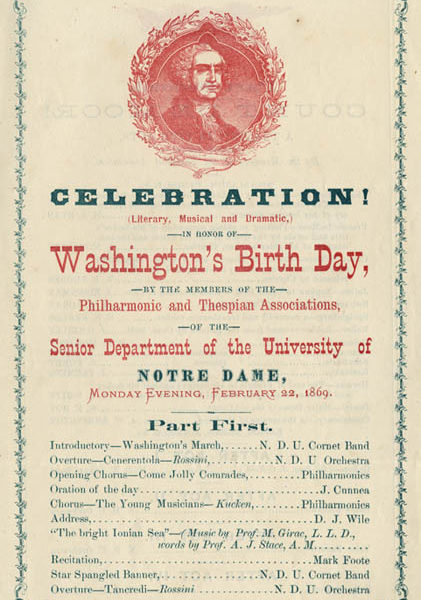
Notre Dame began organizing George Washington Birthday celebrations shortly after its 1842 founding. The events often would consist of musical concerts and theatrical productions from Notre Dame student associations and lectures and speeches from faculty and visitors.
Cover of the 1869 Washington Day Exercises program
At the turn of the 20th century, a flag presentation was added to the Exercises. An American flag was blessed and flown from Commencement throughout the next year. By the mid-1900s, attendance at the Washington Day Exercises was required by Seniors in order to graduate.
Washington Day Exercises – Students in caps and gowns entering Washington Hall through the second floor entrance, c1930s
In 1954, Notre Dame established the Patriot of the Year Award, presented by the Senior Class. The Seniors would vote from a list of prominent nominees and the award winner generally would speak at the Washington Day Exercises. The award winners included Senator John F. Kennedy, Astronaut John Glenn, and Comedian Bob Hope. See the entire list of winners here.
By the early 1970s, the mandatory, theatrical Washington Day celebrations had mostly subsided and there are no longer grand celebrations on campus. “The Exercises through the years have aided many students in the formation of firm ideas about their obligations to the community. The Washington Day Exercises constitute a public and formal acknowledgment of ‘God, Country, and Notre Dame.” [programs from the late 1950s to early 1960s in PNDP 70-Wa-01]

 A wedding party, c1860s-1870s
 Newspaper illustration of the wedding of Minnie Sherman (daughter of General William Tecumseh Sherman) and Lieutenant Thomas Fitch, October 1, 1874, at St. Aloysius’ Church in Washington, D.C. (sketched by Harry Ogden). Among the numerous dignitaries in attendance were President and Mrs. Ulysses S. Grant; Rev. Edward Sorin, CSC, founder and president of the University of Notre Dame; and Mother Angela Gillespie, CSC, director of St. Mary’s Academy (now College), cousin of Ellen Ewing Sherman (wife of William Tecumseh Sherman), and namesake of Angela Boulevard in South Bend
 Pages 42-43 from “My Wedding Day” booklet by Louis LaRovoire Morrow, Bishop of Krishnagar, 1949. These pages outline the vows of the ceremony and the blessing of the rings in English and Latin
 Pages from “Check List for Your Wedding” booklet by Msgr. James A. Magner, 1959. These pages outline what the bride, groom, parents, and attendants should wear to the ceremony. Gloves and hats are no longer required for Catholic weddings.
 A country wedding in Jamaica, c1890s
 Portrait of a bride, c1890s
 A wedding party leaving the Basilica of the Sacred Heart while being pelted with rice, c1930s
 A bride with her father outside of the Basilica of the Sacred Heart, c1960
 A wedding party, guests, and photographer at the Grotto, c1970s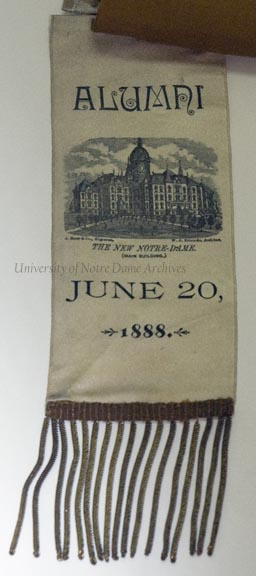








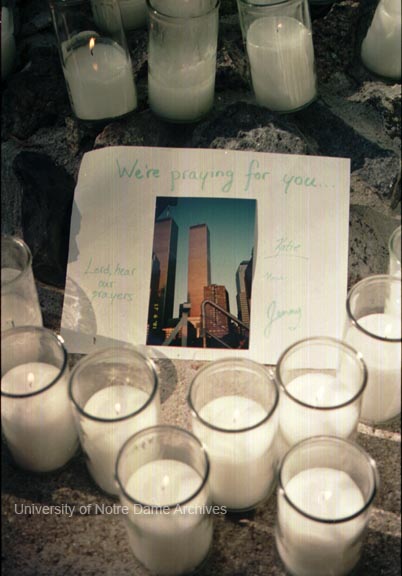


 Vigil Procession after the September 11, 2001, Terrorist Attacks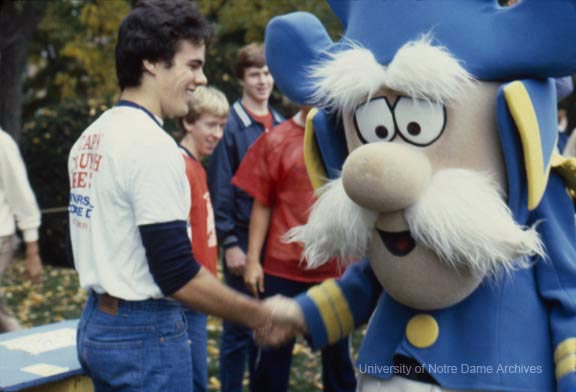




 band in front of the college and in the afternoon Randolph and myself and four other boys went asked one of the Brothers to take us up in the steeple [of the Basilica of the Sacred Heart] to see the Bells which he did immediately so when we got up their three or four of the boys tapped to see how loud it would sound the bell weighs seventeen thousand pounds and, it takes four men to wring it and after he’d played two or three tones by chains. And still St. Patrick was not over yet in the evening they all assembled in the Rotunda of hear some of the boys speak in which George Clark delivered a very fine piece of poetry he is the best speaker of the students of Notre Dame and is a resident of Cairo, Illinois. This is all for the present, so when you receive this letter I suppose you will answer it with more latitude than the last, for I suppose that time are not so hard. Best regards,