
To enable effective data acquisition and processing in open environments, sensing systems must feature behaviors that are taskable, cognizant, and collaborative: the autonomous agents that carry the sensors need to be able to translate high-level human instructions to executable strategies, exhibit high-level awareness of their own and each other’s capabilities and limitations in both sensing and actuation domains for information collection, and be able to self-organize into meta-sensors to fuse multi-modal data collected from different viewpoints. Focusing on the last two characteristics (i.e., cognizant and collaborative), the goal of the proposed work is to develop and evaluate a computationally efficient and rigorous approach for collaborative information gathering and fusion in open environments.
Hierarchical Active Perception
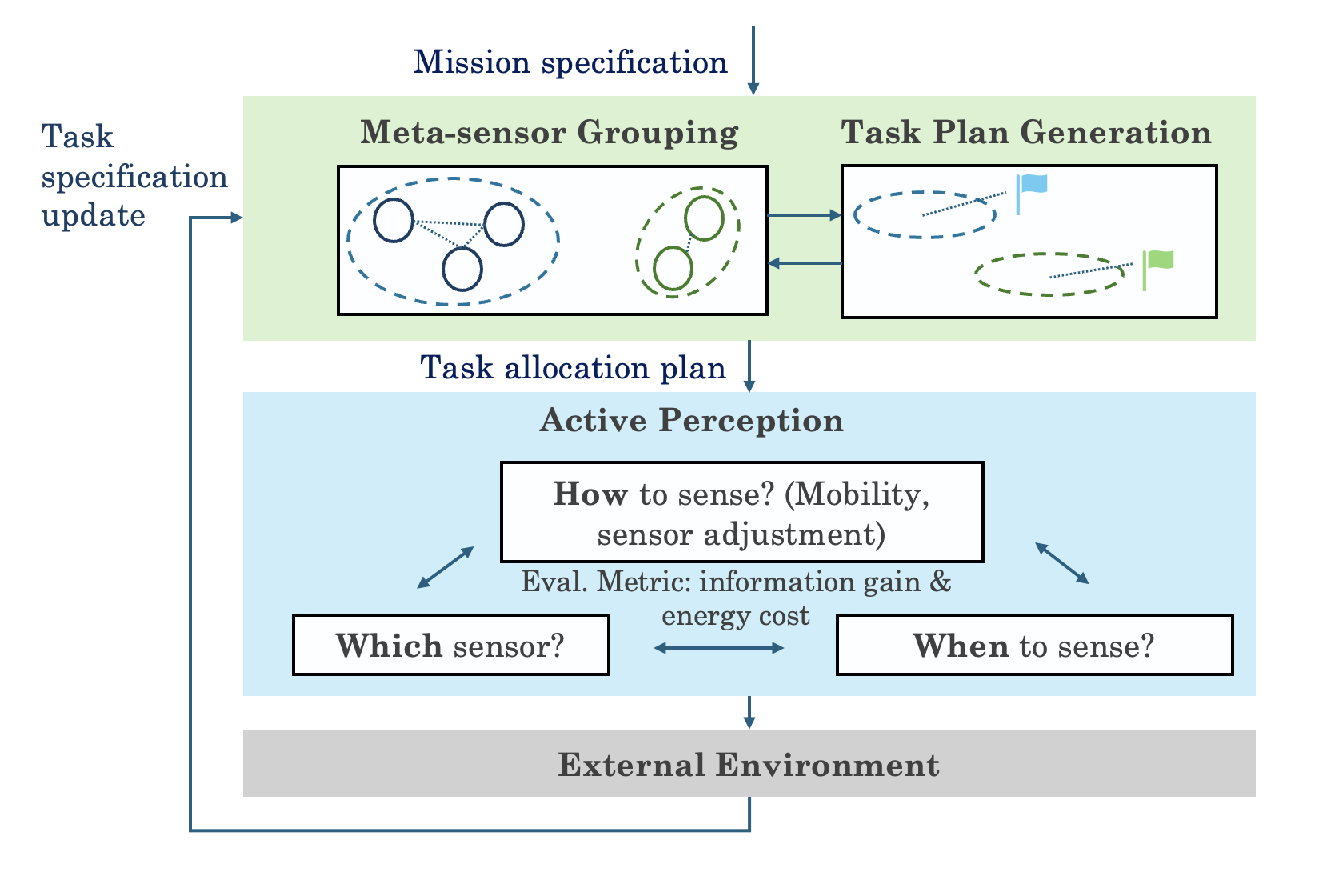
We focus on enabling a team of heterogeneous sensors to identify a mobility and active sensing strategy that generates sufficiently informative data streams. This strategy should specify (i) high-level plans for the agents with diverse sensing and actuation capabilities to coordinate efficiently, leveraging their unique strengths to maximize knowledge acquisition, and (ii) lower-level executable actions, including how to sense, when to sense, and what sensor or modality to use. Overall, the generated strategy should satisfy the desired information collection objective of the command center, while, at the same time, satisfying local and inter-agent constraints.
Multi-modal Sensor Fusion
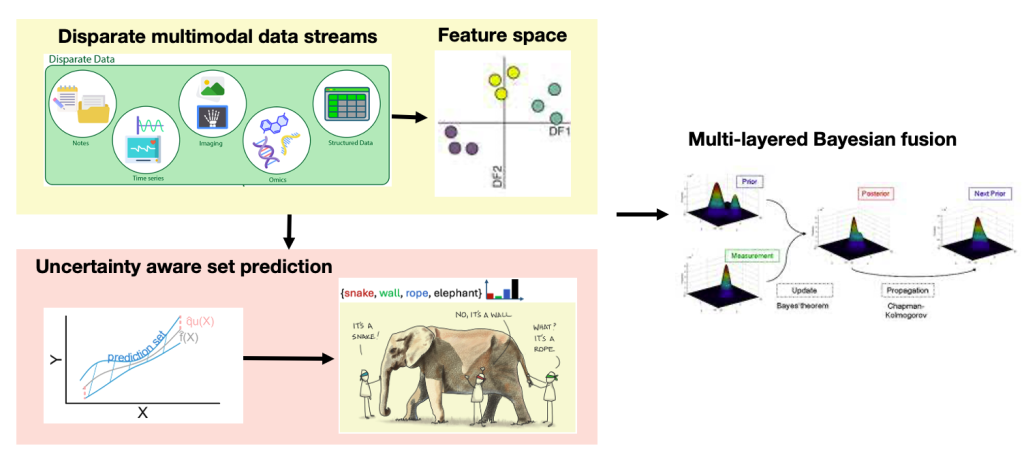
The multi-modal sensory data collected by sensing agents from different perspectives and contexts needs to be fused. A crucial point here is that, in general, the estimate based on all the data can be quite different than fusing estimates based on parts of data. In an extreme case, this can be illustrated by the fable of the blind men and the elephant. Each blind man when looking at only part of the elephant generates the most likely estimate such as a rope or a wall.
However, generating and trying to fuse all possible explanations to the data is also not scalable. Further, in a multi-agent system, sharing all measurements at every timestep leads to communication and computational bottlenecks. However, if information is only shared locally, the Markovian signal is not available anymore, and the coverage guarantee may be lost. The question we aim to answer is developing a “fuse-then-estimate” approach that guarantees coverage of all possible solutions, while at the same time provides real-time responsiveness.
Publications
Zongyao Liu, Vijay Gupta and Mengxue Hou, “NASAP: Hierarchical Non-Myopic Sensor Assignment and Active Sensing for Multi-Target Tracking”, in 2026 IEEE/RSJ International Conference on Intelligent Robots and Systems (IROS), accepted. video