Invitation to GLOBE at Night collaboration

2011-02-28_1255
I’m passing along the invitation below from Connie Walker of the National Optical Astronomy Observatory (NOAO). This concern for light pollution is an important project of our friend and regional collaborator Chuck Bueter of Nightwise.org. So anyone interested in this GLOBE activity might contact Chuck:)

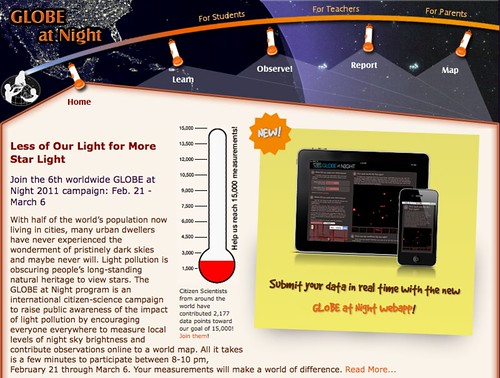
Less of Our Light for More Star Light

Join the 6th annual worldwide GLOBE at Night 2011 campaign: Feb. 21 – March 6

What: The Globe at Night Campaign

When: 8pm to 10pm local time, February 21 – March 6, 2011

Where: Everywhere

Who: Everyone

How: See http://www.globeatnight.org

GLOBE at Night encourages citizen-scientists worldwide to record the brightness of the night sky. During 2 winter/spring weeks of moonless evenings, children and adults match the appearance of a constellation (Orion in February/March and Leo and Crux in March/April) with 7 star charts of progressively fainter stars found at www.globeatnight.org. They then submit their choice of star chart on-line with their date, time and location to help create a light pollution map worldwide.

The GLOBE at Night 2011 campaign dates are February 21 – March 6 (worldwide) and March 22 – April 4 (for the Northern Hemisphere) and March 24 – April 6 (for the Southern Hemisphere). 52,000 measurements have been contributed from more than 100 countries over the last 5 years of two-week campaigns, thanks to everyone who participated!

This year children and adults can submit their measurements in real time if they have a smart phone or tablet. To do this, you can use the web application at www.globeatnight.org/webapp/. With smart phones and tablets, the location, date and time are put in automatically. And if you do not have a smart phone or tablet, there are user-friendly tools on the GLOBE at Night report page to find latitude and longitude.

Through GLOBE at Night, students, teachers, parents and community members are amassing a data set from which they can explore the nature of light pollution locally and across the globe. Please make a difference and join our efforts in 2011. For activity packets, one-page flyers and postcards advertising the campaign, visit www.globeatnight.org/pdf/.

~~~~~~~~~~~~~~~~~~~~
Constance E. Walker, Ph.D.
director, GLOBE at Night campaign (www.globeatnight.org)
chair, International Dark-Sky Association Education Committee
chair, IYA2009 Dark Skies Awareness Cornerstone Project
member, Astronomical Society of the Pacific Board of Directors
associate scientist & senior science education specialist, NOAO

National Optical Astronomy Observatory (NOAO)
950 N. Cherry Avenue
Tucson, AZ 85719 USA
520-318-8535
cwalker AT noao.edu
Summer science workshop for middle schoolers: Sensing Our World

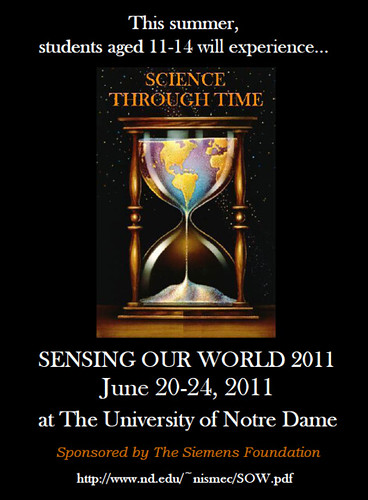
Below I pass along an announcement for a very cool week-long summer science program at Notre Dame for middle school students. NDeRC’s Enviro collaboration organized a day-long session in this event last year, and we had a blast. Send this announcement along to middle school students and their parents, cementing your friendship with them for life:)

2011-02-24_1407

This year’s Sensing Our World: Science Through Time program will explore themes from Earth’s past, present, and future in biology, physics, chemistry, mathematics, and geology. Scientific processes occuron time scales from nanoseconds to eons. In the blink of an eye, cells can divide and a hummingbird can flap its wings almost 90 times! At much lengthier time scales, continents move and animals go extinct, like the dinosaurs. Scientists often look to the past to understand the world today. Also, by understanding current processes and trends, they make predictions about the future.

The week will involve hands-on science, including exploring the structure of skeletons at the Museum of Biodiversity, immersing ourselves in nature to understand the complexities of ecosystems, and tackling issues related to climate change –such as, what should we do for polar bears if all the sea ice melts? We hope you’ll join professors and graduate students during this exciting week on the campus of Notre Dame, so complete the application today!

Classes will be held at the Notre Dame campus Monday through Friday, from 9:00 a.m. to 4:00 p.m. Activities include meeting with ND scientists to learn about their research, and visits to several different academic departments and research labs on campus. We expect a large response to the summer program, so please read through the instructions carefully. The deadline for applications is May 13, 2011. Applications are reviewed by a selection committee, and students will be admitted to the week’s hands-on science exploration program. Selection notices will be e-mailed to students by June 1, 2011.

SPONSORS

Sensing Our World 2011: Science Through Time is supported and sponsored by
•The Siemens Foundation
•The Northern Indiana Science, Mathematics, and Engineering Consortium (NISMEC)
•The Joint Institute for Astrophysics (JINA) and the Nuclear Structure Laboratory
•The Department of Biological Sciences
•The Department of Physics
•The College of Science

March 29 public lecture: The Large Binocular Telescope

2011-02-24_0941

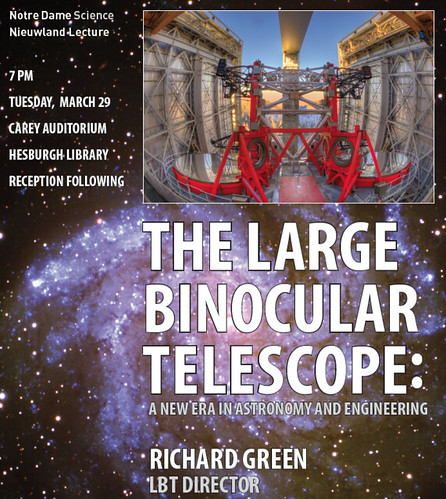
This public lecture is a chance to get a very close look into a major scientific instrument and the experiments surrounding it:  the Large Binocular Telescope.  I’d recommend it for anyone interested in science and engineering. The lecture might be a stretch for middle school students, but just the right kind of stretch. K-12 science teachers are especially encouraged to attend.  Mark your calendars for 7:00 PM, Tuesday, March 29.

I’ve seen the LBT mirrors being ground under the University of Arizona football stadium…each of them is about as large as your living room and kitchen, combined. Come and see. If you’ve got five minutes to peer into the infrastructure of mirror creation, watch the video below:)

The University of Notre Dame is one of nine LBT Corporation Partners.

From the event announcement:
“The Large Binocular Telescope is a marvel of precision engineering with massive scale. With its two 8.4 meter (27.6 foot) diameter primary mirrors on a common mount, it is the largest optical telescope in the world. The primary mirrors are actively controlled at a slow rate to maintain their perfect figures, while the secondary mirrors change shape 1000 times a second to compensate for the blur of the atmosphere. The instrument complement includes pairs of optimized 36 megapixel CCD cameras, high-throughput optical spectographs, and unique multi-object infrared spectographs. Two additional instruments will combine the light coherently from the two sides to create images ten times sharper than those from Hubble Space Telescope. Scientific discovery has been underway since 2008 in fields ranging from stellar archaeology in nearby galaxies to star formation in the distant universe. Notre Dame astronomers have played a leading role as scientific investigators with this unique facility.”

Google Science Fair

Text below is from the Google Apps for Education Newsletter, February 2011:

Google Science Fair

At Google, the only thing we love as much as science is science education. We want to celebrate young scientific talent and engage students who might not yet be engaged with science. So, in partnership with CERN, the LEGO Group, National Geographic, and Scientific American we’ve created an exciting new global science competition, the Google Science Fair. Students all over the world who are between the ages of 13 and 18 are eligible to enter this competition and compete for prizes including once-in-a-lifetime experiences, internships and scholarships.

We’ll be accepting submissions from January 11 to April 4 2011, submitted electronically via a Google Site. Please note that if students at your school are unable to access Google Sites or share a Google Site outside your school, we recommend that they use a personal Google account to create and submit their project.

To learn more, visit google.com/sciencefair, and to request Google Science Fair materials for your classroom fill out this form, or download handouts and posters here.

Google Art Project

from The Google Art Project
Google sets its employees free to collaborate with one another on ANY good purpose: they call these collaborations their “10 percent” projects, since every Google employee from salesman to CEO in encouraged to dedicate 10 percent of their Google time to such collaborations. I’ve been the direct beneficiary of one such “10 percent” project, the Google Certified Teacher community. Google knows that if you want a creative and collaborative workforce you’ve got to encourage creativity and collaboration. Creativity and collaboration are hallmarks of the 21st Century workforce: you’re going to like this.

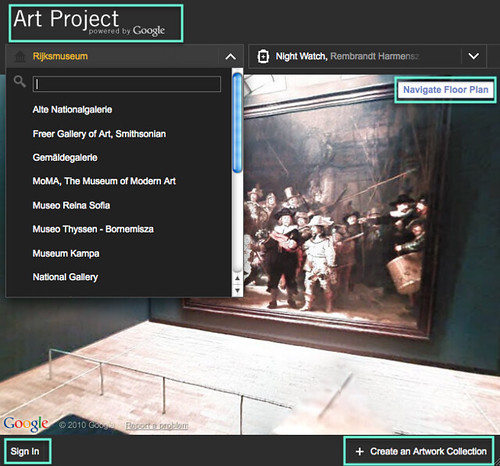
Here’s one of Google’s latest ventures: the Google Art Project. (I haven’t confirmed that this is a 10 percent project.) Notice (with some help from the highlighted boxes above) that you can choose which museum to visit and which artworks to view within that museum; you can navigate through the museum; you can save your favorites, etc, when you sign in; and you can even add your own content–should you have a museum you’d like to share online. So go explore the museums of the world, from your laptop or your smartphone. This is technology in service of the arts.

Every student in Michiana (and everywhere else) can visit the world’s greatest museums, and they should all know it. More than this, every student should believe that they can visit anywhere they like, online. The rule of thumb for the new web is that if you can think of the service you wish existed, it already does exist, it’s free, and you can successfully search for it in 30 seconds. Try it.

Wannabe a software worker-bee?

We all use computers, but we don’t always think about the work that goes into programming them. This article in International Science Grid This Week entitled The Beauty of Software introduces some visualization software that makes it possible to watch the history of a piece of software being programmed in many different versions by many people over time. Watch, enjoy, and check out the article for a bit more explanation.

We need students to learn how to program computers. Let’s invite them by showing them some of the beauty of software development.