All God’s children should code

I got to Code for South Bend on Saturday…or rather, I got to the presentation on the projects they undertook that day. It was a fantastic experience. I had spent six hours earlier in the day listening to some of the best ideas around for promoting STEM education in Michiana. By the end of my time at Code for South Bend, it was clearer to me than ever that even the best of our typical conversations about STEM education are overlooking a hugely important element that is crucial to Michiana’s future. Kids need to code. Take 10 minutes to watch this very fine defense of that claim.

Want to learn to code, but don’t know where to start? Consider starting here, at Code Academy. See my first mistake and first success, below. There are many free resources beyond this one, but I’d start here if you’re starting from scratch. (You can move on to Scratch, a free and easy-to-use program, later:)
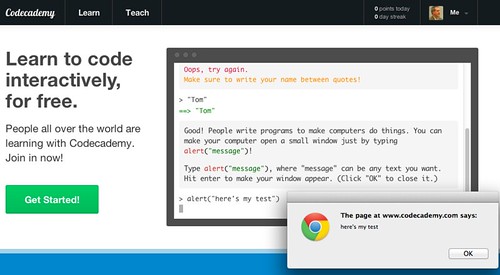
2013-02-28_1456

Here’s work that one local High School student has done with MATLAB, very early on in the learning process. (He had already learned to code in another language, Java, and was only just a month or so into learning MATLAB.) Very plainly, he’s learning to tell the computer what he wants it to do. For those really interested, his code is here.

Unable to display content. Adobe Flash is required.
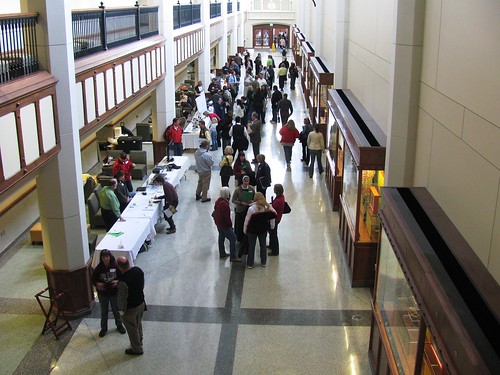
Got tech? Code for the Bend.

This fantastic event, scheduled for this Saturday, February 23, conflicts with our Collaborating for Research and Education Forum. But if you have the time and the spark, consider attending. Register for Code for South Bend here. Even if you have more interest than technical aptitude, there are projects here for you, including the writing of a South Bend-area wiki.

If you are attending the Forum, consider joining the Code for South Bend event (as I will) for the concluding presentation of projects at 5:00 pm. Hope to see you there!

Blog post #1: Experiments are rarely simple

I thought that I would add my first quick post here to reflect on the physiology experiments currently being conducted in our General Biology Lab B course.

We told students from the outset that we didn’t expect them to produce Nobel Prize level work in Physiology in just two lab sessions.   But that our real goal was for them to have the experience of planning, conducting, analyzing, and communicating an experiment that was all their own.

This last week in lab was busy with the buzz of students doing jumping jacks, drinking coffee, listening to music, all for the sake of science.  I was a subject for two experiments; one that looked at the effect of cold on manual dexterity (I had to hold my arm in ice water for 30 sec.) and one on the effect of spinning (I was spun around in a lab chair 15 times) on a mental task (sorting M&Ms  by color).  I admit that I was lured into the second experiment by the promise of chocolate, but in retrospect, I really should have declined. Call it old age, dehydration, caffeine headache, whatever, but I can tell you that I didn’t feel right for the rest of the day.

Undoubtably for some research groups, this will all feel like a grade school science project.  But for many, I hope that they experienced the real struggle of designing a solid experiment with replication, randomization, and appropriate controls.  The statistical analysis portion of the project always brings up the “it depends” answer to the “which is the right statistical test” question.  Lessons to be learned:  even simplest experiments aren’t simple.


Superintendent Glenda Ritz to speak at ND Feb 23rd Forum

IMG_2931
Don’t miss the 6th Annual Collaborating for Education & Research Forum on February 23, 2013 from 8:15 a.m. – 2:00 p.m. in Jordan Hall of Science on the campus of the University of Notre Dame. We’ve compiled a wonderful program for this year’s event!

SPECIAL GUEST
Glenda Ritz – Indiana Superintendent of Public Instruction

PANEL DISCUSSION
On the Road to High Quality Instruction: Creating a Culture of Support for Teachers

MICHIANA SCIENCE AND TECHNOLOGY CENTER PLANNING
President Greg Jones will present an overview of the MSTCi Strategic Plan

LEARN more about Teacher Quality Metrics
REVIEW great STEM Related Opportunities for Teachers & Students
MEET new collaborators in STEM engagement activities
VISIT the lunchtime Project Fair & register for various summer activities
ENJOY a free continental breakfast and lunch
RECEIVE 5 PGPs for participating (teachers only)

REGISTRATION IS FREE, BUT SPACE IS LIMITED.

To register, visit events.michianastem.org.
Please register by Feb 20th to attend.
Continental breakfast begins 8:15a.m.
Program begins promptly at 8:50a.m.
If you have already registered, but cannot attend, please contact tblacket@nd.edu.