

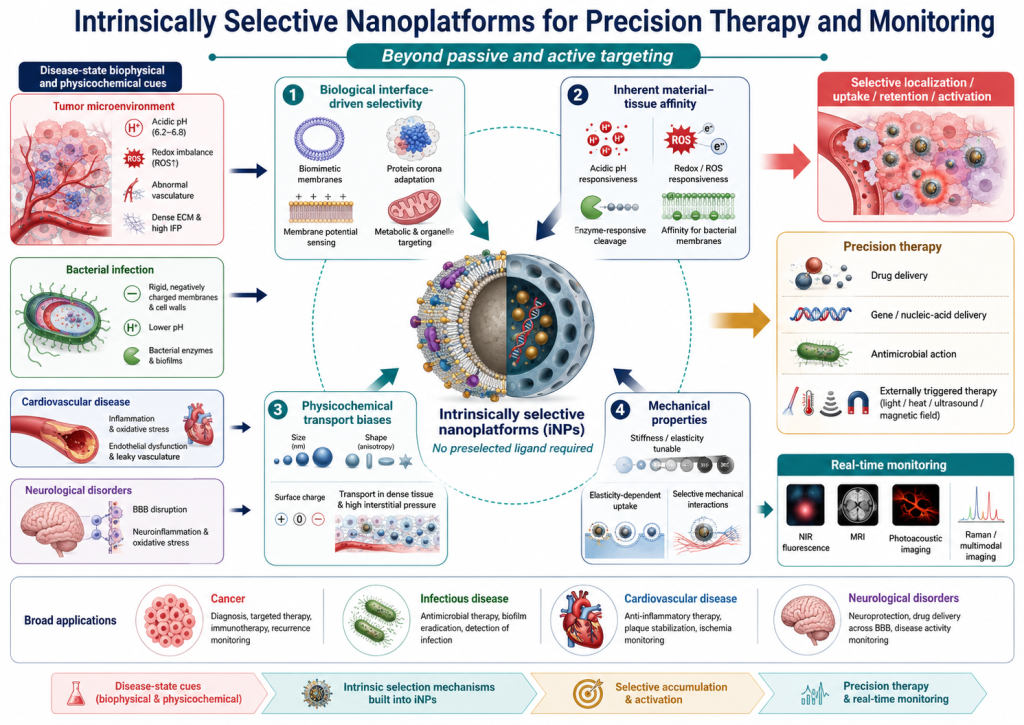
I am thrilled to share that our invited Feature Review — led by graduate researcher Aurelie Brownsberger as lead author with significant contributions from undergraduate researchers in our group— is now published in MDPI’s Journal of Nanotheranostics (JNT), as part of the Special Issue: Feature Review Papers in Nanotheranostics.
Title: Intrinsically Selective Nanoplatforms for Precision Therapy and Monitoring Lead Author: Aurelie Brownsberger (Nallathamby Lab) Journal: Journal of Nanotheranostics, Vol. 7, Issue 2, Article 12 (2026) Read it (open access): https://www.mdpi.com/2624-845X/7/2/12 PDF: https://www.mdpi.com/2624-845X/7/2/12/pdf
Being asked to contribute a Feature Review to a Special Issue is a real honor — the format is designed to consolidate a research area for the broader community, and these invitations are extended sparingly. Our sincere thanks to the JNT editorial team for the invitation and for shepherding the manuscript through to publication.
Aurelie’s Lead Authorship
I want to be very explicit about authorship credit here, because it is well deserved. Aurelie led the drafting of this review from start to finish, under my guidance. That meant conceiving the structure, surveying a broad and fast-moving literature, defending an organizing framework — the intrinsic targeting category, which the review puts forward as a stand-alone class alongside active and passive targeting — and helping me shepherd the manuscript through editorial revisions and peer review. Producing a Feature Review of this scope is a substantial intellectual undertaking at any career stage, and Aurelie executed it with maturity, rigor, and an impressive command of the field.
Earning a lead-author Feature Review in an international journal while still in graduate training is a genuine accomplishment, and I am proud to have had the opportunity to mentor her through it.
For readers who have been following lab news, this is the same Aurelie whose magneto-electric silica nanocarrier project for triple-negative breast cancer earned her an oral-presentation slot and a $400 travel grant at this year’s Harper Cancer Research Day, and who carried that work to the 2026 Society For Biomaterials Annual Meeting. The Feature Review caps off a remarkable run for her this academic year. Congratulations, Aurelie. Outstanding work.
What the Review Argues
The review takes a step back and reframes how we think about precision in nanomedicine. Most reviews in this space emphasize active targeting (decorating a nanoparticle with antibodies, peptides, or aptamers that bind a known receptor) and passive targeting (relying on the leaky vasculature and impaired drainage of tumors — the EPR effect). Aurelie’s central argument is that there is a third, underappreciated category that deserves its own framework:
Intrinsically selective nanoplatforms (iNPs) — particles whose innate biophysical properties (size, shape, charge, stiffness, plasmonic or magnetoelectric behavior) drive selectivity for diseased cells without requiring a ligand or a tumor-leakage mechanism.
Why this matters: a significant fraction of clinically aggressive cancers are “untargetable” in the conventional sense — they do not present distinct, druggable surface markers. Active targeting strategies fail by definition for these tumors. iNPs offer a path forward by exploiting differences in physical environment rather than molecular identity.
Scope of the Review
The review walks through the design principles and case studies for iNPs across both non-communicable and infectious diseases, including:
- Chemotherapeutic and gene-delivery iNPs that achieve selective cancer-cell apoptosis without requiring marker recognition — expanding the therapeutic window of payloads that would otherwise be too toxic.
- Antimicrobial iNPs that exploit the stiffness differential between bacterial cell walls and eukaryotic membranes to disrupt pathogens mechanically rather than chemically — a strategy that side-steps the selection pressure driving antimicrobial resistance.
- Imaging-capable iNPs that double as monitoring tools, enabling non-invasive near-infrared fluorescence, MRI, and photoacoustic imaging for real-time biodistribution tracking and treatment response.
The review closes by mapping out emerging strategies for further enhancing specificity, the open challenges in translating iNPs to the clinic, and where the field is headed next.
Why It Connects to Our Lab’s Program
Readers familiar with our lab’s work will recognize that the iNP framing connects directly to several of our active programs — MagSiNs (magnetoelectric silica nanocarriers for tumor-directed delivery), our phage-architecture antibacterial nanoparticles, and BactiBlank (our charge- and hydration-engineered antibiofilm coating). In an important sense, this review crystallizes a unifying conceptual frame for technologies the lab and our collaborators have been building piece by piece. That synthesis is exactly the contribution Aurelie’s lead authorship makes.
Read It
The article is open access (CC BY), so please feel free to read, share, or cite. We would love to hear from anyone working in adjacent areas — particularly groups thinking about untargetable tumor subtypes, alternative AMR strategies, or theranostic imaging integration.
Once again — congratulations to Aurelie Brownsberger, and thanks to all of our co-authors and the trainees whose work made this synthesis possible.
#OpenAccess #Nanotheranostics #PrecisionMedicine #iNPs #MagSiNs #AntimicrobialResistance #Review #NotreDame #Berthiaume #PDNanoLab #StudentLed

Recent Comments