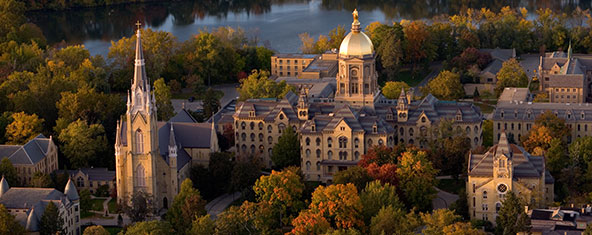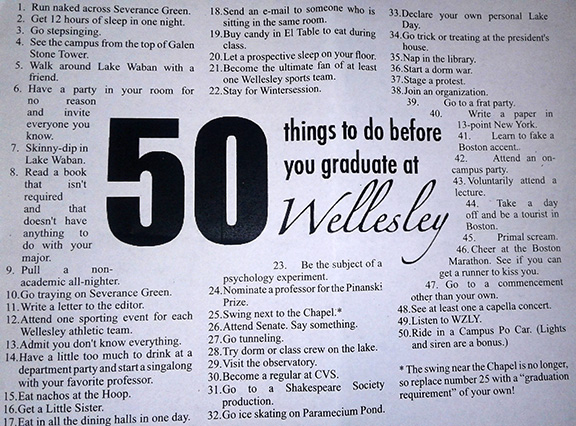
Berea via Chicago | AFTLS on Tour

Berea College in Kentucky

And so on to our next stop – to Kentucky, to Berea College. Well, not quite.

First we were treated to a weekend stop in Chicago, where the time was our own until Monday. After the Friday night show at Notre Dame, we piled up our suitcases (into a stretch limo, obviously – we’re getting used to this) and headed for our downtown Chicago hotel. The view from the 14th floor (or 16th if you’re Sarah – she has contacts everywhere) was fabulous, looking down over the river and a huge neon-assisted sign of “Chicago,” in case you were still in any doubt.

While there, Sarah and I delighted in surely one of the best museums in the world, the Art Institute of Chicago. The breadth of the collection is quite staggering, particularly from the Impressionists onwards; I felt drowned in so much craft and imagination. While I was taking in Seurat’s “Sunday Afternoon on the Island of La Grande Jatte,” a young American student was slowly formulating an opinion. Eventually he turned away, with the words, “it just seems like a lot of dots to me.” Hard to argue with that.

Will and I went ice skating in the shadows of the giant Anish Kapoor silver bean; we watched the greatest Super Bowl comeback in history (still wanted the Falcons to win); we sipped Manhattans and Long Island Ice Teas high up in the Hancock Tower, with a twilit view of this metropolis, and we walked along the Navy Pier and took in the ludicrous expanse of Lake Michigan. What a treat.

But time now for Berea. A very big change from Chicago – and from Notre Dame. A much smaller place (about 1,600 students here), Berea College is a liberal arts college in Madison County, Kentucky. No, I didn’t see any bridges. All students here have to take a job while they study, and you see them in the cafes and shops, and even working the looms and potter’s wheels in the craft shop. In return, their tuition is paid for. Incoming students “have financial need,” and it must be a great relief to get through four years of college without a huge debt pushing down on their shoulders.

“Our generous TUITION PROMISE SCHOLARSHIP makes it possible for you to graduate debt-free…We sometimes call Berea ‘the best education money can’t buy.’”

It has a quiet charm to the place, this Daniel Boone pioneer country, and three times I went hiking up the Indian Fort Mountain to take in the view of the Appalachians in the distance. In fact, the first time, I was on my own and managed to get lost. I tried retracing my steps but to no avail, and I was left wondering which route down took me back to the car. Luckily, I came across a woman walking her dog. “Sorry to bother you,” I said, “but can you tell me which way to go to get down to the parking area?”. “Furshra” she replied. “I beg your pardon?”. “Furshra”. I felt like Hugh Grant, the Englishman who came up a hill and couldn’t get down the mountain – it was as much as I could do to stop myself from fluttering my eyelids and quoting David Cassidy. “Take the Furshra and go straight down”, the woman continued. “Oh, great, first right, yes, of course…thank you.” I stumbled away as fast as affected nonchalance would allow.

It’s always a slightly strange experience, having a five-day gap before returning to the stage. The play seems familiar and yet oddly distant, and we have to recalibrate and make sure we are still being faithful to the story every time we return to it, while also accommodating a different playing space – Berea’s Jelkyl Theater is a wide but intimate space, seating about 250 and it gave us the chance to really use the corners, play ‘upstage’ and engage with the wider space.

And, in the meantime, we have classes to give. This week, the students in one class reimagined the opening stand-off between the two opposing factions not as Montagues and Capulets, but as the Empire (Star Wars) against the Kardashians. They improvised away, with threats of bling and light sabres and various hair flicks. Good fun. Of course, the parting shot from one of the students was still, in a slight Southern lilt, “oh go on, please can you say pip, pip, cheerio for me? I just love that accent”…

We’ve been staying in the historic Boone Tavern. According to YouTube, the hotel is haunted. Well, I don’t know if it was ghosts that took me from room 232 (TV not working) to room 217 (window wouldn’t open) to room 312, but the other members of the company kindly let me know that one of the rooms is haunted by a boy called Timmy, whose cackle of laughter has been heard by various visitors. Yes, you’ve guessed it, it’s room 312. And, sure enough, the next night I was woken by a whispering wailing sound. Eventually I had to turn the lights on to investigate, only to find that the window had slipped, leaving only a sliver of air that whistled through the tiny crack. Dear dear Timmy.
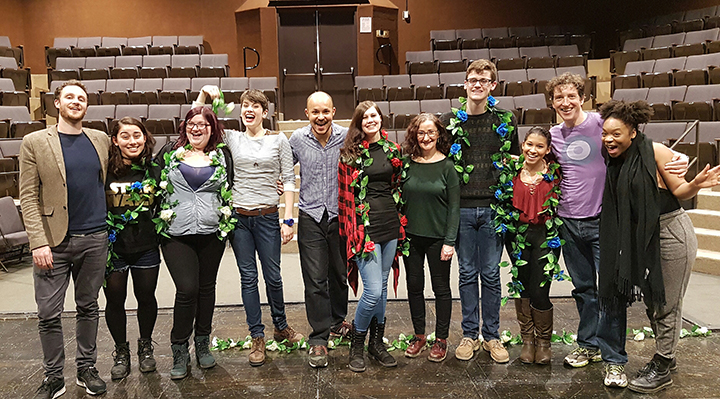
Other than that, the hospitality here has been wonderful. Shan Ayers‘ care for us was way beyond duty, and Tia Davis and family today treated three of us to a wonderful American brunch – thank you, Hassan, for the delicious fare on offer, and to you all for your kind hospitality. It was a treat to be out of a hotel and in such a warm domestic environment …and away from Timmy, obviously.

Next stop Valparaiso, University…in Indiana, not Chile. Time to pack, to try and remember phone charger etc (this time) and all set for a 9.30 start. So long Timmy – and pip pip cheerio, obviously.
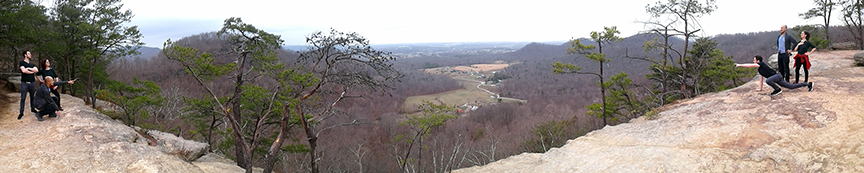
William, Jack, and Sarah meet their doppelgängers in the hills of Kentucky. Playing multiple roles takes its toll on our psyche.

Romeo and Rum Cake: Creating Verona in South London

[The first in a series of blog posts from the spring 2017 Actors From The London Stage tour of Romeo and Juliet. Written by AFTLS actor and tour veteran, Roger May]

So, the journey begins. On many levels. One of which is that I’m a middle-aged blog virgin, so please be gentle with me and join us on a journey of discovery, travel, and adventure as Romeo and Juliet takes five people to new places, real and imaginary.

Jack Whitam, Sarah Finigan, Jasmeen ‘Jas’ James, Will Donaldson, and I were cast together for this play a couple of months ago after an audition and a recall, or call-back, as I think they are called in the States — in fact, let me say now that I apologize in advance for any misunderstandings between the languages of American English and British English. It wouldn’t be the first time. (Note to self, it’s called an eraser over there, an eraser…) Jack is doing his third tour with this company, and I am doing my second (although that was 17 years ago). However, there is no hierarchy within this company. Everyone has different strengths in this group, and not having a director allows us the chance to explore all of these.

Anyway, we had a read-through of the play a few weeks back, and, just before Christmas, we began the process by sitting down together with a blank canvas, a blank rehearsal room and a blank schedule. Only twelve days later, it seems like we’ve known each other a long while already and have built up a very good way of working with each other and explored a lot of different avenues around Verona (“where we lay our scene”).

We rehearse in Brixton, an area in south London that has made us very welcome. On our last rehearsal day before Christmas, there was a post-funeral wake downstairs (we rehearse in the large room upstairs) and, at lunchtime, we were invited to come down and join them for their meal. It was a feast, with some Jamaican specialties like fried plantain and curried goat. I was really moved by the whole thing. There seem to have been plenty of examples of the world closing in recently, becoming more insular, and here were people we didn’t even know inviting us down to eat with them. A Jamaican rum cake followed — I definitely tasted more rum than cake — followed by the rum bottle itself. I am still staggered by the warmth and generosity of that day.

Brixton shows a warm welcome to the cast of Romeo and Juliet: (pictured L-R) Jasmeen James, Sarah Finigan, William Donaldson, and Jack Whitam. Roger May is hiding behind the camera.

As I said earlier, we are now twelve days in – about half-way through our time in Brixton. We are still very much experimenting with different ways of conveying characters, building scenes and finding the through-line of the narrative, but already scenes are coming together, and yesterday we did a run of the play for the two Associate Directors who cast this play. Neither of them walked out.

One of the massive benefits of this way of working (with a cast of five) is that, in my experience, there has always been a clarity that shines out in performance, that helps the play to stand out and connect, and that is our aim here. Romeo and Juliet starts with an avalanche of characters in the first scene — Will is especially busy changing from one character to another (and another!) — and it has a couple of big set pieces. However, it also has a lot of two-hander scenes, so our challenge is to keep the focus clear, to tell the story and bring the audience with us.

On Monday we have a fight director, Philip D’Orleans, joining us. We think (although nothing is set in stone at this stage) that we’ll be using something to represent swords rather than swords themselves, making the trip through airport security a little simpler. We looked at hand-to-hand combat, but there are many references to rapiers and weapons in the script. Anyway, that’s today’s thinking. It all may change.

And, later in the week we have a woman called Donna Berlin coming in to help us with movement, both in terms of the ball scene and more general movement challenges in representing different characters — we have about four or five each to convey through the show. I think it’s fair to say that fitness levels will be tested in the coming weeks.

Busy week ahead. More to come…

Richard III | Mississippi River Run

Photo of St. Louis Skyline by Capt. Timothy Reinhart

AFTLS Quiz Time: I can’t believe this is our last week on the road with Richard III. So, all you Shakespeare pundits. I have a one question quiz for you. Where does this piece of Shakespeare text come from?

To be, or not to be; that is the bare bodkin
That makes calamity of so long life;
For who would fardels bear,
Till Birnam Wood do come to Dunsinane,

But that the fear of something after death
Murders the innocent sleep, great nature’s second course,
And makes us rather sling the arrows of outrageous fortune
Than fly to others that we know not of.
There’s the respect must give us pause:

Wake Duncan with thy knocking! I would thou couldst;
For who would bear the whips and scorns of time,
The oppressor’s wrong, the proud man’s contumely,
The law’s delay, and the quietus which his pangs might take,

In the dead waste and middle of the night, when churchyards yawn
In customary suits of solemn black,
But that the undiscovered country from whose bourne no traveler returns,

Breathes forth contagion on the world,
And thus the native hue of resolution,
Like the poor cat i’ the adage, is sicklied o’er with care,
And all the clouds that lowered o’er our housetops,
With this regard their currents turn awry,
And lose the name of action.

‘Tis a consummation devoutly to be wished.
But soft you, the fair Ophelia:
Ope not thy ponderous and marble jaws,
But get thee to a nunnery—go!

You get two clues…

  1. When I first saw the mighty Mississippi, I laughed like a drain because it reminded me of this brain bender.
  2. It involves a King and a Duke.

Now on to our final two residency weeks, both spent at campuses on the banks of America’s mighty Mississippi River.

Last week, we performed and taught at the University of Missouri–St. Louis, affectionately referred to as UMSL (Um’-Suhl). We all had a blast in class. I taught “Acting for the Camera” to six lovely guys working on scripts written by the brilliant Dr. Niyi Coker Jr. – fantastic contemporary pieces that the young men acted really well. One of them, Dre, turned up in Jacqueline Thompson’s class the next day and knocked me out with his movement, physicalizing some knotty words from RIII.

lizumslI also taught an Honours group who were mostly biochemists, business majors, and athletes in Kim Baldus’s class. They were brave, committed, and lovely to teach. Both Jacqui and Kim did all the exercises along with their students – I do admire that.

hannahHannah went out to the Grand Center Arts Academy, a high school, and part of UMSL’s outreach programme and had a cracking class. We had a 10am matinee on the Friday which was a bit of a shock and had a good talkback after. All of Hannah’s students from the Academy were present and cheered to the rafters when she came out on stage for the talk – just LOVELY.

One of Evvy’s professors sent a message saying, “I’m on FIRE after my AFTLS class.” Not bad, eh?

It’s a strange thing to play just two or three shows a week especially when we all share so much text. We’ve actually only done around 22 performances. Normally, you’d play eight times a week, possibly in repertoire [multiple titles during the same week]. It makes me nervous usually for the first show in a new venue, but we have gradually all become more relaxed and the show has grown and become more textured and nuanced. I think our St. Louis performances were really enjoyed by us AND the audiences. Paul was incredible as he was under-the-weather but soldiered on magnificently. I think audiences are often surprised by how often “the show must go on” does literally happen.

umslmatinee

Our first evening show was interesting as all the motorways got closed down because Vice President Joe Biden was visiting St. Louis, supporting a Democratic senator, and his motorcade drove ALONE down the closed-off highways so many of our audience were stuck and we had to hold the curtain for 15 minutes. What a frightfully glamorous reason. We have been fascinated and often horrified by the lead up to the elections. My brother Nick, a BBC sports journalist did actually suggest that maybe I should have a blonde quaff [wig] as Richard – tempting, very tempting.

The 10-story slide at St. Louis's City Museum

The 10-storey slide at St. Louis’s City Museum

Apart from viewing the magnificent Mississippi, we all visited the St. Louis’s AMAZING City Museum, an adult and child playground (in an old shoe factory) where we all had the guts to brave the slightly hair raising slide and climb some of the contraptions hanging off the roof. Three of us got in those funny pods and went up the Arch, visited the gorgeous Forest Park and also went bowling. Evvy won and Alice got the most-stylish-throwing prize. We were invited to an evening of cocktails by UMSL’s Associate Professor of English (and the driving force of our being invited to UMSL) Kurt Schreyer: he and his wife Kim’s gingerbread house was lovely, and we were thrilled to go to someone’s HOME. A very good week. Read more in this from a post in the UMSL Daily.

My room with a (killer) view at Principia College

The view from our rooms at Principia College

As I write this (and before I tell you the answer to the quiz) I’m sitting in a charming room in Principia College (Elsah, Illinois): a Christian Science college just 45 minutes up the river from UMSL. Set in the most idyllic and peaceful surroundings, Principia has a thriving theatre department led by Jeff and Chrissy Steele who both studied and lived in Stratford on Avon for four years. I taught Jeff’s British Dramaturgy class earlier this week which was great fun and Alice, Hannah, Evvy, and Paul set the acting students alight in acting classes throughout the week. I managed to wangle my way into John O’Hagen’s dance class and Charleston-ed and shim-shammed for 90 minutes. Thanks for letting me join in, John; I just couldn’t resist it.

groupcropYesterday, our full group took full advantage of our surroundings and soared through the trees, reveling in the warmer-than-average autumn weather. Flying over 250′ above the ground, we added a new skill set to our CVs: zipline experts. Hannah outdid the rest of us by taking one run fast enough to flip over our instructor and into local legend.

We’re really looking forward to our last shows tonight and tomorrow where there’s a blinking HUGE church organ on the side of the stage which may HAVE to be used in the persuading of the citizens’ scene; it’s just CRYING out to be included. After this week’s workshops, the small but mighty campus is buzzing for our performances. Thanks Principia for being a brilliant final stop on our US tour.

We return to the UK next week and will perform Richard III in London later this month. See our final two performances at The Cockpit Sunday the 20th (5pm) and Monday the 21st (7:30pm). Tickets are available HERE.


I haven’t forgotten our quiz: the answer is The Adventures of Huckleberry Finn, for that’s where the two fraudsters – the King and the Duke – decide to perform a night of Shakespeare. They also performed in a small American town on the banks of the Mississippi. Mangled bits of Hamlet, Macbeth, and Richard III make up Twain’s hilarious mishmash of a speech. How wonderful that touring Shakespeare in the US is still such a delight 130 years after that novel was written.

— Liz Crowther (November 4, 2016)

Westward (Ida)ho! | Richard III visits Boise State

boise As we descended into Idaho’s Boise Airport, we all saw the most dramatic and stunning scenery: the Rocky Mountains, creeks, gorges, ravines, and trees, trees, and more trees. Boise is the “City of Trees” and home to the largest Basque population outside Europe. Idaho is the land of the potato and has over three hundred natural hot springs, much wildlife, and incredibly welcoming people. Mac Test and Maya Duratovic met us at the airport and took us back to a meeting of all the teachers whose classes we would teach in at Boise State University.

Paul O'Mahony (far right) leads a workshops for Mac Test's English class at Boise State University.

Paul O’Mahony (far right) leads a workshop for Mac Test’s English class at Boise State University.

We were formally greeted by Richard Klautsch, head of the Theatre Arts Department and delighted to discover that many drama students would be in our classes. As Hannah Barrie said later in the week “It was great to do some more advanced stuff with them.” Some examples are the Guildhall exercise, ‘Look/Move/Speak,’ and ‘New Move/New Thought’ (which plays around with WHEN the thoughts/lines of a play drop in. Her students LOVED IT.

It was good for us this week as we taught in pairs for some of the lessons and I watched in awe as Alice (in Jen Black’s class) sent her students soaring and roaring with laughter at some of her fantastic ideas to experiment with the text of Richmond’s oration to his troops: do it as a political speech (timely, eh?); do it as a nursery school teacher, explaining it super clearly to us, her tiny students, and allowing us to interrupt or giggle when we liked, which we did a LOT; and then as a hellfire Southern preacher. Brilliant!

Evvy gave a masterful masterclass on Saturday, breaking down and physicalizing separate words in Richard’s oration to his troops (a nastier speech altogether) and gave such great notes that I took them all on stage with me on Saturday night, and I swear  the speech lit up as the result of her lesson. We had a  young schoolgirl, Samia, among us (the class was open to all in Boise) whom Evvy encouraged to perform Richard’s speech with us as his army; Samia said she felt empowered by speaking it.

Paul (full of energy and fiercely intelligent observations) and I taught in Linda Marie Zaerr’s   British Literature class and worked on the second wooing scene with Richard and Queen Elizabeth. She wrote us such a lovely mail that I have to quote it:

“You engaged the students powerfully, and you affirmed their ideas and interpretations while leading them to an awareness of an infinity of possibilities.”

We also had a long Q&A session with students and Boise residents with all of us as a group, and Matthew Hansen, who runs an after school program called ‘Shake it Up’ for very young students, asked a lot of interesting questions. He was paramount in getting us to Boise, and we truly had a wonderful week. The show was received very kindly and got tighter, with raised stakes in our storytelling.

We are all serious “foodies,” so a visit to Goldy’s Breakfast Bistro down near the Capitol was a must and the Andalusian eggs (with asparagus and chorizo), the potato/dill omelet, and the corned beef hash were mind-blowingly good. We managed Idaho trout, salmon, and sturgeon, a trip to the Basque Market, where I ate Paella Roll and bought membrillo, the heavenly, solid quince paste to eat with cheese, and downed a fairly generous amount of Boise Brewing’s pumpkin cider. It’s a community owned company and all the original shareholders have their own ceramic pint pot with their name on, hung up on the wall…a veritable sea of pint pots.

bogus-basinWe drove up and up and up to Bogus Basin, biked along the river from the delightful campus, visited the Basque museum which told of Basque sheepherders emigrating here in the early 20th century and being welcomed in Basque run boarding houses all over Idaho maintaining their traditional dances and cuisine. We then had an extraordinary weekend in a proper mountain log cabin, high up in Lowman and belonging to the exceptionally kind Maya Duratovic’s family.

log-cabin

20161023_124828We saw the Milky Way and more stars than I have ever seen in my life, listened to the fast running and crystal clear creek water, and saw not another soul till we drove to Idaho City the next day to see this perfectly preserved town of 500 people founded when the Gold Rush was on and with its original territorial prison and courthouse and much rusting mining equipment. A proper Wild West town. And then, three hours in the hot springs just down the road. Our little group melting, our shoulders sinking and the smiles spreading. Absolute bloody bliss!

–Liz Crowther

Back at the Mothership | Richard III returns to Notre Dame

Well, here we are, back at the Mothership after leaving the heat of San Antonio and the crisp walks round the lake at Wellesley. It’s wonderful to be back to the beauty of leaves falling, to be welcomed by our friends, and to feel familiar with the layout of a university campus, our American home, Shakespeare at Notre Dame.
ndautumn
I did a class yesterday on “Media Stardom and Celebrity Culture” with the lovely Christine Becker, and we all discussed the difference between film performances: locked eternally on celluloid, and theatre: mutable, shifting night to night with that glorious chemical reaction between audiences and cast, cast and cast, and cast and venues. Our Richard III has certainly been changing, and we’re a pretty playful bunch of actors who trust each other deeply and want to explore and mine our text to the limit. For example, in the coronation scene in Act 3 where Richard, newly crowned, tests the princely Buckingham’s loyalty by revealing deep insecurity in his position and the nuisance of having the illegitimate young princes around, I say:

Cousin, thou wert not won’t to be so dull;
Shall I be plain? I wish the bastards dead;
And I would have it suddenly performed.
What sayest thou? Speak suddenly; be brief.

Alice, who’s playing a mutely obedient Lady Anne, by my side, has started physically empathizing with Evvy’s noble and wavering Buckingham and silently pleading her horror at this thought. It gives greater emphasis to everyone else’s abhorrence of this thought and to my desire, a few moments later, to get shot of [get rid of] her and say to Catesby:

Rumour it abroad
That Anne, my wife, is very grievous sick.

Hannah who, apart from being a brilliant actor and the choreographer for various moments, had some ideas to improve the ghosts by giving them horrible unearthly gasps before each of them, all Richard’s victims, speak. It works beautifully. And Paul’s Queen Elizabeth is now so heartbreaking and vehemently reasoned in her defense of Richard marrying her daughter, that I’m having to adjust accordingly and find other tacks to succeed.

That’s the glory of Shakespeare: the endless possibilities and interpretations and the pleasure of exploring them. The reactions vary too. At Wellesley College, the audible disgust at Richard kissing Elizabeth on the mouth after persuading her to give him her daughter as a new Queen, was amazing.

shakespeare_houseAlso at Wellesley, there is a Shakespeare Society (founded in 1887) that always holds a party for the actors on their first night there. The Shakespeare House (pictured on right) is INCREDIBLE: a Tudor exterior, with its own stage and a basement heaving with endless, ancient copies of Shakespeare: some with prints that I have never seen. There is a costume department worthy of a local regional theatre in Britain. One entire rail just held CLOAKS. And in November they will perform their all-female Henry V for which they have promised a video. I can’t wait.

50wellesley

Wellesley is Hillary Clinton’s alma mater. I wonder if she ever ran naked across Severance green as is suggested on the 50 things to do before you graduate from Wellesley…I hope so.

Here at Notre Dame, we had a lovely response last night and have all had challenging and interesting classes. I worked with Peter Holland’s students on Tuesday exploring the first soliloquy and the insults to Richard. At the end Professor Holland reminded the class that, if in London, they should visit Garrick’s Temple to Shakespeare, where I am a volunteer (docent in your parlance) and Trustee.

David Garrick and his Wife by his Temple to Shakespeare at Hampton, Johan Zoffany, c. 1762

David Garrick and his Wife by his Temple to Shakespeare at Hampton,
Johan Zoffany, c. 1762

In the eighteenth century, David Garrick made his name, as a 23 year old, playing Richard III. We have a copy of Hogarth’s famous painting of him in the nightmare scene before the battle of Bosworth, as well as Garrick’s commissioned statue of Shakespeare. I was on duty there the week before we started rehearsals on Richard III and had one visitor that day who was intriguing and singular and asked the most informed questions. When I asked him if he was a historian, he said, “No, I work at Kensington Palace; I’m house manager for Richard, Duke of Gloucester.” At this point all the hairs on the back of my neck stood up. I told him I was about to play one of his boss’s antecedents and he said that the current Duke had been at the real King Richard III’s interment at Leicester Cathedral. Gosh.

Evelyn Miller puts Commedia dell'arte on its feet during a visit to John Welle's "On Humor: Understanding Italy" class during the Notre Dame residency.

Evelyn Miller puts Commedia dell’arte on its feet during a visit to John Welle’s “On Humor: Understanding Italy” class during the Notre Dame residency.

I told some of the Foundations of Theology students in Anthony Pagliarini’s class on Friday about the excellent laws that the real King Richard had passed which I learned of in Leicester Cathedral on a research visit. He ensured new laws were written in English to be understood by all. He helped confirm the place of the jury system, bail for the accused, as well as laws for land ownership and trade protection. We were discussing whether Richard’s path was chosen or determined by fate; I put forward my view that he is validating his invalidity. As Ian McKellen says in the brochure accompanying his and Richard Longcrane’s excellent Richard III film made in 1995 and set in the 1930s: “Richard’s wickedness is an outcome of other people’s disaffection with his physique.” I think that being crowned King is proof to him that he is a whole human being.

pep-rallyAfter finishing that class, I had the thrill of seeing and hearing the “pep rally”…a phrase I’d never heard before. Basically, it was all the accumulated bands of Notre Dame marching to the ground for a home game and rallying their supporters. I love a brass band. I love great big drums thumping out. And when there are over five hundred musicians playing all together, it is truly rousing.

[Learn more about the world-famous Notre Dame Victory March.]

–Liz Crowther