

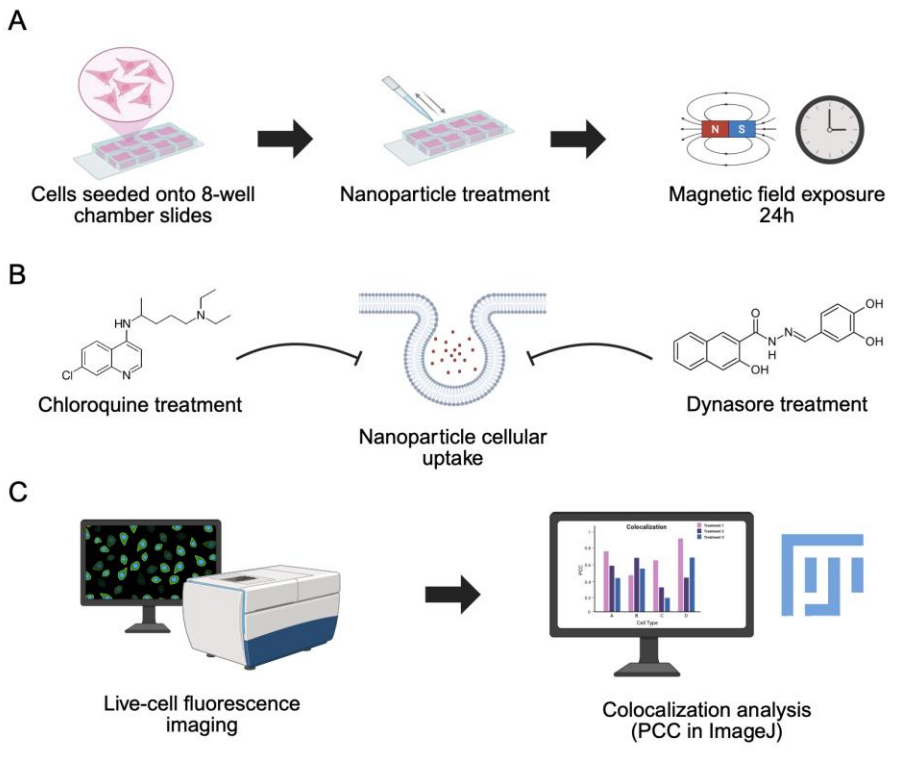
Aggressive malignancies like triple-negative breast cancer (TNBC), ovarian cancer, and prostate cancer remain difficult to treat because they often lack the surface receptors required for traditional targeted therapies. Standard treatments like doxorubicin (Dox) are effective at killing cancer but cause severe systemic side effects, most notably cardiotoxicity. To overcome these barriers, the Nallathamby Lab at Notre Dame has developed a “receptor-independent” delivery system that uses external magnetic fields to control chemotherapy with pinpoint precision.
The Innovation: Magnetoelectric “On-Demand” Release
The team’s platform utilizes Magnetoelectric Silica Nanoparticles (MagSiNs). These tiny carriers, averaging just 6.7 nanometers in diameter, consist of a magnetic cobalt ferrite core encapsulated in a thin piezoelectric silica shell.
This unique structure allows for dual-mode control:
- Guidance: Static magnetic fields can be used to concentrate the nanoparticles specifically at the tumor site.
- Triggered Delivery: When exposed to a low-frequency alternating magnetic field, the nanoparticles undergo a charge polarization that triggers the release of the drug payload directly inside the cancer cell.
Breakthrough Results in Aggressive Cancer Models
The study tested Dox-loaded MagSiNs across multiple cancer cell lines, including those derived from women of African descent, to address TNBC subtypes that are often more resistant to treatment.
Key findings include:
Superior Efficacy: In aggressive HCC1500 breast cancer cells, the MagSiN system reduced cell viability to 14%, compared to 42% when treated with the same dose of free doxorubicin.
- Enhanced Safety: The platform demonstrated high selectivity, effectively killing cancer cells while sparing healthy endothelial cells (HUVECs), which maintained high viability compared to those exposed to free drug.
- Defined Mechanisms: Mechanistic studies confirmed that the particles are internalized through dynamin-dependent endocytosis and accumulate in the cell’s lysosomes before the drug is released.
The Future of Theragnostics
Because MagSiNs are magnetic, they offer a clear path toward theragnostics—the combination of therapy and diagnostics. Future clinical applications could involve using MRI to visualize a patient’s tumor and precisely trigger drug release simultaneously, minimizing off-target exposure to healthy organs like the heart and liver.
This research highlights the potential of externally actuated, label-free strategies to overcome the limitations of traditional targeted medicine.
Project Team: Jichong Lyu, Aurelie Brownsberger, Carlie Kudary, Margo Waters, and Prakash D. Nallathamby. Support: This work was supported by the Berthiaume Institute for Precision Health (BIPH), NDnano, and the CDMRP-PRCRP IDEA award.
https://chemrxiv.org/engage/chemrxiv/article-details/692a9bb2a10c9f5ca1502481

Recent Comments