I’ve been back in the United States for almost three weeks now, and there are a couple of things I’ll mention right from the start:
1. I’ve never appreciated air conditioning as much as I do now,
and 2. I miss being able to walk everywhere.
Without air conditioning (or even fans in my host house), the heat wave that hit France in the middle of July was quite the experience, so now I thoroughly enjoy being able to get away from the North Carolina summer humidity by retreating inside when need be. And secondly, I accumulated close to 20,000 steps per day in France simply by going about my daily routine around the city. I never took a car, train, or bus unless I was going on a significant trip, and even then, I still walked around when sightseeing in a new place. To go really anywhere now back home, I have to get in my car and drive, so I guess you can say I miss the corner markets and endless parks of France.
Looking back over the whole trip, however, it’s hard to believe all that I accomplished. My French improved significantly in the areas I most lacked in (oral comprehension and speaking), and I was able to employ what I learned to real-life situations in markets, at host family dinners, bus stops, and on the train. I think these experiences helped me the most because they were the most organic. I didn’t have time to prepare my set of responses mentally as I would try to do in a classroom setting; I had to on-the-fly listen and respond as best I could, even if I wasn’t 100% confident of where my sentence was going. If I didn’t know a specific word in French, I would try to describe it circularly to whoever was listening instead of just abandoning the train of thought completely. (I did this once during dinner and ended up describing a lizard as “a little snake with arms and legs”… this ended up making everyone laugh once they realized what I was trying to say, not to mention the fact that the French word for lizard anyway is just lézard).
I’ll always remember these little moments of the trip because they were the ones where I really just went for it. Caution was thrown to the wind and words just tumbled from my mouth, bypassing the English-to-French filter that would routinely slow down my responses. This led to a lot of laughs, richer conversations, and of course, bursts of confidence for me.
Now that I’m back in the States, my opportunities to practice spoken French have diminished, but I now have some pen pals both domestic and international who are willing to practice whenever possible. Additionally, I bought nine books while abroad (which I carried all in my handbag when heading home, making the airport security guards raise some eyebrows), so I’m excited to read many of my old favorites in French alongside some new bestsellers I have yet to read even in English.
My favorite part about the SLA grant, however, was the cultural immersion that it enabled me to do. The French lifestyle is significantly different than ours in America, and I would even say that they just understand the idea of “culture” differently than us. In the U.S., I think the term is thrown around most of the time in reference to social media and technology, but in France, I definitely got the sense that to them, “culture” went a lot deeper than just daily routines. It’s how they addressed each other, how they talked about their country, and how they saw themselves in the greater world. This sense is hard to convey in a video or song, so you really have to be surrounded by the French to feel how they embrace and cherish their culture.
To learn a language is to start to know its speakers, and I’m grateful to have had the opportunity to do just that through the SLA grant. I can’t wait to continue my studies in French at Notre Dame and connect the language to more and more of my interests in literature, philosophy, and theology. This was my first trip to France, but most certainly not the last.
 It’s not that there was no buzz of excitement around Rennes stadium; it’s just that it was significantly less than that of the Real Madrid match I had seen. Perhaps it was because this was a women’s match and female soccer games just traditionally bring in less fans, but I thought that the World Cup component of the game would have reversed that reality. The decreased energy may have also been due to the two teams playing: while both Sweden and Germany have amazing teams with talented players, they do not have the robust fanbase of the American or French national teams. Additionally, based on the people my friend and I encountered at the stadium, most fans were actually American, English, or French, and they were just there because they had wanted to see a game; they didn’t necessarily support either team in particular.
 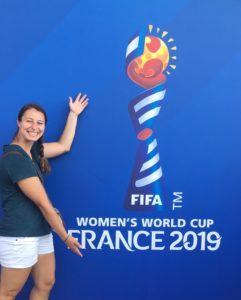 All in all, however, it was a great weekend trip, and I enjoyed watching Sweden advance into the semi-finals. I think my experience of the stadium and initial impressions of the environment, however, just point to how much stronger of a fanbase American women’s soccer has compared to its counterpart in Europe. Our women’s programs in the United States (particularly those at the professional level) are better known and developed than many of Europe’s women’s soccer programs (even if our female athletes still do not get paid as much as the men), but hopefully our most recent World Cup win will serve to improve conditions all around.
 The Villandry gardens