- Reflect on your language learning and acculturation during your SLA experience. What insights did you gain into the language acquisition process? How did you engage and understand cultural differences? Did you meet your goals for language learning that you articulated on the blog before you started your program? Why or why not?
By studying at HIF over the summer I was able to complete my second full year of Japanese in less than a full calendar year. This has accelerated my progress as I will 1`now be taking the third level of the language as I head into my sophomore year. Specifically, I improved most in terms of my speaking ability as I was able to converse with my host family and others outside of the classroom, while using the grammar and vocabulary that I was learning inside the classroom. Every Thursday I would accompany my host family to their gospel choir practices. There I was able to talk with and befriend many of the members, and therefore strengthen my conversational skills. Furthermore, through this experience, I was faced with many cultural differences besides language. Religion, song, food among others were different from what I was used to back home, but I embraced these differences as I was eager to learn more.
Regarding my initial goals, I believe that I was able to meet them. I definitely gained a mastery over level two of the language and am planning to continue studying it until I am able to master everything. Secondly, I believe that I was able to forge many strong relationships with the people that I met in Japan. I became friends with not only my classmates, the other students in the program, and most host family, but many people and students of Hakodate through my IS and extracurricular involvement.
2) Reflect on your SLA experience overall. What insights have you brought back as a result of this experience? How has your summer language abroad changed you and/or your worldview? What advice would you give to someone who was considering applying for an SLA Grant or preparing to start their own summer language study?
By participating in the HIF program I have not only improved upon my ability to communicate in Japanese, but also learned how to live the life of a Japanese student. Because of this, my horizons have been broadened in both a cultural an intellectual manner. I’ve become more understanding regarding the different types of lives people live and the hardships they go through. I’ve seen and experienced the differences in religion and celebration, and the overall mindset of the Japanese culture. Through this, I’ve really come to appreciate the fact that there are many different cultures and lifestyles that coexist in the world as it brings about diversity and difference that is pleasurable to explore.
If someone were applying for the SLA grant or wanting to study abroad, the best piece of advice that I could give would be to be open minded and be willing to experience new things. Because receiving both this grant and the opportunity to study abroad are such rare and exclusive experiences, I wanted to be open to as many new things as I could during my time abroad. I was able to make the most out of my two months in Japan while doing this and I believe that other people who wish to take advantage of every opportunity will also benefit the most from their experience.
3) How do you plan to use your language and intercultural competences in the future? Where do you go from here? How will you maintain, grow and/or apply what you have learned? How might you use your SLA experience during the rest of your academic career and post-graduation? How will your SLA experience inform you as you move forward academically, personally and professionally?
From here I wish to revisit Japan next year studying abroad during either the Spring or Fall semester. Because my language skills, as well as my cultural understandings, have improved this summer, I believe that I will be able to have a more effective and enjoyable experience next year than I would have otherwise. Further in the future, I wish to work in abroad in Japan, or in a position in which my language skills would be utilized. Therefore, I believe that because I was able to accelerate my Japanese language learning, as well as practice my skills in a real-world setting, I have taken a great step forwards into making this goal a reality.
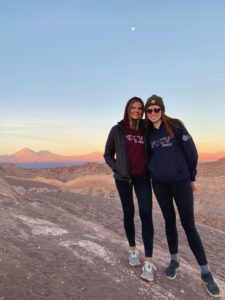
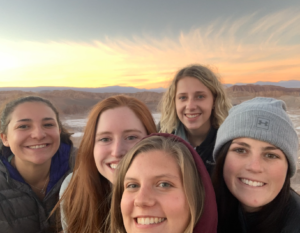


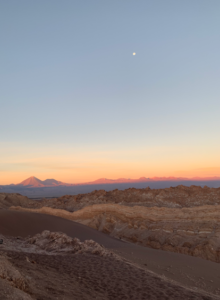
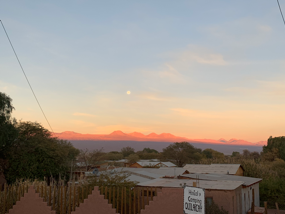

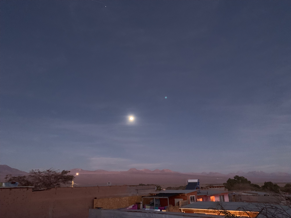
 I know Atacama is one of those memories that I am only spontaneous enough to do while in college. I will ask myself, “What was I thinking? Six students staying in a hostel in the middle of a desert of a country that we barely know?” While it sounds like a recipe for disaster, it was one of the most surreal experiences of my life, with some of the best friends.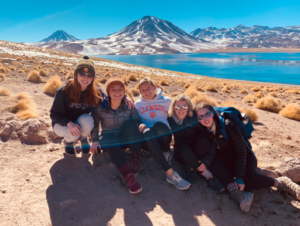

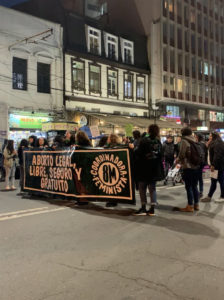
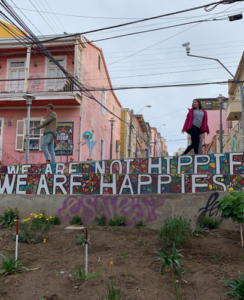
 I’ve started to think of my cerro, or hill, as home base. Recreo is a quaint residential neighborhood between the downtown centers of Viña del Mar and Valparaíso. Each weekday, I leave my house around 9:15am to meet my friends at the bottom of my cerro, at the Recreo metro stop. This metro stop just so happens to be on the coast of the Pacific Ocean and is conveniently two stops away from both downtown Viña and the university in Valpo. There is something soothing about my commute: as I walk down the same winding road, I have started to notice the numerous
  varieties of flowers local to the area. One house on my route has no one, but four golden retrievers whose barks I’ve come to expect as I turn the corner. While I wait for the metro with my friends, I can hear the crashing of waves, and if we are coming back at sunset, we go down the steps to the abandoned dock to watch the sky change color.
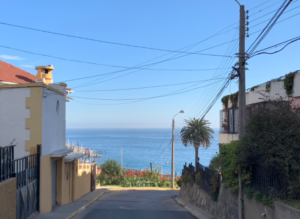 My block has the cutest panaderia, or corner bakery, which I’ve gotten in the habit of visiting on my way back from classes. I don’t know the names of many of the desserts, so I usually just ask the sweet old lady who works there to give me her favorite! Maybe if I try all of the desserts, I will learn the names…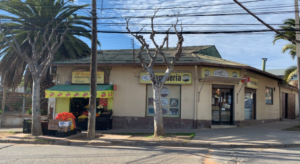

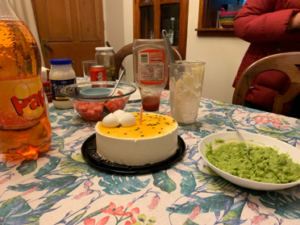
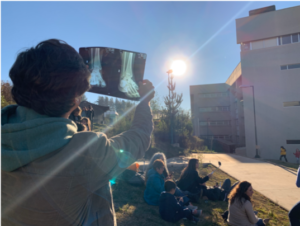
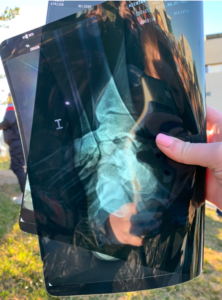
 After the eclipse, we went to eat chorillanas, a Chilean favorite. The chorillanas restaurant is at the bottom of my cerro, which may prove to be dangerous: they are so good, but so unhealthy!
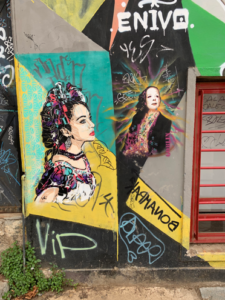
 These stairs have song lyrics written on them, saying: “tu no puedes comprar la lluvia, tu no puedes comprar al sol”. “You cannot buy the rain, you cannot buy the sun.” This song is anti-imperialist and anti-capitalist in nature and demonstrates the important role of social movements and protest in Chilean culture. Social protests are extremely common, so much so, that the local students at my university are on strike right now for better mental health services. There was plenty of apolitical art too, which was no less beautiful.