
by Rocío Colón Cotto (ND ’26), former research assistant in Rare Books & Special Collections

A few weeks ago, I took what was likely the most delightful rideshare of my young adult life. To be sure, it wasn’t because of the quality of my steed (the black car was small and a bit, well, scuffed). Instead, it was because of a conversation with my driver, one which deepened my appreciation for a manuscript I recently studied at Notre Dame’s Rare Books and Special Collections (RBSC).
When I set foot in the teeny black car, things initially followed the usual script: I gave Ashraf, my assigned chauffeur, my four-digit security code, said my quiet “hello!”, and scrolled on my phone mindlessly for a few minutes. However, that morning there was some magic in the dullness of Chicago traffic, and after a few minutes, I began bonding with the stranger in front of me.
In a span of 40 minutes, Ashraf and I chatted about anything and everything. He told me about his two sons, his path to Chicago, and his cultural roots; I told him about my parents, the story behind my name, and my undergraduate adventures. While it was a memorable and enjoyable conversation throughout, there was one moment that I kept coming back to days after I exited the car door: when Ashraf shared with me that “Humans are memories.”
That sole sentence fueled my brain’s thoughts the rest of the week. Specifically, it got me thinking differently about archives and historical documents. As I reflected, I came up with the following claim:
“If humans are memories, and objects are our memory-keepers, then within every material object there exists the essence of at least one person.”
Thus, I concluded that historical objects transcend the simple category of “valuable artifact”; indeed, they become material vessels of human life. Considering this, an object’s materiality must not only be examined through the context of history and science, but also through that of philosophy.


This past year, I collaborated with RBSC to craft a spotlight exhibit on a carta ejecutoria de hidalguía, a beautiful 16th-century Spanish illuminated manuscript which legally certified an individual’s noble status. The investigation used scientific and historical research to understand how the manuscript materially communicated the noble identity of its owner, don Alonso de Resa. Throughout my investigation, I encountered many interesting findings, the most exciting of which was the possible presence of cochineal red, an extremely valuable pigment made from crushed insects in Latin America.

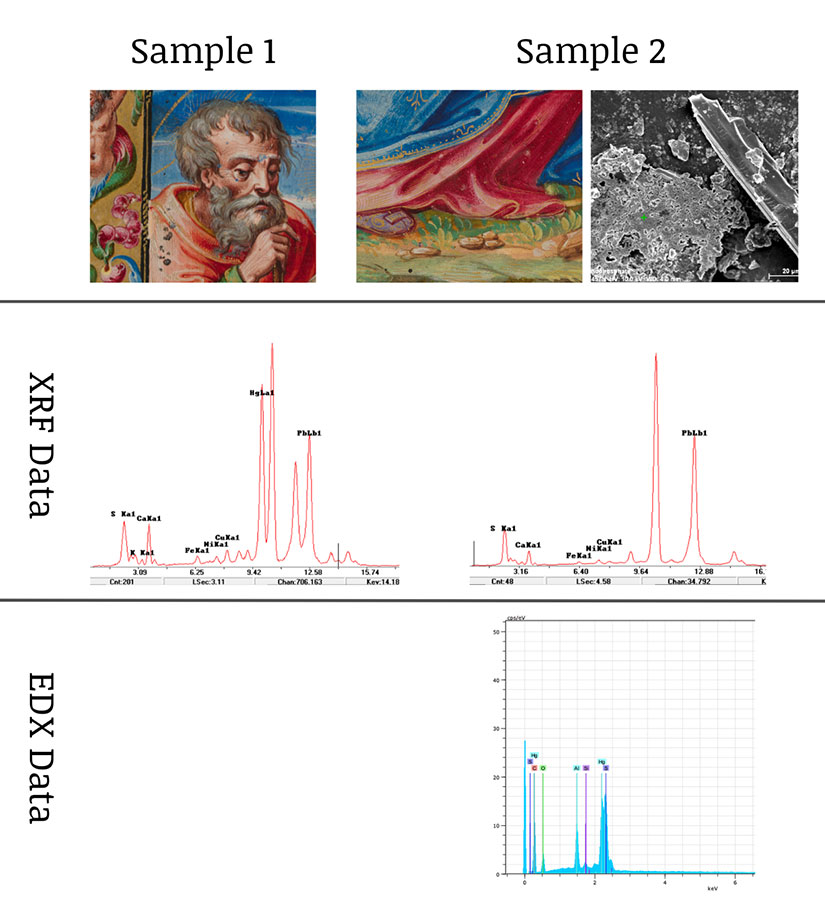
Photo taken by Dr. Khachatur Manukyan.
After my conversation with Ashraf, however, I realized there is much more to the carta ejecutoria’s pigment that I have yet to consider, primarily how it implies the human agency behind the manuscript—namely the labor of artists, manufacturers, and merchants. This is not to say that any of my previous research is inconsequential: it is still true that the likely presence of the cochineal physically demonstrates don Alonso’s wealth and noble status. It is also true that the use of the pigment in this manuscript shows how the Spanish articulated the concept of nobility via a product of global trade.

Sahagún, Bernardino de, et al. Historia general de las cosas de Nueva España (Códice florentino). 1577. Ms. Mediceo Palatino 218–20, Biblioteca Medicea Laurenziana. Códice Florentino Digital / Digital Florentine Codex, edited by Kim N. Richter et al., bk. 11, fol. 216v, Getty Research Institute, 2023.
That said, the artist’s potential use of cochineal begs us to consider the role of those who made it, as well as its path towards its place in the manuscript. Before that pigment was part of don Alonso’s carta, it was crushed by laborers in Latin America, packaged and sent via boat on an overseas journey to Spain, where it was sold and then used by our artist. As such, the pigments I researched were not only a part of my undergraduate life at Notre Dame, but also that of many other people of the past, all of whom contributed to the making and the history of this manuscript. With renewed understanding, those reds, blues, and greens from don Alonso’s carta passed from being meager pigments to material remnants of humanity, tiny little specks of incalculable value. Amazing how color can carry so much memory and significance, right?
With this in mind, next time you find yourself in RBSC, I encourage you to take a moment. As you touch a book’s old bindings and trace its ink with your eyes, think of the hands and stories that have helped shape it and which have brought it to you in that moment. Truly give yourself time to pause and imagine at least one person who might have touched, created, or used the object before you. With this act, you deepen your connection with history by intentionally engaging with the remnants of our past. In this sense, each visit to RBSC is not unlike a memorable rideshare—a brief encounter that leaves a lasting impression, reframing our understanding of how human memory transcends mere space and time.