Collection highlights, acquisition news, events, exhibits, and behind-the-scenes looks at the work and services of Rare Books & Special Collections (RBSC) at Notre Dame.
“Life springs from death, and from the graves of patriot men and women spring living nations.” — P.H. Pearse, August 1915
In 1803, Robert Emmet led a failed rebellion to overthrow British rule in Ireland. In 1848, a group called Young Ireland staged a brief revolt that was hastily crushed. The Fenian Brotherhood invaded British North America in 1866, and the Irish Republican Brotherhood organized a series of unsuccessful raids in Ireland the following year. On Easter Monday, 1916, a small group of Irish insurgents launched a rebellion in Dublin that was quashed in under a week. While these four attempts to create an independent Ireland may have failed, they each gave rise to a powerful romantic narrative that captivated the spirits of the Irish at home and abroad. Out of sacrifice and tragedy sprang patriotic verse, defiant journalism, cultural revival, and eventually, Irish freedom from British rule.
This exhibit features items from Rare Books and Special Collections and the University Archives that document the heroes, martyrs, and idealistic men and women who forged modern Ireland.
This and other exhibits within the Hesburgh Libraries are generously supported by the McBrien Special Collections Endowment.
All exhibits are free and open to the public during business hours.
RBSC will be open regular hours during the University of Notre Dame Fall Break, October 17 – 25.
In 1803, Robert Emmet led a failed rebellion to overthrow British rule in Ireland. In 1848, a group called Young Ireland staged a brief revolt that was hastily crushed. The Fenian Brotherhood invaded British North America in 1866, and the IRB organized a series of unsuccessful raids in Ireland the following year. On Easter Monday, 1916, a small group of Irish insurgents launched a rebellion in Dublin that was quashed in under a week. While these four attempts to create an independent Ireland may have failed, they each gave rise to a powerful romantic narrative that captivated the spirits of the Irish at home and abroad. Out of sacrifice and tragedy sprang patriotic verse, defiant journalism, cultural revival, and eventually, Irish freedom from British rule.
This exhibit features items from Rare Books and Special Collections and the University Archives that document the heroes, martyrs, and idealistic men and women who forged modern Ireland.
The exhibit is curated by Matthew Knight (Irish Studies Librarian and Curator).
Related Events
September 24-7, 2026 | The ACIS Midwest + South Regional Conference will be hosted by the Keough-Naughton Institute for Irish Studies and held on the University of Notre Dame campus. The theme of the meeting will be “Irish Studies On The Ground: Place, Presence and Community.” Please visit the conference website to view details.
October 2026 | Special Collections will host a lecture by curator Matt Knight, exact date and time TBD. Check back for more information.
Tours of the exhibit may be arranged for classes and other groups by contacting rarebook@nd.edu.
All exhibits are free and open to the public during business hours.This and other exhibits within the library are generously supported by the McBrien Special Collections Endowment.
This St. Patrick’s Day and in the March–April spotlight exhibit, Rare Books and Special Collections celebrates the youth of Ireland, who were seen in the late nineteenth and early twentieth centuries as the true soul of the Irish Nation. After all, if Irish independence were to be achieved, nationalists would first have to win the hearts and minds of the next generation.
In 1842, a group known as Young Ireland founded a newspaper called The Nation to advocate for a politically independent Ireland. The Nation envisioned an Irish identity undivided by race or religion; united by Irish language and culture; and forged from a romanticized version of Irish history. To achieve these ends, Young Ireland sought a legion more formidable than a thousand men clad in steel: The young intellect of the country.1
One of our prized collections is a series of draft songs composed for The Nation newspaper by one of the founders of Young Ireland, Thomas Davis (Thomas Davis Collection, MSE/IR 1001). Although Davis tragically died of scarlet fever at age thirty, many of his compositions (“A Nation Once Again,” “The West’s Asleep,” and “Lament for Owen Roe O’Neill”), intended to inspire the Irish youth of his time, are still sung today.
Although the British banned the speaking of Irish and the teaching of Ireland’s history from the national school system, associations inspired by the Young Ireland Movement began to encourage children to study the Irish language, play Gaelic sports, and perform Irish drama and music. This alternative education included journals such as Young Ireland (1875-1891) and groups like the Irish Fireside Club (founded 1887), which helped foster a new national identity among the nation’s youth.
These activities served as training grounds for future nationalists and paved the way for the formation of Connradh na Gaedhilge (The Gaelic League) in 1893. This organization continued to solicit the support of Irish youth, and published numerous books, pamphlets, and broadsides intended to ensure children remained at the forefront of the revival of Irish language and culture.
First published by Connradh na Gaedhilge in 1902, An tÁilleán was written by Tadhg Ó Donnchadha (‘Torna’) with illustrations of the ideal country life by Seoirse Ua Fágáin.
‘Torna’ dedicated the book to the youth of Ireland, saying, “Cuimhnighidh air gur i nÉirinn do rugadh sibh, gur ceart dúinn ár ndícheall do dhéanamh ar son Éireann; maireamhaint agus bás d’fhágháil i nÉirinn; agus ó’s í an Gaedhilg ár dTeanga féin, í labhairt í comhnuidhe.” [Remember that you were born in Ireland, and we must do our best for Ireland; to live and die in Ireland; and since Irish is our own language, speak it always.]
Fuínn na Smól (Songs of the Thrushes) is a collection of Irish tunes drawn from manuscripts, oral tradition, and shorter printed works. An tAthair Pádruig Breathnach (1848–1930), a Catholic priest and member of the Gaelic League, collected Irish songs from his parishioners in his youth. He later published them in a series of works like this one, with each tune printed in the Gaelic typeface and set to a melody in tonic solfa.
Although dedicated to children learning Irish in school, these songbooks had much to offer adults committed to the de-anglicization program of the Gaelic League. Sales ran into the tens of thousands, and they had a lasting influence on the Irish oral tradition.2
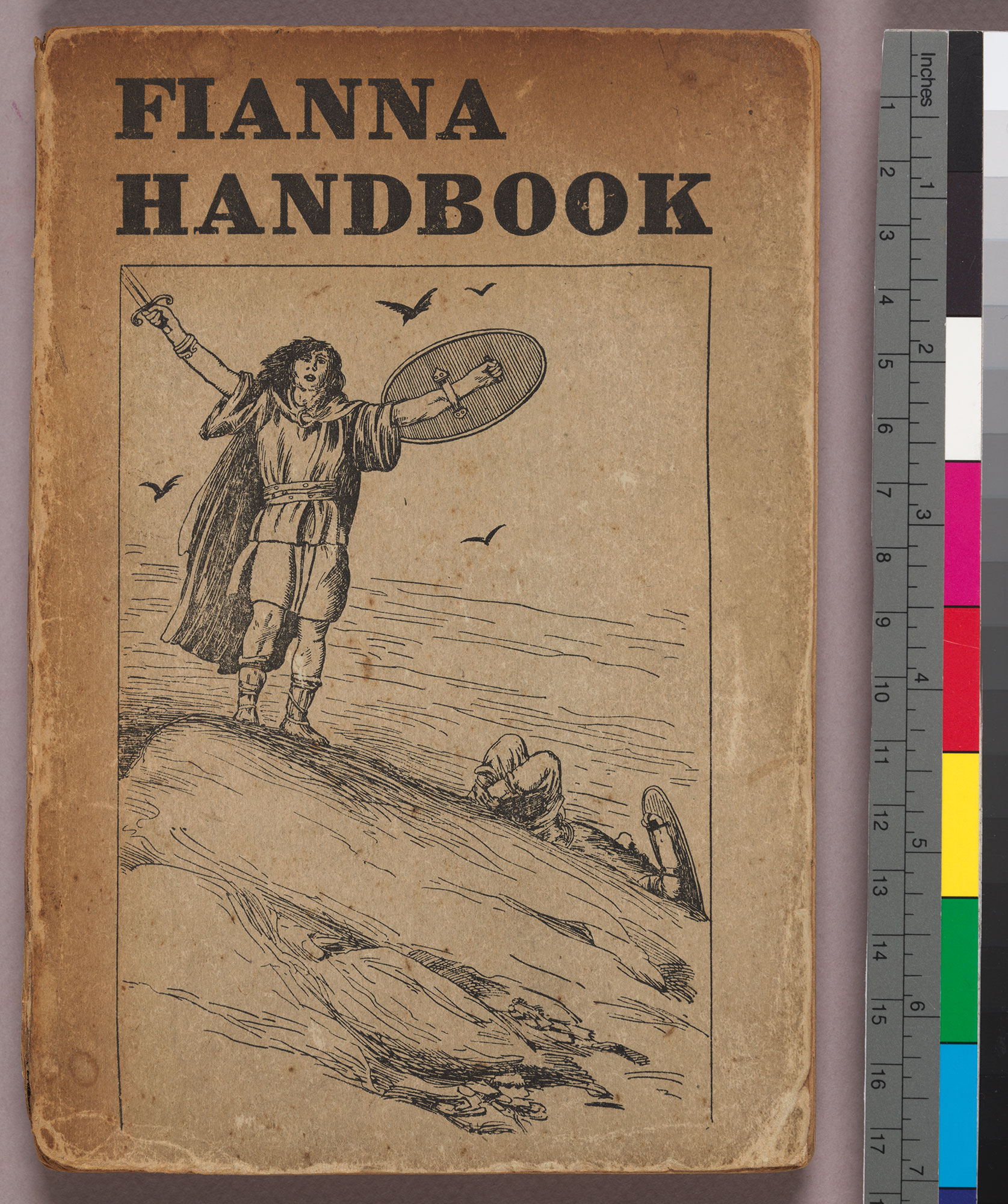
When Gaelic revivalism became more political, groups like Na Fianna Éireann (Boy Scouts of Ireland), founded in 1909, emerged to support a future military insurrection. First published in 1914, the Fianna Handbook served as the official guide and training manual for Na Fianna Éireann. The Fianna Handbook was the Irish nationalist alternative to the Baden-Powell Boy Scout handbook, with the Fianna portrayed holding rifles, in contrast to the Baden-Powell Scouts, who carried walking sticks.
The guide featured training in signaling, first aid, camping, and military drill, but also contained chapters devoted to a cultural nationalist education. Patrick Pearse contributed a chapter on the legendary Fianna; Countess Markievicz, the group’s founder and ‘Chief,’ wrote an inspiring foreword and designed the cover; Roger Casement penned an essay on chivalry; and Douglas Hyde submitted a chapter in the Irish language.
Current and former Fianna participated in the 1916 Easter Rising, and the organization later worked alongside the Irish Republican Army (IRA) in the Irish War of Independence (1919-21).
Eighty years after Young Ireland founded The Nation newspaper, the Irish Free State was declared, and Irish Independence followed soon after. The Gaelic revival survived largely because it recognized that nobody was too young to serve their country, and the new Irish state found many former “Firesiders” and Fianna members serving in leadership roles. These once pint-sized radicals ensured that their dream of a free, Gaelic Ireland would pass to the next generation of Irish children.
Captain Francis O’Neill’s collection 1001 Gems: The Dance Music of Ireland (1907) is so important to the world of Irish traditional music that it’s sometimes called the Bible or simply, ‘The Book’. Starting as a pandemic project, the Irish composer and musicologist Seán Doherty analyzed all 1001 tunes in this influential collection. In this lecture and performance, Seán will discuss the music along with O’Neill’s biography and will play tunes linked to key moments in Chief O’Neill’s life.
Captain O’Neill donated his personal library to the University of Notre Dame, where it is held at the Hesburgh Library. Dr. Doherty’s research visit is supported by the Keough-Naughton Library Research Award in Irish Studies.
The exhibition Making and Unmaking Emancipation in Cuba and the United States is now open and will run through the fall semester.
Curator-led tours, open to the public, will be held noon–1:00pm on the following upcoming Fridays: October 13 and 27 [tour on 10/27 cancelled], and November 17.
Tours of the exhibit may also be arranged for classes and other groups by contacting Rachel Bohlmann at (574) 631-1575 or Rachel.Bohlmann.2@nd.edu.
The October spotlight exhibits are Football and Community at Historically Black Colleges and Universities (August – December 2023) and Path to Sainthood: Brother Columba O’Neill (October – November 2023).
RBSC will be open regular hours (9:30am – 4:30pm) during the University of Notre Dame’s Fall Break, October 16 – 20.
We congratulate the following scholars who won this award in 2023, and we hope they will enjoy, as well as benefit from, their time in the Hesburgh Libraries.
The Keough-Naughton Library Research Award in Irish Studies, a grant designed to assist scholars who travel to use the Irish collections at the Hesburgh Libraries, was inaugurated in 2018. The annual competitive award is sponsored by the Keough-Naughton Institute of Irish Studies and ND International.
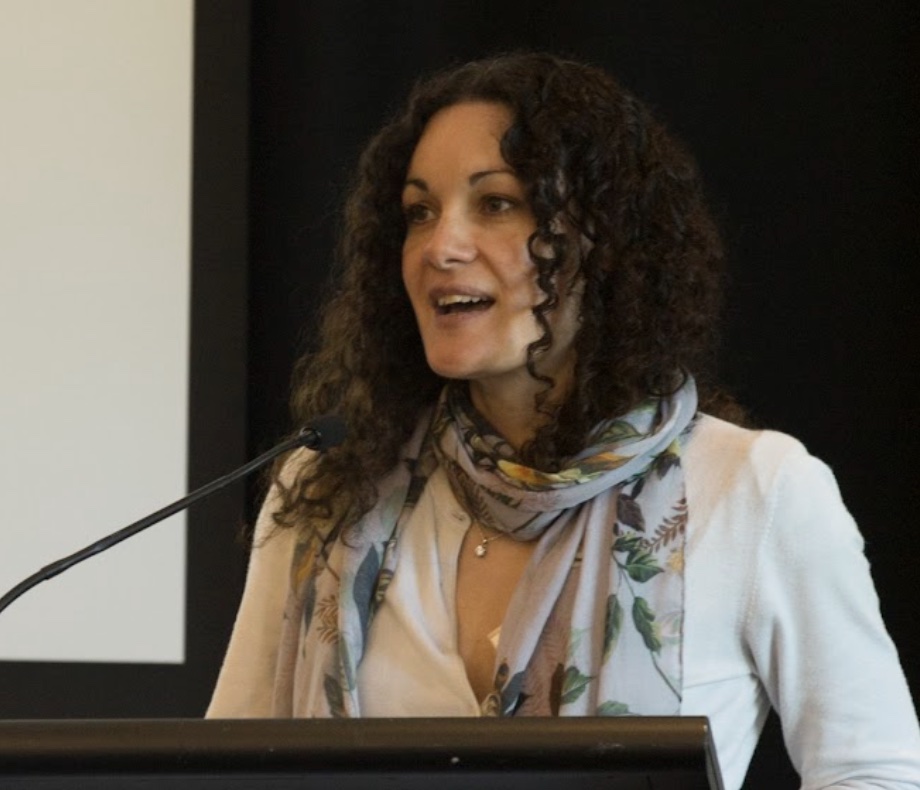
Dr. Seán Doherty, a lecturer at the School of Theology, Philosophy and Music, Dublin City University, is a composer and musicologist.
Seán Doherty
His project is ‘Patterns in 1001 Gems: The O’Neill Collection of Traditional Irish Music.’
Seán expects to visit in the fall and will work closely with the O’Neill Collection, the personal library of Francis O’Neill, the Chicago Chief of Police whose published collections of Irish traditional dance music have played a large role in the music of Ireland.
Dr. Anne Jamison, Senior Lecturer in Literary Studies at the School of Humanities and Communication Arts at Western Sydney University, Australia.
Anne Jamison
Anne is a feminist literary critic with a research focus on nineteenth-century Ireland and also on Australian women’s literature. She has published widely on Somerville and Ross as well as on other Irish women writers.
Her project is ‘Irish Women’s Fairy Tale and Fantasy Writing for Children, 1800-1935.’
She expects to visit this summer, and to make great use of the Irish literature collections throughout the Hesburgh Library, focusing on works by Winifred Letts, Rosa Mulholland and Frances Browne in our Rare Books and Special Collections.
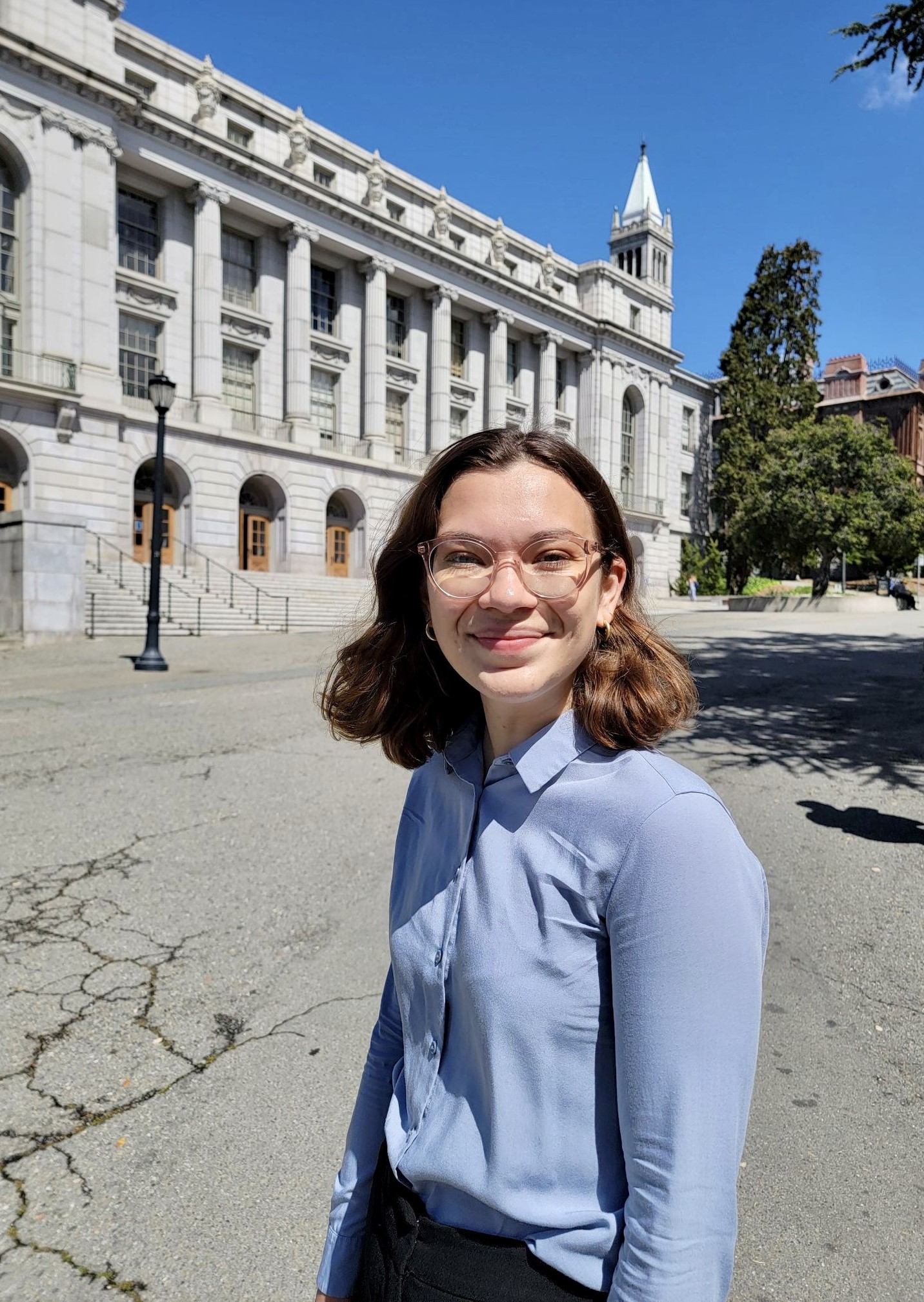
Annabel Barry is at the Department of English at the University of California, Berkeley, where she is a PhD candidate.
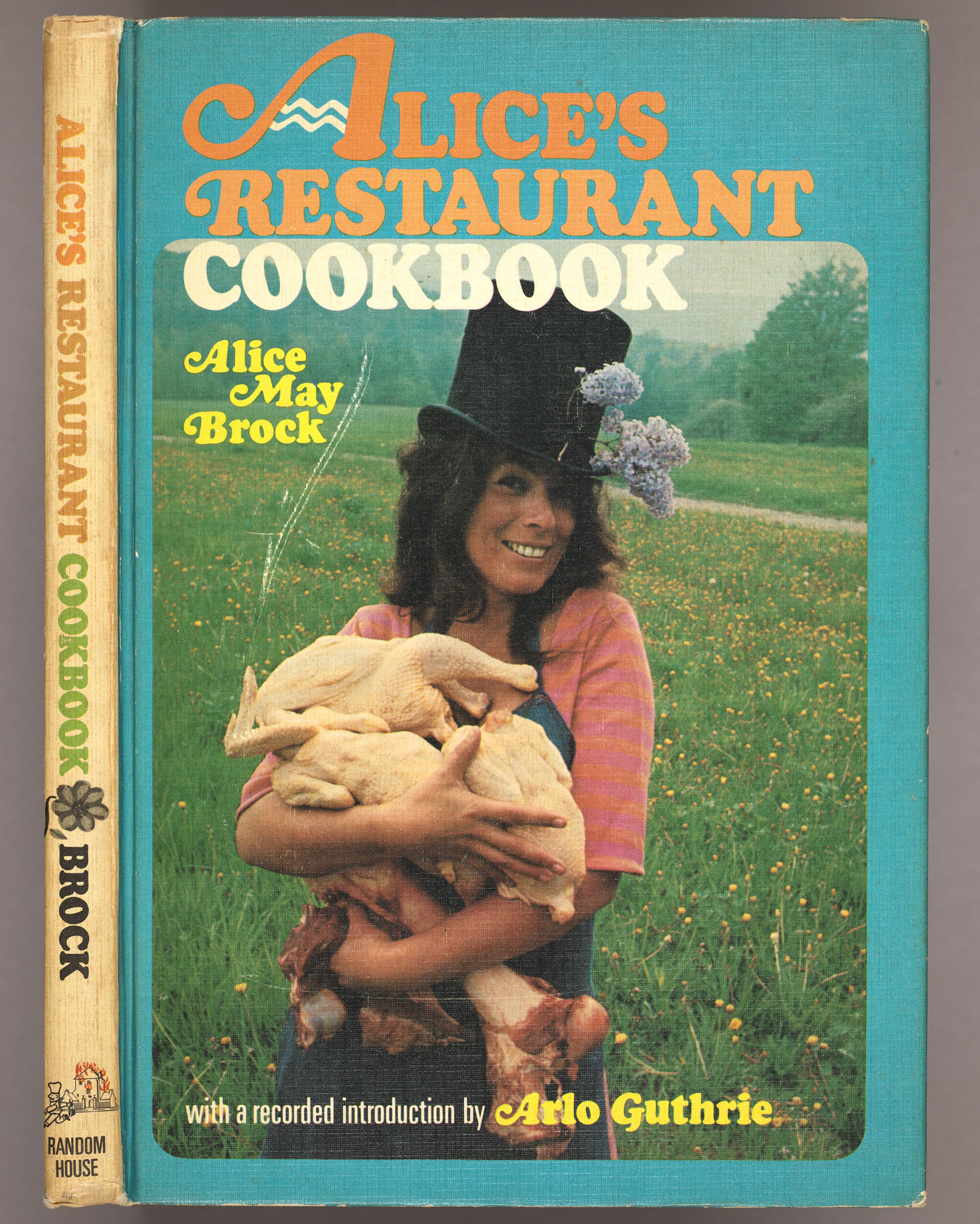
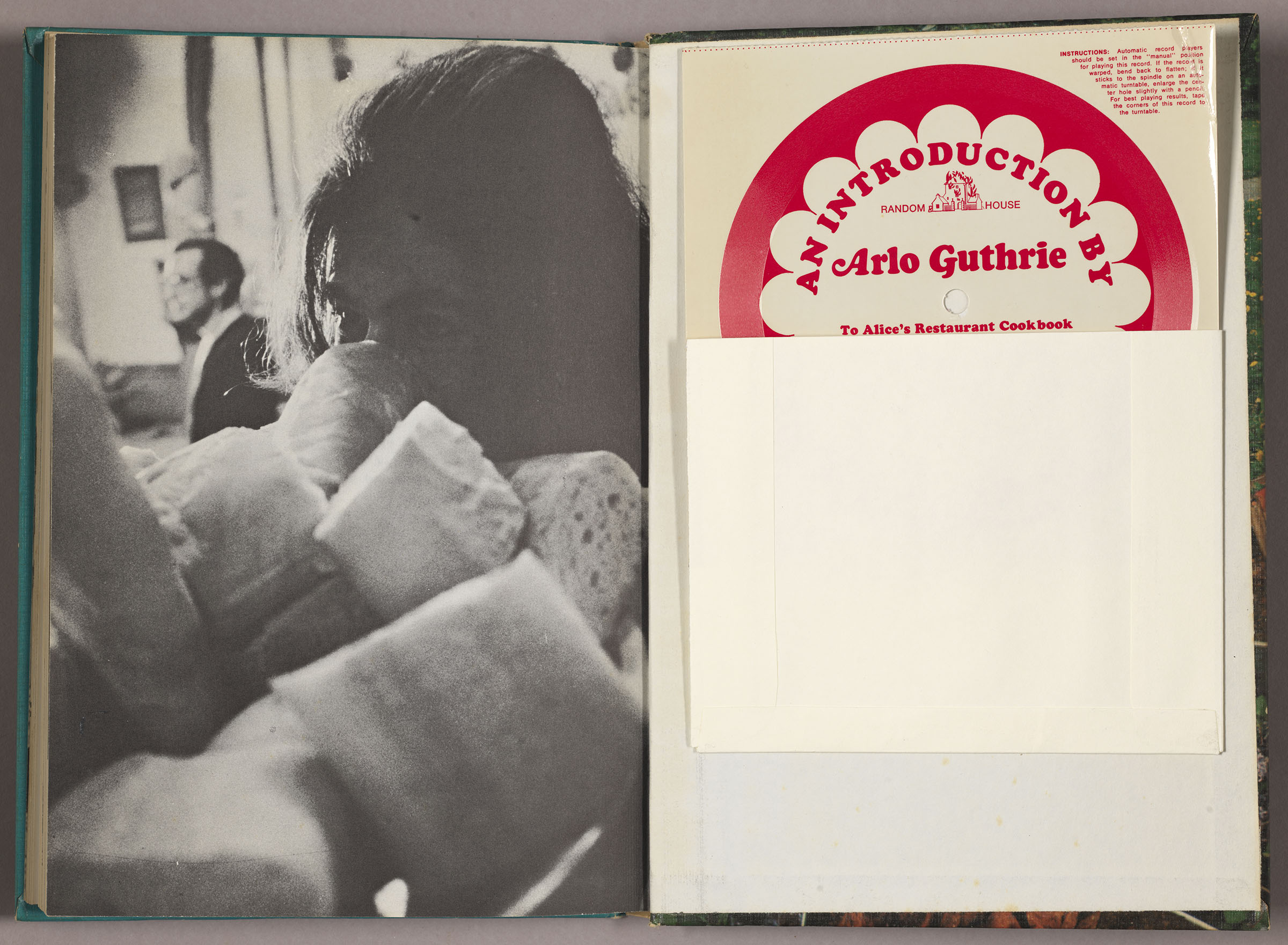
To celebrate Thanksgiving this year, Special Collections highlights Alice’s Restaurant Cookbook by Alice Brock (the Alice of Arlo Guthrie’s “Alice’s Restaurant” song) and the 1965 Thanksgiving that occasioned it. This is not a cookbook for Thanksgiving. It is a book that exists because of Thanksgiving. It is also a commercial, even nostalgic, artifact (produced by a mainstream publisher—Random House) about a countercultural moment already in the past when the book appeared in 1969.
Alice Brock had opened a restaurant—The Back Room—in Stockbridge, Massachusetts in 1965. That Thanksgiving she hosted a gathering of friends that included Arlo Guthrie, the son of folk singer Woody Guthrie. The day after the festivities, Guthrie and a friend helpfully removed a large load of garbage from Brock’s house. The city dump was closed so the young men threw the trash down a nearby ravine. The owner of the property had the two arrested and criminally charged with littering. Brock bailed them out of jail and Guthrie was inspired to write a song, which became “Alice’s Restaurant Massacree,” released in 1967.
In the song, Guthrie relates his Stockbridge Thanksgiving, detention, and subsequent conviction. Then the song changes and Guthrie describes how he used his criminal record to secure a rejection from the New York City Draft Board and avoid military service during the Vietnam War. The song, which is 18 and a half minutes long, unexpectedly became an anthem of anti-Vietnam protests and an expression of countercultural rebellion. Since the 1970s it has also become a cultural icon around Thanksgiving. Today, many radio stations around the country play the song on this holiday.
Guthrie’s story/song also caught the attention of film director Arthur Penn, who adapted it into a film, Alice’s Restaurant. It was released in 1969 with leading roles by Guthrie and a small cameo by Brock (Patricia Quinn played Alice Brock in the film).
Brock published Alice’s Restaurant Cookbook on the song and the film’s commercial coattails. It contains image stills from the movie as well as a small, vinyl record tucked into a pouch attached to the back inside cover. The recording doesn’t include “Alice’s Restaurant Massacree,” but the disk underscores the book’s connection with Guthrie’s famous song with a short introduction by Guthrie and Brock followed by two songs by Guthrie. In “Italian-Type Meatballs” and “My Granma’s Beet Jam,” he puts the words of two of Brock’s recipes to music.
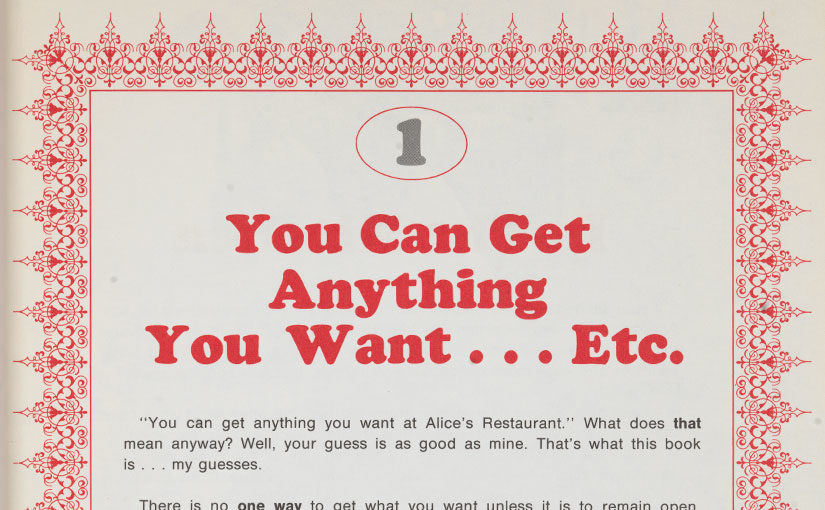
Brock’s cookbook captures her playfulness and openness along with the countercultural ethos of both her Thanksgiving gathering and her cooking. In her introduction, Brock riffs on the chorus of Guthrie’s song (“you can get anything you want at Alice’s restaurant”). “There is no one way to get what you want unless it is to remain open,” she writes. “Keep guessing. . . . No one has ever fried an egg without turning on the gas, but maybe this time if you look that egg straight in the eye and say ‘FRY,’ it will.” (p. 3). And no Betty Crocker cookbook had index entries for “Blowing Your Own Horn” and “Doctor, Get the” as well as “Used Chicken.
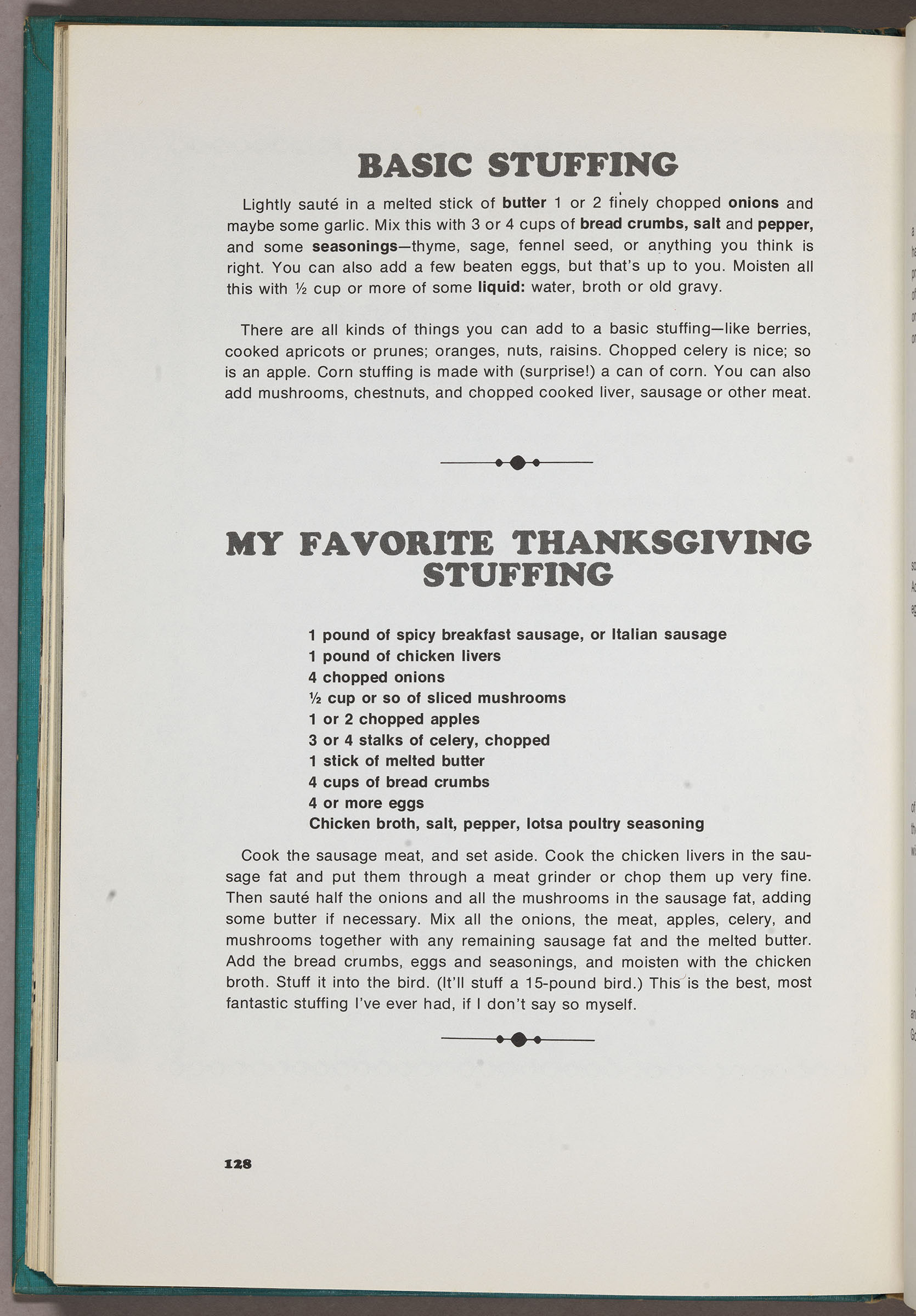
If you hope to find special recipes for cooking a Thanksgiving feast in Brock’s book, however, you’ll be disappointed. The section on “Turkey” takes up just a part of one page and the only reference to Thanksgiving appears in a chapter on “Stuffings And Forcemeat.” But as Alice Brock wrote in her author’s bio, she “[c]ooked good good food with a smile and other expressions . . . Bought a crummy diner . . . Turned it into a crazy-yummy-cozy restaurant . . . Thru it all Alice is a real live human bean—Still foolin’ around and still cookin’ . . .”
Happy Thanksgiving!
RBSC will be closed during Notre Dame’s Thanksgiving Break (November 25-26, 2021). We wish you and yours a Happy Thanksgiving!
Ninety years ago, Francis O’Neill made the University of Notre Dame the valuable gift of his remarkable personal library, a library known primarily for its collections on Irish music and Irish history.
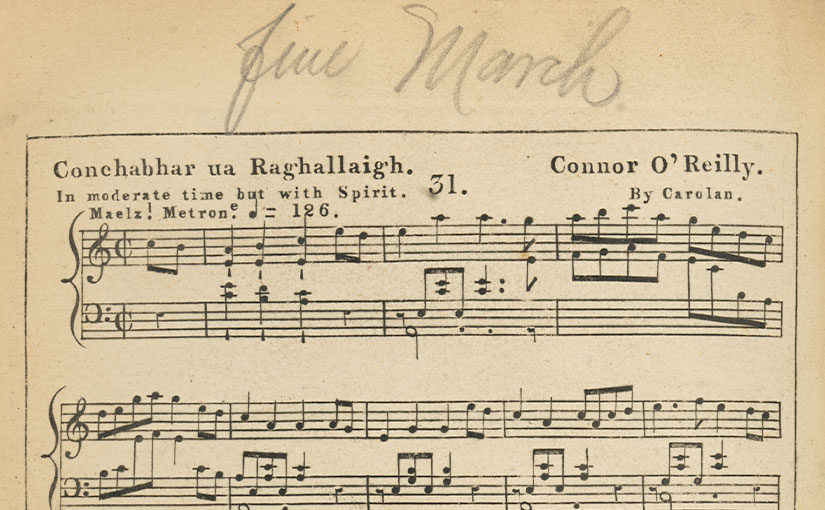
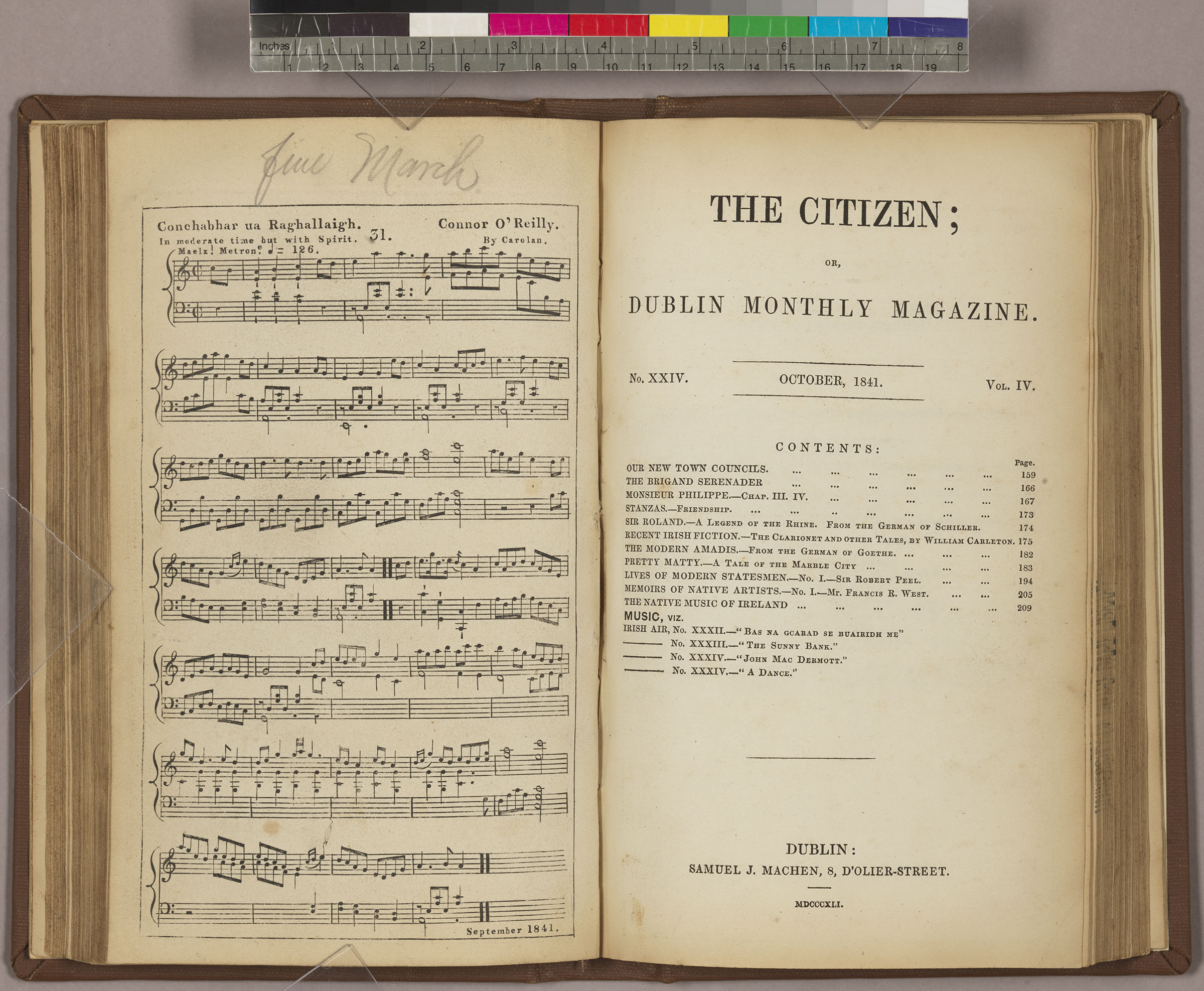
Though the magazine covers literature, history and politics, it is for the music that O’Neill collected these volumes, as borne out by both his pencil annotations on the pages and his listing of these volumes under ‘Musical History and Literature’ in his inventory of the collection (O’Neill Library Inventory, MSN/MN 0502: Series 2).
The periodical ran, with various name-changes, from 1839 until 1843. When William Elliot Hudson (1796-1853) became editor, his brother, Henry Hudson (1798-1889) contributed a regular section on Irish music. This is the same Henry Hudson, a dentist with a practice on St. Stephen’s Green, Dublin, whose manuscripts found their way into various collections including that of Francis O’Neill. We know how O’Neill came by the manuscript from a letter he wrote to Charlotte Milligan Fox in 1911:
When I obtained the MSS. Volume referred to on pages 68 and 249 of “Irish Folk Music” through Nassau Massey, Cork, I was informed that some four or five similar volumes had been purchased for the Boston Library. These latter, it appears, reached Mr. Massey, and were disposed of before the volume I now possess came into his hands.
O’Neill’s letter is published in an article by Fox, “Concerning the William Elliott Hudson Collection of Irish Folk Songs” in which she describes her discovery of the five notebooks in the Boston Public Library, and also argues erroneously that the author is William E. Hudson.
Hudson transcribed the songs and melodies at a time of enthusiasm for collecting and preserving traditional music of Ireland. Edward Bunting’s published collections, beginning with the melodies he transcribed from the Belfast Harp Festival of 1792, inspired a number of others to engage in similar work.
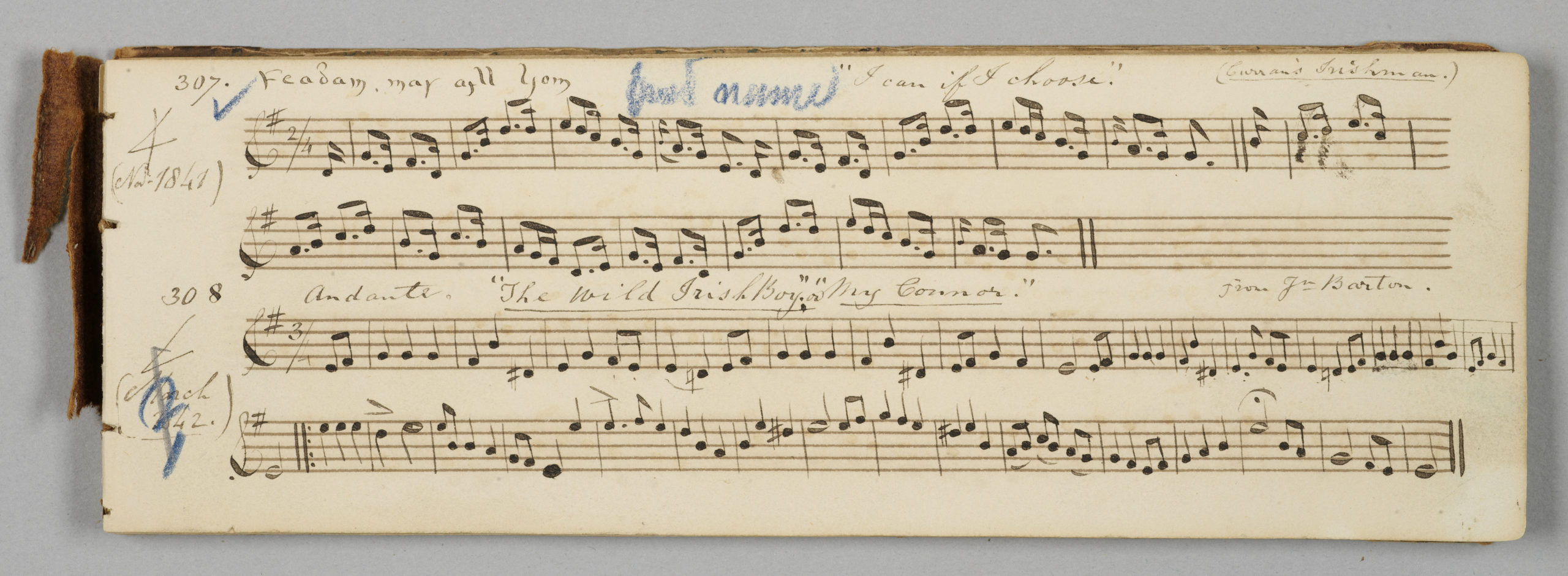
While the manuscript notebooks are filled with the songs or melodies, his published sections on Irish music include also lengthy introductions to the songs. The February 1941 issue of The Citizen also includes an essay on the printing of Irish music.
In our present number we again present our readers with three Irish airs. In the mechanical departments of the work, we are but experimenting. The neglect of every matter of art in Ireland has hitherto been so great, that we have had to cope with difficulties, which few, possibly , of our readers, are prepared to appreciate. The metals to be graven, — the tools to be employed,– the inks to be used, are all in a state of imperfection. The result is, and it has been the case for years, that those requiring any musical work of nicety to be executed, go, or send to London for it; and thus, even in Bunting’s last beautiful work, in the bringing out of which so much notationality has been tastefully displayed, the reader will find the last page deformed with the announcement, “London, engraved by H. T. Skarratt, 5, Eyre-street, Hatton-garden.” One hundred and thirteen plates for an irish work, especially national, engraved in London!
The Citizen or Dublin Monthly Magazine XVI, no. III, February 1841. P. 134
Hudson assigned Irish language titles along with English titles to most of his tunes. Examples are “Fuaim na dTonn” / “The Sound of the Waves” and “An Deoruide Tuirseach” / “The Weary Wanderer”.
“The Wearing of the Green”
Hudson’s series of notebooks of music manuscripts is divided across three libraries: one in the National Library of Ireland, five in the Boston Public Library, and one here in Notre Dame’s Special Collections.
A page from the Hudson manuscript MSE 1434-2B 021
Our notebook has been digitized may be viewed online, and digital copies of those at the Boston Public Library are available in the Internet Archive:
While the Irish Studies collection in the Hesburgh Libraries has grown considerably in recent decades, one of the enduring treasures, and the collection most often inquired about, is the O’Neill Collection. This is the personal library of Francis O’Neill, the famous collector of Irish music who was once Chicago’s Chief of Police.
Francis O’Neill (1848-1936) left Ireland in his teens, travelled the world as a sailor, settled in America and after first qualifying as a teacher in Missouri, moved to Chicago where he joined the police force in 1873. By all accounts a larger-than-life figure, he was well-known both as a police officer and as one of the major experts on Irish traditional music.
Sometime in the later 1880s… Francis O’Neill began to realize that there was yet much Irish traditional music to be collected and preserved that had escaped earlier collectors. He recruited James O’Neill to the project of collection and started to visit him regularly … so that the tunes remembered from Francis’ childhood in Cork could be noted down from his dictation in a private manuscript collection… [i]
As months and years passed and word of their enterprise spread others contributed tunes to the collection and James O’Neill began visiting musicians in their homes to note their music.
Carolan, 11
Nicholas Carolan goes on to describe how O’Neill’s project developed, his publication of O’Neill’s Music of Ireland (1903) and his other books, and of the enduring legacy of these books.
For generations of musicians who play Irish traditional music, O’Neill’s books are perceived as essential. Carolan aptly named his book ‘A Harvest Saved’ as O’Neill collected at a time and place where people had left the communities in which the music had thrived. The 75,000 Irish immigrants in Chicago carried with them the music of many parts of Ireland, and O’Neill was able to tap into the rich repository of their tunes and record them for posterity.
O’Neill was following in the footsteps of important collectors such as Edward Bunting and George Petrie, many of whose books are in O’Neill’s collection and bear pencilled annotations indicating his careful study of the contents.
From New edition of a general Collection of the ancient Irish music. Rare Books XLarge M 1744 .B868 G4 1796
This book is one of the most important works in the history of Irish music collecting. Edward Bunting began his life-long interest in the collection of Irish harp-music in 1792. He notated the music of performers at the Belfast Harp Festival that year, and this inspired him to continue for many years in his collection and study of Irish harp music.
The O’Neill Collection includes also Bunting’s two later collections, published in 1809 and 1840. O’Neill’s pencilled notes can be seen in the margins of these books.
Page detail from New edition of a general Collection of the ancient Irish music. Rare Books XLarge M 1744 .B868 G4 1796
The O’Neill Collection includes important works from Scotland including Orpheus Caledonius by William Thompson, one of the earliest published collections of Scottish songs. First published in two volumes in 1725, our O’Neill copy is volume I only of the 1733 edition. This copy has pencil annotations either by O’Neill or by an earlier reader. It also includes a subscribers list, which is not included in the facsimile edition published in 1962.
When Chief O’Neill offered his library to the University in 1931, he described it as having a ‘Hiberniana’ collection and a music collection. In each case, his library was exceptional. Our O’Neill Collection includes a valuable selection of books on Irish history and antiquities, and in the music section, a collection of many well-known collections of Irish music, along with lesser-known books of dance music, and books on the music and instruments of Ireland, England and Scotland in particular.
Hoping to bring the O’Neill Collection to enthusiasts who cannot visit the Hesburgh, we selected thirty of the rarest books from the collection for digitization. We plan to share these digital collections in a number of ways — the Internet Archive being one — making it possible to study the books anywhere in the world.
The Irish Song Book, with Original Irish Airs. Edited, with an introduction and notes by Alfred Perceval Graves. 2nd ed. London: T. Fisher Unwin, 1895. Rare Books Small M 1744 .G783 I7 1895
[i] The Hesburgh Library’s O’Neill Collection has only two music manuscripts. It would be wonderful if O’Neill’s own manuscripts were still in existence and could be found.
An exhibition which sets the story of the SDP within the larger history of the private press movement in England and examines its artistic as well as literary achievements is currently on display in Special Collections. The exhibition features different types of publications and posters produced by the SDP (though not this volume), is curated by Dennis Doordan (Professor Emeritus School of Architecture, University of Notre Dame), and runs through the summer.
Happy Easter to you and yours from Rare Books and Special Collections at the University of Notre Dame.
After being closed April 19 in observance of Good Friday,
Rare Books and Special Collections reopens at 9am
on Monday, April 22, 2019.
Friday, May 4 at 1:00pm | Awards ceremony for the annual Undergraduate Library Research Award (ULRA), followed by a reception in the Special Collections Seminar Room (103 Hesburgh Library).
The main exhibit this spring is In a Civilized Nation: Newspapers, Magazines, and the Print Revolution in 19th-Century Peru. This exhibit is curated by Erika Hosselkus and draws on strengths of Rare Books and Special Collections’ José E. Durand Peruvian History collection. Together these items offer diverse perspectives on Peruvian political events and cultural and religious practices and preferences from the colonial era, through the country’s birth in 1825, and beyond the turn of the twentieth century.
The spotlight exhibits during early April are From Distant Waters: Whaling Manuscripts in Special Collections and Baseball and Tin Pan Alley: Sheet Music from the Joyce Sports Collection, both curated by George Rugg. The baseball exhibit will end mid-month, with the exhibit Chaste, Choice and Chatty: Irish-American Periodicals of the Nineteenth Century, curated by Aedín Ní Bhróithe Clements, opening for the second half of the month and continuing through the summer.