A Closer Look at the Gorey-est of Vampires

by Sara Weber, Special Collections Digital Project Specialist

Merriam-Webster defines a vampire as, “the reanimated body of a dead person believed to come from the grave at night and suck the blood of persons asleep.” The Oxford English dictionary gives the middle of the eighteenth century as their earliest evidence for the word vampire, but the concept far predates that in the folklore of various cultures. While characters of a vampiric nature occur as early as Babylonian poems recorded on cuneiform and the ancient Greek writings of Philostratus, the folklore that is most significant to the development of the Western concept of a vampire was that of the Slavic cultures of Eastern Europe. These malevolent beings were seen as gruesome and frightening, because death, disease, and degeneracy were all attributed to their actions and influence. As the vampire became a more familiar figure in Western cultures during the eighteenth century (by 1740 Alexander Pope compared himself to “one of those vampires in Germany” when he went out at night), they were initially perceived in a similar, grotesque manner. However, over time the vampire—though still a villain—came to be portrayed as charismatic and seductive.
Bram Stoker, Dracula. Eighth edition. London: Archibald Constable & Co., 1904.
(Rare Books Small PR 6037 .T617 D7 1904)

Bram Stoker’s 1897 Dracula was not the first vampire in English literature, Robert Southey’s 1801 poem “Thalaba the Destroyer” is generally given that title. Polidori’s short story “The Vampyre” (1819), Varney the Vampire; or, the Feast of Blood (1845–1847), and Sheridan Le Fanu’s “Carmilla” (1872) all preceded it as well. But Stoker’s vampire has become the template against which all modern vampires are compared. The Count is initially described as,

“…a tall old man, clean shaven save for a long white moustache, and clad in black from head to foot, without a single speck of colour about him anywhere. …his hand grasped mine with a strength which made me wince, an effect which was not lessened by the fact that it seemed as cold as ice—more like the hand of a dead than a living man.” (Dracula, Chapter 2)

He is gracious and courteous, however, and as the novel progresses, and he feeds, he becomes less corpse-like. When Mina and Johnathan see him in London, she describes him as “a tall, thin man, with a beaky nose and black moustache and pointed beard… His face was not a good face; it was hard, and cruel, and sensual, and his big white teeth, that looked all the whiter because his lips were so red, were pointed like an animal’s.” (Dracula, Chapter 13)

Count Dracula has become more immortal in popular culture than he was in Stoker’s novel, the subject of numerous theatrical adaptations and cinema classics. The first play—more of a staged reading of the book, really—ocurred the same year as the book was published, as a way of securing copyright protection. In the 1920s, Hamilton Deane and John L. Balderson created their own adaptation, and in 1977 a revival of this version arrived on Broadway. This production featured the design work of Edward Gorey in its sets, costuming, posters, and playbills. He won a Tony Award for the Costume Design, and was nominated for Set Design. The play also won a Tony for Most Innovative Production of a Revival. (Frank Langella was nominated for Best Performance by a Leading Actor in a Play, while Dennis Rosa was nominated for Best Direction of a Play.)

As the play became a popular success as well as a critical one, Gorey’s designs appeared on a variety of merchandise from t-shirts and bags to puzzles, toys, and even a miniature theatre, examples of many of which are found in Notre Dame’s Special Collections.

The Suzy Conway and Robert M. Conway Collection of Gorey Ephemera (EPH 5004) also includes articles and article illustrations, drawings, picture postcards, posters, and correspondence. There are materials relating to his work illustrating book covers for Doubleday, including a few other vampire themed or related texts.

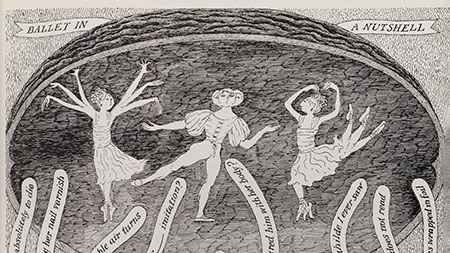
In recognition of the centenary of Edward Gorey’s birth and the 25th anniversary of his death, RBSC’s September-October spotlight has highlighted Gorey’s engagement with the New York City Ballet in his distinctive noir style. Although the exhibit officially closes today, it will remain viewable through early next week, before the installation on November 5 of the November-December spotlight. Come visit Special Collections for a further look at some of Gorey’s distinctive work.


Happy Halloween to you and yours
from all of us in Notre Dame’s Special Collections!

Halloween 2024: An Irish Story Produces a Halloween Icon
Halloween 2023: Demon Horses and How to Tame Them
Halloween 2022: A Halloween Tale: “John Reardon and the Sister Ghosts”
Halloween 2021: A Welsh Witch in the Woods
Halloween 2020: Headless Horsemen in American and Irish Legend
Halloween 2019: A Halloween trip to Mexico
Halloween 2018: A story for Halloween: “Johnson and Emily; or, The Faithful Ghost
Halloween 2017: A spooky story for Halloween: The Goblin Spider
Halloween 2016: Ghosts in the Stacks

Upcoming Events: November 2025

Please join us for the following public events and exhibits being hosted in Rare Books and Special Collections:

Thursday, November 13 at 5:00pm | Italian Research Seminar: “Our Memories, Ourselves: Restoring Political Communities in Purgatorio” by Filippo Gianferrari (UC Santa Cruz).


The Fall 2025 Exhibition | “What through the universe in leaves is scattered”: Mapping Global Dante in Translation

This exhibit traces the global journey of Dante’s masterpiece through rare and valuable printed editions, highlighting how translators, artists, and printers have popularized and reshaped the Commedia. These volumes reveal a dynamic dialogue between Dante’s poetry and the world. A global literary perspective transforms Dante from a monumental yet isolated figure of the European Middle Ages into a central presence in the ongoing international conversation about humanity, the universe, time, eternity, and the power of literature.

Drop in to one of this month’s Exhibit Open Houses to meet and speak informally with one of the curators of the fall exhibition, Mapping Global Dante in Translation. Learn how translators, artists, and printers have popularized and reshaped the Divine Comedy over the centuries and across the world and discover the Library’s many Dante editions.

Friday, November 7, 2:00 – 3:30pm | Exhibit Open House with curator Giulia Maria Gliozzi (Notre Dame, Italian Studies doctoral candidate)

Friday, November 21, 2:00 – 3:30pm | Exhibit Open House with curator Salvatore Riolo (Notre Dame, Italian Studies doctoral candidate)

This exhibit is curated by Salvatore Riolo (Notre Dame, Italian Studies doctoral candidate), and co-curators Giulia Maria Gliozzi (Notre Dame, Italian Studies doctoral candidate); Inha Park (Notre Dame, Italian Studies doctoral candidate); and Peter Scharer (Yale, Comparative Literature doctoral candidate). Theodore J. Cachey Jr. (Notre Dame) and Jacob Blakesley (Sapienza Università di Roma) served as consultants on the exhibit.

The exhibit is co-sponsored by the Center for Italian Studies and the Devers Program in Dante Studies. This and other exhibits within the Hesburgh Libraries are generously supported by the McBrien Special Collections Endowment.


MSH/LAT 0095
(Luz de Sagaceta)

Opening November 5, our next spotlight exhibit will feature several friendship albums being studied this semester by Notre Dame students in a class taught by Vanesa Miseres (Romance Languages & Literatures).

Bibliomania: The Library of Sir Thomas Phillipps curated by Anne Elise Crafton (2024-2025 Rare Books and Special Collections Postdoctoral Research Fellow) will continue through the end of the semester. Portrait of the Artist as a Dance Fan: Edward Gorey and the New York City Ballet curated by Rachel Bohlmann (American History Librarian and Curator) is available to view for just a few more days.

All exhibits are free and open to the public during business hours.


National Hispanic Heritage Month 2025

We join the Library of Congress, National Archives and Records Administration, National Endowment for the Humanities, National Gallery of Art, National Park Service, Smithsonian Institution, and United States Holocaust Memorial Museum in celebrating National Hispanic Heritage Month.

From our Latin American and Latino Studies Archives: Celebration and Resistance

by Payton Phillips Quintanilla, Latin American & Iberian Studies Librarian and Curator

2025 has seen various local and community-based annual public celebrations of Latino heritage scaled-down, postponed, or cancelled altogether out of fears for the safety of participants and community members. Other public celebrations have gone on as planned, with some organizers even rearticulating their yearly “Grito de Independencia” (the September 15th commemoration of the “Cry of Independence” from Spanish colonial rule, specific to the Mexican context) as “Grito de Resistencia” (“Cry of Resistance”). Both paths, however, are guided by a spirit of solidarity, and informed by a history of perseverance, that predate—and are poised to persist beyond—any formal federal recognition of the diverse cultures, accomplishments, and contributions of Latinos in the United States.

Inspired by that same spirit and history, we present three examples, preserved in Notre Dame’s Rare Books and Special Collections, of historical moments when Latino communities organized celebrations of resistance—both public and private, and throughout the calendar year—in direct response to histories and realities of persecution, oppression, exclusion, and erasure.  

1969: “La Fiesta de los Barrios”

“The Fiesta De Los Barrios is the Fiesta of all of our people. For the first time the heritage of our cultural past and the richness of our cultural present will be expressed through the creative talent and skill of our barrio artists, writers and performers. […] It is this pride in ourselves and confidence in our future that has made this magazine and indeed the entire Fiesta possible.”

The name “La Fiesta de los Barrios” carries multiple references: it was a community celebration, a literary journal, and an aspiration for the future. The actual “fiesta” took place in early May, 1969, at Lincoln High School in Los Angeles to celebrate the one-year anniversary of the LA Walkouts: a watershed movement through which Mexican American students protested systemic racism, abuses, and neglect on their campuses, and demanded inclusive and unbiased curricula. (For an introduction to the Walkouts, we suggest you watch this Retro Report hosted by PBS, or this excerpt from PBS’s Latino Americans.)

The journal by the same name, or Fiesta Magazine (MSH/LAT 0099-61), memorialized select verse, prose, and drawings created by community members and event participants, representing a diversity of voices and experiences. And finally, it was the hope, as articulated by photographer Pedro Arias in one of the journal’s opening essays, that all peoples of Mexican descent living in the United States could overcome generational and cultural divides to work together toward common goals: “Y entonces será un día de fiesta, será una FIESTA DE LOS BARRIOS, pero una Fiesta de Los Barrios permanente […]” (And then it will be a day of celebration, it will be a FIESTA DE LOS BARRIOS, but a permanent Fiesta de Los Barrios […]) (7).    

1984: “A benefit for Casa El Salvador Farabundo Martí”  

“Casa El Salvador Farabundo Martí is a solidarity committee of Salvadoran refugees living in the U.S. Our goals are to inform people about the situation in El Salvador and Central America, to promote friendship with our people, and to discourage U.S. intervention in our country.”  

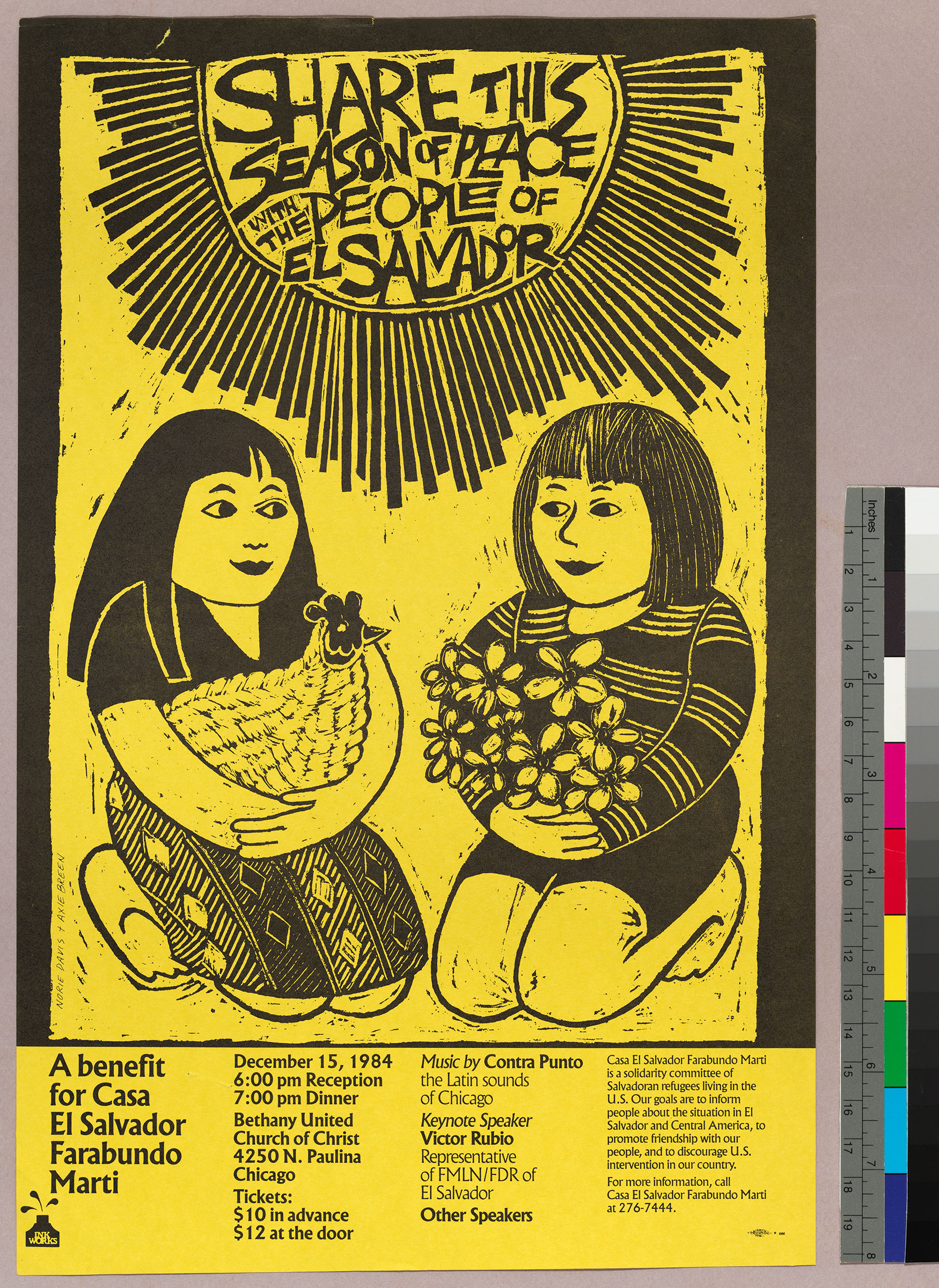
In December 1984, the Chicago-based, refugee-led organization called Casa El Salvador Farabundo Martí hosted a benefit dinner and invited allies and supporters to “share this season of peace with the people of El Salvador.” El Salvador itself, rather than celebrating a season of peace, was deep in a brutal civil war marked by widespread human rights abuses: far from a conflict confined to fighting between armed factions, the government’s military and paramilitary death squads—trained and funded by the United States government—broadly targeted civilian non-combatants. Meanwhile, only a minuscule portion of refugees fleeing El Salvador were granted asylum in the United States. This combination of domestic U.S. policies, enabled by controversial Cold War rhetoric, sparked passionate peace, solidarity, and anti-intervention movements across the country. A snapshot of those efforts, and the array of allies that were involved in them, are captured in this small poster (MSH/LAT 0120 U.S./Central America Cold War Ephemera Collection).

(If this historical moment and its relationship to “sanctuary” activism is unfamiliar to you, an article published earlier this year in The Conversation is a good place to start reading.)

2001: “Encuentro del Canto Popular”

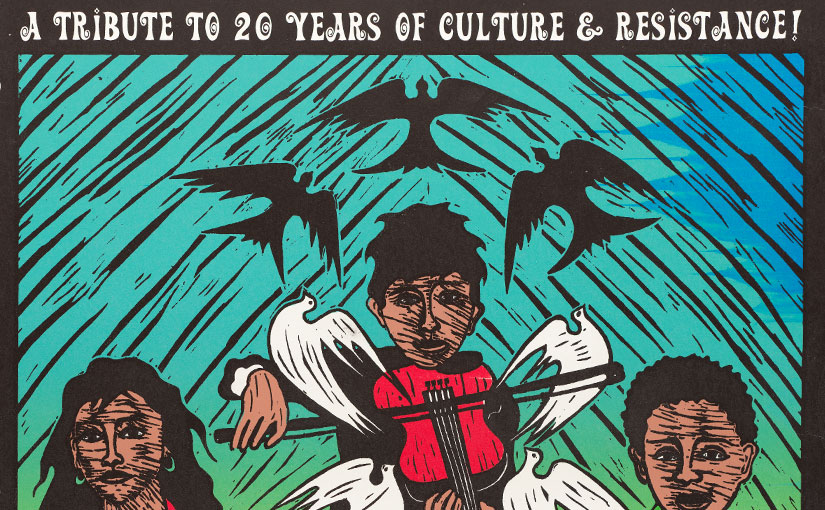
“A Tribute to 20 Years of Culture and Resistance”

San Francisco’s first annual “Encuentro del Canto Popular” (“Gathering of Popular Song”) was organized by volunteers from the community newspaper El Tecolote in 1982. The event was inspired by the life and legacy of Víctor Jara, a Chilean educator, activist, and singer-songwriter who was one of the founding figures of Chile’s—and, ultimately, Latin America’s—nueva canción (new song). This folkloric genre was imbued with such deep social commitment that it became an international movement (the Smithsonian offers an introduction to la nueva canción in their Folkways series). Jara was kidnapped, imprisoned, tortured, and executed by Chile’s military just after the U.S.-backed coup that ousted the democratically-elected president, Salvador Allende, and which began the 17-year military dictatorship of Augusto Pinochet.

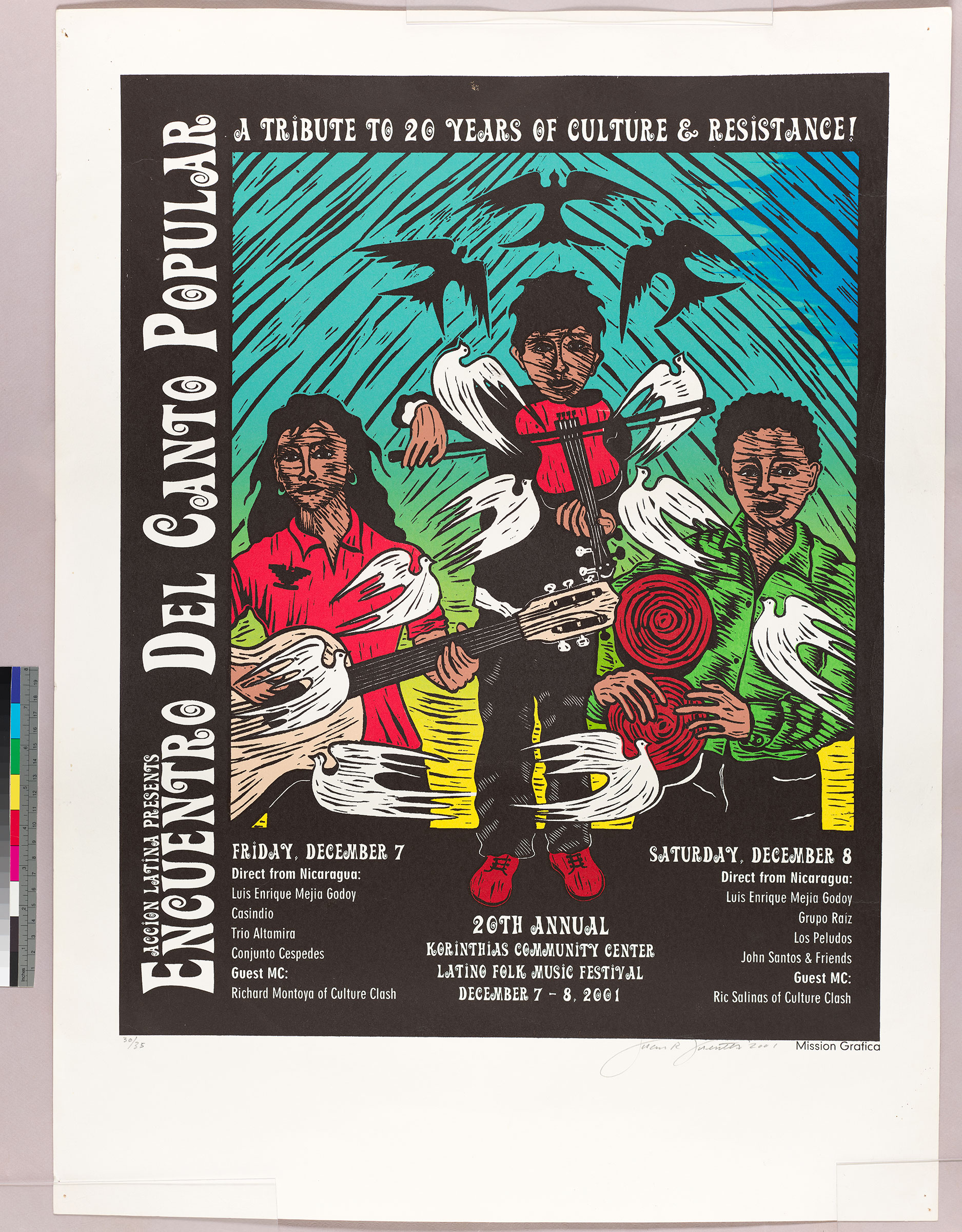
Acción Latina, a community organization based in San Francisco’s Mission District that grew out of El Tecolote, took part in U.S.-based protests against Pinochet’s regime (as can be seen in this post from the Bancroft Library, which now preserves a substantial Acción Latina archive), as well as later solidarity movements. The poster featured here was created for the Encuentro’s 20th year, celebrated in 2001 under the stewardship of Acción Latina. Its lineup of musicians from Nicaragua for this “tribute to 20 years of culture and resistance” was a nod to the protest and dissent expressed in both Nicaragua and the United States following the CIA-led formation in 1981 of the Contras (an umbrella organization of anti-Sandinista combatants), a covert project that ultimately culminated in the Iran-Contra Scandal. The musician wearing the symbol of the United Farm Workers on her shirt speaks to solidarity within and between Latino communities.


Previous Hispanic Heritage Month Blog Posts:

Welcome Back! Spring 2025 in Special Collections

Rare Books and Special Collections welcomes students, faculty, staff, researchers, and visitors back to campus for Spring ’25! Here are a variety of things to watch for in Special Collections during the coming semester.

Special Collections Welcomed Two New Curators in the Fall 2024 Semester

Matthew Knight and Payton Phillips Quintanilla bring subject matter expertise in Irish Studies and Latin American and Iberian Studies.

In addition to stewarding the Hesburgh Libraries’ Irish Studies collections in both general and specialized collections, Knight works with other University faculty members to foster the use of these materials broadly across campus within the larger field of Irish Studies teaching and instruction.

The new Irish Studies Librarian and Curator brings deep expertise in the field of Irish Studies, teaching, and librarianship, including in special collections. He previously served as an Associate Librarian at the University of South Florida and holds an M.A. and Ph.D. in Celtic Languages and Literatures from Harvard University in addition to an M.A. in Library Science from the University of South Florida.

Phillips Quintanilla is responsible for stewarding the Libraries’ Latin American and Iberian Studies collections in both general and specialized collections. She works within the Libraries and across campus to foster the use of the collections broadly within the fields of Latin American Studies and Iberian Studies teaching and instruction. She also supports Latino Studies students and faculty in collaboration with Rachel Bohlmann, American History Librarian and Curator of North Americana.

Phillips Quintanilla brings deep expertise in the field of Latin American and Iberian Studies and teaching, as well as experience in the cultural heritage sector — particularly in areas of provenance and the stewardship of special collections. Before joining the Hesburgh Libraries faculty, she worked as a Research Specialist in the Pre-Hispanic Art Provenance Initiative at the Getty Research Institute. The new librarian and curator holds a Ph.D. in Hispanic Languages and Literatures with a specialization in transatlantic early modern literatures and cultures, as well as an M.A. in Spanish from the University of California, Los Angeles (UCLA), a Master of Professional Writing from the University of Southern California, and a B.A. in Urban and Environmental Policy from Occidental College.

Read the full press release on the Hesburgh Library website.

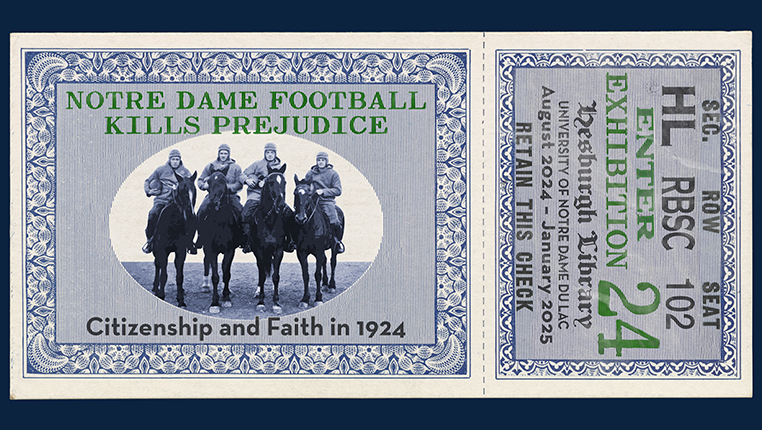
Fall 2024 Exhibition — Notre Dame Football Kills Prejudice: Citizenship and Faith in 1924

Continuing through the end of January.

“Notre Dame football is a new crusade:
it kills prejudice and stimulates faith.”

— Rev. John F. O’Hara, C.S.C., Prefect of Religion,
Religious Bulletin, November 17, 1924

In the fall of 1924, the University of Notre Dame found great success on the football field and confronted a dangerous and divisive political moment. The undefeated Fighting Irish football team, cemented forever in national memory by Grantland Rice’s legendary “Four Horsemen” column, beat the best opponents from all regions of the country and won the Rose Bowl to claim a consensus national championship. Off the field, Notre Dame battled a reactionary nativist political environment that, in its most extreme manifestation, birthed the second version of the Ku Klux Klan. Sympathizers of this “100% Americanism” movement celebrated white, male, Protestant citizenship and attacked other groups—including Catholics and immigrants—who challenged this restrictive understanding of American identity.

In the national spotlight, Notre Dame leaders unabashedly embraced their Catholic identity. They consciously leveraged the unprecedented visibility and acclaim of the football team to promote—within the very real political constraints of the era—a more inclusive and welcoming standard of citizenship. Attracting a broad and diverse fan base, the 1924 national champion Fighting Irish discredited nativist politics and helped stake the claim of Notre Dame—and Catholics and immigrants—to full citizenship and undisputed Americanness.

Curated by Gregory Bond (Curator of the Joyce Sports Research Collection, Rare Books and Special Collections) and Elizabeth Hogan (Senior Archivist for Photographs and Graphic Materials, University Archives).

Spring 2025 Exhibition — Tragedies of War: Images of World War II in Print Visual Culture

Opening mid-February.

Based predominantly on recently acquired Rare Books and Special Collections European holdings, the exhibition commemorates the end of the Second World War (1939-1945) and explores a diverse assortment of themes including Nazi racial ideology, the Holocaust, Children in War, Resistance, Liberation, and Memories of War. By examining these topics through images created for personal use by ordinary people and for state-sponsored propaganda purposes, the exhibit presents a visual narrative of the war’s profound impact on individuals and societies, offering deeper insight into how war was experienced and remembered.

Curated by Natasha Lyandres (Curator, Rare Books & Special Collections), Jean McManus (Catholic Studies Librarian, University Archives) and Julia Schneider (German Language and Literature and Italian Studies Librarian, Hesburgh Libraries).

Spring Spotlight: Building a Campus Boycott to Support Midwestern Farmworkers

Opening end of January.

In 1980, the University of Notre Dame became the first major university to boycott Campbell Soup products in support of Midwestern farmworkers represented by the Farm Labor Organizing Committee (Toledo, OH). In a few short months, a small and dedicated cohort of students tapped into a growing movement and convinced the campus to act in solidarity.

Curated by Emiliano Aguilar (Assistant Professor of History, University of Notre Dame, and Faculty Fellow, Institute for Latino Studies).

These and other exhibits within the Hesburgh Libraries are generously supported by the McBrien Special Collections Endowment.

All exhibits are free and open to the public during regular hours.

Special Collections’ Classes & Workshops

Throughout the semester, curators will teach sessions related to our holdings to undergraduate and graduate students from Notre Dame, Saint Mary’s College, and Holy Cross College. Curators may also be available to show special collections to visiting classes, from preschool through adults. If you would like to arrange a group visit and class with a curator, please contact Special Collections.

Upcoming Events

Thursday, January 16 at 5:00pm | The Spring 2025 Italian Research Seminar and Lectures will begin with a lecture by 4th-year Ph.D. student in Italian Rookshar Myram (University of Notre Dame) titled: “Forging Effigies in the Commedia: Deification as Artistry.”

Learn more about this and other Events in Italian Studies.

Recent Acquisitions

Special Collections acquires new material throughout the year. Watch this blog for information about recent acquisitions.

Upcoming Events: May 2024 and through the summer

Currently there are no events scheduled to be hosted this summer in Rare Books and Special Collections.

The exhibition Mapping the Middle Ages: Marking Time, Space, and Knowledge runs through the summer and closes in late July. Learn more about the exhibit in this video, and plan your visit this summer.

The current spotlight exhibits are Scripts and Geographies of Byzantine Book Culture (February – May 2023) and The Book Beautiful: A Selection from the Arts & Crafts Movement (April – May 2024). Towards the end of May, we will install a double case spotlight exhibit highlighting Special Collections items relating to the early modern history of mathematics.

Rare Books and Special Collections is open
regular hours during the summer —
9:30am to 4:30pm, Monday through Friday.

RBSC will be closed Monday, May 27th, for Memorial Day and Thursday, July 4th, for Independence Day.

Spotlight Exhibit: The Book Beautiful

by Luke Kelly, Gladys Brooks Conservation Fellow, Hesburgh Libraries

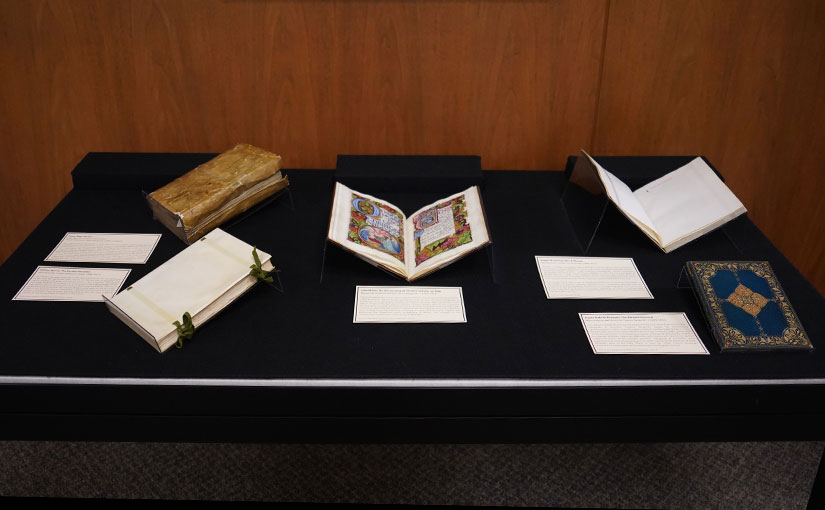
The books in Special Collections’s April-May spotlight exhibit represent a small selection of materials from the University of Notre Dame’s collection that reveal the influence of William Morris on the Arts & Crafts movement. From the printing and binding of Thomas J. Cobden-Sanderson to the illumination and calligraphy of Edward Johnston and Alberto Sangorski, Morris’s ideal of the “book beautiful” was taken up by dozens of other makers who sought in their own way to merge artistry and craftsmanship in the creation of beautiful books.

William Morris founded the Kelmscott Press in 1891 in response to the decorative excesses of the waning Victorian era and declining material and design standards in book publishing. He aimed to print books “which would have a definite claim to beauty, while at the same time they should be easy to read and should not dazzle the eye, or trouble the intellect of the reader by eccentricity of form in the letters.” 1 Perhaps for the first time in Europe since Gutenberg, Morris sought to design the whole book, selecting the paper, type, illustrations, typography, binding, and even the ink that were used in the production of books from the Kelmscott Press.

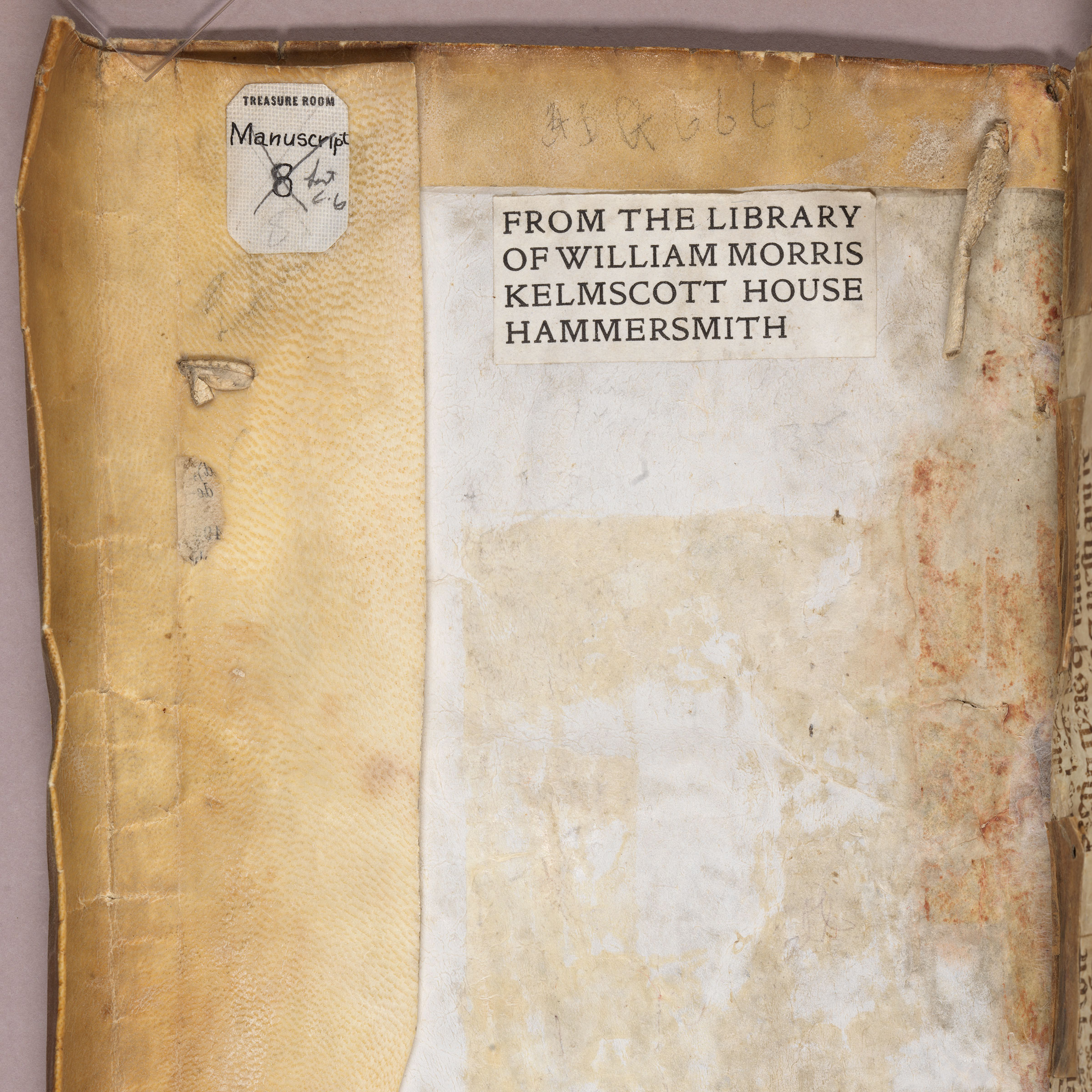
In making these decisions, Morris was informed by a set of exemplary medieval manuscripts and early printed works that he assembled as a personal reference library. On his historical influences in book design, Morris wrote “I have always been a great admirer of the calligraphy of the Middle Ages, & of the earlier printing which took its place. As to the fifteenth century books, I had noticed that they were always beautiful by force of the mere typography, even without the added ornament, with which many of them are so lavishly supplied.” 2 The University of Notre Dame is fortunate to have two medieval manuscripts (cod. Lat. c. 6 and cod. Lat. e. 4) owned by William Morris.

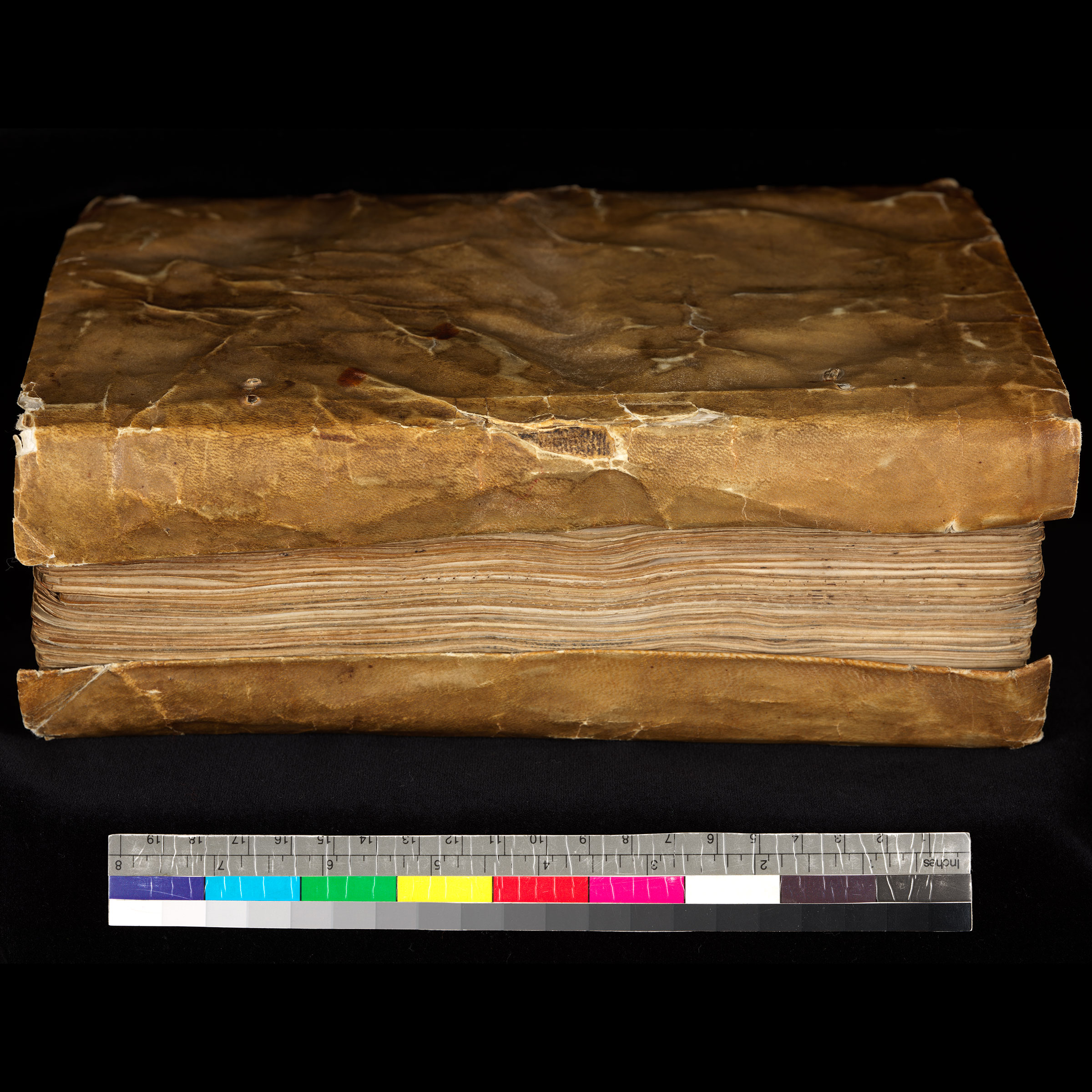
Cod. Lat. c. 6 is a 13th century copy of Peter Riga’s Aurora. Its undecorated, utilitarian limp parchment binding is charming even in its worn state and exemplifies the authenticity that Morris was attracted to in scribal book production. This book features particularly pronounced “yapped” fore-edge folds on the parchment cover, which were intended to protect the page edges from wear. Yapped edges are commonly found in this style of binding, and Morris would go on to incorporate them in his binding designs for books from the Kelmscott Press.

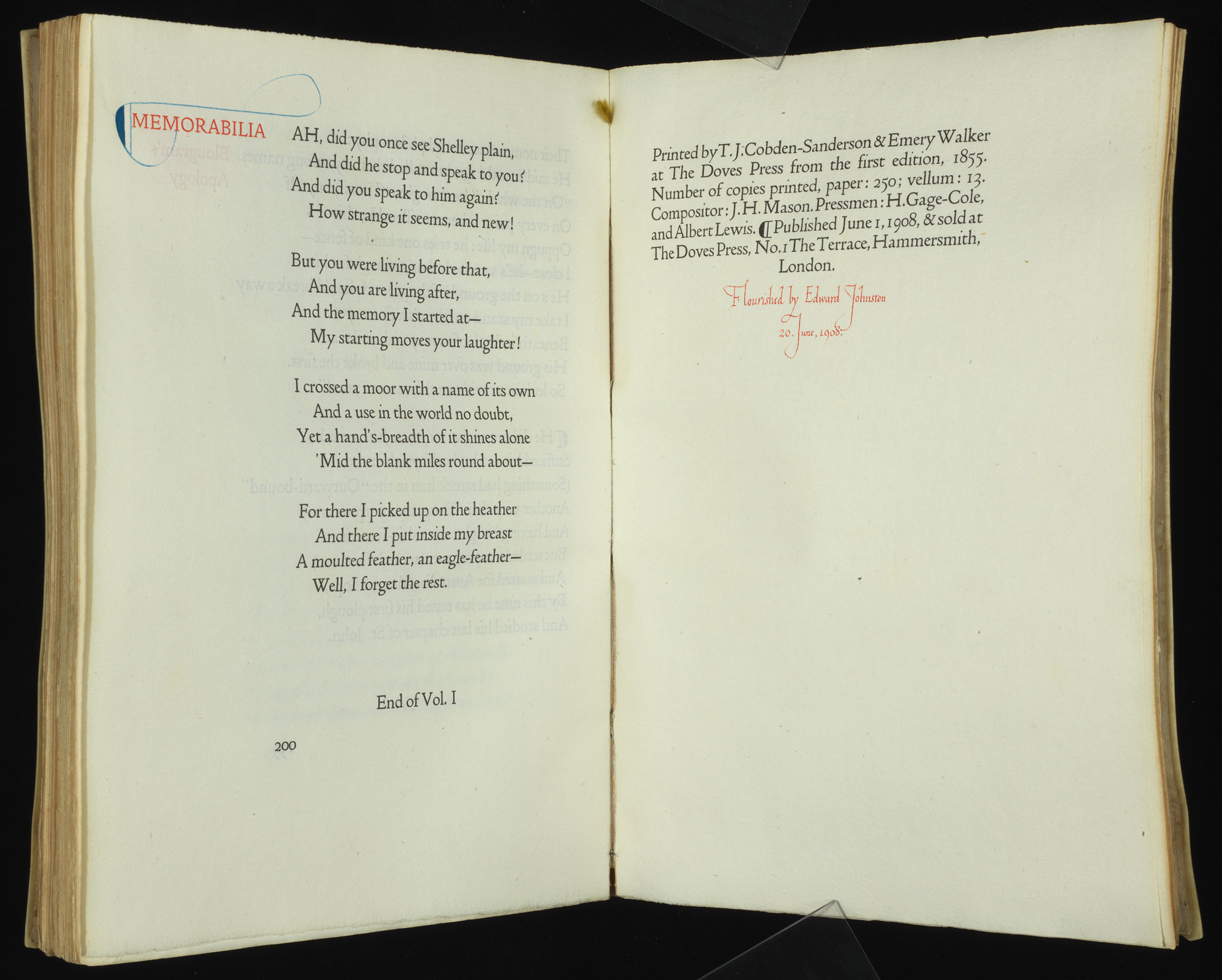
Except for the Kelmscott Press edition of Chaucer’s works, most books from the press were issued in two possible binding configurations: limp vellum with colored silk ties or a hardcover binding with off-white linen covering the spine and blue paper covering the boards. The Earthly Paradise was one of the last publications by the Kelmscott Press, and this particular copy retains its William Morris-designed limp vellum binding with green silk ties. It was bound for the Kelmscott Press by J. & J. Leighton. The yapped fore-edge folds of this binding are reminiscent of the yapped edges on the Riga Aurora manuscript, though they are more diminutive. The use of green silk (custom dyed at the request of Morris and used for the fore-edge ties on this binding) appears frequently in British Arts & Crafts movement books. A similarly colored green silk was used to sew the copy of Men & Women by the Doves Press in the exhibit and is visible in the gutter fold.

Men & Women opening showing colophon and green silk in gutter.

After taking up bookbinding in 1883 at the suggestion of Jane Morris, William Morris’ wife, Thomas J. Cobden-Sanderson established a new aesthetic for gold tooling in bookbinding using repeating patterns of a custom-designed set of brass finishing tools and high quality leather. Cobden-Sanderson’s aesthetic was also disseminated through his teaching. His students, such as Douglas Cockerell and Katharine Adams, became leading binders in their own right. Like William Morris, Cobden-Sanderson was interested in the design of the whole book and believed that ideally each part of the book’s production–materials, typography, illustration, and binding–should function together harmoniously to communicate the ideas contained by the written word.

Though foremost a bookbinder, Cobden-Sanderson collaborated with Emery Walker—a renowned typographer who assisted Morris in the development of several Kelmscott typefaces—to establish the Dove Press in 1900 four years after the death of William Morris. Their Doves typeface was a more accurate, svelte interpretation of Nicolas Jenson’s roman types from the late 15th century than was Kelmscott’s squat Golden typeface used in The Earthly Paradise (and in Morris’s bookplate).

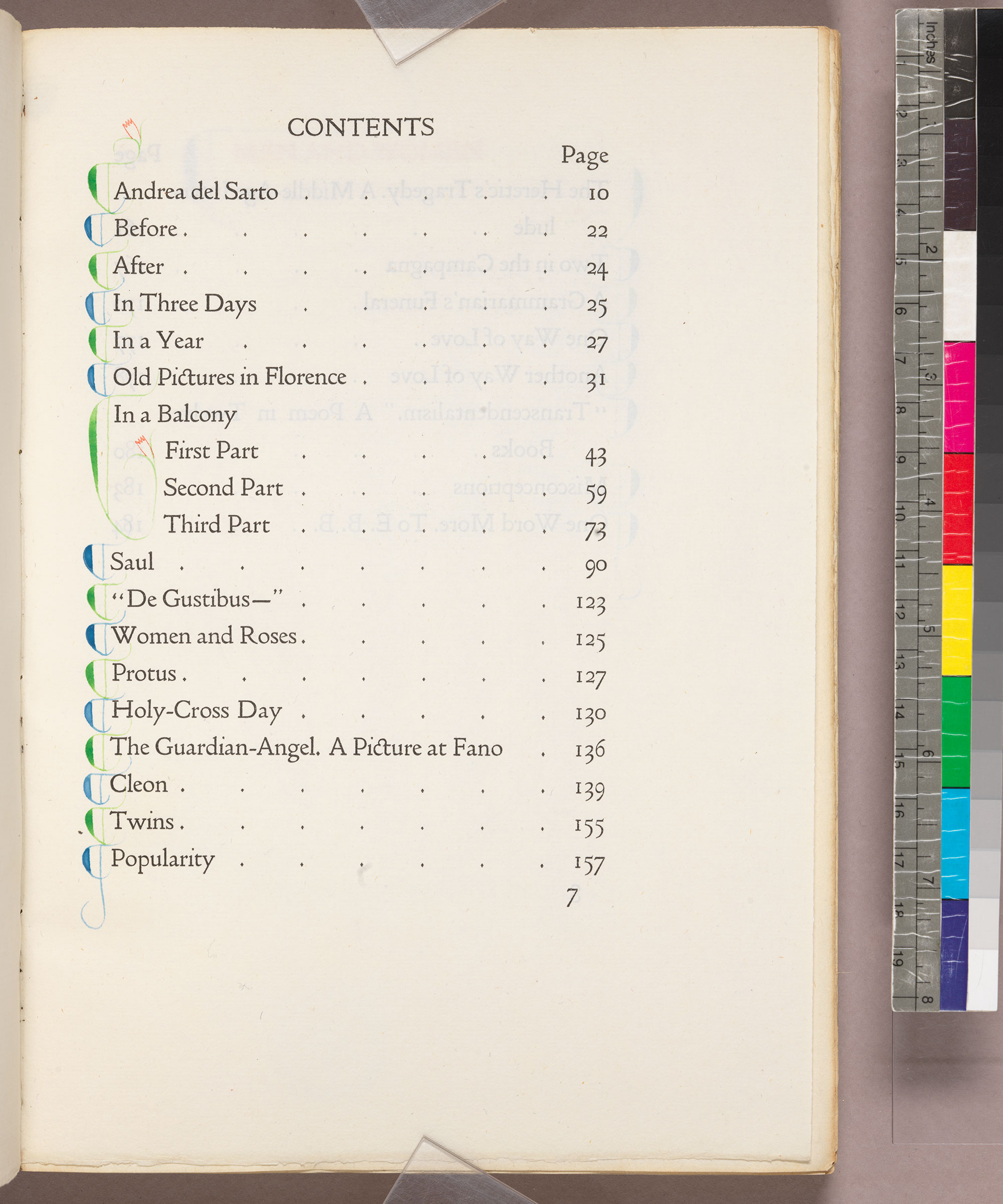
This Doves Press copy of Men & Women by Robert Browning was “flourished” in the margins by Edward Johnston. Johnston was a calligrapher who was inspired by Medieval and Renaissance manuscripts and helped revitalize illumination and lettering in the Arts & Crafts movement. Ironically, Johnston is perhaps best known today for creating the sans serif typeface used by the London Underground transportation system than for his floral calligraphy.

Sometime between 1901 and 1905, Edward Johnston taught calligraphy at the Central School in London to Francis Sangorski, an virtuosic bookbinder and younger brother of Alberto Sangorski. Though Alberto was initially a bookkeeper from Francis’s bindery, Sangorski & Sutcliffe, Alberto learned the rudiments of calligraphy, quill pen cutting, and gold illumination from Francis. In 1905 at the age of 43 (coincidentally the same age Thomas J. Cobden-Sanderson gave up lawyering for bookbinding) Alberto Sangorski established himself as a calligrapher.3

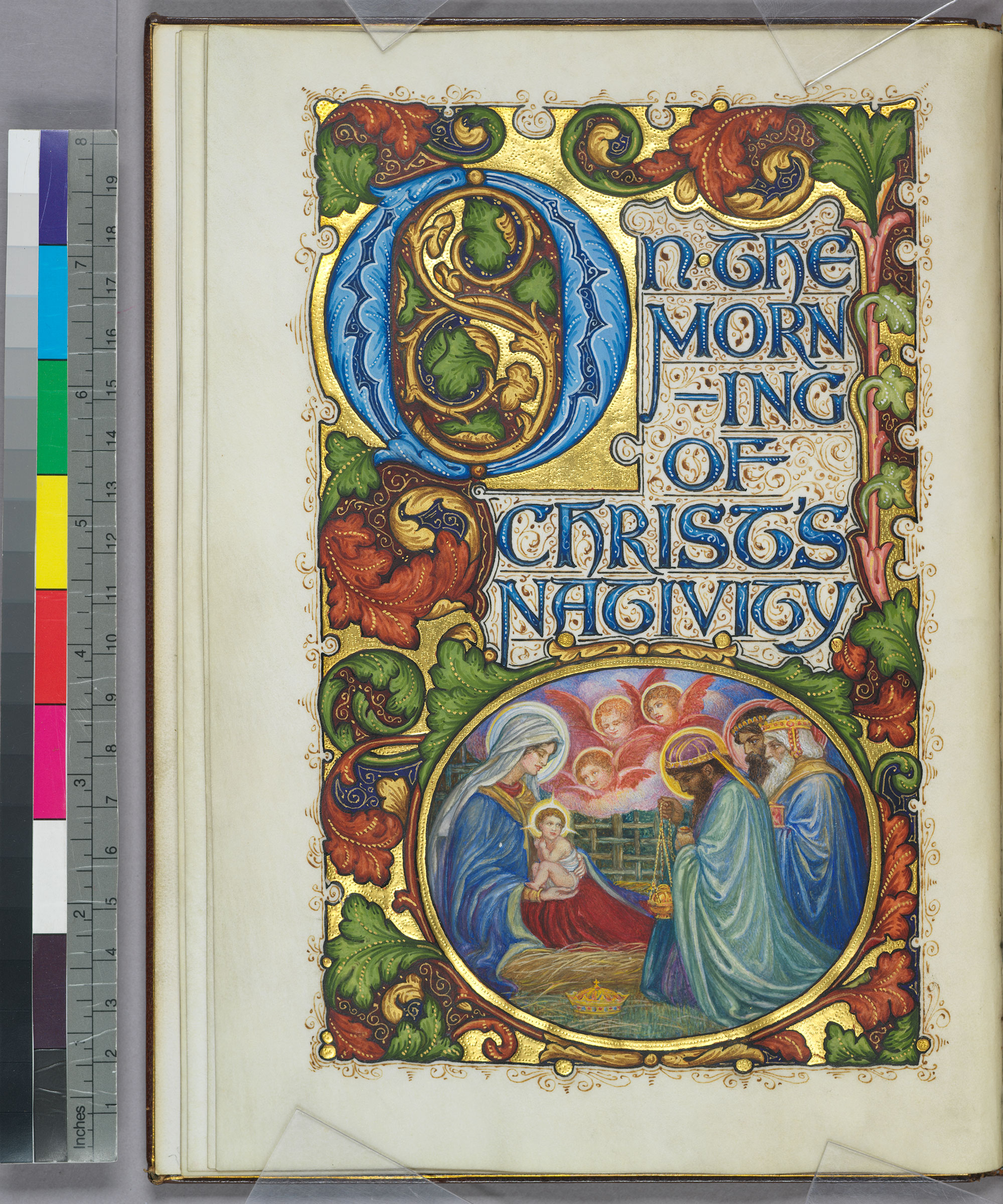
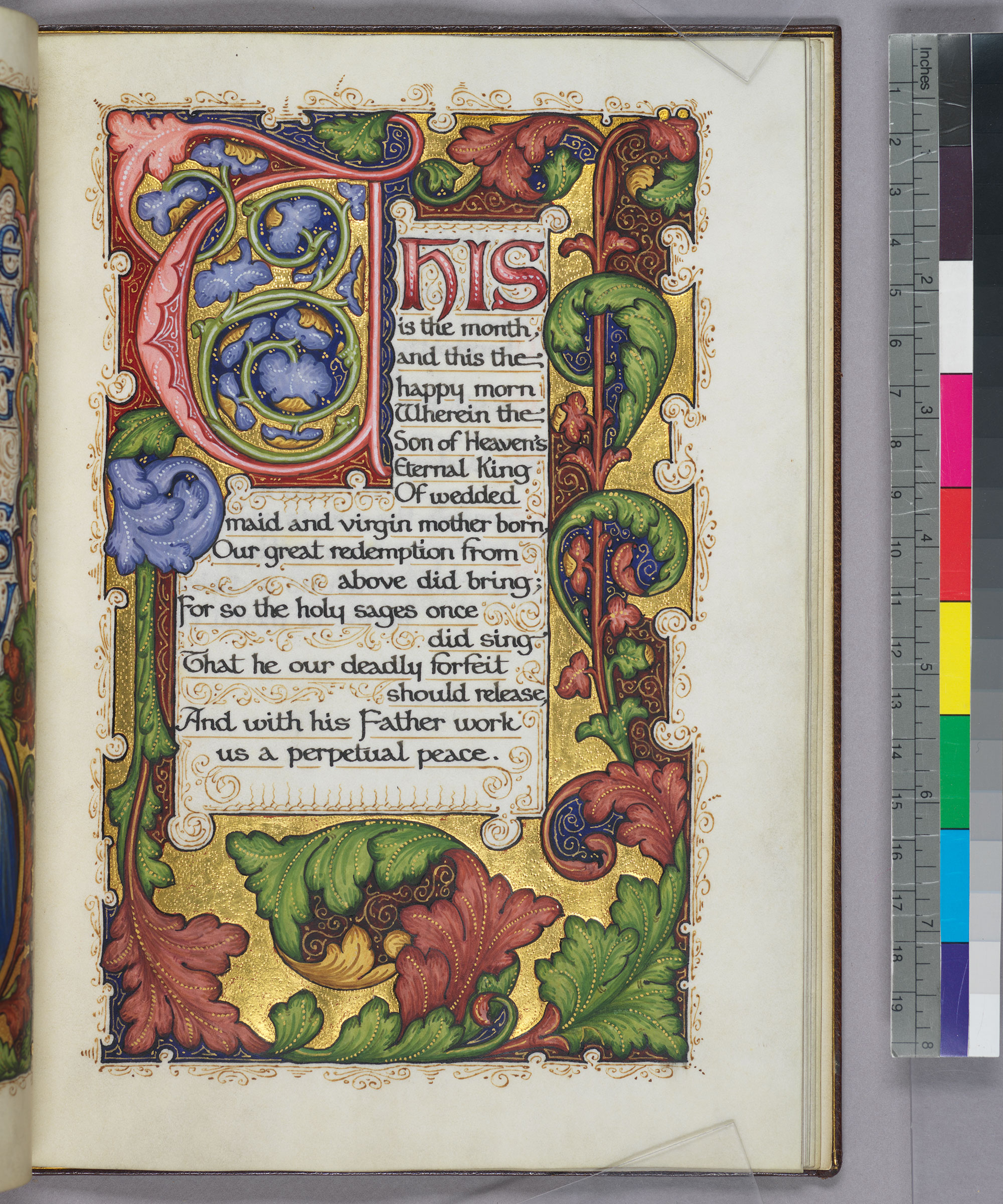
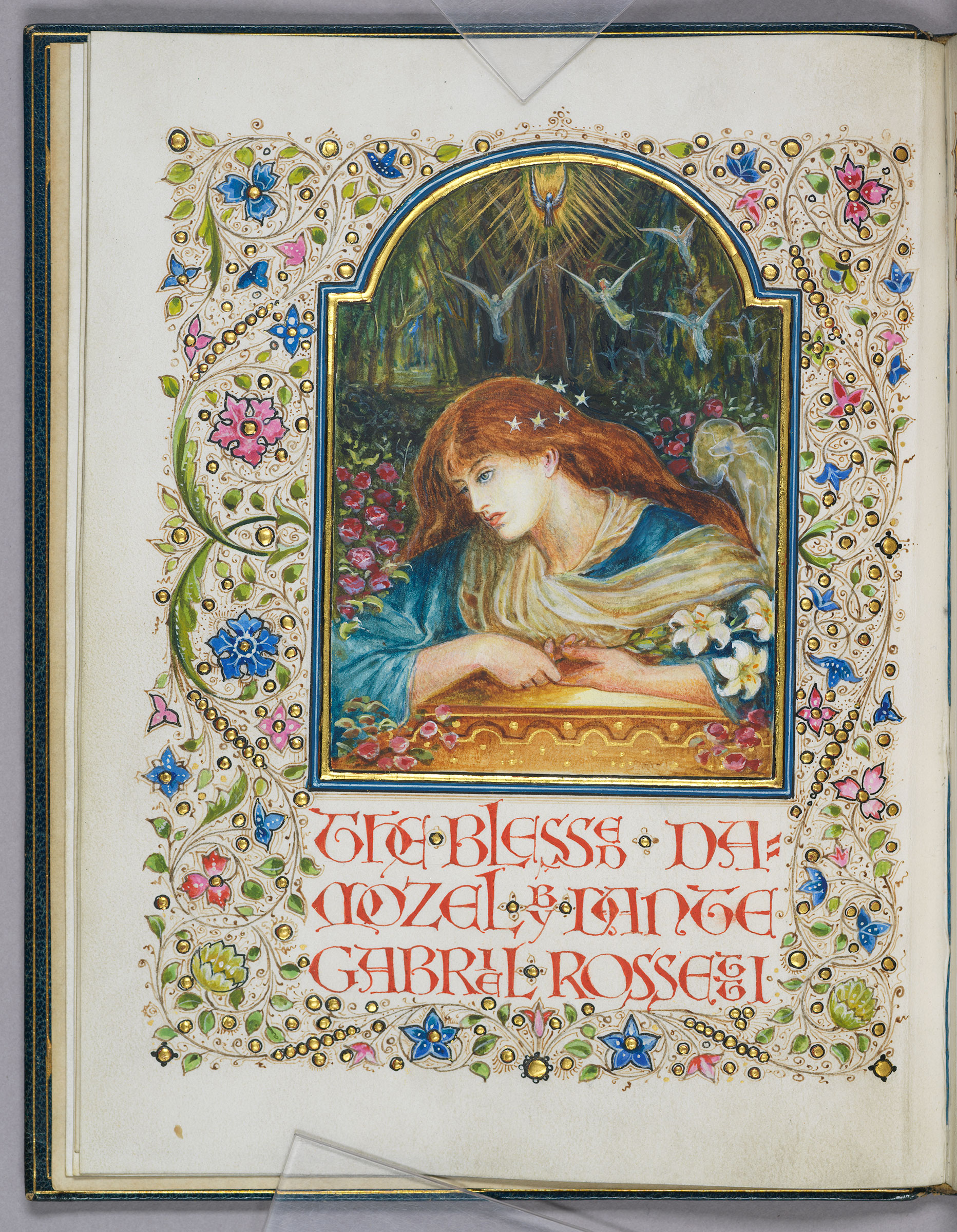
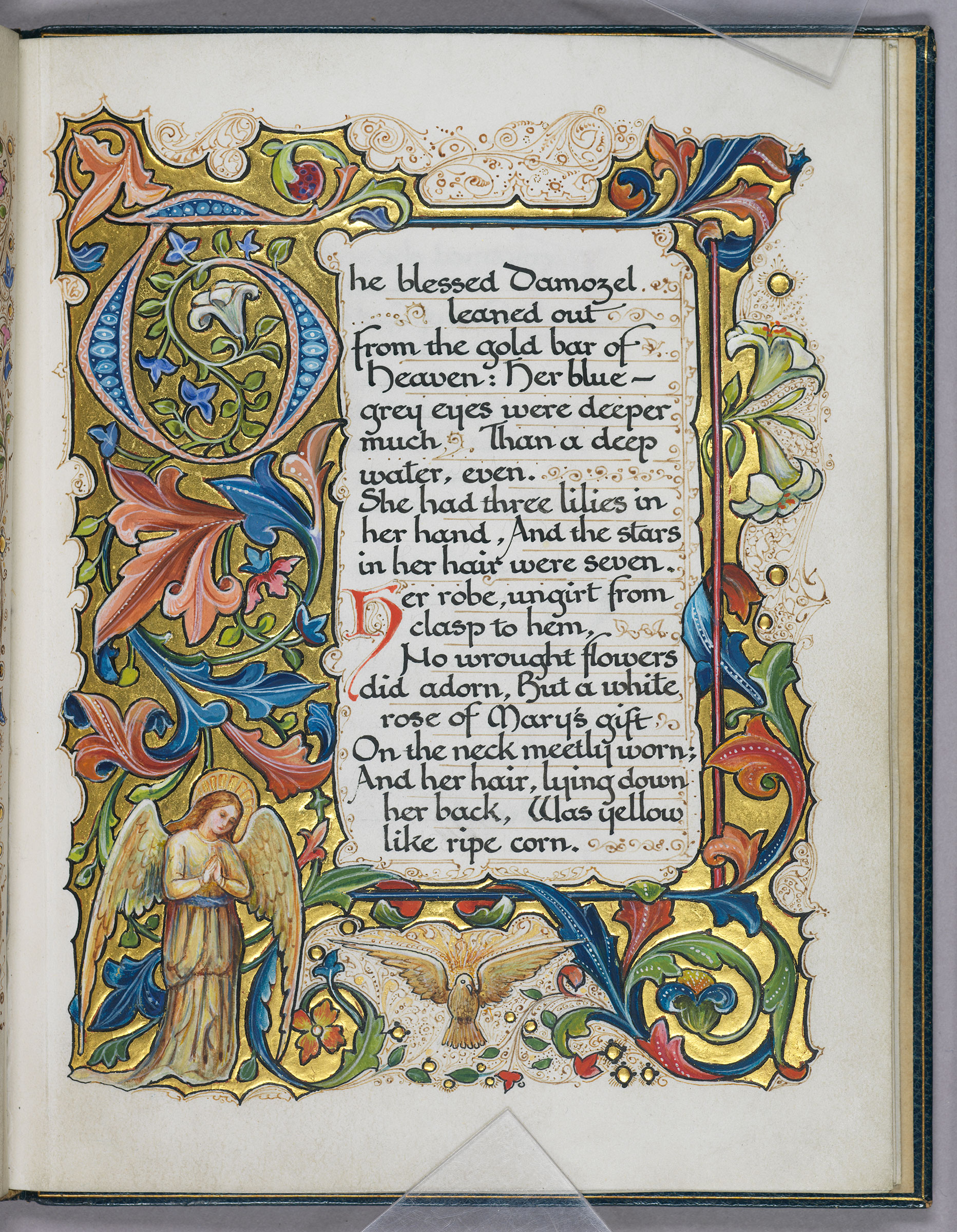
This illuminated manuscript of John Milton’s On the morning of Christ’s nativity: an Ode was created by Alberto Sangorski sometime between 1905 and 1910. Alborto Sangorski developed his own miniaturist painting style based on Medieval and Pre-Raphaelite artists, which can been seen in this manuscript and in the manuscript of Dante Gabriel Rosetti’s The Blessed Damozel also on display in the exhibit. Alberto’s work drifted from the historical modeling of other Arts & Crafts figures and embraced the Edwardian era’s exuberance in design and catered to the conspicuous consumption of the truly “Gilded Age.”

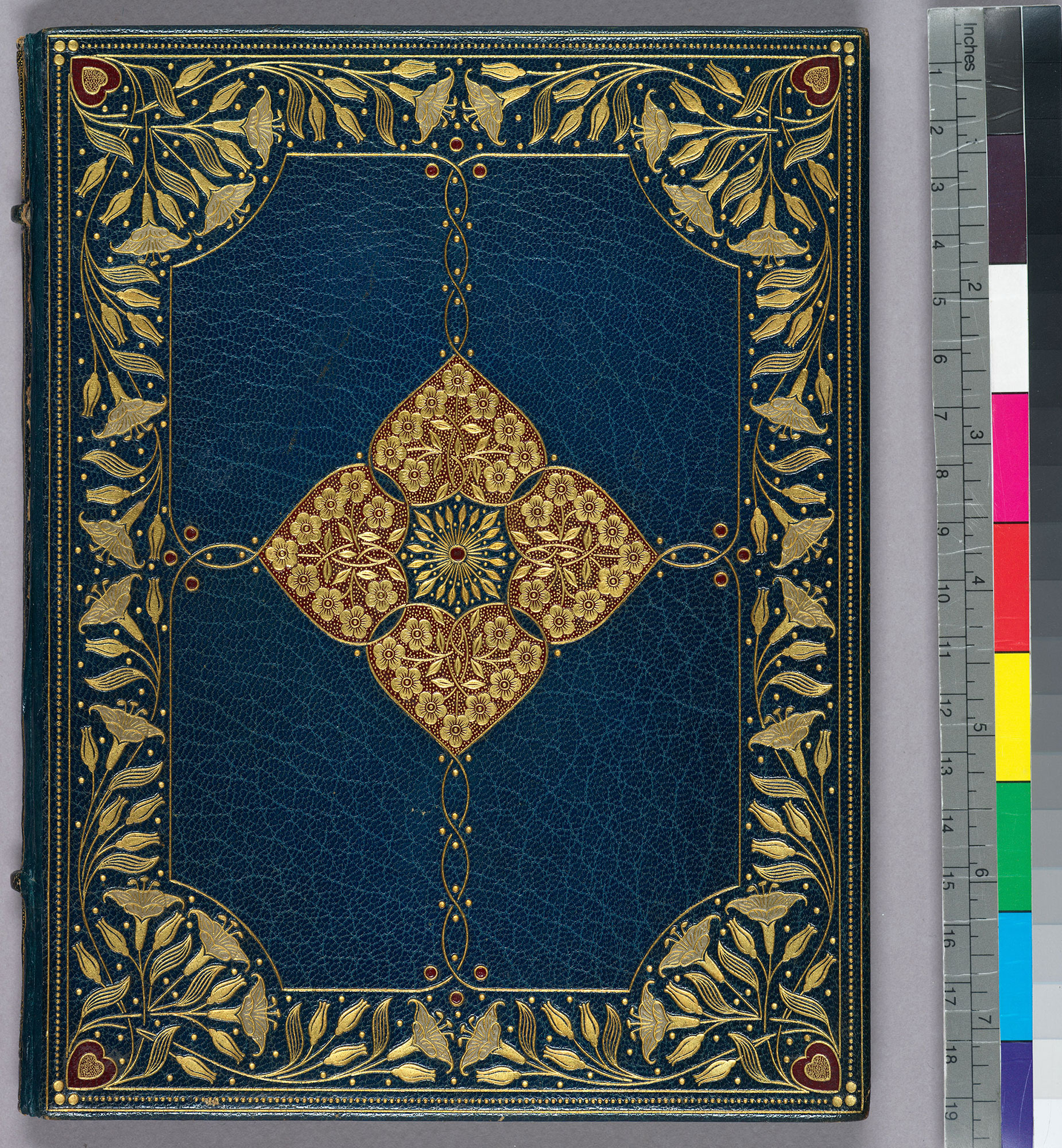
This Alberto Sangorski manuscript of Dante Gabriel Rosetti’s poem The Blessed Damozel was bound by his brother Francis’s bindery, Sangorski & Sutcliffe. Francis Sangorski began his bookbinding apprenticeship in 1901 under Douglas Cockerell, another leading figure in the Arts & Crafts movement who himself trained under Thomas J. Cobden-Sanderson at the Doves Bindery. This binding is typical of Sangorski & Sutcliffe’s higher-end design bindings, featuring elaborate gold tooling and decorative leather onlays of thinly skived crimson goatskin. Sangorski & Sutcliffe’s most expensive and celebrated binding of an 1884 imprint of the Rubáiyát of Omar Khayyám sank on the RMS Titanic on April 14, 1912. Francis Sangorski drowned six weeks later while swimming in the English Channel. Like the Milton manuscript, this codex was likely created early in Alberto Sangorski’s career sometime between 1905 and 1910.


Footnotes

1. Morris 1.

2. Ibid.

3. The Cinderella of the arts 41.


Bibliography

Morris, William. A note by William Morris on his aims in founding the Kelmscott Press. Hammersmith: Kelmscott Press, 1898.

Shepherd, Rob. The Cinderella of the arts: a short history of Sangorski & Sutcliffe. London & New Castle, DE: Oak Knoll Books, 2015.

Upcoming Events: April 2024

Please join us for the following public events and exhibits being hosted in Rare Books and Special Collections:

Thursday, April 11 at 5:00pm | Italian Research Seminar: “Boccaccio, the Disguised Revolutionary” by Martin Eisner (Duke University).


In the spring exhibition, Mapping the Middle Ages: Marking Time, Space, and Knowledge, primary objects bring to the fore the tension between literal and figurative arrangements of space, time, and knowledge during the Middle Ages.

This exhibition is curated by David T. Gura, PhD, Curator of Ancient and Medieval Manuscripts.


The current spotlight exhibits are Scripts and Geographies of Byzantine Book Culture (February – April 2024) and A Medieval Nun’s Choir Book (February – early April 2024). The current bi-monthly spotlight will run through April 5, with a new exhibit featuring a selection of books from the Arts & Crafts movement being installed on April 8.


Special Collections will be closed on March 29, in observance of Good Friday, and will be open regular hours on Easter Monday (April 1).

National Hispanic Heritage Month 2023

We join the Library of Congress, National Archives and Records Administration, National Endowment for the Humanities, National Gallery of Art, National Park Service, Smithsonian Institution, and United States Holocaust Memorial Museum in celebrating National Hispanic Heritage Month.

An Hispanic Superhero in Southwest Texas

by Erika Hosselkus, Curator, Latin American Collections

This year we share two issues of the comic book, El Gato Negro (The Black Cat), created by American artist Richard Dominguez. The popular series debuted in 1993 and narrates the adventures the Hispanic superhero, El Gato Negro, a vigilante crime fighter in Southwest Texas. Special Collections holds single copies of issues 3 and 4. 

Packed with action and defined by dynamic imagery, this graphic title fits solidly within the comic book genre. It also takes on current events, issues in Mexican, Mexican American, and American history, and popular culture in a whole variety of ways. 

Francisco Guerrero, the man behind the El Gato Negro mask, is a social worker in Southwest Texas whose friend, Mario, a border patrol officer, was murdered by drug traffickers. Guerrero takes on the El Gato Negro identity at night to fight against drug-related violence, even while being targeted by local law enforcement. His name combines the first name of Francisco Madero, a hero of the Mexican Revolution, with “guerrero,” or “warrior.” Across its 4 issues, the comic book series references Hispanic soldiers who fought in the Korean War, the Zapatista movement in Mexico, and lucha libre (Mexican professional wrestling). As such, this title speaks to parts of the Mexican American experience in late twentieth-century America in fun and fascinating ways.

Enjoy this selection of images from the comic book and keep an eye out for a possible television adaptation of El Gato Negro in coming months!     

Detail from Issue No. 3

Previous Hispanic Heritage Month Blog Posts:

Souvenirs from the Union Printers National Baseball League Tournament

by Greg Bond, Sports Archivist and Curator, Joyce Sports Research Collection

A pair of finely crafted, meticulously detailed, and distinctively shaped books—a baseball-glove shaped book and a baseball-shaped book—are among the Joyce Sports Research Collections newest acquisitions. The two unusually-shaped publications are both early-twentieth-century souvenir programs of the Union Printers National Baseball League Tournament from 1908 and 1911, respectively. Sponsored each year by the International Typographical Union (ITU), the tournament brought together teams representing the ITU from different cities for several days of sports, camaraderie, and brotherhood. Labor Day seems a fitting time to explore the history of these unique books and to remember the Union Printers National Baseball League Tournament.

The first Union Printers National Baseball League Tournament took place in New York City in September of 1908. To mark the festive occasion, the Allied Printing Trades Council of New York lovingly designed and published the First Printers’ National Baseball Tournament Souvenir Program in the shape of a realistic looking catcher’s mitt. The New York printers seemed to relish the opportunity to show off their craft for their visiting colleagues with this elaborate and creatively shaped program.

The 1908 catcher’s mitt souvenir program describes the origins of the Union Printers National Baseball League Tournament. As early as 1883, union printers in New York City had organized the New York Morning Newspaper Baseball League with teams representing different New York and Brooklyn newspapers. In 1906 and 1907, the squad from the New York American and Journal won the championship, and, after the regular season, team manager Harry B. Wood arranged several games against ITU teams representing the Boston Globe and the Pittsburgh Dispatch. The 1908 souvenir program reported that during their road trip to Pittsburgh, “the light of geniality and the warmth of hospitality from the sun of fraternity and good fellowship was ever on the job.”

Photograph of the New York American and Boston Globe Baseball Teams, taken at American League Park, Boston, September 11, 1907.

Following the successful inter-city matches, Wood hatched his grand plan for an ITU national baseball tournament. He formed an organizing committee, helped draft a constitution, and invited union printers from Boston, Chicago, Cincinnati, New York, Philadelphia, Pittsburgh, St. Louis, and Washington, DC, to come to New York for the event. Each invited city received an informational prospectus that included a framed six-color formal invitation designed by New York artist Harry Goodwin that recipients later described as “a work of art.” The 1908 catcher’s mitt souvenir program, which Goodwin also took the lead in designing, featured a black-and-white reproduction of the elaborate invitation.

A black-and-white reproduction of the formal invitation New York Union Printers sent to their colleagues around the country to organize the First Printers’ National Baseball Tournament.

All eight cities accepted the offer to compete in the tournament that was held in the stadium of the New York Yankees. Boston beat Pittsburgh 5-1 in the 1908 finals to win the inaugural title. For their victory, Boston received the traveling International Typographical Union Championship Trophy that had been donated to the ITU by Cincinnati Reds Owner August Hermann. The first tournament proved to be a rousing success, and it soon became a highly anticipated ITU annual event.

After Chicago (1909) and Washington, DC (1910), St. Louis was the host city for the fourth annual tournament in 1911. Like their counterparts in New York, the Allied Printing Trades Council of St. Louis and the local union printers league, known as the “St. Louis Typo Athletic Association,” spared little expense in designing and printing a lavish baseball-shaped Souvenir Program for the Union Printers National Baseball League Fourth Annual Tournament. The color cover featured pennants for all participating cities, which had expanded to include Denver and Indianapolis, and an image of the Hermann ITU Championship Trophy.

Teams in the Union Printers National Baseball League Tournament were composed of all-star squads representing ITU leagues in each participating city. The New York league, for instance, explained in the 1911 program that the association’s Board of Director’s chose the tournament roster from the pool of eligible athletes: “every player has an equal chance to become a member of the team representing New York in the National Tournament even [if] his team finishes last in the league. This rule causes a good player on a poor team to be satisfied and keeps up interest in the organization.”

Pages from the 1911 Union Printers National Baseball League Tournament featuring the Indianapolis team wearing warm-up sweaters with the ITU (International Typographical Union) logo. The outsides of the round pages are decorated with baseball scenes.

The 1911 souvenir program also emphasized that the participants were both serious athletes and serious union men: “this league differs materially from the great majority [by] the fact that all players must be printers and members of the International Typographical Union, or registered apprentices who have served two and one half years at the trade. From this it will be seen that it is not such an easy matter to get together a representative baseball team to compete in these tournaments.”

International Typographical Union President James M. Lynch also gave his endorsement in the 1911 program, praising the “healthy outdoor recreation” and the “advertising value” of the baseball tournament. He also reminded readers about the ITU’s organizing efforts, which “endeavored to impart dignity to the craft by assisting in the maintenance of just and equitable rights of the individual craftsman and cementing the bonds of friendship and brotherhood that should exist between all men, and especially those of a distinctive craft.”

Most importantly, though, as the 1908 catcher’s mitt souvenir program had proclaimed a few years earlier, the Union Printers Baseball League National Tournament had the “purpose of promoting good fellowship and pure amateur sport.” Happy Labor Day!


RBSC is closed Monday, September 4th, for Labor Day.

Upcoming Events: May and through the summer

Currently there are no events scheduled to be hosted this summer in Rare Books and Special Collections.

The exhibit Printing the Nation: A Century of Irish Book Arts  will run through the summer and close in late July.

The current spotlight exhibits are Language and Materiality in Late Medieval England (February – early May 2023) and Hagadah shel Pesaḥ le-zekher ha-Shoʼah – Pessach Haggadah in memory of the Holocaust (April – May 2023).

Rare Books and Special Collections is open
regular hours during the summer —
9:30am to 4:30pm, Monday through Friday.

RBSC will be closed Monday, May 29th, for Memorial Day and Tuesday, July 4th, for Independence Day.