An Italian Itinerary for Understanding Dante’s Divine Comedy: Trajan’s Column in Rome

Long shot of a row of white statues

AI-generated content may be incorrect.Visitors to the Museum of Civilization in Rome can see plaster casts of the entirety of Trajan’s column. Photo by Notafly – Own work, CC BY-SA 3.0, https://commons.wikimedia.org/w/index.php?curid=4634304

I consider Italian art to be indispensable when teaching Dante. One way to think about the Divine Comedy is as a piece of Late Gothic/Early Renaissance art in poetry. Unfortunately for a classroom teacher, many of the pieces of art that can be most relevant for understanding him ought to be experienced in person because they are as spatial, and they are visual. These works of art do not fit neatly on a screen or piece of paper, and while a video can sometime be helpful in seeing details that are difficult to see in person, it cannot replicate the encompassing nature of the type of art produced in Italy during this time. So, grab a cappuccino (only if it is morning…if it is not, shame on you, espresso is the correct choice!), and plan your Dante-lover trip to Italy. While there are many guides to Italian travel, over the next few posts, I would like to focus here upon some specific pieces of art that Dante lovers ought to pay attention to. 

Most visits to Italy begin in Rome, and there are few things more indispensable to reading Dante than an appreciation for his love of the Roman Empire. The first stop is Trajan’s Column in Rome.

undefined

Trajan’s Column in Rome, Italy. Photo by Livioandronico2013. Creative Commons.

The emperor Trajan appears twice in the Commedia, once as a carved example of humility in the cornice of the Proud in Purgatorio 10.73-99 and again as one of the six chiefs of Justice in the Circle of Jupiter in Paradiso 20. While reading the Commedia the tendency is to think about Trajan as he is depicted in Voragine’s Golden Legend, as a man saved from hell by the prayers of Gregory the Great:

In the time that Trajan the emperor reigned, and on a time as he went toward a battle out of Rome, it happed that in his way as he should ride, a woman, a widow, came to him weeping and said I pray thee, sire, that thou avenge the death of one my son which innocently and without cause hath been slain. The emperor answered: If I come again from the battle whole and sound then I shall do justice for the death of thy son. Then said the widow: Sire, and if thou die in the battle who shall then avenge his death? And the emperor said: He that shall come after me. And the widow said: Is it not better that thou do to me justice and have the merit thereof of God than another have it for thee? Then had Trajan pity and descended from his horse and did justice in avenging the death of her son. On a time S. Gregory went by the market of Rome which is called the market of Trajan, and then he remembered of the justice and other good deeds of Trajan, and how he had been piteous and debonair, and was much sorrowful that he had been a paynim, and he turned to the church of S. Peter wailing for the horror of the miscreance of Trajan. Then answered a voice from God saying: I have now heard thy prayer, and have spared Trajan from the pain perpetual. By this, as some say, the pain perpetual due to Trajan as a miscreant was some deal taken away, but for all that was not he quit from the prison of hell, for the soul may well be in hell and feel there no pain by the mercy of God. 

The visitor to Trajan’s column, which stands in the forum (or market) of Trajan, may have a slightly different perspective. In Roman Art, Donald Strong points out that this column “sets out…to provide an epic version of the [Dacian] wars, with the Roman army under its great leader in the role of hero” (151). In other words, this column shows viewers what Trajan thought was important about his life, the wars he fought and the battles he won.

This monument to the glories of Trajan’s empire does not include the act of kindness remembered by Gregory when he visits the marketplace. To find an artistic engraving of these events of eternal importance, one has to look to the epic poetry of Dante himself:

At that I turned my face
And, looking beyond Mary, saw,
On the same side as he prompted me,
Another story set into the rock.
I went past Virgil and drew near so that my eyes might better take it in.
There, carved into the marble…
Depicted there was the glorious act
Of the Roman prince whose worth
Urged Gregory on to his great victory—
I speak of the emperor Trajan,
With the poor widow at his bridle, weeping,
Revealed in her state of grief
The soil all trampled by the thronging knights.
Above, the eagles fixed in gold
Seemed to flutter in the wind.
In their midst, one could almost hear the plea 
of that unhappy creature: ‘My lord, avenge
My murdered son for me. It is for him I grieve,’
And his answer: ‘Wait till I return,’
And she: ‘My lord,’ like one whose grief is urgent,
‘and if you don’t return?’ and his answer: 
‘He who will take my place will do it,’
And she: ‘What use to you is another’s goodness
If you are unmindful of your own?’
And he then: ‘Now take comfort, for I must discharge
My debt to you before I go to war.
Justice wills it and compassion bids me stay.’
He in whose sight nothing can be new
Wrought this speech made visible,
New to us because it is not found on the earth. (Purgatorio X.49-96; transl. Hollander)

Now, consider this: one of the iconic features of epic poetry is a figure of description known as ekphrasis, whereby a poet describes a work of art, like a painting or a statuary, in a way that competes with physical craftsman and shows that poetry is capable of doing more than a physical craft. For example, the shield of Achilles is described by Homer so that it has features that would be impossible in real life. (Think Harry Potter paintings.) Ekphrasis was one way that epic poets demonstrated that their craft had superior capabilities to that of other craftsmen.

A close-up of a book

AI-generated content may be incorrect.

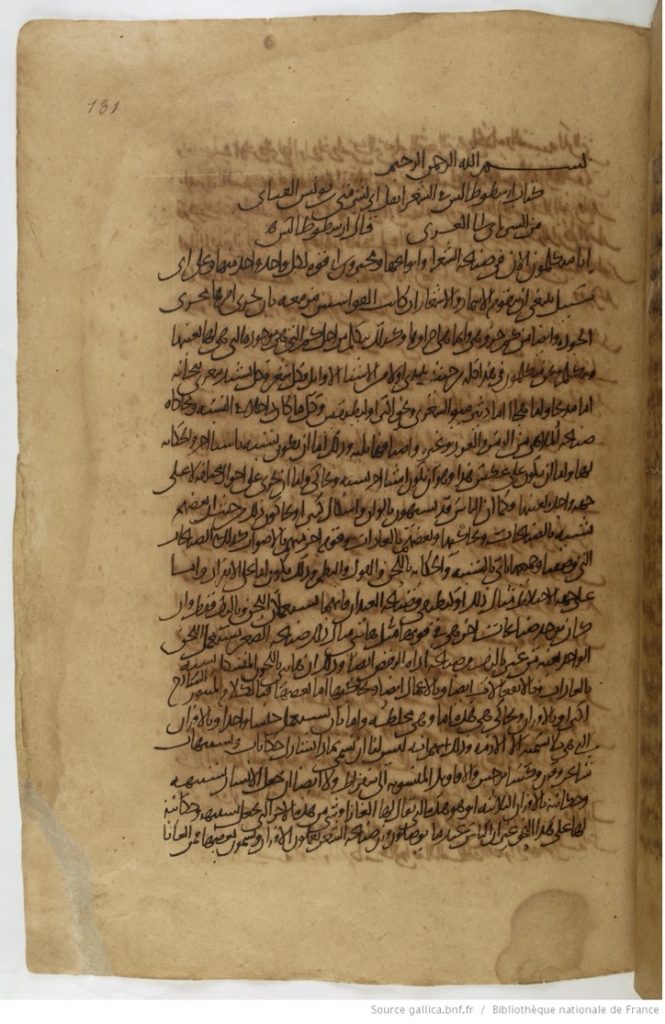
MS Holkam, Misc. 48, p.75, Bodleian Library University of Oxford. https://digital.bodleian.ox.ac.uk/objects/10974934-30a5-4495-857e-255760e5c5ff/surfaces/ef18134f-8c01-4509-89e5-3f82de5ae6f2/

With this perspective in mind, it becomes clearer that Dante’s depictions of Trajan re-write the epic history that Trajan “wrote” for himself in Trajan’s column. In other words, Dante’s poetry competes with a physical piece of art by showing where Trajan’s true glory lay. Dante has imaged for us a “speech made visible” of Trajan’s act of true justice, carved by the divine artisan. Just as Jesus saw the poor woman give a mite to the temple when others marveled at the great riches donated by the wealthy, so Dante imagines the divine artist immortalizing an act that Trajan did not realize would be his most important. As you look at Trajan’s column in Rome, consider what it would take to make a better monument, so realistic that the figures move and make sound, on a subject matter that was higher than Trajan himself could imagine.

Lesley-Anne Dyer Williams is a Professor for Memoria College’s Masters of Arts in Great Books program and graduated with her doctorate from the University of Notre Dame’s Medieval Institute in 2012. She was also the founding director Liberal Arts Guild at LeTourneau University. Her research focuses upon twelfth-century Platonism and poetry, especially Thierry of Chartres and Bernard Silvestris.

Lesley-Anne Dyer Williams
Public Humanities Postdoctoral Fellow
Medieval Institute
University of Notre Dame


Further Reading
Strong, Donald. Roman Art. Yale University Press, 1995.

Mathematical “Small Things” and the Quadrivium

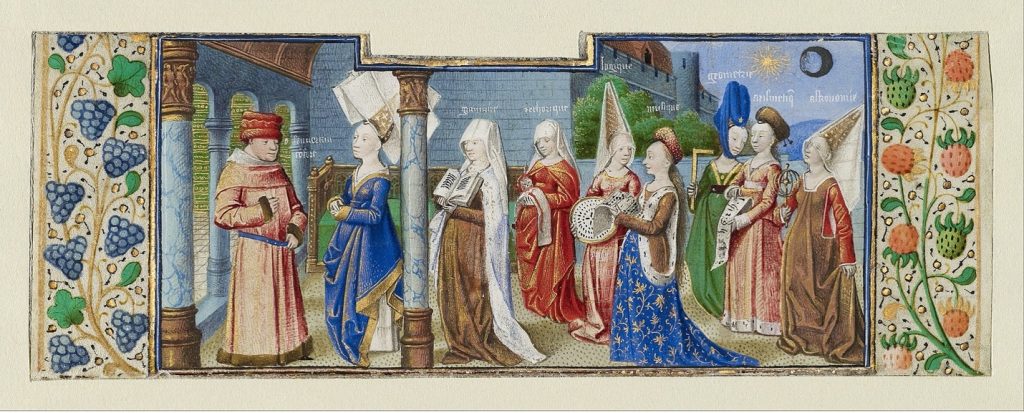
What did early mathematical education look like in the Middle Ages? As is commonly known, the ideal Liberal Arts curriculum of the Middle Ages featured both the Trivium (dedicated to the study of words) and Quadrivium (dedicated to the study of nature in the form of mathematical arts). The Trivium included Grammar, Logic, and Rhetoric. The Quadrivium consisted of Music, Astronomy, Geometry, and Arithmetic. These seven ways (viae) of liberal arts learning prepared students who studied them diligently to “comprehend everything that they read, elevat[ing] their understanding to all things and empower[ing] them to cut through the knots of all problems possible of solution” (John of Salisbury, Metalogicon I.12). Even today, the concept of a Liberal Arts education that prepares a student for life and whatever (foreseen and unforeseen) challenges lay aheadremains. And yet, for anyone who has educated a child, the idea of delaying mathematical education until the early teen years (which is when the formal Quadrivium was taught) seems completely impractical and misguided.
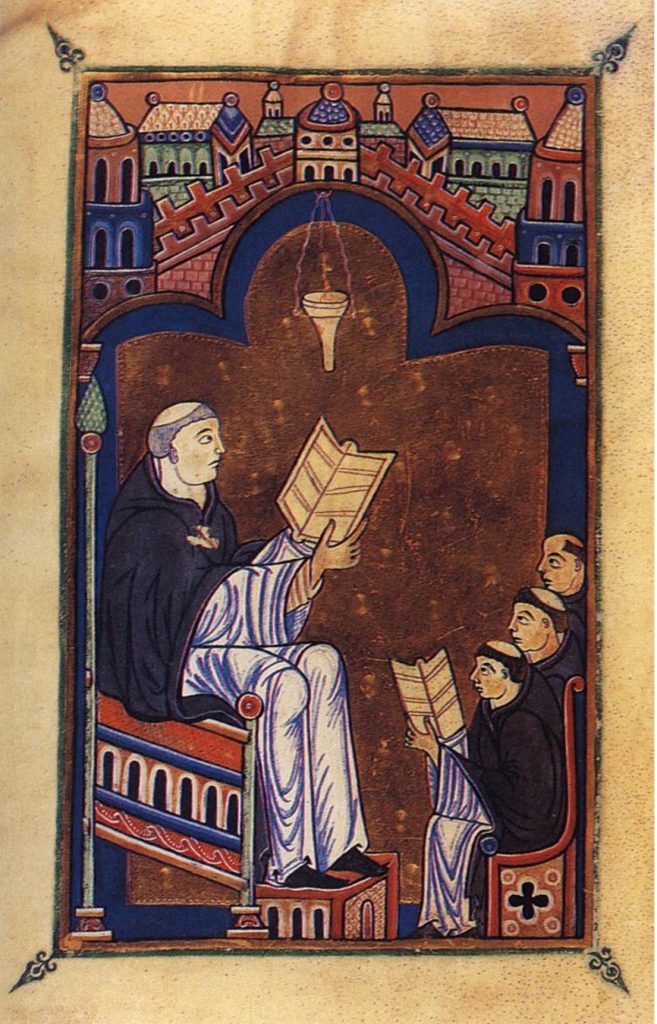
Unknown Miniaturist, French (active 1190s Paris). Bodleian Library, MS Laud Misc. 409 (Oxford Manuscript ) f.3v.

Did medieval educators really wait until students had a full understanding of the Trivium before introducing mathematics? The difficulty here comes in part from the lack of extensive knowledge of the curriculum of early childhood medieval education, including mathematical instruction. The institutions for learning changed over time and even geographic region. Early childhood education could take place in a home, in a monastery, or at a local cathedral school. Another difficulty may also be that our cultures mean slightly different things when we talk about the discipline of mathematics.

The “paper trail” for exactly what early childhood mathematical education might have looked like is not vast. But one tiny, but vivid, glimpse of what boyhood mathematical pursuits might have looked like can be seen in the writings of Hugh of St. Victor, an early twelfth century canon regular who wrote a book on the Liberal Arts called the Didascalicon. In this work, Hugh of St. Victor gives a rare view of his own early mathematical education:

I laid out pebbles for numbers, and I marked the pavement with black coals and by a model placed right before my eyes, I plainly showed what difference there is between an obtuse-angled, and an acute triangle. Whether or not an equilateral parallelogram would yield the same area as a square when two of its sides were multiplied together, I learned by walking both figures and measuring them with my feet. Often I kept watch outdoors through the winter nights like one of the fixed stars by which we measure time. Often I used to bring out my strings, stretched to their number on the wooden frame, both that I might note wih my ear the difference among the tones and that I might at the same time delight my soul with the sweetness of the sound. These were boyish pursuits…yet not without their utility for me, nor does my present knowledge of them lie heavy upon my stomach. (VI.3)

Hugh describes these activities as grounding him “in things small” so that he could “safely strive for all” later in life.

Notice how many of the activities mentioned by Hugh of St. Victor do not require a textbook at all, especially with a charismatic teacher, or in the case of Hugh’s own life, a particularly inquisitive child. Counting and the study of angles required only pebbles. The figuring of surface area required only the measurement of feet. An early acquaintance with the stars required actually going out to look at the night sky, even when it was cold, and the study of the relationship between musical notes came from literally fiddling around with a simple stringed instrument. To these activities, we might presumably add the common medieval practices of singing (cantus) and possibly dancing in set patterns. Or the calculating of times and seasons (computus). Or measurements of land and sea masses for commerce or geography. Or ratios for cooking. Many of these activities can be conveyed orally through constant interaction with numbers in the physical world. That is not to say that no formal study or book learning could or was be done in these areas, but the bulk of early mathematical learning did not need to take place in a school environment with a textbook. All that was needed was a student, the physical world, and a teacher with mathematical knowledge.
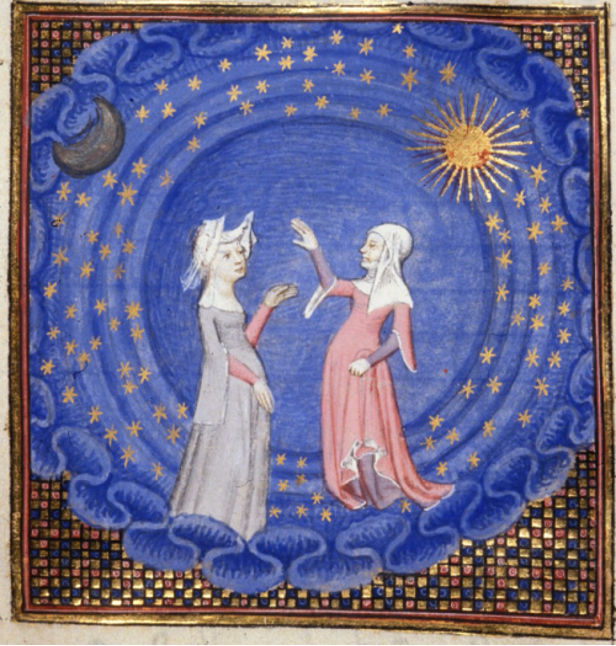
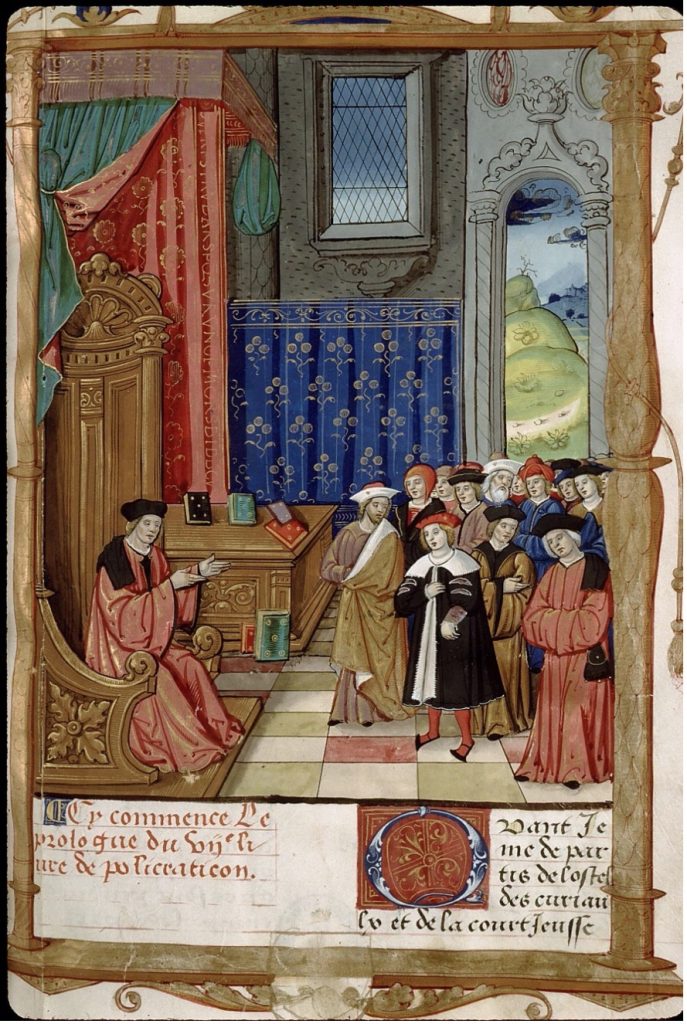
Christine and the Sybil pointing to a ladder from the heavens, from the Book of the Queen, France (Paris), c. 1410-1414, Harley MS 4431, f. 189v.

What Hugh recognized was that these mathematical activities, whether for play or practical application, were essential for what he and his contemporaries would have considered the formal discipline of mathematics as a liberal art (i.e. the Quadrivium), which would have taken place during the teenage years at higher level schools. Hugh distinguishes arts and disciplines in the following manner: “Knowledge can be called an art ‘when it comprises the rules and precepts of an art’ as it does in the study of how to write; knowledge can be called a discipline when it is said to be ‘full’ as it is in the ‘instructional’ science, or mathematics” (II.1).
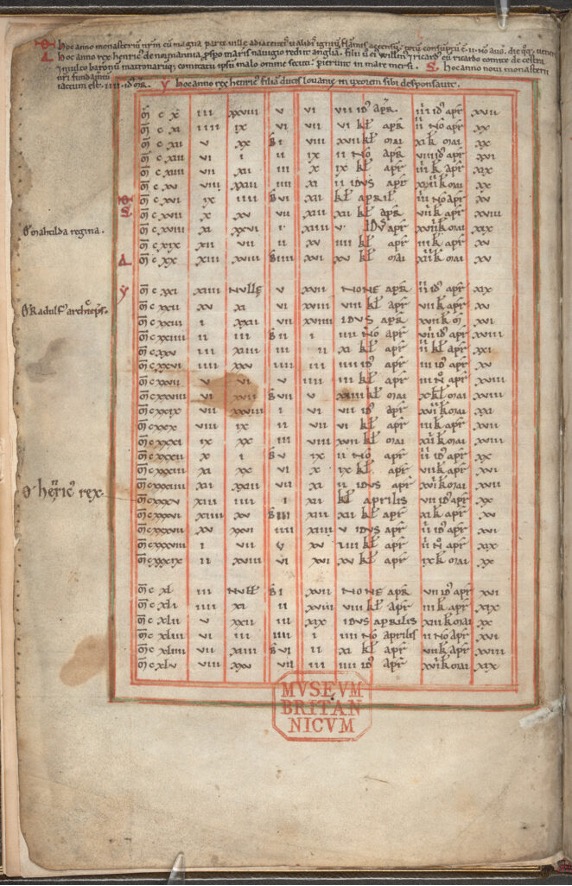
A table used for Computus. Harley MS 3667 f 001v.

 In other words, the sorts of activities Hugh describes himself doing as a boy were not mathematical disciplines in his terminology. Instead, his boyish mathematical play was both pleasant at the time and useful as he grew up to study the mathematical disciplines. For this reason, Hugh praised such activity as best because it aids one’s movement “step by step” rather than “fall[ing] head over heels when [attempting] to make a great leap ahead” (VI.2). This learning process mirrors the original discovery of the disciplines themselves by humanity. As Hugh writes:

Such was the origin of all the arts; scanning them all, we find this true. Before there was grammar, men both wrote and spoke; before there was dialectic, they distinguished the true from the false by reasoning; before there was rhetoric, they discoursed upon civil laws; before there was arithmetic, there was knowledge of counting; before there was an art of music, they sang; before there was geometry, they measured fields; before there was astronomy, they marked off periods of time from the courses of the stars. But then came the arts, which, though they took their rise in usage, nonetheless excel it. (I.11)

Early childish mathematical play was not the Quadrivium, but Hugh considered it a necessary preparation for the later study of the Quadrivial arts. Just as Boethius argued in Institutio arithmetica 1,1,7 that the quadrivium provides steps (gradus) by which the mind is progressively illuminated and can raise itself from its immediate sensible circumstances to the certainty of intelligible truth, so Hugh argued that the humble mathematical play of childhood was one step on the way to learning the discipline of mathematics. Computus, stargazing, learning to sing, learning to dance, and making geometric shapes with pebbles—none of this was Quadrivium. These activities could be boyhood pursuits…or in some cases, ends in themselves practiced into adulthood, but activities of this sort were, in Hugh’s opinion, a necessary preparatory step for the Quadrivial disciplines.

Lesley-Anne Dyer Williams
Public Humanities Postdoctoral Fellow
Medieval Institute
University of Notre Dame

Lesley-Anne Dyer Williams is a Professor for Memoria College’s Masters of Arts in Great Books program and graduated with her doctorate from the University of Notre Dame’s Medieval Institute in 2012. She was also the founding director Liberal Arts Guild at LeTourneau University. Her research focuses upon twelfth-century Platonism and poetry, especially Thierry of Chartres and Bernard Silvestris.

Further Reading:

Hugh of St. Victor. The Didascalicon of Hugh of St. Victor:  A Medieval Guide to the Arts. Edited & translated by Jerome Taylor, Columbia University Press, 1991.

Jaeger, C. Stephen. The Envy of Angels: Cathedral Schools and Social Ideals in Medieval Europe, 950-1200. University of Pennsylvania Press, 1994.

John of Salisbury. Metalogicon. Translated by C.C.J. Webb, Clarendon Press, 1929.

Orme, Nicholas. Medieval Children. Yale University Press, 2001.

Orme, Nicholas. Medieval Schools. Yale University Press, 2006.
Seeing the Medieval Together

Back in November, I spent some time wondering about how the spring 2024 iteration of the “Why the Middle Ages Matter” course at John Adams High School would unfold. I spent the last few weeks of 2023 refining my syllabus, working on lesson plans, communicating with guest speakers, and arranging field trips. Looking back, I think I spent so much time preparing for the course because it was all so new to me. The biggest thing that got me nervous was the fact that I would be teaching high schoolers. My prior teaching experiences involved courses designed for university students, so I worried about my ability to make things resonate with a different audience. Furthermore, for the first time I would be leading a teaching team, coordinating with over a dozen guest lecturers, and planning two field trips. I really wanted it to be a good experience for everyone involved. 

Now that it is May and teaching for the course has wrapped up, I like to believe that I can say that things worked out rather well. We all survived! I had six lovely students enrolled in the course. They came from different walks of life and had varying degrees of familiarity with the Middle Ages. These students were all united by their curiosity and eagerness to learn. They impressed me, other members of the teaching team, and my guest lecturers with their questions and comments. I got the impression that they saw our time together during the fourth hour of school as a time to experiment and take risks. They never worried about if a question was partially formulated or about sounding like a novice. Time and time again I thought about how fortunate I was to have such engaged students. Together, we tracked changes around the Mediterranean and beyond as curious co-investigators. With guest lecturers as our guides on our journey, our collective knowledge grew. Field trips allowed us to think beyond the confines of the classroom and encounter cultural productions from the times and places we discussed. They made the Middle Ages feel more real.

We as a class came to the consensus that our trip in mid-April to the Raclin Murphy Museum was a highlight. They were dazzled by the brand-new building, the high ceilings, and impressive gallery spaces. This was the first visit to the museum for all but one of my students. Maggie Dosch, the Assistant Curator of Education School Programs, was our North Star and guiding light as she led us through her thoughtfully-crafted tour and lesson plan. The teacher became a student as I relinquished control to Maggie and her expertise. She shared so much knowledge with us that morning as she led us through close-readings of various works of art.


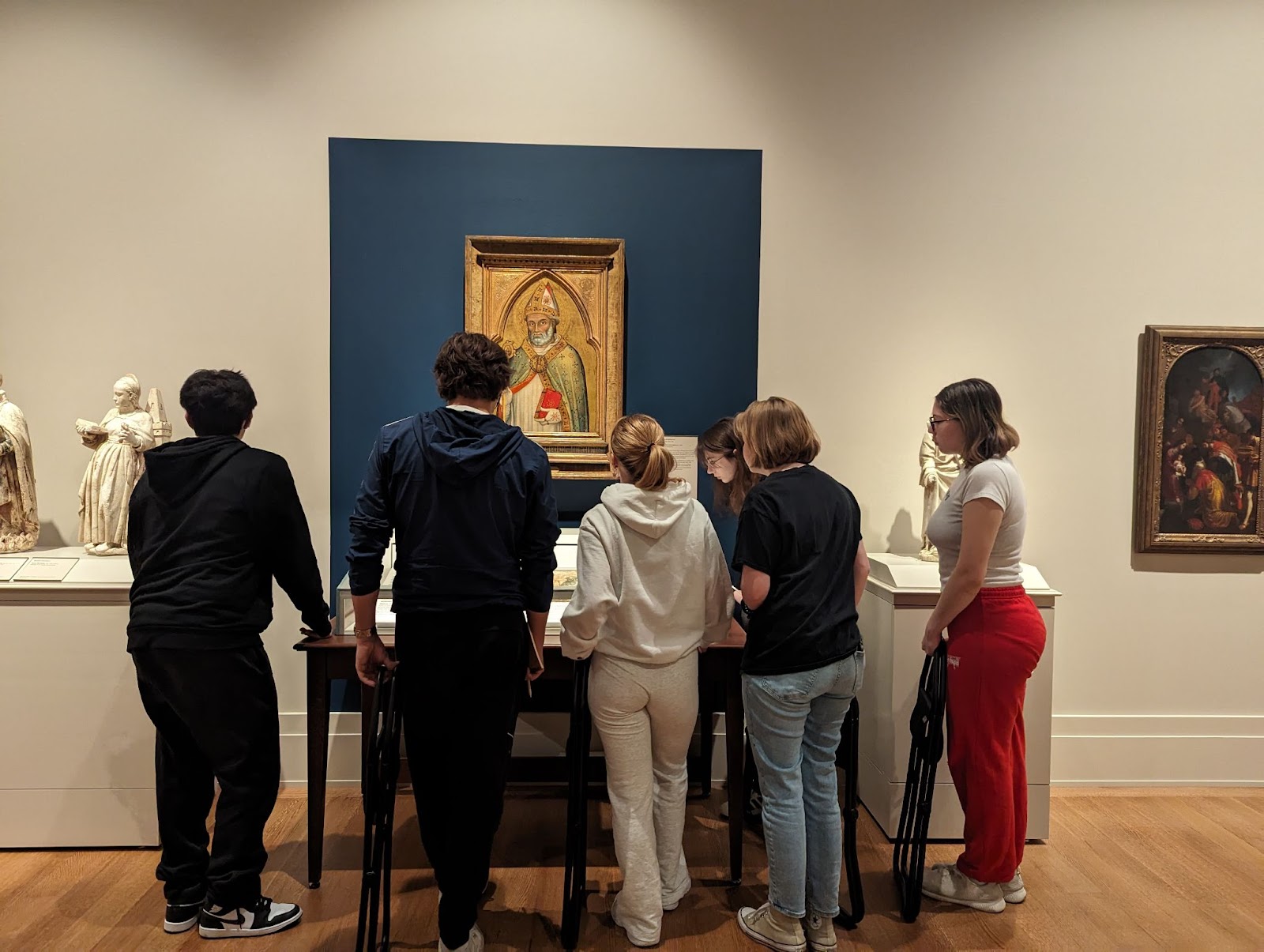
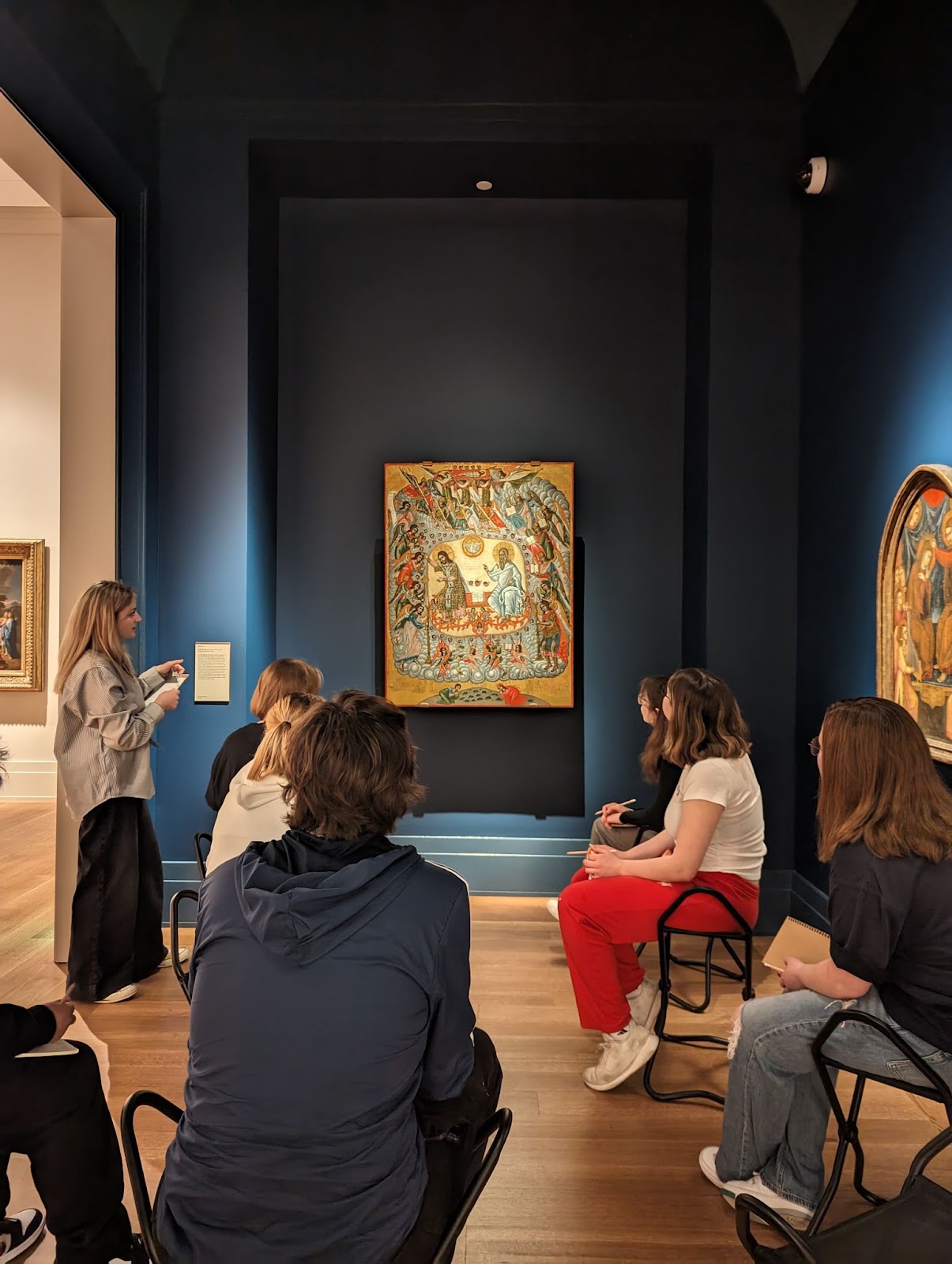
Maggie Dosch (left, standing), Assistant Curator of Education School Programs, guides students from John Adams High School, South Bend, IN through a close reading of a piece depicting Byzantine iconography. 

Maggie started us off with a selection of pieces from the gallery that features European Art Through 1700. It was wonderful to see my students outside of our typical classroom setting. Instead of sitting in classic student desks facing the front of our cider-blocked classroom, we were all huddled together around various tableaus and sculptures. With nothing but our humble, portable stools and notebooks and pencils, we were all equals in Maggie’s moving classroom. I found myself joining my students in asking Maggie questions about context and materiality. We all wanted to take advantage of being in the presence of someone who knew the gallery and pieces so intimately. She had us all eating out of the palm of her hand as she told us about the process of gilding, reliquaries, and more. Maggie had choreographed a beautiful,  delicate dance that allowed her to move gracefully between the medieval and the contemporary. We saw works from Byzantium and Italy and beyond. Indeed, she took us on a journey around the Mediterranean even though we never really ever left South Bend. Before we knew it, our time with Maggie was done. She only had an hour to spend with us before she had to move onto her next group.

Over lunch at a nearby fast casual restaurant, my students groaned about how short the visit was. Why couldn’t we have doubled or even tripled our time? There was so much more to see and explore! We barely scratched the surface! As they chatted amongst themselves over a feast of pizza and soda, I could hear them asking each other about their favorite parts of the visit. It was great, as an instructor, to know that my students were having these conversations organically among themselves. When lunch time came to an end and we had to make our way back to John Adams High School, I reminded them that the Raclin Murphy Museum is a community resource – they were welcome to return with their friends and family. Many seemed eager to plan for their next visit!


Students from John Adams High School, South Bend, IN gather around a display detailing various inks used during the Middle Ages as well as the process of gilding

Indeed, experiential learning is crucial for making the Middle Ages matter to these students. It is one thing to work with primary sources, listen to guest lecturers, and look at art and architecture on PowerPoint slides. It is another thing entirely to get outside of the conventional classroom setting and encounter a work from the past in an intimate setting. It is a privilege to have an expert help you make various connections between artistic techniques, influences, and historical context. It is powerful to share your observations in real time with someone who can answer any questions you may have as well as provide more insights. It is a way to break down barriers.

Years from now, I have a feeling that my students will not remember me. I mean, I am guilty of not remembering all the names of my wonderful instructors! As time passes, the details of this class might become fuzzy. My students might be able to tell others something along the lines of, “yeah, I took a medieval studies class in high school that was in partnership with the University of Notre Dame.” Perhaps they will recall a guest lecture or two. They might still have a booklet that they made when Dr. Megan Hall came and taught them about medieval book making technologies. Time can take a toll on memory. Despite this, what I hope is that their visit to the museum will become something they can fondly remember years from now. I think about their course evaluations and how they wrote how appreciative they were to be in such an immersive environment. Indeed, experiential learning is powerful. It allows for one to make meaningful connections between classroom lessons and important takeaways. Sensing the Middle Ages is different from reading about it. It allows us to be transported. We are challenged to ask questions about context, movement, materiality, and more. I am so proud of my students, who embraced their status as novices. May they hold onto their curiosity, kindness, and wit as they grow older and experience new things. As for our limited time as a class: we got to see the medieval together, and for that I am forever grateful.

Anne Le, Ph.D.
Public Humanities Postdoctoral Fellow
Medieval Institute
University of Notre Dame