Discovering Universal Salvation

Little is more exciting to a medievalist than the discovery of a lost text preserved in a forgotten codex in some neglected archive. Or, in some cases, the text is right under our nose: In 1983, the great Syriac scholar Sebastian Brock came across an unknown work of Isaac of Nineveh in a manuscript at Oxfordโ€™s Bodleian library. Isaac was a monk who lived in Qatar and Mesopotamia during the seventh century (the first century of Islamic rule). In the Bodleian text, Isaac weighed in on a central topic of medieval thought: What happens after we die?

For many Jews, Christians, and Muslims in the premodern Islamic world, the answer to this question was similar, at least in its basic outlines. After an intermediate period in which souls sleep or have a foretaste of their future state, God will raise the dead and pass judgment on every person who has ever lived. Some will suffer eternal punishment, while others experience eternal joy. Poets, preachers, and artists across the medieval world delighted in imagining the exquisite pleasures of paradise and the equally exquisite pains of hell.

Virgil shows Dante the suffering of the simoniacs (15th c.).

As Brock discovered, Isaac rejected the idea of eternal punishment and argued instead for universal salvation. God, he wrote, punishes as a father does, to teach and correct. Punishment in hell is therefore temporary, and God will have mercy on all people. Even the Devil will be saved![1]

Arabic Icon of Isaac of Nineveh.

As I became more interested in Isaacโ€™s views, I found that Brockโ€™s discovery was (as is so often the case) a re-discovery. Around 1100 years earlier, a Christian in ninth-century Iraq named แธคanลซn b. Yลซแธฅannฤ b. al-แนขalt went hunting for Isaacโ€™s books. He would later describe his quest in an Arabic paraphrase of Isaacโ€™s writings. As แธคanลซn tells it, he was consumed with questions raised by his study of the Bible: Does God really grow angry? Do temporal sins deserve eternal punishment? Or does God have mercy on all people?

แธคanลซn asked these questions to anyone who would listen: โ€œThey gave me answers,โ€ he wrote, โ€œbut their answers did not satisfy me!โ€ Eventually, a monk suggested that แธคanลซnโ€™s views resembled those of Isaac of Nineveh. แธคanลซn immediately rushed off in search of Isaacโ€™s books, not stopping until he came to a monastery in the city of al-Anbฤr. Al-Anbฤr lay in central Iraq (near modern-day Fallujah), a region dotted with Christian monasteries.

Syriac Orthodox monastery of Mor Mattai, near Mosul, Iraq.

There, at last, แธคanลซn discovered Isaacโ€™s teaching that the punishments of hell will end and all people will be saved.[2]

When I first read แธคanลซnโ€™s account of Isaacโ€™s views, I was surprised to find how much of it is shaped by the words of the Qurโ€™an, sayings of the Prophet Muhammad, and other Islamic texts.[3] As I read further, I realized that the ways in which แธคanลซn wrote about God and salvation reflected broader debates in โ€˜Abbasid Iraq.

My research at the Medieval Institute examines these debates. They reveal a shared Jewish, Christian, and Islamic conversation about salvation and the related topics of divine mercy, justice, and punishment. Jewish, Christian, and Muslim authors posed the same questions (โ€œDoes God punish to deter evil?โ€ โ€œIs divine mercy universal or particular?โ€) and often answered them in similar terms. Their discussions probed the limits of deeply held religious convictions and were enlivened by colorful metaphors: the condemned delight in hell, as an early Muslim thinker put it, โ€œlike vinegar worms in vinegar.โ€[4] Universal salvation was a minority position in the medieval Islamic world, but the questions and debates surrounding it formed an important part of Jewish, Christian, and Islamic thought and of interreligious exchange.

Discovering Universal Salvation, Part 2:

Entrance to the Egyptian National Library (Dฤr al-Kutub al-Miแนฃriyya).

In 1995, Muแธฅammad b. สฟAbd Allฤh al-Simharฤซ discovered a manuscript in the Egyptian National Library containing the full version of a treatise on universal salvation by Ibn Taymiyya (d. 1328), a highly influential scholar from medieval Syria.[5] The publication of this text has helped spur a surge of interest in Islamic views of universal salvation, including in the writings of towering figures such as Ibn สฟArabฤซ (d. 1240) and Mulla แนขadra (d. 1640).[6]

But how did these authors develop their ideas? One aim of my research is to show how the seeds of Islamic universalism developed in the earlier debates of the Umayyad and โ€˜Abbasid eras. This does not, of course, take away from the creativity of later thinkers, but it will help us understand more precisely how these thinkers wove together elements from earlier Islamic tradition in new ways that shaped the trajectory of Islamic thought on salvation.

The wonderful resources and community of the Medieval Institute have been a tremendous boon as I examine these Jewish, Christian, and Islamic conversations and the vibrant intellectual culture that fostered them.

John Zaleski
A. W. Mellon Junior Faculty Fellow
Medieval Institute
University of Notre Dame


[1] Sebastian P. Brock (ed. and trans.), Isaac of Nineveh (Isaac the Syrian). โ€˜The Second Partโ€™, Chapters IV-XLI, CSCO 554/5, Syr. 224/5 (Leuven: Peeters, 1995), esp. 148โ€“71 (Syriac) / 160โ€“82 (English).

[2] แธคanลซnโ€™s account is edited in Paul Sbath, Traitรฉs religieux, philosophiques et moraux, extraits des oeuvres dโ€™Isaac de Ninive (VIIe siรจcle) par Ibn As-Salt (IXe siรจcle) (Cairo: N.G. Thamaz, 1934).

[3] On this, see Alexander Treiger, โ€œMutual Influences and Borrowings,โ€ in Routledge Handbook on Christian-Muslim Relations, ed. David Thomas (London: Routledge, 2018), 196โ€“97.

[4] Attributed to Abลซ Ismฤสฟฤซl al-Biแนญแนญฤซkhฤซ, in, e.g. al-Ashสฟarฤซ, Maqฤlฤt al-islฤmiyyฤซn, ed. Helmut Ritter, 3 vols. (Istanbul: Maแนญbaสฟat al-dawla, 1929โ€“1933), 2:475. See also al-Jฤแธฅiแบ“, Kitฤb al-แธคayawฤn, ed. สฟAbd al-Salฤm b. Muแธฅammad Hฤrลซn, 7 vols. (Beirut: Dฤr al-Kitฤb al-สปArabฤซ, 1969), 3:396.

[5] Ibn Taymiyya, Al-Radd สฟalฤ man qฤla bi-fanฤสพ al-janna wa-l-nฤr, ed. Muแธฅammad b. สฟAbd Allฤh al-Simharฤซ (Riyadh: Dฤr al-Balansiyya, 1415/1995).

[6] See especially Mohammad Hassan Khalil, Islam and the Fate of Others (Oxford: Oxford University Press, 2012).

Preaching without Permission? Women Preachers in Medieval Islam with Dr. Linda G. Jones

A few months ago, Ben and Will sat down with Dr. Linda Jones, Professor at Pompeu Fabra University in Barcelona, where she teaches medieval history. Dr. Jones is an expert in religious and cultural history of medieval al-Andalus and the Maghreb, especially on topics such as gender dynamics , Islam-Christendom encounters, and oratory practices. She is the author of The Power of Oratory in the Medieval Muslim World (Cambridge University Press, 2012), the first monograph to consider the significance of preaching in the medieval Islamic world.

We typically imagine women as having been entirely subordinated to men in the medieval world, especially in those contexts which were explicitly religious. However, Dr. Jones offers to us a striking counterexample. In the medieval Islamic world, she explains that women were allowed to preach, not in formal contexts, but informally. Even despite the lack of formality, their preaching still carried authoritative weight, one that was often expressed in exhortative formโ€”encouraging listeners to undertake ascetic practices or to pray more fervently.

In addition to fascinating topics of cultural and religious practices in the medieval Islamic world, Ben and Will speak with Dr. Jones about the differences of teaching college students in the US versus Spain, the challenges of interpreting medieval manuscript handwriting, and the enduring importance of the humanities today.

Thanks for listening, and stay tuned for more!

Optical Character Recognition with Tesseract: a Tutorial for Medievalists

This tutorial is for those of you who want to learn some basic programming in Python for the digital humanities, but also for those who have never programmed or may become filled with terror at the sight of a single line of code (trust me, I know the feeling!). At the end of this guide, you should know how to perform optical character recognition (OCR) to make a pdf searchable. For this, we are going to use โ€œocrmypdfโ€, a Tesseract-based Python package with wonderful capabilities. Everything will be done online from your web browser, so donโ€™t worry, you will not have to install anything on your computer!ย 

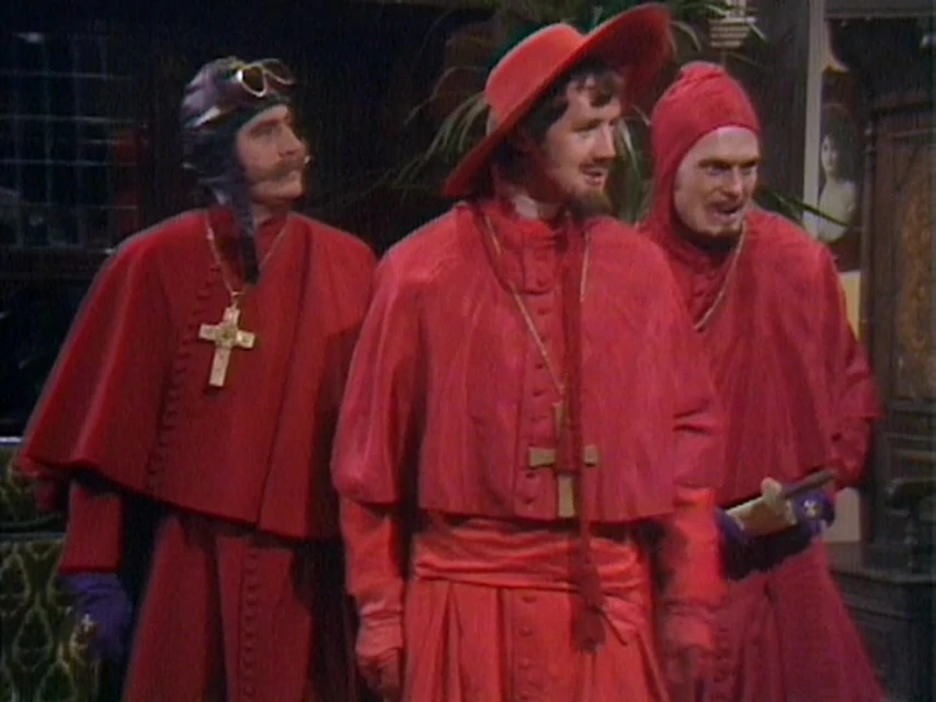
I have tried to keep the tutorial very simple and straight to the point, at the cost of occasionally sacrificing some useful and important explanations about the code. For that, I profusely apologize to my colleagues in the department of computer science. Please, do not send the Spanish Inquisition.

The name “Python” is a tribute to Monty Python (please excuse the poor joke).

Why Tesseract and ocrmypdf?

Some of you may be familiar with, or even regular users of the OCR function provided by Adobe Acrobat DC pro. The ctrl+f function is one of the simplest and most efficient tools to support analysis of text and research. Acrobat DC is a powerful and very easy to use software, but this comes at a price. First, Acrobat works only with a handful of common modern languages such as English, French, German or Japanese. Tesseract on the other hand can recognize characters from a broad variety of modern and classical languages, including, but not limited to, Armenian, Classical Arabic, Classical Greek, Syriac, and Old Georgian, to name only a few. Second, Tesseract is a free, and open-source software, presenting a more cost-efficient option compared to other expensive commercial options and I am sure many of you would rather settle for the free but equally powerful alternative.

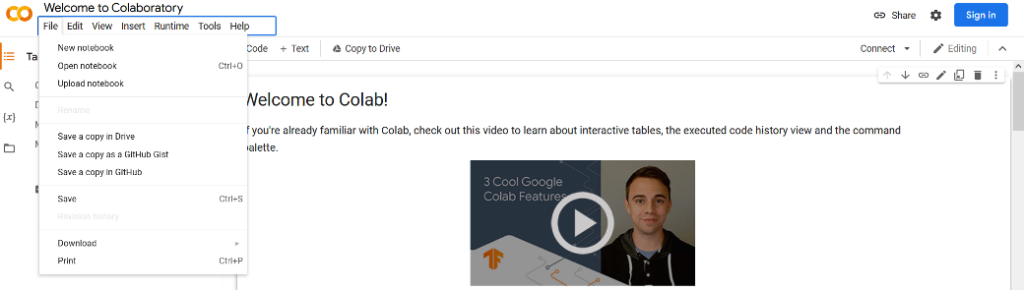
First, go to https://colab.research.google.com/

This is a free Jupyter notebook that will save your data on your personal google drive. Just remember to hit the save button before closing the page.      

Open a new notebook and sign up with a Gmail address. You will want to use your @nd.edu address but any personal google account will work too.

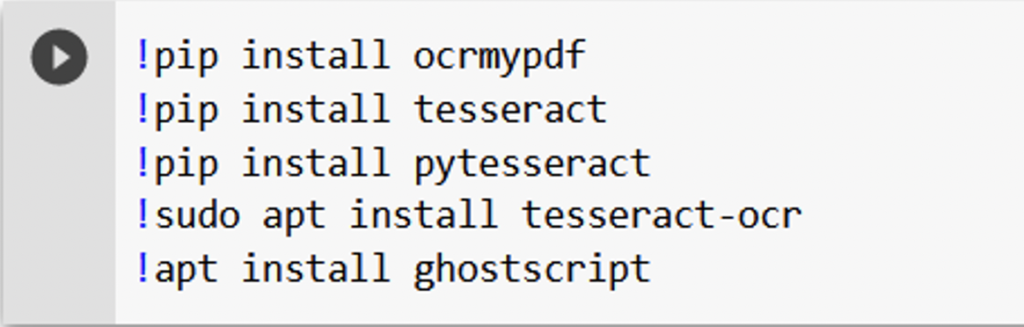
As a first step, we need to download ocrmypdf, and all its dependencies. To do so, simply type the following lines. The first will download the python package ocrmypdf, while the other lines will deal with the dependencies. For those of you new to coding, you will learn the first rule of coding: any errors in spelling, indentation and so forth can break your code. Be careful!

When the above lines have been written, run the cell by pressing ctrl+enter or press the button in the upper left corner. The download process should take around a minute. Once the download is complete, you should see a little green tick next to the upper left arrow.

Once the package and its dependencies have been downloaded, we will need to import โ€œocrmypdfโ€ so that we can put it to work. Add a line of code to your colab sheet by clicking on + Code and write the following code:

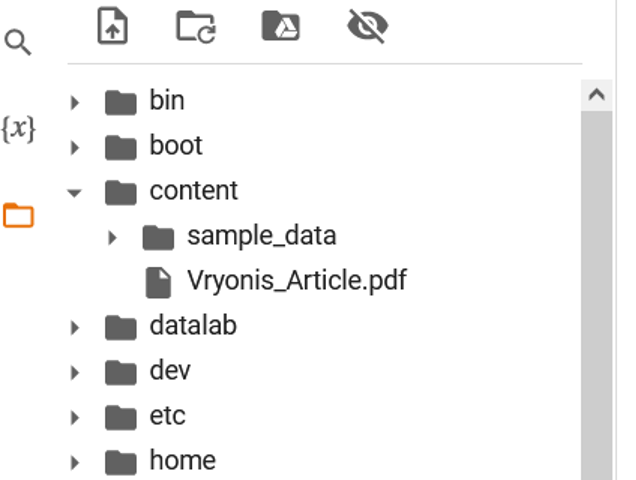
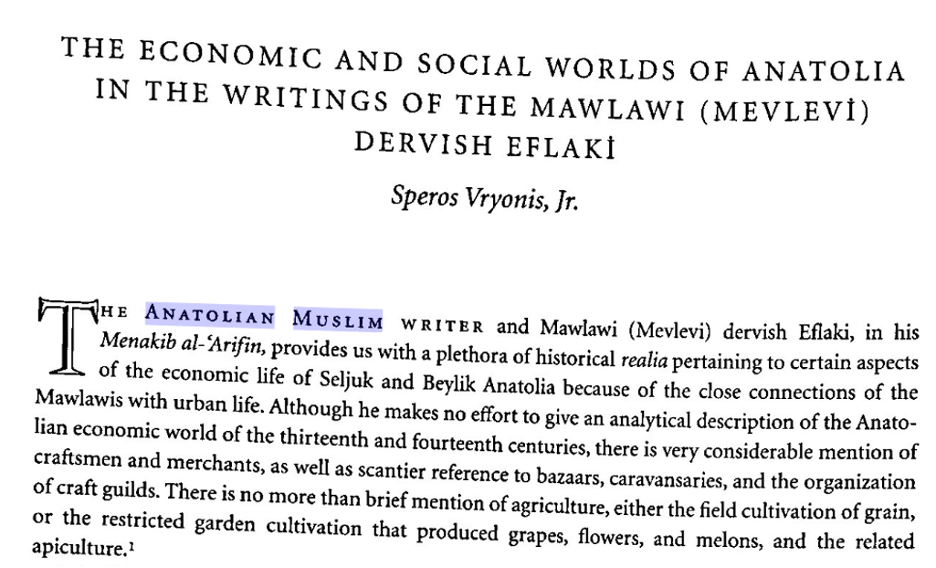
Next, add a copy of your scanned pdf to the “files/content” folder  on the left side of your screen (or any other folder of your choice, you will just have to note its path somewhere). In our case, we are going to work with the first page of an article on the Mevlevi Sufi order published by the Byzantinist Speros Vryonis Junior.

In a new cell, enter the following lines of code (beware, the underscores are double underscores!).

Here, the name on the left should be that of the file you want to ocr (or its path if put in another folder), the one on the right should be that of the new, postprocessed file. The code uses the exact name of the file, โ€˜Vryonis_Article.pdfโ€™. You can keep the exact same name if you want the new file to overwrite the original one. In my case, my code is directing ocrmypdf to create a new file: โ€˜Vryonis_Article_OCR.pdfโ€™. Once generated, the post-processed article should appear in the same folder.

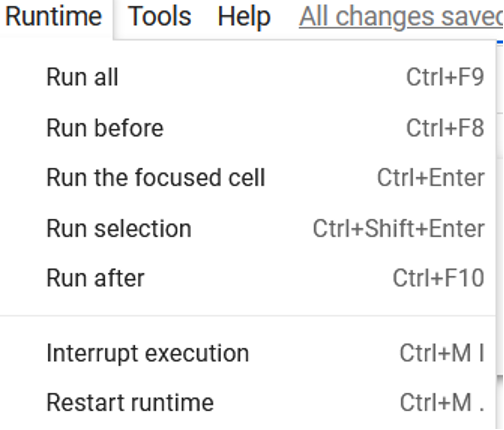
If you ever get an error, simply restart the runtime before running the cell again.

Et voila! You can now search your pdf with ctrl+F or copy and paste any sentence you want.

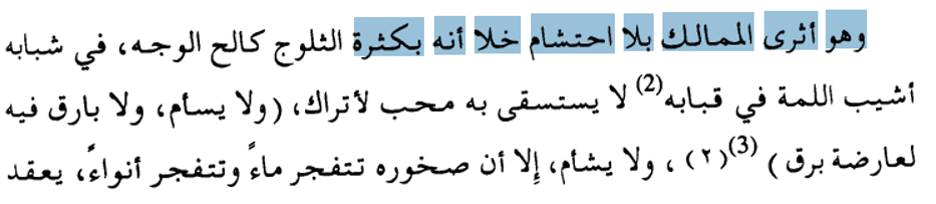
But this is not the most exciting part of this tutorial, and we may want to spice things up a little bit. Tesseract is very good at OCRing (yes, this is a verb, at least according to the WordSense dictionary) non-Latin scripts, but the process is a bit more involved. As an example, letโ€™s take a page from the Masฤlik al-abแนฃฤr fฤซ mamฤlik al-amแนฃฤr written in the 14th century by the Syrian polymath al-สฟUmarฤซ.

For this, you need first to download the Arabic trained data at https://github.com/tesseract-ocr/tessdata/tree/main/script

Then move the downloaded file to the following folder /usr/share/tesseract-ocr/4.00/tessdata

The process is the same as before, simply change the language code to that of the language you just added, in our case โ€œaraโ€. The various language codes can be found here: (https://tesseract-ocr.github.io/tessdoc/Data-Files-in-different-versions.html)

ูˆู‡ูˆ ุฃุซุฑู‰ ุงู„ู…ู…ุงู„ูƒ ุจู„ุง ุงุญุชุดุงู… ุฎู„ุง ุฃู†ู‡ ุจูƒุซุฑุฉ

And here we are. Those who can read Arabic will notice that the result is extremely impressive. This, however, is a rather neat scan and Arabic is often difficult to properly OCR because of the cursive nature of the script. If the quality of your scan is poor, you may also be able to clean it with Python beforehand for a better result. I may develop this point further in another post.

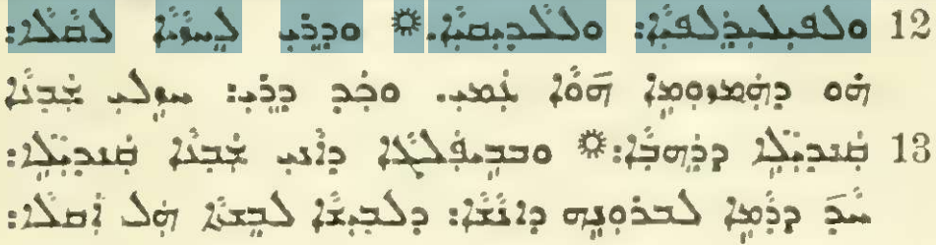
Beyond Arabic, Tesseract works very well with other non-cursive Semitic scripts, and you may get excellent results with Hebrew for example. Here is a last example from a Syriac Bible.

If you have any questions or comments about this guide, feel free to contact me.

Romain Thurin
PhD Candidate
Medieval Institute