An Old Norse Saga Guide to Surviving the Holidays

Christmas is the most wonderful time of the year, but between treacherous weather, family politics, and dietary decisions, it can also be a tricky time to navigate. To help you get through the season, here are some top tips from the Old Norse sagas on surviving the holidays.

Drinking with the Devil. Reykjavรญk, Stofnun รrna Magnรบssonar รญ รญslenskum frรฆรฐum, AM 673 a III 4to (Teiknibรณk), 18v. Image from handrit.is

Pick the right day to celebrate

If you lived in the Middle Ages, deciding when to host your winter festivities could be tricky. For a long time, as Scandinavia gradually converted to Christianity, the winter months saw the coexistence of two different Yule festivals: Christian Christmas and pagan Jรณl. The latter was likely celebrated differently across the region but said in one kingโ€™s saga, Hรกkonar saga gรณรฐa, to begin on midwinter night and continue for three nights. These diverging celebrations became a point of friction during the conversion process so, around the middle of the tenth century, the Christian Norwegian king, Hรกkon the Good, attempted to consolidate the two. According to his saga, he decreed that โ€˜observance of Yule should begin at the same time as Christian people observed Christmasโ€™ (97).

Although not without its challenges, this was a clever move. We can see its legacy several decades later in ร“lรกfs saga helga, which describes the changing customs of a man named Sigurรฐr:

During the pagan period, he was accustomed to hold three sacrificial banquets every year, one at the winter nights, the second at midwinter, the third in the summer. And when he accepted Christianity, he still kept up his established custom with the banquets. Then, in the autumn he held a great party for his friends, and also a Yule feast in the winter and then again invited many people; a third banquet he held at Easter. (127)

Once youโ€™ve settled on a date to celebrate, make sure you invite the right people โ€“ and if you get an invitation to someone elseโ€™s Yule-feast, itโ€™s bad form to not show up. Some time after Sigurรฐrโ€™s death, his brother รžรณrir invited his son รsbjวซrn to a Yule feast, but รsbjวซrn refused the invitation. รžรณrir took this as a personal slight and in return made such great mockery of รsbjวซrn and his expeditions that รsbjวซrn sullenly โ€˜stayed at home during the winter and went to no partiesโ€™ (131). A sad fate indeed.

Choose the perfect gifts

To be a powerful king in medieval Scandinavia, you had to surround yourself with groups of loyal retainers who would feast with you, fight for you, and uphold your rules. This loyalty needed to be rewarded, and Yule was the perfect time for kings and other powerful men to shower their best retainers with gifts. Thereโ€™s even a term for gifts given in this season: โ€˜jรณlagjวซfโ€™. In ร“lรกfs saga helga, for instance, it is said that the king had a custom of โ€˜making great preparations, […] gathering together his treasures to give friendly gifts on the eighth evening of Yuleโ€™ (199). One of these gifts was a beautiful gold-adorned sword, given to his skald Sigvatr. This was said to be a fine, enviable treasure, though perhaps not as enviable as ร“lรกfrโ€™s earlier gift to Brynjรณlfr, which he received with a rather unimaginative verse:

Bragningr gaf mรฉr
brand ok Vettaland.

The ruler gave me a sword and Vettaland (an important estate). (51)

Yule-gifts were also an important way to cement friendships and alliances in Scandinavian and Icelandic society, for which clothes appear to have been a popular choice. According to Laxdรฆla saga, King Haraldr Fairhair once gifted ร“lรกfr Peacock โ€˜an entire suit of clothes made from scarletโ€™ (30). Even more impressive is a set of Yule-gifts exchanged between the Norwegian Arinbjวซrn and the Icelander Egill in Egils saga:

As a customary Yuletide gift, [Arinbjorn] gave Egil a silk gown with ornate gold embroidery and gold buttons all the way down, which was cut especially to fit Egilโ€™s frame. He also gave him a complete set of clothes, cut from English cloth in many colours. Arinbjorn gave all manner of tokens of friendship at Yuletide to the people who visited him, since he was exceptionally generous and firm of character. (134)

Of course, before you splash out on expensive swords or clothes, you need to make sure the receiver is worthy of your gift. This is what King Raknarr did on the eve before Yule in the semi-legendary Bรกrรฐar saga snรฆfellsรกss, entering the hall of King ร“lรกfr Tryggvason, decked out with armour, helmet, sword, gold necklace, and gold ring. After going round the room to no response, he finally announces scathingly: โ€œHere have I come and nothing at all has been offered to me by this great figure. I shall be more generous for I shall offer to award those treasures that I have here now to that man who dares to take them from me โ€” but there is no one like that here.โ€ (261)

Raknarrโ€™s passive aggressive gifting strategy may not be the best example to follow, particularly as he turns out to be a reanimated corpse who must be slain by the hero Gestr. Instead, why not take inspiration from the troll-woman Hรญt in the same saga (254), whose Yule party favor for Gestr is a wonderfully loyal dog!

Feast and be merry!

Once youโ€™ve bought and wrapped your presents, the next step is to plan your menu. The sagas are full of Yule feasts, although they rarely provide specific details of what is actually eaten. At one point in Eirรญks saga rauรฐa, for example, Eirรญkr is hosting a number of voyagers over the winter at his home in Greenland, but starts to become gloomy as Yule approaches for he does not have the resources to throw them all a proper holiday feast. One of the voyagers, Karlsefni, comes to his rescue, offering him use of their provisions:

โ€œ[...] Weโ€™ve malt and flour and grain aboard our ships, and you may help yourself to them as you will, to prepare a feast worthy of your generous hospitality.โ€

Eirik accepted this. Preparations for a Yule feast began, which proved to be so bountiful that men could scarcely recall having seen its like. (11)

What exactly was in that grand feast goes entirely unstated, but it clearly involved some kind of malt, flour, and grain.Hรกkonar saga gรณรฐa does suggest that horse meat was an important part of pagan Yule and other feasts. One winter, the saga relates, King Hรกkon attended a Yule feast with a large number of farmers from รžrรกndheimr, where he was very reluctantly forced to eat a few pieces of horse-liver and โ€˜drank all the toasts that the farmers poured for him without the sign of the Crossโ€™ (102). Itโ€™s never good to offend your hosts โ€” especially when they are armed.

One way to get into the sacred spirit of Christmas in advance of the gluttony to come is to fast in preparation. Indeed, not doing so could have dire consequences. In Grettis saga, the ill-tempered Glรกmr demanded meat from his wife on the eve of Yule. She tried to dissuade him, saying, โ€œItโ€™s not the Christian custom to eat on this day, because tomorrow is the first day of Christmas. It is our duty to fast today.โ€ (101) Glรกmr scoffed at this, claiming a preference for the old pagan ways, and tucked into his meat. That very night, he was found dead in the snow and, even worse, eventually rose again to haunt the area.

As Christianity became the dominant religion in Scandinavia, later kings were less accepting of the old customs. One winter, King ร“lรกfr the Holy got word that the farmers of Innรพrล“ndir had been holding forbidden midwinter sacrificial feasts, and summoned a representative to explain themselves. But the quick-thinking man had the perfect excuse:

โ€œWe held,โ€ he says, โ€œYule banquets and in many places in the districts drinking parties. The farmers do not make such scant provision for their Yule banquets that there is not a lot left over, and that was what they were drinking, lord, for a long time afterwards. At Mรฆrin there is a large centre and huge buildings, and extensive settlements round about. People find it good to drink together there for enjoyment in large numbers.โ€ (117)

The king remained suspicious, but could not fault the farmerโ€™s logic. For, if thereโ€™s one thing about Christmas that everyone can agree on, itโ€™s the importance of alcohol.

Drink… but not too much

When King Hรกkon the Good ordered the convergence of Yule and Christmas, he had one condition of how to celebrate: each person was to consume a measure of ale (16.2 litres, according to one estimate) and celebrate for as long as the ale lasted, or else pay a fine (97).

Drinking is a key component of most Yule feasts described across the sagas. Even core principles like seeking vengeance for fallen kin must come second. In Hรกkonar saga herรฐibreiรฐs, for instance, King Ingi relates that he told one man about the killing of another, sure that he would be spurred to vengeance, but โ€˜those people behaved as if nothing was as important as that Yule drinking feast and it could not be interruptedโ€™ (227).

In fact, throughout the sagas, Yule-drinking (โ€˜jรณla-drykkjaโ€™) causes all sorts of problems. According to ร“lรกfs saga helga, a Yule drinking competition in Jamtaland naturally led to bickering between Norwegians and Swedes, and the spilling of secrets as โ€˜the ale spoke through the Jamtrโ€™ (172). In Eyrbyygja saga, รžรณrรณlfr bรฆgifรณtr got his thralls drunk at Yule and convinced them to burn down an enemyโ€™s house (168โ€“69). The troll-womanโ€™s Yule-feast in Bรกrรฐar saga Snรฆfellsรกss steadily deteriorated as the drinking got heavier, leading to a rowdy game, a bloody nose, and a long feud (253).

Even without alcohol, Yule became a time of battle and slaughter throughout the sagas of kings. It is only in Magnรบss saga blinda ok Haralds gilla that the two titular warring kings accepted a Christmas truce โ€˜because of the sanctity of the timeโ€™, although Magnรบss did use this opportunity to fortify his town and โ€˜no more than three days over Yule were kept sacred so that no work was doneโ€™ (175).

This is a good example for academics everywhere: as much as we might feel the need to work over the holidays, there comes a time to put down our books, buy some gifts, and feast with family, friends, and nemeses โ€” even if it is for just three days over Yule. If you manage to do so, you might just make it through the season alive.

Ashley Castelino, DPhil
Public Humanities Postdoctoral Fellow 
Medieval Institute, University of Notre Dame 

Bibliography

Bardโ€™s Saga [Bรกrรฐar saga snรฆfellsรกss]. Translated by Sarah M. Anderson. In The Complete Sagas of Icelanders, edited by Viรฐar Hreinsson. Vol. 2. Leifur Eirรญksson, 1997.

Egilโ€™s Saga [Egils saga]. Translated by Bernard Scudder. In The Complete Sagas of Icelanders, edited by Viรฐar Hreinsson. Vol. 1. Leifur Eirรญksson, 1997.

Erik the Redโ€™s Saga [Eirรญks saga rauรฐa]. Translated by Keneva Kunz. In The Complete Sagas of Icelanders, edited by Viรฐar Hreinsson. Vol. 1. Leifur Eirรญksson, 1997.

The Saga of Grettir the Strong [Grettis saga]. Translated by Bernard Scudder. In The Complete Sagas of Icelanders, edited by Viรฐar Hreinsson. Vol. 2. Leifur Eirรญksson, 1997.

The Saga of the People of Eyri [Eyrbyggja saga]. Translated by Judy Quinn. In The Complete Sagas of Icelanders, edited by Viรฐar Hreinsson. Vol. 5. Leifur Eirรญksson, 1997.

The Saga of the People of Laxardal [Laxdรฆla saga]. Translated by Keneva Kunz. In The Complete Sagas of Icelanders, edited by Viรฐar Hreinsson. Vol. 5. Leifur Eirรญksson, 1997.

Snorri Sturluson. Hรกkonar saga gรณรฐa. In Heimskringla, translated by Alison Finlay and Anthony Faulkes. Vol. 1. Viking Society for Northern Research, 2011.

Snorri Sturluson. Hรกkonar saga herรฐibreiรฐs. In Heimskringla, translated by Alison Finlay and Anthony Faulkes. Vol. 3. Viking Society for Northern Research, 2015.

Snorri Sturluson. ร“lรกfs saga helga. In Heimskringla, translated by Alison Finlay and Anthony Faulkes. Vol. 2. Viking Society for Northern Research, 2014.

Old Directions in Medieval Language Acquisition

When more than a dozen undergraduates successfully banded together last year to petition the administration for me to teach the first ever course in Old Norse language and literature at my (now former) institution, I vowed not to disappoint them.[1] Knowing that these students would likely never have another opportunity to spend a semester learning and reading Norse in a formal setting, I soon realized that in two one-hour meetings per week over a single semester we could hope for little more than a forced march through any standard textbook, yielding some sense of the rules of the language but no real experience reading it.

A portrait of Guรฐbrandur Vigfรบsson (13 March 1827 โ€“ 31 January 1889) byย Sigurรฐur mรกlari.

Broadening my search, I came across Guรฐbrandur Vigfussonโ€™s 1879 Icelandic Prose Reader. Vigfusson recommends jumping right into reading, ideally beginning by muddling through the Gospel of Matthew, with which he assumes students will be familiar, before moving on to a shorter sagaโ€”he recommends Eirik the Red. He offers this advice:

The beginner should at first trouble himself as little as possible with grammatical details, but try the while to get hold of the chief particles, the pronouns, and a few important nouns and verbsโ€”the staple words of the languageโ€ฆThe inflexive forms are of less import; they will be more easily learnt and better remembered, if they are allowed to grow bit by bit on the mind, as they occur in the reading. Grammar is, after all, but the means to an end, and much of oneโ€™s freshness and power of appreciation is lost, if it is incessantly diverted from the subject before one, to the ungrateful study of dry forms.[2]

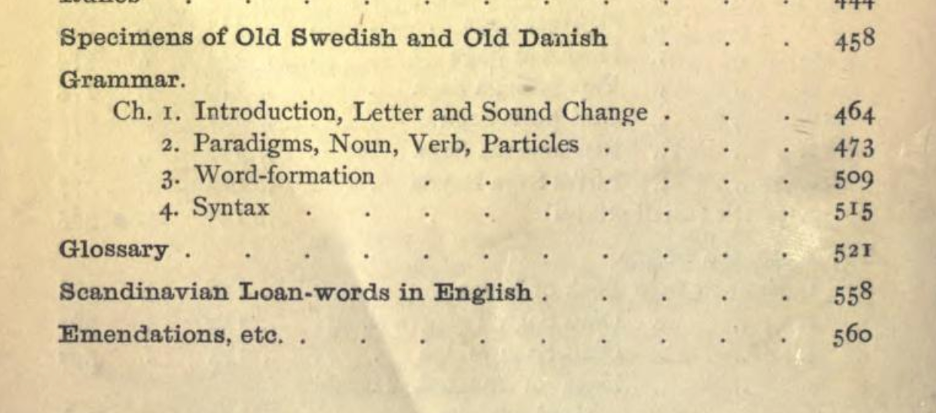
Though the reader does come equipped with a brief grammar consisting primarily of tables and charts, Vigfusson underscores his grammar-deemphasized, reading-first method by featuring the texts first in the volume, grammar second.

The grammar portion makes up only fifty pages of 560.

Though Vigfusson gave very little concrete advice for teaching besides a general idea to dump students in and let them swim, it got me thinking about how else we might teach and learn old north germanic languages. How did medieval students and teachers approach language learning?

The Anglo-Saxons (despite or perhaps due to King Alfredโ€™s lamentations about the state of Latin learning in his realm) were particularly accomplished language learners, as anyone considered truly literate had to read and write a completely foreign languageโ€”Latin. This literacy included many skills besides grammatical analysis. To quote R.W. Chambers, โ€œtheir aim was to read Latin, write Latin, and dispute in Latin.โ€[3] Recallingโ  Vigfussonโ€™s suggestion to start with the Gospel of Matthew, the youngest students of written Latin would begin with the Psalms, which they had previously learned by heart, along with the letters of the alphabet and various Latin prayers.[4] The upshot is, medieval students had a lot of the target language in their ears and memorized by heart before they ever began a program of study directly aimed at mastering grammar, learning to read, and creating in the language.

Then theyโ€™d move on to the Latin colloquy, question-and-answer dialogues meant to be memorized, acted out, and expanded through creative variation. One of the best-known colloquies, written for young scholars by prolific homilist and grammarian ร†lfric of Eynsham at the turn into the eleventh century, was paired close to the time of ร†lfric himself with an interlinear Old English gloss. Iโ€™d like to suggest a way of using this text in class in a way that goes beyond reading or translating the Old English (or the Latin, for that matter).[5]

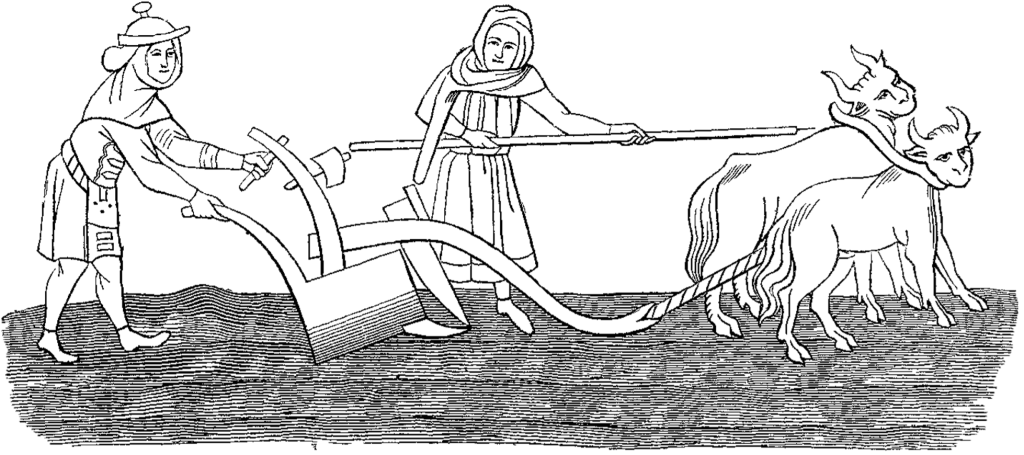
The early part of the colloquy is set up as a question-and-answer between the teacher and a classfull of students, who take the parts of people working diverse jobs, a ploughman, a monk, a hunter, a cook, etc.

Facsimile of a Miniature in a mediaeval manuscript published by Shaw, with legend โ€œGod Spede รพe plough, and send us korne enow.โ€ Image in the Public Domain.

Here the teacher (perhaps played by one of the students) introduces us to the ploughman.

Hwรฆt sรฆแตนest รพu, yrรพlinแตนc? Hu beแตนรฆst รพu weorc รพin?

Eala, leof hlaford, รพearle ic deorfe. Ic แตนa ut on dรฆแตนrรฆd รพywende oxon to felda, and iuแตนie hiแตน to syl; nys hit swa stearc winter รพรฆt ic durre lutian รฆt ham for eแตนe hlafordes mines, ac แตนeiukodan oxan, and แตนefรฆstnodon sceare and cultre mit รพรฆre syl, รฆlce dรฆแตน ic sceal erian fulne รฆcer oรพรพe mare.

A passage like this gives ample opportunity for working in the target language even beyond memorizing and acting out the dialogue (both excellent for building vocabulary and familiarity with grammatical structures). It also allows for imitation and creative response to a series of questions based on the text.

One question is already built into the dialogue.

Eala yrรพlinแตนc, hu beแตนรฆst รพu weorc รพin?

  • Ic แตนa ut on dรฆแตนrรฆd รพywende oxon to felda, and iuแตนie hiแตน to syl.

But we can ask other questions that test comprehension and encourage active imitation.

For example:

Hwรฆt รพฤ“oweรพ sฤ“ yrรพlinแตนc ut to felda?

  • Sฤ“ yrรพlinแตนc รพฤ“oweรพ to felda รพรฆs oxon.

Even without knowing exactly how to conjugate the verb, the student gets to employ the correct form in context through recognition and imitation. I say โ€œรพฤ“oweรพ,โ€ and the student recognizes it as the form needed in the response.

I can drill conjugation, though, if I want:

Eala yrรพlinแตนc, hwรฆt รพฤ“owst รพu to felda? (Exaggeratedly pointing a finger at the student to emphasize the second person singular pronoun)

  • Ic รพฤ“owe รพรฆs oxon.

The student will quickly begin to recognize that โ€œรพฤ“owst รพuโ€ needs โ€œic รพฤ“oweโ€ as a response. If a student says โ€œic รพฤ“owstโ€ or similar, I might repeat back โ€œรพu รพฤ“owst, ic รพฤ“oweโ€ (with approriate finger pointing) and move right along.

We can work with different verbs:

Eala yrรพlinแตนc, hwรฆt iugast รพu to syl?

  • Ic iugie รพรฆs oxonto syl.

And play with conjugation:

Hwรฆt iugiaรพ sฤ“ yrรพlinแตนc to syl?

  • Sฤ“ yrรพlinแตนc iugiaรพ รพรฆs oxon to syl.

But there are plenty of other questions we could ask about the same bit of dialogue.

Eala yrรพlinแตนc, hwaenne gรฆst รพu ut to felda?

  • Ic gฤ on dรฆแตนrรฆd to felda.

Hwon gรฆรพ sฤ“ yrรพlinแตนc ut to felda?

  • Sฤ“ yrรพlinแตนc gรฆรพ ut to felda for eแตนe his hlafordes.

Students might start out with one- or two-word responses. โ€œYea.โ€ โ€œOxon.โ€ โ€œOn dรฆgrรฆd.โ€ But with encouragement and practice with mirroring back much of the content of the question, they will start to put together more complex utterances.

I might ask:

Hwรฆรพer sฤ“ yrรพlinแตนc gรฆรพ ut to felda nihtes?

  • Se yrรพlinแตนc ne gรฆรพ ut to felda nihtes. Sฤ“ yrรพlinแตนc gรฆรพ ut to felda on dรฆแตนrรฆd.

or

Hwรฆรพer sฤ“ yrรพlinแตนc willaรพ gan ut to felda?

  • Se yrรพlinแตนc ne willaรพ gan ut to felda. Sฤ“ yrรพlinแตนc gรฆรฐ ut to felda for eแตนe his hlafordes.

These examples give some idea of the approach Iโ€™ve used, alongside extensive reading of accessible texts, to great result in my Old Norse and Latin classes. The method can be applied to other readings, even if you spend most of the class translating. Pull out a few sentences youโ€™d like to drill down into and ask questions about in the target language.

As a postscript, we did read the gospel of Matthew and the saga of Eirik the Red, and my former students have kept up a Norse reading group, without further help or interference from me.

Rebecca M. West, Ph.D.
The Center for Thomas More Studies
Hillsdale College


[1] An earlier version of this material was presented at ICMS 2024.

[2] Vigfusson, An Icelandic Prose Reader, vi.

[3] R. W. Chambers, Thomas More, 58.

[4] See Garmonsway, ร†lfricโ€™s Colloquy, 12.

[5] I took inspiration from the Latin colloquy in developing new materials for my Old Norse class, but the teacher of Old English is saved this laborious step.

Riddles, Reindeer, and Irish Prostitutes, Part 2

Find Part 1 to this post here!

The Perils of Studying Virgilย 

That the erudition of Irish scholars in the early Middle Ages was not always cast in a positive light is reflected in a letter, written nearly two centuries earlier, by Aldhelm, abbot of Malmesbury (d. 709). Aldhelm writes in admonishing language to his student Wihtfrith that he is none too pleased with the latterโ€™s decision to go study in Ireland. He wonders why Wihtfrith would forsake the study of the Old and New Testament to read foul pagan literature, i.e., Virgil, which was apparently being taught in the monastic centres of Ireland. More colourful still is Aldhelmโ€™s language in the oft-quoted passage below:

Quidnam, rogitans quaeso, orthodoxae fidei sacramento commodi affert circa temeratum spurcae Proserpinae incestumโ€”quod abhorret fari enucleateโ€” legendo scrutandoque sudescere aut Hermionam, petulantem Menelai et Helenae sobolem, quae, ut prisca produnt opuscula, despondebatur pridem iure dotis Oresti demumque sententia immutata Neoptolemo nupsit, lectionis praeconio venerari aut Lupercorum bacchantum antistites ritu litantium Priapo parasitorum heroico stilo historiae caraxere.

What, pray, I beseech you eagerly, is the benefit to the sanctity of the orthodox faith to expend energy by reading and studying the foul pollution of base Proserpina, which I shrink from mentioning in plain speech; or to revere, through celebration in study, Hermione, the wanton offspring of Menelaus and Helen, who, as the ancient texts report, was engaged for a while by right of dowry to Orestes, then, having changed her mind, married Neoptolemus; or to recordโ€”in the heroic style of epicโ€”the high priests of the Luperci, who revel in the fashion of those cults that sacrifice to Priapus [โ€ฆ].[1]

But Aldhelm did not stop there. No, truly, Ireland held further dangers still than the dactylic hexameters of the Augustan poets of old. He continues:

Porro tuum discipulatum ceu cernuus arcuatis poplitibus flexisque suffraginibus feculenta farna compulsus posco, ut nequaquam prostibula vel lupanarium nugas, in quis pompulentae prostitutae delitescunt, lenocinante luxu adeas, quae obrizo rutilante periscelidis armillaque lacertorum terete utpote faleris falerati curules comuntur, [โ€ฆ]

Moreover, I, compelled by this foul report, beg your Discipleship, genuflecting, as it were, with arched knee and bent leg, that you in no wise go near the whores or the trumpery of bawdy houses, where lurk pretentious prostitutes with luxury as their pander, who are adorned with the flashing burnish of leg-bands and with smooth arm bracelets, just as ornamented chariots are adorned with metal bosses; [โ€ฆ]

It would seem that reading Virgil and engaging prostitutes go hand in hand, the beneficiary being equally worthy of damnation in Aldhelmโ€™s eyes. It is a pity that we never find out whether Wihtfrith actually heeded his teacherโ€™s advice or, indeed, what lines (facetiously penned in hexameter?) he may have tendered in response to assuage his anxious masterโ€™s fears. The letter to Wihtfrith, along with many others of Aldhelmโ€™s writings, survives today only in William of Malmesburyโ€™s Gesta Pontificum Anglorum, an early-twelfth-century history of the English bishops. Aldhelmโ€™s letters are contained in Book V of the Gesta, the section of Williamโ€™s work dedicated to the history of Malmesbury Abbey and to Aldhelm, its founder.

King Alfred and a Reindeerย 

Having now moved from Ireland, via Wales, into Anglo-Saxon England, we are coming to our final stop on the journey through language contacts, manuscripts, and riddles in North-western Europe. While this section does not contain a riddle or admonition, it deals with one of the most interesting examples of language contact that I have come across. And it involves no lesser a man than Alfred of Wessex himself. As I mentioned before, it is only natural to reflect, when two languages come into contact, how these are both different and alike. When I recently listened to BBC4โ€™s In Our Time podcast on the โ€˜Danelawโ€™[2] (referring to both an area of Norse occupation as well as customs and legal practices), one of the speakers, Prof. Judith Jesch of the University of Nottingham, discussed the story of the voyages of the Norwegian tradesman Ohthere during his stay at the court of King Alfred. Alfred had acceded to the throne of Wessex in 871, the only kingdom within Anglo-Saxon England that was not under Norse rule at the time, and later in 886, Alfred negotiated a treaty with the Danish king Guthrum, establishing a border between their two domains. Apart from being a skilled military and political leader, Alfred was also invested in cultural reform and education, looking for inspiration across the Channel to what had been achieved as part of the Carolingian Renaissance. One of the areas that Alfredโ€™s efforts centred on was providing translations of important Latin texts, especially theological and historical works. One of these works was Orosiusโ€™ Seven Books against the Pagans, by that time the standard source for world history. At one time, it was even believed that it was Alfred himself who translated the text into Old English, although this theory has now largely fallen out of favour.[3] And it is as part of the Old English Orosius that we find the fascinating story of the voyage of Ohthere to Alfredโ€™s court. Ohthere tells the king that he comes from the northernmost part of Norway, hardly inhabited, and brings him a gift of walrus tusks, containing precious ivory. Then he tells the king that:

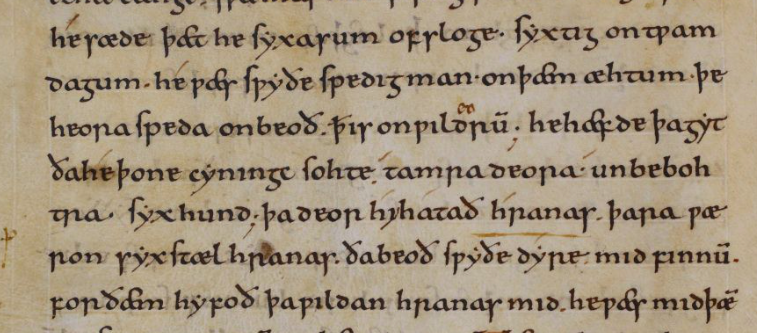
He wรฆs swyรฐe spedig man on รพรฆm รฆhtum รพe heora speda on beoรฐ, รพรฆt is on wildrum. He hรฆfde รพagyt, รฐa he รพone cyningc sohte, tamra deora unbebohtra syx hund. รพa deor hi hataรฐ hranas; [โ€ฆ]

He was a very rich man in those possessions which their riches consist of, that in wild deer. He had still, when he came to see the king, six hundred unsold tame deer. These deer they call โ€˜reindeerโ€™.[4]

Ohthereโ€™s account in British Library, MS Cotton Tiberius B i, f. 12v [5]
Several insights can be gained from this little anecdote. As Judith Jesch points out in the podcast, there seems to have been no translator present at the conversation between Ohthere and the king. It must be that either Ohthereโ€”as a tradesmanโ€”had sufficient knowledge of Old English to talk to Alfred; or that in turn, Alfred and the members of his court had sufficient knowledge of Old Norse to navigate the conversation; or indeed, that Old Norse and Old English were similar enough that, to borrow Jeschโ€™s terms, linguistic differences could easily be negotiated. Such a negotiation is particularly apparent from the above passage by the introduction of the word for โ€˜reindeerโ€™ into the English language. Since English had no word for this foreign animal, the Norse hreinn was borrowed into English as hrรกn (see Bosworth and Toller s.v. hrรกn), as Old Norse ei is equivalent to Old English รก (that the reverse happened also can be seen through the borrowing of English personal names such as ร†thelstan into Norse as Aรฐalsteinn).[6] We can imagine Alfredโ€™s clerk interrogating Ohthere as to what exactly a hrรกn was and why it made him so wealthy. Embedded in the wider context of the Old English translation of Orosius, we therefore find this fascinating exchange between Alfred the Great and a humble yet resourceful reindeer farmer from Norway.

This selection of anecdotes found and lifted from the pages of medieval parchment provides just a glimpse into the fascinating world of medieval Irish, Welsh, Anglo-Saxon, and Norse contacts. And just as the modern student diligently devotes their time to make sense of the difficult Old-Irish Paradigms and Selections from the Old-Irish Glosses, annotating their copy with helpful notes, so did medieval scribes annotate their Latin texts, spelling out difficulties and playing with languages. And as undergraduates and postgraduates apply to the most competitive and most coveted university programmes, either with or without the counsel of an academic mentor or advisor, so did Wihtfrith no doubt make Ireland his educational destination. And no doubt, when Alfred of Wessex received Ohthere at his court, we may not have anticipated learning so much about northern Norwegian fauna. What these examples teach us is that history and language, manuscripts and literature can never be studied in isolation, but must come together to allow us to construct the story of the past. And while the past may be a different country (pace Hartley),[7] they donโ€™t always do things differently there.

Marie-Luise Theuerkauf, Ph.D.
University of Cambridge


[1] Lapidge, M. and Herren, M., Aldhelm: The Prose Works. D.S. Brewer, 1979: 154.

[2] Visit: https://www.bbc.co.uk/programmes/m0003jp7 [last accessed 28/04/19].

[3] Lund, Niels (ed.), Two voyagers at the court of King Alfred: The ventures of Ohthere and Wulfstan, together with the Description of northern Europe from the Old English Orosius. York, 1984: 6.

[4] Lund 1984: 20.

[5] The manuscript is available online here: http://www.bl.uk/manuscripts/FullDisplay.aspx?ref=Cotton_MS_Tiberius_B_I.

[6] Lund 1984: 56.

[7] Hartley, L. P., The Go-Between. Hamish Hamilton, 1953.