Having recently posted a blog on dragonomics in Beowulf and Tolkien’s Hobbit, I decided to follow up by offering a complementary poetic translation of the Sigemund-episode in Beowulf.
I have chosen to isolate the Sigemund-episode (874-902) and translate this passage as a discrete poem, in part because the episode operates as a poem within a poem, delivered as one of three songs by the Danish court poet and recited in celebration of Beowulf’s victory over Grendel. Numerous scholars have tried to identify its literary function in Beowulf, and the episode has traditionally been regarded as a heroic exemplum, honoring Beowulf and foreshadowing his fight with the dragon. I wish to challenge this reading of the passage.
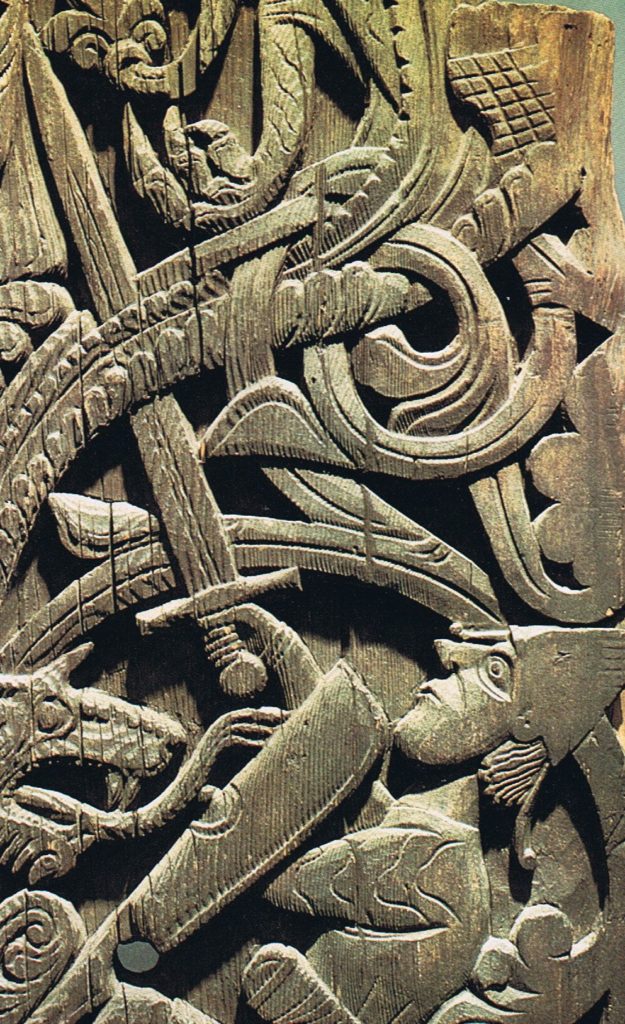
“The Sigurðr Portal” from Hylestad Stave Church, Setesdal, Norway; now housed at the Oldsaksamlingen of the University of Oslo.
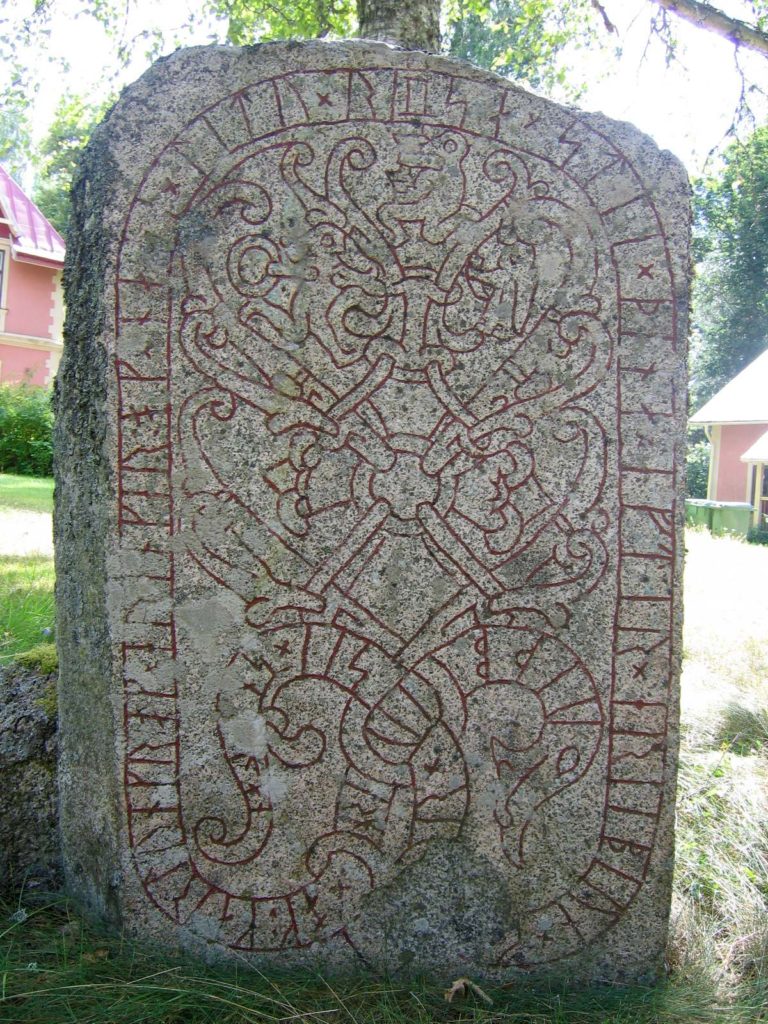
The Sigemund-episode in Beowulf is the earliest known account of the Vǫlsung legend, and this tale is alluded to in both the anonymous Poetic Edda and the Prose Edda of Snorri Sturluson as well as in Njáls saga, Þiðreks saga and the Vǫlsunga saga. Christine Rauer notes in her study of the Beowulf-dragon and analogous medieval dragon-fights, “The more extensive accounts of the Vǫlsung dragon-fight, such as those found in Fáfnismál (Poetic Edda) and Vǫlsunga saga, date from the thirteenth century, although the subject matter can be presumed to be of an earlier date” (42). However, in these later Old Norse-Icelandic versions of the legend, it is Sigurðr, Sigmundr’s son, who is credited with slaying the hoard-guarding dragon, Fáfnir—not his father.
I would note that, in the section in Beowulf describing Sigemund’s slaying of the dragon, there appears to be an alliterative formula that features also in the Old English Maxims II. This poem characterizes the behavior, function and stereotypical nature of various things—including references to cyning “a king” (1, 28), wulf “wolf” (18) and þyrs “giant” (42), in addition to geological features such as ea “a river” (30), wudu “woods” (33) and brim “sea” (45), as well as material objects and structures such as daroð “a spear” (21), beorh “barrow” (34) and duru“doors” (36).Maxims II describes sweord “a sword” (25) before shifting focus onto the stereotypical image of a gold-proud and barrow-dwelling dragon. The line reads drihtlic isern. Draca sceal on hlæwe “lordly iron. The dragon shall be in a barrow” (26). This closely parallels a similar line in Beowulf, which reads dryhtlic iren. Draca morðre swealt “lordly iron. The dragon died by murder” (892). Although the ending of the line is altered, the commonalities are nevertheless striking, especially since in both cases the alliteration stretches across two discrete semantic units.
I have also tried in my translation and recitation to emphasize the poetics of this episode, especially the two rhyming b-verse half-lines, which emphasize the dragon’s demise. The first, draca morðre swealt “the dragon died by murder” (892), characterizes Sigemund’s killing of the monster as a crime, in its description of the slaying as morðor “murder” (892). The second, wyrm hat gemealt “the hot worm melted” (897), reiterates the dragon’s death at the hand of the hero, and emphasizes also the element of heat—otherwise absent from the characterization of the dragon in the Sigmeund-episode—though explicitly linked to the Beowulf-dragon, described as fyrdraca “fire-dragon” (2689) and ligdraca “flame dragon” (2334, 3040).
Vǫlsung Legend runestone discovered at Drävle (U 1163), relocated in 1878 to the courtyard of the manor house Göksbo, containing image of Sigurðr who thrusts his sword through the serpent.
The Sigemund-episode is also enveloped by references to his ellendædum “valorous deeds” (876, 900), a compound that appears at both the beginning and end of the passage. However, Mark Griffith has provided a detailed commentary of the episode, and he concludes that “The episode of Sigemund is more highly enigmatic, and its central figure much more problematic than received opinion has it” (40). Griffith observes the numerous pejorative terms used to describe the hero, perhaps most famously his characterization as aglæca “fearsome marauder” (893), a term used to characterize each monster in the poem, Grendel (159, 425, 433, 591, 646, 732, 739, 816, 989, 1000, 1269), Grendel’s mother (1259), and the dragon (2520, 2534, 2592, 2907, 3061), though notably also Beowulf at two key moments (1512, 2592). As Griffith points out, “if the term does have pejorative meaning, then this applies to both Sigemund and Beowulf” (35).
This calls into question the merits of his heroism, and makes the reader wonder about the nature of his ellendædum, uncuþes fela “valorous deeds, much known” (876). The mystery introduced in this line is resolved when the Danish poet reports that þara þegumena bearn gearwe ne wiston,/ fæhðe ond fyrena, buton Fitela mid hine “feuds and crimes, of which the sons of men did not readily know, except Fitela with him” (878-79). Indeed we learn that his valorous deeds are characterized specifically as fæhðe “feuds” (879), a term associated with the Grendelkin’s feud with God (109), and especially Grendel’s mother’s vengeance (1333, 1340, 1380, 1537) as well as the dragons wrath (2403, 2513, 2525, 2689). We learn also that these deeds are explicitly fyrena “crimes” (879)—a term repeatedly associated with Grendel (101, 164, 639, 750, 811, 1001, 1669)—who likewise performs fæhðe ond fyrene (137, 153).
Moreover, the reference to Fitela, Griffith argues, may call to mind information for the Vǫlsunga saga, which “records how Signy changes shape with a sorceress, visits her brother and sleeps with him, whilst in this disguise, in order to beget a son to further the Vǫlsung feud with her husband” (25). In other words, Sigmundr (Sigemund) is both father and uncle to Sinflǫtli (Fitela), as a result of his incestuous relations with his twin sister. This seems further emphasized by the reference to the secrets shared eam his nefan “uncle to nephew” (881), which focuses the reader’s attentions on Sigemund’s incest and role as eam, an Old English term which indicates specifically “maternal uncle.”
Indeed, troubling descriptions of the hero persist, as Sigemund becomes characterized as wreccena wide mærost “the most famous of exiles”(898), which calls to mind the exiled Grendel, described as mære mearcstapa “famous border-crosser” (103), depicting the hero once again in pejorative terms. I would argue that this bears especially on the final reference to Sigemund’s ellendædum “valorous deeds” (900), and specifically the parenthetical half-line at the end of the episode, which indicates that he þæs ær onðah “he prospered before by these” (900).
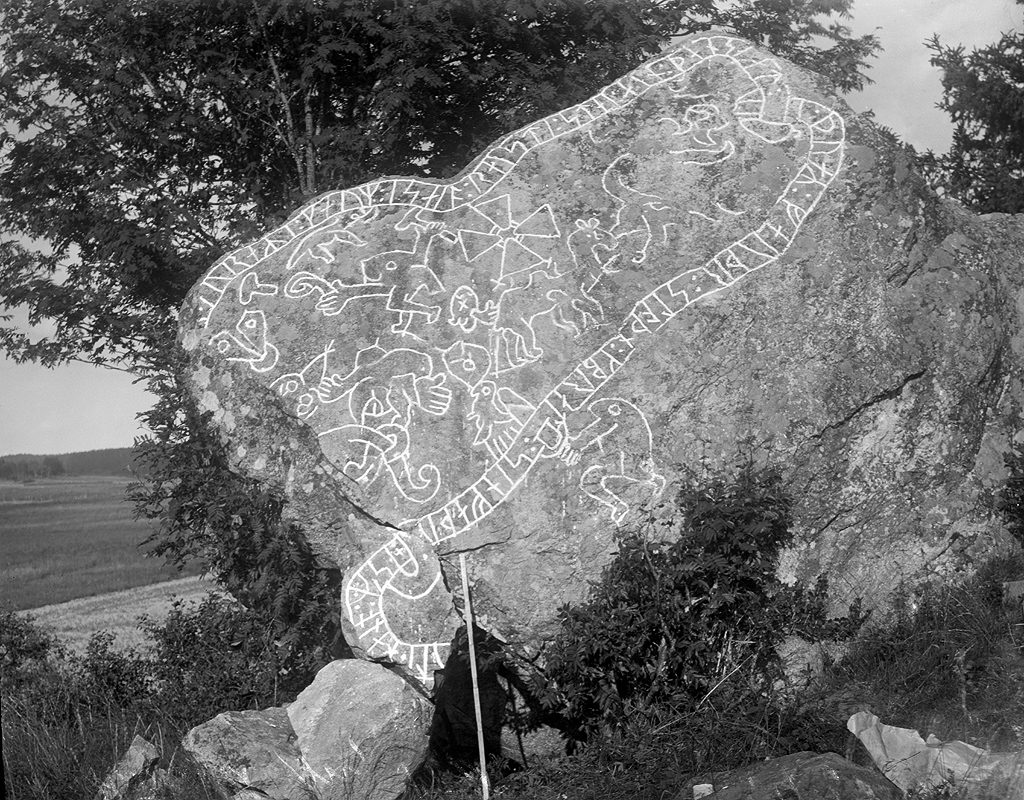
Vǫlsung legend runestone located at Gök (Sö 327), containing a runic text on two serpents that surround much of the Vǫlsung imagery, including a depiction of Sigurðr stabbing the serpent from below (photo from 1922).
If Sigemund prospers through fæhðe ond fyrena “feuds and crimes” (879), what does this say about the warrior ethics displayed in the poem? Indeed, I would suggest that the parenthetical half-line he þæs ær onðah “he prospered before by these” (900) highlights how in the heroic world of Beowulf, the only way to thrive is by imitating monsters and engaging readily in fæhðe ond fyrena. In Beowulf, feuds and crimes result in the protagonist’s death and the subsequent genocide of the Geatish people—which mirrors Sigemund’s (and Fitela’s) annihilation of ealfela eotena cynnes “an entire race of giants” (883)—perhaps in part because Beowulf seems to adopt Sigemund as a role model and seeks to emulate the ellendæda of this aglæca.
Richard Fahey
PhD Candidate in English
University of Notre Dame
Further Reading:
Abram, Christopher. “Bee-wolf and the Hand of Victory: Identifying the Heroes of Beowulf and Vǫlsunga saga.” The Journal of English and Germanic Philology 116.4 (2017): 387-414.
Bonjour, Adrien. The Digressions in Beowulf.Basil Blackwell. 1950.
Kaske, Robert. “The Sigemund-Heremod and Hama-Hygelac Passages in Beowulf.” Publications of the Modern Language Association 74 (1959): 489-94.
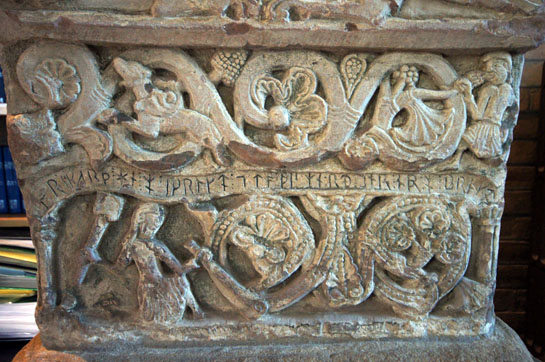
In the mid-twelfth century, a stoneworker in the far northwest of England at Bridekirk, Cumbria cut a lavishly-decorated baptismal font with reliefs of dragons, mysterious figures, and, curiously, a line of runic writing. By the early modern period, the characters on the Bridekirk font were nothing but strange. Early English historian and chronographer William Camden, who included a sketch of the runic inscription in the 1607 edition of his Britannia, declared himself perplexed: “Quid autem illae velint, et cuius gentis characteribus, ego minime video, statuant eruditi.”[1]
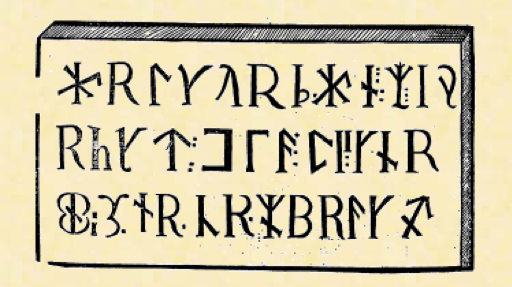
First published in 1586, Camden’s massive historico-chronographical Britannia went through six editions in the author’s lifetime, and Camden continually updated and expanded the text, augmenting it with maps and diagrams, such as the rendition of the Bridekirk runes seen below. The last Britannia edition on which Camden collaborated was a 1610 English translation by Philemon Holland, who translates: “But what they signifie, or what nations characters they should be, I know not, let the learned determine thereof.” Camden’s uncertainties cut straight to the heart of the matter: whose runes are these? and what do they mean?
In the more than 400 years that have passed since the publication of Camden’s Britannia and despite the best efforts of the eruditi, no simple answer has been found to either of Camden’s questions, the first of which I’ll consider in today’s post. Whose runes are these?
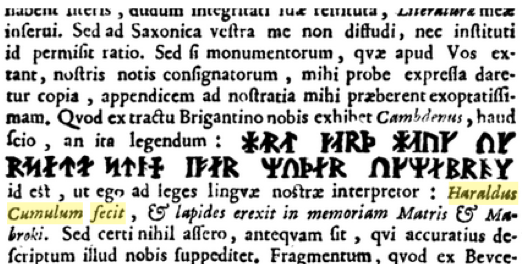
Danish antiquarian Ole Worm learned of the inscription from the Britannia and included his own version of the runes in a 1634 letter to one Henry Spelman:
Translation: But if a well-printed text of the monuments inscribed with our characters that exist [in England] is sent to me, they would make up the much-desired appendix to those from our country. As far as the one Camden shows us in his book Britannia, I hardly know whether it can be read: [RUNES] That is, as I interpret it according to the laws of our language: “Harald made [this] mound and set up stones in the memory of [his] mother and Mabrok.” But I claim nothing as certain until someone can supply us with a more accurate description.[2]Leaving aside Worm’s wildly inaccurate translation, which he based off of the second-hand evidence of Camden’s printed transcription, I’d like to note that Worm seems to claim the Bridekirk runes among the monumentorum nostris notis consignatorum (monuments signed with our script): he counts these as Scandinavian runes.
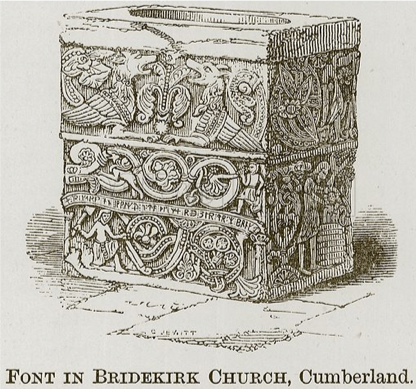
At other times the inscription has been claimed as English. The description of the Bridekirk font in Charles Macfarlane’s Comprehensive History of England, first published in 1856, praises the “ingenuity of design and execution” of the font and notes its “Saxon inscription.”[3]
The font as pictured in Macfarlane’s History.
Modern scholars agree with Worm that the incised characters are, in the main, Scandinavian. But the inscription is not wholly so: the text employs a few non-runic, decidedly English characters, including ⁊, Ȝ, and a bookhand Ƿ. Moreover, the language is not the Norse one might expect from Scandinavian runes but rather English:
Ricard he me iwrokte ⁊ to þis merð ʒer ** me brokte.[4]
Richard crafted me and brought me (eagerly?) to this splendor.
So if the runic inscription is neither fully Norse nor fully English, whose runes (cuius gentis) are they? While Charles Macfarlane claimed them as “Saxon” and Worm counted them as Scandinavian, the runes are actually neither but rather the product of a mixed society continuing to encode both English and Norse cultural practices on stone. Most literally the runes represent phonological values and a particular message, but for most of the font’s history the place of these symbols in cultural memory – whose runes they have become – has been just as important as what they originally meant. The cultural equivocality of the Bridekirk inscription is emblematic of larger ambiguities involving Anglo-Scandinavian ethnicity and culture as imagined by the post-Hastings medieval English. These ambiguous cultural signs, later re-imagined in the early modern period, raise the question of what it meant to be Anglo-Norse in an Anglo-Norman world.
Rebecca West, PhD Candidate
University of Notre Dame
[1] William Camden, “William Camden, Britannia (1607) with an English Translation by Philemon Holland: A Hypertext Critical Edition,” ed. Dana F. Sutton (The Philological Museum, 2004), Descriptio Angliae et Walliae: Cumberland, 7.
[2] Ole Worm, Olai Wormii et ad eum doctorum virorum epistolæ, vol. 1 (Copenhagen, 1751), Letter 431. This translation is my own.
[3] Charles MacFarlane, The Comprehensive History of England :Civil and Military, Religious, Intellectual, and Social : From the Earliest Period to the Suppression of the Sepoy Revolt, Rev. ed. (London, 1861), 164.
[4] The transliteration above is based on that of Page, who reads “+Ricarþ he me iwrocte / and to þis merð (?) me brocte.” R. I. Page, Runes (University of California Press, 1987), 54.
Like many fans across the world—this winter—each snowfall increased my anticipation for the return and final season of HBO’s fantasy television series, Game of Thrones, the popular film adaption of George R. R. Martin’s A Song of Ice and Fire. As a medievalist who enjoys medievalism, I am especially intrigued by successful modern adaptions of medieval themes and concepts, particularly when it comes to representations of the monstrous.
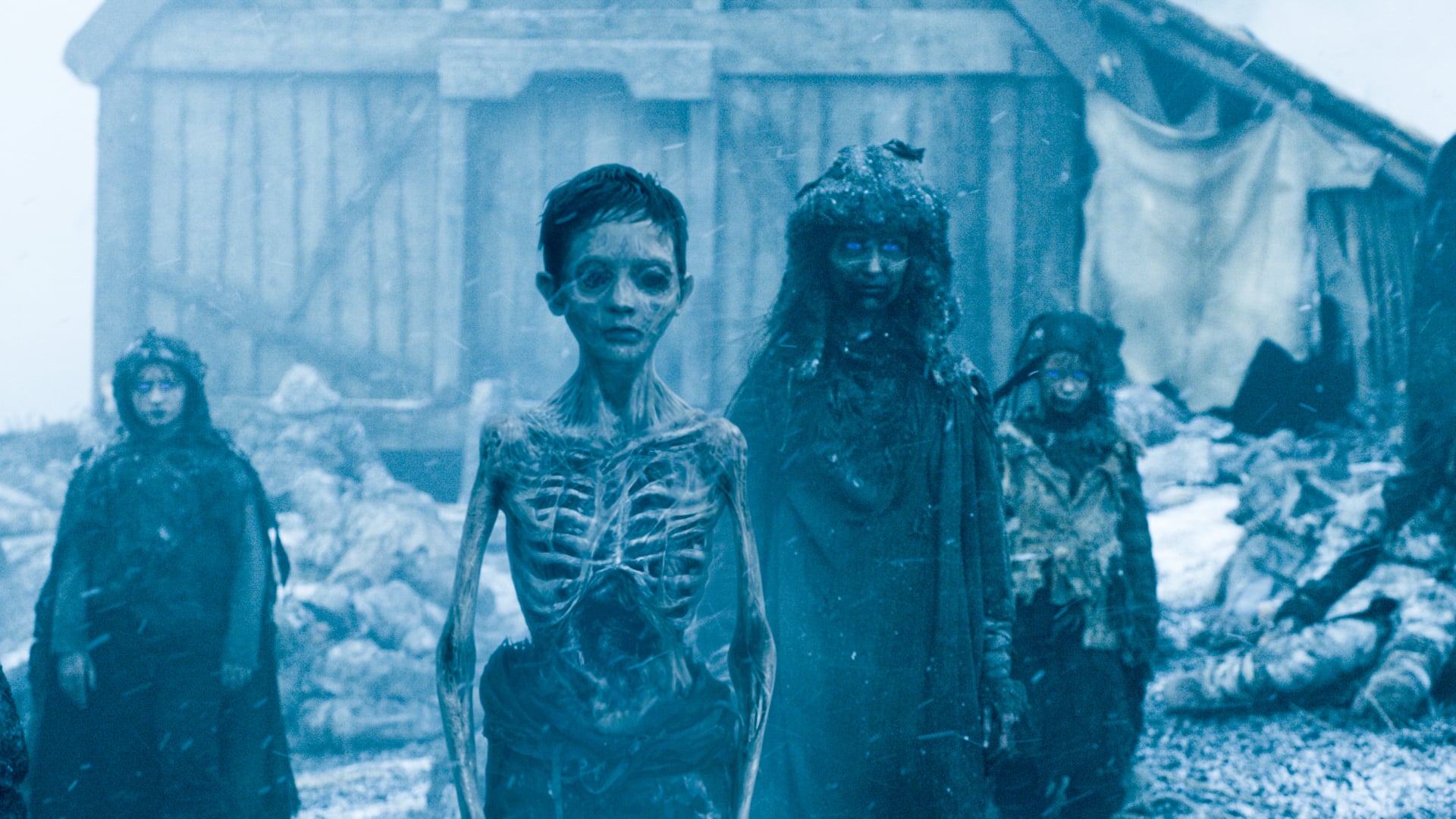
In Game of Thrones, one of the most terrifying of the fantastic creatures on Westeros are the frost-bearing White Walkers (also called Others), who come with winter and bring with them an undead horde of icy zombies (called wights). The show’s opening scene masterfully features these horrifying monsters, and introduces the audience to the shadowy specters who haunt the frigid North, growing stronger every season. Martin describes his wintry revenants in the prologue, when two men of the Night’s Watch come upon a group of White Walkers:
White Walkers from season 3 of HBO’s ‘Game of Thrones’ (2013).
“A shadow emerged from the dark of the wood. It stood in front of Royce. Tall, it was, and gaunt and hard as old bones, with flesh pale as milk. Its armor seemed to change color as it moved; here it was white as new-fallen snow, there black as shadow, everywhere dappled with the deep grey-green of the trees. The patterns ran like moonlight on water with every step it took” (Martin 7).
The White Walkers are characterized in AGame of Thrones (Martin’s first novel in the series, which HBO’s corresponding show adopted as its title) by their haunting eyes and the freezing cold that accompanies their approach:
“The Other halted. Will saw its eyes; blue, deeper and bluer than any human eyes, a blue that burned like ice. They fixed on the longsword trembling on high, watched the moonlight running cold along the metal. For a heartbeat he dared to hope. They emerged silently from the shadows, twins at first. Three of them…four…five…Ser Waymar [Royce] may have felt the cold that came with them, but never saw them, never heard them” (Martin 7-8).
Night King, leader of the White Walkers, from season 7 of HBO’s ‘Game of Thrones’ (2017).
After the White Walkers kill Ser Waymar Royce, his companion—Will—comes to investigate his corpse, and discovers yet another horror in his own captain:
“Royce’s body lay facedown in the snow, one arm outflung. The thick sable cloak had been slashed in a dozen places. Lying dead like that, you saw how young he was. A boy. He found what was left of the sword a few feet away, the end splintered and twisted like a tree struck by lightning. Will knelt, looked around warily, and snatched it up. The broken sword would be his proof….
Will rose. Ser Waymar Royce stood over him. His fine clothes were a tatter, his face a ruin. A shard from his sword transfixed the blind white pupil of his left eye. The right eye was open. The pupil burned blue. It saw” (Martin 8).
Undead wights from season 6 of HBO’s ‘Game of Thrones’ (2016).
These monsters (and their zombie horde) envelop the series, and the build up to the final battle for the soul of Westeros, between the living and dead, looms ever-present throughout the series and has all but come to fruition.
Like many aspects of Martin’s fantasy world, his modern monstrosities resemble medieval ones. Although also reminiscent of the monstrous Wendigo, his White Walkers share distinct characteristics with Old Norse-Icelandic depictions of revenants, generally from the fornaldarsǫgur, “sagas of olden times,” which depict a posthumous pre-Christian medieval culture that is undoubtedly the basis for Martin’s wildlings (also called free folk) and various peoples north of the Wall. Some terms for revenants in Old Norse Icelandic include haugbúi (“mound-dweller”), draugr (“revenant”) and aptrgangr (“again-walker”). The latter term explicitly describes revenants as “walkers” (gangr), corresponding directly to the second element in Martin’s own White Walkers.
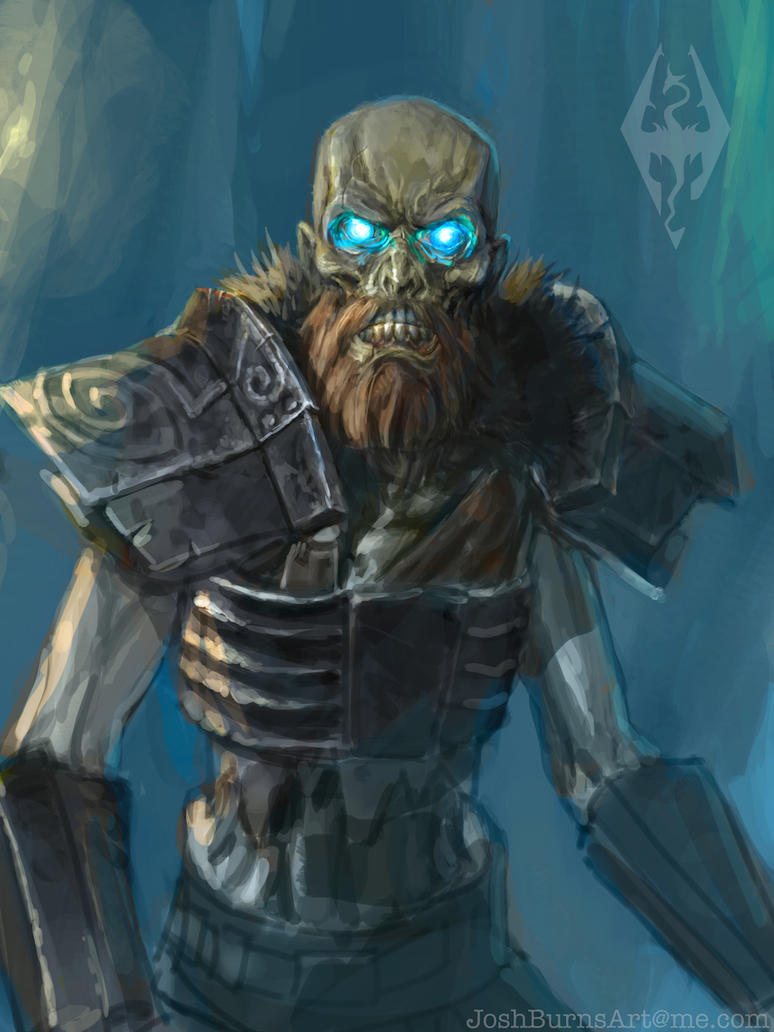
‘Draugr’ by Josh Burns (2016).
Grettis saga is the saga, which most famously contains Old Norse revenants. Grettis saga is the story of a mighty warrior named Grettir, who slays a variety of monsters throughout the saga, until he becomes something of a monster himself, exiled to a cave and the object of heroic slaughter. In this saga, Grettir meets two revenants; the first is Kárr “the Old”—a haugbúi “mound-dweller” that haunts his own grave and the surrounding island (similar to the zombified Angantyr from Hervarar saga Heiðreksand Þráinn from Hrómundar saga Gripssonar). Grettir’s friend Auðunn tells him about the revenant, Kárr:
“‘Out on the headland stands a grave-mound,’ said Auðunn. ‘In it was laid Kárr the Old, Þorfinn’s father. At first, father and son owned a single farm on the island, but after Kárr died he returned from the dead and started walking, so much so that in end he drove away all those farmers who owned lands here’” (Byock 51).
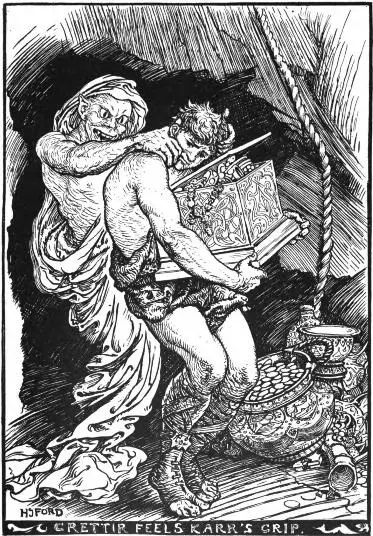
When Grettir enters the Kárr’s barrow he discovers both a foul reek and a terrifying image. After disturbing the treasure hoard in the barrow, the revenant rises up and attacks Grettir, only to be put to rest by decapitation:
‘Kárr the Old seizes Grettir’ by Henry Justice Ford (1901).
“Grettir then descended into the mound. It was dark inside, and not altogether sweet-smelling. He had to feel around to get an idea of what was inside. He found some horse bones, and next bumped into the back-posts of a seat. He realized that a man was sitting there in the chair. There was a pile of gold and silver all mixed together. There was also a chest full of silver under the man’s feet. Grettir took all the treasure and carried it to the rope, but as he was making his way out of the mound something strong grabbed hold of him. He let go of the treasure and turned to resist. A fierce fight began, and everything in their path was broken as the mound-dweller attacked with fury. For a long time Grettir tried to give way. Finally he realized there would be no chance of winning if he continued just to shield himself. Now neither spared himself, and they shoved each other until they came to where the horse bones were. There they struggled for a long time, with each at times falling to his knee. But in the end the mound-dweller fell backwards with a great crash, and with that noise Auðunn dropped the ropes and ran away, assuming that Grettir had been killed. Grettir now drew the sword Jǫkull’s-gift and struck at the mound-dweller’s neck. He cut off the head and placed the head against Kárr’s buttocks” (Byock 52).
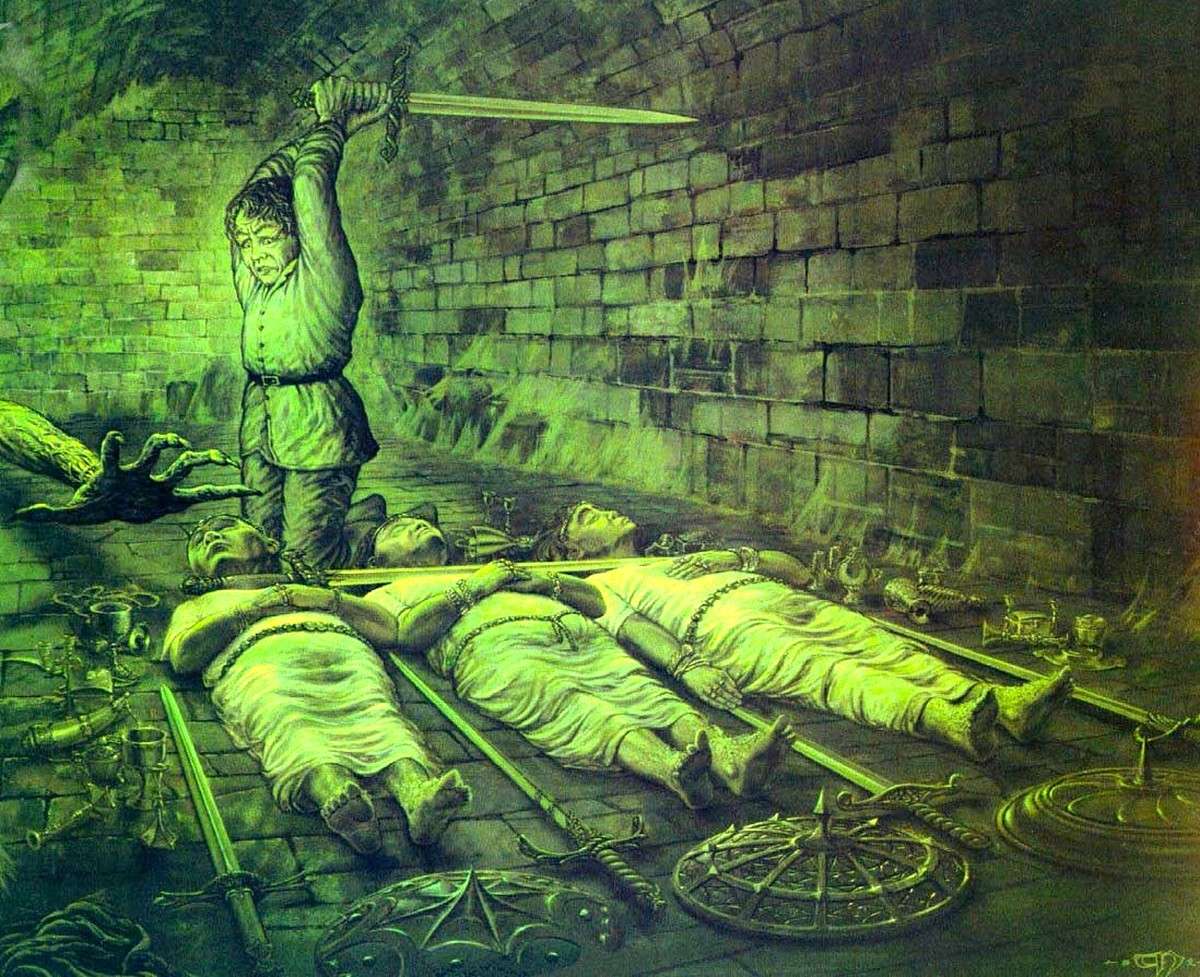
Kárr “the Old” is identified as a haugbúi “mound-dweller” in Grettis saga, and has a more direct influence on another fantasy author’s work, TheLord of the Rings by J.R.R. Tolkien. On Tolkien’s Middle-Earth, barrow-wights haunt certain old graves, and the hobbits stumble upon a haunted barrow in the chapter eight of The Fellowship of the Ring, “Fog on the Barrow-Downs.” Description of the barrow-wight (which has since become a common translation for haugbúi in English), reflects a close affinity to Old Norse-Icelandic mound-dwellers, such as Kárr. When the hobbits are in the barrow-wight’s burial mound, they are put under a spell and “round the corner a long arm was groping” (Tolkien 169), which causes Frodo at first to consider only his own escape and survival. However, eventually he decides to help his companions, put to sleep by the barrow-wight’s incantation:
‘Under the Spell of the Barrow-wight’ by Ted Nasmith (1987).
“the courage that had been awoken in him was now too strong: he could not leave his friends so easily. He wavered, groping in his pocket, and then fought with himself again; and as he did so the arm crept nearer. Suddenly resolve hardened in him, and he seized a short sword that lay beside him, and kneeling he stooped low over the bodies of his companions. With what strength he had he hewed the crawling arm near the wrist, and the hand broke off; but at the same moment the sword splintered up to the hilt. There was a shriek and the light vanished. In the dark, there was a snarling noise” (Tolkien 160-161).
Kárr “the Old” is not the only revenant in Grettis saga. The second specter, Glámr, is the protagonist’s most fearsome monstrous opponent. Glámr is described as explicitly anti-Christian, and when he dies in a snowstorm, his body seems to move about, preventing him from being buried at a church and receiving last rites from the local priest. Soon Glámr starts haunting, especially in the heart of winter—at Yuletide—the winter solstice celebration often associated with Christmas:
“A little later people became aware that Glámr was not lying there quietly. He became a scourge to the local people. Many lost their senses when they saw him, some of them never recovering. Immediately after Yule, some people thought they saw Glámr inside the farmhouse. They were terribly frightened, and many of them fled the farm. Then Glámr took to riding the house in the evenings, so that the roof was nearly broken. Then he started walking about, both day and night. Men scarcely dared to go up the valley, even when they had reason to do so. For the people in the district it seemed as if a terrible misfortune had descended upon them” (Byock 95).
Glámr is identified as a draugr “revenant” (popularized by their appropriation in the video game Skyrim), and continuities between Glámr and Grendel have long been observed by scholars. This has encouraged some critics to consider Beowulf and Grettis saga to be analogues, especially the reference to the leoht unfæger “ugly light” (Beowulf 727) in Grendel’s eyes—comparable to Glámr’s—and the similar action sequences in each respective fight between the heroic protagonists and their monstrous antagonists.
Draugr from the video game ‘Skyrim’ (2011).
In Grettis saga, when Grettir first encounters Glámr, he glimpses only the revenant’s head peeking through the door, “when the door opened, Grettir saw the creature stick its head in. It seemed to Grettir to be large and horribly deformed, with strangely oversized features” (Byock 100). Their subsequent battle is detailed in the saga:
“Glámr now wanted to get out of the house, but Grettir held onto him. Grettir braced his feet wherever he could find a footing, but still Glámr was able to drag him across the hall. They struggled violently, because the slave intended to drag Grettir from the hall. As difficult as it was to fight Glámr inside, Grettir saw that it would be worse dealing with him outside the house. For this reason he put all his strength into preventing Glámr from getting out” (Byock 101).
After an unsuspecting misdirection by Grettir, Glámr is finally able to pull Grettir out of the hall and into the night, where the battle continues:
“Outside it was bright in the moonlight, with gaps here and there in the cloud cover. On and off, the moon shone through. Just as Glámr fell, the clouds moved, revealing the moon. Glámr stared up at the light, and Grettir later said that this sight was the only one that had ever scared him. Exhaustion and the sight of Glámr’s threatening eyes now took their toll, and Grettir’s strength left him. Unable to draw his sword, he lay between life and death. Because Glámr had more evil power in himself than most of the other walking dead, he said: ‘You have shown much determination, Grettir, in finding me. And it would be expected that you would receive only ill fortune from me’” (Byock 101-102).
‘Grettir and Glámr’ by Didrik Jon Kristofersson (1998).
Glámr then places a curse up Grettir that he will become diminished and fall into outlawry and exile, saying:
“‘Most of what you do will now turn against you, bringing bad luck and no joy. You will be made an outlaw, forced to live in the wilds and to live alone. And further, I lay this curse on you: these eyes will always be within your sight, and you will find it difficult to be alone. This will drag you to your death’” (Byock 102).
As with Kárr, Grettir ends Glámr’s haunting by beheading the monster, for after his curse “the powerlessness that had gripped Grettir slid away. He drew his sword and cut off Glámr’s head, placing it against his buttocks” (Byock 102). However, Grettir’s encounter with Glámr causes him to fear the dark ever after—and a number of elements of Glámr’s characterization are reflected in the White Walkers, especially his moving corpse, terrifying eyes and preference for haunting during the dead of winter.
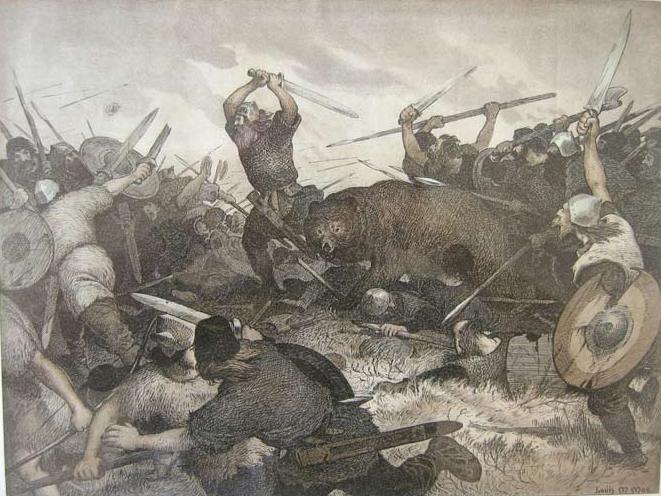
Although Glámr resembles Martin’s White Walkers, perhaps the closest parallel from Old Norse-Icelandic saga literature can be observed in the final battle in Hrólfs saga kraka, which serves also as the source for the “Battle of Five Armies” in Tolkien’s The Hobbit. In Hrólfs saga kraka, King Hrólfr and his warriors are pitted against Skuld’s monstrous horde, composed of “elves, norns and countless other vile creatures” (Byock 71). During the battle, which also occurs during Yule, the slain rise again as revenants that resemble the armies of Martin’s White Walkers and their zombie wights.
‘Hrólfr’s Last Stand’ by Louis Moe (1898).
“Men fell dead across each other in front of him [Bǫðvar Bjarki], until both his shoulders were covered with blood. Corpses were heaped high all around him, and he behaved as though overcome with madness. However many of Hjǫvard’s and Skuld’s men he and Hrólfr’s champions killed, their enemies’ ranks, remarkably, never diminished. It was as though Hrólfr’s men were having no effect, and they thought they had never come upon so strange an occurrence. Bǫðvar said, ‘Deep are the ranks of Skuld’s army. I suspect that the dead are wandering about. They rise up again to fight against us and it becomes difficult to fight with ghosts [draugar]. As many limbs as we cleave, shields we split, helmets and mail coats as we hew apart, and war leaders we cut down, the encounters with the dead are the grimmest” (Byock 76).
The image of a zombie horde is featured somewhat regularly in modern zombie-apocalypse literature, such as George Romero’s Dawn of the Dead (1978), Paul Anderson’s Resident Evil(2002), and AMC’s Walking Dead (2010). Nevertheless, both their terrible gaze and association with winter sets Martin’s White Walkers apart from the rest of the herd, and draws on medieval lore and legend in order to create a monster that speaks both to the past and the present.
Richard Fahey
PhD Candidate
Department of English
University of Notre Dame
Texts and Translations:
Byock, Jesse. The Saga of King Hrolf Kraki. London, UK: Penguin Books, 1998.
—. Grettir’s Saga. Oxford, UK: Oxford University Press, 2009.
Chadwick, Nora K. Stories and Ballads of the Far Past. Cambridge, UK: Cambridge University Press, 1921.
Martin, George R. R. A Game of Thrones. New York, NY: The Random House Publishing Group, 2011.
Tolkien, J. R. R. The Fellowship of the Rings. New York, NY: The Random House Publishing Group, 1954.
Chadwick, Nora K. “Norse Ghosts: A Study in the draugr and the haugbui.” Folklore 57.2 (1946): 50-65.
—. “Norse Ghosts II: A Study in the draugr and the haugbui.” Folklore 57.3 (1946): 106-127.
Fjalldal, Magnús. The Long Arm of Coincidence: The Frustrated Connection between Beowulf and Grettis saga. Toronto, ON: University of Toronto Press, 1998.
Jakobsson, Ármann. “The Fearless Vampire Killers: A Note about the Icelandic Draugr and Demonic Contamination in Grettis saga.” Folkore 120.3 (2009): 307-316.
—. “Vampires and Watchmen: Categorizing the Mediaeval Icelandic Undead.” JEGP 110.3 (2011): 281-300.
Keyworth, David. “The Aetiology of Vampires and Revenants: Theological Debate and Popular Belief.” Journal of Religious History 34.2 (2010), 158-173.
—. Troublesome Corpses: Vampires & Revenants—from Antiquity to the Present. Desert Island eBooks, 2013.
Orchard, Andy. Pride and Prodigies: Studies in the Monsters of the Beowulf-Manuscript. Toronto, ON: University of Toronto Press, 1995.
Stern, Elizabeth. Legends of the Dead in Medieval and Modern Iceland (Supernatural). University of California, Los Angeles: ProQuest Dissertations Publishing, 1987.