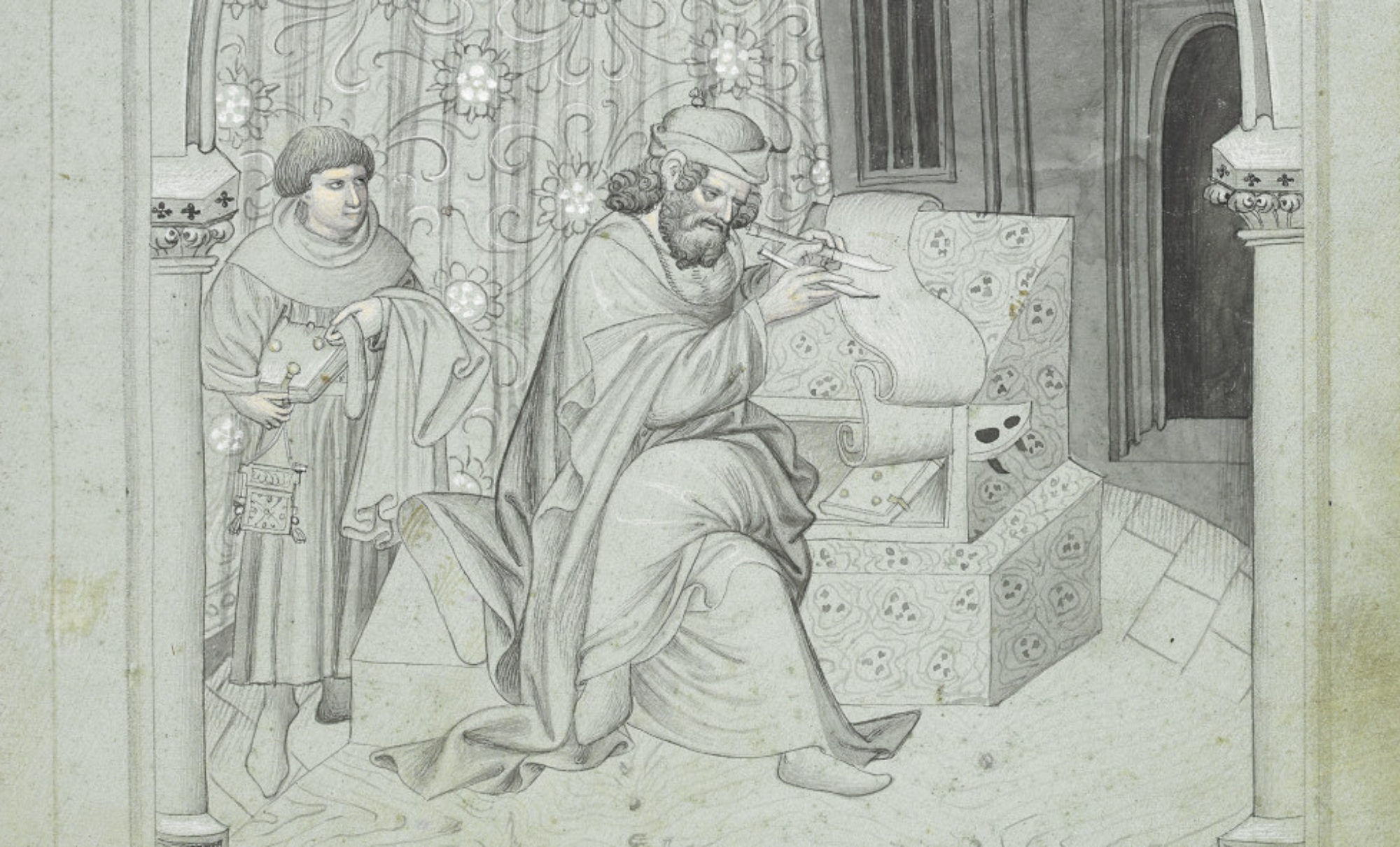
Laycus of Amalfi on the Azymes

As a continuation of sorts to my last post, on Peter Damiani’s reaction to the events of 1054, I’ve decided to take a look at another churchman writing on the same topic a few years later, a certain Laycus of Amalfi, who undertook to compose a defense of the use of unleavened bread (azymes) in the Eucharist around the year 1070 [1]. His work took the form of a letter, addressed to Sergius, a Latin-rite abbot living in Constantinople. According to the text, Laycus had been motivated to write by reports from his correspondent and from other Latins that they had been completely surrounded by those who were trying to persuade them to abandon the Latin liturgical usage in favor of the Greek [2].

Other than his name, virtually nothing else is known about the author of the text. The sole surviving manuscript witness (Brussels, Bibliothรจque royale 1360 / 9706-25, 116v-119r) gives only the identification “a letter of Laycus, cleric” (“epistola layci clerici”), a seeming contradiction in terms that leaves us with the assumption that “Laycus” is a given name. Anton Michel, who edited the text in 1939, notes further that monastics of the time tended to identify themselves as such: the absence of a word like “frater” in self-reference suggests that the author was not in monastic orders [3]. Even the origins of the author in the city of Amalfi are conjectural, and they are based more on his presumed links to Abbot Sergius, who was likely the leader of the monastery of St. Mary of the Amalfitans in Constantinople, an establishment attested by Peter Damiani around the same time[4].

The famous bronze doors of the Cathedral of St. Andrew in Amalfi, manufactured in Constantinople around the year 1060. Photo credits Berthold Werner, CC BY-SA 3.0 https://creativecommons.org/licenses/by-sa/3.0, via Wikimedia Commons.

The manuscript that preserves this text is also one of the few early copies of the work of Humbert, Cardinal of Silva Candida, and, as it happens, it is from Humbert’s writings that our Laycus drew most of his arguments in favor of the azymes. The core argument, in Laycus as in Humbert, was an appeal to the example set by Christ at the institution of the Eucharist during the Last Supper. According to the argument, Christ, who came to fulfill the Law of Moses, would have used unleavened bread at the Last Supper since the synoptic Gospel accounts place the event on the first day of the celebration of Pascha (Pesach), when leavened bread was prohibited in observant Jewish households. This act of institution was reinforced during the supper at Emmaus, which likewise occurred during the days of Pascha and is regarded in the text as a celebration of the Eucharist [5]. This practice was preserved by the Roman Church, according to Laycus, who cited Popes Anacletus, Clemens, and Sylvester as uniquely instrumental in this effort [6].

Especially for the period of the pre-Gregorian Reform, the tone of the text is fairly mild. The introductory paragraphs make reference to the “most pious, holy, and wise fathers and doctors [of the Greeks]” who themselves used leavened bread in the Eucharist (but who didn’t, though, attack the Latin use) [7]. And the letter of Laycus appears all the more gentle in comparison with the source material: gone is the spirited, “listen up, stupid” (“audi, stulte”) style of invective found in Cardinal Humbert [8]. Instead, we find almost a plea to avoid rending the garment of Christ by provoking division between the two rites, coupled with an emphatic statement that the one faith could contain various customs within the churches [9].

Does the work of Laycus of Amalfi change our understanding of the azyme debate or the conflict between the Eastern and Western churches more broadly? In terms of theological content, to put it bluntly, not really. The arguments advanced by Laycus were the same as those put forward by Humbert some fifteen years prior, and, while the text written by Laycus was itself copied by Bruno of Segni in another epistle in the early twelfth century, this branch of the post-Humbertine literary tradition does not leave any substantial mark in the theological framework of the Latin church. On the other hand, the very existence of this letter, along with the fact that a Greek prelate took the time to respond to it, does indeed broaden our insight into the East-West conflict more generally [10]. It emphasizes, first of all, that the Humbertine legation in 1054 was not a one-off attempt to open lines of communication between the two churches. Rather, communication was happening, even without the intervention of popes and patriarchs, and it was based on pre-existing and well-established ties connecting East and West. A Latin-rite monastery in Constantinople, staffed by Amalfitans, would naturally be in contact with friends, relatives, and fellow clerics back home.

Second, to return to a point that I’ve made before, this letter makes clear that there was no general sense of schism between East and West in the aftermath of the 1054 legation. Indeed, as noted above, the tone of this letter is notably more civil than the polemics of Humbert. Although Laycus was certainly more of an azyme partisan than was Peter Damiani, the work and its date of composition points to an extended window in which ecumenical dialogue, in the sense that both sides still saw each other as part of the same community, was still possible.

Nick Kamas
PhD in Medieval Studies
University of Notre Dame

  1. Anton Michel has published the only substantial scholarly treatment of the material and the only edition of the text. Amalfi und Jerusalem im Griechischen Kirchenstreit (1054โ€“1090): Kardinal Humbert, Laycus von Amalfi, Niketas Stethatos, Symeon II. von Jerusalem und Bruno von Segni รผber die Azymen (Rome: Pont. Institutum Orientalium Studiorum, 1939. See also a short summary in Jonathan Shepard, “Knowledge of the West in Byzantine Sources, c.900โ€“c.1200” in A Companion to Byzantium and the West, 900-1204, ed. Nicolas Drocourt and Sebastian Kolditz (Leiden: Brill, 2021), 67.
  2. Laycus of Amalfi, c. 1, Michel, Amalfi und Jerusalem, 35.
  3. Michel, Amalfi und Jerusalem, 21.
  4. Peter Damani, Letter 131, trans. Owen J. Blum, The Letters of Peter Damian Peter Damian, Vol. 5, Letters 121โ€“150, The Fathers of the Church: Medieval Continuation 6, (Washington, D.C.: Catholic University of America Press, 2004), 55. For an assessment on why this monastic house in particular, see Michel, Amalfi und Jerusalem, 18โ€“19.
  5. Laycus of Amalfi, c. 5โ€“11, Michel, Amalfi und Jerusalem, 37โ€“42.
  6. Laycus of Amalfi, c. 14โ€“15, Michel, Amalfi und Jerusalem, 44โ€“45.
  7. Laycus of Amalfi, c. 2, Michel, Amalfi und Jerusalem, 36. “Licet illorum [Graecorum] religiosissimi, sanctissimi atque sapientissimi patres ac doctores fuerint et studuerint ex fermentato pane omnipotenti domino sacrificium offerre, tamen numquam invenimus illos nostram oblationem evacuantes aut deridentes [โ€ฆ].”
  8. Humbert, Cardinal of Silva Candida, Responsio sive Contradictio adversus Nicetae Pectorati Libellum, cap. 13, edited in Cornelius Will, Acta et Scripta quae de controversiis ecclesiae graecae et latinae saeculo undecimo composita extant (Leipzig: N. G. Elwert, 1861), 141.
  9. Laycus of Amalfi, c. 3, Michel, 36โ€“37. “Numquid divisus est dominus in corpore suo, ut alius sit Ihesus Christus in Romano sacrificio, alius in Constantinopolitano? Quis hoc orthodoxus dixerit nisi ille, qui dominicam non veretur scindere vestem? Nos veraciter tenemus, immo firmiter credimus, quia, quamvis diversi mores ฤ™cclesiarum, una est tamen fides [โ€ฆ].”
  10. Probably Symeon II of Jerusalem. Michel, Amalfi und Jerusalem, 25โ€“28.

(Pseudo-) Peter Damiani and the Reception of the Schism

In stark contrast to the almost non-reception of the events of 1054 in the literary Byzantine world, discussed here, on the Latin side of the equation, the report of the legation penned by Cardinal Humbert of Silva Candida quickly found its way into various historical chronicles and into theological literature. Two particularly fascinating examples that appear in Patrologia Latina 145 are both published under the name of Peter Damiani, who was, together with Humbert himself, one of the leading members of the papal curia in the mid-eleventh century. Although he would not be elevated to the cardinalate until 1057, under Pope Stephen IX, by the time of Humbert’s legation to Constantinople he was already active in attending various synods and had written the deeply influential Liber Gomorrhianus (addressed to Pope Leo IX). What makes these two works interesting, in light of their purported joint authorship, is that they take views of the azyme conflict (the use of unleavened bread in the celebration of the Eucharist) that are at odds both with each other and with the stance adopted by the Humbertine legation.

Photograph of a bust of Peter Damiani taken from the Florentine church of Santa Maria degli Angeli. Credit to Srnec at English Wikipedia. CC 2.5.

The first example is a letter fragment written by Peter Damiani to Henry, the Archbishop of Ravenna, most likely between 1052 and 1058 [1]. The text is eye-opening both for the historian and for the contemporary canonists, so I’ll cite the full text of Fr. Blum’s translation:

โ€ฆJust as it makes little difference whether at Mass we offer wine or unfermented grape juice, so, it seems to me, it is all the same whether we offer leavened or unleavened bread. For that “living bread that came down from heaven,” just as he wished to manifest himself under the appearance of wheat, he did so also under the form of the vine. “Unless,” he said, “a grain of wheat falls into the ground and dies, it remains a solitary grain.” And again, “I am the real vine.” Therefore, it suffices for me to offer either whatever is made from grain or whatever is produced by the vine. Nor am I too careful to inquire whether the bread was preserved in an immature dough until it could ferment, or also whether the grape juice was kept in a vat until it could turn into what one calls wine. But since it is not my purpose here to discuss these matters, I leave them to be handled by othersโ€ฆ. [2]

Peter Damiani here showed himself to be vastly more permissive than most of the mainstream Latin West when it comes to the correct materials for confecting the Eucharist, and even more tolerant than the legates to Constantinople. Humbert, while he tacitly acknowledged that the Greek practice of using leavened bread was permissible, also had a clear preference for the unleavened Latin host. Peter, interestingly, does not here even mention the Greek practice: his letter is entirely within the context of the Latin rite, addressed to an archbishop of an (admittedly Byzantine-influenced) Latin see. This text allows us to see an approach very different from the one that appears in the aforementioned Liber Gomorrhianus. Given the fact that this was a topic of considerable polemics when he wrote the letter, Peter Damiani appears as a moderating, or even progressive, voice in the conflict.

What a surprise, then, when we examine the second text, taken from the Expositio canonis missae. The work as a whole falls into the genre of Mass commentaries, theological treatises that explain the various ritual components of the eucharistic celebration with historical or scriptural parallels and allegory. Fairly early in this treatise, while discussing the phrase “He took bread” (“accepit panem”) the author complains:

Leavened bread should not be offered in the sacrifice, both by reason of deed and by reason of the mystery. As is read in Exodus: “Leaven signifies corruption”, and as the Apostle witnesses: “A little leaven corrupts the whole lump”. But the Greeks, persisting in their error, celebrate [the Eucharist] from leaven. [3]

Now present is a direct mention of the conflict with the Greeks, using scriptural references that were first applied to the debate by the Humbertine legation. And gone is the tolerance of the previous passage, in which the matter of the Eucharist – so long as it comes from grapes and wheat – is a matter of indifference. Instead, for the author, the use of leavened bread violates the spiritual message of the scriptures, signifying corruption, and is therefore wholly unsuitable for the celebration of the Eucharist. 

The wildly divergent views, of course, lead the reader to question the traditional attributions of authorship for one or both of the passages, and indeed, the Expositio canonis missae has caught the attention of several scholars for containing passages that seem out of place in the literary corpus of Peter Damiani. In particular, the text uses the word “transubstantiation” (“transubstantiatio”), which would be the first appearance of this terminology if it could, in fact, be dated to the middle of the eleventh century. It is this terminological incongruity that caused Joseph de Ghellinck to conduct a line-by-line comparison with other commentaries on the Mass and to conclude that the Expositio postdates not only the De sacramentis of Hugh of St. Victor (d. 1141) but also the De sacro altaris mysterio of Lothar of Segni (later Pope Innocent III), which was written in 1198 [4]. The true date of composition, then, would fall somewhere around the turn of the thirteenth century, about a hundred and fifty years after originally supposed.

When applied specifically to the passage about leavened bread, this reattribution to an anonymous author of the thirteenth century clears up a couple of difficulties. In the first place, the notion of the Greeks persisting “in their error” makes much more sense with the later dating. The use of un/leavened bread in the Eucharist didn’t arise as a point of contention until the 1050s, so the Greeks couldn’t have persisted in the error for very long if it had been Peter Damiani admonishing them. By the year 1200, of course, Latin polemicists could much more reasonably suppose that the Greeks had been given sufficient warning, and therefore that their continued use of leavened bread qualified them as “persisting” (“pertinaces”). Similarly, the hard-and-fast rule that “leavened bread should not be offered” is much more typical of the later period, in contrast with the more permissive attitude found in the eleventh century. We see, for example, an identical notion, in nearly identical phrasing expressed in Lothar’s De sacro altaris mysterio: “Not leavened bread, but rather unleavened, should be offered in the sacrifice, both by reason of deed and by reason of the mystery” [5].

But I want to conclude with an emphasis on the relative openness and permissiveness of the mid-eleventh century. Contrary to the reputation that the events of 1054 have developed in the centuries since, the Latin Christians at that time had only begun to develop their stance on the various points under discussion, un/leavened bread being maybe the most important among them. Had the more irenic figures like Peter Damiani (and even Humbert!) exercised a little more influence on this topic, the West might have maintained a more permissive tone by the time of the authorship of our Pseudo-Peter, and indeed, perhaps a different approach taken under the leadership of Innocent III, who had clearly been swayed by a century and a half of increasing aggressive liturgical polemics in his approach to the Greek rite. Whether openness to a variety of liturgical forms could have prevented the entirety of the calamity of the Fourth Crusade is doubtful, but it certainly couldn’t have hurt.

Nick Kamas
PhD in Medieval Studies
University of Notre Dame

  1. For the Latin text and date, see Kurt Reindel (ed.), Die Briefe des Petrus Damiani, MGG Briefe d. dt. Kaiserzeit 4.2, (Mรผnchen, 1988): 1โ€“2.
  2. Owen Blum (trans.), Peter Damian, Letters 31โ€“60, The Fathers of the Church: Medieval Continuation, (CUA Press, Washington, D.C., 1990): 215.
  3. (Ps.) Peter Damiani, Expositio canonis missae, PL 145.88. “Panis fermentatus non debet offerri in sacrificium, tum ratione facti, tum ratione mysterii. Sic legitur in Exodo. Fermentatum etiam corruptionem significat, teste Apostolo: modicum fermentum totam massam corrumpit. Graeci tamen in suo pertinaces errore de fermento conficiunt.”
  4. Joseph de Ghellinck, Le mouvement thรฉologique du XIIe siรจcle: รฉtudes, recherches et documents (Paris: Librairie Victor LeCoffre, 1914), 355โ€“359.
  5. Lothar of Segni (Pope Innocent III), De sacro altaris mysterio, PL 217.854. “Panis autem non fermentatus, sed azymus debet offerri in sacrificium, tum ratione facti, tum etiam ratione mysterii.”

Could Medieval Women Read?

As a specialist in the study of womenโ€™s education and literacy in England in the Middle Ages, Iโ€™m asked this question a lot. Iโ€™ll cut to the chase: YES. 

How do we know this? 

Medieval England (on which Iโ€™ll focus this blog) was a multilingual nation.1 English had been its primary vernacular from the time of the Anglo-Saxons (about 450) until the Norman Conquest of 1066, when French became the language of the nobility, government, and diplomacy.2 By the mid-fifteenth century, though, English had reasserted dominance as the primary vernacular language, while the Church, clerics, and higher education continued to use Latin.3 Because medieval English people would have heard and used all three languages in daily life, children were taught to read and speak all of them.4 Whether childrenโ€™s reading knowledge became advanced depended on the importance of reading in their lives and what socioeconomic station they attained. In fact, most of the evidence for literacy survives from the upper classes; uncovering the history of less privileged groups remains difficult. 

In infantia

Medieval scholars commonly thought of childhood in three divisions: infantia (birth to about 7 years), pueritia (about 7 to 14 years), and adolescentia (about 14 to 21 years).5 The teaching of reading began in infantia with parents and nurses, if the family could afford such help. 

Girls and boys began by learning the letters of the Latin alphabet and the sounds they made. In this way they acquired the basic skills of early reading, called contemporaneously sillibicare (sounding out syllables) and legere (sounding out words), even if they didnโ€™t understand what those sounds or words meant.6 Singing might have been used as well to teach pronunciation, as sung Latin was used in church services. Because reading was important to promote spiritual instruction, and had indeed been cited at least as far back as Jerome in the fourth century as a reason girls should be taught to read, some of the earliest texts learned were the Pater Noster, the Ave, and the Creed. Alphabets and these simple prayers could be written out on a variety of surfaces: boards, painted walls, wooden trays covered in ash or sand, ceramic or metal vessels, or hand-held tablets made of materials such as slate, horn, or board covered in parchment (more on this below).

Beginning around 1300 in England, medieval parents had a model of teaching in St. Anne, the mother of the Virgin Mary. Depictions of her teaching Mary to read appeared in stained-glass windows, manuscript illuminations, wall paintings, and other artistic representations.7 One such survives today in the Church of St. Nicholas in Stanford-on-Avon, Northamptonshire, England.

Image of stained glass window of Saint Anne teaching the Virgin Mary to read
โ€œSaint Anne teaching the Virgin to Read,โ€ about 1330ยญโ€“50, the Church of St. Nicholas, Stanford-on-Avon, Northamptonshire, England; south aisle, east window, farthest left panel. Image from Painton Cowenโ€™s The Online Stained Glass Photographic Archive

In this window, Mary is shown sitting in Anneโ€™s lap and holding a bound book with letters written on its pages. She holds the book open so the text is visible to the reader. Her mother Anne points upward, in a gesture both teacherly and pointing heavenward, perhaps emphasizing the importance of reading for spiritual development.8

This beautifully-painted miniature from a Book of Hours shows Anne and a young Mary holding a book together. With her right hand, Anne isolates text for Mary to examine.  

Saint Anne Teaching the Virgin to Read, a miniature painted by Master of Sir John Fastolf (French, active before about 1420โ€“about 1450), in a Book of Hours created in France or England about 1430โ€“1440. Tempera colors and gold ink on parchment. Los Angeles, Getty Museum, MS 5 (84.ML.732), fol. 45v

Other surviving representations show Anne using a hornbook (mentioned above) to teach Mary to read. This illustration comes from a Book of Hours that originated in England around 1325ยญโ€“1300. 

Oxford, Bodleian Library, MS Douce 231, fol. 3 

This detail shows the hornbook more closely. 

Though the hornbook was at least a medieval invention (discussed recently by Erik Kwakkel and Trinity College, Cambridge, librarians), it survives only from early modern centuries, as in this example, created in London around 1625. The text is printed on sheepskin parchment and fixed to an oak paddle with a brass frame and iron nails; the handle is used for holding the hornbook. The parchment is laminated over with a processed animal horn (hence the name) to protect the text. 

“Aabc (English hornbook),” Washington, Folger Shakespeare Library, STC 13813.6 (dated 1625).

A text from the 1230s, written by a layman, Walter of Bibbesworth, also reveals much about how boys and girls learned, especially languages, in a gentry household. Bibbesworth was a wealthy English landowner and a knight who wrote this book for his neighbor and fellow member of the gentry, Dionisie de Munchensi. Dionisie had three young children to educate, and as part of the expectations of their class, they would have needed to learn a French more advanced than what they would have picked up through everyday living. The image below shows the opening leaf of Walter of Bibbesworthโ€™s Tretiz

The opening leaf of Walter of Bibbesworthโ€™s Tretiz. The manuscript dates from 1325. London, British Library, Additional MS 46919, fol. 2r. 

Walter addresses Dionisie in column 1, lines 10-20, identifying the purpose of his text: โ€œChere soer, pur ceo ke vous me / pryastes ke jeo meyse en ecsryst [sic] / pur vos enfaunz acune apryse / de fraunceys en breve parolesโ€ (Dear sister, because you have asked that I put in writing something for your children to learn French in brief phrases). What follows is a narrative poem, beginning in column 1, line 21, that describes childhood, starting with birth and ending in young adulthood with a large household feast. In each scene, Walter presents French vocabulary for Dionisieโ€™s children to learn.

Many clues in the text demonstrate that the physical book was shown to children so they could learn the reading of words on a page, not just the sounds of them. Walter gives many homophones, for example, that would only make sense in writing, rather than in pronunciation. Some of the vocabulary also has English translations written in between the lines of the main text. You can see this in the image above in the poem, which starts at column 1, line 21, and goes into column two. All the smaller words written between the lines give the English translation of the main text, which is written in French.

In pueritia and adolescentia

Once they moved into pueritia (about 7-14 years of age), girls of the upper classes would often transition into the care of a mistress (called at that time magistramagistrix, or maitresse). The mistress provided education in such things as deportment, embroidery, dancing, music, and reading.9 For any skills the mistress did not herself have, she could bring in other household members, such as the minstrel for musical training, the chaplain for more advanced reading and spiritual instruction, and the huntsman for hunting. Specialized academic tutors could teach girls more advanced academic subjects. Sometimes these well-to-do girls were sent to other households to be fostered, serving as ladies-in-waiting to upper-class women. Girls, especially those of the upper classes, could be sent to nunneries as well (sometimes beginning in infantia) for education. Not all girls sent to nunneries were meant for the vocation of nun.10

As their reading abilities progressed, girls and boys moved on to reading comprehension (intelligere) and began to read more sophisticated spiritual texts, such as prayer-books, books of hours, psalters, antiphonals, and saintsโ€™ lives. They also would continue on, as personal libraries grew in the thirteenth century, in reading romances, histories, poetry, classical authors, theology, philosophy, and more. It is most likely, given that women were not admitted to the university (unlike boys, who could progress from this stage to Latin grammar school and then on at a university level to the study of business, liberal arts, medicine, canon or civil law, or theology), that the reading of these last few would have been limited to girls whose families could afford private tutors.

Miscellany of religious, medical, and secular verse and prose in French, Latin and English. Oxford, Bodleian Libraries, MS Digby 86, fol. 68r. Produced in Worcestershire, England, c.1271โ€“83, this โ€œcommon-place bookโ€ contains French, Latin and eighteen English texts of various genres including fabliau, romances, devotional and didactic texts, prognostications, charms and prayers, among others written between 1271 and 1283. The manuscript was written by its owner and has amateurish scribal drawings and decoration. This image shows three sections of French text: the end of the hymn Veni Creator Spiritus (Come, Creator Spirit) (top 11 lines); a list of the unlucky days in the year (middle section of the text); and at the bottom a list of Arabic numerals 1 through 46. Three shields decorate the bottom. 

In adulthood

By the time they reached adulthood, women who were privileged enough to have obtained a sophisticated education and their own libraries could be avid readers. 

Gospel lectionary written in Latin, made in England c.1025โ€“50, later owned by St. Margaret of Scotland. Oxford, Bodleian Libraries, MS. Lat. liturg. f. 5, fols. 21vโ€“22r. This opening shows St. Luke with the start of his gospel reading. The Bodleian Libraries digital Treasures exhibition notes: โ€œA compact selection of passages from the Gospels, this finely illustrated book was Margaretโ€™s favourite, and one she read and studied closely, even when she travelled. A poem added at the front describes how this very book was dropped into a river but remained almost unharmed: this miracle contributed to her growing reputation for holiness.โ€

The historical and literary records provide examples of such sophisticated learning, primarily among the nobility. For example, the Norman monk and chronicler Robert of Torigni (c.1110โ€“1186), praised the education of St. Margaret of Scotland (d. 1093) and her daughter Matilda (1080โ€“1118), wife of Henry I, writing, โ€œQuantae autem sanctitatis et scientiae tam saecularis quam spiritualis utraque regina, Margareta scilicet et Mathildis, fuerintโ€ (Of how great holiness and learning, as well secular as spiritual, were these two queens, Margaret and Matilda).11

In a different Latin life, commissioned by Matilda about her mother Margaret, the biographer describes how Margaret from her childhood would โ€œin Divinarum lectionum studio sese occupare, et in his animum delectabiliter exercereโ€ (occupy herself with the study of the Holy Scriptures, and delightfully exercise her mind) and notes that her husband, King Malcom III, cherished the โ€œlibros, in quibus ipsa vel orare consueverat, vel legereโ€ (books, which she herself used either for prayer or reading), even though Malcom himself could not read Latin.12

London, British Library, Harley MS 2952, fol. 19v. Book of Hours, made in France c.1400โ€“1425. 

This image above shows the unidentified female patron of this Book of Hours kneeling on a prie-dieu, her prayer book open to the text โ€œMaria mater gratiaeโ€ (Mary, mother of grace). This open book with its discernable text has several functions: it leads the reader into the  prayer; it demonstrates the piety of the patron, kneeling in prayer before both her spiritual book and the Blessed Virgin and Christ (illustrated on the facing leaf); and it shows one of the primary purposes of teaching children to read: being able to use spiritual texts in personal devotion. 

Even women who were not noble and who were not able to read much Latin possessed and used books such as the one pictured above. In the mid-fifteenth century Englishwoman Margery Kempe wrote through her scribe of a memorable time in her church of St. Margaret in Kingโ€™s Lynn when a chunk of masonry fell from the ceiling down onto her as she was praying with her prayer book in hand.

The image below comes from her Book of Margery Kempe as preserved in London, British Library, Additional MS 61823. Lines 24-28 narrate, โ€œSche knelyd upon hir / kneys heldyng down hir hed. and hir boke in hir hand. / prayng owyr lord crist ihesu for grace and for mercy. Sodeynly fel / down fro รพe heyest party of รพe cherche vowte fro undyr / รพe fote of รพe sparre on hir hed and on hir bakke a ston / whech weyd .iii. powndโ€ (She knelt on her knees, bowing down her head and holding her book in her hand, praying to our Lord Christ Jesus for grace and mercy. Suddenly fell down from the highest party of the church out from under the foot of the rafter onto her head and her book a stone which weighed three pounds). She survived, for which she credited the mercy of Christ.

The Book of Margery Kempe, online facsimile and documentary edition hosted by Southeastern Louisiana University, project director Joel Fredell. London, British Library, Additional MS 61823, fol. 11r.

Finally, a note on those of the working classes. I have not discussed them in detail as it is unfortunately difficult, in fact nearly impossible, to say much about the reading skills of those who left few or no records behind: the great majority of women (and men) of the medieval population were laborers who left little trace in the written record. Yet as we see from the image here below, even for working women, especially in the last few centuries of the Middle Ages, possession and use of books was within the norm, provided those books could be afforded. 

A woman attendant reading a book, from La Bible historiale of Guyart des Moulins, c. 1470s. London, British Library, Royal MS 15 D I, fol. 18.

Conclusion

My focus here has been tightly on the teaching of reading to medieval English girls. Girls and boys alike were taught to read, and began their reading education in the same ways. Boys alone could attend the medieval university and reach the highest (and best educated) ranks of clerics, but if girls had access to the right resources, they too could be highly educated. The evidence demonstrates that the teaching of reading was not linked specifically to gender; rather, it was a function of both socioeconomic station and the usefulness of such skills for oneโ€™s life.

If youโ€™re interested in this topic, I cover the subject in much greater detail, with many other examples and suggested readings, in my article, โ€œWomenโ€™s Education and Literacy in England, 1066โ€“1540,โ€ in the “Medieval and Early Modern Education” special issue ofย History of Education Quarterly, and the accompanying HEQ&A podcast.

Megan J. Hall, Ph.D.
University of Notre Dame

Twitter @meganjhallphd


[1] On languages in medieval England, see Amanda Hopkins, Judith Anne Jefferson, and Ad Putter, Multilingualism in Medieval Britain (c. 1066โ€“1520): Sources and Analysis (Turnhout, Belgium: Brepols, 2012).

[2] W. M. Ormrod, โ€œThe Use of English: Language, Law, and Political Culture in Fourteenth-Century England,โ€ Speculum 78, no. 3 (July 2003), 750โ€“87, at 755; and William Rothwell, โ€œLanguage and Government in Medieval England,โ€ Zeitschrift fรผr franzรถsische Sprache und Literatur 93, no. 3 (1983), 258โ€“70.

[3] David Bell, What Nuns Read: Books and Libraries in Medieval English Nunneries (Kalamazoo, MI: Cistercian Publications, 1995), 57.

[4] On the complexities of a trilingual England, with a number of helpful citations therein for further reading, see Christopher Cannon, โ€œVernacular Latin,โ€ Speculum 90, no. 3 (July 2015), 641โ€“53. 

[5] A variety of frameworks were imposed upon the ages of humankind, though these major divisions for the stages of childhood were fairly commonly accepted. For a discussion, see Nicholas Orme, From Childhood to Chivalry: the Education of the English Kings and Aristocracy, 1066-1530 (London: Methuen, 1984), 5โ€“7; and Daniel T. Kline, โ€œFemale Childhoods,โ€ in The Cambridge Companion to Medieval Womenโ€™s Writing, ed. Carolyn Dinshaw and David Wallace (Cambridge, UK: Cambridge University Press, 2003), 13โ€“20, at 13.

[6] Jocelyn Wogan-Browne, โ€œโ€˜Invisible Archives?โ€™ Later Medieval French in England,โ€ Speculum 90, no. 3 (July 2015), 653โ€“73. For more on levels of reading Latin, see Bell, What Nuns Read, 59โ€“60; and Malcolm B. Parkes, โ€œThe Literacy of the Laity,โ€ in Scribes, Scripts, and Readers: Studies in the Communication, Presentation, and Dissemination of Medieval Texts1976 (London: Hambledon Press, 1991), 275โ€“97, at 275.

[7] On the cult of St. Anne and the teaching of reading, see Nicholas Orme, Medieval Children (New Haven, CT: Yale University Press, 2001), 244โ€“45; and Clanchy, โ€œDid Mothers Teach their Children to Read?,โ€ in Motherhood, Religion, and Society in Medieval Europe, 400โ€“1400: Essays Presented to Henrietta Leyser, ed. Conrad Leyser and Lesley Smith (Farnham, UK: Ashgate, 2011), 129โ€“53. For further examples and a detailed analysis of the Education of the Virgin motif, see Wendy Scase, โ€œSt. Anne and the Education of the Virgin,โ€ in England in the Fourteenth Century: Proceedings of the 1991 Harlaxton Symposium, ed. Nicholas Rogers (Stamford, UK: Paul Watkins, 1993), 81โ€“98.

[8] For a discussion of this window, see Orme, Medieval Children, 244โ€“45.

[9] Boys (especially royal princes) typically followed the same path of moving from the nursery into the care of an educator-caretaker: pedagogus (a term used into the eleventh century) or magister or me[i]stre (terms in use from the twelfth century forward) (Orme, From Childhood to Chivalry, 19).

[10] Excellent reading on the education of girls in nunneries is found in Eileen Power, Medieval English Nunneries, c. 1275 to 1535 (Cambridge, UK: Cambridge University Press, 1922); Alexandra Barratt, โ€œSmall Latin? The Post-Conquest Learning of English Religious Women,โ€ in Anglo-Latin and Its Heritage, Essays in Honour of A. G. Rigg on His 64th Birthday, ed. Siรขn Echard and Gernot R. Wieland (Turnhout, Belgium: Brepols, 2001), 51โ€“65; and J. G. Clark, โ€œMonastic Education in Late Medieval England,โ€ in The Church and Learning in Late Medieval Society: Essays in Honour of R. B. Dobson; Proceedings of the 1999 Harlaxton Symposium, ed. Caroline Barron and Jenny Stratford (Donington, UK: Shaun Tyas/Paul Watkins, 2002), 25โ€“40; and Dorothy Gardiner, English Girlhood at School: A Study of Women’s Education Through Twelve Centuries (Oxford, UK: Oxford University Press, 1929).

[11] Robert of Torigni [Robertus de Monte], Historia nortmannorum liber octavus de Henrico I rege anglorum et duce northmannorum, ed. J.-P. Migne, Patrologia cursus completus, series latina 149 (Paris, 1853), col. 886; translated in โ€œHistory of King Henry the First, by Robert de Monte,โ€ ed. Joseph Stevenson, The Church Historians of England vol. 2, part 1 (London, 1858), 10.

[12] Transcribed in Symeonis Dunelmensis Opera et Collectanea, ed. J. Hodgson Hinde, vol. 1 (London, 1868), at 238, 241, from the version preserved in London, British Library, Cotton MS Tiberius D iii, fols. 179vโ€“186r (late twelfth century).