Of all the horrifying scenes, which activate what Michael Lapidge has termed the psychology of terror in Beowulf,[1] none are more terrifying than the scene of Grendel’s approach from the night, through the marsh and to the hall. Translations and adaptations of Beowulf approach Grendel in a variety of ways—from emphasizing his monsterization as a eoten “giant” (761) and þyrs “troll” (426) to more humanizing treatments that focus on his status as a wonsaeli wer “unfortunate man” (105).
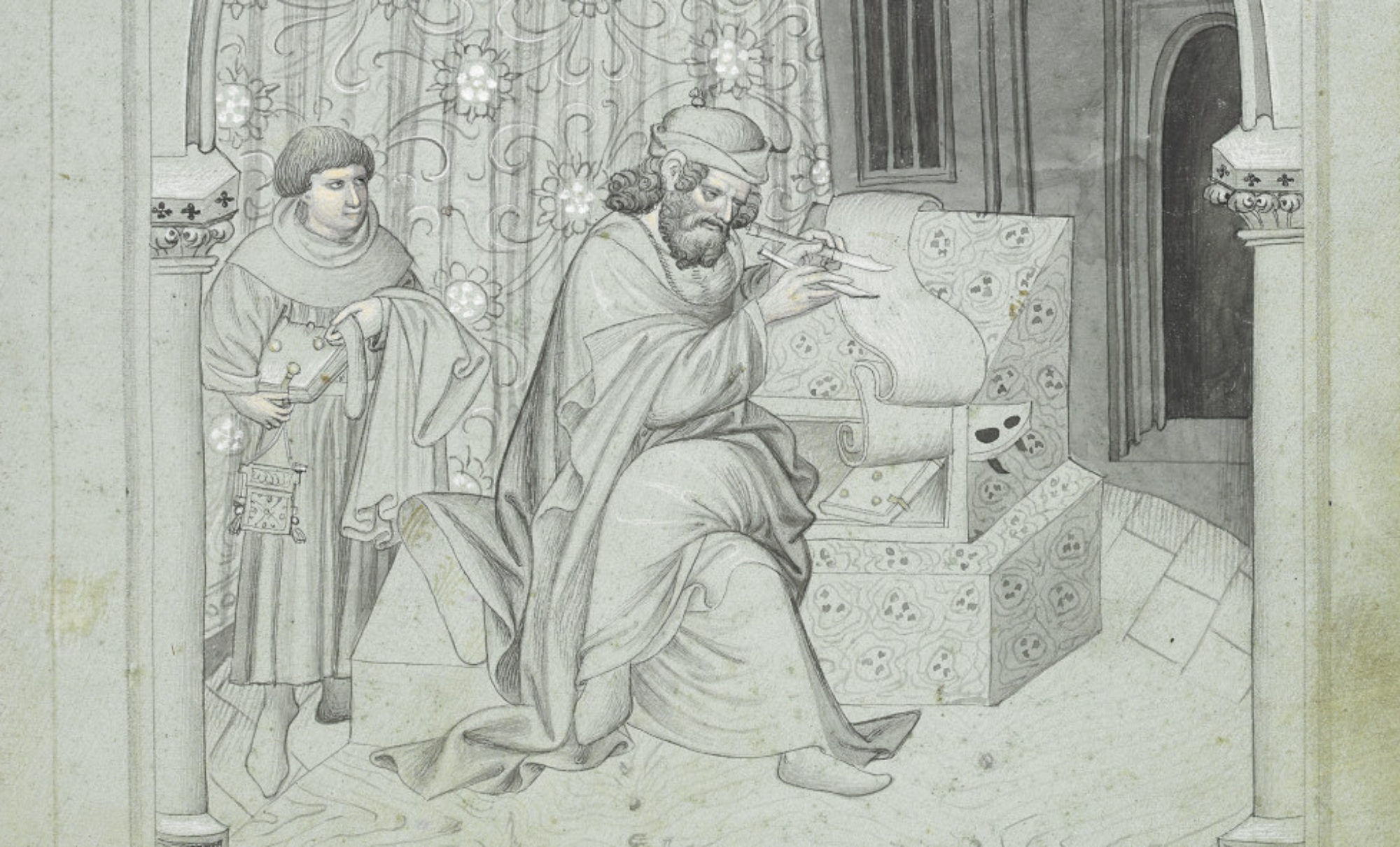
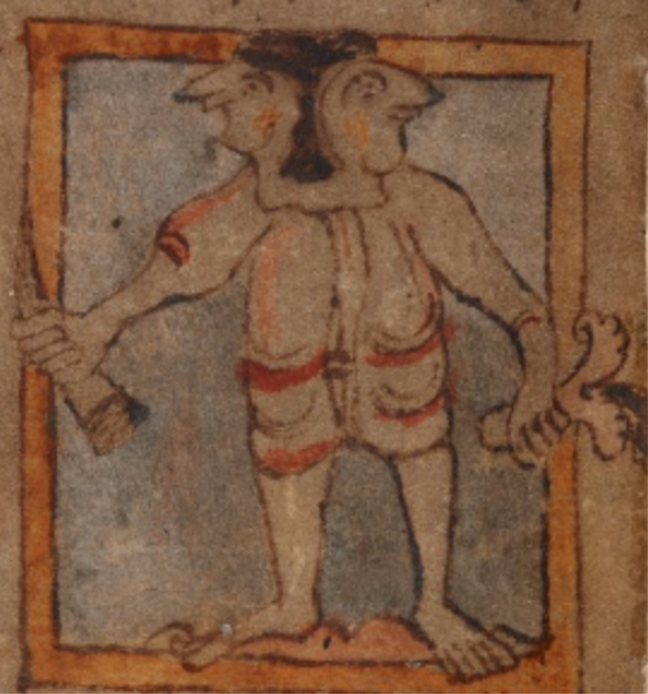
Monster from the Nowell Codex’s ‘Wonders of the East’, British Library, Cotton Vittelius a.xv, f101v.
This Halloween, in continuing our series on Monsters & Magic, I offer a translation and recitation of the monster’s haunting journey to Heorot. This scene has been well-treated in the scholarship, and Katherine O’ Brien O’Keeffe has noted that once the monster finally enters the hall, there is a potential “horror of recognition” by the audience who is then able to identify Grendel as human.[2]
This blog will focus closely on the Old English poetic language and how Grendel shape-shifts as he draws nearer to Heorot, seemingly coming ever better into focus and transforming to match the space in which he inhabits. I will consider three major sections of his approach, signaled by the thrice repeated verb com “he came” (703, 710, 720), and I will reflect on the ways in which Grendel is described in each leg of his journey.
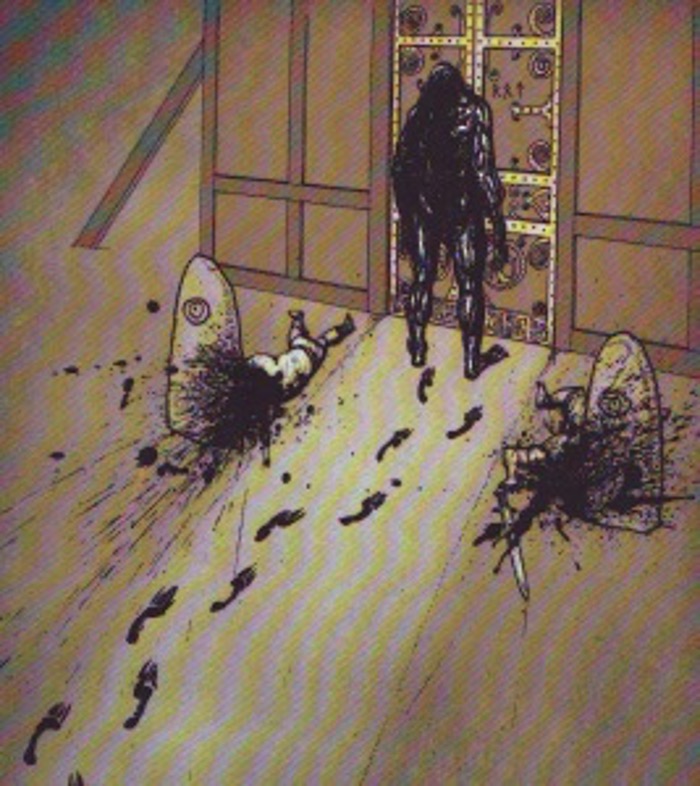
Image of Grendel as a Shadow Monster from Gareth Hind’s graphic novel adaptation of Beowulf (1999)
In the first passage, Grendel com on wanre niht “came in the dark night” (702), and he is characterized as sceadugenga “shadow-walker” (703): either a “going shadow” or “one who goes in the shadows” (both at available options based on the poetic compound). His movement is described as scriðan “slithering” or “gliding” (703), further emphasizing his portrayal as a shadow monster. Later, when Grendel is named a synscaða: either a “relentless” or a “sinful ravager” (707), depending on how one interprets the polysemous Old English syn in the compound,[3] the monster is described as pulling men under shadow, characterizing Grendel as a night terror shrouded in darkness. Indeed, when Grendel comes from the dark night, he is represented by the narrator as a shadow monster that hunts and haunts after sundown.
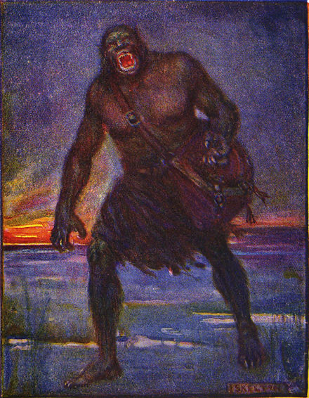
Image of Grendel by J. R. Skelton from “Stories of Beowulf” (1908).
In the second passage, when Grendel ða com of more under misthleoþum “then came from the marsh under misty-slopes” (710), the monster emerges from the swamp and is addressed by his name: Grendel (711). I imagine the silhouette of the monster taking shape in the mist—perhaps a human shape—corresponding to his characterization as manscaða, which likewise plays on polysemous Old English man in the compound, (either mān meaning “criminal” or man meaning “human”).[4] The alliteration in line 712 seems to stress the possibility of monstrous manscaða as “ravager of humans” or a “human-shaped ravager” since manscaða alliterates with the monster’s intended prey, manna cynn “the kin of humans” or “mankind” (712).
The mist rising from the marsh continues to obscure the audience’s view as Grendel wod underwolcnum “went under the cloud” (714) maintaining the suspense generated in the scene by suspending knowledge of Grendel’s ontology. Nevertheless, in this second leg of his journey, Grendel’s form seems to come into focus as he shifts from sceadugenga “a shadow-walker” (703) into manscaða “a mean, man-shaped, ravager of men” (712).
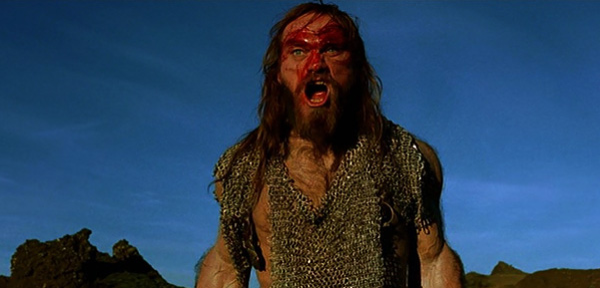
Grendel portrayed as human in Sturla Gunnarsson’s ‘Beowulf & Grendel’ (2005)
In the third passage, Grendel finally arrived at the hall and the audience learns at long last what Grendel is: rinc dreamum bedæled “many bereft of joy” (720-21). During the last leg of his journey, Grendel’s humanity is laid bare leading to the ultimate realization identified by O’Brien O’Keeffe, when Beowulf appears to recognize Grendel’s humanity after the monster bursts open the door of the hall.
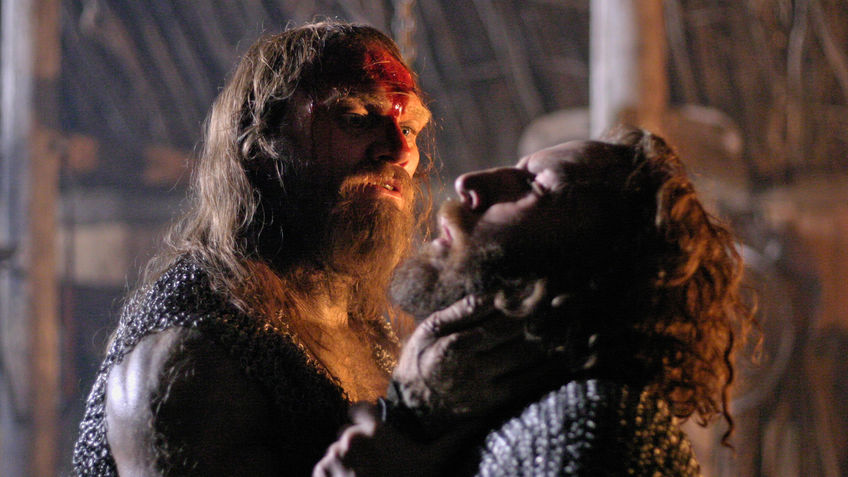
Throughout the next twenty lines, in addition to Grendel (720), the term rinc “human warrior” is repeated: twice in reference to the Geatish troop as a whole (728, 730), once in reference to the sleeping man Grendel cannibalizes when he arrives, who the audience later learns is Hondscio (741), and once in reference to Beowulf himself (747). This repeated use of rinc “human warrior” highlights how Grendel is a mirror for the hero and the Geatish warriors, characterized in identical terms.
Grendel killing Hondscio in Sturla Gunnarsson’s ‘Beowulf & Grendel’ (2005)
Similarly, when Grendel approaches from the shadows, Beowulf is described as bolgenmod “swollen-minded” and angrily awaiting battle (709); however, once the monster arrives at the hall, Grendel becomes gebolgen “swollen (with rage)” as he enters the hall ready to glut himself upon the men sleeping inside (723). This parallel description interweaves the respective emotions and behaviors of both hero and monster in Beowulf.
The interplay between hero and monster continues when Beowulf and Grendel struggle together, both called reþerenweardas “ferocious hall-guardians (770) and heaðodeore “battle-brave ones” (772) during their epic battle that nearly destroys the hall. The fusion of hero and monster together into a shared plural subject and object respectively helps to underscore their mutual affinity: the hall must contend against the fury of both warriors and each is a fearsome—yet overconfident—conqueror, who intends to overcome any enemy he encounters.
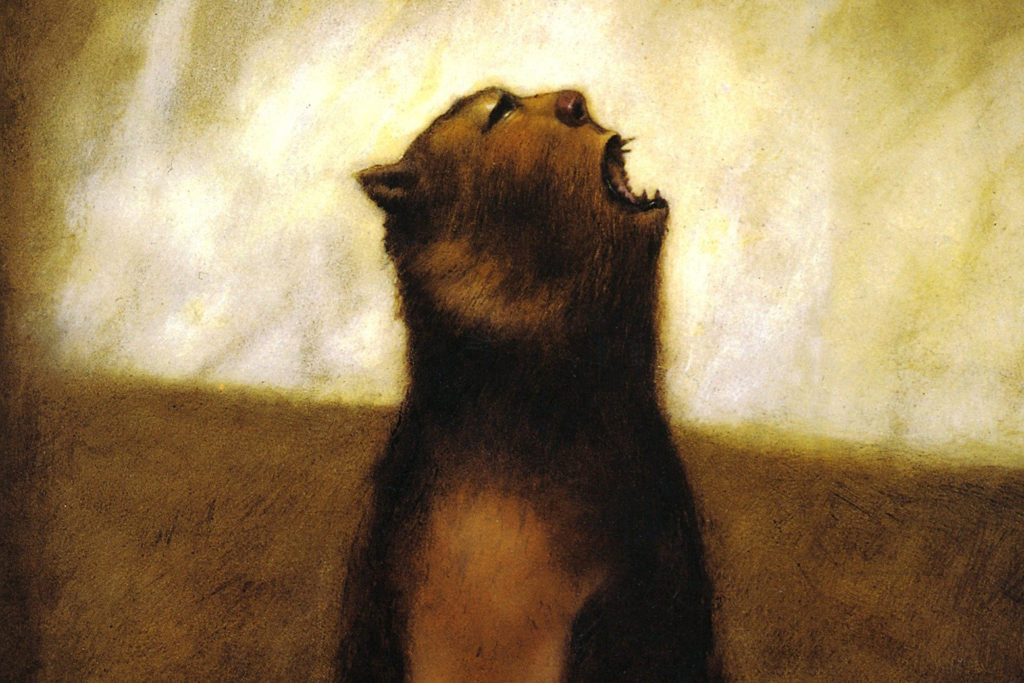
Grendel from the cover of John Gardner’s novel, ‘Grendel’ (1980).
We know that this is Grendel’s final chance to haunt the hall, and the monster is at least able to feast on one last human, this time a Geat and one of Beowulf’s own warriors (Hondscio). Sadly for Grendel, once Beowulf finally decides to enter the fray, and after a relatively brief struggle, the monster is fatally disarmed and retreats to die at home in the marshes.
Naturally, vengeance follows. Unfortunately for the Danes, and especially Hroðgar’s best thane Æschere, the audience soon learns that Grendel has a mommy, and anyone who messes with her baby boy, will have to answer to her.
Richard Fahey PhD in English University of Notre Dame
Further Reading:
Brodeur, Arthur G. The Art of Beowulf. Berkeley, CA: University of California Press, 1959.
Gwara, Scott. Heroic Identity in the World of Beowulf. Leiden, Netherlands: Brill, 2009.
Johansen, J. G. “Grendel the Brave? Beowulf, Line 834.” English Studies 63 (1982): 193-97.
Joy, Eileen, Mary K. Ramsey, and Bruce D. Gilchrist, editors. The Postmodern Beowulf: A Critical Casebook. Morgantown, WV: West Virginia University Press, 2006.
Köberl, Johann. The Indeterminacy of Beowulf. Lanham, MD: University of America Press, 2002.
Lapidge, Michael. “Beowulf and the Psychology of Terror.” In Heroic Poetry in the Anglo-Saxon Period: Studies in Honor of Jess B. Bessinger, edited by Helen Damico and John Leyerle, Studies in Medieval Culture 32, 373-402. Kalamazoo, MI: Medieval Institute Publications, Western Michigan University, 1993.
O’Brien O’Keeffe, Katherine. “Beowulf, Lines 702b-836: Transformations and the Limits of the Human.” Texas Studies in Literature and Language 23.4 (1981): 484-94.
Orchard, Andy. Pride and Prodigies: Studies in the Monsters of the Beowulf-Manuscript. Toronto, ON: University of Toronto Press, 1995.
Sharma, Manish. “Metalepsis and Monstrosity: The Boundaries of Narrative in Beowulf.” Studies in Philology 102 (2005): 247-79.
Ringler, Richard N. “Him Sēo Wēn Gelēah: The Design for Irony in Grendel’s Last Visit to Heorot.” Speculum 41.1 (1966): 49-67.
[1] Michael Lapidge, “Beowulf and the Psychology of Terror,” 373-402.
[2] Katherine O’Brien O’Keeffe, “Transformations and the Limits of the Human,” 492.
[3] Andy Orchard raises the possibility of polysemy in synscaða, see Pride and Prodigies, 38.
[4] Orchard also raises the possibility of polysemy in manscaða, see Pride and Prodigies, 31.
When one thinks of modern Christmas, warm images from Christ’s nativity to Santa’s midnight sleigh ride might come to mind. However, Saint Nicholas is not the only thing that goes bump in the night—Yule monsters represent another syncretized and modernized phenomenon, which corresponds to a medieval tradition that presents winter solstice as an ideal setting for monsters to emerge from the darkness of the long night. In celebration of the holiday season, my latest blog in our series on monsters will consider the tradition of Yuletide monsters and discuss some instances of Christmas haunting in vernacular Middle English and Old Norse-Icelandic sources, thereby catching a brief glimpse at a broader medieval tradition of monsters associated with the winter solstice.
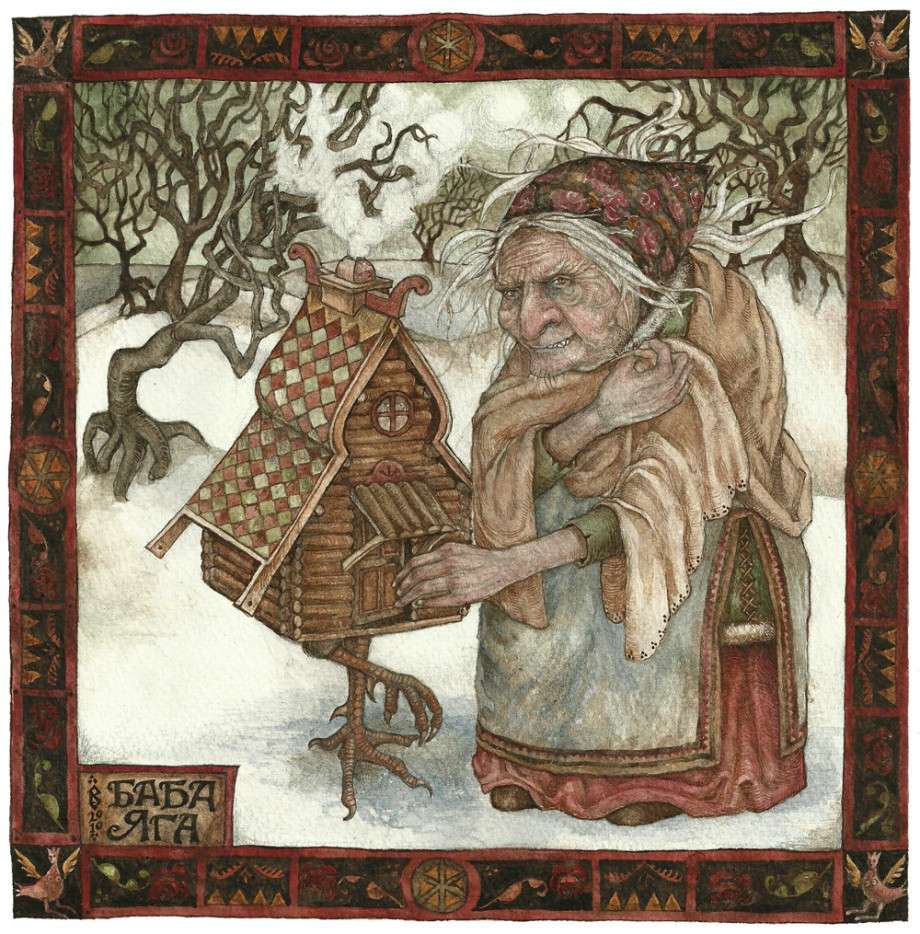
Rima Staines, ‘Baba Yaga’ (2014).
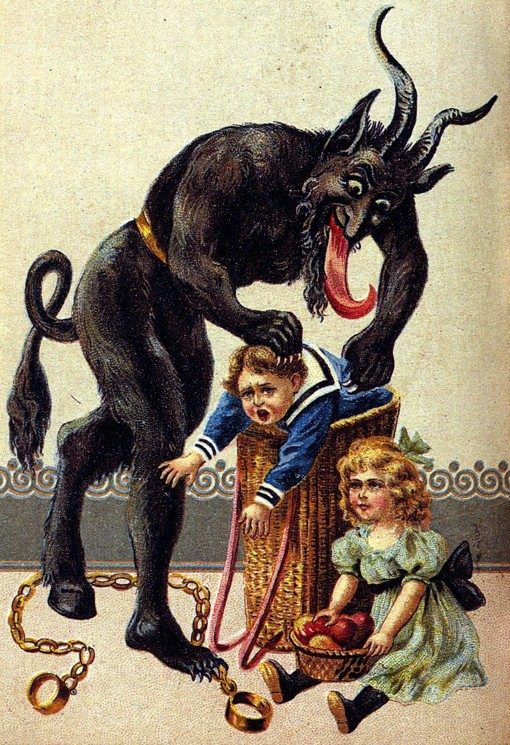
Christmas hauntings have a deep cultural and literary history. One seasonal spook, the Slavic Baba Yaga—a present-stealing witch—is generally remembered today as a holiday monster, though her character has only become associated with Christmas and New Years in modern times. Another, perhaps the most famous Yule monster, is Krampus—the notorious, child-stealing Christmas demon and son of Hel (the Norse goddess of the underworld), who is still popular in modern Germany and increasingly abroad. These modern Christmas hauntings align with a robust medieval tradition of Yuletide monsters that come with the cold and specifically the long night of the winter solstice. Even Grendel in Beowulf, who notoriously terrorizes the hall of Heorot, does so for XII wintra tid “twelve winters’ time” (147) specifically. While this phrase surely refers to the monster’s yearlong assault on Denmark, it also seems to stress the dark and snowy season as the prime time for Grendel’s hauntings.
Gruss vom Krampus, 1900s greeting card reading ‘Greetings from Krampus!’
Today, I will mention three popular medieval texts—one poem and two sagas—which feature Christmas hauntings of all types, including by a green man, an undead revenant, a troll woman and a dragon.
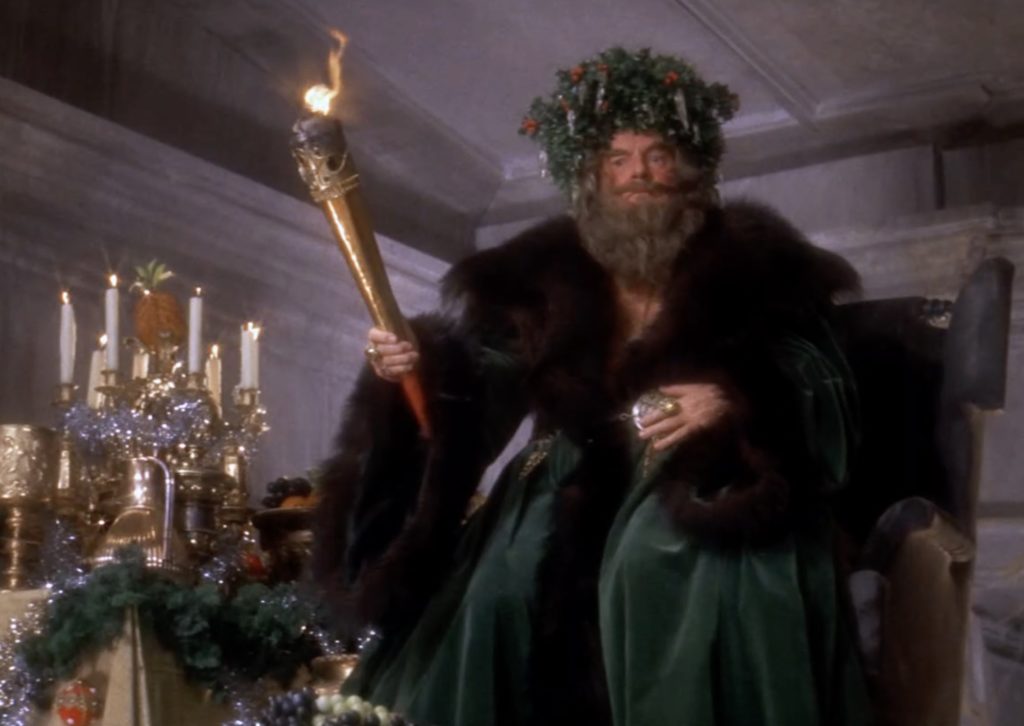
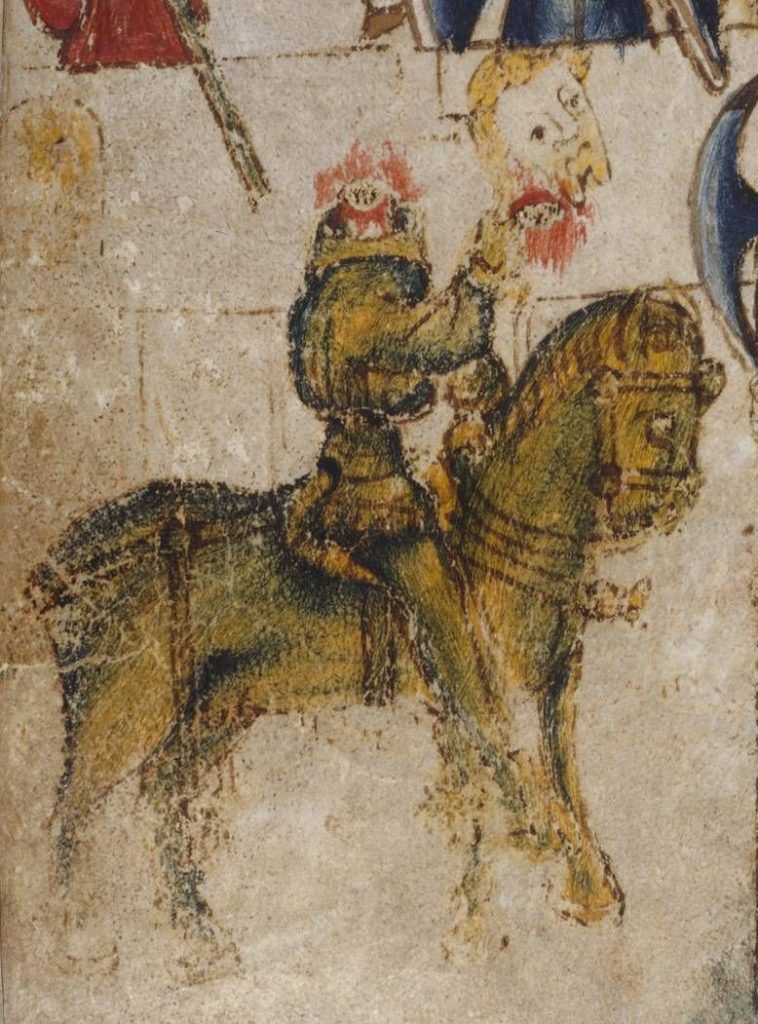
Although most of the Christmas monsters discussed in this blog come from popular Old Norse-Icelandic sagas, the Middle English alliterative poem Sir Gawain and the Green Knightbegins with a mysterious Green Knight, gome gered in grene “a man geared in green” (179), described as half etayn in erde “half-giant on earth” (140) and aluisch mon “elvish man” (681), who appears at Camelot on Christmas riding a green horse and wielding a green axe. Not only does the Green Knight come at Yule (284), he emerges in court wearing a fur-trimmed robe (152-56) and holding a holyn bobbe “holly bundle” (206) in his hand, as if he were the Ghost of Christmas Present from Charles Dickens’ AChristmas Carol.
Ghost of Christmas Present from film ‘Scrooge’ (1970) directed by Ronald Neame.
Moreover, he explicitly wishes to play a Crystemas gomen “Christmas game” (283). The passage describing the Green Knight’s arrival emphasizes his coming for the Christmas festivities, thereby linking him with the tradition of Yuletide monsters. The Green Knight declares that since there is no warrior who can match him in battle:
I craue in þis court a Crystemas gomen, For hit is Ȝol and Nwe Ȝer, and here ar ȝep mony: If any so hardy in þis hous holdez hymseluen, Be so bolde in his blod, brayn in hys hede, Þat dar stifly strike a strok for an oþer, I schal gif hym of my gyft þys giserne ryche, Þis ax, þat is heué innogh, to hondele as hym lykes, And I schal bide þe fyrst bur as bare as I sitte (283-290).
“I desire in this court a Christmas game, for it is Yule and New Year, and you here are many. If any in this house holds himself so hardy, be his blood so bold—his brain in his head—that he dare stiffly strike one stroke for another, I shall give him my gift, this rich gisarme—this axe—that is heavy enough to handle as he likes, and I shall abide the first blow, as bare as I sit.”
Manuscript illustration of the headless Green Knight in British Library, Cotton Nero A.x f.94v.
Christmas stays a prominent theme throughout the poem, and it operates as a metric by which to measure time. Gawain spends the following Christmas with Lord and Lady Bertilak in anticipation of the subsequent Christmas game, when the Green Knight will deliver a return blow. Christmas feasting both begins and concludes this Middle English romance, enveloping the narrative with this holiday theme. Indeed, Christmas is mentioned nine times in the poem, demonstrating its role in framing the narrative. Yule is mentioned twice, and the first reference comes from the Green Knight himself as to the reason for his journey to King Arthur’s court.
The next text in our discussion is the Old Norse-Icelandic Grettis saga, which contains multiple Christmas haunting episodes, each featuring a very different type of Yule monster. In Grettis saga, the holiday of Yule is likewise a repeated fixture and marker of time, and Yule is referenced thirty-three times in the saga.
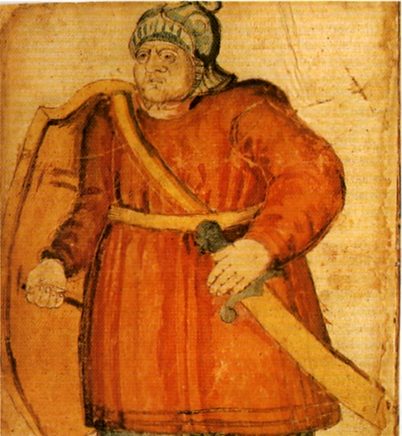
Grettir Ásmundarson as depicted in a 17th-century manuscript illustration, Reykjavík AM 426.
The major and most frequently discussed Yuletide haunting in the saga concerns the undead revenant Glámr, a Swedish herdsman who ignores Christmas traditions:
Nú leið svo þar til er kemr aðfangadagr jóla. Þá stóð Glámr snemma upp ok kallaði til matar síns. Húsfreyja svaraði: “Ekki er það háttr kristinna manna at matast þenna dag því at á morgun er jóladagr hinn fyrsti,” segir hún, “ok er því fyrst skylt at fasta í dag” (chapter 32).
“Now time past there until when comes the eve of Yule. Then Glámr stood up and called for his food. The lady of the house answered: ‘It is not proper that Christian men eat meat on this day, because tomorrow is the first day of Yule,” she says, “and thus they shall first fast today.’”
Glámr’s response marks him as explicitly unchristian, which may serve to foreshadow his untimely demise:
Hann svarar: “Marga hindurvitni hafið þér þá er ek sé til einskis koma. Veit ek eigi at mönnum fari nú betr at heldr en þá er menn fóru ekki með slíkt. Þótti mér þá betri siðr er menn voru heiðnir kallaðir ok vil ek mat minn en öngvar refjar” (32).
“He answers, ‘You have many restrictions, when I see no good come of it. I do not know that men fare better now than when they did not heed such things. It seems to me that the customs of men were better when they were called heathens, and now I want my meat, and no foolishness.”
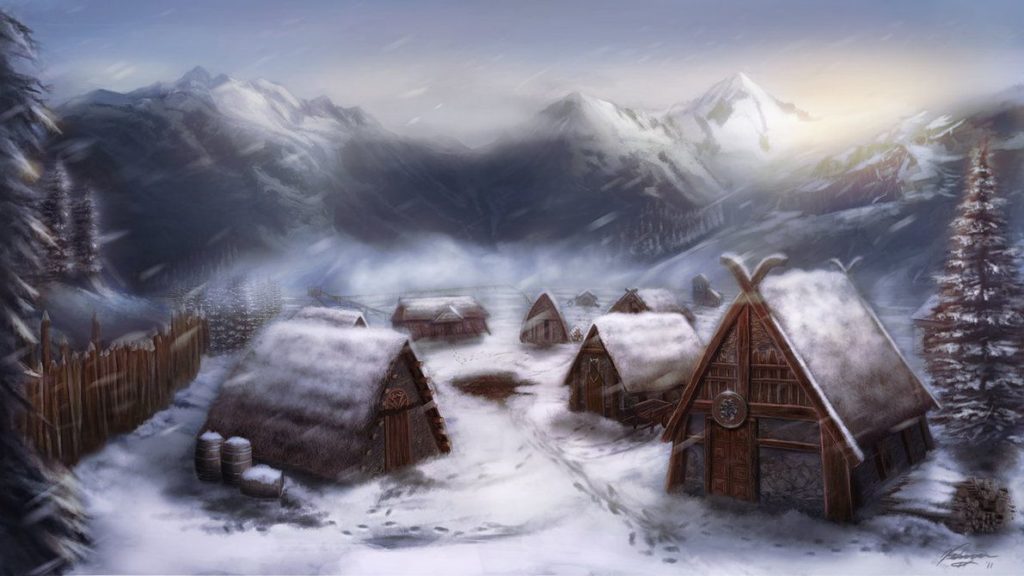
Michael Davini, “Viking Village” (2011).
After his praise for heathenism, spurring caution, Glámr ventures into a known haunted region at Yuletide, and he never returns. We are told that kom hann ekki heim jólanóttina “he came not home on Yule-night” and soon we learn that he has died. After days of searching and a number of attempts to bring Glámr’s body to the church to be buried, eventually the townsfolk give up and bury Glámr where they find him, and Það drógu menn saman at sú meinvættr er áðr hafði þar verið mundi hafa deytt Glám “men drew from this, that the evil spirit which had been there before will have killed Glámr.” However, shortly thereafter, it is the undead Glámr who perpetrates Yuletide hauntings, as the saga reports:
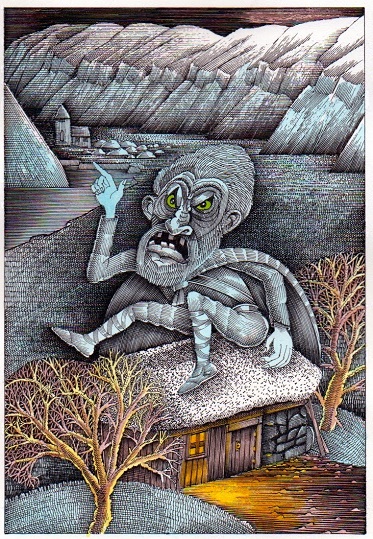
Litlu síðar urðu menn varir við það at Glámr lá eigi kyrr. Varð mönnum at því mikið mein svo at margir féllu í óvit ef sáu hann en sumir héldu eigi vitinu. Þegar eftir jólin þóttust menn sjá hann heima þar á bænum. Urðu menn ákaflega hræddir. Stukku þá margir menn í burt. Því næst tók Glámr at ríða húsum á nætr svo at lá við brotum (32).
“A little time after men were aware that Glámr did not lay quiet. People become so greatly disturbed by this, that many fell into hysteria when they saw him, and some lost their wits. Even after Yule men thought they saw him at home on the farm. People became extremely scared. Many men then fled. Next, Glámr took to riding houses at night, so that he nearly broke them.”
John Vernon Lord, illustration of Glámr riding roofs in ‘Icelandic Sagas’ 2, The Folio Society, 2002.
Grettir famously defeats Glámr, who is frequently associated with the Old Norse-Icelandic draugr, but not until the revenant has cursed Grettir with unceasing fear of the dark, as terrible light from Glámr’s eyes haunts Grettir until the end of his days and he becomes nyctophobic forevermore.
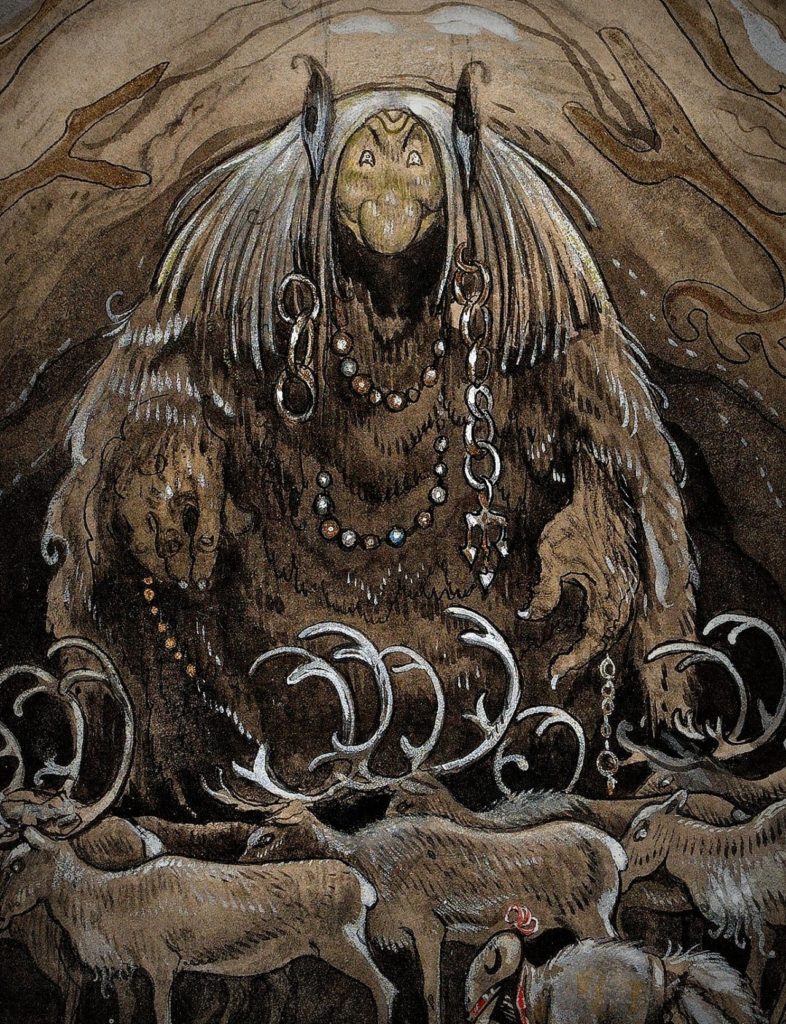
Another Yuletide monster discussed in the saga takes place when Grettir arrives at Sandhaug to investing a trǫllagangr “troll-haunting” (chapter 64), and he encounters a trǫllkona “troll woman” (65). This monster enters the halls of Sandhaug on aðfangadag jóla “Yule-eve” (64), and she plunders the halls during the long night:
Nú er frá Gretti það at segja at þá er dró at miðri nótt heyrði hann út dynr miklar. Því næst kom inn í stofuna trǫllkona mikil. Hún hafði í hendi trog en annarri skálm heldr mikla. Hún litast um er hún kom inn ok sá hvar Gestur lá ok hljóp at honum en hann upp í móti ok réðust á grimmlega ok sóttust lengi í stofunni (65).
“Now it is said of Grettir that when it drew towards midnight, he heard a great din outside. Then a great troll woman came into the hall. She had a trough in one hand, and a blade, rather great, in the other. She looked around when she came in and saw where ‘Guest’ [i.e. Grettir] lay and ran towards him, but he jumped up to meet her, and they wrestled fiercely and struggled together for a long time in the hall.”
John Bauer, ‘Troll Cave with Deer’ (1915).
Eventually, she drags Grettir from the hall, carries him off and tries to escape to her lair ofan til árinnar ok allt fram at gljúfrum “up to the river and all the way to the gorges” (65). Grettir is ultimately able to cut her shoulder, slicing off the troll woman’s arm, a fatal blow which sends her off a cliff and to her death. After recovering from his encounter with the troll woman, Grettir sneaks into her cave and slays her companion, a jǫtunn “giant” (66).
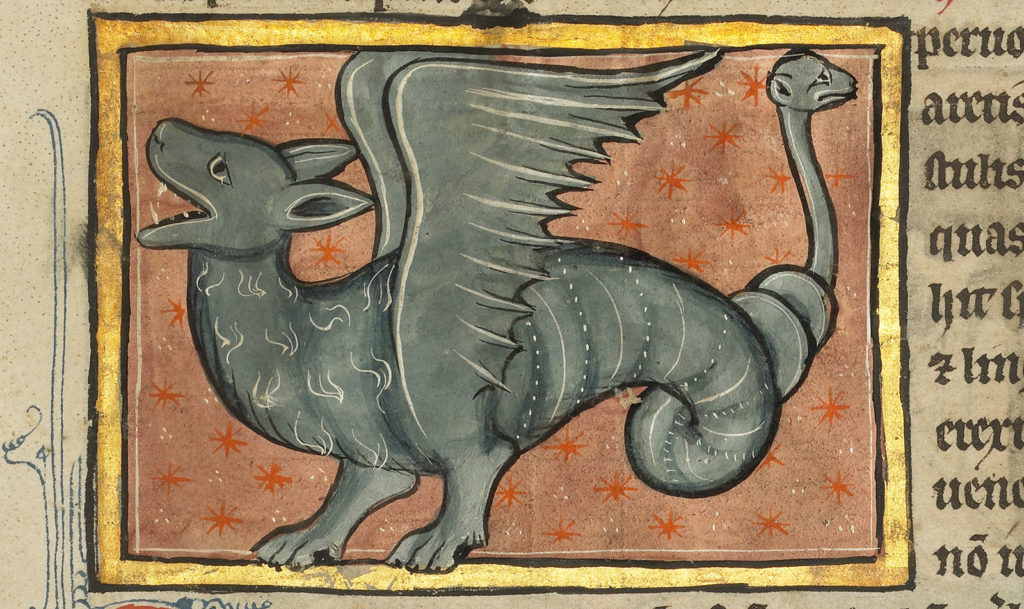
The final Yuletide haunting discussed in this blog comes from Hrólfs saga kraka, when a massive flying dýr “beast” (probably a dragon of some kind) threatens the hall. The cowardly Hǫttr explains how this night-terror returns during Yule to haunt the hall of king Hrólfr:
Ok sem leið at jólum, gerðust menn ókátir. Bǫðvarr spyrr Hǫtt, hverju þetta sætti. Hann segir honum, at dýr eitt hafi þar komit tvá vetr í samt, mikit ok ógurligt, “ok hefir vængi á bakinu, ok flýgr þat jafnan. Tvau haust hefir þat nú hingat vitjat ok gert mikinn skaða. Á þat bíta ekki vápn, en kappar konungs koma ekki heim, þeir sem at eru einna mestir.
Bǫðvarr mælti: “Ekki er hǫllin svá vel skipuð sem ek ætlaði, ef eitt dýr skal hér eyða ríki ok fé konungsins.” Hǫttr sagði: “Þat er ekki dýr, heldr er þat mesta trǫll” (chapter 35).
“And as Yule neared, men became gloomy. Bǫðvarr asked Hǫttr what caused this. He said to him that a beast had come there for two winters in a row, great and monstrous. ‘And it has wings on its back and frequently flies. For two autumns now it has visited and caused great harm. No weapon bites it, and the king’s champions, those who are the greatest, do not come home.’”
Bǫðvarr spoke: ‘the hall is not so well guarded as I thought, if one beast shall here destroy the king’s realm and livestock.’ Hǫttr said: ‘It is not a beast, rather it is the greatest troll.’”
A Winged Dragon in a bestiary, 1278–1300, Franco-Flemish. Tempera colors, pen and ink, gold leaf, and gold paint on parchment. The J. Paul Getty Museum, MS Ludwig XV 4, f.94.
This warning is quickly validated, for when jólaaptann “Yule-eve” arrives, King Hrólfr commands his warriors to stay inside and forbids them from fighting the monster, proclaiming that it is better to lose his livestock than his people. However, Bǫðvarr Bjarki sneaks into the night, dragging Hǫttr behind him, and the hero quickly slays the Yuletide monster terrorizing the kingdom. Then, at Bǫðvarr’s behest, Hǫttr consumes the flesh and blood of the beast, which strengthens and emboldens him, transforming him into a hero (in a way that recalls Sigurðr’s actions after Fáfnir is slain).
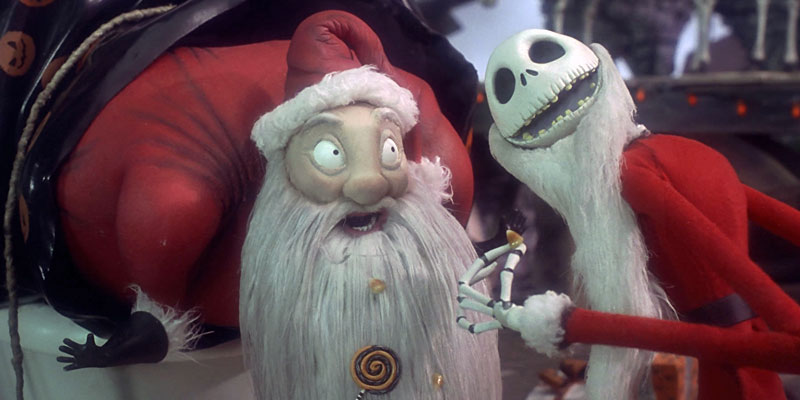
These medieval stories of Yuletide monsters participate in a robust tradition of winter-time (and even Christmas-specific) hauntings, which continued throughout the ages and manifests still today. Dickens’ Christmas Carol is perhaps one of the more memorable, with visitations by four ghosts at the home of the miserly Ebenezer Scrooge on Christmas Eve. Dr. Seuss’s Grinch renders its Scrooge-like antihero in the form of a green Christmas-hating monster bent on stealing Christmas, and Tim Burton’s Nightmare Before Christmas explores the theme of Christmas haunting when the pumpkin king and leader of Halloween Town, Jack Skellington, decides he would rather celebrate Christmas one year instead out of sheer boredom with his own holiday. Jack then proceeds to haunt Christmas transforming cozy festivities into a horror show as if he were a Yule monster of old.
Jack Skellington and Santa Claus from Tim Burton’s ‘Nightmare Before Christmas’ (1993).
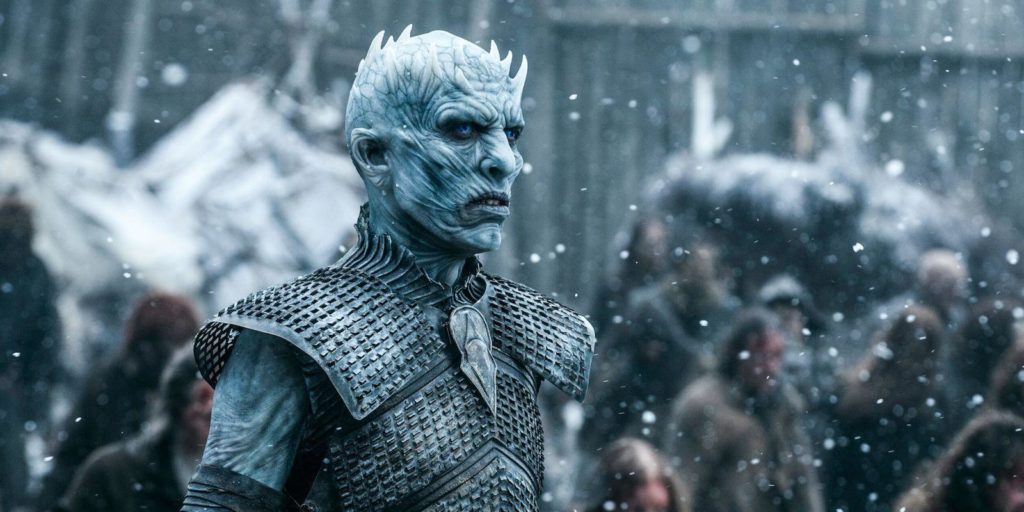
More recently, in George R.R. Martin’s Song of Ice and Fire (and HBO’s corresponding TV series Game of Thrones), winter monsters known as the White Walkers (seemingly inspired by Old Norse-Icelandic revenants), led by the fearsome Night King, come with the cold in the long night to terrorize Westeros. Even Netflix’s edgy reboot of Sabrina the Teen-age Witch, appropriately retitled Chilling Adventures of Sabrina (2018), gives a nod to medieval tales of wintertime monsters when during the solstice the Spellmans place a protective candle in the chimney to prevent Yule demons from entering their home; however, this does not stop Grýla—an Icelandic giantess—from visiting during the night when the witches’ protective candle becomes accidentally extinguished.
Night King from season eight of HBO’s ‘Game of Thrones’ TV series (2018).
Yuletide continues to provide a haunting wintry setting for monster visits. Although often balanced by saccharine images of Christmas as a source of light and warmth against the cold dark, what lurks beyond the illumination of society during the long night seems to readily elicit horror in the modern—as well as medieval—imagination.
Richard Fahey PhD in English University of Notre Dame
Carrière, Jean Louise. “Sir Gawain and the Green Knight as a Christmas Poem.” Comitatus: A Journal of Medieval and Renaissance Studies 1.1 (1970): 25-42.
Chadwick, Nora K. “Norse Ghosts (A Study in the Draugr and the Haugúbi).” Folklore 57 (1946): 50–65
—. “Norse Ghosts II (Continued).” Folklore 57 (1946): 106–127
Jakobsson, Ármann and Miriam Mayburd. Paranormal Encounters in Iceland 1150–1400. Kalamazoo, MI: Medieval Institute Publications, 2020.
—. “Vampires and Watchmen: Categorizing the Medieval Undead.” Journal of English and Germanic Philology 110 (2011): 281–300
—. “The Fearless Vampire Killers: A Note about the Icelandic Draugr and Demonic Contamination in Grettis Saga.” Folklore 120 (2009): 307–316.
Kirk, Elizabeth D. “‘Wel Bycommes Such Craft Upon Cristmasse’: the Festive and the Hermeneutic in Sir Gawain and the Green Knight.” Arthuriana 4.2 (1994): 93-137.