MS B44 Inferiore of Milan’s Ambrosiana Library is an unstudied aestivial (summer season) homiliary from the thirteenth century. It is an exceptionally large manuscript, measuring approximately 40cm by 30cm. An eighteenth-century librarian of the Ambrosiana marked it as a homiliary of the “Ambrosian rite,” which is not a description meaningful for ascertaining the paradigms on which the homiliary’s structure is based. The invocation of the “Ambrosian rite” does, however, point to peculiarities in the Lombard region’s liturgical calendar which B44 might reflect. The homiliary’s reflection of local liturgical traditions could best be judged through a study of its “sanctorum” portion; this, however, was not the focus of my time with the manuscript. Despite its large size and length, the homiliary only spans the summer part of the liturgical year. Its de tempore section begins with the Easter Vigil and ends with the Feast of the Nativity of the Virgin. The Feast of Mary’s Nativity was locally important since the Milanese Duomo was dedicated, from at least the eleventh century, to the Blessed Virgin’s birth.
To familiarize myself with the manuscript’s structure and homiletic content, I surveyed the sermons it included for the Easter season (1v-52r), noting sermon incipits from Easter until Pentecost. Though for the sanctorale section, there are a wide variety of authors, the Easter de tempore section largely consists of homilies from Sts. Ambrose, Bede, Gregory, and Augustine. The sermon choices are, however, eclectic, and do not match the arrangement of the paradigmatic homiliaries summarized by Réginald Grégoire in his still-unsurpassed Homéliaires Liturgiques Médiévaux. In short, MS Inf. B44’s Easter sermons do not match those included in the Roman and Toledan homiliaries, nor those in the collections of Pseudo-Fulgencius, Paul the Deacon, or Romain d’Agimond. As far as contemporary homiletic developments go, Inf. B44 also is far removed from the pocket-manuscript homiliaries popular among the mobile mendicants; more generally, the patristic collection of Easter homilies here does not reflect high medieval developments in preaching. No “scholastic” sermons based around themae are included, nor is there any trace of the politically and socially-charged “activist” preaching of mendicants like Giordano da Pisa (1255-1311) or Remigio de Girolami (d. 1319). In short, though Inf. B44 compiles an eclectic set of sermons, it is a conservative exemplar of the homiliary genre.
The description of the eighteenth-century Ambrosiana librarian on the manuscript’s first folio also notes that B44 Inf. was acquired for the Ambrosiana in the seventeenth century, when it was removed from Milan’s cathedral. It is unknown if the homiliary had been a possession of the cathedral from the outset, and, if not, why or when it was moved to the cathedral. Judging by the highly moralizing and interior-focused content of the Easter sermons, it is possible that the homiliary had been used by the cathedral canons or a northern Italian monastic community. From its large size, it seems the homiliary likely would have stayed in one place, for use in private mediation or as an aid for the composition of monastic sermons. If we seek a more specific paradigm, it should be noted that B44 Inf. shares basic similarities with high-medieval Cistercian homiliaries copied in northern Italian and Burgundian monasteries, such as the house of Morimondo near Milan. These Cistercian homiliaries were usually fairly large, written in twelfth-century miniscule, and included sermons of Augustine, Bede, Ambrose, and Gregory—all characteristics that B44 Inf. shares.[1] However, further study of the Cistercian homiliaries of northern Italy is necessary to ascertain whether these and our manuscript conform to a common paradigm.
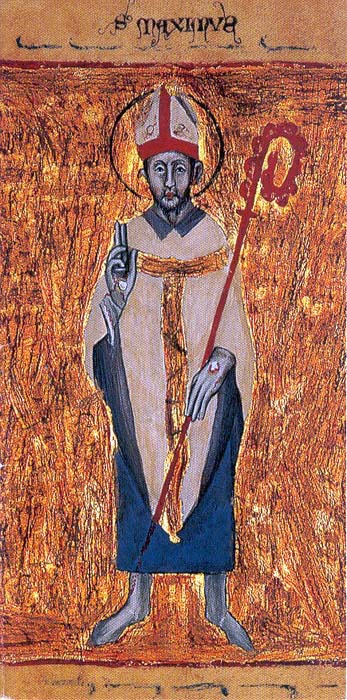
Particularly interesting among Inf. B44’s Easter sermons is the second entry for the fifth day after Easter, located between ff. 16v and 17v. This homily, misattributed in the manuscript to St. Ambrose (probably as a result of local enthusiasm for that venerable bishop), is actually a probable composition of St. Maximus of Turin, and its main theme—defending oneself from lustful temptations—coheres well with the manuscript’s probable monastic origin. However, how the sermon conveys this theme is in no way typical, as it does so by extended engagement with the story of Ulysses and the Sirens. Though in Late Antiquity, scientific exegesis of Greek mythology was very common in neo-Platonic circles, Christocentric engagement with a mythological text is a rare phenomenon, even within Maximus’ own homiletic corpus.
To provide a brief analysis of the sermon: Maximus begins by recalling the passage of Ulysses’ ship past the isle of the Sirens, whose lusty song is irresistible to the sailors. Because Ulysses knows that the ship will be lost if it is captured by the siren song, he ties himself to the mast. For Maximus, the mast and the ship to which the sailors cling are figures of the cross of Christ, on which all sin is expiated. Maximus soon moves from the example of Ulysses—whose story he calls “fictive and not factual”—to Moses’ healing of his people by means of a snake affixed to a staff. Unlike the Ulysses example, the history of the Jewish people is factual, and so truly prefigures Christ’s sacrifice. It can be argued that Maximus’ Christocentric interpretation of Ulysses’ binding to the mast is inspired by Christian exegesis of the Hebrew Scriptures, the methods of which Maximus then applies to Greek myth. There is, after all, a strong exegetical tradition, beginning already with the second century Christian apologist Justin Martyr, which sees ships—specifically Noah’s ark—as a figure of the cross. From there, the paradigm might be easily transferred even to the ships of Greek myth. But transference is not all that Maximus is doing, notwithstanding his curt dismissal of Ulysses’ story. For later in the sermon Maximus encapsulates salvation-history thus: “Fittingly is he crucified on wood so that, since man was deceived in paradise by the tree of desire, he might now be saved by the same tree of wood; and the matter which was the cause of death might be the remedy of health.” In Maximus’ thought, nature itself—here instantiated in wood—constitutes the means of salvation, providing remedies for the bodily weakness of humankind. Since Ulysses’ salvation came directly through divinely-created nature, his tale is not just some forgettable fable. In this conception, however subtly stated, pagans and non-Christians are not outside the economy of salvation, for they, too, exist within a grace-filled nature which can proffer the remedies for their ailments.
For my transcription, translation and recitations (in Modern English and Latin), see my multimedia edition of Maximus of Turin’s homily for the fifth day after Easter in Ambrosiana MS B44 Inferiore.
Mihow McKenny
PhD Candidate in History
University of Notre Dame
[1] Mirella Ferrari, “Dopo Bernardo: biblioteche e ‘scriptoria’ cisterciensi dell’Italia settentrionale nel XII secolo,” in Pietro Zerbi, ed., San Bernardo e l’Italia. Milan, 1993, pp. 253-306.
Bibliography
D’Avray, D. L. The Preaching of the Friars: Sermons Diffused from Paris before 1300. Oxford: Clarendon, 1985.
De Lubac, Henri. Medieval Exegesis: The Four Senses of Scripture. 3 volumes. Translated by Mark Sebanc and E. M. Macierowski. Eerdmans, 1998-2009.
Ferrari, Mirella. “Dopo Bernardo: biblioteche e ‘scriptoria’ cisterciensi dell’Italia settentrionale nel XII secolo.” In Pietro Zerbi, ed., San Bernardo e l’Italia. Milan, 1993, pp. 253-306.
Grégoire, Réginald. Homéliaires liturgiques médiévaux : analyse de manuscrits. Spoleto: Centro italiano di studi sull’Alto Medioevo, 1980.
Longère, Jean. La Prédication Médiévale. Paris: Études Augustiniennes, 1983.
Maximus of Turin. Maximi episcopi taurinensis sermones.Edited by A. Mutzenbecher. Corpus Christianorum Series Latina, vol. 23. Turnhout: Brepols, 1962.
Rahner, Hugo, S.J. Greek Myths and Christian Mystery. Translated by Brian Battershaw. New York: Harper and Row, 1963.