As medievalists and scholars who spend our days reading, researching, and teaching the Middle Ages, it is easy to take for granted the vibrancy, intrigue, and importance of the period. But how can we help audiences outside the academy connect to people and cultures so distant from themselves? My own work offers me a readymade solution: animals. For several years, including in my current position as the Public Humanities Postdoctoral Fellow at Notre Dame’s Medieval Institute, I have had the privilege of speaking to many different groups of children and adults across multiple countries about the Middle Ages and its animals. It is always such a great joy to introduce them to the weird and wonderful world of medieval animal riddles and poetry, facts from bestiaries and other encyclopedias, and of course manuscript illuminations.
I usually start these talks with a series of strange animal illustrations from medieval manuscripts, asking the audience simply to guess what the animals are. A recent event for kids at the St Joe County Public Library thus began with these four pictures and more:
Then comes the reveal that all of the wildly different illustrations are meant to be the same animal: a crocodile. What follows are usually cries of incredulity and laughter over how inaccurate all the images are. They’re not all terrible, of course, and I do make it clear that I choose the silliest ones available.
The significant question, then, is why there are so many bad medieval animals out there. With animals like crocodiles, one straightforward answer is that the illustrators had never seen the creatures in real life, but were drawing them based on writings from other parts of the globe. This becomes a good opportunity to talk about the interconnectedness of the medieval world — an animal from the Nile gets written about by a bishop in Seville, whose words inspire a drawing in Peterborough. This can also lead to conversations about the nature of the writers and illustrators themselves, often monks and other holy men and women who are testament to the importance of medieval religious houses as centers of science and learning, thus challenging a popularly held stereotype about the “Dark Ages”.
With children (and their grown ups), there’s a silly drawing game I like to play to put them in the shoes of these medieval illustrators — how good can they be at drawing an animal they have never seen before? This can be done by making up an entirely new beast, but I prefer to defamiliarize an animal that the children already know, asking them to draw it one feature at a time, as with this example with information drawn from medieval accounts:
The animal is reddish in colour.
It has four feet and legs like those of a bull or a deer.
Its body is short at the back and tall at the front so it looks like it is always sitting down.
It has a long neck like a horse.
It has a head like a camel.
It is covered in white spots like a leopard.
By the time the kids figure out that they are drawing a giraffe, the results are usually already hilariously wonky, not far from the illustrations they were laughing at a few minutes ago!
Left: Activity sheets from the St Joe County Public Library event. Right: Manuscript illumination from British Library, Additional MS 11390, fol. 22v.
When giving these talks in the UK, often to school groups, I would generally begin with a different animal that they would be fairly familiar with, the badger. As with crocodiles, medieval illustrations of badgers could be ridiculously unrecognizable, as evident in the two images below.
Unlike crocodiles and giraffes, however, medieval Europeans should have been more familiar with badgers; literary, archaeological, and place-name evidence suggests that the animal was a common feature of the British landscape. What excuse, then, could medieval illustrators have in this case? In some instances, there was a method to their madness. According to the Third-Family Bestiary in the above Cambridge manuscript, the badger is called melo in Latin either because of its fondness for honey (mel) or because it is rotundissimo like a melon (melo). It’s safe to say that this particular illustrator was inspired by the notion of roundness.
The Cambridge illustration also to me recalls Thomas of Cantimpré, the thirteenth-century Flemish Dominican friar and preacher who in his natural encyclopedia, De natura rerum, wrote that the fatness of a badger increases when the moon waxes and diminishes when it wanes. As nocturnal animals, some badger behaviours (notably their mating patterns) are thought to be influenced by lunar cycles. Lunar influence on its rotundity may be more dubious, but did have significant practical implications. Thomas later stated that badger fat is a useful cure for fevers, which means that it was important to know when the animal would be at its fattest and most medicinally useful, and illustrations are a good way to get that lesson across. These may not be the most accurate illustrations, but they are undoubtedly memorable, which makes them extremely effective teaching and memorization tools.
This example thus becomes a good way to demonstrate to audiences beyond the academy that the so-called “Dark Ages” were really a time of curiosity, observation, experimentation, and innovation, when science and medicine were given great importance and there was a deep investment in understanding the world around us. Medieval animal texts are a testament to a love for learning and science and stories, and therefore a great way to help the public, children and adults alike, to connect with the Middle Ages.
Of course, it’s also very possible that many of these illustrators were simply bad at drawing animals and decided to lean into the absurdity of their creations. On this, I am sure we can all relate.
Ashley Castelino, DPhil Public Humanities Postdoctoral Fellow Medieval Institute University of Notre Dame
Translation, like any cultural practice, entails the creative reproduction of values.
— Lawrence Venuti, The Scandals of Translation (1998), 1.
In the introduction to the provocative collection The Word Exchange (Norton, 2011), Michael Matto cites the anonymity of Old English poetry as a constraint on its perceived voice, a problem exacerbated by the likelihood that any anthologized group of Old English poems will have been rendered by the same translator (Broadview, I’m looking at you). Matto states that avoiding this singularity is a motivation for seeking the efforts of established American, English, and Irish poets to have a crack at the highlights of the extant corpus. And some of these versions are quite tasty. [Particularly fun is James Harpur’s version of the “Rune Poem” or the Metrical Charms section. Many of the riddles are good too].
However, the cast of characters is pretty uniform otherwise: mostly white [Yusef Komunyakaa is the only Black poet featured] and all intentionally non-specialists. There may be a desire to bring multiplicity to the corpus, to “frequently exchange/ kindred voices” there — to cite my current translation of Riddle 8’s nightingale [wrixle geneahhe / heafodwoþe, ll. 2–3] — but the tone is pretty level no matter what. Mostly serious, mostly stately, mostly the expected sorts of voices. This is unfortunate. A good opportunity lost to the basic assumptions of the field. Dan Remein makes a similar observation, noting how conservative impulses to translation inevitably “converts Old English to popular contemporary workshop verse,” and produces a “homogenizing operation of conversion” (“Auden, Translation, Betrayal: Radical Poetics and Translation from Old English,” Literature Compass 8 [2011], 813).
I’m no stranger to Old English translation. Like Leonard Cohen says, “I know this room and I’ve walked this floor.” I took on a massive translation project unasked in 2007 as a game, as training, as a challenge. It started with Andreas, a text I needed for my dissertation and eventual book (Political Appetites [The Ohio State University Press, 2017]) and it ballooned from there. I have to admit I started it in pique, after being assigned S. A. J. Bradley’s Anglo-Saxon Poetry (Everyman, 1982) back at Princeton. Those translations are so thoroughly non-apt, tamed and domesticated — yet so bloody canonical, ubiquitous like a cough. So, I went to work: rendering fifty lines a day for years, through change and transformation, learning a lot and making many, many mistakes along the way [many you can still find in my as-yet unedited versions online].
But after rendering about 27,000 lines of Old English poetry (which you can find here), I can only hear a dry wheeze in the “accepted voice” for its translation, the voice preferred even in The Word Exchange — the voice my work fell into as I went along, I am ashamed to admit. I stepped into the arena wanting to render poetry into poetic translations but failed at it largely. The conservatism of the field was a tide risen up to my thighs, and it was obstructing my steps.
Studies of Old English poetry have been resistant to change, slow to adapt, quick to distrust innovation, eager to exclude alternatives and erase competing arguments. It lags in time — and flirts with its own irrelevance. Part of the answer to this hesitancy, as far as I can survey in this valley of dry bones, rests in sepulchers of translation. In canons of respectability, as if Frederick Klaeber’s going to reach out from wherever and say, “Good job.”
But screw that, I no longer want to practice respectability.
I want my translation work to be scandalous. Queer. Deviant. Affronting. Extra extra. I want my translations to streak across the sky, their path both fyre gefysed and “scrawling red RSVPs in the sky” (Beowulf, 2309, tr. Headley, 2313).
Sure, I’m punk rock kid and I want to freak out the squares, but my desire is scholarly as well. These fusty translations do not invite interesting theories. They are largely “dog-trots,” to be truthful — guides to the language, and little more. Tightly controlled curations of a historical experience. They sacrifice poetry and music while chasing the dragon of “accuracy.” They often don’t even acknowledge that new arguments have been made and old ideas overshadowed or passed over, repeating the same old interpretation again and again. Largely this is because translation is not seen as productive scholarly work. It’s something thrown to a senior scholar, someone vested in the traditional ways of doing things. And any attempt to even gently question the party line is usually met with shuddering revulsion. How many Beowulves are out there that say exactly the same thing, that contain no fresh insights?
As Lawrence Venuti argues in The Scandals of Translation (1998), translation is fraught, difficult, and bound up in power differentials — these relations conscribe the translated text to the service of the translating culture (4). It is no different for translating Old English poetry: the theories and the needs of scholarship drive how the text is revealed. We clothe that figure. There is no objectivity possible in the act. There is no accurate translation. Even the reflex to claim authenticity is suspect — how often are the words themselves subject to emendation when they don’t accord with what an editor or dictionary-maker or metricist presumes should be there? Sculan does a lot of work in Old English studies, and the infinitive isn’t even extant.
Tl;dr — I am less interested these days in translating with propriety in mind and more about discovering new ways the poems might work through playing at their glitches. I am all about treating this archive less like a fetish in a glass box, and more like one of the items in my colleague James Brown Jr’s RCADE resource (the Rutgers-Camden Archive of Digital Ephemera), a place where one learns about the intersections of technology, culture, and code by “cracking” an archived device — breaking it in effect.
That is where hip hop comes into the “Shield” Riddle.
It is clear that this lyric does not operate in the same way as its comrades in either run of Riddles in the Exeter Book. It does not riff on anaphoric hwilum clauses. It does not demand answers to its identity. It does not even move that far afield in its figurative leaps: a matter of sad synecdoche rather than eager metaphor. Its solution is only half the picture, and not really the most interesting part. Far more daring and challenging is how the poem exploits riddlic technology to invest an everyday object with otherwise unrepresentable emotion. There usually is no room in heroic literature for the aftermath, for the wounds and losses, for the pain even in victory or survival. The shield speaks those remainders — the real guþ-laf — through the glitches in its design.
I have long been an admirer of hip hop culture. At first, I was intrigued by its contrariety, its insistence on reinterpreting history beyond white exceptionalism. How it thwarts musical expectations by making “noise” into structure, lovely in its chaos. I loved how it reverses chains of the commodity through sampling and loops and breaks and beats. The artform reclaims products of dominant culture to serve the needs of those it marginalizes. The consumer determines a proper use for the commodity — a reversal of the idea of “productive consumption” (to use Marx’s term [“Introduction to the Critique of Political Philosophy” (1857), 92]). It’s what “poaching” might sound like in de Certeau’s scheme of strategies versus tactics as resistance (The Practice of Everyday Life [Berkeley, 1984, trans. Steven Rendall], I.xii).
Only later did I start to appreciate the poetic designs of its emcees. How traditional practices of “signifying” not only challenge dominant schemes of language but also unfolds their fullest potentials in chains of signification (see Gates, The Signifying Monkey (1988), see ch. 2, 44ff.) in exactly the same way as the samples, poaching the resources of a language many did not choose. Rap lyrics encode minoritarian resistance to linguistic structures of oppression (such as Deleuze and Guattari describe in A Thousand Plateaus, 106ff.) Tricia Rose, in her foundational 1994 study of hip hop history and aesthetics, Black Noise, invokes hip hop’s Legbean quality of rising from the intersections of US urban cultures:
“Situated at the ‘crossroads of lack and desire,’ hip hop emerges from the deindustrialization meltdown where social alienation, prophetic imagination, and yearning intersect. Hip-hop is a cultural form that attempts to negotiate the experiences of marginalization, brutally truncated opportunity, and oppression within the cultural imperatives of African-American and Caribbean history, identity, and community. It is the tension between the cultural fractures produced by postindustrial oppression and the binding tics of black cultural expressivity that sets the critical frame for the development of hip hop” (21).
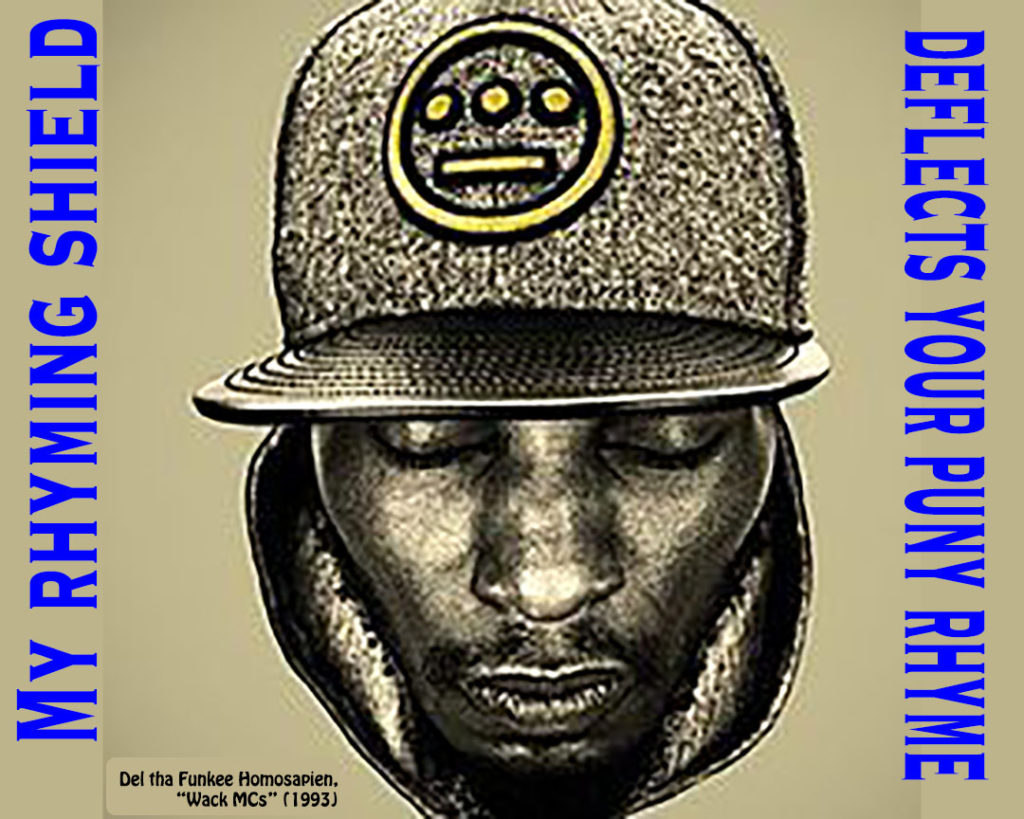
Del tha Funkee Homosapien’s 2011 release, “Golden Era” (with one of his earlier rhymes superimposed), edited by Aaron Hostetter (2021).
Dr. Rose’s invocation of “Black noise” is appropriate here: hip hop thrives in the immense marches that Eurocentric poetics rely upon as exclusion, as outside to acceptability in order to create its own spaces of power. Hip hop poetry is a mearc-stapa (here, Ini Kamoze might chorus, “Word ‘em up!”], a voice from a culture many are conditioned not to accept as poetical at all. Jay-Z, in his book Decoded (2010), discusses the flush of language possible in the intersection of rhythmic spaces, low social expectations, and the desire to express oneself on multiple levels at once:
The words you use can be read a dozen different ways: They can be funny and serious. They can be symbolic and literal. They can be nakedly deceptive. It seems so straightforward and personal and real that people read it completely literally, as raw testimony or autobiography. (54)
Jay-Z hits at a common truth here: just like with hip hop emcees who could not possibly be creating elaborate metaphorical worlds of identity and expression, ancient poets are also denied fictionality and ambiguity by many modern readers. Scholars reduce their voices into stereotype. So, my goal is to locate and celebrate the moments of distortion, play, and contradiction in these lyrics.
Here, in Exeter Book Riddle 5, I though the best way to do so was to try my hand at writing bars.
Hip hop also features an expansive metrical form, embodied in the tension between rhythm and verbal stress, with unstressed syllables popping in to fill spaces between hard beats. The structure of a line is very similar to Old English meter, roughly built in groups of four strong stresses (to follow a rhythmic musical line in 4:4 time). The uneven distribution of unstressed syllables creates frequent opportunities for syncopation and off-stress sound effects (much like extant Old English poetry does, when performed properly).
Additionally, hip hop poets frequently glory in sound relations of every sort, including slant-rhyme, internal rhyme, off-beat rhyme, assonance, consonance, and of course alliteration. Most importantly, hip hop is explicitly a performed poetics, negotiating both sides of a supposed “Great Divide” between oral and written literatures, always already both and the same.
For my re-translation of this riddle, I chose to adopt a dense lyrical style similar to that used by the late MF DOOM (but is hardly exclusive to his rhymes). For example, see the intricate network of sound-play in this couplet:
Spot hot tracks like spot a pair of fat asses. Shots of the scotch from out of square shot glasses (Madvillain, “All Caps” [2004]).
Also check out this couplet from Inspektah Deck:
My mind’s all-smart, it’s in the ballpark as Jean-Paul Sartre. Yours is in the parking lot of Walmart bagging Duck Dynasty wall-art [Czarface, “Deviatin’ Septums” [2015]).
The translation cannot be just voiceless, so I thought I’d engineer an easy beat and arrangement for it (I’m only just learning how to do this). The backing track is an instrumental version of “Mind’s Playin’ Tricks on Me” by The Geto Boys (1991), a song about the psychological costs of violence and stress. The samples are eclectic, some Bringing Out the Dead (1999), some Space is the Place (1974), and a bit of Dead Presidents (1995), as well as Admiral Akbar, Del tha Funkee Homosapien, and Biggie Smalls. The idea is to link the experience of post-traumatic stress disorder possibly alluded to in the Shield Riddle, with expressions of reality made weird through warfare and violence, especially as that trauma has been unevenly distributed to African-American communities. To give the shield warrior’s space to heal: to be their læcce-cyn after all these centuries.
Aaron Hostetter Associate Professor of Old and Middle English Rutgers University-Camden
For Dr. Hostetter’s translation and recitation, see his Exeter Book Riddle 5.
In my my most recent blog, “Encoded References in the Exeter Book Bird-Riddles,” I discuss arcane references in the Exeter Book Riddles and build on a previous piece, “Reading Runes in the Exeter Book Riddles,” which explores the cryptic use of runes in this Old English riddle collection. Both of these blogs note how certain Riddles contained in the Exeter Book (Exeter Cathedral Library MS3051) rely on esotericism as a rhetorical strategy in order to obfuscate their solutions.
Because I translated four bird-riddles in my most recent piece on Exeter Riddles, I decided that I would supplement my work by providing also recitations and making them available through our Medieval Poetry Project. Currently, the translated Old English riddlesinclude:
Exeter Book Riddles 7-9; Exeter Cathedral Library MS3051 f.103r. Image reproduced with permission of the University of Exeter Digital Humanities and the Dean & Chapter, Exeter Cathedral.
Translating a medieval riddle can be especially tricky because these poetic projects double as verbal puzzles, and therefore coded language is crucial to their rhetorical structures and modes of obfuscation. In this way, specific diction and the semantics of those words chosen (especially when polysemous), are often quintessential clues for solving these riddles, and for this reason I have attempted to stay as faithful to the original Old English as possible in my translations. Although at this point there are only four translated riddles (from the Exeter Book collection containing almost a hundred riddles), perhaps others may soon wish to follow my lead and contribute their favorite Old English riddles. With this in mind, I am hopeful that eventually we may have many more of the Exeter Book Riddles available as part of our poetry project.
Richard Fahey
PhD in English (2020)
University of Notre Dame
Editions and Translations:
Exeter Anthology of Old English Poetry. Edited by Bernard J. Muir. Exeter, UK: University of Exeter Press, 1994.
The Old English Riddles of the Exeter Book. Edited by Craig Williamson. Chapel Hill, NC: University of North Carolina Press, 1977.