Teaching Consent: More Lessons from the Wife of Bath

On this day three years ago, my first contribution to the Medieval Studies Research Blog, in which I connected the Wife of Bathโ€™s Tale with contemporary rape culture, was published. In December 2017, the #MeToo movement was gaining momentum, and the survivors of sexual violence were thrust into the media spotlight. But while the public eye was focused on the victims who came forward in record numbers, Brock Turner, the former Stanford University student who was caught raping an unconscious 22-year-old woman in 2015, was attempting to have his multiple felony sexual assault convictions overturned. With โ€œThe Silence Breakersโ€ taking center stage, we barely noticed when Turner was trying to sneak out the back door.  

Mugshot of Brock Turner, taken by the Santa Clara County Sheriffโ€™s Office when he was arrested in January 2015. Turner was found guilty of three felony assault charges. Despite prosecutors’ recommendation that he be sentenced to six years in prison, Turner was sentenced to only six months in a county jail and then released after three.

Witnessing how our collective gaze fixated on victims, I felt that the Wife of Bathโ€™s Tale had something valuable to teach us about shifting our attention to the perpetrators of sexual violence and social reformation. I still do. So today, I return to the tale to consider how we can actively create a culture of consent. Rather than concentrating on violence, I want to highlight how the tale emphasizes education as a critical component of cultural reformation. After all, it is through education that the rapist knight is reformed in the tale.

As a refresher for those who have not recently read the Wife of Bathโ€™s Tale or who may not be familiar with the Middle English poem from Geoffrey Chaucerโ€™s Canterbury Tales, the narrative begins with the protagonist knightโ€™s rape of a maiden whom he meets in the woods. Called to the court of Camelot for his crimes, the knight escapes King Arthurโ€™s condemnation to death only because the queen suggests an alternative: the knight will return to the court in a year and one day to provide an answer to the question, โ€œWhat thyng is it that wommen moost desirenโ€?[i]

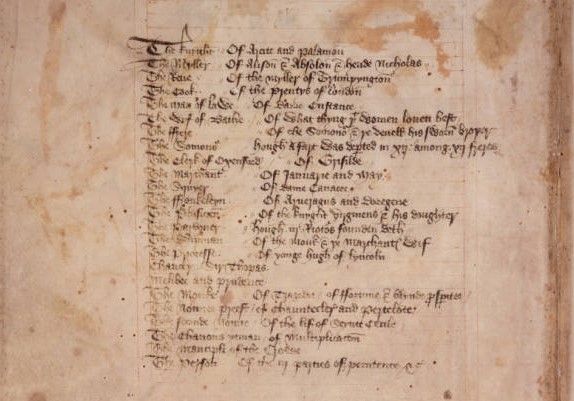
Table of Contents for the Canterbury Tales included in the Ellesmere Chaucer, a fifteenth-century manuscript housed at the Huntington Library, San Marino, MSS EL 26 C 9, fol. 72 r. The entry for the Wife of Bathโ€™s Tale, listed in the sixth row descending, contains the description โ€œOf what thyng [รพat] women louen bestโ€ โ€“ or in modern English, โ€œAbout the thing that women love most.โ€  

The task that the queen requires of the knight, in turn, requires that he receive an education โ€“ one through which he acquires information but also learns effective communication. In contrast to the knightโ€™s singular concern with what he wants and the brutal assertion of his will over a young womanโ€™s body, the endeavor upon which the knight embarks depends upon asking women what they want and listening to what they have to say. Over the course of the tale, the knightโ€™s quest forces him to see that the answer to such a question is subjective. He discovers that women desire different things and, effectively, that women have wills of their own. His journey leads him to the only acceptable answer: above all things, women desire sovereignty. Returning to Arthurโ€™s court, the knight acknowledges that women want autonomy. But his answer alone โ€“ the act of speaking the words aloud โ€“ does not suffice. Only after the knight puts his new knowledge into practice, specifically in a sexual context that compels communication with and respect for the woman in his bed, does he appear fully exonerated in the tale. In the end, the knight preserves his life and gains a wife with whom he lives happily ever after.

At this point, the fact that Chaucer may have committed rape himself deserves disclosure, since Iโ€™m striving to convey how a narrative penned by his hand that rewards a rapist can teach us about consent. But the Wifeโ€™s tale is fiction and the wife herself a fictional character; neither entity represents Chaucer the person nor reflects on his charges of raptus in 1380. It is paramount to understand that my interpretation of the tale and its teachings derive directly from the Wifeโ€™s wisdom as represented in her prologue and her tale. We should recall that the Wife is a survivor of sexual assault, and as I suggested three years back, if she has something valuable to teach us about combatting sexual violence, we must listen. According to Alisoun of Bath, education is the key to consent.
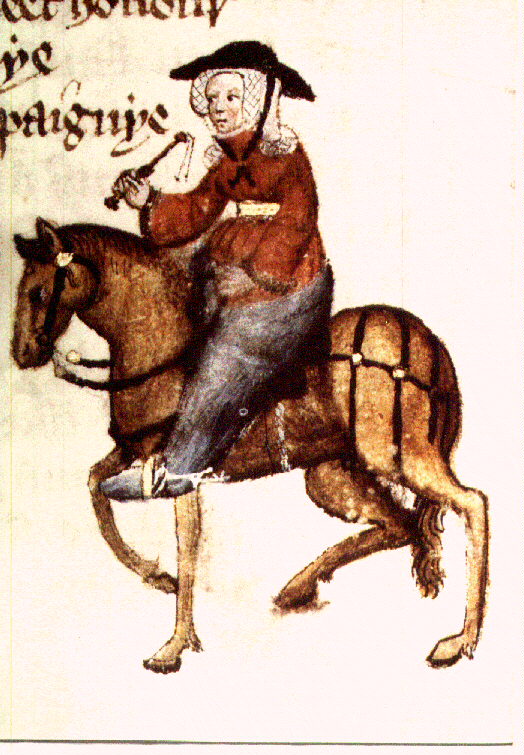
One of only two surviving medieval illuminations of the Wife of Bath, which appears in the Ellesmere Chaucer. The other appears in a fifteenth-century manuscript housed at the Cambridge University Library, MS Gg.4.27.

Without sexual education, we replicate the conditions in which rape culture thrives. Socially, we continue to idolize hegemonic masculinity, a paradigm that rewards attributes like virility, aggression, and dominance and, by extension, conflates sex with conquest, a combination that inherently undermines consent. At the same time, we generally shy away from conversations about what women want because sexuality, especially when it pertains to womenโ€™s pleasure, remains so stigmatized. The sexual education young people currently receive in the U.S. is inconsistent across the country and largely deficient in its emphases and omissions. On the one hand, public school curriculums traditionally highlight the dangers of sexual activity, attempting to frighten adolescents with pictures of disease and stories of unintended pregnancy. On the other hand, conservative states and institutions tend to employ an abstinence-only strategy, via which they articulate a particular set of values related to sexual behavior but do not necessarily provide information about sex. By instilling young people with fear and denying them information, these approaches to sexual education are antithetical to sexual health. Moreover, the absence of sexual education models silence where sexual activity is concerned. Consent, however, depends upon successful communication.

Comprehensive sexual education provides young people information about human bodies and sexual behavior that is pertinent to their everyday lives.[ii] It is crucial not only for their personal health but also for the health of others, particularly their romantic partners both present and future. Healthy relationships cannot happen without communication, and without engaging in intentional conversations about sex, students are prevented from practicing a skill essential to personal and communal sexual well-being.

Due to the deficits and overall incongruity of sexual education across the country, many young people enter their college campuses and their adult lives without the tools that enable them to make informed decisions and communicate effectively in sexual situations. During their first year of college, students should have access to a course on human sexuality that provides a comprehensive introduction previously unavailable to them and appropriate for them as adults. But not all colleges include sexuality studies in their course offerings. My own institution, for example, does not currently offer a course on human sexuality for its undergraduate population. Yet if students are not equipped with the information and skills necessary for fostering sexual health, it impairs our ability to develop a community in which consent becomes accepted as doctrine.
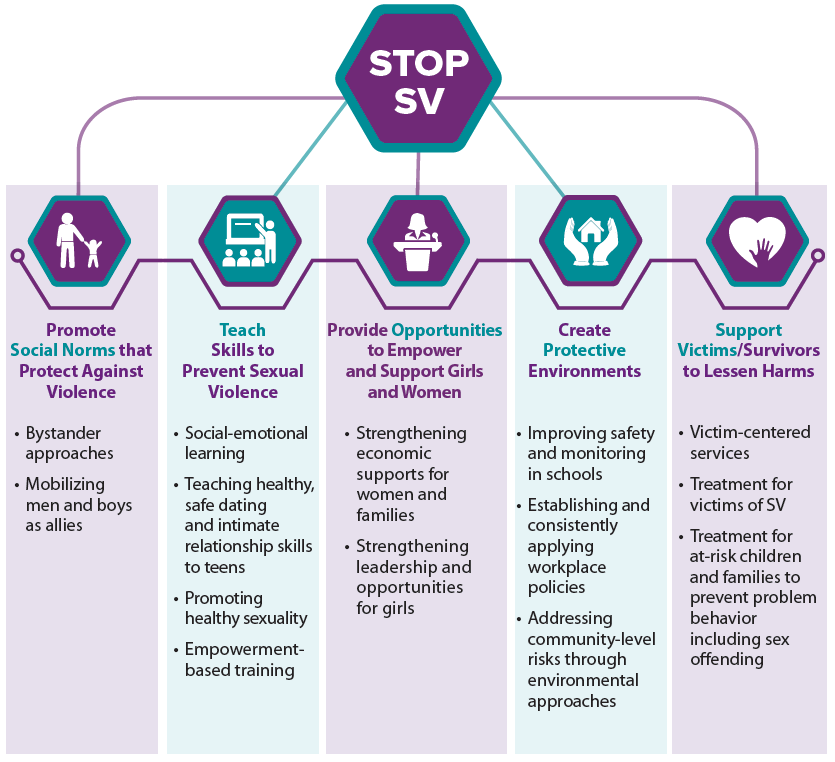
The Center for Disease Control identifies education as an essential tool for preventing sexual violence

Comprehensive sexual education provides young people the information integral to navigating an omnipresent part of human experience, an aspect that affects us individually, as well as interpersonally. Conducting conversations about sex in an educational environment also establishes a visible and tangible connection between open communication and healthy sexuality. Communication, of course, cannot be separated from consent.

I want to be very clear: comprehensive sexual education need not eschew faith-based values, just as science need not exist apart from religion. Students can be taught the science surrounding sex alongside lessons about spiritual life. As Pope John Paul II said, โ€œScience can purify religion from error and superstition; religion can purify science from idolatry and false absolutes. Each can draw the other into a wider world in which both can flourish.โ€

We all deserve to flourish. By foregrounding education, the Wife of Bathโ€™s Tale begins to show us how.

Emily McLemore
Ph.D. Candidate, Department of English
University of Notre Dame


[i] Chaucer, Geoffrey. The Wife of Bathโ€™s Tale. The Riverside Chaucer, edited by Larry D. Benson, Houghton, 1987, pp. 116-22, line 905.

[ii] Bedbible Research Center. “Sex Education Statistics โ€“ The state of sexual education (+Dataset),” 2015, https://bedbible.com/sex-education-statistics/.

Medieval Sexuality, Medical Misogyny, and the Makings of the Modern Witch

With Witch ranked the most popular costume nationwide, Frightgeist reports, โ€œThereโ€™s a frighteningly high chance you will see a Witch costume on Halloween this yearโ€ โ€“ and these costumes will likely share some similarities. Asked to describe the physical features of a witch, we tend to list tropic characteristics like those returned through a Google search: she is old and ugly with a hooked nose and green or otherwise sallow skin. First and foremost, however, the witch is a woman.    

The iconic Wicked Witch of the West, played by Margaret Hamilton in The Wizard of Oz (1939).

The last known execution for witchcraft was recorded in 1782, at which time some 110,000 people had been tried and up to 60,000 had been executed โ€“ most of them women.[1] Not quite as well-known as the witch trials themselves, the Malleus maleficarum, or the Hammer of Witches, served not only as an extensive manual for the identification of witches but also advocated for their extermination.

But even before the publication of the Malleus in 1487, there was De secretis mulierum, or On the Secrets of Women, an immensely popular treatise composed in the late-thirteenth or early-fourteenth century that still survives in more than 80 manuscripts. Drawing from medieval medical philosophy, the Secrets branded women as evil based on their biological composition and helped lay the foundation for the figure of the witch, which resulted in the deaths of so many women.  

Specifically, the ideas about sexuality solidified through the intersections of medicine and religion situated women not merely as inferior to men but as polluted both physiologically and psychologically, via which they were eventually posited as predisposed to evil. The anatomical traits that distinguished women and men situated the sexes as binary opposites: they were a heterogenous, hierarchical pair. In conjunction with humoral theory, female softness and weakness were attributed to the bodyโ€™s cool composition, while male strength and hardness were generated by their hot and dry climates.

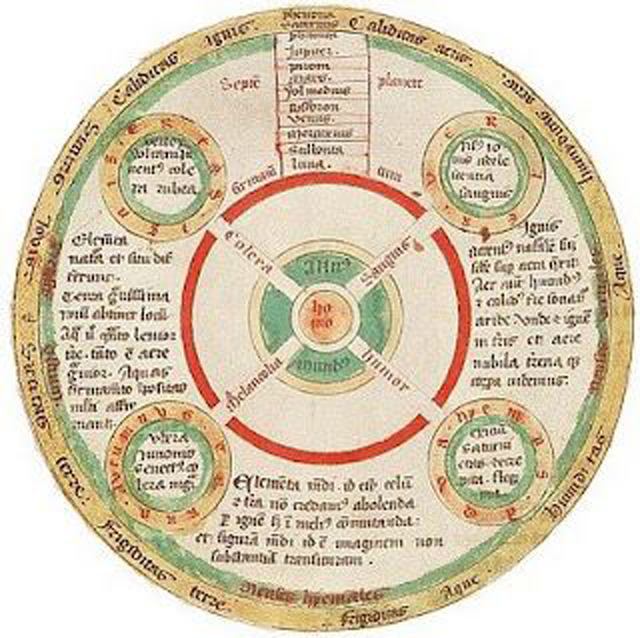
Diagram illustrating the relationship of the four humors, depicted as radiating diagonally from the center, to the temperaments, planets, and seasons (c. 1450-1475), The Morgan Library & Museum MS B.27.

Menstrual blood and semen, according to medieval physicians, were the defining essences of woman and man and were starkly contrasted in terms of their character. Menstrual blood was seen as an excess and, therefore, as physical evidence of the defectiveness of the female body because โ€œit marked the inability of the body to become warm enough to refine blood.โ€[2] The blood itself was considered toxic because it was comprised of โ€œunrefined impurities.โ€[3]

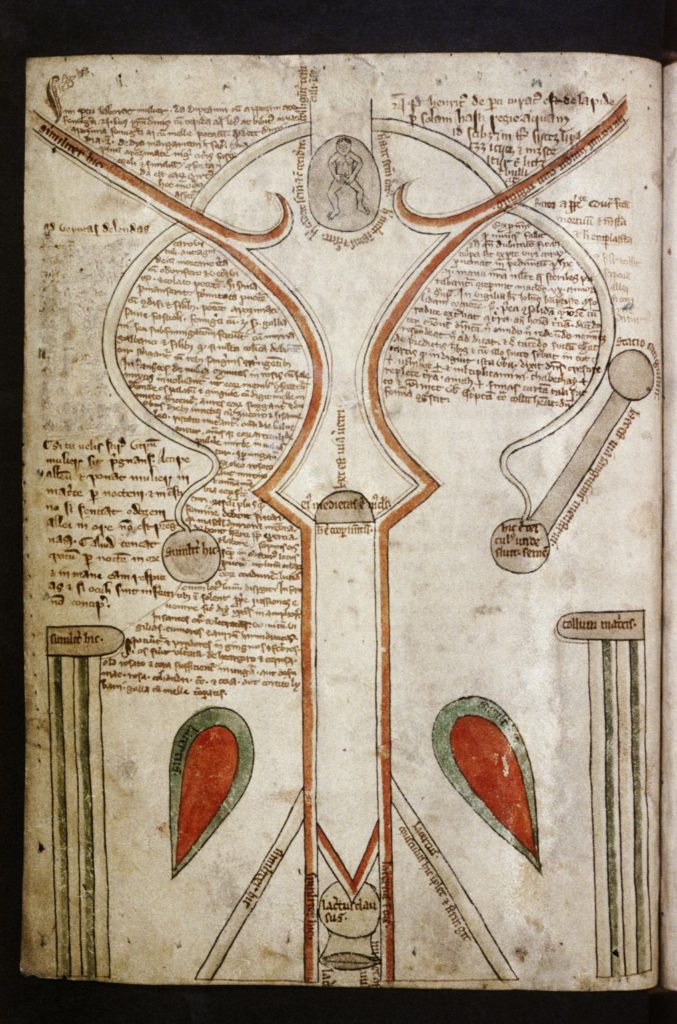
Schematic diagram of a uterus, one of the earliest surviving anatomical drawings from Western Europe (c. 1250-1310), Bodleian MS Ashmole 399, f. 13v.

Although semen was thought to be a form of blood, it was blood that had been transformed into a precious substance within the testicles after traveling down the spinal cord from the brain.[4] Through its direct connection with the brain, male sexuality was associated with cognitive activity and rational, measured behavior. Womenโ€™s sexuality was posited as opposite: their bodies were considered passive, but women themselves were considered โ€œprofoundly sexual.โ€[5] The womb was central to the understanding of female anatomy and determined womenโ€™s passivity in contrast to menโ€™s activity, as well as her association with the physical body. Moreover, women were characterized as open in relation to their genitalia, which subsequently indicated their openness to sexual activity and informed the idea that women were inherently lustful.[6]

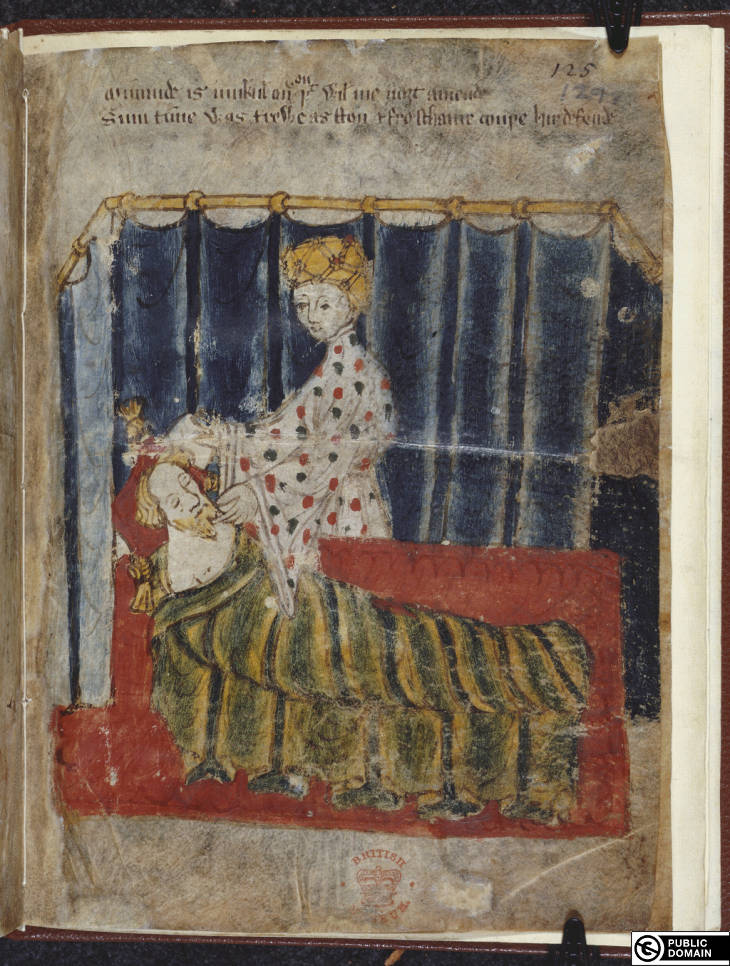
In an image accompanying the first of the seduction scenes in Sir Gawain and the Green Knight (c. 1400), the Lady stands over Gawain while he lies asleep, apparently naked, British Library MS Cotton Nero A.x., f. 125/129r.

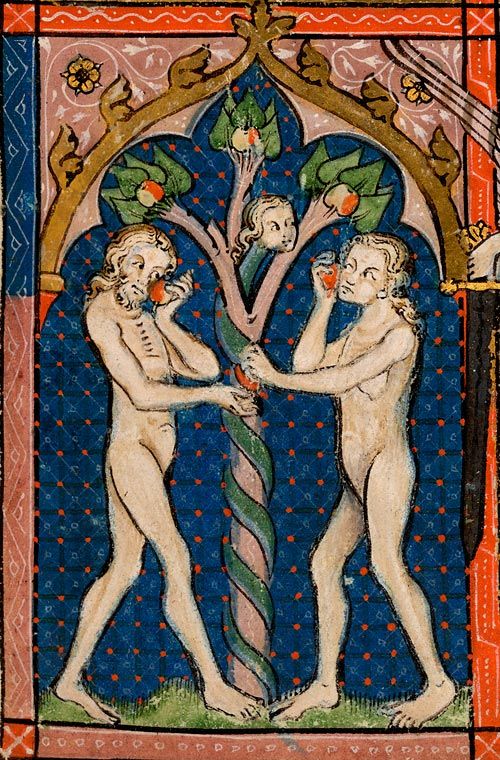
Attitudes toward womenโ€™s sexuality were also influenced by Christian beliefs, which associated sex with original sin. As the descendants of Eve, women were deeply connected with desire and consistently constructed as temptresses. In effect, they disproportionately bore responsibility where temptations of the flesh were concerned. Church fathers considered men โ€œstrong, rational, and spiritual by nature,โ€ while women were โ€œnot only soft, but carnal,โ€ in short, they โ€œembodied sexualityโ€ and continuously reproduced Eveโ€™s initial temptation of Adam.[7]

Illuminated image of The Fall of Man, depicting Adam and Eve holding fruit from the Tree of Knowledge to their mouths and a female-headed serpent entwined around the trunk between them, Ramsey Psalter leaves (c. 1300-1310), The Morgan Library & Museum MS M.302, f. 1r.

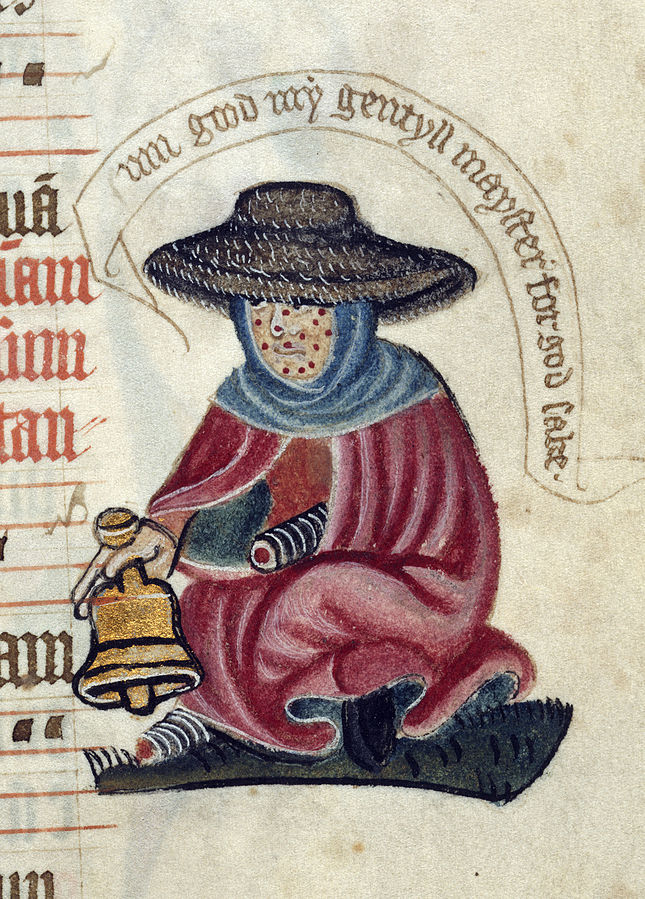
Drawing upon both biology and theology, medieval medicine synthesized the phallocentric understandings of womenโ€™s bodies and their perceived proclivity for sex and sin. While intercourse was believed to negatively alter menโ€™s bodily composition, it was considered necessary for women, who were more likely to suffer from a lack of sexual activity. Menstrual blood was considered superfluous and conflated with pollution: its retention harmed the woman whose body failed to purge its humoral excess, and its expulsion threatened to poison others, causing illness and even death. Because their bodies were viewed as toxic, women were considered largely responsible for the transmission of diseases, especially those associated with sexual activity.

Marginal image of a leprous beggar ringing a bell from The Evesham Pontifical (c. 1400), British Library MS Lansdowne 451, f. 127r.

The Secrets then transmuted medical philosophy into overt misogyny and deemed women dangerous explicitly in relation to their sexuality. A particularly poignant passage describes the process by which women, essentially, drained and absorbed menโ€™s life force through sex:

โ€œThe more women have sexual intercourse, the stronger they become, because they are made hot from the motion that the man makes during coitus. Further, male sperm is hot because it is of the same nature as air and when it is received by the woman it warms her entire body, so women are strengthened by this heat.โ€[8]

Describing menstruation as a time during which โ€œmany evilsโ€ arise, the Secrets cautions against intercourse, warning men that women are prone and prepared to deliberately cause them harm: โ€œFor when men have intercourse with these women it sometimes happens that they suffer a large wound and a serious infection of the penis because of iron that has been placed in the vagina.โ€[9] According to a commentary that often circulated with the manuscript, the man may not even notice that he has been wounded by the iron vindictively concealed within the vagina โ€œbecause of the exceeding pleasure and sweetness of the vulva,โ€[10] an ominous addendum that vividly draws together desire, danger, and disease at the site of the female body.

Desire and danger similarly coalesce in Sarah Stephensโ€™ role in The VVitch (2015). Set in Puritan New England in 1630, the film portrays the destruction of a pious family whose fear of witchcraft spreads among them like a disease.

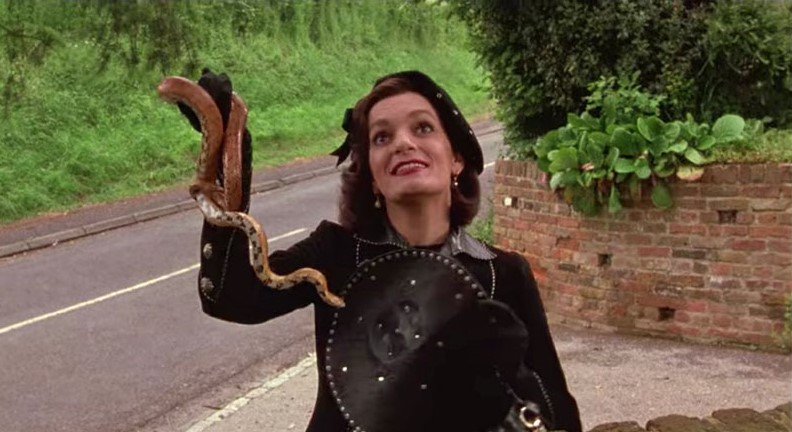
Even body parts not in direct contact with menstrual blood could become infected during menstruation. The Secrets describes the process by which a serpent is generated following the planting of hairs from a menstruating woman,[11] a proposition that viscerally evokes womenโ€™s connection with Eve and, more pointedly, with the devil. 

A witch attempts to entice the young protagonist with a snake she removes from her handbag in The Witches (1990), based on the novel by Roald Dahl. Moments later, she places its body around her neck and then begins whispering to the creature. The 2020 remake emphasizes the connection between witches and snakes at several points in its revised plot, including the snake-like resemblance of the witches themselves.

Older women were considered especially dangerous when their periods became intermittent, even more so following menopause when they failed to discharge superfluous fluid from their bodies and became increasingly noxious as a result. A passage from the Secrets explains as follows:

โ€œIf old women who still have their periods, and certain others who do not have them regularly, look at children lying in the cradle, they transmit to them venom through their glance โ€ฆ One may wonder why old women, who no longer have periods, infect children in this way. It is because the retention of the menses engenders many evil humours, and these women, being old, have almost no natural heat left to consume and control this matter, especially poor women, who live off nothing but coarse meat, which greatly contributes to this phenomenon. These women are more venomous than the others.โ€[12]

As the passage indicates, women who ceased to menstruate and subsisted on meager means were additionally threatening, a claim that further ostracized those already existing at outer margins of class society.

Located deep in the woods but eschewing its candy coating for far scarier fare, the witchโ€™s house in Gretel and Hansel (2020) distances her from society, a feature that pervades both folkloric and popular culture representations of the witch.  

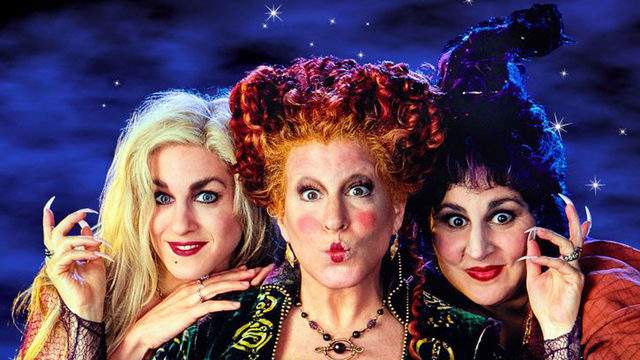
The innate malice of womenโ€™s bodies, illustrated so poignantly in the Secrets, was a disparaging ideological assemblage disseminated throughout the late Middle Ages, which became ingrained and interpreted in a way that unequivocally connected womenโ€™s sexuality with evil. The treatise emphasizes the wickedness of womenโ€™s physiological composition and psychological character and elevates their social stigma to its medieval pinnacle, perfectly epitomized in the textโ€™s avowal that โ€œwoman has a greater desire for coitus than a man, for something foul is drawn to the good.โ€[13] And of course, men were not the only ones at risk; the innocent victims often included children.

The Sanderson sisters, from Disneyโ€™s ‘Hocus Pocus’ (1993), who despite their humorous depiction draw their strength by sapping the life from children.

It is these misogynistic ideas about womenโ€™s sexuality that seeded their demonization in the years that followed, as the Secrets served as a direct source for the Malleus maleficarum. Indeed, the most famous statement from the Malleus explicitly connects witchery with ideas about womenโ€™s sexuality rooted in the medieval period: โ€œAll witchcraft comes from carnal lust, which is in women insatiable.โ€[14]

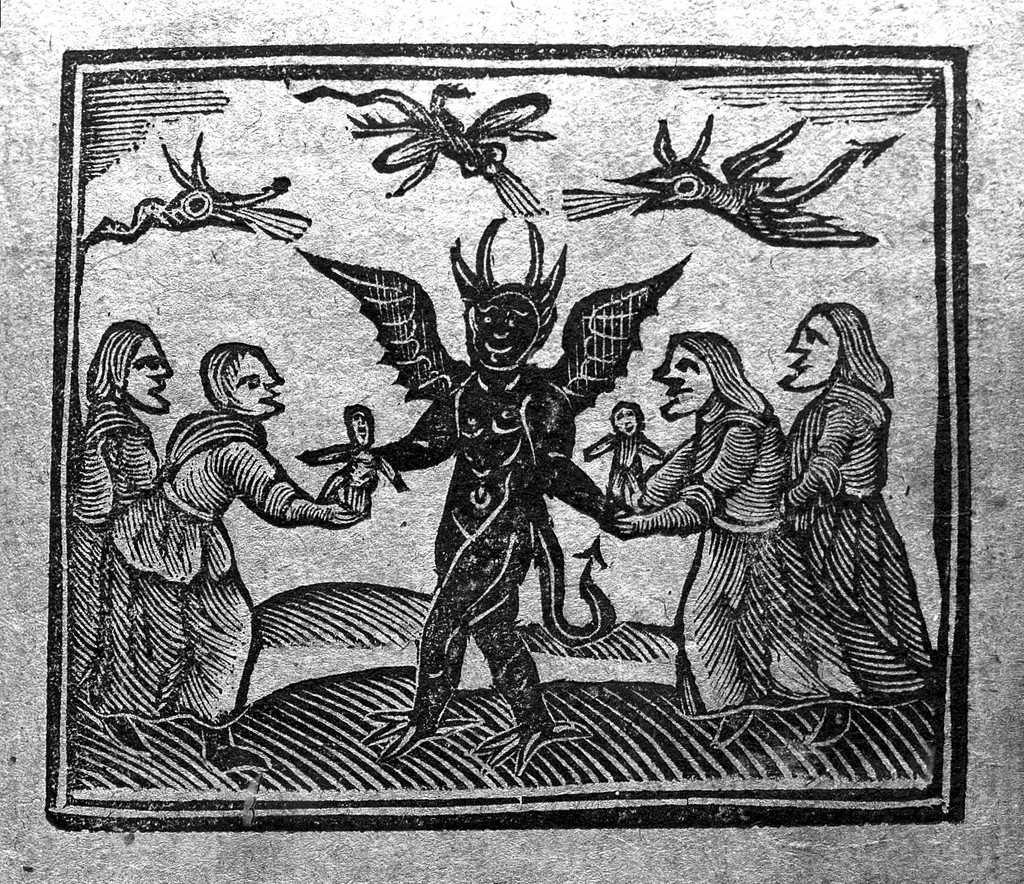
Women giving wax dolls to the devil, The History of Witches and Wizards, 1720, Wellcome Collection, London, U.K.

Emily McLemore
Ph.D. Candidate, Department of English
University of Notre Dame


[1] Britannica.com, โ€œSalem witch trials,โ€ 25 Oct. 2020.

[2] Joyce Salisbury, โ€œGendered Sexuality,โ€ Handbook of Medieval Sexuality, edited by Vern L. Bullough and James A. Brundage, New York and London: Garland Publishing, Inc. (1996): 81-102, at 89.

[3] Salisbury, โ€œGendered Sexuality,โ€ at 89.

[4] Danielle Jacquart and Claude Thomasset, Sexuality and Medicine in the Middle Ages, translated by Matthew Adamson, Cambridge: Polity Press (1988), at 13.

[5] Salisbury, โ€œGendered Sexuality,โ€ at 84.

[6] Salisbury, โ€œGendered Sexuality,โ€ at 87.

[7] Salisbury, โ€œGendered Sexuality,โ€ at 86.

[8] Helen Rodnite Lemay, Womenโ€™s Secrets: A Translation of Pseudo-Albertus Magnusโ€™ De Secretis Mulierum with Commentaries, Albany: State University of New York Press (1992), at 127.

[9] Lemay, Womenโ€™s Secrets, at 88.

[10] Lemay, Womenโ€™s Secrets, at 88.

[11] Lemay, Womenโ€™s Secrets, at 96.

[12] Les Admirables secrets de magie du Grand Albert et du petit Albert, MS Paris, Bibliothรฉque nationale, Latin 7148, fol. 2 r. 9 v., translated by Jacquart and Thomasset, Sexuality and Medicine in the Middle Ages, at 75.

[13] Lemay, Womenโ€™s Secrets, at 51.

[14] Heinrich Kramer and James Sprenger, Malleus maleficarum, translated by Montague Summers, New York: Dover (1971), at 47.

What the Wife of Bath Still Has to Teach Us

As a medievalist who is both interested and personally invested in the representation of womenโ€™s bodies, I am acutely aware of how our gendered ideology hearkens back to the Middle Ages. The ways in which the Canterbury Tales mirror contemporary discourse and practices around sexual violence are abundant, and though I know them well through my work with Chaucer, they remain alarming.

A sign outside a strip club near Denver, Colorado, an image that accompanied an article in The Guardian, dated December 3, 2017

Needless to say, I was hardly surprised when, in October of 2016, Sonja Drimmer and Damian Fleming described in a blog post to In the Middle the remarkable relevance of the Millerโ€™s Tale, in which Nicholas corners an unsuspecting Alisoun and grabs her by her genitals[i]:

โ€œAnd prively he caughte hire by the queynte,
And syde, โ€˜Ywis, but if ich have my wille,
For deerne love of thee, lemman, I spille.โ€™โ€[ii]

Used to describe Alisounโ€™s genitalia as โ€œa clever or curious device or ornament,โ€ the word โ€œqueynteโ€ employs both of its Middle English definitions, as it is simultaneously a โ€œpunningโ€ on a more modern derogatory term for the vaginal organs.[iii] That Alisoun โ€œsproong as a colt dooth in the traveโ€[iv] to escape Nicholasโ€™s hands on her vulva demonstrates that his fondling of her body is not only unexpected but also unwanted.[v] What Chaucerโ€™s narrative describes is sexual assault.

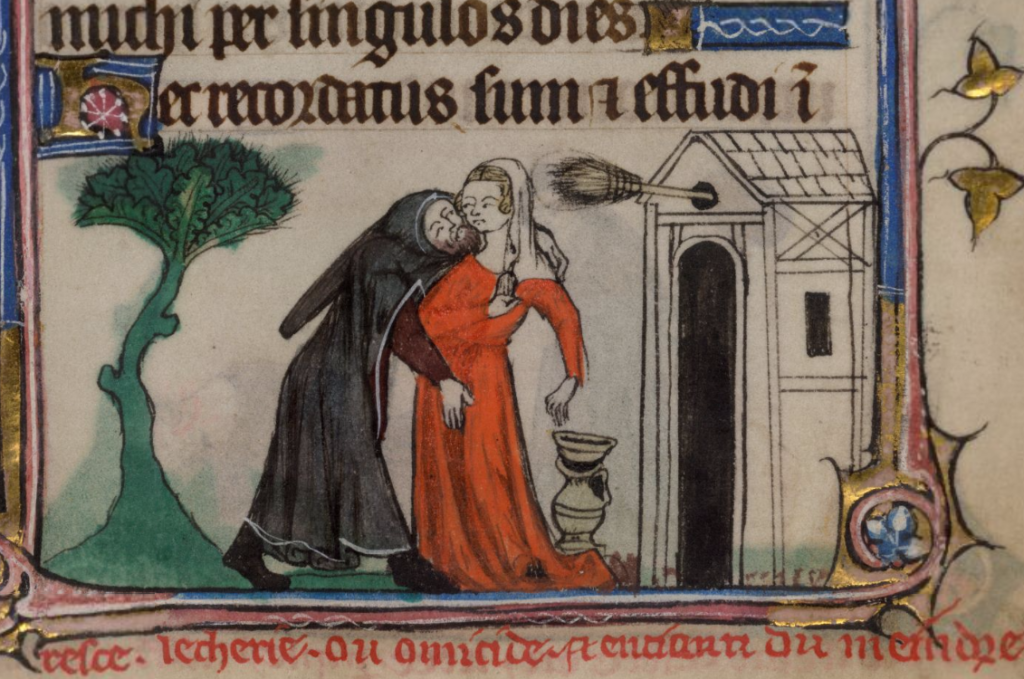
A friar grabs a woman by her genitals in an image from a fourteenth-century manuscript, The Taymouth Hours, London, British Library MS Yates Thompson 13, fol. 177. Specifically citing the manโ€™s actions as lechery (โ€œlecherieโ€), the French caption condemns his behavior and serves as a warning for young women, who would have been the textโ€™s primary audience. The Wife of Bath begins her tale with an allusion to the prevalence of friars in woods like those where the maiden is raped by the knight.[vi] 
The Millerโ€™s Tale is, of course, a fabliau, characterized by bawdy humor intended to make the audience laugh. The genre, however, should not negate the inappropriateness of Nicholasโ€™s actions, and if it renders them humorous, it does so at womenโ€™s expense. If further evidence is needed for the genreโ€™s proclivity for misogyny, one needs only to consider the Reeveโ€™s Tale, which follows the Millerโ€™s and appropriates rape as its punchline. While critics have traditionally navigated the fabliau genre with the argument that the โ€œenthusiastically unchaste wivesโ€[vii] escape ridicule at the narrativeโ€™s end, the portion of this approach that requires the casual dismissal of sexual assault merits reconsideration, especially because consent cannot be given retroactively. That being said, Alisoun does consent to a sexual relationship with Nicholas, but only after he has violated her. Sexual contact without consent is assault โ€“ period.

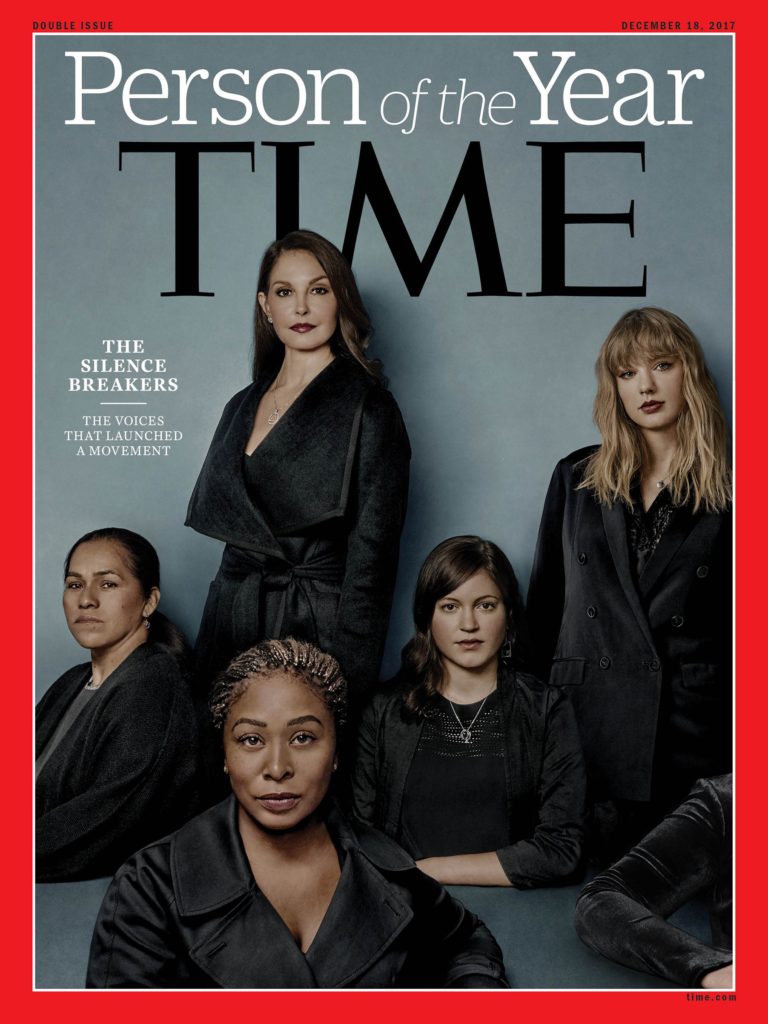
Our own cultural conversation around sexual assault hasnโ€™t ebbed since last fall. On the contrary, its media current seems to be only gaining momentum. On Tuesday, December 6, Time magazine revealed their 2017 Person of the Year: โ€œThe Silence Breakers,โ€ the many women, as well as some men, who have recently been compelled to share their experiences as victims of sexual harassment and assault. Primarily composed of womenโ€™s voices, the massive movement demands that the men perpetuating this violence be held accountable for their actions. Meanwhile, Brock Turner, the former Stanford University student found guilty of three counts of felony sexual assault early last year, served only three months of a grossly lenient, six-month sentence in a county jail and began the process of appealing his conviction the same week as Timeโ€™s cover release.[viii] According to the New York Times, approximately 60 pages of the 172-page appeal document emphasize the intoxication of Turnerโ€™s victim on the night he raped her.[ix] As far as Turner is concerned, the violence he committed is still not his fault, suggesting that accountability can only take us so far, and, frankly, itโ€™s not nearly far enough.

Time cover announcing the “Silence Breakers” as Person of the Year, released online December 6, 2017

Current events have inspired me to return to the Canterbury Tales, this time to the Wife of Bath. In what is an often cited conundrum of the Wifeโ€™s tale, the knight who rapes the maiden at the storyโ€™s outset is rewarded at its end, while his female victim vanishes from the narrative entirely. While some critics see the maidenโ€™s disappearance as a problematic act of erasure, Iโ€™d like to consider what can be achieved through the Wifeโ€™s attention to the rapist, rather than his victim.

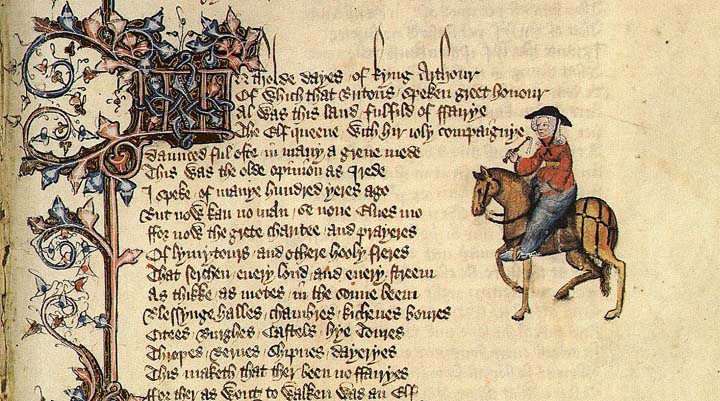
The first page of the Wife of Bath’s Tale from the Ellesmere Chaucer, a fifteenth-century manuscript housed at the Huntington Library, San Marino, MSS EL 26 C 9, fol. 72 r

In a tale that focuses more on remedy than reaction, the Wife conveys how the knight should not merely be punished but, rather, reformed. To weight the punishment Arthur initially proposes against the repercussions for contemporary sexual aggressors is a telling measure, as Arthur would have the knight executed for his actions. Guinevere, however, intervenes and โ€“ after her husband agrees that she should sentence the knight โ€œat hir willeโ€ โ€“ challenges him instead to discover what women desire most.[x] The quest upon which the knight embarks does not lead him to an explicit answer for her question, and his failure in this endeavor is, in my opinion, precisely the point: he must learn that women have wills of their own and understand that womenโ€™s wills should not be subsumed by menโ€™s.

At the taleโ€™s conclusion, it is only when the knight recognizes his wifeโ€™s will as equal to his own, a reflection of his reformed character, that he is rewarded. Admittedly, when the wife tells him he may choose to have her โ€œfoul and oldโ€ but โ€œa trewe, humble wyf,โ€ or โ€œyong and fairโ€ but unfaithful, neither option is ideal.[xi] But having just concluded her speech on โ€œgentillesse,โ€[xii] through which she conveys how nobility originates in oneโ€™s character and is defined through oneโ€™s actions,[xiii] it would appear that the knight accepts the meaning of her words:

โ€œMy lady and my love, and wyf so deere,
I put me in youre wise governance;
Cheseth youreself which may be moost pleasance
And moost honour to yow and me also.โ€[xiv]

Not only does the knight address his wife with kindness and respect, but he also conveys that he has internalized the lesson she has taught him by deferring to her โ€œwise governanceโ€ and imploring her to decide what kind of woman she wishes to be. Through his deliberate suspension of his own will to accommodate his wifeโ€™s, the knight demonstrates how his character has been reformed from the narrativeโ€™s beginning when he exerts his will over his female victimโ€™s in his sexual assault on her body. In effect, the Wife of Bathโ€™s Tale advocates for social reformation of masculinity as a proactive solution to sexual violence, situating punishment alone as a reactive and, thus, less productive response.

As a medieval scholar, I am dedicated to the idea that there is much we can learn from our past. As a literary scholar, I believe that studying literature can facilitate much of that learning. As a woman and a feminist, I wonder what can be gained by redirecting our collective gaze onto the perpetrators of sexual violence. Perhaps the Wife of Bath, a survivor of gendered violence herself, has a lesson she can teach us โ€“ and if thereโ€™s anything that can be learned, we must listen.

Emily McLemore
University of Notre Dame

[i] Drimmer, Sonja and Damian Fleming. โ€œNot Subtle; Not Quaint.โ€ In the Middle, 9 Oct. 2016.

[ii] Chaucer, Geoffrey. The Millerโ€™s Tale. The Riverside Chaucer, edited by Larry D. Benson, Houghton, 1987, pp. 68-78, lines 3276-78.

[iii] Queynte] Middle English Dictionary, def. 1a, 2a.

[iv] Trave] an enclosure or a frame for restraining horses while they are being shod (Middle English Dictionary, def. b)

[v] Chaucer. The Millerโ€™s Tale. The Riverside Chaucer, line 3282.

[vi] Chaucer. The Wife of Bathโ€™s Tale. The Riverside Chaucer, pp. 116-22, lines 865-81.

[vii] Benson, Larry D. โ€œThe Canterbury Tales.โ€ The Riverside Chaucer, pp. 8.

[viii] Stack, Liam. โ€œLight Sentence for Brock Turner in Stanford Rape Case Draws Outrage.โ€ New York Times, 6 Jun. 2016.

[ix] Salam, Maya. โ€œBrock Turner is Appealing his Sexual Assault Conviction.โ€ New York Times, 2 Dec. 2017.

[x] Chaucer. The Wife of Bathโ€™s Tale. The Riverside Chaucer, lines 894-97.

[xi] Chaucer. The Wife of Bathโ€™s Tale. The Riverside Chaucer, lines 1219-26.

[xii] Chaucer. The Wife of Bathโ€™s Tale. The Riverside Chaucer, line 1211.

[xiii] Gentillesse] nobility of birth or rank, or nobility of character or manners (Middle English Dictionary, def. 1a, 2a)

[xiv] Chaucer. The Wife of Bathโ€™s Tale. The Riverside Chaucer, lines 1230-33.