On St. Nick’s Beard

The development of the appearance of the modern Santa Claus is a fascinating one, evolving from traditional representations in Germany and the Low Countries, a distinctly English Father Christmas, and the Coca-Cola Company’s efforts to sell product. One of the most distinctive features of the modern portrayal, though, predates all of these: the beard, a sine qua non of the modern depiction, dates back centuries, and likely originated with the historical St. Nicholas himself. Unlike some of the other aspects of his appearance, though, the decision of St. Nicholas (probably) to wear a beard, and the decisions of his later iconographers to depict him with one (or not, as the case may be), were generally not socially or theologically neutral. In this post, I’d like to explore some aspects of the meaning conveyed by St. Nick’s beard, focusing mostly on the Middle Ages and as an excuse to bring up my favorite research topic: the differences that arose between Latin and Greek expressions of Christianity during and after the conflict of the mid-eleventh century.

But first, by way of background, what can be said about the appearance of the historical St. Nicholas, the bishop of Myra in Asia Minor in the first half of the fourth century? While the sources for the general practice of the time period are not unanimous, the consensus of the Christian writers of the period, especially in the Eastern part of the Roman Empire, seems to have been in favor of beard-wearing [1]. Clement of Alexandria, writing the century prior, argued, “For God wished the woman to be hairless and smooth, rejoicing in her hair alone, like the horse does its mane, but He decorated man with a beard, just like the lions” [2]. Nor was the sentiment confined to Christian authors. Emperor Julian (“the Apostate” or “the Philosopher” depending on whom you ask), about as un-Christian an author as one could ask for and a reasonably close contemporary of Nicholas, is famous for his written defense of the beard. At the same time, clergy in many parts of the West, and the city of Rome in particular, retained the republican and imperial Roman custom of cleanshavenness.

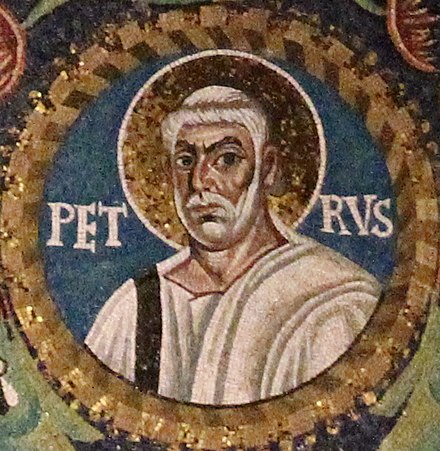
The preference of the Eastern churchmen has been taken into account for forensic reconstructions done on the basis of the relics in his tomb in Bari, and the resulting depiction is dominated by a sizeable beard ]. This depiction persisted in subsequent centuries of Greek Christian iconography. From the earliest surviving example (seventh or eighth century, available in the Mount Sinai Archives), through to the present day, St. Nicholas, in the Greek tradition, is consistently depicted with a beard. And, given his ubiquity in the medieval and modern Orthodox church setting, it might be fair to say that he became one of the definitive archetypes for how clergy should look.

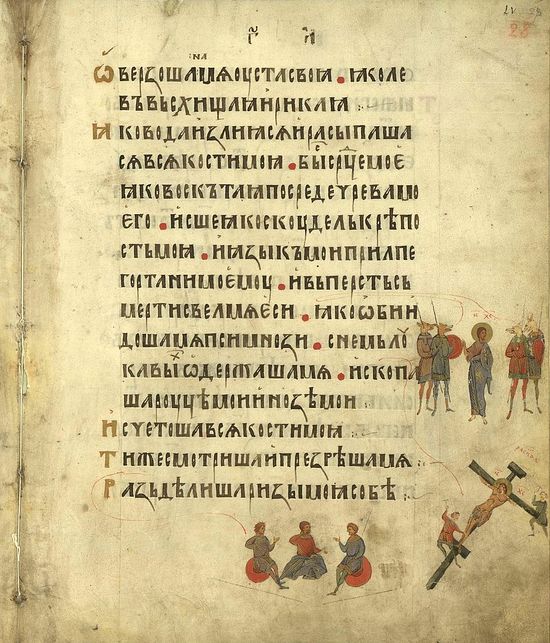
Apse of the Ferapontov Convent, Russia, By Dionisius, turn of the 16th c.
Public domain, via Wikimedia Commons.

Clerical appearance took on a new significance as conflicts between the Greek and Latin churches began to arise. During the so-called “Photian Schism” in the ninth century, for example, while Photios himself noted the differences between Greek and Latin practices with equanimity, other Greeks were less tolerant [3]. The Roman Pope at the time, Nicholas I, complained to Hincmar of Reims that the Greeks condemned them for being clean shaven [4]. By the time of the legation of 1054, this condemnation had grown into an occasional cause for a break in communion. As Humbert of Silva Candida complained: “maintaining the hair of their head and their beards, they [i.e., the Greeks] do not receive into communion those who tonsure their hair and shave their beards according to the institution of the Roman Church” [5].

The Latins, as mentioned above, were much friendlier to the notion of cleanshavenness as far back as the Patristic period, especially among the clergy, and this permissiveness gradually evolved into a situation in which not having a beard became one of the defining markers of the clerical state. Even within monastic communities, wearing a beard was a sign of the low social standing of lay brothers in religious communities. Monks who were also ordained, in contrast, were usually clean shaven [6]. Defenders of the Latin tradition, therefore, predictably took a very different position from their Greek interlocutors. This expression ranged from the mild-mannered observation of the difference in practice made by the Norman Anonymous, writing around the turn of the twelfth century (“they observe a different custom in tonsure and habit […], for they are bearded”) to the vituperative Leo Tuscus half a century later (“Their priests, in a Jewish manner, permit their beards to grow, which are sodden with the Lord’s blood when it is drunk by them.”) [7].

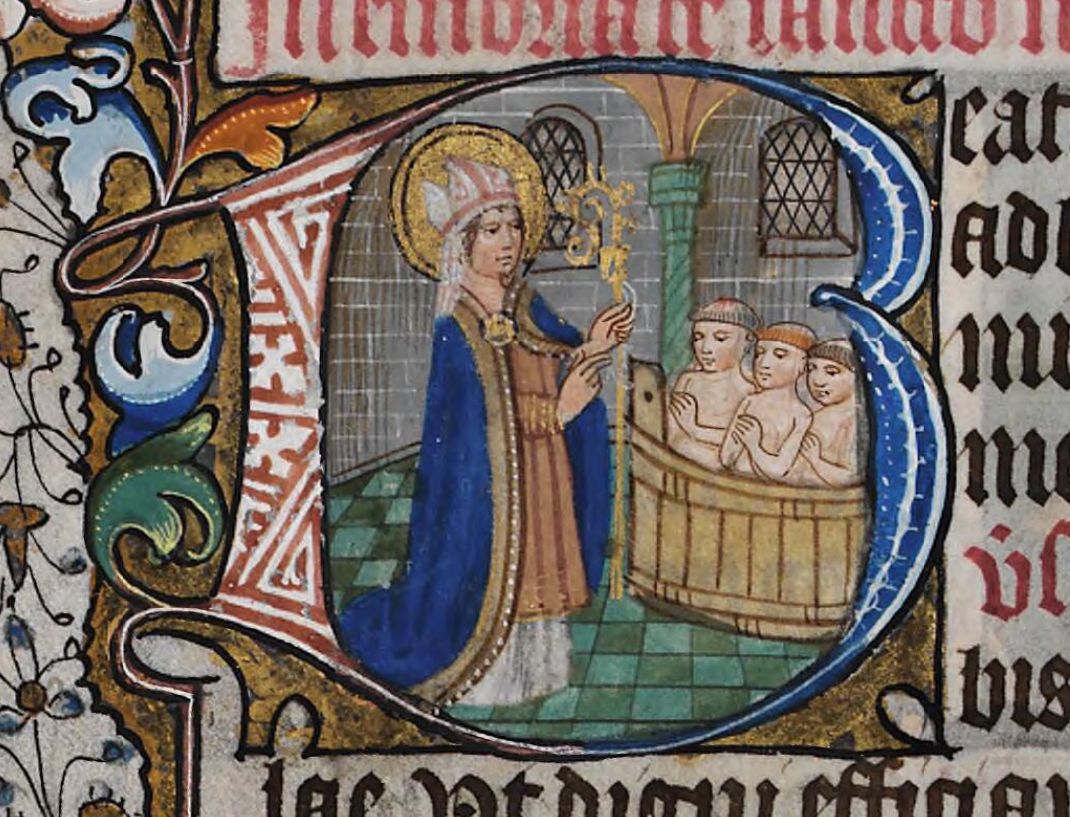
So what of St. Nicholas? While the Greeks continued to portray him in the traditional manner, Latin artists (or perhaps iconographers?) chose to portray him not as he was, but as they felt he ought to have been. The Nicholas that emerges in the late Middle Ages looks every bit the part of a Latin bishop: in Latin clerical dress, complete with miter and crosier, and without a trace of a beard.

The De Grey Hours (c. 1390), National Library of Wales, CC0, via Wikimedia Commons
The De Grey Hours (c. 1390), National Library of Wales, CC0, via Wikimedia Commons.

Of course, it is important to note that St. Nicholas was hardly alone in this treatment: it was entirely commonplace to update the saints of antiquity to suit the sartorial standards of the artist. At the same time, precious few saints with so wide a following in the Latin Church were known to be Greek, and the Greek preference for the beard was equally well known, so it’s difficult not to see some degree of deliberate Latinization in the portrayal of the saint.

In the end, East-West polemic shifted to other topics, clearing the way for the restoration of the beard. And, in a sense, in fixing the image of a bearded Santa Claus so firmly in the modern imagination, to the point that a beardless Santa Claus would be near anathema, perhaps the Coca-Cola Company has earned a small debt of gratitude from contemporary iconographers.

Nick Kamas
PhD in Medieval Studies
University of Notre Dame

[1] A. Edward Siecienski, “Holy Hair: Beards in the Patristic Tradition” St Vladimir’s Theological Quarterly 58:1 (2014), 64.

[2] Clement of Alexandria, Paidogogus 3.3. PG 8.580.

[3] Photius of Constantinople, The Mystagogy of the Holy Spirit, trans. Holy Transfiguration Monastery (Long Island City, NY: Studion Publishers, 1983), 45–46. For a discussion of this and many of the following sources, see A. Edward Siecienski, Beards, Azymes, and Purgatory: The Other Issues that Divided East and West (Oxford: Oxford University Press, 2023), 38–78.

[4] PP Nicholas I, Epistola Hincmaro et Ceteris Confratribus Nostris Archiepiscopis et Episcopis in Regno Karoli Gloriosi Regis […], MGH Epistolae VI, 603.

[5] “Excommunicatio qua feriuntur Michael Caerularius atque ejus sectatores.” Acta et Scripta, ed. Cornelius Will (Frankfurt am Main: Minerva GMBH, 1963), 153–154.

[6] Giles Constable, The Reformation of the Twelfth Century (Cambridge: Cambridge University Press, 1996), 195–196.

[7] Norman Anonymous. “De consecratione sacerdotis,” in Die Texte des Normannischen Anonymus, ed. Karl Pellens (Wiesbaden: Franz Steiner Verlag, 1966), 104. Leo Tuscus, Malae consuetudines Graecorum, PG 140.547D.

Why 1054? Dating the Schism for the Church of Constantinople

To the best of my knowledge, no serious historian or theologian working over the last century has been willing to date a definitive schism between the current Catholic and Eastern Orthodox churches to the year 1054. This raises some obvious questions: what marks a schism in the first place? When did such a division occur between these two ecclesial bodies? And the topic partially addressed in this blog post: how did the year 1054 rise to such prominence that it appears in virtually every high school-level world history textbook in the present day?

It might be helpful to clarify what happened during the Latin legation to Constantinople in 1054. After a mutually unsatisfactory meeting and some debates over issues of liturgical and church disciplinary practice, the Latin legates excommunicated the patriarch of Constantinople, Michael Keroularios, but the expressly excluded the Eastern Roman emperor at the time, Constantine X Monomachos, as well as the city in general, from this breach in communion [1]. Patriarch Michael responded by convening a council to excommunicate the legates personally, but he took great pains to avoid condemning the bishop of Rome, on the grounds that the legates were imposters who hadn’t been sent by the pope at all. Still less was the whole of the Latin Church implicated in the Greek conciliar statement. It is abundantly clear from the surviving documents that no general division between the eastern and western halves of Chalcedonian Christianity was intended in the exchange of the excommunications, and there is no evidence from the time of the event itself that any such division was achieved.

This is confirmed by sources and events in the years immediately following 1054. In the immediate aftermath, Patriarch Michael Keroularios dispatched letters to the other eastern patriarchs complaining about the legates and about Latin liturgical and ritual practices, but he does so without any notion of a break in communion with the whole of western Christianity.  The encomium of Michael Psellos for Keroularios, who died in 1059, praises the late Patriarch’s resistance to the legates. Psellos, ever philosophically-minded, focused on the question of the filioque, which was, in fact, one of the issues least discussed by the respective parties in 1054 itself (rather, they were concerned with whether bread for the Eucharist should be leavened, whether priests could be married, etc.). While admitting that Old and New Rome were in disagreement, and that the Roman position was “impious,” there is again no indication of a formal split in communion [2]. In another example a few years later, this time primarily from Latin sources concerning the great pilgrimage of Gunther of Bamberg, we are told that the Greeks were excessively proud in their dealings with the pilgrims (not an uncommon complaint), but not that they considered each other to be heretics or schismatics [3].

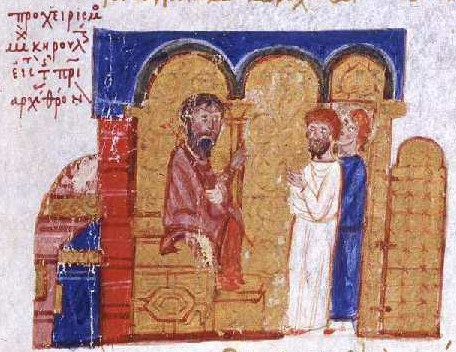
Michael Keroularios
Enthronement of Michael Kerularios, from the Madrid Skylitzes, Biblioteca Nacional de España, fol. 225r
Unknown, 13th-century author, Public domain, via Wikimedia Commons

So, then, why the significance of this date? If not in the first-hand accounts, was any significance ascribed to the year 1054 in the works of later theologians and polemicists? I am preceded in this examination by an especially helpful article by Tia Kolbaba, a Byzantinist working at Rutgers, who examined twelfth-century sources with the expectation that the increased political tension between the Latin kingdoms and the Eastern Empire would evoke the historical example of Michael Keroularios in the theological literature [4]. Her conclusion is surprising: she was able to find no firmly-datable sources that considered the role of Michael Keroularios in the schism at all, and only a handful of short texts plausibly belonging to the twelfth century that mention him in passing. In the latter group, there is an interpolation in the history of Scylitzes, a single text in Vat. grec. 2198, a paragraph attributed to a certain Nicetas the Chartophylax, and a handful of anonymous texts collected by Hergenröther. This last item, edited under the collective title “Opuscula de origine schismatis,” is the most substantial of these, and even these short texts mention the role of Keroularios in conflicting terms and only in passing, at the end of rather confused accounts about the supposed errors of the Church of Rome [5].

In virtually all of these texts, the cause of the schism (which is fully recognized by the twelfth century) is attributed to the Latins’ mistaken Trinitarian theology, and specifically the question of the filioque. Although it does get mentioned, much less attention is given to the question of (un)leavened bread, a complete reversal of the 1054 conflict in which ritual questions were given pride of place. This change of emphasis leads most, if not all, of these later commentators to draw upon source material from an earlier rupture between Rome and Constantinople: the ninth-century Patriarch Photios, although he did eventually restore communion with the See of Rome, left behind substantial writings and a strong tradition of critiquing the Latin position, especially in terms of its Trinitarian theology. And it is primarily to Photios, rather than to Keroularios, that later Greek church historians and polemicists turned.

And finally, it appears that this interpretation persisted into the early modern period, even among Greek clergy sympathetic to the Roman position. John Plousiadenos, a fifteenth-century Cretan Byzantine-rite priest in union with the Church of Rome, appears content to attribute the fundamental basis of the schism to Photios, whom he described as “the very maker and the demiurge of the schism and the division” [6]. Charles Yost, a fellow graduate of the Medieval Institute, pointed out in his 2019 dissertation that the historiography of Plousiadenos concerning the schism, as well as that of other high-profile Greek churchmen of his time, was rather garbled, with different authors presenting conflicting accounts of whether Photios, for example, was ever personally restored to communion with Rome. In nearly all accounts, however, Keroularios is conspicuous by his absence: Plousiadenos says nothing about him at all, and Manuel Kalekas, another unionist, downplays his role [7]. At the end of the Middle Ages, then, the Great Schism, to the extent that the Greeks were willing to date it at all, happened in the ninth century, and the examples of intercommunion in the centuries following were, ultimately, just failed attempts at reunion.

So where does this leave our starting question, and can we trace any part of the modern prominence given to the date 1054 to the Constantinopolitan/Greek historical or theological tradition? I think that the answer is no. None of the Greek sources following the events themselves are willing to date a definitive schism to that year. At most, the actions of Michael Keroularios are a (small) episode in a series of conflicts with the Church of Rome that began at least two centuries earlier. Otherwise, his name and his role are omitted entirely from the discourse of later commentors. I have found nothing akin to the modern celebrity given the 1054 conflict until the writings of the Athonite Kollyvades fathers around the turn of the nineteenth century. Other than that, it only within the Latin medieval tradition that we can possibly find a substantial reception of 1054. And these both are very much topics for separate posts.

Nick Kamas
PhD in Medieval Studies
University of Notre Dame

[1] The best edition for the documents cited here in relation to the 1054 legation remains Cornelius Will, ed., Acta et Scripta quae de controversiis ecclesiae graecae et latinae saeculo undecimo composita extant (Leipzig: N. G. Elwert, 1861).

[2] K. N. Sathas, ed., Μεσαιωνική Βιβλιοθήκη Δ‘ (Athens: Koromela, 1874), 348. “Στασιάζει πρὸς τὴν νεωτέραν Ρώμην ἡ πρεσβυτέρα, οὐ περὶ μικρῶν οὐδὲ παρορᾶσθαι ἀξίων, ἀλλὰ περὶ τοῦ πρώτου λόγου τῆς εὐσεβείας, καὶ τῆς περὶ τῆν ἁγίαν τριάδα θεολογίας […].”

[3] Annales Altahenses maiores, ed. altera, ed. E. L. B. von Oefele, MGH SS Rer. Germ. 4 (Hannover: impensis bibliopolii Hahniani, 1891), 67. “Constantinopolitanos vidimus [Latini episcopi] graece et imperialiter arrogantes.”

[4] Tia Kolbaba, “The Legacy of Humbert and Cerularius: The Tradition of the ‘Schism of 1054’ in Byzantine Texts and Manuscripts of the Twelfth and Thirteenth Centuries,” in Porphyrogenita: Essays on the History and Literature of Byzantium and the Latin East in Honour of Julian Chrysostomides” (Aldershot: Ashgate, 2003), 47-61.

[5] “Opuscula de origine schismatis,” ed. J. Hergenröther in Monumenta graeca ad Photium ejusque historiam pertinentia, (Regensburg: G.J. Manz, 1869). The first of these texts is unusual in reporting (inaccurately) that Michael Keroularios excommunicated the whole of the Latin church (p. 163), but this is corrected by the second text, which follows Keroularios’s own account that Latin legation had been tampered with for political ends (p. 170). The third text does not mention him at all.

[6] Charles Yost, “The Thought and Ministry of a ‘Unionist Priest’ (ἙΝΩΤΙΚῸΣ ἹΕΡΕΎΣ): John Plousiadenos (†1500), the Council of Florence, and the Tradition of Byzantine Unionism” (Ph.D. Diss., University of Notre Dame, 2019), 649, esp. n. 480.

[7] Ibid., pp. 672, 674.