Epithets, Epistles, and Erasmus, Oh my [most serene king of Britain]!

In his treatise on the writing of letters, the De Conscribendis epistolis,[1] Dutch humanist and prolific letter-writer Desiderius Erasmus emphasizes the importance of the opening section of the letter. Going wrong here in the salutatio, the writer will, he says,โ€œโ€ฆlike a poor helmsmanโ€ฆrun aground right in the harbour.โ€[2] ย His advice is to keep things simple, adopting the โ€œnewโ€ Ciceronian style:

I approve the simplicity of the ancients; I only wish that we could emulate it everywhere amid the corrupt practices of our age, so that we might greet one another by the mere mention of names, as in: โ€˜Pliny gives his Calvus greeting!โ€™ What could be truer or simpler? When you hear a manโ€™s name pronounced you hear all his good qualities in a nutshell.[3]

Here and throughout his treatise, Erasmus makes a point of attacking the โ€œcorrupt practices of our age,โ€ that is to say, medieval dictaminal practice. Erasmusโ€™ friend and correspondent, the younger scholar Juan Luis Vives, who wrote a De Conscribendis Epistolis of his own, agrees that in medieval practice the use of epithets had spiraled out of control. Vives suggests that they should instead be employed as sparingly as possible, their use restricted to legitimate titles derived from the office of the addressee: โ€œsenator, consul, quaestor, bishop, priest, curate.โ€[4] He underscores the fact that a badly placed epithet might tarnish honor instead of enhancing it, suggesting that a name like Erasmus of Rotterdam carries its own distinction with no need for titles:

Other titles, originating from a debased custom, produce laughter or annoyance rather than confer distinction. Is it not more flattering to be so highly thought of that there is no need of epithets, as in the case of Guillaume Bude, Erasmus of Rotterdam, or Thomas More? In the lustre of such names expressions like โ€œmost learned in both tongues,โ€ โ€œconsummate theologian,โ€ โ€œgentleman of greatest renownโ€ are superfluous.[5]

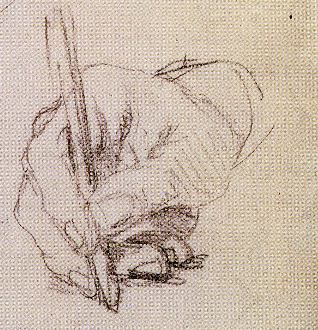
Detail, Two Studies of the Left Hand of Erasmus of Rotterdam; Study of the Right Hand Writing. Silverpoint, black crayon and red chalk on grey-primed paper, 20.6 ร— 15.3 cm, Louvre, Paris. Christian Mรผller; Stephan Kemperdick; Maryan Ainsworth; et al, Hans Holbein the Younger: The Basel Years, 1515โ€“1532, Munich: Prestel, 2006. Erasmus holds a pointed italic quill, suited to the purposes of his humanistic hand.

Erasmus ostensibly agrees, directly criticizing the customary pleonastic manner of addressing royals and nobles:

The king of the French alone is called โ€œmost Christian,โ€ the king of Spain alone โ€œCatholic,โ€ the king of England โ€œmost serene,โ€ the emperor alone โ€œever august,โ€ dukes โ€œmost illustrious,โ€ other members of the lesser nobility โ€œillustrious,โ€ and others โ€œmost noble.โ€ Who introduced this superstition about titles into the world? โ€ฆ By the constant repetition of phrases like โ€œmost reverend lordships,โ€ โ€œCatholic majesties,โ€ and โ€œmagnificent fatherhoodsโ€ we fill up a large part of a letter, and ruin the gracefulness of the Latin tongue. I pardon those who use them against their will; I do not pardon those who devise them, or who insist upon them as a serious matter.[6]

Despite this ideal, as with so many rules and regulations meant to govern the rules of prose, humanistic or otherwise, theory does not always accord with practice. Vives certainly uses flattering epithets in his own letters, despite his counsel to the contrary.[7] But although Erasmus begins by praising the โ€œmere mention of names,โ€ in practice his treatise goes on to linger on the salutatio for nearly a dozen sections, recommending the use of essential titles and the use of an aptโ€”but not sycophanticโ€”epithet (he suggests over 100 as suitable).[8]

Moreover, for the 1515 dedication to his Senecae Lucubrationes, Erasmus composes a salutation that hardly appears to follow his own advice: โ€œTo the most distinguished Father D. Thomas Ruthall,โ€ he writes, โ€œBishop of Durham, Secretary of State of the Most Serene King of Britain, Erasmus of Roterdam sends greeting.[9] Though he does give himself merely his two names Erasmus Roterodamus, he is not content to give his friend Ruthall the single epithet amplissimoโ€”he goes on to add his titles as well as those of Ruthallโ€™s master, the โ€œMost Serene King of Britain.โ€ Leaving aside the elevated diction Secretarius Magnus and the choice of Britanniae instead of Angliae, Erasmus appears to fall right into the very โ€œsuperstition about titlesโ€ he criticized above: calling the king of England โ€œmost serene.โ€ As Erasmus cannot be imagined to here use epithets โ€œagainst [his] will, in our charity we must conclude that he simply does not โ€œinsist upon them as a serious matter.โ€ Indeed, we might imagine this apparent โ€œdo as I say, not as I doโ€ as part of a game among friends. A glance at the letters of another friend of Erasmus, fellow correspondent Sir Thomas More, reveals that More uses titles only rarely in his salutationsโ€”rare exceptions include the high-flung salutation of Henry (that same most serene king of Britain) as Britanniae Galliaeque Regi and a 1506 letter addressed to Regio apud Anglos Secretario, our very own Thomas Ruthall. In the year 1506, Erasmus was staying in Moreโ€™s house at Bucklersbury, and the two were engaged in the translation of Lucianโ€™s dialogues. Moreโ€™s almost overly learned letter to Ruthall offers some โ€œfirst fruitsโ€ of these Greek studies. More and Erasmus engage here in a game of language and words, breaking their own rules, offering their efforts to a mutual humanist friend they knew would delight in their linguistic play.

Despite living the most fruitful parts of his adult career after the conclusion of what is generally considered the medieval period, Desiderius Erasmus never really attempted to avoid or evade the Middle Ages. Both in his return to the Classics and his agitations for a new humanistic approach to writing and scholarship, Erasmus continues to engage with medieval thinkers and medieval ways of thinking. In responding to and helping drive the dramatic shift away from the centuries-old medieval dictaminal tradition designed for the mass production of documents essential to the court of every Christian kingdom to a humanistic model grown out of the fourteenth-century Renaissance and Francesco Petrarchaโ€™s rediscovery of the personal letters of Cicero to his friend Atticus, Erasmus engages in a humanistic game that plays off of tension with the near medieval past.

Rebecca West, PhD
Literature Core Faculty
University of Dallas


[1] Erasmus was already writing an early version of this text for his student Robert Fisher by about 1498 (Epistularum scribendarum ratio).โ  A pirated version of his treatise was published at Oxford in 1521 by Siberch,โ  more or less forcing Erasmus to come out with an expanded, corrected official version in 1522. The standard edition of the treatise is Charles Fantazzi, ed., โ€œOn the Writing of Letters / De Conscribendis Epistolis,โ€ in The Collected Works of Erasmus: Literary and Educational Writings, 3 and 4, by J. K. Sowards, ed., 25 (University of Toronto Press, 1985). Hereafter abbreviated as CWE 25/3.

[2] CWE 25/3:50. The ars dictaminis aimed at organizing the letterโ€”a form largely meant for public declamation of official communicationsโ€”according to standardized models following a set of rules derived from ancient Ciceronian oratory. Erasmus devotes significant portions of his treatise to the proper way to frame the opening of a letter, the portion corresponding to the salutatio and captatio benevolentiae of a letter written according to the terminology of the medieval dictaminalmodel.

[3] CWE 25/3:51

[4] Charles Fantazzi, ed., J.L. Vives: De Conscribendis Epistolis: Critical Edition with Introduction, Translation and Annotation, trans. Charles Fantazzi (Leiden: Brill, 1989), 47.

[5] Vives: De Conscribendis Epistolis, 47.

[6] CWE 25/3:61.

[7] See the introduction to Fantazziโ€™s edition for the use of flattering epithets in Vivesโ€™ own corpus of letters.

[8] CWE 25/3:50-62.

[9] Amplissimo patri D. Thomae Ruthallo Episcopo Dunelmensi Serenissimi Britanniae Regis Secretario Magno Erasmus Roterodamus S. D. Text from Elizabeth Frances Rogers, ed., The Correspondence of Sir Thomas More, (Princeton: University Press, 1947), letter 5.Translation from Clarence H. Miller, Leicester Bradner, Charles A. Lynch, and Revilo P. Oliver, eds., The Complete Works of St. Thomas More, Volume 3, Part II (New Haven: Yale University Press, 1984), 1:2โ€“8.

Old Directions in Medieval Language Acquisition

When more than a dozen undergraduates successfully banded together last year to petition the administration for me to teach the first ever course in Old Norse language and literature at my (now former) institution, I vowed not to disappoint them.[1] Knowing that these students would likely never have another opportunity to spend a semester learning and reading Norse in a formal setting, I soon realized that in two one-hour meetings per week over a single semester we could hope for little more than a forced march through any standard textbook, yielding some sense of the rules of the language but no real experience reading it.

A portrait of Guรฐbrandur Vigfรบsson (13 March 1827 โ€“ 31 January 1889) byย Sigurรฐur mรกlari.

Broadening my search, I came across Guรฐbrandur Vigfussonโ€™s 1879 Icelandic Prose Reader. Vigfusson recommends jumping right into reading, ideally beginning by muddling through the Gospel of Matthew, with which he assumes students will be familiar, before moving on to a shorter sagaโ€”he recommends Eirik the Red. He offers this advice:

The beginner should at first trouble himself as little as possible with grammatical details, but try the while to get hold of the chief particles, the pronouns, and a few important nouns and verbsโ€”the staple words of the languageโ€ฆThe inflexive forms are of less import; they will be more easily learnt and better remembered, if they are allowed to grow bit by bit on the mind, as they occur in the reading. Grammar is, after all, but the means to an end, and much of oneโ€™s freshness and power of appreciation is lost, if it is incessantly diverted from the subject before one, to the ungrateful study of dry forms.[2]

Though the reader does come equipped with a brief grammar consisting primarily of tables and charts, Vigfusson underscores his grammar-deemphasized, reading-first method by featuring the texts first in the volume, grammar second.

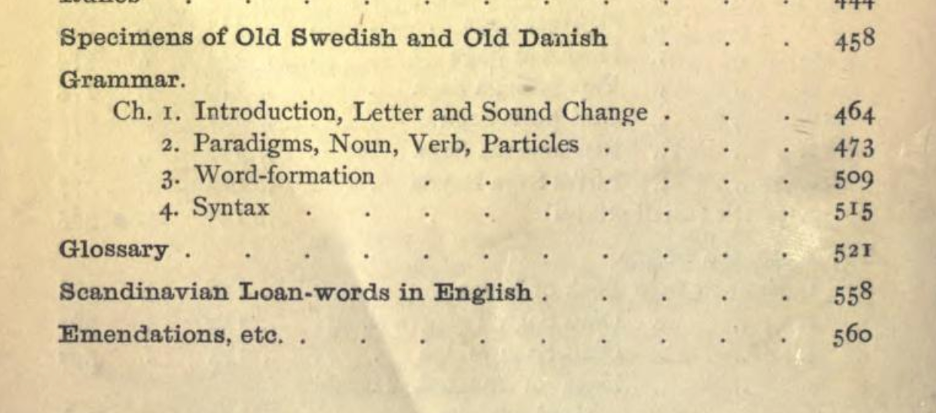
The grammar portion makes up only fifty pages of 560.

Though Vigfusson gave very little concrete advice for teaching besides a general idea to dump students in and let them swim, it got me thinking about how else we might teach and learn old north germanic languages. How did medieval students and teachers approach language learning?

The Anglo-Saxons (despite or perhaps due to King Alfredโ€™s lamentations about the state of Latin learning in his realm) were particularly accomplished language learners, as anyone considered truly literate had to read and write a completely foreign languageโ€”Latin. This literacy included many skills besides grammatical analysis. To quote R.W. Chambers, โ€œtheir aim was to read Latin, write Latin, and dispute in Latin.โ€[3] Recallingโ  Vigfussonโ€™s suggestion to start with the Gospel of Matthew, the youngest students of written Latin would begin with the Psalms, which they had previously learned by heart, along with the letters of the alphabet and various Latin prayers.[4] The upshot is, medieval students had a lot of the target language in their ears and memorized by heart before they ever began a program of study directly aimed at mastering grammar, learning to read, and creating in the language.

Then theyโ€™d move on to the Latin colloquy, question-and-answer dialogues meant to be memorized, acted out, and expanded through creative variation. One of the best-known colloquies, written for young scholars by prolific homilist and grammarian ร†lfric of Eynsham at the turn into the eleventh century, was paired close to the time of ร†lfric himself with an interlinear Old English gloss. Iโ€™d like to suggest a way of using this text in class in a way that goes beyond reading or translating the Old English (or the Latin, for that matter).[5]

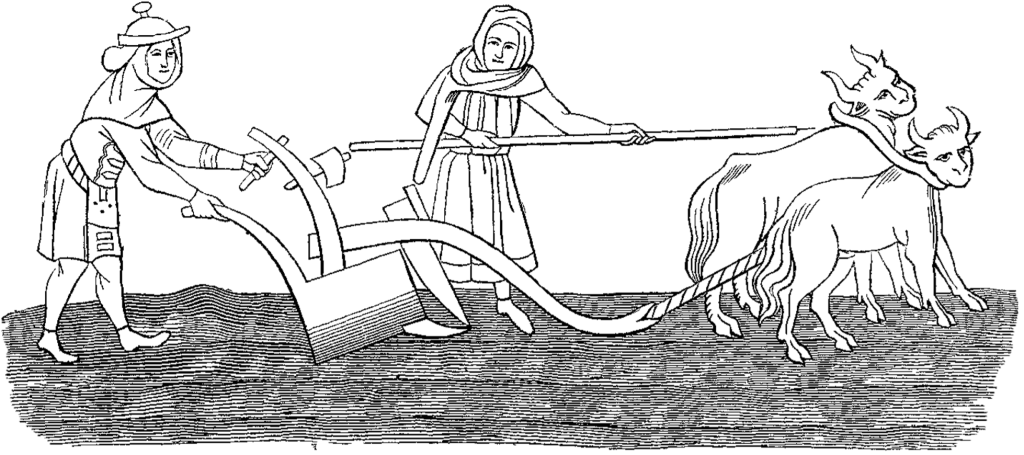
The early part of the colloquy is set up as a question-and-answer between the teacher and a classfull of students, who take the parts of people working diverse jobs, a ploughman, a monk, a hunter, a cook, etc.

Facsimile of a Miniature in a mediaeval manuscript published by Shaw, with legend โ€œGod Spede รพe plough, and send us korne enow.โ€ Image in the Public Domain.

Here the teacher (perhaps played by one of the students) introduces us to the ploughman.

Hwรฆt sรฆแตนest รพu, yrรพlinแตนc? Hu beแตนรฆst รพu weorc รพin?

Eala, leof hlaford, รพearle ic deorfe. Ic แตนa ut on dรฆแตนrรฆd รพywende oxon to felda, and iuแตนie hiแตน to syl; nys hit swa stearc winter รพรฆt ic durre lutian รฆt ham for eแตนe hlafordes mines, ac แตนeiukodan oxan, and แตนefรฆstnodon sceare and cultre mit รพรฆre syl, รฆlce dรฆแตน ic sceal erian fulne รฆcer oรพรพe mare.

A passage like this gives ample opportunity for working in the target language even beyond memorizing and acting out the dialogue (both excellent for building vocabulary and familiarity with grammatical structures). It also allows for imitation and creative response to a series of questions based on the text.

One question is already built into the dialogue.

Eala yrรพlinแตนc, hu beแตนรฆst รพu weorc รพin?

  • Ic แตนa ut on dรฆแตนrรฆd รพywende oxon to felda, and iuแตนie hiแตน to syl.

But we can ask other questions that test comprehension and encourage active imitation.

For example:

Hwรฆt รพฤ“oweรพ sฤ“ yrรพlinแตนc ut to felda?

  • Sฤ“ yrรพlinแตนc รพฤ“oweรพ to felda รพรฆs oxon.

Even without knowing exactly how to conjugate the verb, the student gets to employ the correct form in context through recognition and imitation. I say โ€œรพฤ“oweรพ,โ€ and the student recognizes it as the form needed in the response.

I can drill conjugation, though, if I want:

Eala yrรพlinแตนc, hwรฆt รพฤ“owst รพu to felda? (Exaggeratedly pointing a finger at the student to emphasize the second person singular pronoun)

  • Ic รพฤ“owe รพรฆs oxon.

The student will quickly begin to recognize that โ€œรพฤ“owst รพuโ€ needs โ€œic รพฤ“oweโ€ as a response. If a student says โ€œic รพฤ“owstโ€ or similar, I might repeat back โ€œรพu รพฤ“owst, ic รพฤ“oweโ€ (with approriate finger pointing) and move right along.

We can work with different verbs:

Eala yrรพlinแตนc, hwรฆt iugast รพu to syl?

  • Ic iugie รพรฆs oxonto syl.

And play with conjugation:

Hwรฆt iugiaรพ sฤ“ yrรพlinแตนc to syl?

  • Sฤ“ yrรพlinแตนc iugiaรพ รพรฆs oxon to syl.

But there are plenty of other questions we could ask about the same bit of dialogue.

Eala yrรพlinแตนc, hwaenne gรฆst รพu ut to felda?

  • Ic gฤ on dรฆแตนrรฆd to felda.

Hwon gรฆรพ sฤ“ yrรพlinแตนc ut to felda?

  • Sฤ“ yrรพlinแตนc gรฆรพ ut to felda for eแตนe his hlafordes.

Students might start out with one- or two-word responses. โ€œYea.โ€ โ€œOxon.โ€ โ€œOn dรฆgrรฆd.โ€ But with encouragement and practice with mirroring back much of the content of the question, they will start to put together more complex utterances.

I might ask:

Hwรฆรพer sฤ“ yrรพlinแตนc gรฆรพ ut to felda nihtes?

  • Se yrรพlinแตนc ne gรฆรพ ut to felda nihtes. Sฤ“ yrรพlinแตนc gรฆรพ ut to felda on dรฆแตนrรฆd.

or

Hwรฆรพer sฤ“ yrรพlinแตนc willaรพ gan ut to felda?

  • Se yrรพlinแตนc ne willaรพ gan ut to felda. Sฤ“ yrรพlinแตนc gรฆรฐ ut to felda for eแตนe his hlafordes.

These examples give some idea of the approach Iโ€™ve used, alongside extensive reading of accessible texts, to great result in my Old Norse and Latin classes. The method can be applied to other readings, even if you spend most of the class translating. Pull out a few sentences youโ€™d like to drill down into and ask questions about in the target language.

As a postscript, we did read the gospel of Matthew and the saga of Eirik the Red, and my former students have kept up a Norse reading group, without further help or interference from me.

Rebecca M. West, Ph.D.
The Center for Thomas More Studies
Hillsdale College


[1] An earlier version of this material was presented at ICMS 2024.

[2] Vigfusson, An Icelandic Prose Reader, vi.

[3] R. W. Chambers, Thomas More, 58.

[4] See Garmonsway, ร†lfricโ€™s Colloquy, 12.

[5] I took inspiration from the Latin colloquy in developing new materials for my Old Norse class, but the teacher of Old English is saved this laborious step.