The โ€œSinfulโ€ Soldiers of the Early Ottoman Military Structure: ฮฟฮน แผฮผฮฑฯฯ„ฯ‰ฮปฯŒฮน

This short research blog focuses on the development of the word แผฮผฮฑฯฯ„ฮฌฮฝฯ‰ โ€œto sinโ€ from the advent of Christianity to the late Byzantine era. The word, แผฮผฮฑฯฯ„ฮฌฮฝฯ‰, is widely used in the Bible as it appears forty-three times. To wordโ€™s primary meaning in the Bible was to โ€œerr and sinโ€; however, from time to time, it was also used to signify the action of offending. แผฮผฮฑฯฯ„ฮฌฮฝฯ‰ occurs in many different forms in the New Testament as we see it in aorist first-person singular active form แผญฮผฮฑฯฯ„ฮฟฮฝโ€ eight times, second-person singular indicative middle six times, and second-person indicative active plural form three times.[1] I will trace the different nuances in the meaning of this word in the subsequent periods, especially in the late Byzantine period. My argument is that as several Greek and non-Greek sources indicate, the word แผฮผฮฑฯฯ„ฮฌฮฝฯ‰ began having a military connotation in this period as it was applied to the Christian military units who had cooperated with the enemy forces, especially the Turks.

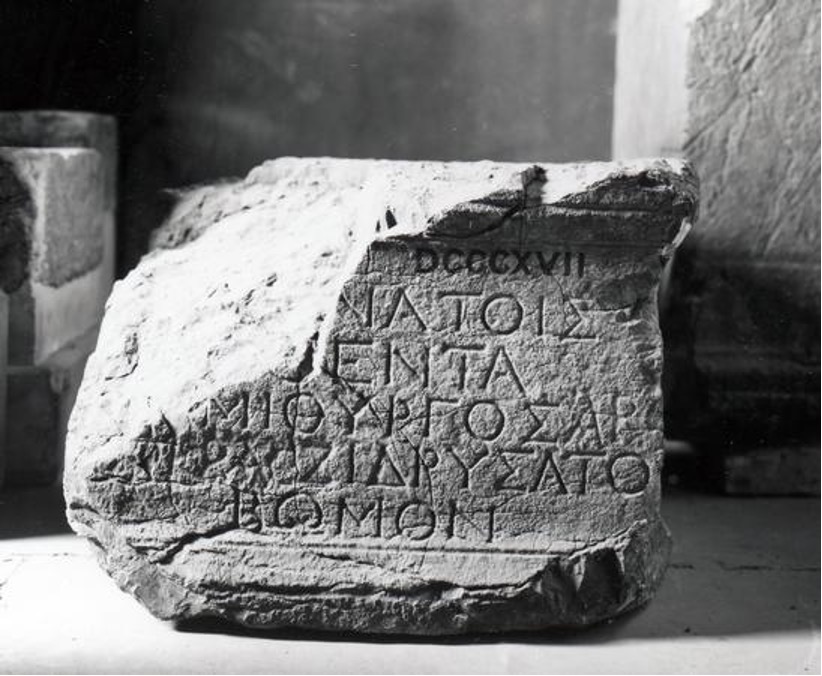
Inscription, in The Collection of Ancient Greek Inscriptions in the British Museum

        In Homeric times, แผฮผฮฑฯฯ„ฮฌฮฝฯ‰ had no religious connotation. The Theological Dictionary of the New Testament suggests that, initially, the word was used to convey the action of โ€œmissingโ€ i.e failure to follow rules and signify a moral deficit or immoral physical undertaking. [2] However, in the later periods (c. 400 BCE), we begin seeing a shift from legal to religious use since แผฮผฮฑฯฯ„ฮฌฮฝฯ‰ made its way to the Book of Kings in the old testament, meaning โ€œto rebelโ€ against the god and his order in the earth.[3] From a theological standpoint, rebelling against the will of God means to err from the true path and therefore to sin. In this way, those who had intentionally deviated from moral or religious standards came to be defined as ฮฑฮผฮฑฯฯ„ฯ‰ฮปฯŒฯ‚ โ€œthe sinful oneโ€ in the later Christian religious texts.[4]

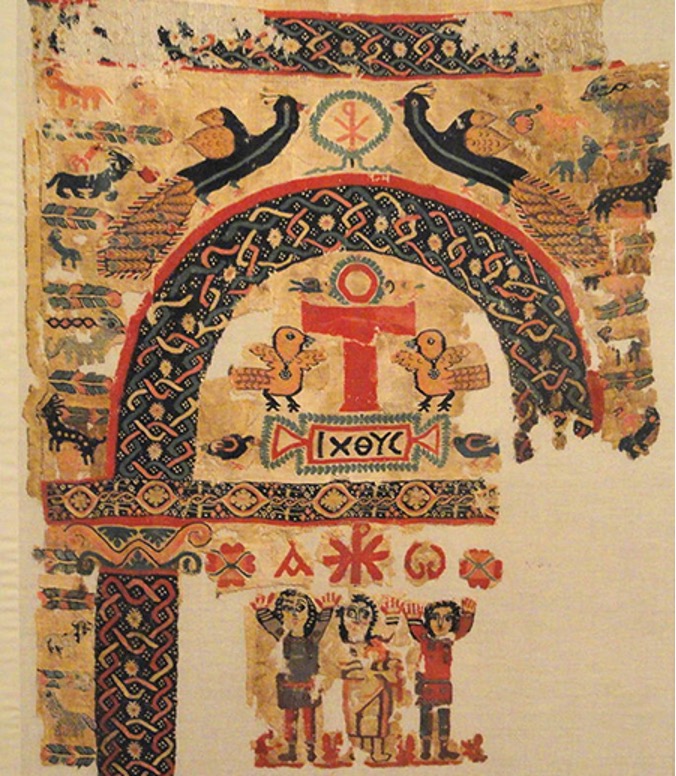
Early Christian symbols on an Egyptian textile, the Cleveland Museum of Art, Cleveland, Ohio.

        แผฮผฮฑฯฯ„ฮฌฮฝฯ‰ is mostly used to signify the action of โ€œsinโ€ and neglecting the commands of God with an exception of โ€œoffendingโ€ in the New Testament.[5] In the Book of Romans, for instance, we see the following structure: โ€œฮณแฝฐฯ แผ€ฮฝฯŒฮผฯ‰ฯ‚ แผฅฮผฮฑฯฯ„ฮฟฮฝ แผ€ฮฝฯŒฮผฯ‰ฯ‚ ฮบฮฑแฝถโ€ which means โ€œIndeed without law I sinned without law also[โ€ฆ]โ€.[6] Here, แผฮผฮฑฯฯ„ฮฌฮฝฯ‰ was used in the aorist, active, and indicative form. In another example, this time from the Book of Corinthians, the word is used in such a construction: โ€œฮฟแฝ•ฯ„ฯ‰ฯ‚ ฮดแฝฒ แผฮผฮฑฯฯ„ฮฌฮฝฮฟฮฝฯ„ฮตฯ‚ ฮตแผฐฯ‚ ฯ„ฮฟแฝบฯ‚โ€ meaning โ€œthus moreover sinning against those [โ€ฆ]โ€ in the participle, present, active form.[7] Besides the action of sinning, แผฮผฮฑฯฯ„ฮฌฮฝฯ‰ seems to be used in a different meaning, โ€œto offendโ€, in the Book of Apostles although a minor disagreement exists between various interpreters. Regarding the following phase: โ€œฮšฮฑฮฏฯƒฮฑฯฮฌ ฯ„ฮน แผฅฮผฮฑฯฯ„ฮฟฮฝ[โ€ฆ]โ€ while New American Standard Bible renders the word as โ€œcommittingโ€, the King James version translate the term as โ€œoffendingโ€. However, the new international version disagrees with these suggestions, interpreting the whole phrase as โ€œCaesar [in] anything sinned [โ€ฆ]โ€.[8]

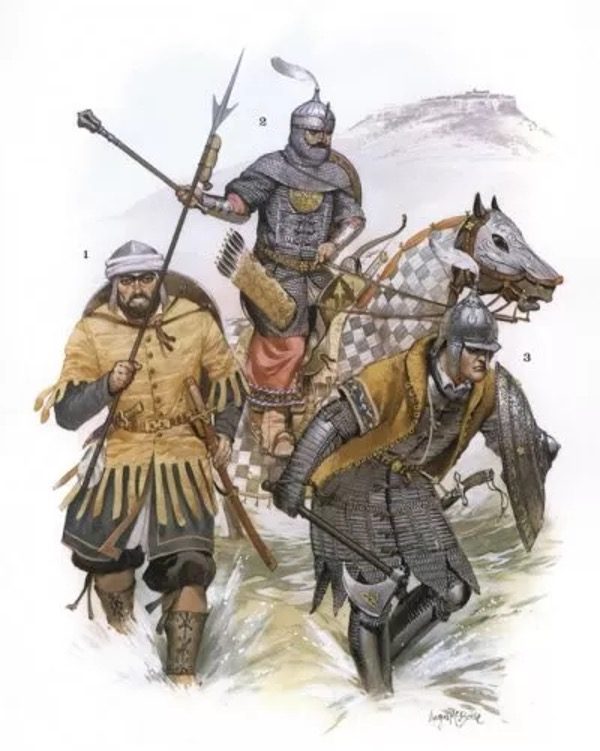
Nicolle, David. Armies of the Ottoman Turks 1300-1774. London: Osprey, 1983.

        Besides its use in legal and religious spheres, towards the late Byzantine period, we begin seeing the word, แผฮผฮฑฯฯ„ฮฌฮฝฯ‰, or its variants in Greek and Turkish texts in the military context. With the Turkish advance towards western Asia Minor and the Balkans in the later 13th and early 14th centuries, the local Greek-speaking people began adjusting to the newly established political reality in their respective territories by means of cooperating with their new rulers. A significant portion of the Greek population in these regions had converted to Islam, while others participated in the Ottoman military system as auxiliary units. As the later Byzantine writer Pachymeres states in his ฮ™ฯƒฯ„ฮฟฯฮฏฮฑ, the Greeks from Anatolia, โ€œแผฯ€ฮนฮผฮนฮพฮฌฮฝฯ„ฯ‰ฮฝ ฮบฮฑแฝถ แฟฌฯ‰ฮผฮฑรญฯ‰ฮฝ แผฮพ แผ€ฮฝฮฑฯ„ฮฟฮปแฟ†ฯ‚โ€, had occasionally joined the Turkish forces to raid the Byzantine territories in the hopes of acquiring material gain.[9] Besides Pachymeres, Doukas also refers to these Greek collaborators in his historical work, calling them โ€œฮผฮนฮพฮฟฮฒฮฑฯฮฒฮฑฯฮฟฮนโ€ meaning half-Greek and half-Turks.[10] Although these authors shunned using the word, แผฮผฮฑฯฯ„ฯ‰ฮปฯŒฯ‚, several Turkish authors borrow this term from their Greek correspondents. An early Ottoman called AลŸฤฑkpaลŸazade reports that the founder of the Ottoman principality, Osman Gazi, had a โ€œmartolosโ€ ( ู…ุงุฑุชู„ูˆุณ) by the name of Artun who acted as a spy in the Byzantine territories for the Ottomans.[11] After the Ottoman conquests in the Balkans, as the land surveys indicate, the Ottomans had given landed estates to several Christian military units who were also called โ€œmartolosโ€.[12]

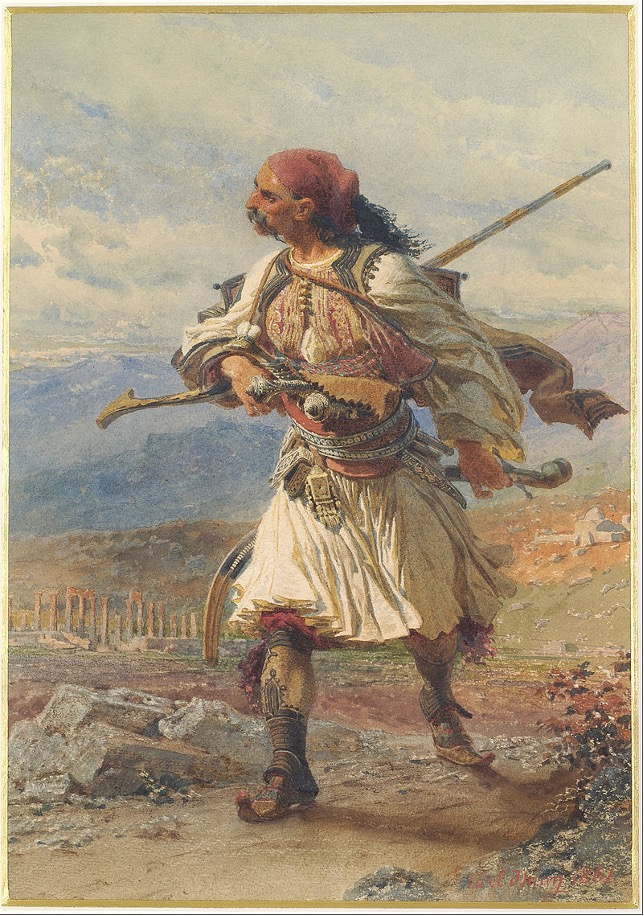
Greek Armatolos by Carl Haag (1820โ€“1915).

         Lastly, after the mid-fourteenth century, the Ottomans also formed provincial forces in mainland Greece named โ€œarmatolosโ€ which had a clear phonetic resemblance with the word โ€œamartolosโ€. Although several scholars argued that this term had derived from a medieval loan word from Latin arma โ€œweaponโ€ via Greek ฮฑฯฮผฮฑฯ„ฮฟฮปฯŒฯ‚ it is also within the boundaries of possibility that the development of that word might have originated from ฮฑฮผฮฑฯฯ„ฯ‰ฮปฯŒฯ‚ since the use of the latter preceded the former. During the Greek War of Independence (1821-1828), these ฮฑฯฮผฮฑฯ„ฮฟฮปฯŒฯ‚ units had actively participated in military encounters against the Ottoman forces as we are able to trace their role in Greek folk songs: โ€œฯƒฯ…ฮปฮปฮฟฮณฮนฯƒฯ„ฮตฮฏฯ„ฮต ฯ„ฮฟ ฮบฮฑฮปฮฌ, /ฯŒฯ„ฮน (: ฮณฮนฮฑฯ„ฮฏ) ฯƒฮฑฯ‚ ฮบฮฑฮฏฮผฮต ฯ„ฮฑ ฯ‡ฯ‰ฯฮนฮฌยท / ฮณฯฮฎฮณฮฟฯฮฑ ฯ„โ€™ ฮฑฯฮผฮฑฯ„ฮฟฮปฮฏฮบฮน,/ ฮฟฯ„โ€™ ฮตฯฯ‡ฯŒฮผฮฑฯƒฯ„ฮต ฯƒฮฑฮฝ ฮปฯฮบฮฟฮนโ€ โ€œThink well, / that [why] we burn your villages; / quickly the armatoliki, / that we come like wolvesโ€.[13]

        In sum, แผฮผฮฑฯฯ„ฮฌฮฝฯ‰ had no religious implications during Homeric times as it was used to convey the idea of โ€œmissingโ€ (i.e. โ€œmissing the markโ€). However, in the later periods, it started appearing in the Bible as the word began to signify the act of transgression against the word of God. In the late Byzantine period, however, a derivation of this word,  แผฮผฮฑฯฯ„ฯ‰ฮปฯŒฯ‚, was used for Christians who cooperated with the enemy forces since it was thought that they rebelled against God by aligning themselves with the non-Christian adversaries. 


[1] Thesaurus Linguae Graecae. Search for word: แผฮผฮฑฯฯ„ฮฌฮฝฯ‰.

[2]Danker, Frederick W. et al., A Greek-English Lexicon of the New Testament and Other Early Christian Literature (Exeter: Eerdmans, 1974) 44.

[3] Ibid. 43.

[4] Oxford Classical Greek Dictionary, ed. James Morwood and John Taylor, (Oxford: Oxford University Press, 2002)

[5] Geoffrey W. Bromiley. Theological Dictionary of the New Testament. Exeter: William Eerdmen Publishing, 1985. 49.

[6] www.biblegateway.com, Romans 2:12-16.

[7] www.biblegateway.com, Corinthians 8-12.

[8] www.biblegateway.com, Acts 25:8.

[9] George Pachymeres, Relations Historiques, ed. Albert Failler, 5 vols (Paris, 1984โ€“2000) 4:643.18.

[10] Doukas, Decline and Fall of Byzantium to the Ottoman Turks by Doukas, ed. Harry Magouilas. Detroit, 1975. 33.

[11] AลŸฤฑkpaลŸazade, OsmanoฤŸullarฤฑโ€™nฤฑn Tarihi ed. Kemal Yavuz and Yekta Saraรง. ฤฐstanbul: MAS Matbaacฤฑlฤฑk, 2003. 324.

[12] Suret-i Defter-i Sancak-ฤฑ Tirhala, ed. Melek Delilbasi and Muzaffer Arikan, (Ankara: TTK, 2001) 296-334.

[13] Demetrius Petropoulos, ฮตฮปฮปฮทฮฝฮนฮบฮฑ ฮดฮทฮผฮฟฯ„ฮนฮบฮฑ ฯ„ฯฮฑฮณฮฟฯ…ฮดฮนฮฑ Vol1 (Greek Popular Songs), (Athens: ฮ’ฮฑฯƒฮนฮบฮท ฮฒฮนฮฒฮปฮนฮฟฮธฮทฮบฮท, 1958): 3-65.

Elisabeth Achler, Patron Saint of Crazy Cat Ladies

Vernacular religious literature from fifteenth-century Germany is not known for being eloquent, creative, or interesting. When I proposed a dissertation topic that heavily involved the eraโ€™s didactic literature, one of the members of my committee responded, โ€œAre you sure you want to do that?โ€

Yet fifteenth-century Germans produced more vernacular literature than any other time or place in the Middle Ages, and scholars estimate seventy to eighty percent of it was religious. [1] These books, however lacking in literary splendor, were wildly popular both to read and to write; they survive from clerical and lay libraries alike.

            The context adds one more layer to the interesting (really!) German hagiography of Elisabeth Achler von Reute (1386-1420), written by her confessor Konrad Kรผgelin. Kรผgelin wins no prizes for his prosecraft, to be sure. He makes up for it with his ebulent enthusiasm for Achlerโ€™s sanctity and his obvious concern for her as a person. But most of all, he makes up for it through the often colorful stories he spins out of what was apparently a quiet and peaceful cloistered life.

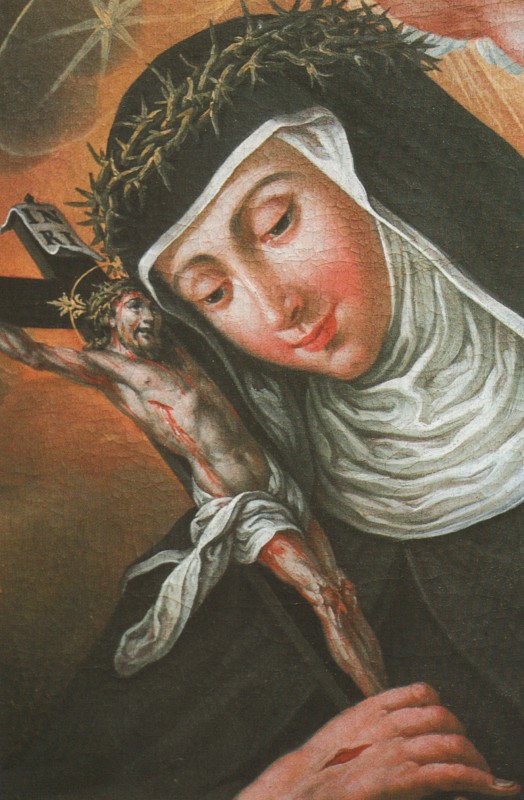
Painting of Elisabeth Achler in the monastery at Ruete. Paulin Link, “The Good Beth,” Ostfildern, 1992.

            Achler was a sister in a convent founded by Augustinian friar Kรผgelin and loosely affiliated with the Franciscan Order. As her Leben shows, she spent most of her adult life struggling to fit the mold of a late medieval holy woman. Above all, that mantle meant self starvation. Achler was either a star or a fraudโ€”depending on whether you asked Kรผgelin or asked his portrayal of the conventโ€™s other sisters.

            Kรผgelin insists upon their suspicion (argwon) of Achlerโ€™s supposed miraculous inedia again and again through the Leben. Heโ€™s not reticent about the reason for the emphasis: it demonstrates Achlerโ€™s Christ-like forebearance in the face of persecution. Here, Iโ€™m going to look at two episodes depicting the sistersโ€™ suspicion.

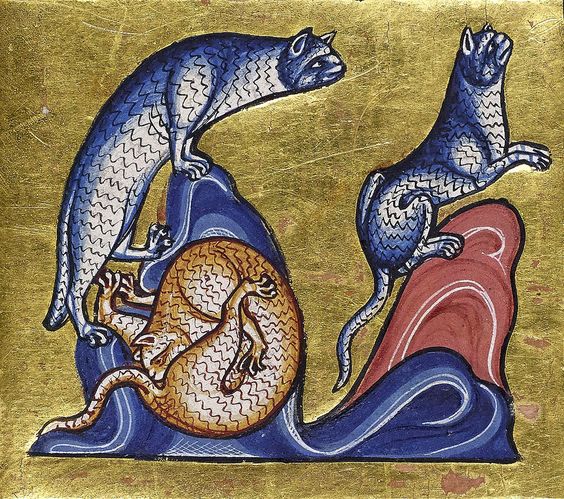
            The first one is actually pretty cute, or at least, it would be cute if it werenโ€™t so sad. One day, the sister assigned to the kitchen sets up to cook several pieces of meat. But when itโ€™s time to eat, there are only two pieces left. When one sister wonders aloud where the meat went, the cook answers, โ€œOh, where all the other things must goโ€”our cat with two legs must have taken it.โ€ [2]

Cats, Aberdeen Bestiary, England ca. 1200 Aberdeen University Library, MS 24, fol. 23v.

            The โ€œcat with two legsโ€ story is short and almost sweet, even if Kรผgelin was attempting to portray the sistersโ€™ suspicion instead of their support for Achlerโ€™s efforts at sanctity. A second anecdote could likewise be spun as suspicion or concern. Realizing that Achler hasnโ€™t been eating, one sister goes off to the town of Reute to buy โ€œlittle fishesโ€ that hopefully she will like. Achler dutifully eats themโ€”demonstrating her adherence to monastic obedience, of course. But she almost immediately throws them back up, not even slightly digested. [3]

            In both cases, Kรผgelinโ€™s presentation of events can be read as suspicious sisters setting a deliberate trap with simmering meat on the stove or specially-purchased fish, or as concerned sisters desperately trying to get Achler to eat something. Rather than unravel that mystery, Iโ€™m going to take a more basic approach: Kรผgelinโ€™s presentation of events can be read in the first place.

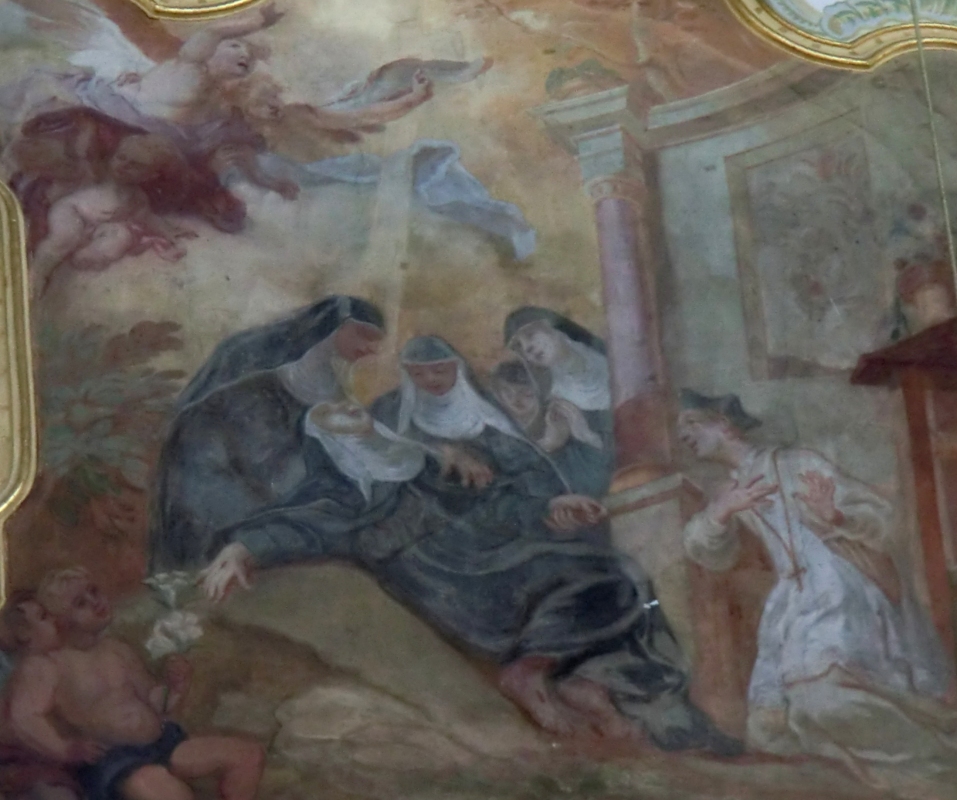
Eustachius Gabriel: Elisabeth on her death bed, accompanied by sisters and Konrad Kรผgelin, fresco, 1764, restored in 1875, in the Church in Reute.

            Kรผgelin wrote numerous drafts of Achlerโ€™s Leben, which survive in multiple manuscripts. Their relationship was examined by Karl Bihlmeyer in 1932, who showed that the cat with two legs story and the little fishes episode are both new to one of the revisions. In the oldest version, the two anecdotes have only a faint presence. Regarding the first, Kรผgelin notes that some beans and lentils went missing from the kitchen. Thatโ€™s the beginning and end of the โ€œactionโ€ in a long paragraph emphasizing suspicion. No simmering meat, no cute comments. In the little fishes story, similarly, there are no trips to town and no little fishes. Achler eats something one day and promptly throws it up. [4]

            Thus, Kรผgelin added or embellished stories from the likely first to the likely second drafts of Achlerโ€™s Leben.

            As a modern reader, I appreciate this development. As a scholar who told her concerned committee member, โ€œYes, Iโ€™m sure,โ€ I also appreciate that Kรผgelin went against contemporary trends when he increased the entertainment value of the hagiography. He did the equivalent of writing out his sermons with great exempla already woven in.

            Unfortunately and unfairly, I have to leave youโ€”and more to the point, meโ€”without a snappy conclusion regarding why Kรผgelin believed these later additions would strengthen the case for Achlerโ€™s sainthood. But look on the bright side. Two different versions of Achlerโ€™s hagiography have been in print since 1881 and 1932. What better time to start comparing them than 2020?

Cait Stevenson
PhD in History
University of Notre Dame

—

[1] See, for example, Karl Ruh, โ€œGeistliche Prosa,โ€ in Europรคisches Spรคtmittelalter, ed. Willi Ergrรคber, Neues Handbuch der Literaturwissenschaft 8 (Akademie Verlagsgesellschaft Athenaion, 1980), 565; Werner Williams-Krapp, โ€œThe Erosion of a Monopoly: German Religious LIterature in the Fifteenth Century,โ€ in The Vernacular Spirit: Essays on Medieval Religious Litearture, ed. Renate Blumenfeld-Kosinski, Duncan Robertson, and Nancy Bradley Warren (Palgrave, 2002), 239.

[2] Anton Birlinger, ed., โ€œLeben heiliger alemannischer Frauen I: Elisabeta Bona von Reute,โ€ Zeitschrift fรผr Sprache, Litteratur, und Volkskunde des Elsasses, Oberrheins und Schwabens 9 (1881): 280.

[3] Birlinger, 281.

[4] Karl Bihlmeyer, ed., โ€œDie Schwรคbishe Mystikerin Elsbeth Achler von Reute (d. 1420) und die รœberlieferung dihrer Vita,โ€ in Festgabe Philipp Strauch zum 80. Geburtstage am 23. September 1932, ed. Georg Baesecke and Ferdinand Joseph Schneider (Max Niemeyer Verlag, 1932), 101-102.

โ€œTo Hell or Heaven with the Greeksโ€: Common Apocalyptic Beliefs Between the Turks and the Greeks in the Late Middle Ages

        The expansion of the Oghuz Turks towards the Levant region in the early to mid- 11th century had crucial importance not only for the Middle eastern region but also world politics. The expansion of the Turkish political dominance in the region culminated in the Battle of Manzikert in 1071 which paved the way for various Turkish-speaking groups to migrate to Anatolia in the hopes of finding a new financial resource for their nomadic economic structure. The Turks conquereed to the region by the force of arms; however, as time passed, they began to adapt to the cultural, ecologic, politic and socio-economic realities of their new homelands. Their close interactions with the neighboring communities not only reshaped their physical appearances, economic structures, administrative and bureaucratic practices but also introduced them to new spiritual and religious beliefs. Contemporary scholarship in the area of interfaith and several cross-cultural studies have recently demonstrated how the Turks actually borrowed eschatological ideas and notions with respect to the end of the world and the developments that are expected to take place prior to this cataclysmic event.  

        Although interfaith and cultural exchange began taking place between the Greeks and Turks immediately after 1071 (and perhaps even before then), I would argue these interactions noticeably increased alongside the Turkish political expansion towards western Anatolia and Thrace especially after the late 1200s and early 1300s. The missionary activities of Turkish holy men and the tolerant attitudes of the state officials in these Turkish-controlled regions created an environment for Christians and Muslims to discuss various spiritual matters and learn more about each otherโ€™s faiths. In fact, one of the most influential Orthodox clerics, Gregory Palamas, was invited by the Ottoman court to converse about religion with a Muslim spiritual figure in the 1340s. Referring to several striking similarities between the Jesus Prayer and Dhikr practice, some scholars even argue that the influence of Islamic Sufi ideology encourages the appearance of Hesychasm in the Byzantine spiritual environment in this period.[1] Besides the Islamic ideological influence over Orthodox Christianity, it seems that some Christian beliefs also disseminated among the Muslim believers.

Christ as the apocalyptic Lamb with the cross on the throne surrounded with seven candlesticks. Chancel mosaic, 6th century CE.

        A certain Ottoman Sufi by the name of Ahmed Bican who lived in fifteenth century Gallipoli seems to have possessed an extensive knowledge about the Byzantine apocalyptic traditions. In his book, Dรผrr-i Meknรปn, not only he did refer to several Byzantine messianic beliefs, but he also refashioned them with an Islamized veneer. For example, although there is no certain date regarding the end of the world in the theology, adopting the Byzantine tradition, adopted the opinion that doomsday will take place in 1492. What is even more noteworthy is his familiarity with the Byzantine liturgical calendar. It seems that he was personally aware of the Byzantine system since he states that Byzantine scholars determined the era of humankind as 7000 years; however, since Muslims use a lunar calendar instead of solar calendar, he notes that it should be regarded as 7200 years by the Muslims. 

        Furthermore, a general belief about the blonde people in Byzantine apocalyptic and messianic expectations can be observed in Bicanโ€™s work too. According to these, the Byzantine peoples believed that their capital, the city of Constantinople, will fall to their enemies one day; however, a blonde nation from the northern regions will soon appear to help the Greeks to โ€˜liberateโ€™ their previous possession, expelling the Muslims as far as Syria. In his work, Bican also stated that one of the โ€œblonde peoplesโ€ from the northern regions will indeed recapture Constantinople and expel the Muslims soon but he also made some additions to the story. Attributing a messianic role to the Ottoman ruler, he argued that the sultan will appear in this desperate situation and be able to defeat the blonde people by recapturing Constantinople for the second time, glorifying the religion of Islam.

Georgios Klontzas, “The Last Judgement” (1540-1608).

         Yet lastly, Bican seems to have been aware of a Greek messianic tradition prophesizing โ€œthe return of the kingโ€ which promises a rightful ruler will reclaim the throne of Constantinople.  The Laskaris dynasty which came to power in Nicaea after 1204 had a special importance for western Anatolians since Laskarid rulers initiated an economic development program in the region and successfully protected the eastern borders against the Turcoman incursions in this period. When Michael Palaeologus usurped the Byzantine throne in 1261 by imprisoning and then blinding John, the last Laskarid ruler of the empire, the western Anatolian Byzantines began developing stories, predicting his expected return. Cyril Mango argues this belief even spread to the European half of the empire since a prophecy which was circulated in the 13th century tells about a civil war that would take place in Constantinople. According to this prophecy, he argues, at the end of the civil war, as an old and shabbily dressed man, John Laskaris would appear in Constantinople to be crowned by the angels. His shabbily dress and his old age refers to the imprisonment case and signals that a civil war will take place in his later years. After the enthronement, the angels will give him a sword, saying; โ€œTake courage, John, vanquish the enemy!โ€

Depiction of a Deviant Dervish from the Early Ottoman Period (Abdal-i Rum), in The Nauigations, Peregrinations, and Voyages, Made into Turkie by Nicholas Nicholay Daulphinois, trans. T. Washington the Younger, 103r.

        In Bicanโ€™s work, I think, it is possible to observe several clues about this late Byzantine apocalyptic expectation since Bican also talks about a civil war that would wake place in Constantinople. According to his interpretation, the fighting parties will be led by two military figures who have these initials in their name: โ€œMโ€ and โ€œSโ€. Although, I think, โ€œMโ€ might represent Michael Palaeologus, โ€œSโ€ does not match with Johnโ€™s initial. However, I argue that this letter might be modified in a later period due to Bicanโ€™s concern with adjusting it to a specific contemporary ruler. It is also within the boundaries of possibility that โ€œSโ€ stands for the second and last consonants of the dynastic name of John: Laskaris. Although the events were given in a very fragmented nature in this work, Bican also points out an imprisonment case, saying that the imprisoned will soon take the throne by defeating his enemy which has a clear resemblance with John Laskarisโ€™ imprisonment by Michael.

Depiction of a Heterodox Dervish Figure (Portrait of a Qalandar), Timurid, 9th-15th century. ยฉ Metropolitan Museum of Art, New York (Cora Timken Burnett Collection, 57.51.30).

        Messianic and apocalyptical intellectual exchange constitute a small part of interactions between the various groups of Christians and Muslims, who have lived in the Middle East and the Balkans side by side for the centuries. There are many more cultural and religious interactions between these people in this regard including but not limited to spread of brotherhood (futuwwa) institutions from the crusader states to the Muslim world in the Levant region. Although scholars have begun turning their focus to these borrowings in the eastern Mediterranean in the last couple of decades, there are still a long way to traverse since western Anatolia and the Balkans have received less attention so far. Hopefully, as the winds of time are changing, more scholars and students will become curious about the relations, interactions and shared traditions between Christians and Muslims in Istanbul and beyond.

Husamettin Simsir
PhD Candidate in History
University of Notre Dame

Further Reading

Arnakis, G. Georgiades. โ€œGregory Palamas among the Turks and Documents of His Captivity as Historical Sources.โ€ Speculum, Vol. 26, No. 1 (1951): 104-118.

Bican, YazฤฑcฤฑoฤŸlu Ahmed. Dรผrr-i Meknun. Trans. Necdet SakaoฤŸlu. ฤฐstanbul: Tarih Vakfฤฑ Yurt Yayฤฑnlarฤฑ, 1999.

Karamustafa, Ahmet. God’s Unruly Friends. Utah: University of Utah Press, 1994.

Preiser-Kapeller, J. โ€œWebs of conversion. An analysis of social networks of converts across Islamic-Christian borders in Anatolia, South-eastern Europe and the Black Sea from the 13th to the 15th cent.โ€ Workshop Cross-cultural life-worlds, Institute for Byzantine Studies, Austrian Academy of Sciences, Bamberg 2012.

ลžahin, Kaya โ€œConstantinople and the End Time: The Ottoman Conquest as a Portent of the Last Hourโ€ Journal of Early Modern History 14 (2010): 317-354.

Shawcross, Teresa. โ€œIn the Name of the True Emperor: Politics of Resistance after the Palaiologan Usurpationโ€ Byzantinoslavica 66 (2008): 203-229.

Spanos, Apostolos. โ€œImperial Sanctity in Byzantium: The case of the emperor John III Vatatzesโ€ Research Gate 10.13140/RG.2.1.3635.6248.


[1] Nicol defines the prayer practice in the Eastern Christian tradition as follows: โ€œin the solitude of his cell, the monk must sit with chin resting on his breast and eyes fixed upon his navel. Then, while carefully regulating his breathing, he must say over the Jesus-Prayer.โ€ Donald M. Nicol, Church, and Society in the Last Centuries of Byzantium (Cambridge: Cambridge University Press, 2008) 38.