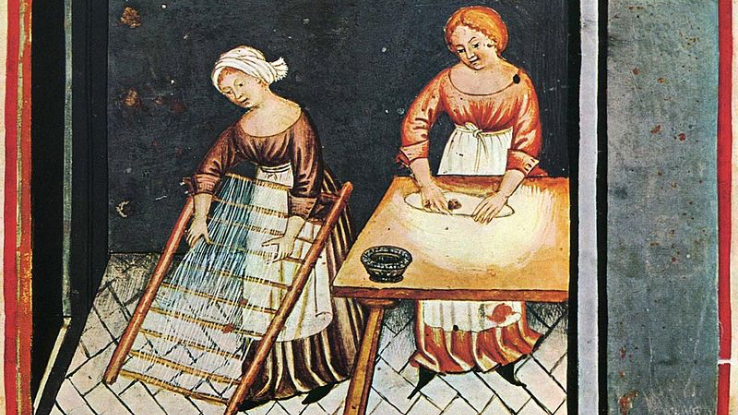
Women making pasta, from the workshop of Giovannino de Grassi, Italy, 1390s
Nobody loves a listsicle like late medieval Christianity. You know the seven deadly sins; now meet the seven gifts of the Holy Spirit, the six sins against the Holy Spirit, the four sins that cry to heaven (but one of which is silent)…and in late medieval didactic literature, enumerated lists are everywhere. Fortunately, twenty-first century versions like “10 Badass Medieval Women” tend to have slightly more cross-cultural appeal. But a funny thing happens when you start reading through those lists: they can be almost as repetitive as their medieval ancestors. They feature a few sentences or a short paragraph about Hildegard of Bingen, Eleanor of Aquitaine, Sitt al-Mulk, maybe Jeanne la Flamme or Catherine of Siena.
And so the Medieval Studies Research Blog is proud to introduce our new, non-listsicle series on Medieval Women You Should Know. It aims to use the stories of women around the medieval world to illuminate life in the Middle Ages more broadly. That might mean an examination of the transmission history of a woman-authored text, a look at the relationship dynamic between two women, or the traditional contextualized-biography approach.
Yes, “badass women” will be represented, like the now-nameless mother of eleventh-century vizier al-Afdal, who went undercover as the mother of a deceased soldier to root out opposition to her son’s rule [1]; or Juliana Peutinger, the three-year-old who recited a Latin oration to the Holy Roman Emperor in a premodern version of Toddlers & Tiaras. [2]
But there are also the women known to us only by chance, whose existence is folded into miracle collections or tax registers: women extraordinary only to themselves and their loved ones. Through their eyes and lives we see through the bright lights to the texture of medieval society. As Katherine Anne Wilson points out, we should not look at a photo of a gorgeous tapestry and think only of its master, but also the women who spun the thread, the women who cooked meals for the craftsmen and cared for their children. [3]
To illuminate women great and small also offers the chance to highlight one of my favorite things about medieval studies and our scholars: that is, the ability to draw an entire life story out of a line or two in a court case, a papal petition. Who needs a detailed biography when you can read that nine-year-old Mary de Billingsgate drowned in the Thames, and reconstruct her single mother’s efforts to raise a child, manage a household, and try to earn a living on her own? [4]
And finally, as Medieval Studies Research Blog pageview statistics indicate that the blog is taking on a double life as a medieval studies resource blog, I hope to pay forward a debt from the very beginning of my graduate work. When I first fell in love with medieval women mystics, there was an amazing online resource called “Other Women’s Voices.” It collated biographical data, links to online scholarship, and excerpts from the writing of women from antiquity through the early 1700s. Even more than the Classics of Western Spirituality series and the index of Bynum’s Holy Feast and Holy Fast, Other Women’s Voices was my entry to what was for me an unknown and wondrous world. While the Medieval Studies Research Blog has no intentions of replicating that site (which lives on through archive.org’s Wayback Machine), we hope the posts in this series can provide a similar sort of inspiration: not an end, but a beginning.
Cait Stevenson PhD in Medieval Studies University of Notre Dame
—
[1] Della Cortese and Simonetta Calderini, Women and the Fatimids in the World of Islam (Edinburgh University Press, 2006), 37.
[2] Jane Stevenson, Women Latin Poets: Language, Gender, and Authority from Antiquity to the Eighteenth Century (Oxford University Press, 2005), 229-230.
[3] Katherine Anne Wilson, “The Hidden Narratives of Medieval Art,” in Whose Middle Ages? Teachable Moments for an Ill-Used Past, ed. Andrew Albin et al. (Fordham University Press, 2019).
[4] Reginald R. Sharpe (ed.), Calendar of Coroners Rolls of the City of London, A.D. 1300-1378 (Richard Clay and Sons, Ltd., 1913), 252-253.
Beowulf is historically known for its “digressions” into extratextual storytelling, and scholars have regarded these intrusions as everything from evidence of Beowulf’s oral origin to a demonstration of the problematic structure of the poem. My interpretation of this narrative interlace understands the various stories as directly engaged with the main subject of the plot by providing parallel circumstances that highlight important aspects of the main narrative centered on Beowulf and monster-slaying.
Much ink has been spilled on the Sigemund and Heremod episodes. Some read these stories as foils of each other with Sigemund representing a positive model for Beowulf to follow and Heremod representing a negative model that serves as a warning for the young hero. However, Mark Griffith has demonstrated how even the Sigemund episode is coded with misdeeds, and he has suggested that many of the details included in the story portray the hero rather pejoratively.
There are numerous other “digressions” within Beowulf, though these two have traditionally gained the lion’s share of attention in the scholarship. Today, I want to look closely at the form and possible narrative function of the Hildeburh episode (1076-1159), frequently called the Finn episode, which follows directly after the two previously referenced stories, and the three serve as entertainment during the celebration following Grendel’s defeat and Beowulf’s triumph.
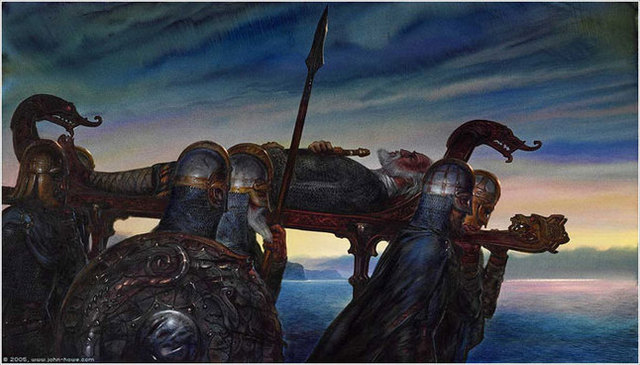
John Howe’s illustration of the funeral of king Finn (2005).
While the first two “digressions” seem to parallel aspects of Beowulf’s own character, the episode centered on Hildeburh conveys a very different message, and I would argue, perhaps to a specific audience. While the first two stories focus on heroes who possess great strength, the third story centers on something only hinted at thus far in the poem: maternal loss.
Just prior to the celebratory storytelling in Heorot, we learn that Wealhðeow, queen of the Danes, advises her husband, King Hroðgar, to place his trust in his nephew and kinsman Hroðulf rather than investing in a foreign hero, like Beowulf. Thomas Shippey has noted the irony in this as earlier in the poem there is reference to the burning of Heorot, which is perpetrated by Hroðulf and results in the murder of both of Hroðgar’s sons and Hroðulf’s usurpation. These enigmatic references to a future Danish power struggle might easily be missed, but they nevertheless frame Wealhðeow as a mother who will lose her sons to violence and kin-slaying, possibly within the broader context of a feud between rival brothers for the throne. After all, Hroðgar is not the first in line, and he even remarks of his late (and elder) brother Heorogar—deep in his cups—that sewæs betera ðonne ic “he was better than I” (469) presumably referring to his prior kingship.
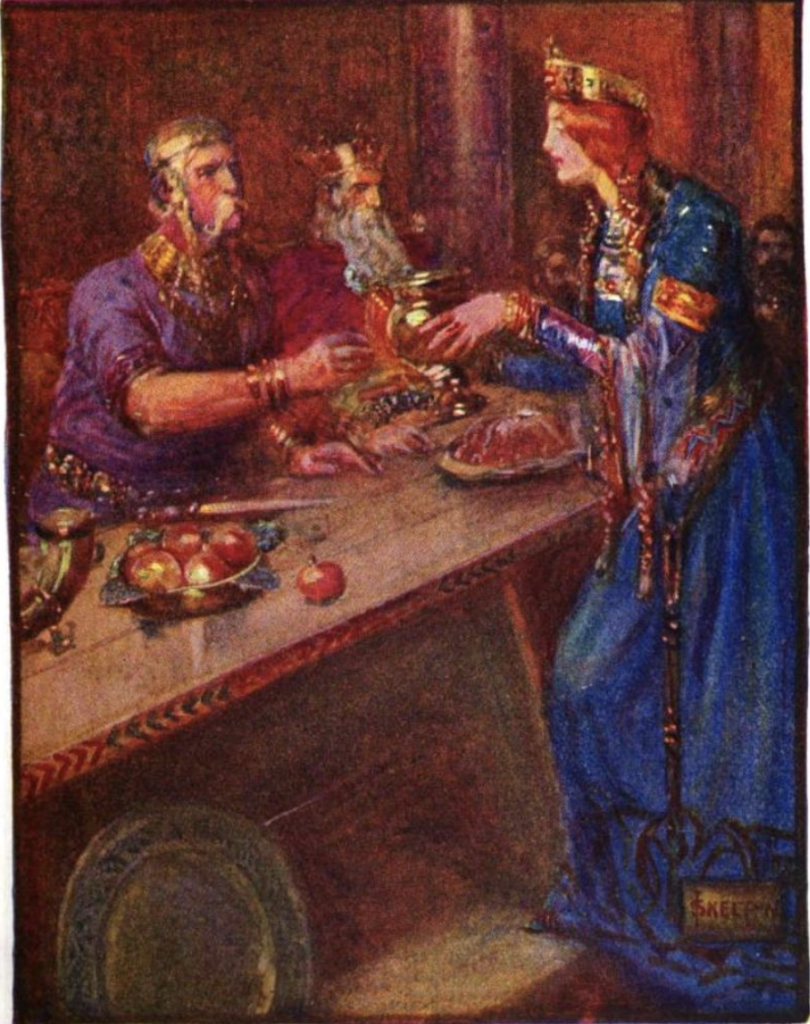
J. R. Skelton’s image of Wealhðeow as a cup-bearer in Stories of Beowulf by Henrietta Elizabeth Marshall (1908).
Indeed, the need for Hroðgar to build Heorot at all suggests that the former Danish mead hall is no longer around, which invites further questions such as whether its destruction was a result of inter-family violence and Hroðgar’s overthrow of his older brother to claim the Danish crown. Alas, the poem does not tell.
Although the Hildeburh episode concludes the celebration of Beowulf’s victory over Grendel, its mood is far from jovial. The tale relates a feud between the Danes and the Frisians and Hildeburh is caught in the middle. Hildeburh’s song relates how her bearn ond broðor “sons and brothers” (1074) find themselves on opposite sides of a feud where everybody dies in the ensuing conflict—everyone loses—all of them die in the violence. Indeed, Hildeburh’s role as Danish princess made Frisian queen herself—a failed freoðuwebbe “peace-weaver” (1942) is highlighted by the mutual deaths of her family members. The feud takes both Finnes eaferan “the heirs of Finn” (1068) and hæleð Healfdena “heroes of the half-Danes”(1069) as the parallel descriptions of how wig ealle fornam (1080) “war took all” and lig ealle forswealg “fire swallowed all” (1122) connects warfare with their shared cremation next to one another on the funeral pyre.
Hildeburh metodsceaft bemearn “bemoaned her fate” (1077) because she has no way to avenge her kinsmen. She is on both sides and therefore on neither. No matter what happens in the ongoing feud between her peoples, Hildeburh will suffer loss. And again, a mother loses her sons. Moreover, her tale parallels the foreshadowed fate of Wealhðeow’s sons, who will be betrayed by her treacherous nephew Hroðulf (1180-7).
As I discuss in much greater depth in my dissertation subchapter “The Ethical Paradox of Grendel’s Mother’s Revenge” (358-370), it is this contextual framework within which Grendel’s mother appears in the narrative (out of nowhere) as a wrecend “avenger” to wreak vengeance upon those who murdered her son. In a sense, Grendel’s mother does—and is able to do—what Hildeburh cannot. And, as Leslie Lockett and others have observed, Grendel’s mother’s actions represent a legally and ethically “fair” exchange: a life for a life. This engenders further sympathy for her character’s suffering and retaliation, especially following directly after the context established by Hildeburh episode.
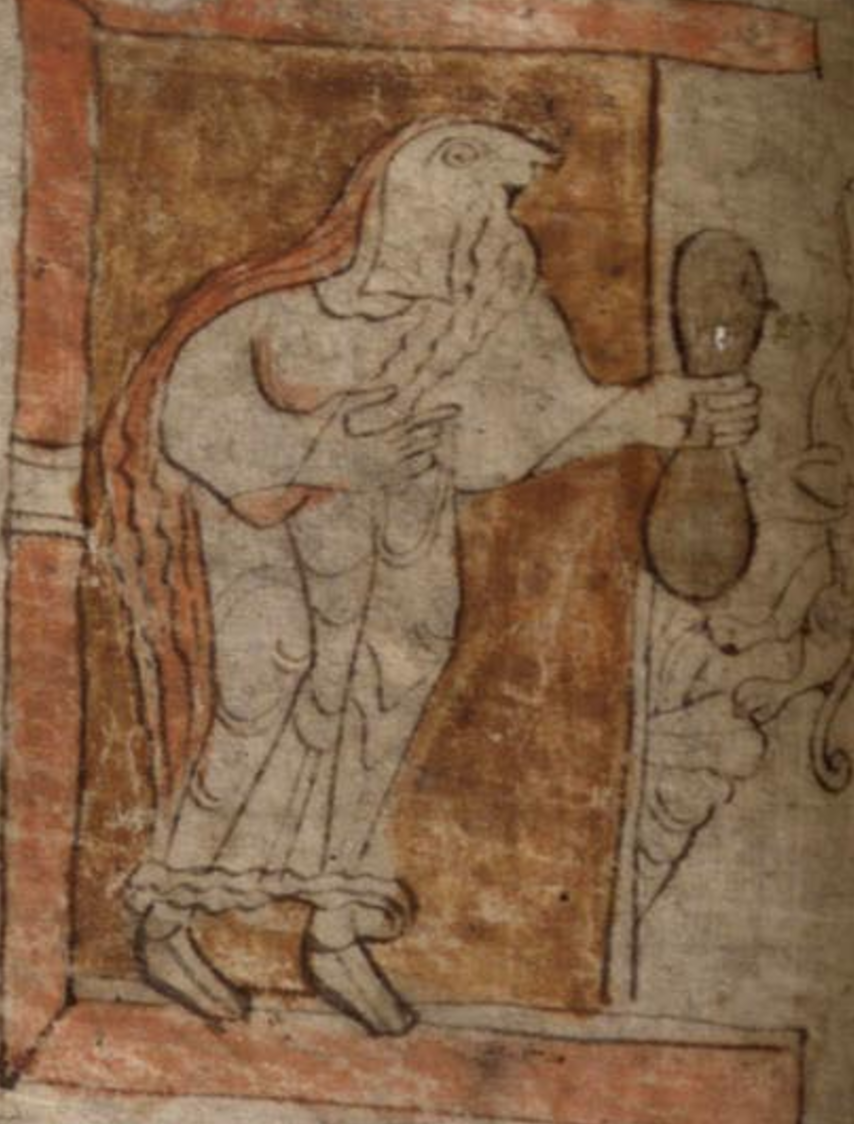
Image of monstrous hybrid-woman from The Wonders of the East in British Library, Cotton Vitellius a.xv, f.105v.
Even after Grendel’s mother is slain, the pattern repeats. Not long after we meet Queen Hygd in Geatland, her son is killed in a feud with the Swedish king Onela, leaving Beowulf to inherit the throne. Yet another mother loses her son to a feud, underscoring the narrator’s comments on the violence between the Danes and the Grendelkin: ne wæs þæt gewrixle til,/ þæt hie on ba healfa bicgan scoldon/ freonda feorum “that was not a good exchange, that they on both sides should pay with the lives of kinsmen” (1304-06).
We do not know who wrote Beowulf, and probably never will. Nevertheless, at this point in the poem, I am reminded of Virginia Woolf’s argument in A Room Of One’s Own: “I would venture to guess that Anon, who wrote so many poems without signing them, was often a woman.” While I am not arguing for a female author of the poem (though why not), I would contend that there seem to be strong rhetorical appeals directed at women—especially mothers—within Beowulf, which suggest that they were likely part of the poem’s anticipated audience.
Richard Fahey PhD in English University of Notre Dame
Further Reading
Bonjour, Adrien. The Digressions in Beowulf. Basil Blackwell. 1950.
Fahey, Richard. “Enigmatic Design and Psychomachic Monstrosity in Beowulf.” University of Notre Dame: Dissertation, 2020.
—. “The Lay of Sigemund.”Medieval Studies Research Blog. Medieval Institute: University of Notre Dame (March 22, 2019).
Fell, Christine. Women in Anglo-Saxon England. Oxford: Basil Blackwell, 1984.
Griffith, Mark. “Some Difficulties in Beowulf, Lines 874-902: Sigemund Reconsidered.” Anglo-Saxon England 24 (1995): 11-41.
Kaske, Robert. “The Sigemund-Heremod and Hama-Hygelac Passages in Beowulf.” Publications of the Modern Language Association 74 (1959): 489-94.
Lockett, Leslie. “The Role of Grendel’s Arm in Feud, Law, and the Narrative Strategy of Beowulf.” In Latin Learning and English Lore: Studies in Anglo-Saxon Literature for Michael Lapidge (I), edited by Katherine O’Brien O’Keeffe and Andy Orchard, 368-88. Toronto, ON: University of Toronto Press, 2005.
Overing, Gillian. Language, Sign and Gender in Beowulf. Carbondale, IL: Southern Illinois University Press, 1990.
Shippey, Thomas A. “The Ironic Background.” In Interpretations of Beowulf: A Critical Anthology, edited by Robert D. Fulk, 194-205. Bloomington, IN: Indiana University Press, 1991.
At a conference I attended earlier this month, a woman medievalist suggested we stop teaching Beowulf. It was during a session on privilege and position in medievalist pedagogy that the presenter proposed we remove Beowulf from our syllabi and replace it with Judith. She prefaced her proposal with a powerful anecdote: in preparation for reading Judith, she warned her students about encountering sexual violence in the poem. She was particularly concerned about one of her students whom she knew had been victimized, but rather than being triggered, the student said that she had felt empowered by the narrative, that Judith’s heroism helped her see her own strength as a survivor.
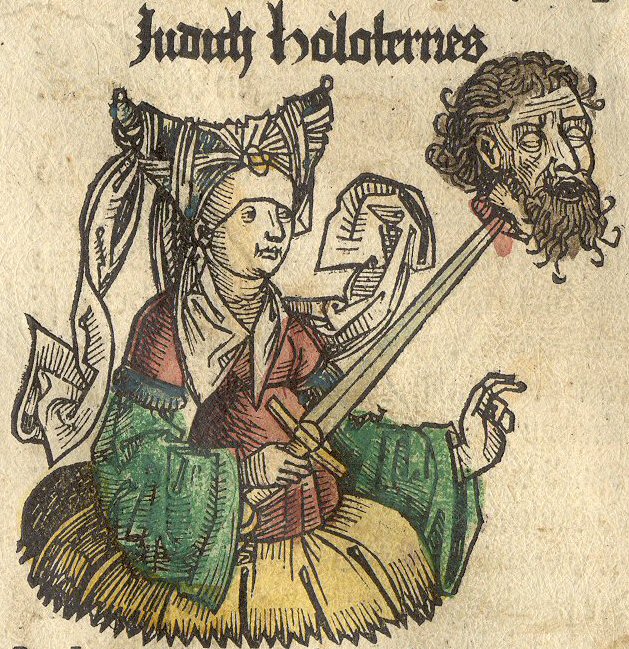
Judith displays Holofernes’s severed head upon her sword in this depiction from the Nuremberg Chronicle, first published in 1493. The Old English poem, however, dates to approximately 1000 CE. Judith appears after Beowulf in the Nowell Codex, one of four major manuscripts containing Old English literature.
By substituting texts focused on male figures with those centering women’s experience, the presenter argued, we would not only be disrupting a predominantly male medieval canon but also be teaching texts that resonate more with the women in our classes. I agree that Judith deserves a place in our reading lists. But the idea that we should sacrifice Beowulf pains me because it was in the pages of Beowulf that I found myself and decided who I wanted to become.
There are many markers from my adolescence that might have signaled my proclivity for medieval studies. I grew up reading The Hobbit and The Lord of the Rings and watching Disney’s Sword in the Stone on repeat. I hoarded anything related to Arthurian legend and collected all the British folklore I could get my hands on. Although my literary preferences tended toward medievalism, my interests were rooted in Medieval England, rather than fantasy. But it wasn’t until I read Beowulf in one of my undergraduate courses that I realized how much I loved medieval literature and wanted to make my way in academia.
I’m a medievalist because I read Beowulf—because it gripped me and pulled me in and has never let me go. So the thought of removing it from my syllabus is, frankly, unfathomable because I remember the way it whispered to me in a language at once ancient and familiar and how it made my heartbeat feel like the echo of drums carried across so much water.
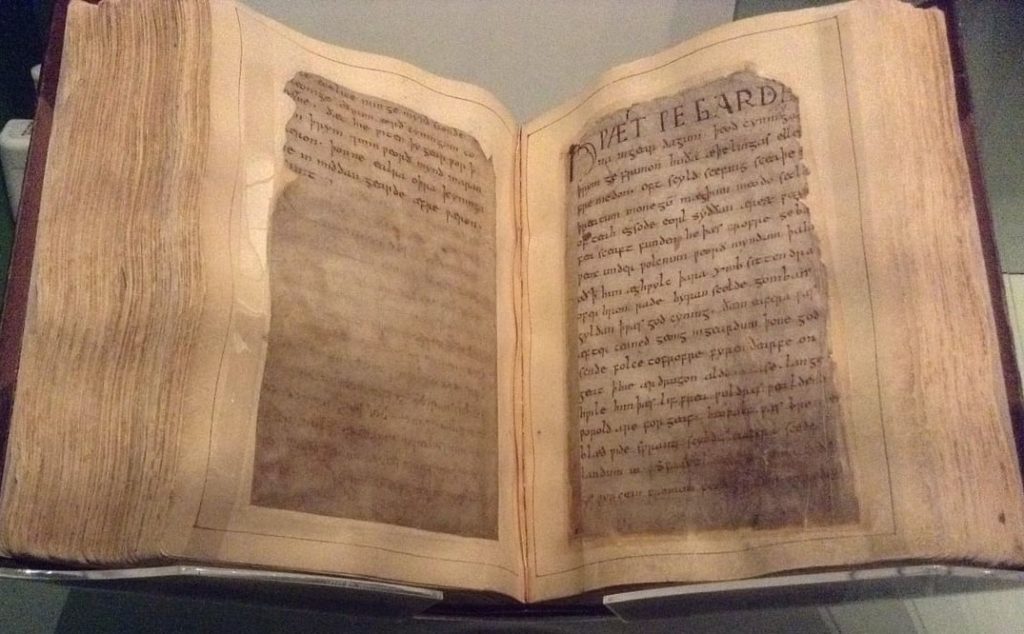
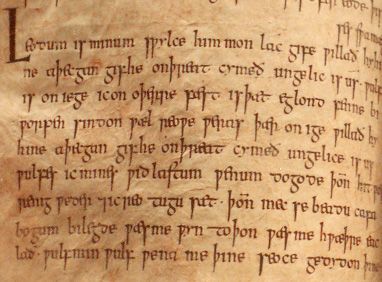
Dated to the late tenth or early eleventh century, Beowulf is the longest epic poem written in Old English. It tells the story of the warrior Beowulf in 3,182 alliterative lines and recounts his battles with Grendel, Grendel’s mother, and the dragon responsible for his demise. The poem survives in a single manuscript known as the Nowell Codex, part of the bound volume Cotton MS Vitellius A XV, which is housed at the British Library in London and opened here to display the poem’s first page.
Setting Beowulf aside to center women with other Medieval English texts implies not only that its female characters are unworthy subjects of study but also that the poem does not or cannot resonate with women. Discarding Beowulf would, I think, do us all a disservice.
The women of Beowulf have long been relegated to the margins, a critical tradition that corroborates the misperception of the poem as both about and for men. Women medievalists, too, have been underrepresented in the adjacent scholarship. Indeed, Beowulf studies suffers from a gender problem in a way that scholarship on other iconic medieval texts does not. Women publish proportionately less on Beowulf than they do on many other texts in the Old English corpus, a disparity that does not appear to correlate with women’s limited representation in the narrative. Even The Battle of Maldon, which includes no female characters whatsoever, generates more published work by women than Beowulf does, relatively speaking. The same is true for The Wanderer, The Seafarer, and The Dream of the Rood. Women are eclipsed by men in the production of published editions and translations of the poem, as well as in their contributions to critical anthologies. I suspect that our skewed scholarly representation does not reflect a lack of interest in the poem but, rather, the extent to which we are welcomed to engage with it.
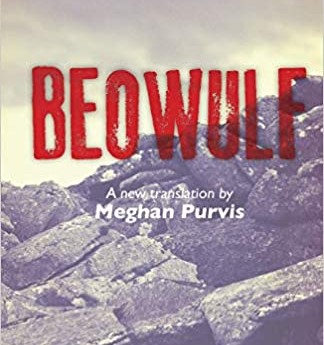
For example, Meghan Purvis, whose stunning translation was published in 2013, did not initially feel that a translation of Beowulf was a project she should undertake. In the preface to her translation, she writes, “I was in my third year of university when the professor of my History of the English Language class stood up at the front of the lecture hall and recited the opening of English’s first epic poem. The hair on the back of my neck stood up…It was because the class was taught by Professor Jennifer Bryan, and it was the first time I’d heard Old English spoken by a woman.” Purvis acknowledges that “[t]here were, of course, women already working with Old English,” but it was the experience of hearing the language of Beowulf voiced by a woman that invited her to consider that “Beowulf was a story [she] could tell.”
Meghan Purvis’s Beowulf (London: Penned in the Margins, 2013) was awarded the Stephen Spender Prize for literary translation and recommended by the Poetry Book Society. With its unique format and unprecedented exploration of gender, Purvis’s translation departs from the traditionally conservative approach to the poem’s translation. Listen to her read her award-winning poem “The Collar,”
Like Purvis, I have also felt that Beowulf was not within my reach—as a non-traditional student who came to the story late and the language even later and as a female scholar who is keenly aware not only of the vastness of Beowulf studies but also of the academic landscape’s predominantly male and often hostile terrain. So while my singular love for the poem most certainly influences my desire to teach it, I will continue to include Beowulf in future courses because I want other women to feel welcome to find themselves in its pages.
We do not need to stop teaching Beowulf. We do, however, need to think about teaching it in ways designed to destroy the stigmas surrounding women’s interest in the text and any misconstrued ideas about gendered accessibility. Instead of eliminating Beowulf and other similarly male-centric Old English texts from our literature courses, let’s actively reflect upon how we teach these texts and revise traditional pedagogical practices that inherently center men in the canon and in our classrooms. Let’s teach the Old English Judith alongside Beowulf; The Wife’s Lament and Wulf and Eadwacer in tandem with and not simply supplemental to The Wanderer and The Seafarer.
Two female-voiced laments, Wulf and Eadwacer (MS 3501, pictured here) and The Wife’s Lament, survive solely in the Exeter Book, dated to the tenth century and housed at Exeter Cathedral Library. Like the Nowell Codex, the Exeter Book is one of the four major codices containing Old English literature; the other two are known as the Vercelli Book and the Junius Manuscript.
When teaching Beowulf, let’s incorporate translations by women—whether more conservative or more creative depending upon our individual preferences and purposes. For my part, I am particularly fond of Purvis’s translation, which multiplies women’s voices, underscores their position in relation to violence, and renders Grendel’s mother visible in a way that highlights both her ferocity and her femaleness, as exemplified in this excerpt:
Grendel was torn apart, and she came looking for the meat
of her son, hanging from hooks in the ceiling. Her home was a death-house, was becoming Grendel’s tomb; the hell-dam came – and was she less frightening
for being a woman? – hardly. The men in the dark room screamed out that “he” was here, too caught in pain and fear to see the claw at the end of an arm smooth
and hairless, sharp teeth in a softer jaw.
Furthermore, maybe we focus on Grendel’s mother and the fear she evokes through her fury and her fighting skills. Maybe we review a variety of translations with our students, analyzing how and why representations of Grendel’s mother vary so greatly—from woman to monster, a mere-wyf, a “monstrous hellbride,”[1] and even Angelina Jolie.[2] Then we also teach Judith. Maybe together, she and Grendel’s mother can swallow up any remaining misconceptions about women’s proximity to Old English heroic poetry.
[1] See Seamus Heaney’s Beowulf (W. W. Norton and Company, 2000).
[2] See Beowulf, directed by Robert Zemeckis (2007).
Emily McLemore Ph.D. Candidate, Department of English University of Notre Dame