Greco-Latin Polemic and the Problem of the Single Immersion Baptism

Of the many issues that rose to the fore in the course of the conflicts between the Latin and Greek churches during the Middle Ages, one of the most consistent, and to me, surprising, was the repeated accusation that the Greeks rebaptized Latin Christians when they, for whatever reason, wished to switch their ritual use (what we would now understand as a “conversion” between different denominations). Although the veracity of these claims has been debated, I think, as I have written elsewhere, that there is good reason to believe that the Greeks really did rebaptize Latins. Complaints about the practice began in the mid-11th century with Cardinal Humbert of Silva Candida, who was elsewhere highly accurate in his claims about liturgical practice, and continue well into the 13th century, including an honorable mention in the canons of the Fourth Lateran Council under Pope Innocent III.

What is less clear, though, is why the Greeks were so keen to rebaptize their Latin cousins. It is tempting to see rebaptism as symptomatic of more ethereal theological topics, in which the perceived differences between the two churches was sufficiently great that the Greek clergy (or at least a subset of them) felt the need to mark the reception of these “converts” from heresy by means of the administration of the sacrament. Certainly this understanding had precedent: as early as 325, the canons of the First Council of Nicaea mandated the reception of Paulianists, who were nontrinitarians, by means of baptism. But I think that this understanding is a mistake with reference to the Latin/Greek conflict. Especially in its earlier phase, in the 11th century, there was no general sense of lasting division: the Greeks generally viewed the Latins as wayward brethren to be corrected, not as heretics utterly outside of the Church, and therefore rebaptism can’t be understood as a requirement resulting from serious deficiencies in the faith on the scale of nontrinitarianism.

Rather, I think that these rebaptisms were because of perceived ritual deficiencies in the Latin rite of baptism, and particularly, in the idea that the Latins were prone to using a single immersion when administering the sacrament. And when looking at this possibility we find a much greater incidence of Latin complaint and Greek explanation. Shortly after Cardinal Humbert complained about rebaptisms, Michael Cerularius, the Patriarch of Constantinople, wrote to Peter, the Patriarch of Antioch, that the Latins performed baptism with a single immersion [1]. The two centuries that followed saw repetitions of both: Odo of Deuil, Leo Tuscus, an anonymous Dominican author writing from Constantinople in the mid-13th century, and Jerome of Ascoli (i.e., Pope Nicholas IV) all noted that Latin Christians were being rebaptized. The “Byzantine Lists”, a genre of polemic that enumerated liturgical and cultural “errors” committed by the Latins, again and again returned to the notion that the baptism of the Latin rite was performed through a single immersion [2]. In doing so, the authors of these lists were implicitly invoking another of the canons of the early church, this time from the so-called Apostolic Canons (no. 50): “If any Bishop or Priest does not perform three immersions in making one baptism, but only a single immersion […], let him be deposed” [3]

Assuming that my conclusion is correct, that Greeks rebaptized Latins with some degree of frequency because they believed their form of the sacrament to be ritually defective, the question that next arises is how the Greeks came to hold that belief. Prior to the widespread adoption of affusion or aspersion in the Latin West, the form of baptism appears to have been similar to that of the Greek East: a full triune immersion, done together with the invocation of the persons of the Trinity. We see this clearly referenced as late as the early 13th century, when Pope Innocent III, writing to the Maronite Church, instructs them to invoke the Trinity only once “while completing a triple immersion” [4]. The great exception to the standard Latin practice was the famous license given by Pope Gregory the Great to the church in Spain to baptize with a single immersion as a way to signify the oneness of the Trinity and thereby to combat Arianism. This practice was further codified by the 633 Council of Toledo and its existence confirmed in the works of Isidore of Seville and Ildefonsus of Toledo [5]. The practice is referenced twice more, toward the end of the eighth century, in the letters of Alcuin of York, who acknowledged that the practice existed in certain parts of Spain only long enough to condemn the people who baptize in this way as “neglecting to imitate, in baptism, the three-day burial of our Savior” [6]. They maintain this custom, according to Alcuin, “contrary to the universal custom of the holy Church” making Spain the “wet-nurse of schismatics” [7].

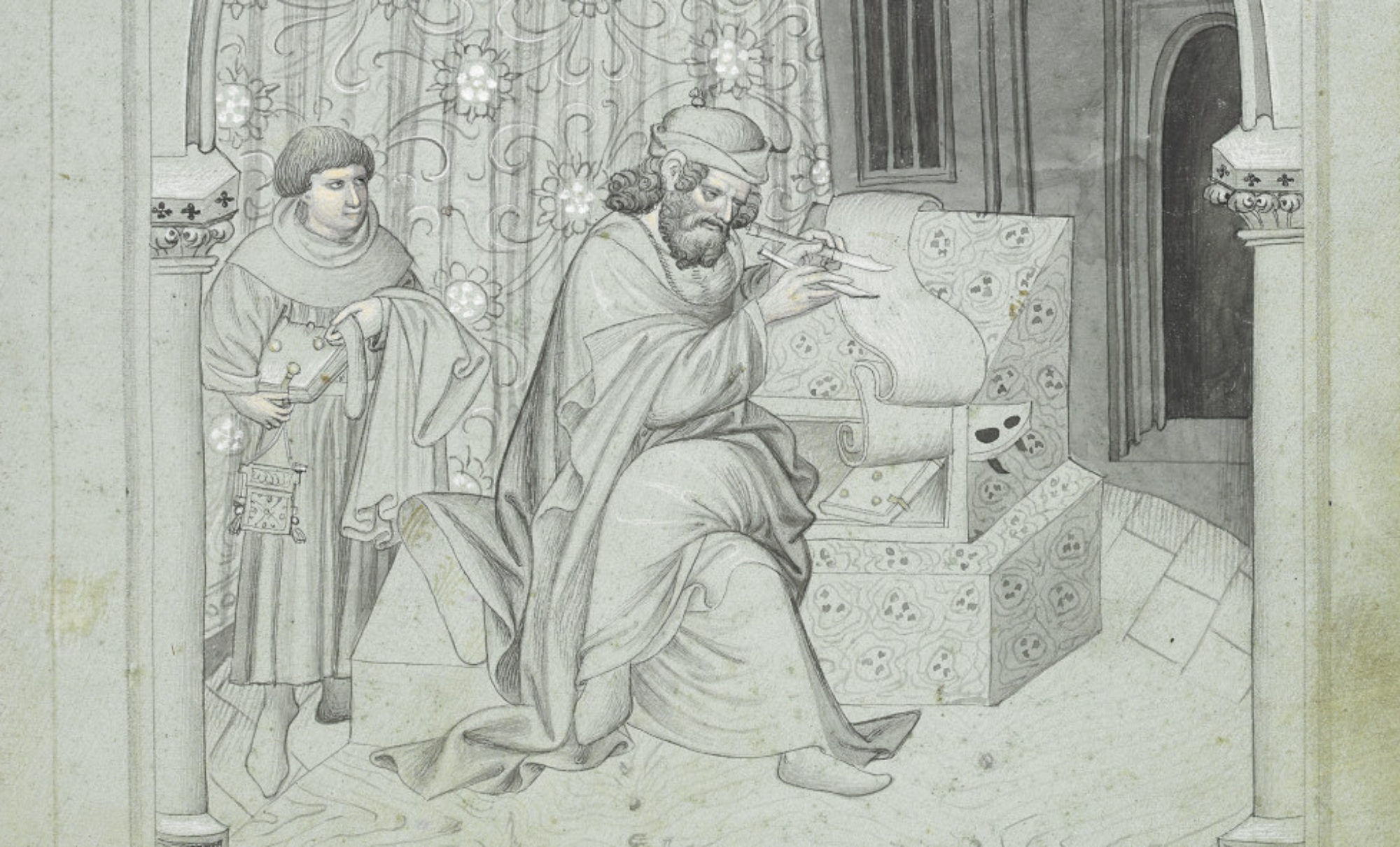
Gregory the Great, the source of the conflict? Antiphonary of Hartker of the monastery of Saint Gall (Cod. Sang. 390, 13 (paginated). Creative Common licensing.

Returning, then, to the polemics of the Greeks, is it possible that their complaints about a Latin single-immersion baptism stemmed from the Spanish practice? I see no other possible cause, although this feels unsatisfactory as an explanation. At most, the single-immersion baptism was a regionalism confined to the Iberia, and the opposition of Alcuin, the great champion of Romanization in the West, makes it unlikely that it would ever have spread further than its native peninsula. Indeed, the gradual imposition of the Roman rite throughout the Christian West likely reduced the frequency of single-immersion baptisms within Spain itself in the centuries following the initial permission of Pope Gregory. If the practice survived at all by the mid-11th century, when Cardinal Humbert and Patriarch Michael wrote their respective complaints – and I haven’t found any evidence from that time for or against – it would probably have been a very rare indeed for someone baptized “incorrectly” to have been found in Constantinople.

Pending further evidence, then, we are left with the Greeks reacting at most to an improbability, and more likely to outdated information. While I fully acknowledge that it’s no more than supposition on my part, my best guess is that the works either of Gregory the Great or of Isidore of Seville (or of both, or of someone else entirely) were received in the theological circles of 11th-century Constantinople, leaving the mistaken impression that the practice of single immersion baptism was common in the West. From there, the notion that the Latins performed this sacrament incorrectly, along with most of the others, proved hard to dislodge.

Nick Kamas
PhD in Medieval Studies
University of Notre Dame

  1.  Cornelius Will, ed., Acta et Scripta quae de controversiis ecclesiae graecae et latinae saeculo undecimo composita extant (Leipzig: N. G. Elwert, 1861), 153 (Humbert) and 182 (Michael).
  2. Tia M. Kolbaba, The Byzantine Lists: Errors of the Latins (Urbana and Chicago, University of Illinois Press, 2000), 192.
  3. The Rudder, trans. Ralph Masterjohn (West Brookfield, Massachusetts: The Orthodox Christian Educational Society, 2005), 179.
  4. “in trina immersione unica tantum fiat invocatio Trinitatis”. No. 216. Acta Innocentii III, ed. P. Theodosius Haluščynskyj (Vatican, Typis Polyglottis, 1944), 458.
  5. J.D.C. Fisher, Christian Initiation, Baptism in the Medieval West (London: S.P.C.K., 1965), 91.
  6. “triduanamque nostri salvatoris sepulturam in baptismo imitari neglegentes”. Ep. 139. Ed. Ernest Duemmler, MGH Epp. 4 (Berlin: Weidmannos, 1895), 221.
  7.  “[…] Hispania – quae olim tyrannorum nutrix fuit, nun vero scismaticorum – contra universalem sanctae ecclesiae consuetudinem […].” “Adfirmant enim quidam sub invocatione sanctae Trinitatis unam esse mersionem agendam.” Ep. 137. Ibid., 212.

Michael Cerularius and the Letters of Leo of Ohrid

Michael Cerularius, the Patriarch of Constantinople during the papal legation of 1054, has long been seen as a difficult personality whose theological, political, and personal views led him to thwart the will of the Eastern Emperor, Constantine IX Monomachos, and to undermine any hope of a military alliance between the Eastern Empire and the Papacy to combat the Norman advances in the south of Italy. This assessment stems even from the report of the papal legation itself, written by Cardinal Humbert, which portrays the Emperor as open, welcoming, and even deferential to the legates, while the Patriarch was standoffish and intransigent. Not surprisingly, this view has prevailed in the scholarly literature, up to and including the last dedicated biographical treatment of Cerularius in 1989 by Franz Tinnefeld [1].

More recently, though, Anthony Kaldellis (University of Chicago, recently of Ohio State University) suggested a very different reading of some of the available sources [2]. In his retelling, Cerularius was an agent of a cohesive imperial policy toward the Latins who did nothing to provoke a hostile response from the legates or to stall the efforts of Emperor Constantine to forge a military alliance with Pope Leo IX. Instead, Kaldellis’s Cerularius deliberately avoided confrontation with the legates in order to give the emperor the space to make diplomatic overtures and to attempt to smooth over the religious differences that had been brought to light by polemicists on both sides. Kaldellis’s argument is bold, given that it seeks to overturn an essentially unbroken narrative about the 1054 legation that stretches back to the events themselves. It also asks important questions about the sources upon which this existing narrative has been based, noting quite reasonably that Cerularius was probably not some kind of evil mastermind lurking behind everything that the legates found objectionable in Constantinople. At the same time, I think a complete exoneration of Cerularius from any sort of offensive action stretches the source material too far in the other direction.

To keep things to a blog-appropriate length, I’d like to examine a single issue at the beginning of the conflict to serve as a microcosm of the whole. In the year prior to the famous legation, Archbishop Leo of Ohrid, a Greek churchman who had held high positions within the Constantinopolitan church hierarchy prior to his appointment to the province, wrote a series of three letters critiquing the Latin use of unleavened bread in the Eucharist, among other ritual practices [3]. These letters were addressed primarily to the primate of Grado, Dominicus Marengo, and also to (arch)bishop John of Trani, with a request by the author in the first letter to forward the contents to the pope and to the Latin clergy in general. At least one of the addressees did just that, handing a copy of the first letter in the series (which may have been the only one received at that point) over to the papal court, and specifically to Cardinal Humbert, who drafted both a translation into Latin and an extensive point-by-point rejoinder. Humbert’s translation, unlike the original Greek text, ascribes this letter both to Leo of Ohrid and to Michael Cerularius. The question, then, is to what degree Cerularius was involved in this composition.

The Church of St. Sophia, Leo of Ohrid’s cathedral. Diego Delso, delso.photo, License CC-BY-SA.

Kaldellis rightly points out, with the agreement of other scholars, that the see of Ohrid was independent of Constantinople and that Leo was a long-tenured archbishop with the political and theological wherewithal to send his own letters [4]. The suggestion, though, that Cerularius didn’t play any role, and indeed “tried to create a constructive relationship in order to promote imperial interests, not instigate or inflame a conflict,” ignores both the concurrent and robust exchange of letters and people between East and West as well as the other actions of Cerularius himself.

To begin with, Leo of Ohrid did not write these letters in isolation. Just as Leo of Ohrid wrote to Dominicus of Grado, Dominicus was in turn writing to Patriarch Peter III of Antioch, who then replied to him [5]. Dominicus’s correspondence is instructive simply by virtue of its existence, since it shows a broader level of communication between East and West than is commonly assumed, and also because it complains that the holy Roman church had been attacked “by a clergyman of Constantinople” for its use of unleavened bread (“παρὰ τοῦ τῆς Κονσταντινουπόλεως κλήρου”) and that “they censure [with a plural verb: “Ψέγουσι”] the most sacred azymes.” In the aftermath of the excommunications the following year, Michael Cerularius and Peter of Antioch exchanged their own letters, in which they discussed nearly all of the same issues raised by Leo of Ohrid [6].

Cerularius, for his part, is known to have written only one letter, addressed to Pope Leo IX and unfortunately not extant, that seems to have avoided discussing any of these contentious issues. He was, however, busily pursuing the same agenda by other means. By his own later admission, he had already repeatedly refused to give communion to Argyrus, the Eastern Roman catepan in southern Italy on the grounds that he (a Lombard) was a supporter of unleavened bread [7]. Argyrus was known to the papal curia, so it is likely that Humbert knew about this when drafting his translation. Cerularius also took the even more provocative step of closing the Latin-rite churches in Constantinople (or at least some of them) [8]. His inimical stance against the Latin rite was also noted by other Westerners in Constantinople. Pantaelo of Amalfi, in his independent account of the 1054 legation, described him as “most foolish in deeds and discernment” (“actibus et intellectu stultissimus”) a direct contrast to Constantine Monomachos, the “most victorious emperor” (“victoriosissimus imperator”) [9]. Cerularius was, in short, not going out of his way to build constructive relations with the Latin church.

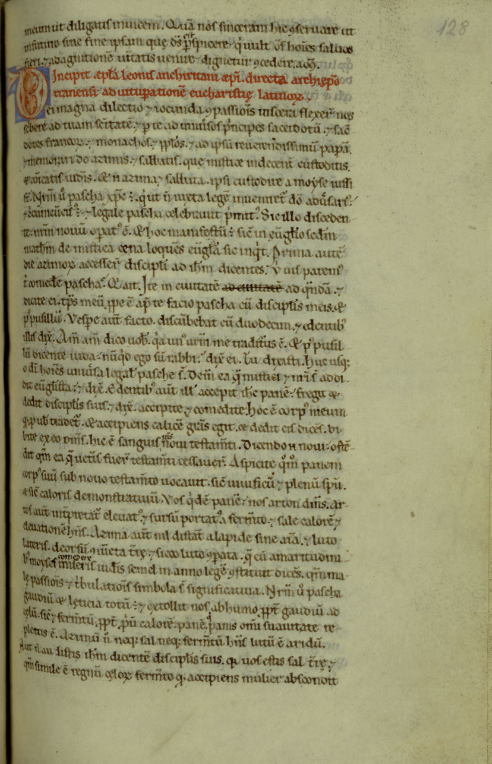
Translated first letter of Leo of Ohrid. Roma, Biblioteca Universitaria Alessandrina, Manoscritti, ms. 169, fol. 128a. Rights belong to Internet Culturale https://www.internetculturale.it/it/15/termini-d-uso

So, at the very least, the joint authorial attribution in Humbert’s translation of Leo of Ohrid’s first letter represents the fact that Cerularius’s theological opinions were long-held, promulgated throughout the Mediterranean world, and closely aligned with the contents of the text. I think it’s also not too far a stretch to grant some credence to Humbert’s joint attribution of the text. Dominicus was a frequent conduit of information between Constantinople and the Papacy; John of Trani had just personally returned from a trip to Constantinople, likely with some degree of insight into the thought of Cerularius [10]. Both Dominicus and John were in close contact with the Curia during this time, and at least one of them gave the letter to Humbert. The balance of probability suggests that the letter was written at least with the knowledge and approval of Cerularius, and perhaps at his direct behest.

Does this bring us back to Michael Cerularius, evil mastermind? I think not. Kaldellis’s argument is an important check on a narrative that has often been taken too far, in which Cerularius is presented as a man of overwhelming political ambition doing his best to subvert imperial policy and take control of the throne, in fact if not in name. Rather, I think we ought to take him, together with the other Greek polemicists who were involved, at their word: they really were concerned about what type of bread to use in the celebration of the Eucharist. While he could not have been unaware of the political aims of Emperor Constantine, Cerularius clearly didn’t let them stop him from taking highly provocative actions against the Latin church. And in the end, for a medieval churchman, politics really shouldn’t be expected to stand in the way of orthodoxy.

Nick Kamas
PhD in Medieval Studies
University of Notre Dame

  1. Franz Tinnefeld, “Michael I Kerullarios, Patriarch von Konstantinopel (1043-1058): Kritische Überlegungen zu einer Biographie,” Jahrbuch der Österreichischen Byzantinistik 39 (1989): 95–127.
  2. Anthony Kaldellis, “Keroularios in 1054: Nonconfrontational to the papal legates and loyal to the emperor” in Byzantium and the West: Perception and Reality (11th–15th c.), ed. Nikolaos G. Chrissis, Athina Kolia-Dermitzaki, and Angeliki Papageorgiou  (New York: Routledge, 2019): 9–24.
  3. Edited in Elmar Büttner, Erzbischof Leon von Ohrid (1037-1056): Leben und Werk (Bamberg, 2007): 181–256.
  4. Kaldellis, 10–11. See also Axel Bayer, Spaltung der Christenheit: Das sogenannte Morgenländische Schisma von 1054 (Böhlau: Böhlau Verlag, 2002), 65–67.
  5. Both are edited in Cornelius Will, Acta et Scripta quae de controversiis ecclesiae graecae et latinae saeculo undecimo composita extant (Leipzig: N. G. Elwerti, 1861): 205–208 (Dominicus to Peter), 208–228 (Peter to Dominicus).
  6. Will, Acta et Scripta, 172–183 (First letter of Cerularius to Peter), 184–188 (Second letter Cerularius to Peter), 189–204 (Letter of Peter to Cerularius).
  7. Will, Acta et Scripta, 177.
  8. This point has been contested, but I don’t think convincingly. See Tia Kolbaba, “On the closing of the churches and the rebaptism of Latins : Greek perfidy or Latin slander?” Byzantine and Modern Greek Studies 29 (2005): 39–51, J. R. Ryder, “Changing perspectives on 1054” Byzantine and Modern Greek Studies 35 (2011): 20–37, and Tia Kolbaba, “1054 revisited: response to Ryder” Byzantine and Modern Greek Studies 35 (2011): 38–44.
  9. Edited in Anton Michel, Amalfi und Jerusalem in Griechischen Kirchenstreit: Kardinal Humbert, Laycus von Amalfi, Niketas Stethatos, Symeon II. von Jerusalem und Bruno von Segni über die Azymen (Rome: Pont. Institutum Orientalium Studiorum, 1939): 52–54.
  10. Büttner, 43–44, 48.