Reading the Medieval Landscape through Archaeological Maps of the Nineteenth and Early Twentieth Centuries

There are few things I like to do more than pouring over an old map.  For those working on the Maeander River Valley (modern Büyük Menderes in western Türkiye), we are spoiled by old maps from archaeological surveys and excavations from the nineteenth and early twentieth centuries.  Unlike earlier maps, these maps surveyed and composed for archaeological purposes were more detailed and often more accurate in their spatial representation.  In this blog, I want to introduce two fascinating maps.

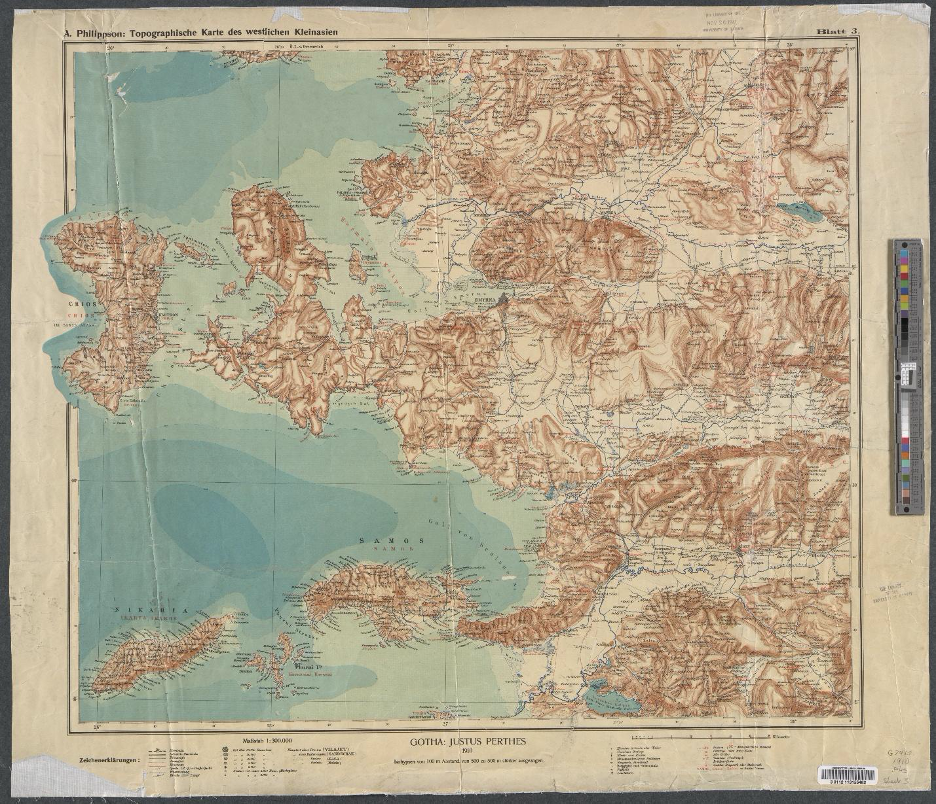
First, is the Lyncker map, named for the military officer Karl Lyncker who carried out the bulk of the investigations around 1908 and 1909.  The map was produced for the archaeological exploration and excavations conducted in the valley by Theodor Wiegand.  This map is best understood as a composite map, including the map of Lake Bafa by the military officer Walther von Marées in 1906 (Fig. 1) and the map of the Milesian peninsula by the mine surveyor Paul Wilski in 1900 (Fig. 2).  Alfred Philippson, a geologist, would conduct his own surveys and produce his own map in 1910 (Fig. 3).  Later, Philippson would compile all the earlier maps and publish them as a composite map in 1936 in the series of volumes of the Miletus excavation.[1] 
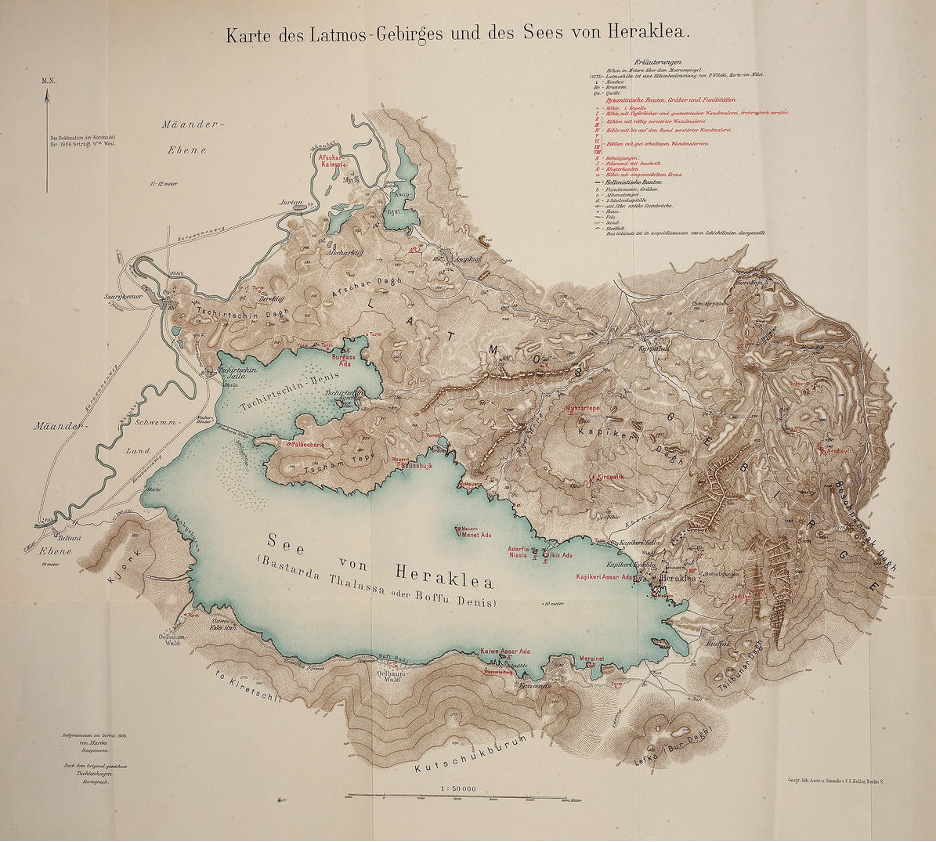
Figure 1: A Map of Mount Latmos and Lake Bafa produced by Walther von Marées in 1906.
Figure 2: A Map of the Milesian Peninsula produced by Paul Wilski in 1900. 
Figure 3: A Map of Western Asia Minor produced by Alfred Philippson in 1910.

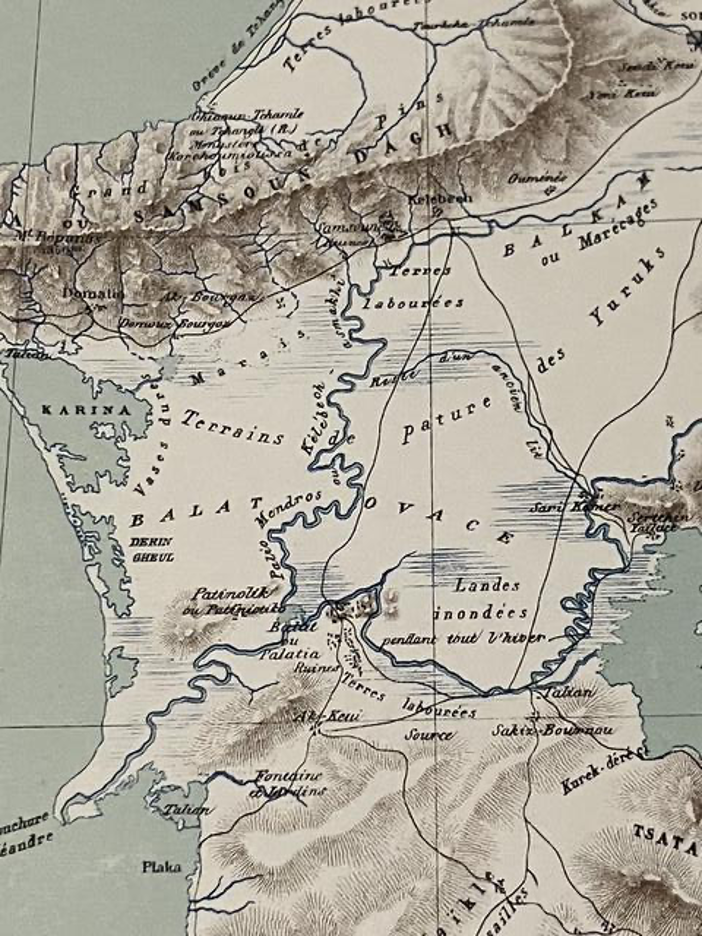
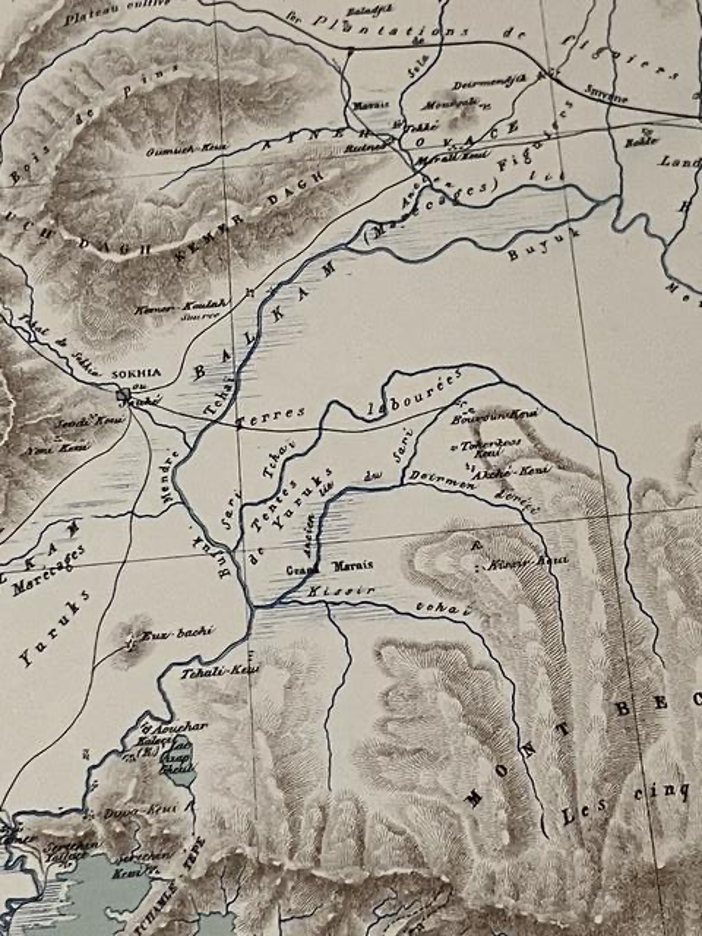
The second map accompanied the archeological work of Olivier Rayet and Albert Thomas and was composed in 1874 (Figs. 4, 5, and 6).[2]  While Wiegand outsourced his cartography to professional geodesists, Rayet drew the map himself.

Figure 4: A Map of the Maeander River Valley produced by Olivier Rayet in 1874.
Figure 5: Close Up of the Area Around Miletus (Balat ou Palatia) in the Rayet Map.
Figure 6: Close Up of the Area Around the Turkish Town of Söke (Sokhia) in the Rayet Map.

These maps are an important source of ancient and medieval ruins that have since disappeared.  However, I have always marveled at what these maps reveal unintentionally:  the landscape of the late Ottoman Maeander Valley before a series of changes that would occur in the twentieth century.

Before the Population Exchange of 1923

In 1923, the Greek populations living the Maeander were exchanged with Turkish populations living in Greece.  These maps include many Greek toponyms that are no longer used.  Didyma is known by its Byzantine name of Hieron (Jeronda), while the town on the southern coast of Lake Bafa was known as Mersinet, a survival of the Byzantine Myrsinos (Fig. 1).  The toponym of Patniolik (Figs. 2, 3, and 5), which became the modern Batmaz Tepe (the hill that cannot sink), makes clear that the origin is not Turkish, but Byzantine; this was a village owned by the monastery of Saint John the Theologian on the island of Patmos.  On the southern face of Mount Mykale, the ancient site of Priene is still known by its Byzantine name of Samson (Samsoun) on the Rayet map (Fig. 5), while the village of Domatia (Figs. 3 and 5) is likely the survival of the Byzantine toponym Stomata, which references the mouth of the Maeander River. 

The town of Bağarasi (Gjaur – Bagharassi on the Lyncker map) missed out having its old Greek name, Mandica, as it was renamed after the Greek War of Independence (1829).  Still, not all Greek toponyms imply a direct Byzantine survival.  The Greek communities of the late Ottoman period are idiomatic to their time and are not simply the fossils of another era; some immigrated from the islands after the plagues of the seventeenth century, while others moved to the area to work for local Turkish lords (like the Cihanoğlu family in the Turkish town of Koçarlı – there is no reason to assume that the church in Koçarlı in the Lyncker map required a Byzantine predecessor). 

Before the Draining of the Büyük Menderes

Beginning in the late 1920’s, a series of drainage canals fundamentally transformed the hydrological realities of the Maeander Valley.  Before the construction of this system of canals, the Maeander valley flooded every winter and remained inundated until spring.  This could wreak havoc on transportation across the valley and rendered many places in the plain isolated throughout the winter.  A rather frustrated Gertrude Bell – a Byzantinist in her own right – who visited the Maeander Valley around the same time as Lyncker, remarked:

“This sort of travelling is far more difficult and less pleasant than my Syrian journeys.  There one simply gets onto a horse and rides off, carrying one’s house with one.  Here there are so many arrangements to be made and one has to depend on other people’s hospitality which is always a bore.  It’s worth doing however and while I am about it, I will see as much of the country as I can so that I need not come back.”[3]

The draining of the valley was not just the construction of individual canals, but the construction of a system of canals that included the entire valley, where the canals, parallel to the river, provided drainage for the entire valley.  Greeks, Romans, Byzantines, and Ottomans all had drainage of some type in the Maeander, but I have seen no evidence of a valley-wide attempt to drain until the early years of the Turkish Republic.[4]  One of the clearest representation of these canals as a system is found in a map from a British Naval Intelligence Division geographical handbook from 1943, when this process was well underway but far from finished.[5] 

Despite the difficulties of living in the open plain in this period, the Lyncker map shows considerable number of settlements, from the series of houses along the river between Priene and Miletus, to the villages east of the town of Söke (Fig. 3).  While the Rayet map is less detailed in showing the late Ottoman settlement pattern, it does often show where the major fields were located (Terres labourées), such as the northeastern extreme of the Milesian peninsula, those directly south of Priene (Fig. 5), and the plain between Söke and Burunköy (Bouroun Keui, Fig. 6).  Because marshes are dynamic and seasonal in the Maeander, that these two maps do not show the same regions as swamp makes sense.  The Lyncker map is oriented more towards the summer and fall, mapping the lakes found at the center of a swamp, while Rayet shows the much wider area that likely saw itself underwater during the winter and spring.  Near Miletus (Balat ou Palatia), Rayet designates “lands flooded during the winter” (Landes inondées pendant tout l’hiber).  In fact, this is a consistent problem when examining maps, even into the second half of the twentieth century.  What can appear as an invented lake – a “paper lake,” if you will – is instead a cartographer mistaking what is permanent for what is seasonal.

For western Türkiye, the twentieth century introduced a series of fundamental changes to the landscape.  Being able to see what the landscape looked like before that can provide important insights about the medieval landscape.  But, if I am honest, pouring over these maps is simply just a great way to pass an afternoon!

Tyler Wolford, PhD
Byzantine Studies Postdoctoral Fellowship
Medieval Institute
University of Notre Dame


[1] Alfred Philippson.  Das südliche Jonien.  Milet III.5.  Berlin and Leipzig, 1936.

[2] Olivier Rayet and Albert Thomas. Milet et le Golfe Latmique, Tralles, Magnésie du Méandre, Priène, Milet, Didymes, Héraclée du Latmos: Fouilles et explorations archéologiques.  Paris, 1877.  This map can be viewed online at http://digi.ub.uni-heidelberg.de/diglit/rayet1877a/0002.

[3] https://gertrudebell.ncl.ac.uk/l/gb-1-1-1-1-17-19

[4] Süha Göney. Büyük Menderes Bölgesi. Istanbul, 1975, 245-256.

[5] Naval Intelligence Division.  Turkey.  Volume II.  Geographical Handbook Series.  1943, 159.

Bigger House: Cost of Living and Medieval Byzantium

Cost of living is a pressing issue faced by many people today. Inflation, gas prices, and housing costs all impact our quality of life. Recently these pressures have encouraged many people to move to areas where they hope to find better conditions. Large cities offer many conveniences. However, one’s home will not only be quite expensive, but also quite small. For the cost of a one bedroom condo in San Francisco, one could purchase a large house with a yard here in South Bend. Where one lives has a significant effect on the home they can have. This relationship between house size and location is not unique to today.

Those living in medieval Byzantium could not consult home listings from across the Empire. Nor was the freedom of movement that we have today in existence in the Middle Ages. However, there still existed significant variation in the size of village houses across regions. Villagers may not have simply been able to decide to move to an area that would provide their family with a larger house or greater resources, but clear differences in housing are preserved in the archaeological record.

Looking at the villages of the Byzantine Empire provides us with a fascinating glimpse of how location affected the houses of everyday people. Movement by villagers was restricted within Byzantium, but it did occur regularly. Most often this movement was spurred by necessity and not personal choice. After all, there was no simple way to compare houses from Anatolia and the Peloponnese. Further, the greatest impact on village houses was not the amount of money one could pay for them. The materials used to construct the house and local topography were the most significant factors. Most frequently, village houses were built by those who lived within them.

The physical location of one’s house would have a significant impact on its overall size. Often village houses were constructed on the slopes of hills or mountains. The steeper the incline, the smaller the house would be. Houses were most often rectangular in form and built perpendicular with the slope with the long sides of the house descending down slope. The short wall connecting these sides at the bottom of the slope served not just as a kind of retaining wall for the building, but needed to have a rather significant height in order to make a level platform for the second floor that was frequently included. If the incline on which the house was constructed was quite significant, this would limit the length that the house could be.

Holger Uwe Schmitt, The Byzantine ruined city of Mystras

For example, if the elevation along the slope changed by 5 meters after a 10 meter distance, then a house with 10 meter long walls would require a 5 meter high wall at the bottom in order to make a level area for second floor. That would be quite significant, and in some cases might be impossible to construct. Further, the short wall would need to be even higher to accommodate the height of the second floor and support the roof. A shorter house than would be required on the slope.

 Examples of how incline affects house size in the Byzantine village are found in the Mani peninsula. The Mani is the southernmost region of the Greek Peloponnese. The houses of the Byzantine village of Marathos are built along a steep mountainside. For the village of Sarania, the houses are built on a modest hill. While the houses of Marathos belong to a village that by all appearances had a longer and more prosperous life than Sarania, the houses here are generally smaller. In their original form, houses at Sarania are more than 10 m2 larger on average than houses at Marathos. Economic status of the settlements was not the determining factor in the size of the homes. Rather, it was topography that played the more significant role.

Camster, Modern village of Vathia in the Mani

In addition to their local topography, the physical material that houses were made from would impact their size as well. The houses of the Mani were built in the “megalithic” style. Large, roughly cut blocks of local limestone formed the walls of the house. Stone was even used to span the houses, forming support for additional floors or the roof. The use of stone for this purpose would limit the width of the village house. In theory, one could make their house as long as they wanted, but it would still be relatively narrow. Materials would limit size.

Moving across Byzantium to Cappadocia in central Anatolia, modern Turkey, we come to one of the most unique landscapes in the medieval world. Here, houses, churches, monasteries, and more are all carved into the volcanic rock of the region. Carving one’s house from stone would seemingly provide less limitations on the overall form and size. Building material did not need to be acquired and the physical limitations of built architecture were absent. There were other factors to consider however. While the volcanic stone of the region is considered soft as far as rock goes, it requires specialized tools and labor to carve. Different limitations then were placed on the houses of villagers here. It was not the building material that constrained the size of the houses, but the labor one could employ.

W. Bulach, Rock Carved settlement near Göreme in Cappadocia, Turkey

One can only imagine the thoughts that would go through the mind of a Byzantine villager who was able to observe the variation in housing within the Empire. How struck would they be by the different size of houses in one region compared to another? Would the rock carved homes of Cappadocia appear familiar or strange? Just as in the United States individuals working similar jobs can afford much different houses depending on their location, the housing of Byzantine villagers may be affected by similar dynamics. Other differences exist of course. Today, individuals working the same job may be paid differently based on where they live. However, anyone that has looked at house prices in the past year would see that these differences in pay are not proportional to the difference in the cost of housing. Villagers in one region of Byzantium may have had a better quality of life than those in another. The richness of Byzantine housing provides an important insight into these elements of daily life that reflect similarities of our experiences today.  

Mark James Pawlowski
Byzantine Studies Post-Doc
Medieval Institute
University of Notre Dame

Further Reading:

Pawlowski, Mark James. “Housing and the Village Landscape in the Byzantine Mani,” PhD Diss. (UCLA, 2019)

Ousterhout, Robert. Visualizing Community, Art, Material Culture, and Settlement in Byzantine Cappadocia (Washington D.C., 2017).

Bouras, C. 1983. Houses in Byzantium. Δελτίον τῆς Xριστιανικῆς ἀρχαιολογικῆς ἐταιρείας 11: 1-26