Connecting with the Public through Medieval Animals

As medievalists and scholars who spend our days reading, researching, and teaching the Middle Ages, it is easy to take for granted the vibrancy, intrigue, and importance of the period. But how can we help audiences outside the academy connect to people and cultures so distant from themselves? My own work offers me a readymade solution: animals. For several years, including in my current position as the Public Humanities Postdoctoral Fellow at Notre Dame’s Medieval Institute, I have had the privilege of speaking to many different groups of children and adults across multiple countries about the Middle Ages and its animals. It is always such a great joy to introduce them to the weird and wonderful world of medieval animal riddles and poetry, facts from bestiaries and other encyclopedias, and of course manuscript illuminations.

I usually start these talks with a series of strange animal illustrations from medieval manuscripts, asking the audience simply to guess what the animals are. A recent event for kids at the St Joe County Public Library thus began with these four pictures and more:

Manuscript illuminations from: Cambridge, Corpus Christi College Parker Library, MS 053, fol. 193v (CC BY-NC 4.0); Bayerische Staatsbibliothek, Cod. gall. 16, fol. 17r; British Library, Royal MS 2 B VII, fol. 102v; Bibliothèque Municipale de Douai, Ms. 711, fol. 11v (CC BY-NC 3.0).

Then comes the reveal that all of the wildly different illustrations are meant to be the same animal: a crocodile. What follows are usually cries of incredulity and laughter over how inaccurate all the images are. They’re not all terrible, of course, and I do make it clear that I choose the silliest ones available.

The significant question, then, is why there are so many bad medieval animals out there. With animals like crocodiles, one straightforward answer is that the illustrators had never seen the creatures in real life, but were drawing them based on writings from other parts of the globe. This becomes a good opportunity to talk about the interconnectedness of the medieval world — an animal from the Nile gets written about by a bishop in Seville, whose words inspire a drawing in Peterborough. This can also lead to conversations about the nature of the writers and illustrators themselves, often monks and other holy men and women who are testament to the importance of medieval religious houses as centers of science and learning, thus challenging a popularly held stereotype about the “Dark Ages”.

With children (and their grown ups), there’s a silly drawing game I like to play to put them in the shoes of these medieval illustrators — how good can they be at drawing an animal they have never seen before? This can be done by making up an entirely new beast, but I prefer to defamiliarize an animal that the children already know, asking them to draw it one feature at a time, as with this example with information drawn from medieval accounts:

  1. The animal is reddish in colour.
  2. It has four feet and legs like those of a bull or a deer.
  3. Its body is short at the back and tall at the front so it looks like it is always sitting down.
  4. It has a long neck like a horse.
  5. It has a head like a camel.
  6. It is covered in white spots like a leopard.

By the time the kids figure out that they are drawing a giraffe, the results are usually already hilariously wonky, not far from the illustrations they were laughing at a few minutes ago!

Left: Activity sheets from the St Joe County Public Library event. Right: Manuscript illumination from British Library, Additional MS 11390, fol. 22v.

When giving these talks in the UK, often to school groups, I would generally begin with a different animal that they would be fairly familiar with, the badger. As with crocodiles, medieval illustrations of badgers could be ridiculously unrecognizable, as evident in the two images below.

Manuscript illuminations from: Cambridge University Library, Kk.4.25, fol. 74v (CC BY-NC 4.0); University of Oxford, Bodleian Library MS. Bodl. 130, fol. 85r (CC BY-NC 4.0).

Unlike crocodiles and giraffes, however, medieval Europeans should have been more familiar with badgers; literary, archaeological, and place-name evidence suggests that the animal was a common feature of the British landscape. What excuse, then, could medieval illustrators have in this case? In some instances, there was a method to their madness. According to the Third-Family Bestiary in the above Cambridge manuscript, the badger is called melo in Latin either because of its fondness for honey (mel) or because it is rotundissimo like a melon (melo). It’s safe to say that this particular illustrator was inspired by the notion of roundness.

The Cambridge illustration also to me recalls Thomas of Cantimpré, the thirteenth-century Flemish Dominican friar and preacher who in his natural encyclopedia, De natura rerum, wrote that the fatness of a badger increases when the moon waxes and diminishes when it wanes. As nocturnal animals, some badger behaviours (notably their mating patterns) are thought to be influenced by lunar cycles. Lunar influence on its rotundity may be more dubious, but did have significant practical implications. Thomas later stated that badger fat is a useful cure for fevers, which means that it was important to know when the animal would be at its fattest and most medicinally useful, and illustrations are a good way to get that lesson across. These may not be the most accurate illustrations, but they are undoubtedly memorable, which makes them extremely effective teaching and memorization tools.

This example thus becomes a good way to demonstrate to audiences beyond the academy that the so-called “Dark Ages” were really a time of curiosity, observation, experimentation, and innovation, when science and medicine were given great importance and there was a deep investment in understanding the world around us. Medieval animal texts are a testament to a love for learning and science and stories, and therefore a great way to help the public, children and adults alike, to connect with the Middle Ages.

Of course, it’s also very possible that many of these illustrators were simply bad at drawing animals and decided to lean into the absurdity of their creations. On this, I am sure we can all relate.

Ashley Castelino, DPhil
Public Humanities Postdoctoral Fellow
Medieval Institute
University of Notre Dame

Further Reading:

For anyone interested in medieval bestiaries and animal illustrations, bestiary.ca is an invaluable resource, as is theriddleages.bham.ac.uk for anyone interested in medieval riddles. On badgers, see articles on ‘Foxes and Badgers in Anglo-Saxon Life and Landscape‘ and ‘European Badger’s Mating Activities Associated with Moon Phase‘, and Exeter Book Riddle 15.
Imagining the Medieval Bestiary

Medieval bestiaries, which flourished during the twelfth and thirteenth centuries, particularly in England, are compendia of brief descriptions of various animals (sometimes plants and stones are included as well), which offer moral or allegorical lessons, and are often colorfully illustrated.

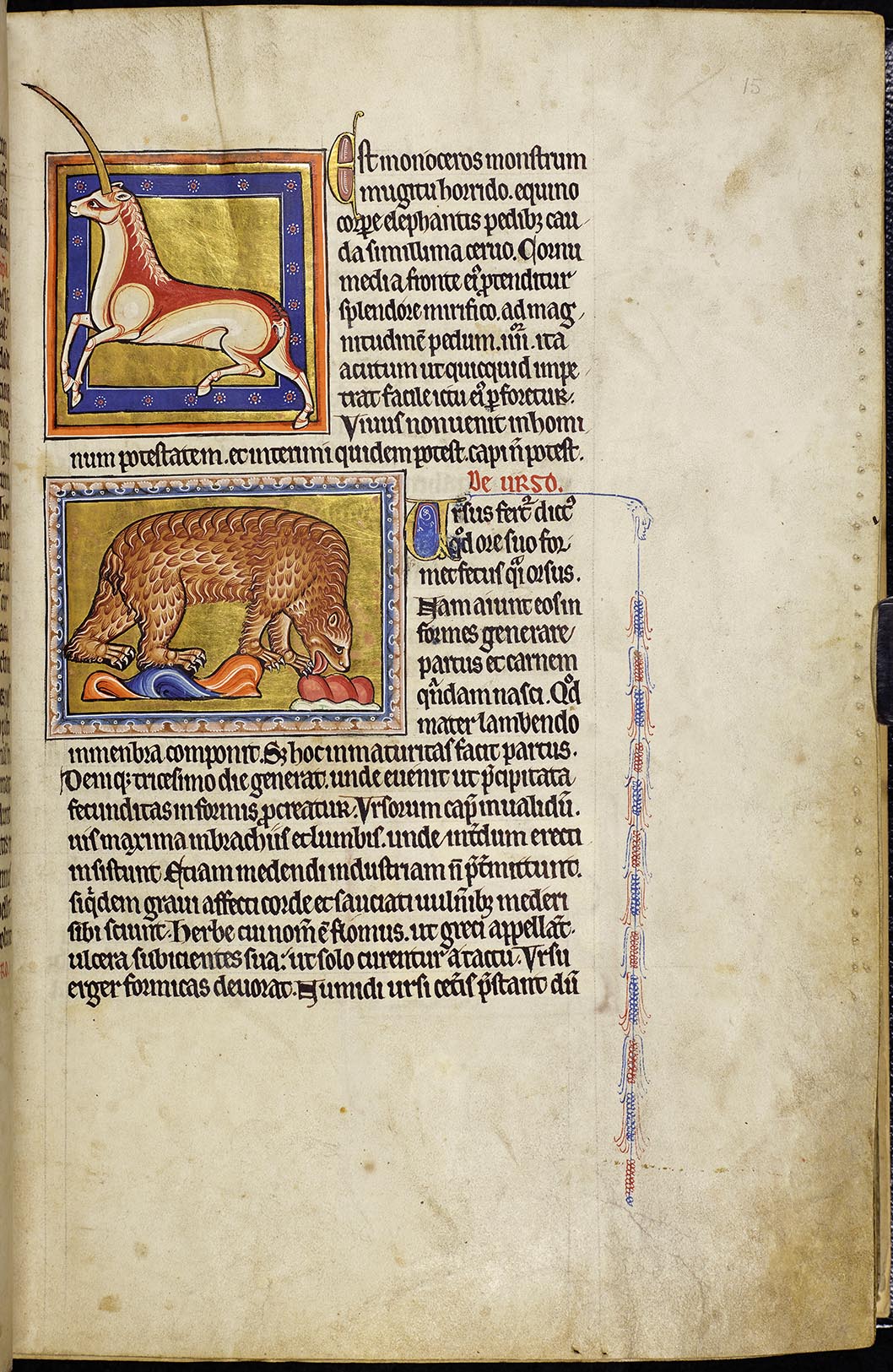
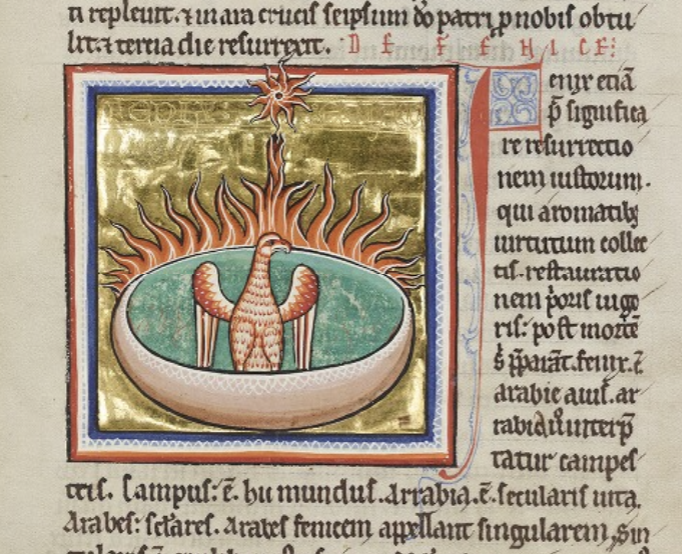
Basic modern definitions often suggest a sort of binary, ontological taxonomy for the creatures in these texts: bestiaries feature “real” animals (or “actual” or “factual” ones, such as dogs, crocodiles, beavers, and elephants), but also “imaginary” ones (or “mythical,” “legendary,” or “fabulous” ones, etc., such as unicorns, phoenixes, and manticores).

Unicorn from Aberdeen Bestiary (Aberdeen, Aberdeen University Library MS 24, f15r).

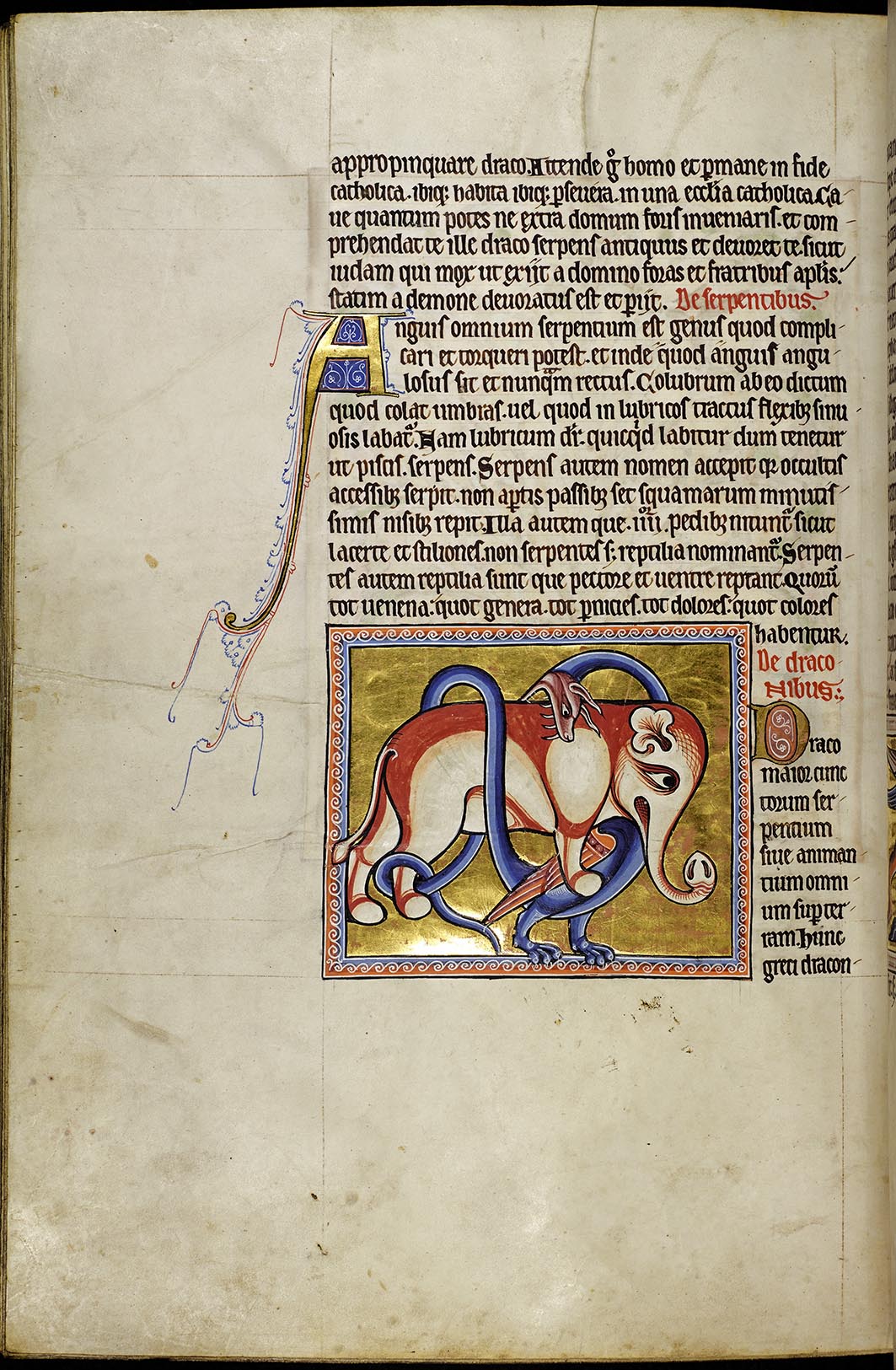
Bestiaries themselves don’t appear to distinguish between “real” and “imaginary” animals, in terms of the arrangement of entries or the way that creatures from these two categories are verbally described or artistically depicted;[1] the distinction is a modern and anachronistic one. Furthermore, bestiaries’ inclusion of hard-to-believe anecdotes about well-known creatures who actually do exist (e.g., the stag’s alleged habit of drowning snakes) renders the boundary between “real” and “imaginary” animals, as we might consider it, less firm in these texts. At stake in the discourse of the “real” versus the “imaginary” in bestiaries is our view of medieval thinkers.

One approach to the “imaginary” animals in bestiaries—a very old approach to interpreting mythical creatures, in fact—is rationalistic: positing that even the legends have some basis in reality, and that real animals were, through a combination of misunderstanding and literary transmission, rendered (almost) unrecognizable. Notable proponents of this view in modern times have included T. H. White (1954), and more recently, zoologists Wilma George and Brunsdon Yapp (1991).

Phoenix from Ashmole Bestiary (Oxford, Bodleian Library, MS Ashmole 1511, f68r).

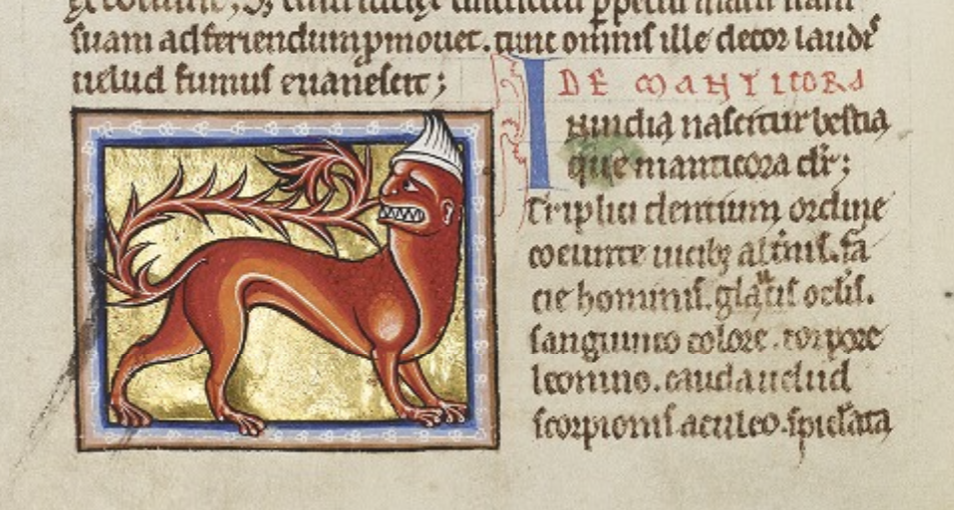
Bestiaries, for these scholars, can be read as works of natural history, albeit flawed ones, and we should perhaps extend some generosity to their creators, in light of the limitations of their knowledge. George and Yapp characterize the bestiary as “an attempt, not wholly unsuccessful or discreditable for the time at which it was produced, to give some account of some of the more conspicuous creatures that could be seen by the reader or that occurred in legends.”[2] They suggest, for instance, that the manticore—described in bestiaries as a creature with a man’s face, a lion’s body, three rows of teeth, and a tail like a scorpion stinger—was based on the cheetah; that the unicorn could actually be an oryx; and that the half-human, half-fish siren could be a Mediterranean monk seal.

Reading bestiaries as genuine, sometimes highly faulty attempts at something comparable to modern natural history is not a popular position amongst medievalist scholars of bestiaries. However, the idea of bestiaries as failed pre-modern zoology lingers in some sources aimed at popular audiences. The entry on bestiaries in the Encyclopaedia Britannica, for example, claims that the “frequently abstruse stories” in these works “were often based on misconceptions about the facts of natural history.”

Manticore from Ashmole Bestiary (Oxford, Bodleian Library, MS Ashmole 1511, f22v).

As for the ontological status of “imaginary” bestiary creatures to medieval readers, i.e., whether they believed unicorns, etc. actually existed, this is hard to ascertain, and perhaps of less interest to many scholars than the prospect of examining the messages these rich works articulate on their own terms. Still, the unsupported assertion that bestiary stories were “generally believed to be true” in the Middle Ages, as the Wikipedia page for bestiaries claims, is very much in line with widespread perceptions of the period.

It is an appealing contemporary fantasy, not so much to believe in dragons or unicorns, but to believe that people really believed in them, once—a sort of vicarious experience of enchantment, accomplished not simply by imaginatively engaging with medieval works that depict fantastic animals, but by imagining more credulous medieval readers, and perhaps even by imagining oneself in their place.

Dragon from Aberdeen Bestiary (Aberdeen, Aberdeen University Library MS 24, f65v).

To take both “real” and “imaginary” bestiary creatures as the texts present them—not seeking to sieve the factual from the fabulous, not seeking an ordinary, well-known animal behind the remarkable verbal and visual depictions that bestiaries offer—allows for, amongst other things, a certain defamiliarization of the natural world we inhabit.

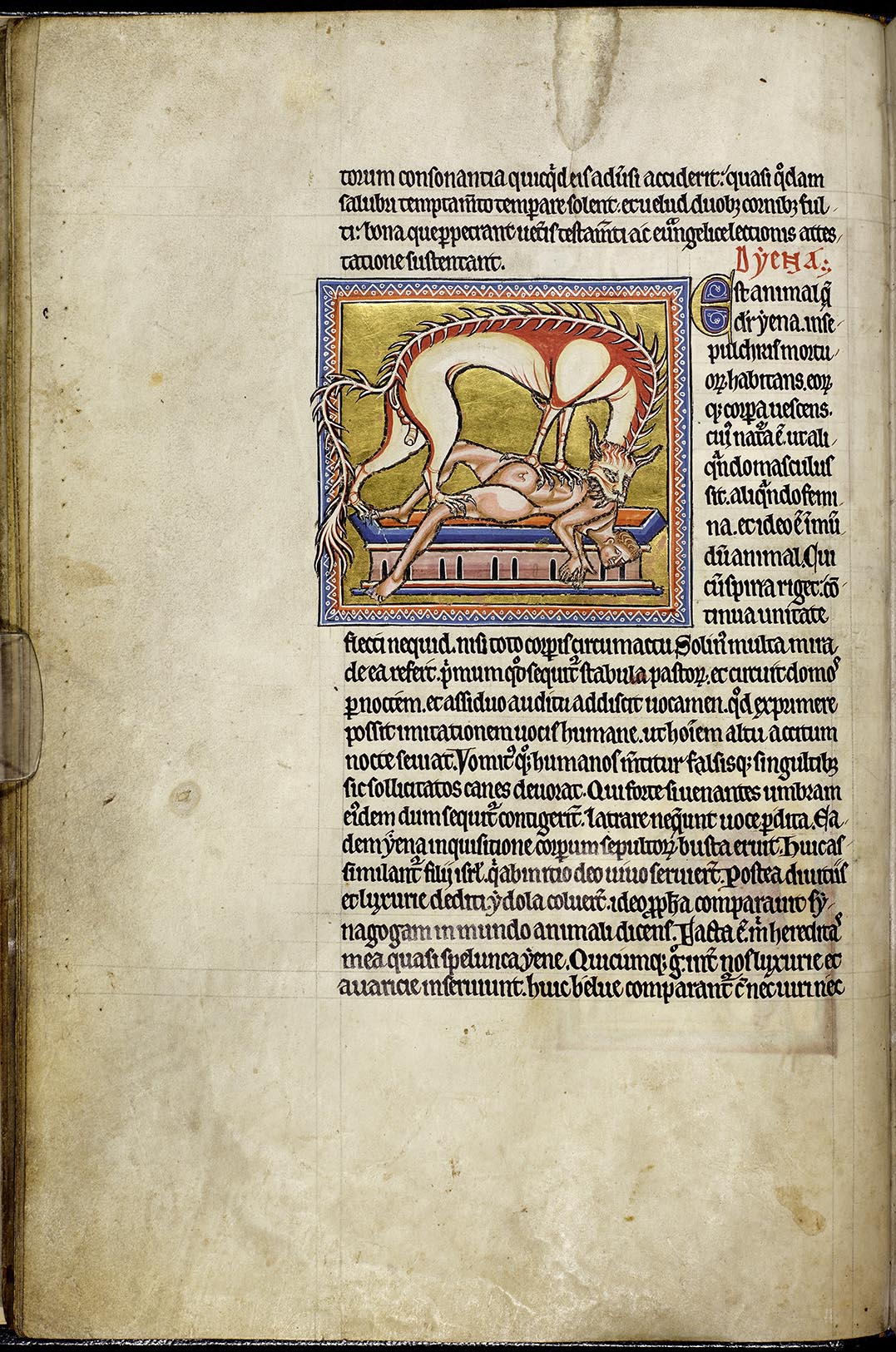
Playing on the fertile ambiguities of bestiary accounts is a project by The Maniculum (a podcast series which brings together medieval texts and modern gaming, co-hosted by E. C. McGregor Boyle, a PhD Candidate at Purdue University, and Zoe Franznick, an award-winning writer for Pentiment). On the Maniculum Tumblr, readers are offered “anonymized” selections from the Aberdeen Bestiary (i.e., the name of the animal being described is replaced with a nonsense-word to disguise its identity). Contributors are invited to create artwork inspired by the bestiary description itself, rather than their knowledge of what the animal is “supposed” to look like. The results are diverse; the “hyena” entry, for instance, yielded representations of creatures resembling everything from pigs to predatory snails, in a wide range of styles.

Hyena from Aberdeen Bestiary (Aberdeen, Aberdeen University Library MS 24, f11v).

Bestiaries continue to fascinate and inspire, centuries after their creation. Below are some medieval bestiary facsimiles and related resources to explore:

  • The Aberdeen Bestiary (Aberdeen, Aberdeen University Library MS 24), written and illustrated in England ca. 1200. Digital facsimile, accompanied by commentary, and Latin transcriptions and modern English translations of each folio.
  • The Ashmole Bestiary (Oxford, Bodleian Library, MS Ashmole 1511), early 13th century, England, possibly derived from the same exemplar as the Aberdeen bestiary. Digital facsimile.
  • The Worksop Bestiary (New York, Pierpont Morgan Library, MS M.81), ca. 1185, England. Digital facsimile.
  • The Medieval Bestiary: Animals in the Middle Ages, a website on bestiaries by independent scholar David Badke. Includes indices of bestiary creatures, cross-referenced with manuscripts and relevant scholarship, as well as galleries of medieval illustrations.
  • Into the Wild: Medieval Books of Beasts, YouTube video by The Morgan Library & Museum.

Linnet Heald
PhD in Medieval Studies
University of Notre Dame


[1] Pamela Gravestock, “Did Imaginary Animals Exist?” in The Mark of the Beast: The Medieval Bestiary in Art, Life, and Literature, ed. Debra Hassig (New York: Garland, 1999), 120.

[2] Wilma George and Brunsdon Yapp, The Naming of the Beasts: Natural History in the Medieval Bestiary (London: Duckworth, 1991), p. 1.