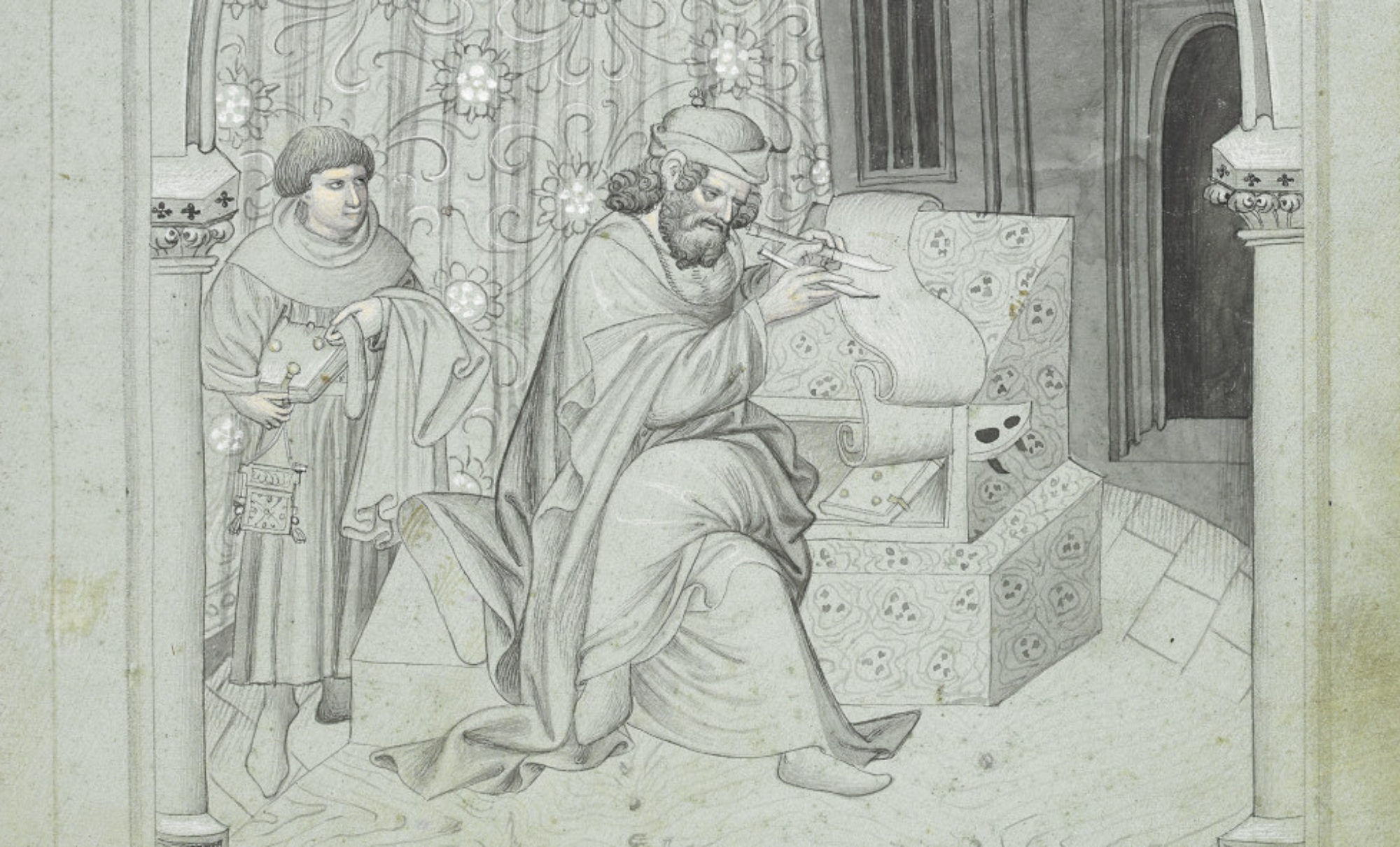
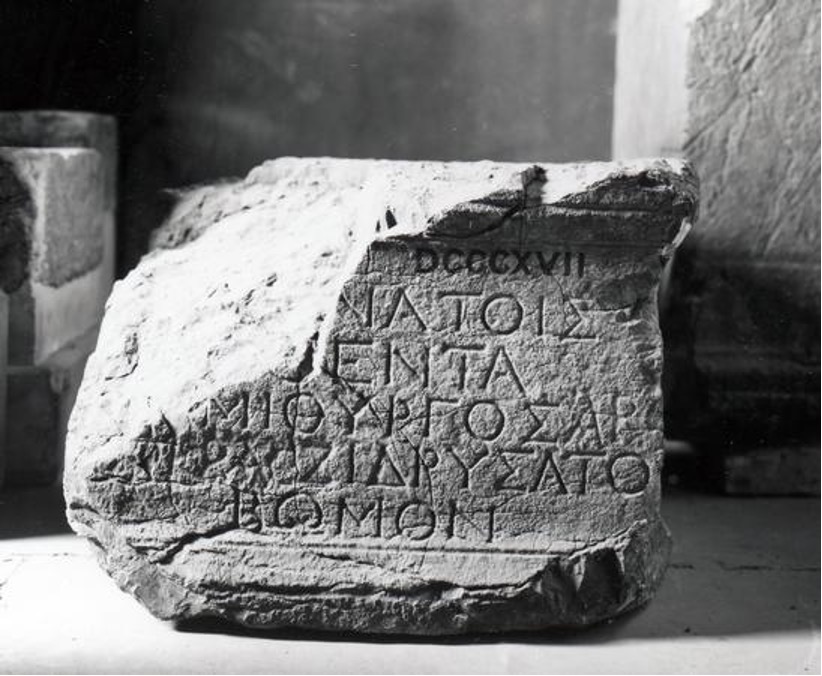
This short research blog focuses on the development of the word ἁμαρτάνω “to sin” from the advent of Christianity to the late Byzantine era. The word, ἁμαρτάνω, is widely used in the Bible as it appears forty-three times. To word’s primary meaning in the Bible was to “err and sin”; however, from time to time, it was also used to signify the action of offending. ἁμαρτάνω occurs in many different forms in the New Testament as we see it in aorist first-person singular active form Ἥμαρτον” eight times, second-person singular indicative middle six times, and second-person indicative active plural form three times.[1] I will trace the different nuances in the meaning of this word in the subsequent periods, especially in the late Byzantine period. My argument is that as several Greek and non-Greek sources indicate, the word ἁμαρτάνω began having a military connotation in this period as it was applied to the Christian military units who had cooperated with the enemy forces, especially the Turks.
Inscription, in The Collection of Ancient Greek Inscriptions in the British Museum
In Homeric times, ἁμαρτάνω had no religious connotation. The Theological Dictionary of the New Testament suggests that, initially, the word was used to convey the action of “missing” i.e failure to follow rules and signify a moral deficit or immoral physical undertaking. [2] However, in the later periods (c. 400 BCE), we begin seeing a shift from legal to religious use since ἁμαρτάνω made its way to the Book of Kings in the old testament, meaning “to rebel” against the god and his order in the earth.[3] From a theological standpoint, rebelling against the will of God means to err from the true path and therefore to sin. In this way, those who had intentionally deviated from moral or religious standards came to be defined as αμαρτωλός “the sinful one” in the later Christian religious texts.[4]
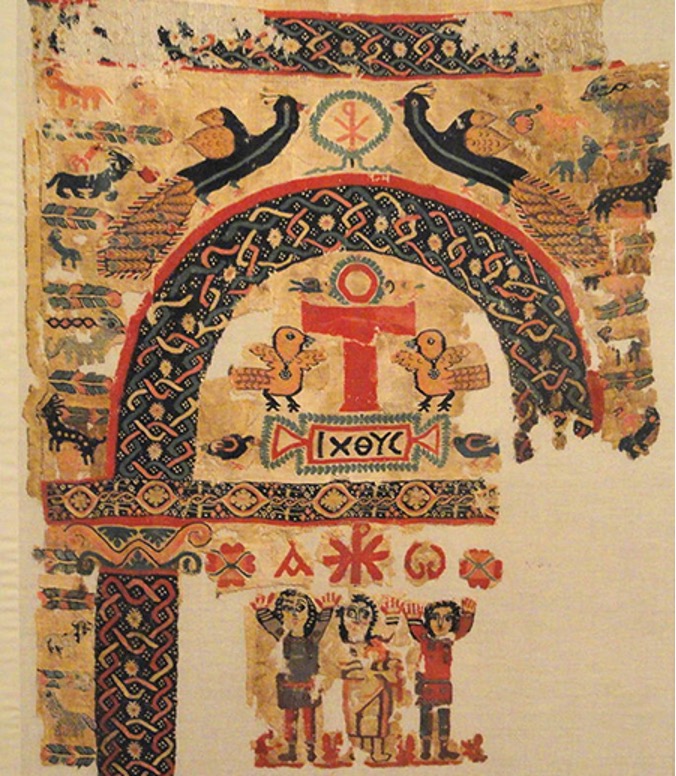
Early Christian symbols on an Egyptian textile, the Cleveland Museum of Art, Cleveland, Ohio.
ἁμαρτάνω is mostly used to signify the action of “sin” and neglecting the commands of God with an exception of “offending” in the New Testament.[5] In the Book of Romans, for instance, we see the following structure: “γὰρ ἀνόμως ἥμαρτον ἀνόμως καὶ” which means “Indeed without law I sinned without law also[…]”.[6] Here, ἁμαρτάνω was used in the aorist, active, and indicative form. In another example, this time from the Book of Corinthians, the word is used in such a construction: “οὕτως δὲ ἁμαρτάνοντες εἰς τοὺς” meaning “thus moreover sinning against those […]” in the participle, present, active form.[7] Besides the action of sinning, ἁμαρτάνω seems to be used in a different meaning, “to offend”, in the Book of Apostles although a minor disagreement exists between various interpreters. Regarding the following phase: “Καίσαρά τι ἥμαρτον[…]” while New American Standard Bible renders the word as “committing”, the King James version translate the term as “offending”. However, the new international version disagrees with these suggestions, interpreting the whole phrase as “Caesar [in] anything sinned […]”.[8]
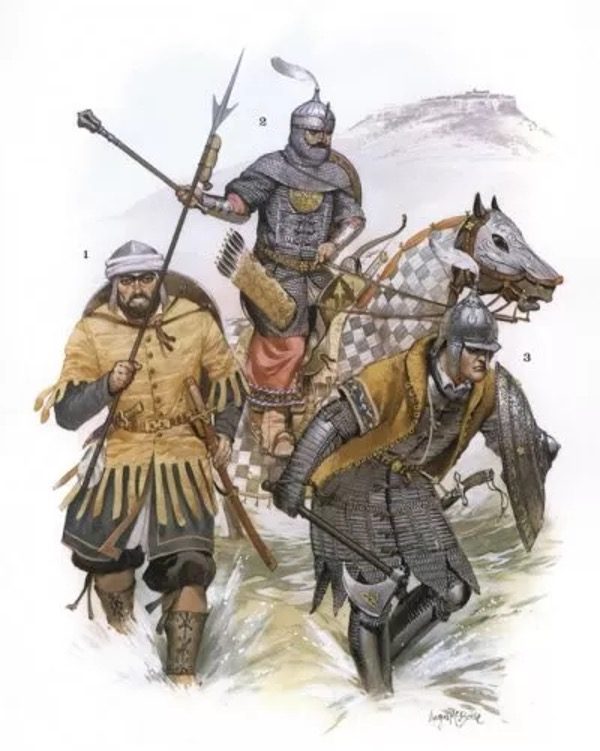
Nicolle, David. Armies of the Ottoman Turks 1300-1774. London: Osprey, 1983.
Besides its use in legal and religious spheres, towards the late Byzantine period, we begin seeing the word, ἁμαρτάνω, or its variants in Greek and Turkish texts in the military context. With the Turkish advance towards western Asia Minor and the Balkans in the later 13th and early 14th centuries, the local Greek-speaking people began adjusting to the newly established political reality in their respective territories by means of cooperating with their new rulers. A significant portion of the Greek population in these regions had converted to Islam, while others participated in the Ottoman military system as auxiliary units. As the later Byzantine writer Pachymeres states in his Ιστορία, the Greeks from Anatolia, “ἐπιμιξάντων καὶ Ῥωμαíων ἐξ ἀνατολῆς”, had occasionally joined the Turkish forces to raid the Byzantine territories in the hopes of acquiring material gain.[9] Besides Pachymeres, Doukas also refers to these Greek collaborators in his historical work, calling them “μιξοβαρβαροι” meaning half-Greek and half-Turks.[10] Although these authors shunned using the word, ἁμαρτωλός, several Turkish authors borrow this term from their Greek correspondents. An early Ottoman called Aşıkpaşazade reports that the founder of the Ottoman principality, Osman Gazi, had a “martolos” ( مارتلوس) by the name of Artun who acted as a spy in the Byzantine territories for the Ottomans.[11] After the Ottoman conquests in the Balkans, as the land surveys indicate, the Ottomans had given landed estates to several Christian military units who were also called “martolos”.[12]
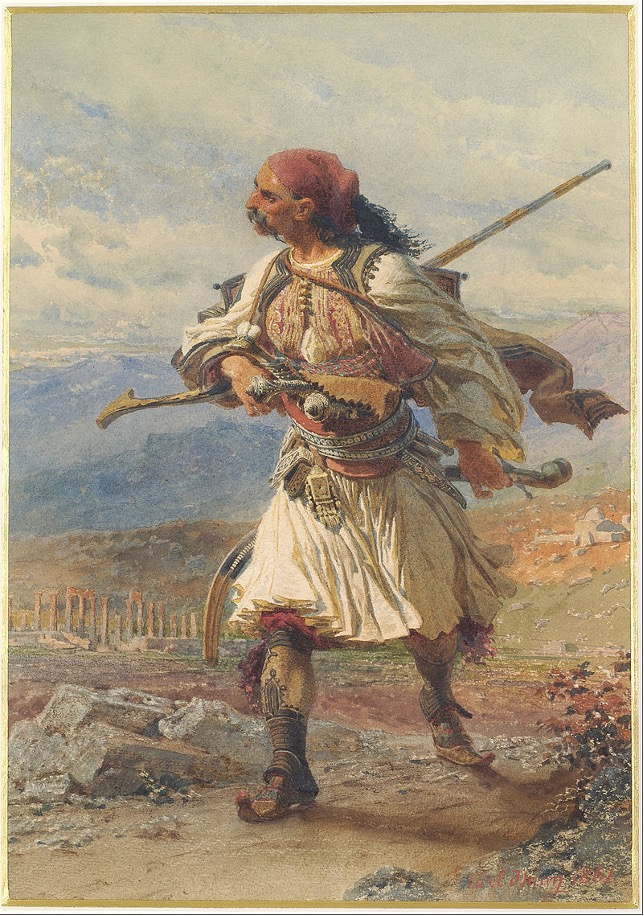
Greek Armatolos by Carl Haag (1820–1915).
Lastly, after the mid-fourteenth century, the Ottomans also formed provincial forces in mainland Greece named “armatolos” which had a clear phonetic resemblance with the word “amartolos”. Although several scholars argued that this term had derived from a medieval loan word from Latin arma “weapon” via Greek αρματολός it is also within the boundaries of possibility that the development of that word might have originated from αμαρτωλός since the use of the latter preceded the former. During the Greek War of Independence (1821-1828), these αρματολός units had actively participated in military encounters against the Ottoman forces as we are able to trace their role in Greek folk songs: “συλλογιστείτε το καλά, /ότι (: γιατί) σας καίμε τα χωριά· / γρήγορα τ’ αρματολίκι,/ οτ’ ερχόμαστε σαν λύκοι” “Think well, / that [why] we burn your villages; / quickly the armatoliki, / that we come like wolves”.[13]
In sum, ἁμαρτάνω had no religious implications during Homeric times as it was used to convey the idea of “missing” (i.e. “missing the mark”). However, in the later periods, it started appearing in the Bible as the word began to signify the act of transgression against the word of God. In the late Byzantine period, however, a derivation of this word, ἁμαρτωλός, was used for Christians who cooperated with the enemy forces since it was thought that they rebelled against God by aligning themselves with the non-Christian adversaries.
[1] Thesaurus Linguae Graecae. Search for word: ἁμαρτάνω.
[2]Danker, Frederick W. et al., A Greek-English Lexicon of the New Testament and Other Early Christian Literature (Exeter: Eerdmans, 1974) 44.
In what follows, I would like to offer a little medley of anecdotes, originating from Ireland, Wales, or Anglo-Saxon England which I have either come across during my time as an undergraduate student, and remember very fondly, or have learned about more recently, and which have struck me as particularly fascinating. While my own background is in Celtic Studies, where I work especially on editing Old and Middle Irish texts (yes, from the original manuscripts), I’ve always had a fondness for the relationships that existed between various medieval civilisations and especially for contact between languages. During the year I spent as a Murphy Irish Exchange Fellow at Notre Dame, I also had the opportunity to study Greek and Latin with Profs. Mazurek and Mazurek, topping up on my knowledge of both of these languages pursued while studying in Ireland. Below are four tales of linguistic contact, demonstrating scribal cleverness and competition, some riddles, the danger of studying in Ireland, and also information about reindeer. I hope you’ll enjoy!
Nolite te grammatica carborundorum (or some actual Latin)
Every student of Old Irish, myself included, will at one stage have come across the Old Irish Glosses, and most of the time they will form the foundation of any beginner’s level Old Irish course. As a novice to this fascinating language, I naturally wondered what exactly glosses were and why they were so important. In John Strachan’s Old Irish Paradigms and Glosses, one of the standard teaching works, we find the complicated tables which ought to be learned off by heart by anyone wishing to have even the smallest sense of how the Old Irish verbal system works. But the bulk of the book is filled with practice sentences drawn from actual unadapted material (in contrast to the grammatical ‘safe-space’ that is E. G. Quin’s Old-Irish Workbook), and thus the adventurous student is plunged into the world of orthographical variation and grammatical uncertainty, the world of the Glosses. The primary sources for the student of Old Irish, which also provide the majority of the source material to Rudolf Thurneysen’s seminal Grammar of Old Irish, are interlinear and marginal notes written in Old Irish as commentary on Latin texts, found in manuscripts which are now, for the most part, kept in libraries in Continental Europe. One such source is a mid-ninth-century manuscript in the Stiftsbibliothek of St. Gallen in Switzerland, known as Codex Sangallensis904.[1] It contains a copy of Priscian’s Institutiones Grammaticae (6th century), one of the most important sources for the instruction of Latin in the Middle Ages.
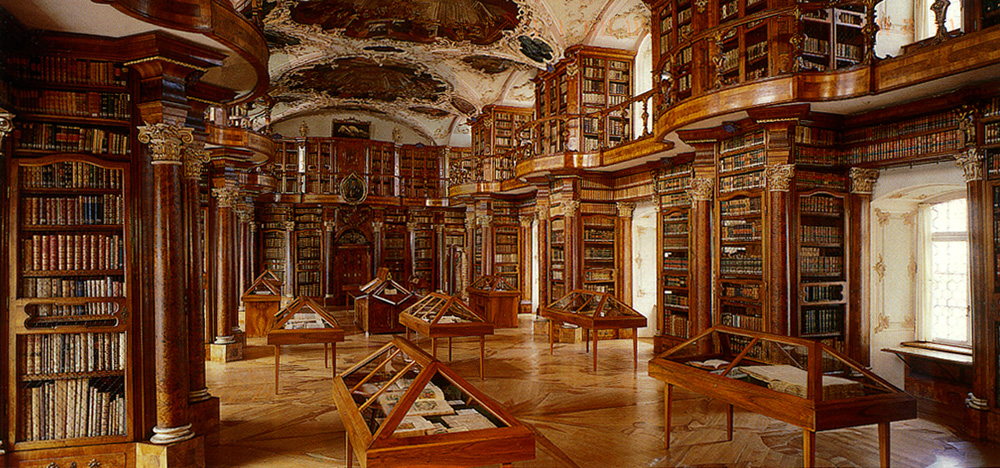
Abbey Library, St. Gall, Switzerland
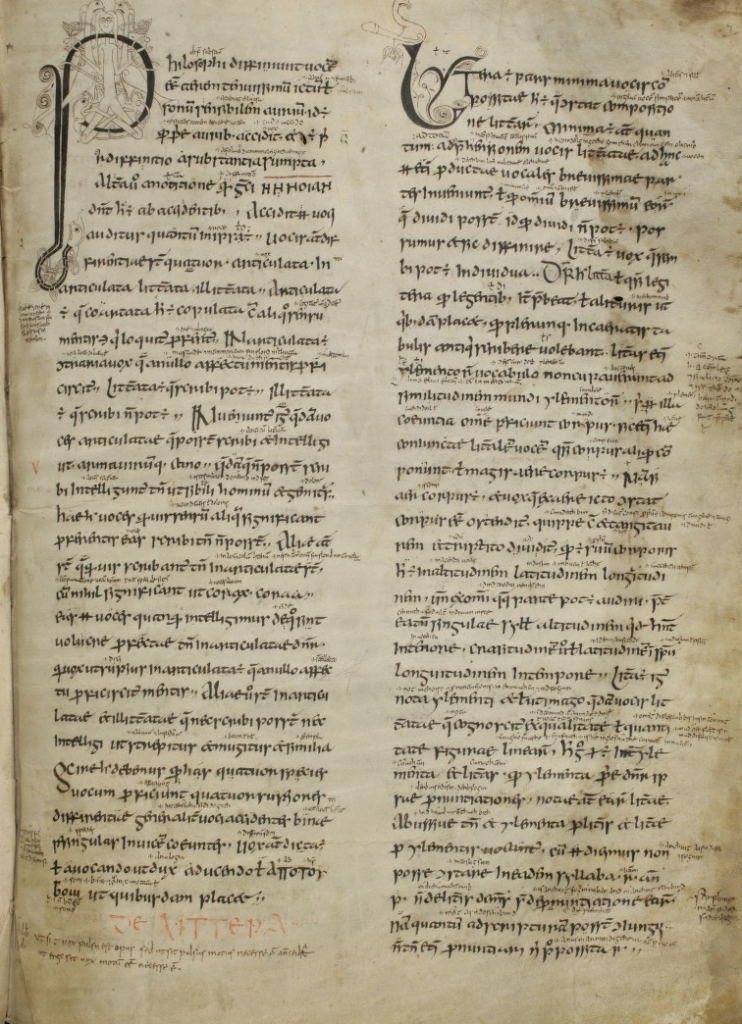
To the student of Old Irish, this work is simply known as ‘the St. Gall Glosses’. As can be seen in the image below, the main text is written in large script, but in-between the lines and in the margins, we find much smaller annotations, explanations, and comments in Latin and in Old Irish. These are to a large extent explanatory teaching notes, as a knowledge of Latin was indispensable for understanding, studying, and also copying biblical texts, hagiography, or even computus.[2]
St. Gallen, Stiftsbibliothek, Cod. Sang. 904, f. 3 – Prisciani grammatica
When studying a foreign language, be it ancient, medieval, or modern, it is only natural to ponder the ways in which that language is both alike and different from one’s own. And building a bridge between the familiar and the foreign is the mark of a good teacher as well as a good student. Among the glosses found in the Codex Sangallensis are numerous gems of language contact, which provide insight into the mind of the medieval Irish Latin teacher and of his students. An example familiar to many students of Old Irish will no doubt be the little nature poem written in the margin on ff. 203-4, here given from Gerard Murphy’s edition[3] together with Seamus Heaney’s and Timothy O’Neill’s translation:[4]
Dom-ḟarcai fidbaide fál fom-chain loíd luin, lúad nād cél; hūas mo lebrán, ind línech, fom-chain trírech inna n-én. Fomm-chain coí men, medair mass, hi mbrot glass de dingnaib doss. Debrath! nom-Choimmdiu-coíma: caín-scríbaimm fo roída ross.
Pent under high tree canopy,
A blackbird, listen, sings for me,
Above my little book’s ruled quires
I hear the wild birds jubilant.
From a shrub covert, shadow-mantled
A cuckoo’s clear sing-song delights me.
O at the last, the Lord protect me!
How well I write beneath the wood.
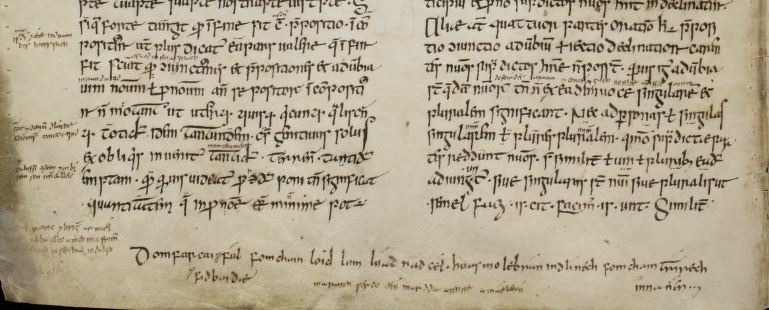
This little poem is one of the highlights of medieval Irish nature poetry and was long held to be a reflection of the hermitic lifestyle of the medieval Irish monk until that assumption was challenged by Donnchadh Ó Corráin.[5] In what might feel more recent, but was still twenty years ago this year, Patrick Ford made a fascinating contribution to the subject in challenging ‘the conventional scholarship that ignores the physical setting in which we find it [the poem]’.[6] Ford was interested in the question, which had not before been asked, as to why this little poem had survived in this particular manuscript and on this particular page of Priscian’s Grammar, and confronted the practice of reading texts outside their manuscript contexts lest ‘the genre determines the meaning of the work’. But what exactly is the poem’s manuscript context?
Nature poem beginning Dom-ḟarcai fidbaide fál, St. Gallen, Stiftsbibliothek, Cod. Sang. 904, f. 203, lower margin
On f. 203 in the St. Gall copy of Priscian’s Grammar, the reader is treated to a description of the Latin pronominal system (this is part of Book 12 of De Figuris), specifically the distinctions between simple and compound pronouns, e.g. huiusmodi, mecum, etc. With this manuscript context in mind, Ford has made the ingenious argument that the scribe, far from musing about blackbirds and cuckoos, very much had pronouns on his mind.[7] One of the most distinctive features of Old Irish (and, to a certain extent, also Welsh) are infixed pronouns. In the Old Irish verbal system, both the subject and the object of an action were expressed within the verbal complex, the former through the ending of a synthetic verb form, e.g. finnamar ‘Let us find out’, and the latter through a pronoun that was either suffixed to the verbal ending or inserted before the main verb with the help of a preverb or other particle. Thus, ‘He kills his enemy’ (as you do) is marbaid a námait, but ‘He kills him’ is either marbthai with a suffixed pronoun or na marba with an infixed pronoun (and the conjunct particle no as well as the dependent form of the verb). There is nothing equivalent to the infixed pronoun in Latin, however. Given that our little nature poem contains six pronouns in the space of eight lines, five of which are infixed pronouns and one possessive, Ford concluded that the scribe was engaging both critically and creatively with Priscian’s text: he responded to the idiosyncrasies of Latin pronominal compounding in the most Old Irish way possible—with a poem filled with infixed pronouns.
While the poem of the scribe in the woods may be the most famous example of the creative interplay between Latin and Old Irish, it is far from the only one. The differences between Latin and Old Irish are most certainly not confined to the way both languages employ pronouns. One of the most striking differences between the two is the modal category of the infinitive. While most European languages have an infinitive (étudier, studieren, etc.), Irish does not. But that does not mean that Latin infinitives are not glossed in Priscian and other Latin texts containing Old Irish glossing. See, for instance, the following examples occurring in the Old Irish glosses to the commentary on the Psalms contained in the Codex Ambrosianus C 301 inf, another ninth-century Irish manuscript now held at the Biblioteca Ambrosiana in Milan.[8] On f. 15a 10, the word inficere is glossed fris-n-orr, literally ‘that he may injure’; on f. 78b 24, the deponent infinitive opinari is glossed with an Old Irish deponent form du-menammar ‘that we may opine’; and on f. 39b 3, supplicare is glossed with ṅges ‘that he may pray’. The Old Irish solution for the lack of an infinitive was to put the verb into the present subjunctive and employ a sub-clause construction known as a nasalising relative clause (this nasalisation is indicated by the ninnges and before the verbal stem in fris-n-orr).
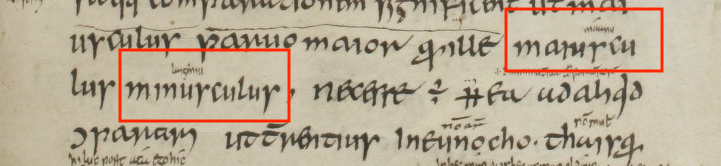
Dwelling for another moment on Priscian and the teaching of Latin in Irish monasteries, Irish scribes did not only ponder the differences between Latin and their own language, but also commented on the similarities or sought equivalent Irish solutions for a particular Latin phenomenon. A curious case of morphological creativity in the glosses on Priscian is the occurrence of what seem to be special comparative forms of certain adjectives. See for instance the two forms on f. 45, where the forms maánu ‘a little greater’ and laigéniu ‘a little smaller’ occur. These are to be understood as comparative forms of mór ‘great’ and becc ‘small’ (with adjectival suppletion) respectively, though their regular comparative forms are móo or máo and lagiu. The words glossed by máanu and laigéniu, respectively, are maiusculus and minusculus, again ‘a little greater’ and ‘a little smaller’.
The words maiusculusand minusculus glossed on f. 45 of St. Gallen, Stiftsbibliothek, Cod. Sang. 904
It appears then that the Latin teacher wanted to make his students understand that –cul is a Latin diminutive suffix which can express variation in the degree of comparison, specifically to what extent something is lesser or smaller than something else. And the Irish equivalent of such a diminutive suffix is én or án. Thus, laigiu becomes laigéniu and móo becomes maánu, creating nonce words for the sake of teaching. The Old Irish Glosses are a veritable treasure trove, and any student or scholar versed in the reading of insular minuscule should set the Thesaurus Paleohibernicus, the standard edition of the Old Irish Glosses,[9] aside and look at the manuscripts directly. Fortunately, the St. Gall manuscript has been fully digitized and can be consulted free of charge.
Greek Substitution Cyphers, or ‘Are you smarter than an Irishman?’
Our next stop on the journey of language contact is Wales, although we are taking a few Irish people along with us. One of the most intriguing riddles of medieval Western Christendom (in my not entirely unbiased opinion) is the cypher known as the ‘Bamberg Cryptogram’. So called after one of its manuscript sources, a late-tenth-century codex held at the Staatsbibliothek Bamberg in Bavaria, the context of the cryptogram goes back to an Irish scholar named Dubthach mac Máel Tuile whose obit is recorded in 869. Dubthach was a most learned man, versed not only in Latin and, to a certain extent, Greek, but also in computus, cryptography, and cryptanalysis.[10] The ‘Rosetta Stone’ to Dubthach’s cypher is provided by a letter written in Latin verse which gives the answer to the riddle (provided one is fluent in Latin, of course). This letter was sent by another Hiberno-Latin author named Suadbar, better known under the name Sedulius Scottus, another of the great ninth-century Irish scholars, to his master Colgu in Ireland. The context of the letter is Suadbar’s journey to the court of Merfyn Frych (d. 844), king of Gwynedd in North Wales, together with three companions. He tells us that scholars, such as himself and his fellow students, arriving from Ireland at the court of Merfyn are tested and given Dubthach’s cypher to decode.
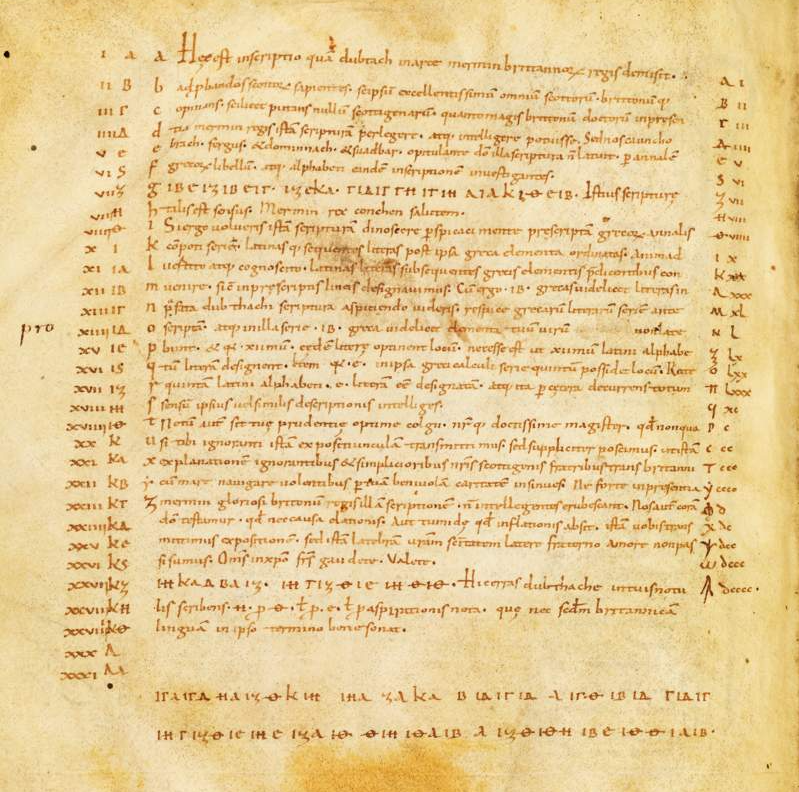
Bamberg, Staatsbibliothek,Msc.Class.6, f. 109v[11]In what Nora Chadwick termed ‘a delightful bit of patriotic cheating’,[12] Suadbar did not wish upon his fellow Irishmen at home the embarrassment of being unable to decipher the code in front of the king. And so he sends the letter. Dubthach’s cypher itself is quite short; it consists of twenty-two letters and four words. The cypher in the image above is found in l. 7 (uii or g) and is extracted here below:
If you have ever had any dealings with codes and cyphers (if not, I highly recommend Simon Singh’s The Code Book), it will be obvious to you that we are dealing with a simple substitution cypher using the Greek alphabet as the basis. In order to understand the message, Suadbar and his companions had to substitute Roman letters for the Greek ones by assigning a Greek letter to each letter in their own alphabet and proceeding alphabetically. The key for the cypher, as given on f. 109r of the Bamberg manuscript, is as follows:
Α
Β
Γ
Δ
Ε
S
Ζ
Η
Θ
Ι
ΙΑ
ΙΒ
ΙΓ
ΙΔ
ΙΕ
ΙS
ΙΗ
ΙΖ
ΙΘ
Κ
ΚΑ
ΚΒ
ΚΓ
a
b
c
d
e
f
g
h
i
k
l
m
n
o
p
q
r
s
t
u
x
y
z
Equipped with this cryptanalytic tool, we can now read the above line as
MERMEN. REX. CONCHN. SALUTEM
As David Howlett explains in the commentary to his edition of the cryptogram,[13] the phrase is from the salutation of a letter from King Merfyn to Cyngen (Irish Conchen), king of Powys and brother to Merfyn’s wife Nest. The name of the king, Merfyn, in Welsh is here spelled in Irish orthography, where medial m would have the same phonetic value as f in Welsh, hence Mermen. Translated, the line means ‘Merfyn the king salutes Conchenn’. Let us hope that Suadbar’s fellow students back in Ireland were worthy of the answer!
[5]Ó Corráin, Donnchadh, ‘Early Irish hermit poetry?’, in D. Ó Corráin, L. Breatnach, and K. McCone (eds.), Sages, Saints and Storytellers. Celtic Studies in Honour of Professor James Carney. Maynooth, 1989: 251-67.
[6]Ford, Patrick K., ‘Blackbirds, Cuckoos, and Infixed Pronouns. Another Context of Early Irish Nature Poetry’, in R. Black, W. Gillies, and R. Ó Maolalaigh (eds.).Celtic Connections. Proceedings of the 10thInternational Congress of Celtic Studies, 1999: 162-170; 162-3.
[9]Stokes, Whitley and John Strachan (eds.), Thesaurus Palaeohibernicus, 3 vols. Cambridge, 1903 (repr. 1987).
[10]Dubthach mac Máel Tuine, doctissimus Latinorum totius Europae, in Christo dormiuit‘Dubthach mac Máel Tuile, most learned of all the Latinists of Europe, died in Christ’ (Dáibhí Ó Cróinín, Early Medieval Ireland, 400-1200. London and New York, 1995: 236).
[12]Chadwick, Nora K., ‘Early culture and learning in North Wales,’ in N. Chadwick, K. Hughes, C. Brooke, and K. Jackson, Studies in the Early British Church. Cambridge, 1958: 29-120; 96.
[13]Howlett, David, ‘Two Irish Jokes’, in Pádraic Moran and Immo Warntjes (eds.), Early Medieval Ireland and Europe: Chronology, Contacts, Scholarship.A Festschrift for Dáibhí Ó Cróinín. Turnhout, 2015: 225-264; 243.
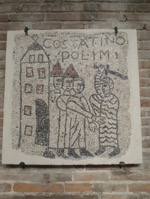
Fragment of a floor mosaic (13th century) depicting the sack of Constantinople by the Latin crusaders in 1204; Ravenna, San Giovanni Evangelista
The Council of Ferrara-Florence (1438/39) is considered the last remarkable, though ultimately unsuccessful, attempt in the Middle Ages to restore church unity between the Latin West and the Greek East. Throughout history, certain events and their enduring consequences had nourished a growing scissure that ever deepened the alienation between the churches – just to mention a few of the most striking: the so-called Photian schism at the end of the 9th century, the mutual excommunications in 1054, the sack of Constantinople in 1204 followed by the Latin Empire of Constantinople until 1261, the Byzantine Emperor’s acceptance of an eventually short-lived church union on the Second Council of Lyons in 1274 (succeeded, though, by its refusal in 1282) etc. Following the history of reception of these events in the Middle Ages and beyond is like dealing with not only one, but several “points of no return”: While this might seem contradictory to itself, it nevertheless helps to understand (1) that dating the breakout of the schism depends on what kinds of sources we rely on, and (2) that, again throughout history, there have been many attempts and frequent parallel endeavours to heal this fracture between the churches.
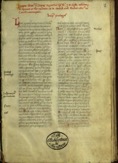
One milestone of such an effort was the lifetime achievement of an anonymous Dominican from the year 1252, a learned theologian who dedicated himself to an in-depth study of the Greek language, theology, and church life. Based on this knowledge, he was capable and well-equipped to write a theological treatise “Against the Greeks” (Tractatus contra Graecos) in Constantinople, which eventually became a bestseller in controversial literature dealing with how to argue in Greek-Latin debates. Up to the 15th century, it greatly influenced theology and the Latin church and deeply affected how Latin authors perceived the Greek church. The anonymous Dominican was the first theologian who determined what later appeared on the agenda of the union councils in Lyon (1274) and Ferrara-Florence (1438/39): That a number of four issues of conflict – filioque, purgatory, azymes, and Roman primacy – had to be solved in order to proclaim the unity of the church, something which he didn’t see as lost, but as highly at risk. In a manner of fraternal correction, the Dominican author sought to convince the Greeks of their errors by quoting their own reliable sources, i.e. the Greek fathers and church councils, and by demonstrating that they all, in fact, supported the Latin positions. Additionally, he provided his (indented Latin) readers with a dossier of contemporary Greek writings in a Latin translation along with a commentary which was both meant to keep the readers informed about the situation on the spot and to support their argumentation in ongoing debates.
“Tractatus contra Graecos” (Inc.: Licet grecorum ecclesiam); Mantova, Bibliotecta Communale, Ms. Nr. 604 (D. I. 31), fol. 1ra-43rb, here: 1r
From today’s perspective, the actual value and impact of the Tractatus contra Graecos is impaired by the fact that today it is known only based on an early modern edition of 1616[1], which is deficient and at times almost incomprehensible. This is why an updated and reliable critical edition is a particularly urgent task: Based on 30 manuscripts that are known thus far and that are kept in libraries in Central and Southern or Southeast Europe, a critical edition will lead to a reconstruction of the text ranging from the time it was written in mid-13th-century Constantinople up to how it was used as a handout and source of information on the councils of the Late Middle Ages by leading Latin theologians. The surviving manuscripts give evidence that not only in the 15th century, but also already by the author himself, the treatise has been remodelled and shaped according to the needs of time and occasion. Both the critical edition of this Dominican key work and its history of reception contribute to a better understanding of the relationship between Rome and Byzantium in the Middle Ages and, thus, to a more detailed knowledge of the history of today’s Catholic and Orthodox churches.
—
Dr. Andrea Riedl
Senior research fellow at the Department of Theology/University of Vienna and currently visiting researcher at the Medieval Institute/University of Notre Dame.
[1] Ed. Petrus Stevartius Leodiensis (1549–1624), Tomus singularis insignium auctorum, tam graecorum, quam latinorum, Ingolstadt 1616, 487–574, and reprinted in Migne’s Patrologia graeca, PG 140, 487–574. This is the transcription of a manuscript of the Bavarian State Library in Munich, Clm 110 (fol. 1r-88).