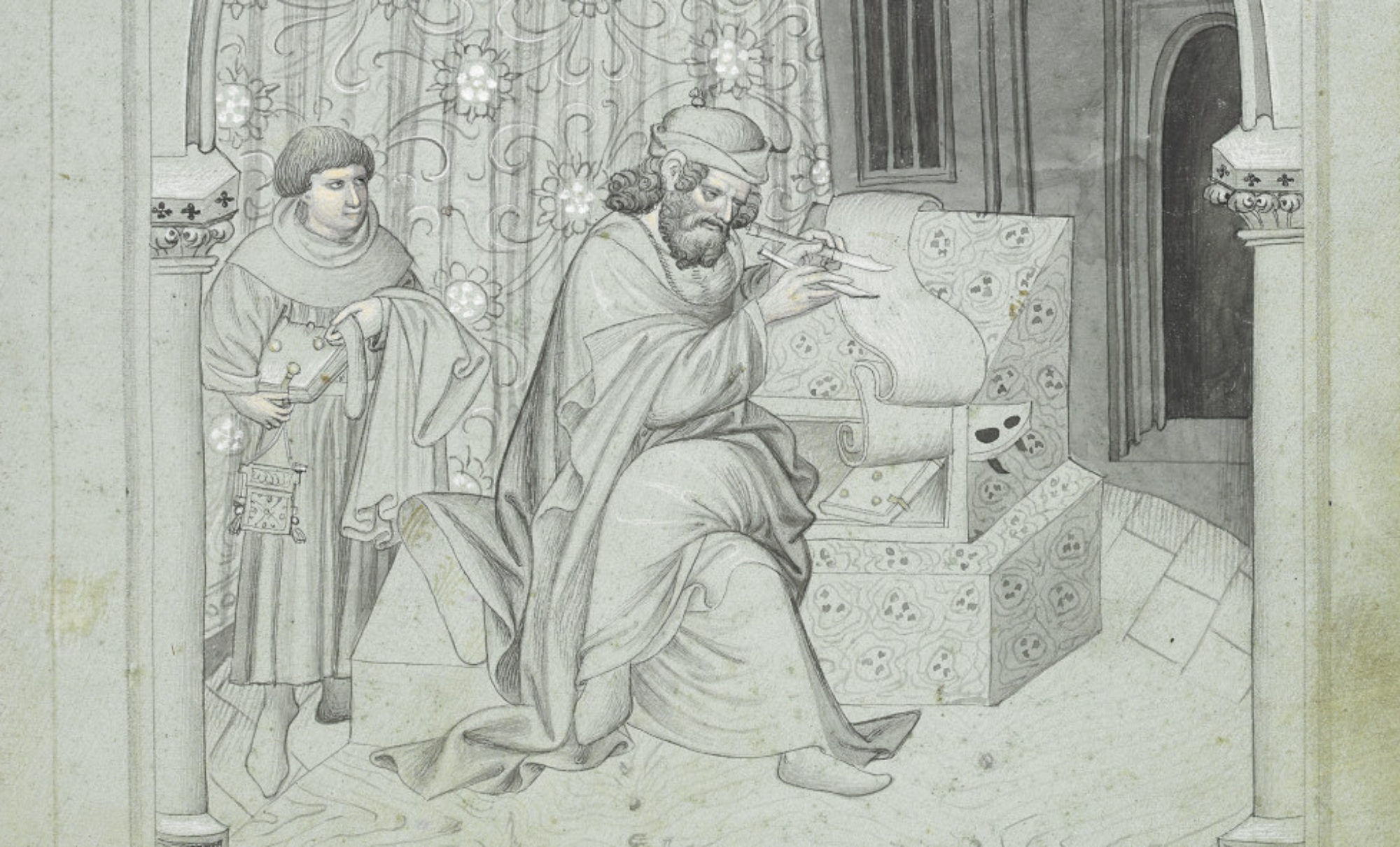
The Riddle of Grendel’s Monstrous Mother: Echoes of Scylla in Beowulf?

Grendel’s mother has long been regarded by scholars as the least monstrous of the three—not being an obvious vampire-cannibal like Grendel nor a fire-breathing dragon. Her vengeful response to the death of her son, and her decision to continue the feud between the Grendelkin has been regarded as ethical (within the broader context of warrior ethos), legal (within the context of early medieval Norse and English laws), and even heroic (aligned with the heroism as depicted in the poem).
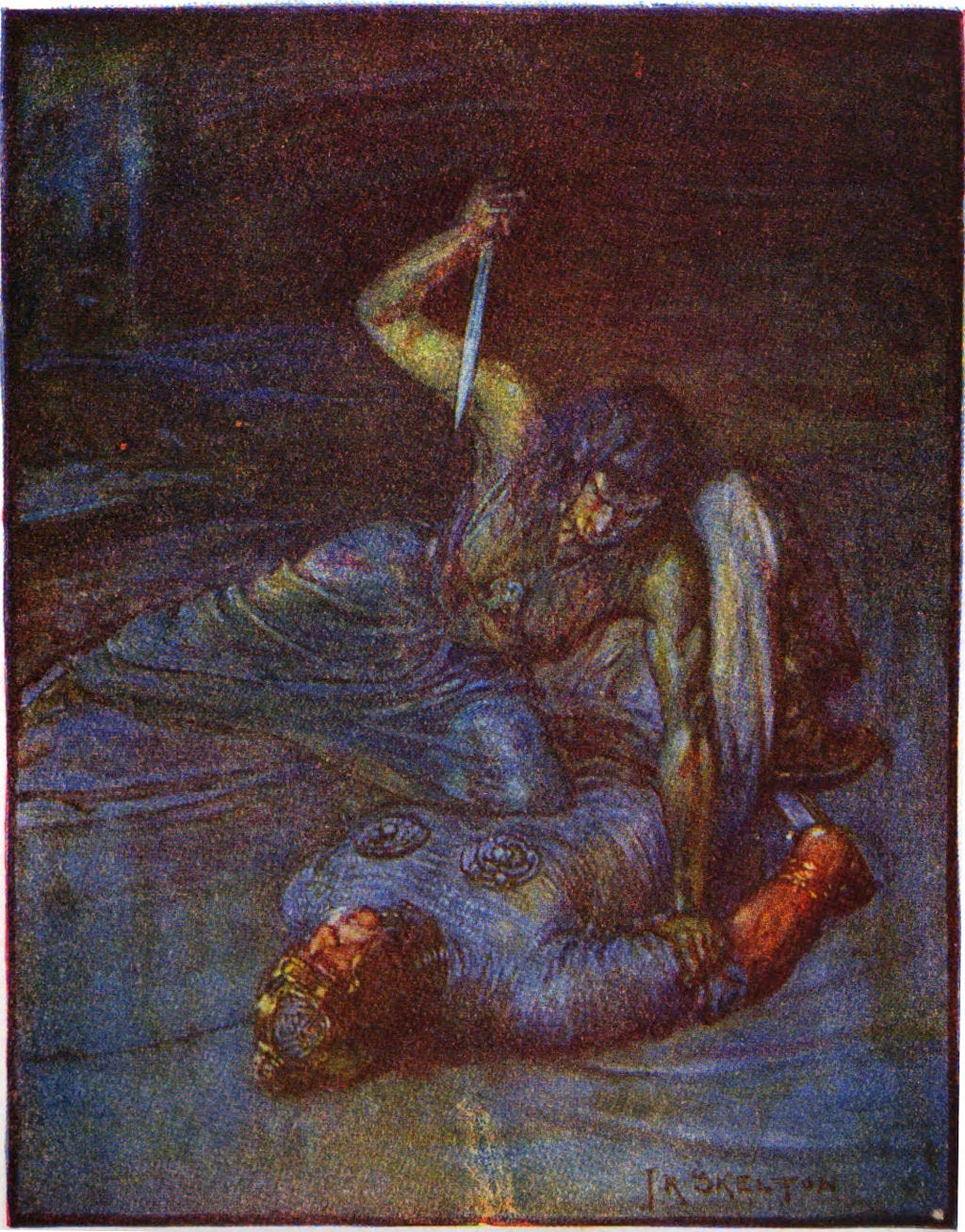
Grendel’s mother tries to stab Beowulf. Illustration by J.R. Skelton, 1908.

While I would generally agree with this broad characterization of Grendel’s mother, and there is no doubt that her actions mirror those of any avenging warrior in Beowulf, to erase her monstrosity seems to ignore at least some of the evidence. While I do not find her maternity at all indicative of abject horror (indeed quite the opposite as it is her identity as “mother” that humanizes her in my view), certain terms used to describe her and indeed everything from her association as Caines cynn “Cain’s kin” (107; 1261-65) and the hellish descriptions of her lair suggest some measure of monstrosity embedded in her character. And for this Halloween, we will spend some time unpacking the nature of her monstrosity.

I would contend that the main reason scholars argue about Grendel’s mother’s monstrosity and characterization is because of her enigmatic design. As I point out in my dissertation, riddles encode Beowulf, and, in my opinion, employ riddling rhetorical strategies, especially imitation, equivocation, esotericism and paradox. These obfuscations help account for the many irregularities observed in the poem the scholars have scratched their heads over for more than a century and help explain why often the heroes looks like the monsters—and the monsters like the heroes.  

Grendel’s mother battles Beowulf. Illustration by John Howe, 2006. All rights reserved.

Because of the influence of riddling rhetorical strategies on Beowulf, turning to the Anglo-Latin enigmata tradition is an especially fruitful practice, especially in explorations of monstrosity in the poem. Indeed, monsterized riddles have long been a feature starting with the late classical enigmatist, Symphosius, who establishes the Anglo-Latin tradition, includes numerous riddles on wondrous creatures, such as the phoenix (Enigma 31). Similarly, Aldhelm’s enigmata also feature numerous monsterized riddles, in some cases the solution is a wondrous creature (as with Symphosius’ paradoxical phoenix-riddle), in other cases the mundane is made monstrous through imitation, and the monsterization is another mechanism of obfuscation (as in Aldhelm’s Enigma 97 solved nox). Even Boniface, whose riddles center on vices and virtues, monsterizes his vice-riddles in the mode of Prudentius’ Psychomachia, a popular classroom text in early medieval English which depicts vices as monsters in an allegorical epic.

Ira’s sword shatters on Patientia’s helmet, then the enraged Ira dies by her own blade (c.900, Bern, Burgerbibliothek, Codex 264, p.79).

But what does this have to do with Grendel’s monstrous mother? Let’s start with her introduction and the complex portrait it paints:

Þæt gesyne wearþ,
widcuþ werum,   þætte wrecend þa gyt

lifde æfter laþum,   lange þrage,
æfter guðceare:   Grendles modor.
Ides aglæcwif   yrmþe gemunde,
se þe wæteregesan   wunian scolde,
cealde streamas,   siþðan Cain wearð
to ecgbanan   angan breþer,
fæderenmæge.   He þa fag gewat,
morþre gemearcod,   mandream fleon,
westen warode. 

“That became manifest, widely known to men, that an avenger still lived after the hostile one, for a long time, after war-grief: Grendel’s mother. A lady, a fearsome woman remembered misery, he who must inhabit the terrible-waters, the cold streams because Cain became the edge-slayer to his only brother, kin of the same father. He then went hostile, marked by murder, fled the joys of men, inhabiting the wilderness.”

Beowulf, 1255-65.

The first term used to describe Grendel’s mother emphasizes her desire for vengeance. The narrator names her a wrecend “avenger” (1256) —an appropriate title considering her entire characterization is framed by revenge and feuding—and her motive is thrice repeated almost verbatim and with language that could apply equally to avenging heroes in the poem (1276-78, 1339-1340, 1546). Moreover, Grendel’s mother’s is thrice described as wif “woman” (1259, 1519, 2120,) and even twice as an ides “lady” (1259, 1351) establishing gender as one of the pillars of her characterization, alongside her roles as avenger and mother. Kinship ties are further emphasized when Grendel’s mother is described as Grendles maga “Grendel’s female relative” (1391) and twice as Grendles mæg “Grendel’s kinsman” (2006, 2353), which account for her desire for revenge in upholding the warrior ethics and continuing the feud between the Danes and the Grendelkin.
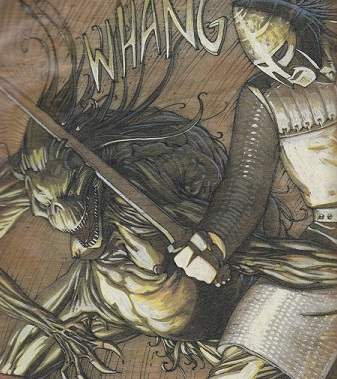
Beowulf fights Grendels mother Gareth Hinds
Beowulf fights Grendel’s mother. Illustration fromm Gareth Hinds graphic novel, Beowulf (2007). All rights reserved.

Moreover, like the monstrous vices in Prudentius’ Psychomachia and Boniface’s Enigmata, the avenger—Grendel’s mother—is clearly wondrous and monstrous in certain descriptions of her. She and her lake monsters are wæteregesa “water-terrors” (1260). Grendel’s mother is called se broga “the terror” (1260), and together with her son, she is described as mihitig manscaða “man-slayer” (1339), micle mearcstapa “great marked-wanderer” (1348), dyrna gast “secret spirit” (1357), ælwiht “alien thing” (1518), thrice as ellorgæst “foreign spirit” (1349, 1617, 1621) and even deofol “devil” (1680). She is even described as a merewif mihtig “mighty mermaid” (1519), aglæcwif “fearsome warrior woman” (1259) or wif unhyre “untamed woman” (2120), grundwyrgenne “ground wolf” (1518) and twice is characterized with the compound a brimwulf “sea-wolf” (1506, 1599).

It is my contention that descriptions of Scylla—a classical monster, famously featured in the Odyssey and popular in Anglo-Latin literature contemporary with Beowulf—likely influence the characterization of Grendel’s mother, a riddle embedded in the poetic compounds used to describe her and in the depiction of her monstrous lair.

Scylla as a maiden with a kētos tail and dog heads sprouting from her body. Detail from a red-figure bell-crater in the Louvre, 450–425 BC. This form of Scylla was prevalent in ancient depictions.

Scylla is a monstrous sea creature from Greek mythology, known for inhabiting a narrow strait opposite the whirlpool Charybdis. She often has multiple heads with each head bearing a set of sharp, ravenous teeth. Scylla’s body is a woman’s often combining serpentine, aquatic and canine features. She emerges from a rocky cliffside and narrow passage where she lives. She preys on passing sailors, snatching them from ships with her many heads and her “sea dogs” which accompany her. Once a beautiful nymph, she becomes cursed and exiled.

Scylla is the riddle-subject of Aldhelm’s Enigma 95 (solved Scilla) and is featured in his prose De uirginitate (X). Aldhelm’s Enigma 95 describes Scylla as follows:

Ecce, molosorum nomen mihi fata dederunt
(Argolicae gentis sic promit lingua loquelis),
Ex quo me dirae fallebant carmina Circae,
Quae fontis liquidi maculabat flumina uerbis;
Femora cum cruribus, suras cum poplite bino
Abstulit immiscens crudelis uerba uirago.
Pignora nunc pauidi refereunt ululantia nautae,
Tonsis dum trudunt classes et caerula findunt.
Uastos uerrentes fluctus grassante procella,
Palmula qua remis succurrit panda per undas,
Auscultare procul quae latrant inguina circum.
Sic me pellexit dudum Titania proles,
Ut merito vivam salsis in fluctibus exul.

“Look, the Fates gave me the name of dogs—thus does the language of the Greeks render it in words—ever since the incantations of dread Circe, who stained the waters of the flowing mountains with her words, deceived me. Weaving words, the cruel witch deprived me of thighs together with shins, and calves, together with knees. Terrified mariners relate that, as they impel their ships with oars and cleave the sea, sweeping along the mighty wave while the tempest rages, where the broad blade of howling offspring that bark about my loins. Thus the daughter Titan [scil. Circe] once tricked me, so that I should live as an exile—deservedly—in the salty waves.”

Lapidge and Rossier, Aldhelm: The Poetic Works, 91.

In this riddle, solved Scylla (Scilla), Aldhelm emphasizes her canine connection, and gives a reference to her origin in Greek mythology and her transformation at the hands of the witch, Circe. There is also mention of the danger she poses to any who sail by her watery abode, alongside her “howling offspring that bark” about her an further threaten wayward travelers.
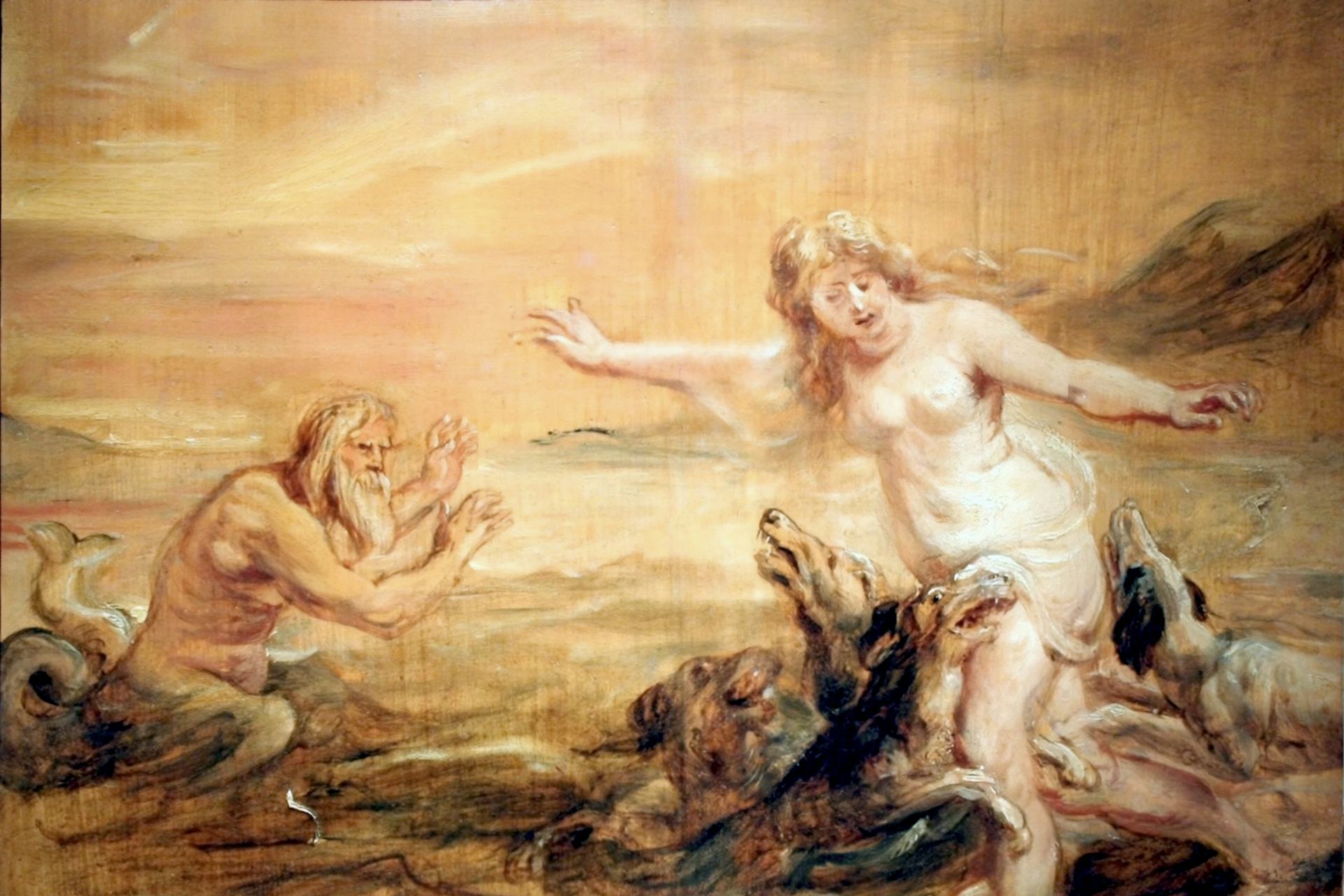
Scylla and Glaucus by Peter Paul Rubens (ca. 1636)
Scylla and Glaucus by Peter Paul Rubens (ca. 1636). Musée Bonnat-Helleu.

Scylla also appears twice in the Liber monstrorum (I.14, II.19), where she is described in detail. This first mention from Liber monstrorum I.14 in the section on humaniod monsters is as follows:

Scylla monstrum nautis inimicissimum in eo freto quod Italiam et Siciliam interluit fuisse perhibetur capite quidem et pectore uirginali sicut sirenae, sed luporum uterum et caudas delfinorum habuit. Et hoc sirenarum et Scyllae distinguit naturam quod ipsae morifero carmine mauigantes decipiunt et illa per uim fortitudinis marinis succinta canibus miserorum fertur lacerasse naufragia.

“It is reckoned that Scylla has been the monster most hostile to sailors in that channel which washes between Italy and Sicily, having indeed the head and chest of a maiden (like the sirens), but the belly of a wolf and the tail of dolphins. And what distinguishes the nature of the sirens from Scylla is that they deceive seamen by their deadly song, whilst she with the strength of her force, girt about with sea-dogs, is said to have mangled the wrecks of the unfortunate .”

Orchard, Pride and Prodigies, 266-67.

This description emphasizes her superlative hostility [inimicissimum]—similar to Grendel’s mother’s characterization as an aglæcwif “fearsome warrior woman” (1259) or wif unhyre “untamed woman” (2120). Emphasis on the narrow channel where Scylla resides shifts to her hybrid representation with “the head and chest of a maiden (like sirens) but the belly of a wolf and the tail of a dolphins” (fuisse perhibetur capite quidem et pectore uirginali sicut sirenae, sed luporum uterum et caudas delfinorum habuit). This establishes Scylla as a woman-canine-marine creature, combining “maiden” (virgo), “wolf” (lupus), and “dolphin” (delphinus) parts. Moreover, she is twice compared to the treacherous sirens, while explaining that unlike the sirens, who use song to ensnare their victims, Scylla uses force, violence and her mighty strength, with her “sea-dogs” (marinis canibus) to take down unfortunate sailors who enter her domain.

Scylla, relief sculpture on a pair of terracotta plaques with glass inlays, late 4th century BCE; in the Metropolitan Museum of Art, New York City. The Metropolitan Museum of Art, New York City, Sandra Brue Gift, 1998 (accession no. 1998.210.1, .2); www.metmuseum.org.

In the second section, centered on bestial monsters, there is an entry on the sea-beasts of Scylla. Liber monstrorum II.19 reads as follows:

fingunt quoque poetae inmari Tyrrheno ceruleos esse canes, qui posteriorem corporis partem cum piscibus habent commune. Ipsis quoque Scyllam ratem Ulixis lacerans marinis succincta canibus describitur.

“the poets also image that there are azure dogs in the Mediterranean, the hind parts of whose bodies they share with fish; also girt round with these same sea-dogs Scylla is described tearing apart the ship of Ulysses”

Orchard, Pride and Prodigies, 266-67.

This entry focuses on the “azure dog” (ceruleos canes) or “sea dogs” (marinis canibus) of Scylla, which are described as featuring canine heads and legs, but “the hind parts of whose bodies they share with fish” (qui posteriorem corporis partem cum piscibus habent commune) making them a canine-marine hybrid creature. Scylla is directly mentioned in connection with her accompanying sea-monsters, and the passage directly references the struggles of Odysseus [i.e. Ulysses] when he encounters Scylla on his epic journey home.
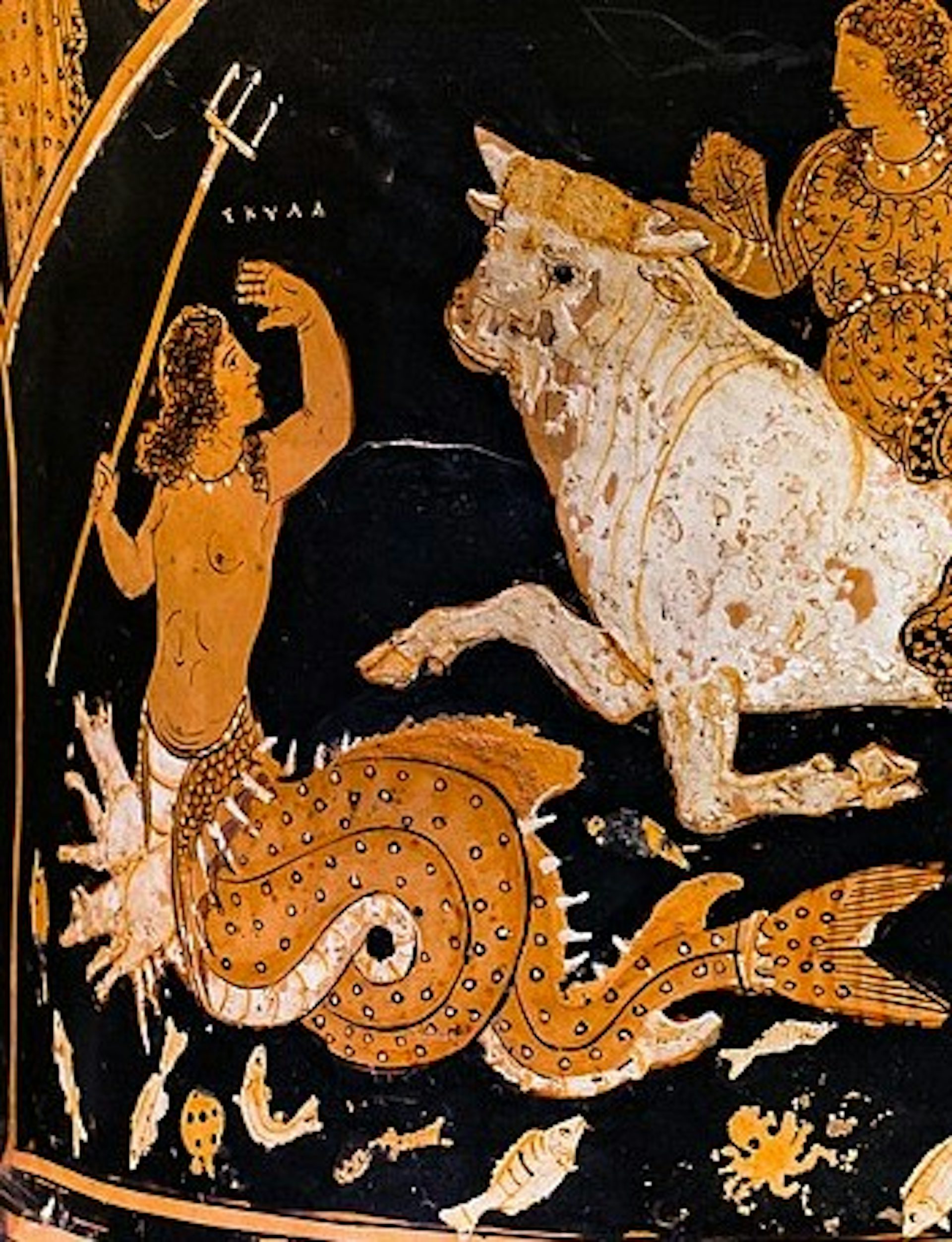
Asteas - Europa on the bull - Dionysos with satyrs and maenads and Pan - Montesarchio
Paestan red figure calyx-crater showing Scylla wielding a trident (ca. 350 BCE). Museo Archeologico Nazionale del Sannio Caudino, Montesarchio. 

The key features of Scylla’s narrow channel are present also in the monster-mere found in Beowulf which is the home and hall of the Grendelkin. Grendel’s Mother’s lair is described in the poem as follows:

Hie dygel lond
warigeað, wulfhleoþu,   windige næssas,
frecne fengelad,   ðær fyrgenstream
under næssa genipu   niþer gewiteð,
flod under foldan
.

“They [Grendelkin] inhabit the secret land, the wolf-slopes, the windy narrows, the dangerous fen-path, where the mountain stream cascades downward under the cover of cliffs, the flood under the land.”

Beowulf, 1357-61.

This description emphasizes the dangerous narrows and the crafty cliffs surrounding the monstrous abode and in this way echoes Scylla’s watery domain. In this passage are numerous references to the steep and narrow geography, especially in descriptions of the wulfhleoþu windige næssas “wolf-slopes (and) windy narrows” (1358), and fyrgenstream under næssa genipu, “a mountain river under the cover of cliffs” (1359-60). As Beowulf enters the waves, he finds himself, like those caught by Scylla in the Odyssey, in a violent struggle for his life at the hands of a ferocious woman who pulls him to the depths of her haunted lake. The narrator explains how:

Bær þa seo brimwylf,   þa heo to botme com,
hringa þengel         to hofe sinum,
swa he ne mihte,         no he þæs modig wæs,
wæpna gewealdan,   ac hine wundra þæs fela
swencte on sunde,         sædeor monig
hildetuxum         heresyrcan bræc,
ehton aglæcan.         ða se eorl ongeat
þæt he in niðsele         nathwylcum wæs,
þær him nænig wæter         wihte ne sceþede,
ne him for hrofsele         hrinan ne mehte
færgripe flodes;         fyrleoht geseah,
blacne leoman,         beorhte scinan.
Ongeat þa se goda         grundwyrgenne,
merewif mihtig .

“When she came to the bottom, the sea-wolf bore the prince of rings to her hall, so he could not, no matter how brave he was, wield weapons, but so many wonders afflicted him while swimming, many a sea-beast poked the battle-armor with battle-tusks, harassed the fearsome assailant (Beowulf). Then the man perceived that he was in some kind of hostile-hall, where no water could harm them at all, nor could the sudden grasps of the flood touch them because of the roofed-hall.  He saw firelight, pale illumination brightly shining. Then the good one (Beowulf) perceived the bottom-wolf, the mighty sea-woman.”

Beowulf, 1506-1519.

Henry Justice Ford “Beowulf battles with Grendels Mother” (1899).

In reading this passage from the poem, we can observe numerous parallels between Grendel’s mother and Scylla, which I believe suggests that the classical monster, frequently featured in Anglo-Latin texts, may have influenced the depiction and characterization of Grendl’s mother. Just like with Scylla’s channel, the monster-mere in Beowulf includes sea-creatures that attack anyone who enters their watery lair. Both Scylla and Grendel’s mother are ancient, cursed and exiled monsters, the former as a result of a witch’s curse, the latter is prediluvian, cursed and marked as kin of Cain. Grendel’s mother seems to travel with sea-beasts (nicoras) which resemble Scylla’s sea-dogs. Both Scylla and Grendel’s mother are hybrid women monsters—featuring both canine or lupine characteristics (as indicated by her description as brimwulf “sea-wolf” and grundwyrgenne “bottom-wolf”) characteristics and piscine or serpentine characteristics (as indicated by her description as merewif “mermaid”). And, both Scylla and Grendel’s mom occupy a craggy narrow passage that is terrifying and dangerous for sailors or sea-men.

While I would not push so far as to contend that Grendel’s mother is intended as a literal representation of Scylla, and while I agree with others who have observed her ethically complex characterization, it seems plausible—even probable—that the famous Scylla could have influenced her enigmatic monsterization. At the very least, many counted among the learned audiences of Beowulf in early medieval England would likely have discerned the numerous and noteworthy parallels between these two monstrous women.

Richard Fahey, PhD
Medieval Institute
University of Notre Damme

Selected Bibliography

Acker, Paul. “Horror and the Maternal in Beowulf.Publication of the Modern Language Association 121.3 (2006): 702-16.

Aldhelm. Aldhelm: The Poetic Works. Translated by Michael Lapidge and James L. Rosier. Dover, NH: D. S. Brewer, 1985.

—. Aldhelm: The Prose Works. Translated by Michael Lapidge and Michael Herren. Cambridge, UK: D. S. Brewer, 1979.

Fahey, Richard. “Enigmatic Design and Psychomachic Monstrosity in Beowulf.” Dissertation: University of Notre Dame, 2020.

Hennequin, M. Wendy. “We’ve Created a Monster: The Strange Case of Grendel’s Mother.” English Studies 89.5 (2008): 503-23.

Klaeber’s Beowulf, 4th Edition. Edited by Robert D. Fulk, Robert E. Bjork and John D. Niles. Toronto, ON: University of Toronto Press, [reprint] 2009.

Kiernan, Kevin S. “Grendel’s Heroic Mother.” In Geardagum 6 (1984): 13-33.

Lockett, Leslie. “The Role of Grendel’s Arm in Feud, Law, and the Narrative Strategy of Beowulf.” In Latin Learning and English Lore: Studies in Anglo-Saxon Literature for Michael Lapidge (I), edited by Katherine O’Brien O’Keeffe and Andy Orchard, 368-88. Toronto, ON: University of Toronto Press, 2005.

Orchard, Andy. A Critical Companion to Beowulf. Cambridge, UK: D.S. Brewer, 2003.

—. Pride and Prodigies: Studies in the Monsters of the Beowulf-Manuscript. Toronto, ON: University of Toronto Press, 1995.

Sayers, William. “Grendel’s Mother, Icelandic Gryla, and Irish Nechta Scene: Eviscerating Fear.” Proceedings of the Harvard Celtic Colloquium 16 (1996): 256-68.
Grendel the Vampire?

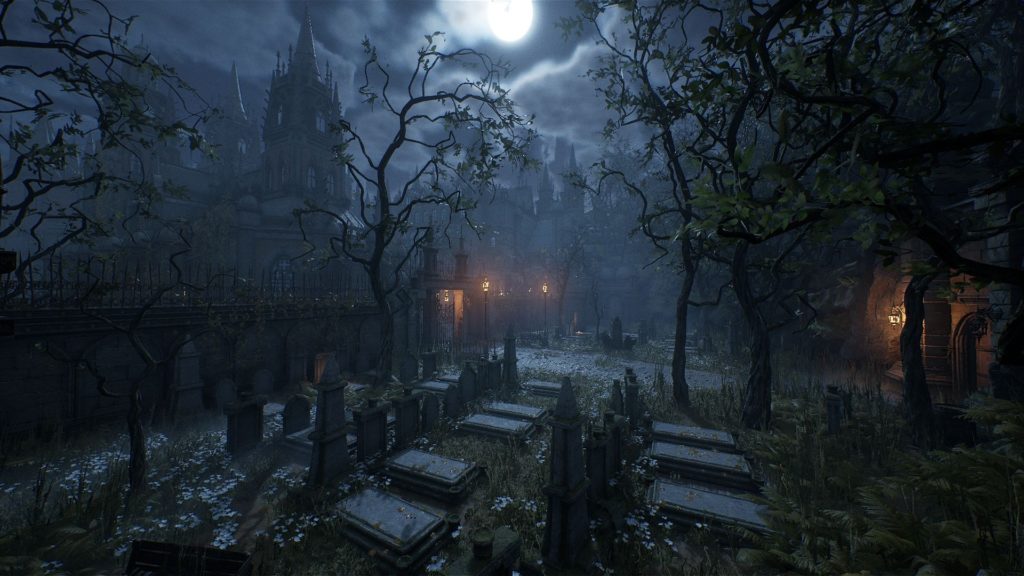
Contemporary monsters associated with modern Halloween celebrations—such as vampires, werewolves and mummies—borrow heavily from the genre of Gothic Horror which takes shape during the early modern period in the hands of Romantic and Victorian authors.

“Gothic Horror Environment” by Unreal Engine (2021).

Indeed, Gothic Horror, the literary source of many monsters commonly associated today with Halloween, regularly draws inspiration from the medieval period. Authors from Mary Shelley to Edgar Allen Poe capitalize on the haunting way the past is often reimagined in the present as mysterious, unknown and full of terrors. This year’s Halloween special, in celebration of Samhain and All Hallows Eve, considers the characterization of one famous medieval monster sometimes associated with the modern concept of “the vampire” in popular culture.

One of the most well-known monsters from the Middle Ages, Grendel, the terrifying cannibal from Beowulf, is frequently regarded as a medieval vampire in contemporary vampire lore, despite that the Old English poem seems not to have been readily available during the Victorian period. Although, Beowulf was first transcribed in 1786, with an edition later printed in 1815 by Grímur Jónsson Thorkelin who also translated the poem into Latin, its influence remained obscure. Some verses from Beowulf were translated into modern English in 1805, and nine complete translations were produced in the 19th century, including one by William Morris, but it was only after the turn of the 20th century that an abundance of translations became available making Beowulf accessible to public audiences and leading to growing interest in the Old English poem during the period which helps establish Beowulf as central to English literary canons thereafter.

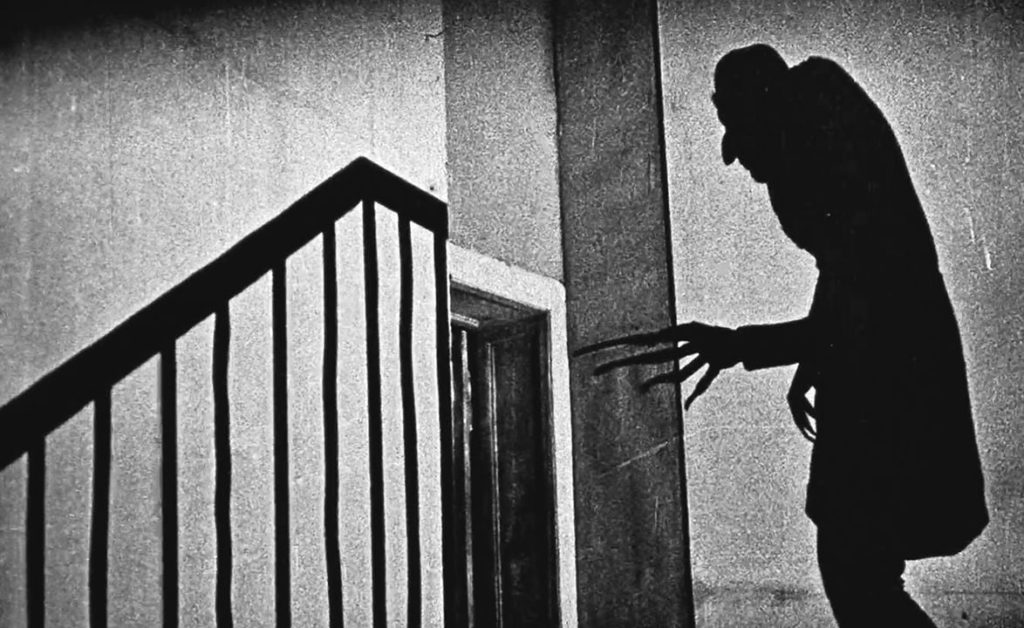
The iconic scene of Count Orlok on the stairs from F. W. Murnau’ film, Nosferatu (1922).

Nevertheless, when Lord Byron, John Polidori, John Stag and Bram Stoker were contributing to the development of tropes and stereotypes that inform modern representations of vampires, they self-consciously and explicitly looked to the past “dark ages” with a macabre, antiquarian eye. Often, these authors will cite unspecified ancient lore and legend in an attempt to ground their vampire literature in a mythologically (if not historically) authenticated past in which monsters and magic are possible. These possibilities, then, extend into the present as gothic monsters reach from the deep recesses of time into modern times so that they may haunt the living. Vampires like many gothic monsters are generally understood as an anachronism, able to exist now only because they existed then, thereby suspending modern sensibilities and skepticisms. Indeed, the longstanding affiliation between medieval corpses and modern vampires is mobilized in a recent blog centered on vampirism, succubi and women’s monstrosity.

Each of these Victorian authors reach to the medieval period in order to craft their modern undead monsters, sometimes even looking toward historical figures, such as Vlad III of Wallachia (better known as Vlad “the Impaler”) as an inspiration for Bram Stoker’s Dracula. Of course, it seems that none would have borrowed directly from the Old English poem.

So why is Grendel considered a vampire? Is there any textual evidence to support this claim?

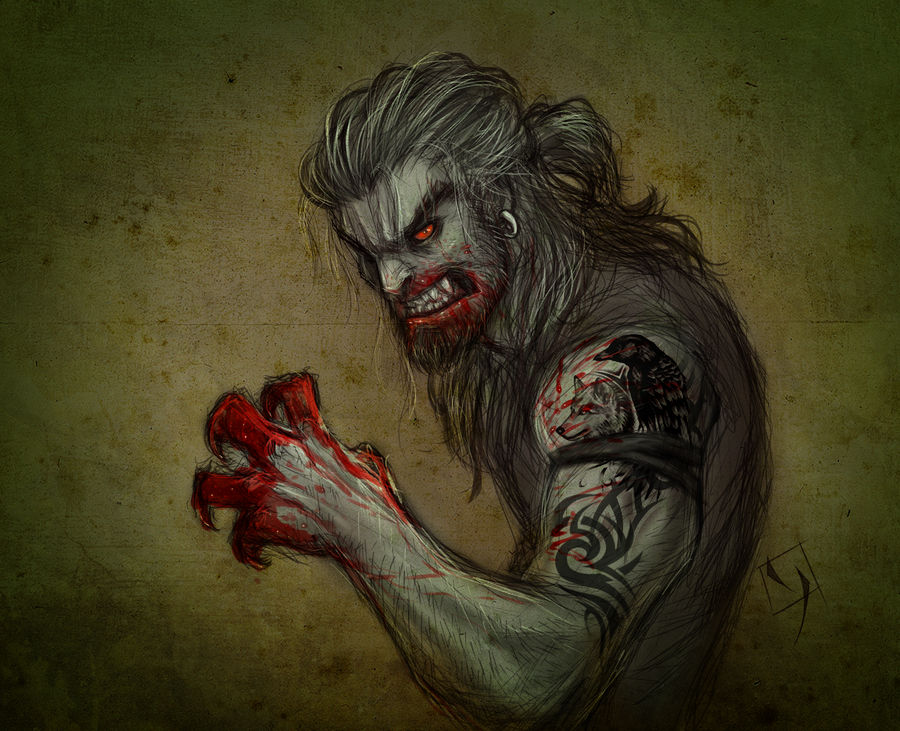
“Grendel” by KaRzA-76 (2005).

While Grendel’s monstrosity remains mysterious, and some might see little resemblance between the medieval monster and Victorian vampires, there is one passage centered on Grendel’s cannibalism, which serves as a major source for Grendel’s association with vampirism. The section reads as follows:

Geseah he in recede    rinca manige,
swefan sibbegedriht    samod ætgædere,
magorinca heap.    Þa his mod ahlog;
mynte þæt he gedælde,    ærþon dæg cwome,
atol aglæca,    anra gehwylces
lif wið lice,    þa him alumpen wæs
wistfylle wen.    Ne wæs þæt wyrd þa gen
þæt he ma moste    manna cynnes
ðicgean ofer þa niht.    Þryðswyð beheold
mæg Higelaces,    hu se manscaða
under færgripum    gefaran wolde.
Ne þæt se aglæca    yldan þohte,
ac he gefeng hraðe    forman siðe
slæpendne rinc,    slat unwearnum,
bat banlocan,    blod edrum dranc,
synsnædum swealh;    sona hæfde
unlyfigendes    eal gefeormod,
fet ond folma.

“He [Grendel] saw in the hall many warriors, the troop of kinsfolk slept, gathered together, a heap of kindred warriors. Then his mind laughed, because he, the terrible, fearsome marauder, intended to rend life from the body of every one of them before day came, when the expectation of gluttony came over him. It was nevermore his fate that he might eat more of mankind over the night. The very mighty kinsman of Hygelac beheld how the criminal destroyer would fare with its sudden grips. The fearsome marauder did not think to delay, but he quickly seized a sleeping man the first time, tore ravenously, bit his bone-locker, drank the blood from his veins, swallowed the sinful morsel; soon he had finished off all of him, unliving, feet and hands” (728-745).

Most often, emphasis is placed on Grendel’s cannibalism and specifically his consumption of flesh mentioned in the passage. Few modern adaptations of Beowulf—from Michael Crichton’s Eater of the Dead (1976) to John Tiernan’s The 13th Warrior (1999) based on Crichton’s adaptation to Sturla Gunnarsson’s Beowulf & Grendel (2005), Robert Zemeckis’ Beowulf (2007), or even Cartoon Network’s adaptation of the poem in Adventure Time’s “The Wild Hunt” (2018)—depict Grendel as especially fond of blod edrum drincan “drinking blood from veins” (742), despite that the poem describes this vampiric act in gory detail.

“Gangrel” by Ypslon (2019).

Although most Beowulf adaptations focus more attention on flesh-eating than on blood-drinking, parallels between vampires and Grendel have not gone unnoticed, and categorizations of vampire-types sometimes include a Grendelish category, as demonstrated by the ferocious and bestial Gangrel, known for being especially close the “the Beast” within, their association with medieval Scandinavia and their ravenous consumption of blood in the popular roleplaying game, Vampire: The Masquerade. Moreover, Cain’s association with vampirism often mirrors his role as progenitor of the Grendelkin and all monsterkind in Beowulf.

Grendel may not be a proper vampire in the technical, stereotypical, modern understanding of the term. Moreover, Grendel’s characterization in Beowulf apparently did not affect vampire stereotypes developed in the early modern period before knowledge of the Old English poem became mainstream. Nevertheless, the graphic image of the monster haunting at night, coming from the darkness, perhaps shapeshifting from a shadow to human form, and most importantly, sucking the blood from the veins of his victim, marks Grendel’s characterization as eerily close in certain aspects to modern vampires, who share his love of darkness, often possess shapeshifting abilities and likewise glut themselves on human blood.

Richard Fahey, Ph.D.
Medieval Institute
University of Notre Dame

Grendel’s Shapeshifting: From Shadow Monster to Human Warrior

Of all the horrifying scenes, which activate what Michael Lapidge has termed the psychology of terror in Beowulf,[1] none are more terrifying than the scene of Grendel’s approach from the night, through the marsh and to the hall. Translations and adaptations of Beowulf approach Grendel in a variety of ways—from emphasizing his monsterization as a eoten “giant” (761) and þyrs troll” (426) to more humanizing treatments that focus on his status as a wonsaeli wer “unfortunate man” (105).

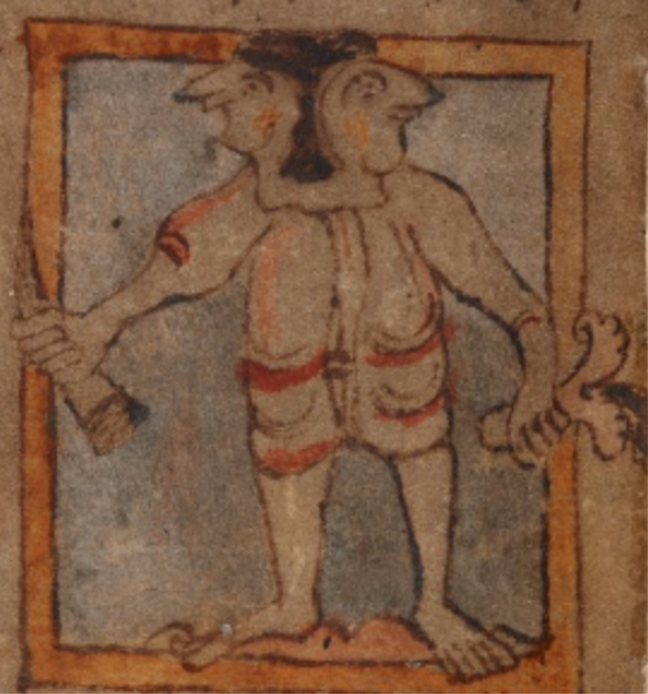
Monster from the Nowell Codex’s ‘Wonders of the East’, British Library, Cotton Vittelius a.xv, f101v.

This Halloween, in continuing our series on Monsters & Magic, I offer a translation and recitation of the monster’s haunting journey to Heorot. This scene has been well-treated in the scholarship, and Katherine O’ Brien O’Keeffe has noted that once the monster finally enters the hall, there is a potential “horror of recognition” by the audience who is then able to identify Grendel as human.[2] 

This blog will focus closely on the Old English poetic language and how Grendel shape-shifts as he draws nearer to Heorot, seemingly coming ever better into focus and transforming to match the space in which he inhabits. I will consider three major sections of his approach, signaled by the thrice repeated verb com “he came” (703, 710, 720), and I will reflect on the ways in which Grendel is described in each leg of his journey.

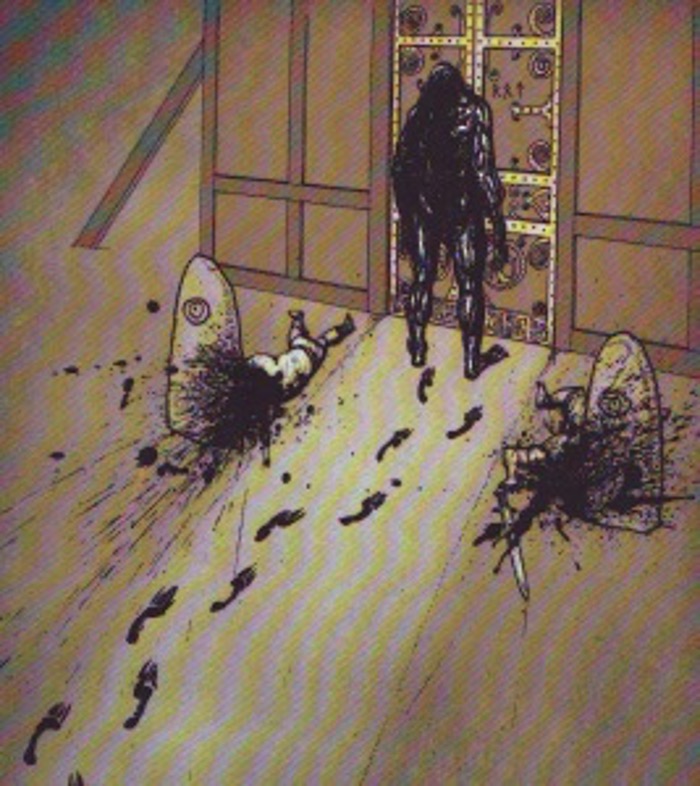
Image of Grendel as a Shadow Monster from Gareth Hind’s graphic novel adaptation of Beowulf (1999)

In the first passage, Grendel com on wanre niht “came in the dark night” (702), and he is characterized as sceadugenga “shadow-walker” (703): either a “going shadow” or “one who goes in the shadows” (both at available options based on the poetic compound). His movement is described as scriðan “slithering” or “gliding” (703), further emphasizing his portrayal as a shadow monster. Later, when Grendel is named a synscaða: either a “relentless” or a “sinful ravager” (707), depending on how one interprets the polysemous Old English syn in the compound,[3] the monster is described as pulling men under shadow, characterizing Grendel as a night terror shrouded in darkness.  Indeed, when Grendel comes from the dark night, he is represented by the narrator as a shadow monster that hunts and haunts after sundown.

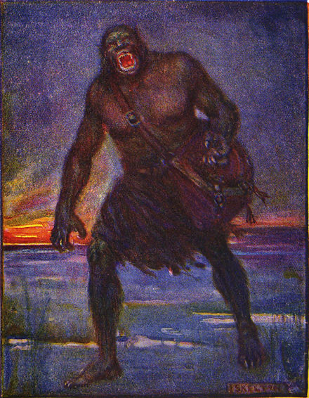
Image of Grendel by J. R. Skelton from “Stories of Beowulf” (1908).

In the second passage, when Grendel ða com of more under misthleoþum “then came from the marsh under misty-slopes” (710), the monster emerges from the swamp and is addressed by his name: Grendel (711). I imagine the silhouette of the monster taking shape in the mist—perhaps a human shape—corresponding to his characterization as manscaða, which likewise plays on polysemous Old English man in the compound, (either mān meaning “criminal” or man meaning “human”).[4] The alliteration in line 712 seems to stress the possibility of monstrous manscaða as “ravager of humans” or a “human-shaped ravager” since manscaða alliterates with the monster’s intended prey, manna cynn “the kin of humans” or “mankind” (712).

The mist rising from the marsh continues to obscure the audience’s view as Grendel wod under wolcnum “went under the cloud” (714) maintaining the suspense generated in the scene by suspending knowledge of Grendel’s ontology. Nevertheless, in this second leg of his journey, Grendel’s form seems to come into focus as he shifts from sceadugenga “a shadow-walker” (703) into manscaða “a mean, man-shaped, ravager of men” (712).

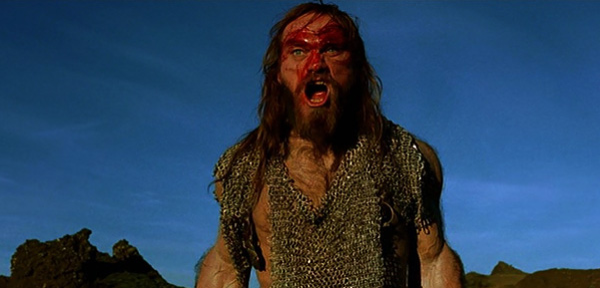
Grendel portrayed as human in Sturla Gunnarsson’s ‘Beowulf & Grendel’ (2005)

In the third passage, Grendel finally arrived at the hall and the audience learns at long last what Grendel is: rinc dreamum bedæled “many bereft of joy” (720-21). During the last leg of his journey, Grendel’s humanity is laid bare leading to the ultimate realization identified by O’Brien O’Keeffe, when Beowulf appears to recognize Grendel’s humanity after the monster bursts open the door of the hall.

Throughout the next twenty lines, in addition to Grendel (720), the term rinc “human warrior” is repeated: twice in reference to the Geatish troop as a whole (728, 730), once in reference to the sleeping man Grendel cannibalizes when he arrives, who the audience later learns is Hondscio (741), and once in reference to Beowulf himself (747). This repeated use of rinc “human warrior” highlights how Grendel is a mirror for the hero and the Geatish warriors, characterized in identical terms.

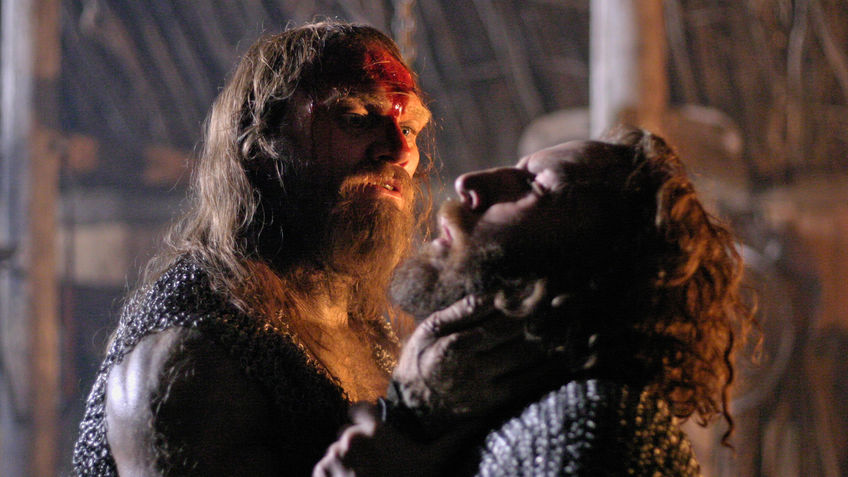
Grendel killing Hondscio in Sturla Gunnarsson’s ‘Beowulf & Grendel’ (2005)

Similarly, when Grendel approaches from the shadows, Beowulf is described as bolgenmod “swollen-minded” and angrily awaiting battle (709); however, once the monster arrives at the hall, Grendel becomes gebolgen “swollen (with rage)” as he enters the hall ready to glut himself upon the men sleeping inside (723). This parallel description interweaves the respective emotions and behaviors of both hero and monster in Beowulf.

The interplay between hero and monster continues when Beowulf and Grendel struggle together, both called reþe renweardas “ferocious hall-guardians (770) and heaðodeore “battle-brave ones” (772) during their epic battle that nearly destroys the hall. The fusion of hero and monster together into a shared plural subject and object respectively helps to underscore their mutual affinity: the hall must contend against the fury of both warriors and each is a fearsome—yet overconfident—conqueror, who intends to overcome any enemy he encounters.

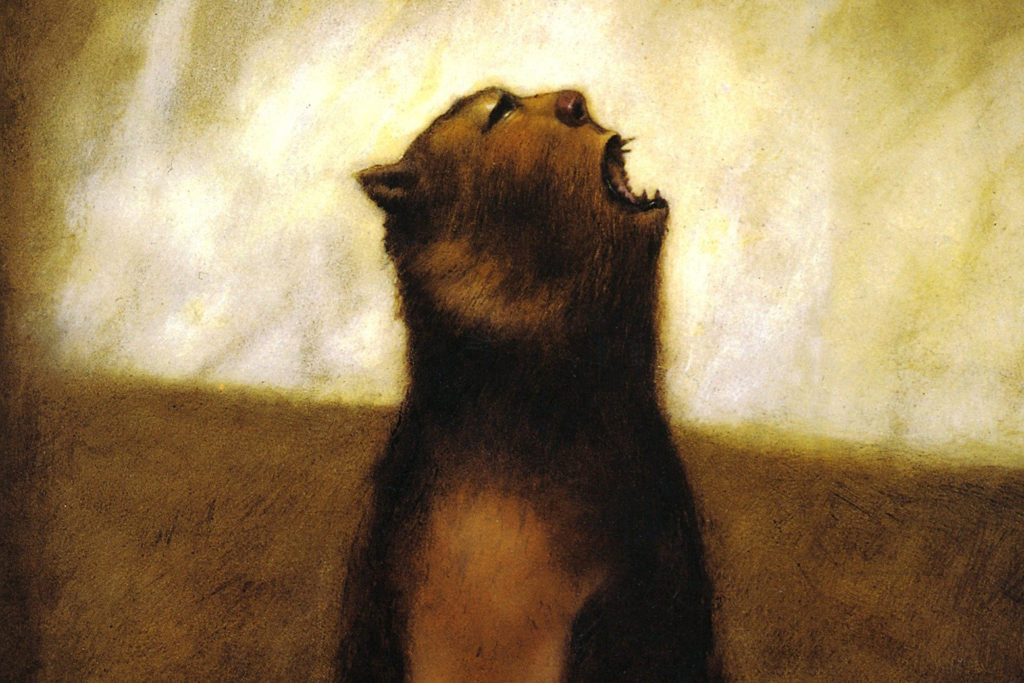
Grendel from the cover of John Gardner’s novel, ‘Grendel’ (1980).

We know that this is Grendel’s final chance to haunt the hall, and the monster is at least able to feast on one last human, this time a Geat and one of Beowulf’s own warriors (Hondscio). Sadly for Grendel, once Beowulf finally decides to enter the fray, and after a relatively brief struggle, the monster is fatally disarmed and retreats to die at home in the marshes.

Naturally, vengeance follows. Unfortunately for the Danes, and especially Hroðgar’s best thane Æschere, the audience soon learns that Grendel has a mommy, and anyone who messes with her baby boy, will have to answer to her.

Richard Fahey
PhD in English
University of Notre Dame

Further Reading:

Brodeur, Arthur G. The Art of Beowulf. Berkeley, CA: University of California Press, 1959.

Fahey, Richard. “Medieval Trolls: Monsters from Scandinavian Myth and Legend.” Medieval Studies Research Blog. Medieval Institute: University of Notre Dame (March 20, 2020).

—. “Enigmatic Design & Psychomachic Monstrosity in Beowulf.” University of Notre Dame: Dissertation, 2020.

—. “Mearcstapan: Monsters Across the Border.” Medieval Studies Research Blog. Medieval Institute: University of Notre Dame (July 20, 2018).

Gwara, Scott. Heroic Identity in the World of Beowulf. Leiden, Netherlands: Brill, 2009.

Johansen, J. G. “Grendel the Brave? Beowulf, Line 834.” English Studies 63 (1982): 193-97.

Joy, Eileen, Mary K. Ramsey, and Bruce D. Gilchrist, editors. The Postmodern Beowulf: A Critical Casebook. Morgantown, WV: West Virginia University Press, 2006.

Kim, Dorothy. “The Question of Race in Beowulf.” JSTOR Daily (September 25, 2019).

Köberl, Johann. The Indeterminacy of Beowulf. Lanham, MD: University of America Press, 2002.

Lapidge, Michael. “Beowulf and the Psychology of Terror.” In Heroic Poetry in the Anglo-Saxon Period: Studies in Honor of Jess B. Bessinger, edited by Helen Damico and John Leyerle, Studies in Medieval Culture 32, 373-402. Kalamazoo, MI: Medieval Institute Publications, Western Michigan University, 1993.

O’Brien O’Keeffe, Katherine. “Beowulf, Lines 702b-836: Transformations and the Limits of the Human.” Texas Studies in Literature and Language 23.4 (1981): 484-94.

Orchard, Andy. Pride and Prodigies: Studies in the Monsters of the Beowulf-Manuscript. Toronto, ON: University of Toronto Press, 1995.

Sharma, Manish. “Metalepsis and Monstrosity: The Boundaries of Narrative in Beowulf.” Studies in Philology 102 (2005): 247-79.

Ringler, Richard N. “Him Sēo Wēn Gelēah: The Design for Irony in Grendel’s Last Visit to Heorot.” Speculum 41.1 (1966): 49-67.


[1] Michael Lapidge, “Beowulf and the Psychology of Terror,” 373-402.

[2] Katherine O’Brien O’Keeffe, “Transformations and the Limits of the Human,” 492.

[3] Andy Orchard raises the possibility of polysemy in synscaða, see Pride and Prodigies, 38.

[4] Orchard also raises the possibility of polysemy in manscaða, see Pride and Prodigies, 31.