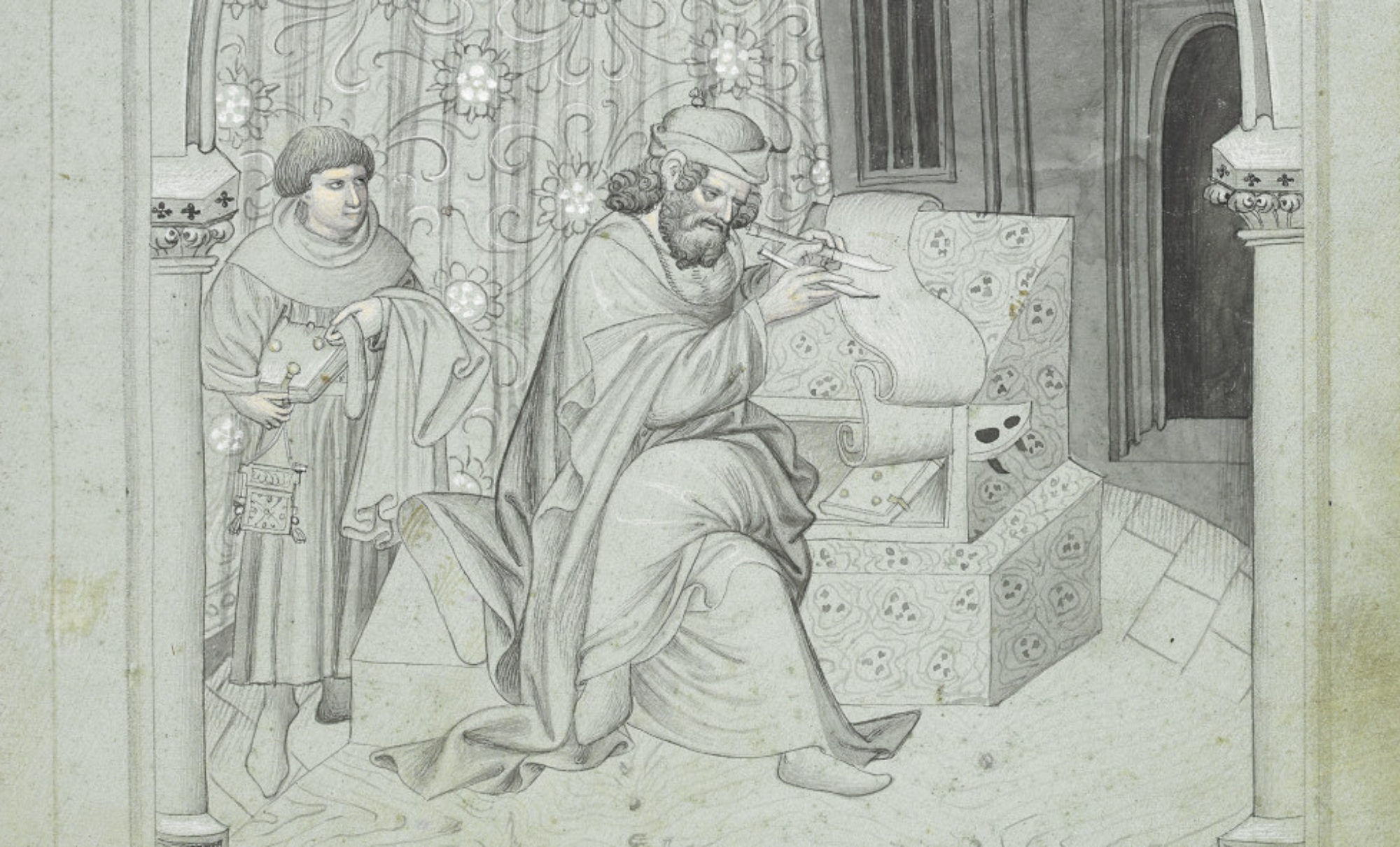
Little is more exciting to a medievalist than the discovery of a lost text preserved in a forgotten codex in some neglected archive. Or, in some cases, the text is right under our nose: In 1983, the great Syriac scholar Sebastian Brock came across an unknown work of Isaac of Nineveh in a manuscript at Oxford’s Bodleian library. Isaac was a monk who lived in Qatar and Mesopotamia during the seventh century (the first century of Islamic rule). In the Bodleian text, Isaac weighed in on a central topic of medieval thought: What happens after we die?
For many Jews, Christians, and Muslims in the premodern Islamic world, the answer to this question was similar, at least in its basic outlines. After an intermediate period in which souls sleep or have a foretaste of their future state, God will raise the dead and pass judgment on every person who has ever lived. Some will suffer eternal punishment, while others experience eternal joy. Poets, preachers, and artists across the medieval world delighted in imagining the exquisite pleasures of paradise and the equally exquisite pains of hell.

As Brock discovered, Isaac rejected the idea of eternal punishment and argued instead for universal salvation. God, he wrote, punishes as a father does, to teach and correct. Punishment in hell is therefore temporary, and God will have mercy on all people. Even the Devil will be saved![1]

As I became more interested in Isaac’s views, I found that Brock’s discovery was (as is so often the case) a re-discovery. Around 1100 years earlier, a Christian in ninth-century Iraq named Ḥanūn b. Yūḥannā b. al-Ṣalt went hunting for Isaac’s books. He would later describe his quest in an Arabic paraphrase of Isaac’s writings. As Ḥanūn tells it, he was consumed with questions raised by his study of the Bible: Does God really grow angry? Do temporal sins deserve eternal punishment? Or does God have mercy on all people?
Ḥanūn asked these questions to anyone who would listen: “They gave me answers,” he wrote, “but their answers did not satisfy me!” Eventually, a monk suggested that Ḥanūn’s views resembled those of Isaac of Nineveh. Ḥanūn immediately rushed off in search of Isaac’s books, not stopping until he came to a monastery in the city of al-Anbār. Al-Anbār lay in central Iraq (near modern-day Fallujah), a region dotted with Christian monasteries.

There, at last, Ḥanūn discovered Isaac’s teaching that the punishments of hell will end and all people will be saved.[2]
When I first read Ḥanūn’s account of Isaac’s views, I was surprised to find how much of it is shaped by the words of the Qur’an, sayings of the Prophet Muhammad, and other Islamic texts.[3] As I read further, I realized that the ways in which Ḥanūn wrote about God and salvation reflected broader debates in ‘Abbasid Iraq.
My research at the Medieval Institute examines these debates. They reveal a shared Jewish, Christian, and Islamic conversation about salvation and the related topics of divine mercy, justice, and punishment. Jewish, Christian, and Muslim authors posed the same questions (“Does God punish to deter evil?” “Is divine mercy universal or particular?”) and often answered them in similar terms. Their discussions probed the limits of deeply held religious convictions and were enlivened by colorful metaphors: the condemned delight in hell, as an early Muslim thinker put it, “like vinegar worms in vinegar.”[4] Universal salvation was a minority position in the medieval Islamic world, but the questions and debates surrounding it formed an important part of Jewish, Christian, and Islamic thought and of interreligious exchange.
Discovering Universal Salvation, Part 2:

In 1995, Muḥammad b. ʿAbd Allāh al-Simharī discovered a manuscript in the Egyptian National Library containing the full version of a treatise on universal salvation by Ibn Taymiyya (d. 1328), a highly influential scholar from medieval Syria.[5] The publication of this text has helped spur a surge of interest in Islamic views of universal salvation, including in the writings of towering figures such as Ibn ʿArabī (d. 1240) and Mulla Ṣadra (d. 1640).[6]
But how did these authors develop their ideas? One aim of my research is to show how the seeds of Islamic universalism developed in the earlier debates of the Umayyad and ‘Abbasid eras. This does not, of course, take away from the creativity of later thinkers, but it will help us understand more precisely how these thinkers wove together elements from earlier Islamic tradition in new ways that shaped the trajectory of Islamic thought on salvation.
The wonderful resources and community of the Medieval Institute have been a tremendous boon as I examine these Jewish, Christian, and Islamic conversations and the vibrant intellectual culture that fostered them.
John Zaleski
A. W. Mellon Junior Faculty Fellow
Medieval Institute
University of Notre Dame
[1] Sebastian P. Brock (ed. and trans.), Isaac of Nineveh (Isaac the Syrian). ‘The Second Part’, Chapters IV-XLI, CSCO 554/5, Syr. 224/5 (Leuven: Peeters, 1995), esp. 148–71 (Syriac) / 160–82 (English).
[2] Ḥanūn’s account is edited in Paul Sbath, Traités religieux, philosophiques et moraux, extraits des oeuvres d’Isaac de Ninive (VIIe siècle) par Ibn As-Salt (IXe siècle) (Cairo: N.G. Thamaz, 1934).
[3] On this, see Alexander Treiger, “Mutual Influences and Borrowings,” in Routledge Handbook on Christian-Muslim Relations, ed. David Thomas (London: Routledge, 2018), 196–97.
[4] Attributed to Abū Ismāʿīl al-Biṭṭīkhī, in, e.g. al-Ashʿarī, Maqālāt al-islāmiyyīn, ed. Helmut Ritter, 3 vols. (Istanbul: Maṭbaʿat al-dawla, 1929–1933), 2:475. See also al-Jāḥiẓ, Kitāb al-Ḥayawān, ed. ʿAbd al-Salām b. Muḥammad Hārūn, 7 vols. (Beirut: Dār al-Kitāb al-ʻArabī, 1969), 3:396.
[5] Ibn Taymiyya, Al-Radd ʿalā man qāla bi-fanāʾ al-janna wa-l-nār, ed. Muḥammad b. ʿAbd Allāh al-Simharī (Riyadh: Dār al-Balansiyya, 1415/1995).
[6] See especially Mohammad Hassan Khalil, Islam and the Fate of Others (Oxford: Oxford University Press, 2012).