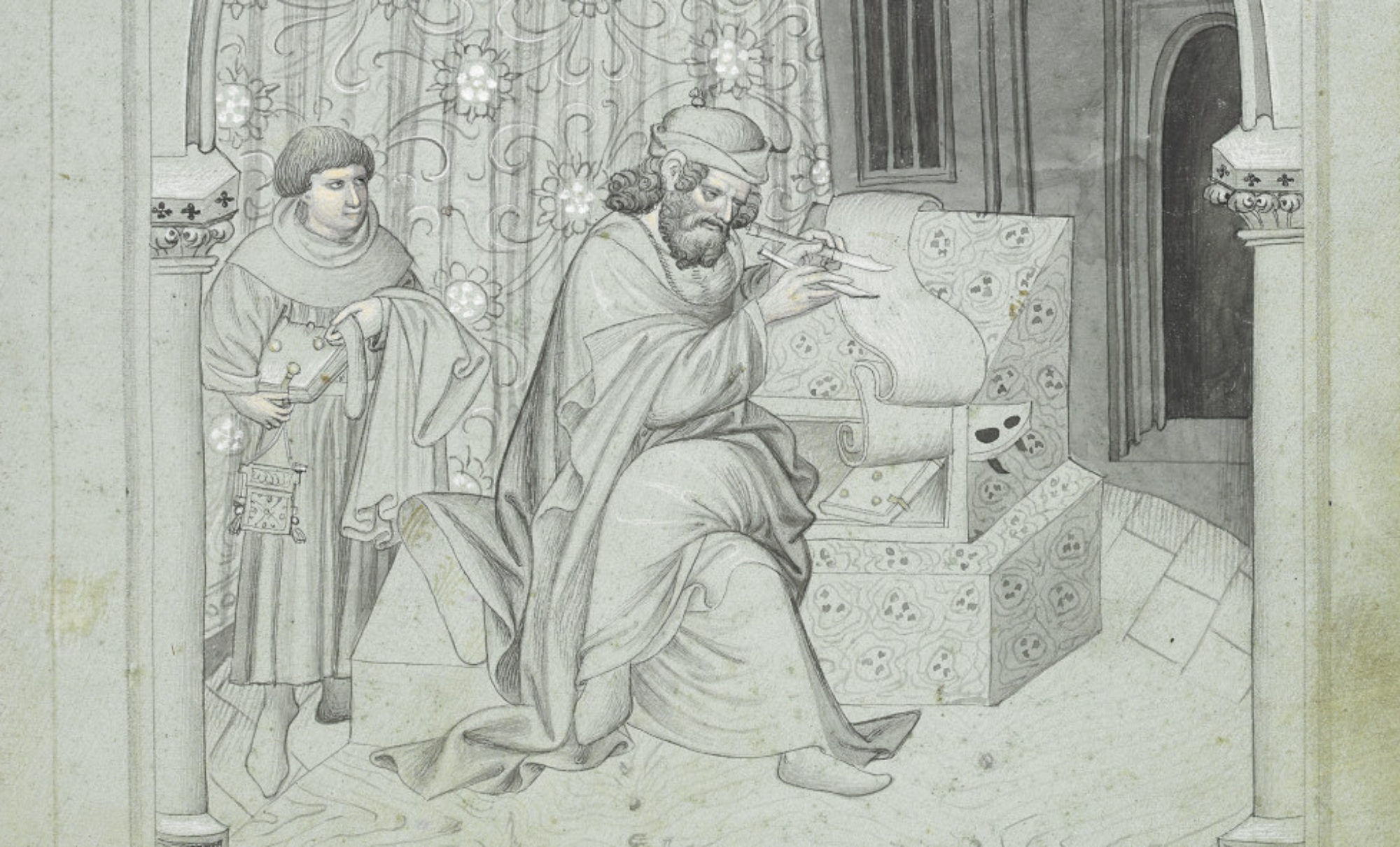

Image 1: Illustration of Ant and Cicada from Tuscan bestiary, mid-15th c. Wellcome Collection, MS.132, fol. 23r.
In the well-known fable of The Ant and the Cicada1 (or cricket, or grasshopper, according to the version—the second character is always a singing insect), a hungry cicada asks an ant for food in the wintertime. The ant asks what the cicada did during the summer, and the cicada replies that she had been singing. The ant then refuses to help her, on the grounds that the cicada had been idle, when she should have been working and acquiring food for the future instead, like the ant herself had done. The moral typically advises that we avoid idleness and plan for the future.
The perspective offered by the moral may seem predictable, based on the narrative. Yet, some medieval versions of the fable suggest that the cicada, at least in her own view, was not a self-absorbed, improvident reveler—she was an uncompensated artist, who entertained others and anticipated some return for her efforts.
The fable’s morals encourage us to take the ant’s position: the cicada’s performances were not labor, and they don’t merit any material reward. As I will discuss below, certain insects’ supposed obsession with song was not always construed negatively in medieval literature; this very disregard of worldly security could also be interpreted as virtuous.
An early version of this fable is by Babrius, in Greek, from the third century; there is also a fifth-century Latin version by Avianus.2 Medieval versions can be found in several Romulus collections in Latin prose and verse,3 Marie de France’s Fables (Old French, late twelfth century), a Latin prose collection by the English bishop and sermonist John Sheppey (d. 1360), and William Caxton’s Aesop (late Middle English prose, 1483–4).
In some versions of the fable, singing seems to be a sort of solitary pastime for the cicada. For example, in John Sheppey’s version, the cicada claims that during the summer she had gone “singing and dancing through the woods, hedges and meadows” (per siluas, sepes et prata ibam, cantans et exultans).4 In Caxton’s Aesop, the cicada, asked by the ant what she has done during the summer, simply reports, “I have sung” (I haue songe).5 The ant’s callous rejoinder in these and some other versions is to the effect of, “If you sang during the summer, then dance during the winter.”6

Image 2: Illustration of cicadas from Tuscan bestiary, mid-15th c. Wellcome Collection, MS.132, fol. 4v.
However, in Marie de France’s Fables and some Romulus versions, the cicada claims she sang for other creatures, and clearly sees this as a form of labor which should be materially rewarded. Marie’s cricket replies to the ant’s inquiry as follows: “‘I sing,’ she said, ‘and so entertain the other animals, but now I don’t find anyone who wants to to repay me for it.’” (“Jeo chant,” fet il, “e si deduis / a autres bestes, mes ore ne truis / ki le me veule reguerduner,” lines 11–13).7
In the Romulus Anglicus cunctus, similarly, the cicada says, “At that time [i.e., in the summer] I was singing for those who were working, and I received no wages from them” (Ego tunc illis qui laborabant cecini, et nichil mercedis ab eis recepi).8 The ant’s dismissive response, and the morals, take the position that performing for others’ pleasure doesn’t count as work, however—material acquisition for the security of oneself and one’s family is what counts.
In every version, the morals side with the ant. John Sheppey’s version is perhaps most straightforward and harsh: “Whoever doesn’t work shouldn’t eat, and, if a worker is worthy of wages, then no wages should come to one who doesn’t work.”9 The same word, merces, which I have translated as “wages,” is used in both the Romulus Anglicus cunctus and Sheppey versions. Apparently, though the cicada clearly expected some sort of wages, she didn’t deserve them, despite all her activity.
While the ant in this fable is portrayed as fairly selfish—she is interested in providing for herself and her own household alone, and essentially refuses to give alms to a beggar—elsewhere in ancient and medieval culture ants were understood as communal animals who worked together for a common good. For example, according to Albert the Great (d. 1280), humans and ants are among those animals who “collaborate in many things in a community of affairs and sustenance, which serve the common utility.”10 The fact that the ant in The Ant and the Cicada is portrayed as possessing the foresight to gather resources ahead of time, too, is consistent with representations of ants in other medieval sources, such as in Isidore of Seville’s Etymologies, in which the ant is said to have “great shrewdness, for it provides for the future and prepares during the summer what it consumes in the winter.”11

Image 3: Illustration of ants collecting grain, from Northumberland Bestiary, 13th c. Getty Museum, MS. 100, fol. 23r.
The notion that a singing insect, such as a cricket, would be so consumed by the act of singing that it might fail to take care of its bodily needs and ultimately die, is also found in Pierre de Beauvais’s Bestiaire d’amour (early thirteenth century): the cricket “loves to sing so much that it loses its appetite, forgets itself in song, lets itself be caught and dies singing.”12
However, unlike in the fable of The Ant and the Cicada, this absorption isn’t read negatively in the Bestiaire, which concludes: “The cricket gives us the example of the just man who is always doing good deeds and penance, and forgets all about the things of this world and bodily pleasures, and thinks about everlasting joy and is always in prayer, and dies praying, that is that he dies singing just as does the cricket.”13
Whether the singing insect in these medieval texts is construed as a doer of good deeds who is “always in prayer,” as a solitary reveler, or as starving artist, the notion remains that its way of life is not compatible with material security. What I find compelling is that the cicada, in some versions of the fable discussed above, believes that there shouldn’t be such an incompatibility. She (naïvely, perhaps) expects to be supported by others for the music she offers them—and, it is implies, dies when she doesn’t receive this support.
While the fable doesn’t suggest that the cicada’s talents could or should be sustained within a broader interspecies community—quite the opposite—the message might change if we think a bit more in terms of natural history. After all, cicadas aren’t known for being able to construct complex nests in which grain can be stored, and ants aren’t known for musicality. Rather, each creature has a different modus vivendi and a different niche. I’d like to envision a scenario that counters the general fable trend of interspecies antagonism, in which each creature could provide in accordance with their own abilities, and receive in accordance with their own need.
Linnet Heald
PhD in Medieval Studies
University of Notre Dame
- Perry Index 112. ↩︎
- J. Wight Duff and Arnold M. Duff, ed. and trans., Minor Latin Poets, Volume II, Loeb Classical Library 434 (Harvard University Press, 1934), p. 734. ↩︎
- See Léopold Hervieux, Les fabulistes latins depuis le siècle d’Auguste jusqu’à la fin du moyen âge, vol. 2 (George Olms Verlag, 1970). ↩︎
- Hervieux, Les fabulistes latins, vol. 4, p. 435; my translation. Exsultare can literally mean to leap, which is amusingly appropriate given the speaker, but it can also mean to revel or rejoice. Charlton T. Lewis and Charles Short, A Latin Dictionary (Clarendon Press, 1879), s.v. “exsulto.” ↩︎
- R. T. Lenaghan, ed. Caxton’s Aesop: Edited with an Introduction and Notes (Harvard University Press, 1967), p. 133. ↩︎
- For example, John Sheppey: “Si in estate cantasti, in yeme salta.” ↩︎
- Charles Brucker, ed., Les fables: édition critique accompagnée d’une introduction, d’une traduction, de notes et d’un glossaire (Peeters, 1998), p. 180; my translation. ↩︎
- Hervieux, Les fabulistes latins, vol. 2, p. 624. ↩︎
- “Qui non laborat, non manducet et, si mercede dignus est operarius, non operantem nulla merces contingat.” Hervieux, Les fabulistes latins, vol. 4, p. 435; my translation. ↩︎
- “conferunt multa in unum communitate negotiorum et ciborum, ex quibus communi consulitur utilitati.” Albert the Great, De animalibus libri XXVI, ed. Hermann Stadler (Aschendorff, 1916), 16 [59]. Quoted in Juhana Toivanen, “‘Like Ants in a Colony We Do Our Share’: Political Animals in Medieval Philosophy,” in State and Nature: Studies in Ancient and Medieval Philosophy, ed. Peter Adamson and Christof Rapp (De Gruyter, 2021), p. 368. The translation above is Toivanen’s (p. 369). ↩︎
- Stephen A. Barney et al., eds. The Etymologies of Isidore of Seville (Cambridge University Press, 2006), p. 254. ↩︎
- “[I]l aime tant le canter qu’il en pert son mangier; et qu’il s’entroublit tot en chantant et s’en laise a porcachier, et muert tot en chantant.” In Le Bestiaire, version longue attribuée à Pierre de Beauvais, ed. Craig Baker (Champion, 2010), p. 159. Quoted in Nancy Freeman Regalado, “Force de parole: Shaping Courtliness in Richard de Fournival’s Bestiaire d’amours, Copied in Metz about 1312 (Oxford, Bodl. MS Douce 308),” in Shaping Courtliness in Medieval France: Essays in Honor of Matilda Tomaryn Bruckner, ed. Daniel E. O’Sullivan and Laurie Shepard (Boydell & Brewer, 2013), p. 258; translation Regalado’s. ↩︎
- “Par le crisnon prendons example del juste home qui adés est en bienfaits et en penanche; et met totes les choses del monde et tos delis del cors en obli, et pense pour la joie pardurable et est adés en oroison et muert tot en orrant, c’est a dire qui einsi meurt qu’il muert tot en cantant aisi comme li crisnon.” Ibid., trans. Regalado. ↩︎