Connecting with the Public through Medieval Animals

As medievalists and scholars who spend our days reading, researching, and teaching the Middle Ages, it is easy to take for granted the vibrancy, intrigue, and importance of the period. But how can we help audiences outside the academy connect to people and cultures so distant from themselves? My own work offers me a readymade solution: animals. For several years, including in my current position as the Public Humanities Postdoctoral Fellow at Notre Dame’s Medieval Institute, I have had the privilege of speaking to many different groups of children and adults across multiple countries about the Middle Ages and its animals. It is always such a great joy to introduce them to the weird and wonderful world of medieval animal riddles and poetry, facts from bestiaries and other encyclopedias, and of course manuscript illuminations.

I usually start these talks with a series of strange animal illustrations from medieval manuscripts, asking the audience simply to guess what the animals are. A recent event for kids at the St Joe County Public Library thus began with these four pictures and more:

Manuscript illuminations from: Cambridge, Corpus Christi College Parker Library, MS 053, fol. 193v (CC BY-NC 4.0); Bayerische Staatsbibliothek, Cod. gall. 16, fol. 17r; British Library, Royal MS 2 B VII, fol. 102v; Bibliothèque Municipale de Douai, Ms. 711, fol. 11v (CC BY-NC 3.0).

Then comes the reveal that all of the wildly different illustrations are meant to be the same animal: a crocodile. What follows are usually cries of incredulity and laughter over how inaccurate all the images are. They’re not all terrible, of course, and I do make it clear that I choose the silliest ones available.

The significant question, then, is why there are so many bad medieval animals out there. With animals like crocodiles, one straightforward answer is that the illustrators had never seen the creatures in real life, but were drawing them based on writings from other parts of the globe. This becomes a good opportunity to talk about the interconnectedness of the medieval world — an animal from the Nile gets written about by a bishop in Seville, whose words inspire a drawing in Peterborough. This can also lead to conversations about the nature of the writers and illustrators themselves, often monks and other holy men and women who are testament to the importance of medieval religious houses as centers of science and learning, thus challenging a popularly held stereotype about the “Dark Ages”.

With children (and their grown ups), there’s a silly drawing game I like to play to put them in the shoes of these medieval illustrators — how good can they be at drawing an animal they have never seen before? This can be done by making up an entirely new beast, but I prefer to defamiliarize an animal that the children already know, asking them to draw it one feature at a time, as with this example with information drawn from medieval accounts:

  1. The animal is reddish in colour.
  2. It has four feet and legs like those of a bull or a deer.
  3. Its body is short at the back and tall at the front so it looks like it is always sitting down.
  4. It has a long neck like a horse.
  5. It has a head like a camel.
  6. It is covered in white spots like a leopard.

By the time the kids figure out that they are drawing a giraffe, the results are usually already hilariously wonky, not far from the illustrations they were laughing at a few minutes ago!

Left: Activity sheets from the St Joe County Public Library event. Right: Manuscript illumination from British Library, Additional MS 11390, fol. 22v.

When giving these talks in the UK, often to school groups, I would generally begin with a different animal that they would be fairly familiar with, the badger. As with crocodiles, medieval illustrations of badgers could be ridiculously unrecognizable, as evident in the two images below.

Manuscript illuminations from: Cambridge University Library, Kk.4.25, fol. 74v (CC BY-NC 4.0); University of Oxford, Bodleian Library MS. Bodl. 130, fol. 85r (CC BY-NC 4.0).

Unlike crocodiles and giraffes, however, medieval Europeans should have been more familiar with badgers; literary, archaeological, and place-name evidence suggests that the animal was a common feature of the British landscape. What excuse, then, could medieval illustrators have in this case? In some instances, there was a method to their madness. According to the Third-Family Bestiary in the above Cambridge manuscript, the badger is called melo in Latin either because of its fondness for honey (mel) or because it is rotundissimo like a melon (melo). It’s safe to say that this particular illustrator was inspired by the notion of roundness.

The Cambridge illustration also to me recalls Thomas of Cantimpré, the thirteenth-century Flemish Dominican friar and preacher who in his natural encyclopedia, De natura rerum, wrote that the fatness of a badger increases when the moon waxes and diminishes when it wanes. As nocturnal animals, some badger behaviours (notably their mating patterns) are thought to be influenced by lunar cycles. Lunar influence on its rotundity may be more dubious, but did have significant practical implications. Thomas later stated that badger fat is a useful cure for fevers, which means that it was important to know when the animal would be at its fattest and most medicinally useful, and illustrations are a good way to get that lesson across. These may not be the most accurate illustrations, but they are undoubtedly memorable, which makes them extremely effective teaching and memorization tools.

This example thus becomes a good way to demonstrate to audiences beyond the academy that the so-called “Dark Ages” were really a time of curiosity, observation, experimentation, and innovation, when science and medicine were given great importance and there was a deep investment in understanding the world around us. Medieval animal texts are a testament to a love for learning and science and stories, and therefore a great way to help the public, children and adults alike, to connect with the Middle Ages.

Of course, it’s also very possible that many of these illustrators were simply bad at drawing animals and decided to lean into the absurdity of their creations. On this, I am sure we can all relate.

Ashley Castelino, DPhil
Public Humanities Postdoctoral Fellow
Medieval Institute
University of Notre Dame

Further Reading:

For anyone interested in medieval bestiaries and animal illustrations, bestiary.ca is an invaluable resource, as is theriddleages.bham.ac.uk for anyone interested in medieval riddles. On badgers, see articles on ‘Foxes and Badgers in Anglo-Saxon Life and Landscape‘ and ‘European Badger’s Mating Activities Associated with Moon Phase‘, and Exeter Book Riddle 15.
Doctors Have Always Gotten a Bad Rap

In their 2013 guide to help physicians curate their online personas, Kevin Pho, M.D., and Susan Gay tell the story of a doctor who, upon Googling herself, finds out that she shares her name with an optometrist accused of deliberately blinding patients. In the age of WebMD, Twitter, and online rankings, the challenges of managing both one’s reputation and the endless stream of misinformation permeating the web have generated new ways of talking about medicine and its practitioners. Skepticism of medical doctors, however, has been around since long before the profession was recognized as such.

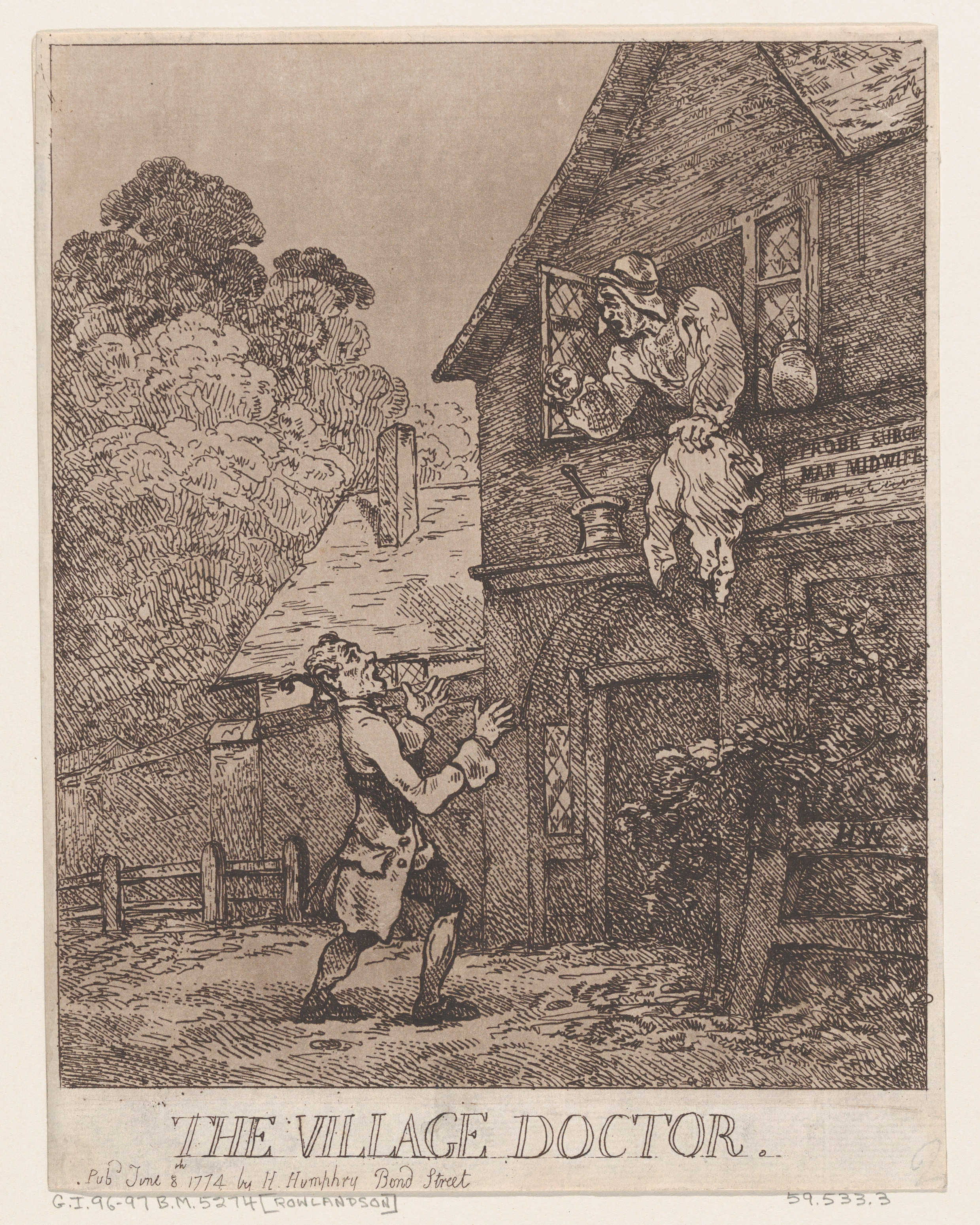
The Elisha Whittelsey Collection, The Elisha Whittelsey Fund, 1959

The standardization of technical medical training in universities was a late development in the Middle Ages, in part because many academics considered the activities of wise women and barber surgeons to fall below the study of Aristotelian natural philosophy, astrology, and religious council. Even after universities across Western Europe began teaching hands-on medical procedures, they struggled to obligate patients, including aristocratic and royal patients, to rely exclusively on those with degrees. Well into the fifteenth century, it was inconceivable to mandate that English medical professionals be university-trained. This was because, first, the institutions that gave out these credentials in England, Oxford and Cambridge, were far removed from the most populated areas like London. Second, these urban communities were far too vast to be served by the handful of medical graduates.

The works of two major fourteenth-century authors demonstrate that the skepticism and ridicule with which doctors are often treated to this day existed even as the occupation of the medical professional was still being defined. In his “General Prologue” to the Canterbury Tales, for instance, Geoffrey Chaucer heavily satirizes his Physician, who knows little of the Bible, dresses extravagantly, and reaps financial rewards from the plague. A trained alchemist, he uses his claimed expertise in the scientific properties of gold to benefit from its economic value: “For gold in physic (medicine) is a cordial,/ Therefore he loved gold especially” (1.443-44). Like so many of Chaucer’s professional academics in the Canterbury Tales, the Physician abuses his qualifications in order to line his pockets.

William Langland’s B text of Piers Plowman anticipates the “General Prologue”’s criticism of the Physician. In the last passus, the personification Life seeks out a “phisik” to cure him of Old Age (B.20.169). The “Physician with a furred hood,” to whom Life gives gold “that gladdened his heart,” is similar to Chaucer’s Physician in that, in his greed, he takes advantage of Life’s illness. He plays a greater role in Langland’s allegorical theology when it becomes clear that his craft obscures the need for spiritual healing. The “glass helmet,” or placebo, that he offers Life is an ineffective diversion from the true purpose of Old Age: to direct Life toward virtue and cast out spiritual despair (B.20.172). Just as the Physician of the “General Prologue” has studied a long list of Greek, Arabic, and other medical sources, “but little of the Bible” (1.438), Langland’s “phisik” transgresses in that he displaces spiritual action with medical practice.

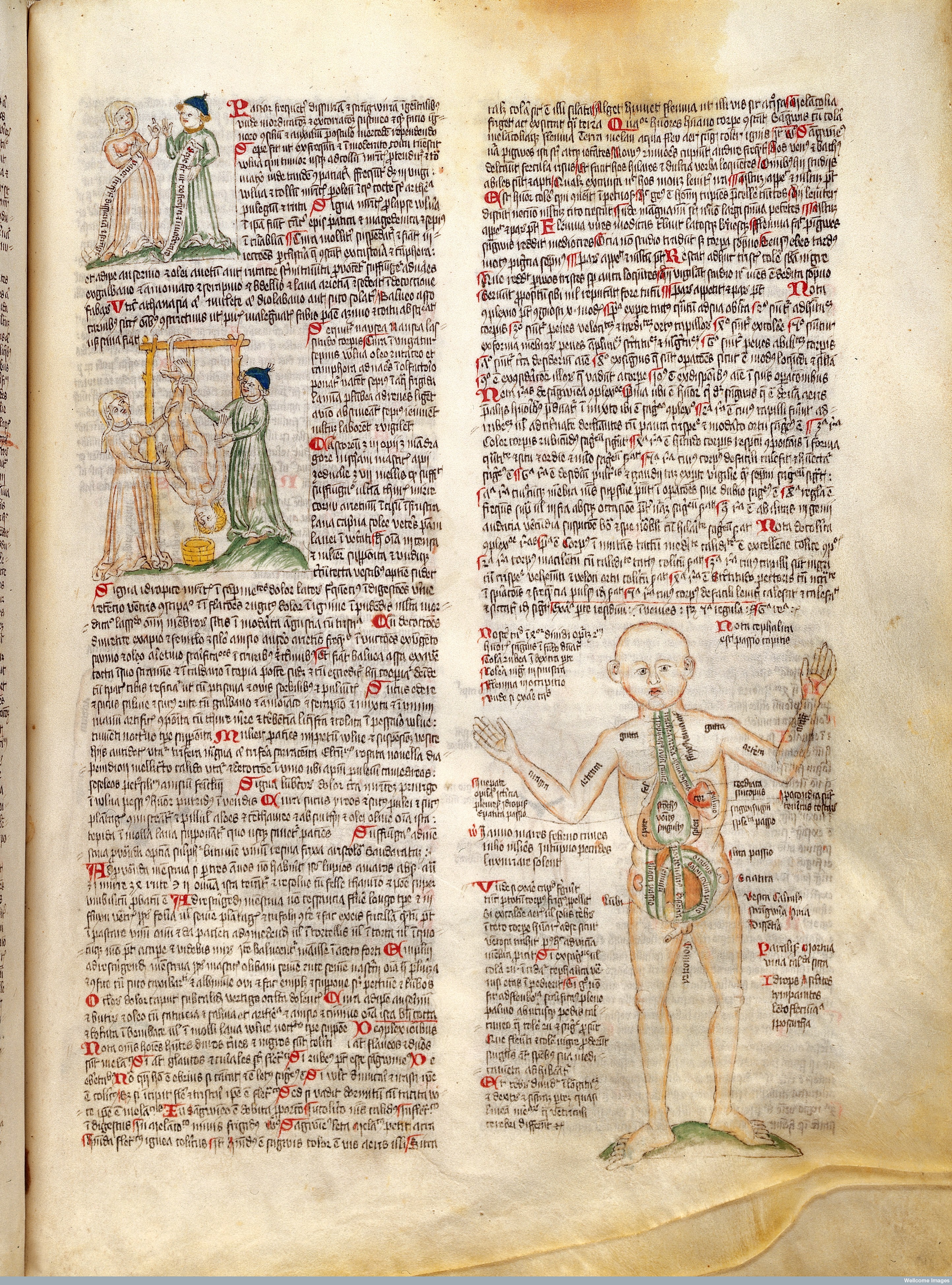
L0029312 Woman and doctor talking, Disease man
Credit: Wellcome Library, London. Wellcome Images
images@wellcome.ac.uk
http://wellcomeimages.org
Woman and doctor talking; text from accompanying treatise on scrolls – Woman and doctor hanging a nude woman upside down by her feet from a scaffold over a bucket for suffumigation – Disease man
Ink and Watercolour
1420? MS. 49
Wellcome Apocalypse
Published: –
Copyrighted work available under Creative Commons Attribution only licence CC BY 4.0 http://creativecommons.org/licenses/by/4.0/

Both Chaucer and Langland portray physicians who use the cachet of their expertise to exploit their patients. One of Langland’s earliest adaptors, however, demonstrates that not everyone took such a caustic view. The maker of Piers Plowman Z, takes care to specify that medical knowledge is valuable, and that at least some of its practitioners are worth consulting. In interpolated lines not present in any other version of Piers, Hunger says:

I defame not fysyk (medicine), for the science is true,
But incompetent scoundrels that cannot read a letter
Make themselves masters men for to heal.
But they are master murderers who slay men,
And no leches (doctors) but liars, Lord amend them!
In Ecclesiastes the clerk that can read
May see it there himself and then teach another:
‘Honor the doctor,’ he says, on account of the ‘need.’ (Z.7.260-267)

In this passage, the Z maker is more concerned with the intellectual hierarchy generated by medical knowledge than he is with “fysyk” itself. He criticizes those without what he deems sufficient education, he applies the logic that the misuse of medicine can be fatal in order to encourage the exclusion of the untrained, and he adds to this sense of hierarchy by immediately asserting that “the clerk that can read” should mediate the Bible for his less educated audience. This passage indicates that understanding not just of the medical material, but also of the ethical implications underpinning it, must be mediated by a professional. The Z maker’s frustration is akin to that of many of today’s physicians when their patients diagnose themselves using pharmaceutical commercials and online forums. In the case of Piers Plowman Z, this tension is amplified by the integral nature of bodily and spiritual healing in medieval culture.

Erica Machulak
PhD in English
University of Notre Dame
Founder of Hikma Strategies

References and Further Reading

Chaucer, Geoffrey. The Riverside Chaucer. Edited by Benson, L.D. and Robinson, F.N. 3rd ed. Boston, MA: Houghton Mifflin Co, 1987.

Chen, Pauline W. “Doctors and Their Online Reputation.” New York Times, March 21, 2013. https://well.blogs.nytimes.com/2013/03/21/doctors-and-their-online-reputation/.

Dumas, Geneviève, and Faith Wallis. “Theory and Practice in the Trial of Jean Domrémi, 1423–1427.” Journal of the History of Medicine and Allied Sciences 54, no. 1 (January 1, 1999): 55–87.

Fuller, Karrie. “The Craft of the ‘Z-Maker’: Reading the Z Text’s Unique Lines in Context.” Yearbook of Langland Studies 27 (2013): 15–43.

Getz, Faye. Medicine in the English Middle Ages. Princeton, NJ: Princeton University Press, 1998.

Kerby-Fulton, Kathryn. “Confronting the Scribe-Poet Binary: The Z Text, Writing Office Redaction, and the Oxford Reading Circles.” In New Directions in Medieval Manuscript Studies and Reading Practices Essays in Honor of Derek Pearsall, edited by Sarah Baechle, John J. Thompson, and Kathryn Kerby-Fulton, 489–513. Notre Dame, IN: University of Notre Dame Press, 2014.

Langland, William. Piers Plowman: The B Version: Will’s Visions of Piers Plowman, Do-Well, Do-Better and Do-Best. Edited by George Kane and E. Talbot Donaldson. London: Athlone Press, 1975.

McVaugh, Michael. Medicine before the Plague: Practitioners and Their Patients in the Crown of Aragon, 1285-1345. Cambridge History of Medicine. Cambridge, UK; New York: Cambridge University Press, 1993.

Pho, Kevin, and Susan Gay. Establishing, Managing, and Protecting Your Online Reputation: A Social Media Guide for Physicians and Medical Practices. Phoenix, MD: Greenbranch Publishing, 2013.

Rawcliffe, Carole. Medicine & Society in Later Medieval England. Stroud, England: Alan Sutton Pub., 1995.

Rawcliffe, Carole. Urban Bodies: Communal Health in Late Medieval English Towns and Cities. Woodbridge, Suffolk: The Boydell Press, 2013.

Rigg, A.G., and Brewer, Charlotte, eds. Piers Plowman: The Z Version. Studies and Texts 59. Toronto: Pontifical Institute of Mediaeval Studies, 1983.