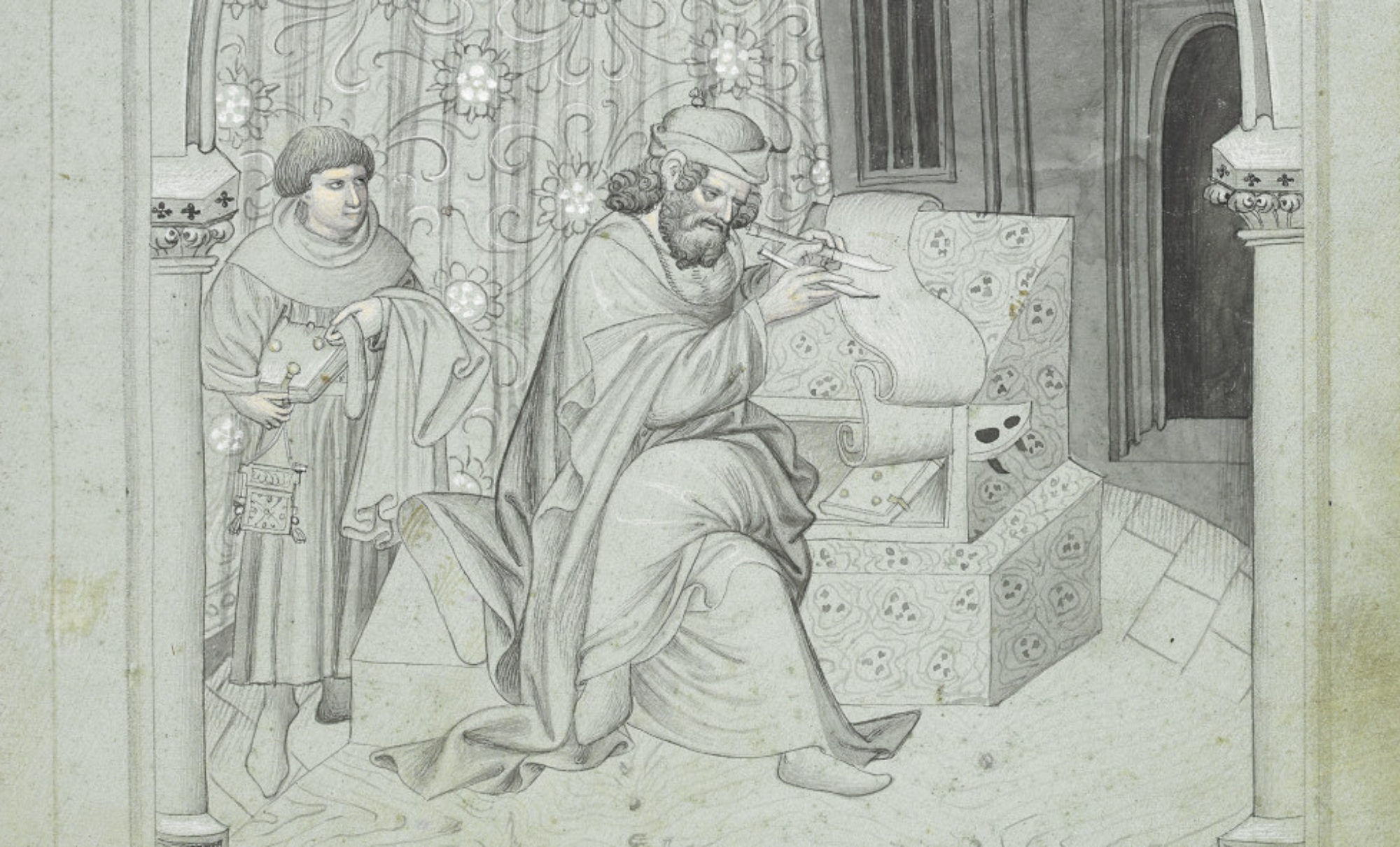
Confinement in Byzantine Narrative, Part II: A Woman Between Walls – St. Matrona of Perge and the Power of Chosen Enclosure

In Part I of this discussion, we saw how imprisonment in Byzantine martyr narratives could become a spiritual threshold. Confinement was not merely punishment; it could mark transformation.

But what happens when confinement is not imposed – when it is actively sought?

The Greek Life of St. Matrona of Perge, written in the mid-sixth century or later, offers a striking answer. Unlike martyrs forced into prison, Matrona repeatedly chooses enclosure. Yet she must move constantly in order to find it.

Her story unfolds across cities – Constantinople, Emesa, Jerusalem, Beirut – and is marked by flight, disguise, and pursuit. Beneath this movement, however, lies a single, persistent aim: isolation for the sake of God.

Movement Toward Enclosure

Matrona begins as a married woman who longs for a more ascetic life. In Constantinople, she takes the dramatic step of disguising herself as a eunuch and entering the male monastery of Bassianos. There she lives for three years in disciplined seclusion. The monastery becomes her first chosen confinement – a space of radical self-redefinition.

When her identity is discovered, she is compelled to leave. What follows is not freedom, but further searching. Her husband pursues her from city to city. Each escape becomes a new attempt at enclosure.

The most revealing episode occurs in Beirut.

A Deserted Temple at the Edge of the City

After a series of perilous journeys, Matrona settles in a deserted pagan temple on the edge of the city. It is an abandoned structure – neither fully urban nor truly wilderness. This marginal setting becomes the stage for her most intense confrontation with space.

Here, the narrative slows down. The rapid sequence of travels pauses, and attention shifts to the place itself.

One night, while chanting psalms, Matrona hears voices responding to her, though no one is present:

Now, it happened once, as she performed the nightly psalmody, that demons sang most fervently in response, for she heard the voices of many men singing. Taking fright and fortifying herself with the sign of the cross, she completed the psalmody, considering within herself and saying: “this place is deserted and the house unhallowed; there is no populated place in this area, nor have any passers-by approached; whence, then, come these voices?”

(trans. Featherstone and Mango 1996: 35)

The temple is empty – yet inhabited. In late antique imagination, abandoned pagan sites were not neutral ground. They were associated with demons, remnants of displaced gods. By choosing this place, Matrona does not withdraw into safety. She enters contested territory.

Soon a demon appears in the form of a woman and urges her to leave: this is no place for you; return to the city, where there is comfort, hospitality, and provision.

The temptation is subtle. The demon does not threaten; it invites. The argument is pragmatic: ascetic isolation is unnecessary, even dangerous. The city offers order and security. Why remain in desolation?

Matrona refuses.

Yet the text carefully preserves tension. The temple, including its environs, is described in two sharply contrasting ways. On the one hand, it is hostile, demonic, barren. On the other, it miraculously sustains her, “supplying her with daily nourishment, as if by tribute” (cf. trans. Featherstone and Mango 1996: 36). The very space that appears lifeless becomes productive.

Confinement in Matrona’s Life is thus presented as both threat and gift. The place resists her presence, yet it also yields to it. The demon attempts to drive her away; the environment sustains her perseverance.

The temple is not merely a backdrop. It becomes an active participant in her ascetic formation.

By remaining in the temple, she affirms that isolation is necessary for spiritual concentration. Confinement becomes a deliberate narrowing of focus. The deserted temple is thus transformed into a workshop of holiness.

What makes Matrona especially compelling is that she is not a desert solitary; she remains largely within urban settings. Even her most radical isolation occurs at the margins of a city. Her holiness is shaped not by geographical remoteness, but by deliberate withdrawal within inhabited worlds.

Movement, paradoxically, enables enclosure. Each journey strips away a former identity – wife, mother, and disguised monk. Each new space intensifies her spiritual focus.

Return, Foundation, and Spatial Memory

After years in Beirut, Matrona eventually returns to Constantinople. The narrative comes full circle. The city she once fled becomes the site of her lasting foundation: she establishes her own monastic community and dies as its revered abbess.

The woman who once concealed herself within male walls now builds her own.

A later reworking of her Life from the tenth century adds a striking spatial detail. It specifies the precise location of her convent in Constantinople: the place “had the sea on the right side, and on the other, it neighbored the monastery of Bassianos” (cf. trans. Bennasser 1984: 148).

This detail is remarkable. In the end, Matrona is situated between the two elements that shaped her identity: the monastery of Bassianos – her first place of confinement in male disguise – and the sea, the medium of her repeated journeys from one city to another. Movement and enclosure, which structured her life, are now fixed in geography.

St. Matrona of Perge, Menologion of Basil II (c. 1000), Vatican Library, Vat. gr. 1613, p. 169. The miniature from the Menologion depicts her simply as a nun. The dramatic episode of male disguise has faded from view. What remains is her identity as founder and spiritual mother. The visual tradition, like the later literary tradition, stabilizes her legacy.

Matrona’s story suggests that holiness in Byzantine narrative is not achieved through static withdrawal alone. It is forged through negotiation with space – through choosing where to remain, where to depart, and where to resist departure.

In Part I, prison was a threshold imposed by others. In Matrona’s Life, enclosure becomes intentional. She enters it again and again, not because she is forced, but because she recognizes its power.

Confinement, in her life, is not a boundary. It is a method.

And perhaps that is why her story endured: it proposes that spiritual transformation does not always require distant deserts. Sometimes it begins at the edge of the city – in a place others have abandoned – when someone decides to remain.

For Matrona, holiness is not found by fleeing walls, but by deciding which walls to inhabit – and why.

Christodoulos Papavarnavas
Visiting Assistant Research Professor
Medieval Institute
University of Notre Dame


Papavarnavas, Christodoulos. “Confinement in Byzantine Narrative, Part I: Martyrs and the Threshold of Holiness“. Medieval Studies Research Blog. Medieval Institute: University of Notre Dame (October 15, 2025).

Confinement in Byzantine Narrative, Part I: Martyrs and the Threshold of Holiness

One of the questions that has long fascinated me is how human beings experience the spaces around them, and how those experiences are shaped, narrated, and transformed in literature. In the Byzantine world – stretching from 330, when Constantinople became the new capital of the Roman Empire, to 1453, when it fell to the Ottomans – literature was a window into these experiences, capturing how people imagined and interpreted space.

Among the many spaces that captured Byzantine imagination, few are as revealing as the prison. The narratives of Christian martyrs – stories inspired by the early Christian persecutions (first to fourth centuries) yet mostly composed during the Byzantine era – portray imprisonment not merely as suffering, but as a spiritual turning point. These texts recount the trials of devout men and women who were interrogated, tortured, imprisoned, and executed for refusing to renounce their faith. I first became deeply interested in this topic while examining how confinement was depicted in Byzantine hagiography, a line of inquiry that culminated in my monograph Gefängnis als Schwellenraum in der byzantinischen Hagiographie (Prison as a Liminal Space in Byzantine Hagiography, De Gruyter, 2021) . In this first part of a two-part blog, I return to that subject to explore the prison as a threshold space – one that mediates between human endurance and divine transformation.

Why start with martyrs? Among all genres of Byzantine literature, martyrs’ Passions – accounts of Christian martyrdom – offer the richest and most detailed depictions of imprisonment. These accounts were not only compelling to read but also deeply instructive, showing how imprisonment shaped a martyr’s journey toward holiness. In light of our own recent global experiences of confinement, such as during the COVID-19 pandemic, these medieval depictions of (in)voluntary isolation speak to us in new ways.

Prison as a Threshold

In martyr narratives, the prison is more than a location – it is a liminal space, a threshold between the human and the divine. After enduring brutal tortures, the martyr is thrown into a cell, often bloodied and near death. Conditions are harsh: hunger, thirst, vermin, filth, and extreme overcrowding challenge the body and spirit. Yet, the prison also becomes a space of transformation.

Inside these walls, martyrs pray fervently, and divine intervention is depicted in vivid ways. Christ or angels may appear to heal or strengthen them. Dreams and visions bring the imprisoned closer to God and the promise of Paradise. Simultaneously, martyrs often convert visitors and heal fellow prisoners, demonstrating that the prison is also a space of active spiritual engagement. It is here that martyrs begin to transcend their human limitations and move toward sanctity.

The Martyrdom of Eudoxios, Romylos, Zenon, and Makarios, from an illustrated Menologion (eleventh century, London, British Library, Codex Add. 11870, fol. 67r).  This miniature shows the transition from torture to imprisonment and highlights the prison as a space of spiritual transformation.

Sometimes, the narratives even hint at the possibility of escape, yet martyrs choose to remain. They understand imprisonment as a necessary step on the path to holiness, a phase through which they must pass to achieve ultimate communion with God.

Beyond Martyrs: Voluntary Confinement of Ascetics and Monks

While martyrs faced forced imprisonment, Byzantine literature also explores voluntary forms of confinement, particularly among ascetics and monastics. These individuals deliberately withdrew from society, seeking solitude in caves or cells to cultivate spiritual virtues. Here, too, the space of confinement is transformative.

The ascetic’s cell or cave is not a site of punishment, but of self-imposed discipline. The narratives show how sustained solitude shapes character, deepens devotion, and influences the progression of the story itself. By examining both involuntary and voluntary forms of confinement, we can see a continuum of experiences: whether imposed by external authorities or chosen freely, these spaces are intimately linked with personal and spiritual growth.

The Martyrdom of Lucian of Antioch, from the Menologion of Basil II (ca. 1000, Vatican, Biblioteca Apostolica Vaticana, Codex Vat. gr. 1613, p. 115). The image is divided into two scenes: on the left, Lucian sits alone in his dark cell; on the right, his executioner casts his body into the sea. According to the text, Lucian dies of starvation in prison – his cell thus becomes both his place of death and of spiritual rebirth. The juxtaposition underscores the prison’s central role in shaping the martyr’s fate and ultimate sanctity.

Why These Stories Matter Today

You might wonder: why should readers care about Byzantine martyr narratives today? Part of the answer lies in their timeless human themes. Confinement – whether imposed or voluntary – forces reflection, endurance, and transformation. In our contemporary world, moments of isolation, such as quarantine or personal retreat, echo the ancient experiences depicted in these texts. By understanding how Byzantines imagined and narrated confinement, we gain insight not only into a distant past but also into our own relationship with space, suffering, and growth.

Moreover, these texts offer a rare glimpse into the Byzantine worldview. Hagiographies – texts dedicated to the lives of saints – served multiple purposes: honoring saints, promoting veneration, instructing readers in moral and ethical behavior, and even entertaining them with vivid depictions of daily life, including violence and crime. In this sense, Byzantine hagiographies were a medieval form of “television,” engaging their audience on many levels.

The richness of these texts, preserved across centuries, allows scholars and enthusiasts alike to explore a world where physical spaces and spiritual journeys are inseparably intertwined. The prison is not simply a place of punishment; it is a threshold, a transformative environment, shaping human experience and bringing one closer to the divine.

In studying how Byzantines imagined confinement, we discover not only their mindset, but something essential about ourselves: the ways in which the human spirit turns limitation into transcendence.

Christodoulos Papavarnavas
Visiting Assistant Research Professor
Medieval Institute
University of Notre Dame

Finding a Voice for Lay Sisters in a Monastic Community

Is it possible to talk about monastic women writers without discussing community? Even the collaborative efforts by which so many monastic women’s texts were created and handed down bring the community context and influence to the foreground.

And they give us our general idea of “monastic community”: nuns in their black or gray habits, singing the Divine Office together every day, recording the revelations reported by a particularly special community member.

But this is a purposefully distorted picture. The community of people within a monastery included a variety of servants and lay sisters (or brothers). Lay sisters, sometimes known as conversae, professed similar vows to choir nuns, but their mode of religious life was strictly providing manual labor for the convent. Joining the convent from the rural peasantry or urban lower classes, they did not sing the liturgy, meditate over books and images, or even learn to read at all.

Monastic women authors, so often keen on preserving the words of their (choir) sisters, show little interest in the inner lives of their servants and lay sisters. Authors of the Schwesternbücher from fourteenth-century Germany, especially Elsbeth Stagel of Töss and Katharina von Gebersweiler, offer miniature hagiographies of exceptional lay sisters like Gertrude of Saxony (with all the attendant questions about whether these connect to reality, or to the choir sister’s ideal). The brilliant and courageous Caritas Pirckheimer, prioress of the Dominican Katharinenkloster during the Reformation, is a rare case of referring to some servants by name. But even she writes of the city in the clutch of Reformers:

“Sometimes rather angry, audacious fellows surrounded the cloister and threatened our servants that they were about to attack the cloister on that very night, so we were very afraid and worried and could hardly sleep from fear.” [1]

Pirckheimer tells us the what that happened to the servants, but both the “we” and the emotional reaction (it is clear in context) only apply to the choir sisters.

However, these women joined convents rather than seeking secular employment for a reason. They had spiritual goals and spiritual lives of their own, but they seem almost completely silenced.

To make matters worse: an even rarer case where a lay sister is allowed an actual voice, in the spiritual autobiography of 14th-century Dominican nun Margaretha (Margaret) Ebner, the picture is hardly flattering.

In 1324, Ebner and the other nuns of Maria Medingen had to flee their convent for safety during a flare-up of fighting between yet another Holy Roman Emperor and yet another pope. Ebner reports that the convent prayed feverishly for protection. She even had a vision of the convent filled with “poor people” [souls in purgatory] who instructed her to pray vigils to God on their behalf for the health of the community.

But the war came too close. Rather than move to a different Dominican house, the usual practice, Ebner records in her Offenbarungen that she returned to her mother’s family home at Donauwörth. But she did not go alone:

I continued reading vigils [for the souls in purgatory]. I had a lay sister (weltlich swester) with me who was sad because I read vigils so much, and she was very angry about it and said it would do me woe. Then she saw one time that the house was full of poor souls and they said to her, “As you will not pray for us, do not begrudge that others pray for us.” [2]

Ebner presents a picture of a lay sister who cannot comprehend the importance or the point of an actual monastic life—who does not, it seems, even understand prayer. And it hinders her to the extent of trying to deny Ebner the chance to pray with the goal of the safety of her community—the community they both supposedly belong to.

Was this lay sister just another person who thought Ebner should be relieved to have a “vacation” from monastic drudgery? That does not seem to describe someone who would vow their entire life to serving nuns who sang the liturgy daily.

It’s important to note that Ebner started her spiritual biography in 1344, twenty years after this supposed incident, and that she was working within very specific genre conventions. Namely, both the text and the life it claimed to described needed to fit specific patterns of holiness. Even if the Offenbarungen relate some version of an actual incident, it serves a very particular purpose in the text. Ebner’s commitment to the liturgy, to claustration even in the secular world, to the safety of her convent community is on full display. It even receives divine confirmation!

Instead of a voice of protest, thus, the lay sister is rendered a prop for Ebner’s sanctity. Whether or not she ever thought or told Ebner that maybe she should back off the prayers, the conventions of spiritual autobiography turn her into a literary device.

But conventions only work if they make sense to readers. In this case, that means understanding and accepting that Ebner would flee her convent for her mother’s home, and that a lay sister would accompany her. That was not the typical pattern, in which the community would evacuate together (including servants, books, and chickens, it is often noted). The lay sister is specifically identified as such, not as a servant, and at any rate, there would have been servants aplenty at Donauwörth.

Instead, we have a case of a lay sister who went along with a nun despite an apparent lack of a warm relationship between the two (or, one hopes, Ebner would not have presented her so negatively). In other words: this is probably a woman who had nowhere else to go. Maybe her own home was too far away; maybe it was close enough to be under just as much threat as Maria Medingen.

The lack of security surely shaped the lay sister’s religious life some way, including during times of relative safety. It definitely would have affected how she related to the convent as a whole, and to her experiences there. Further reading through the silences—and the silencing—of monastic texts by women and their male supporters will hopefully allow us to tease out something of the average, not just the exceptional, lay sister’s spiritual life as true members of a monastic community.

Cait Stevenson, PhD Candidate
University of Notre Dame

~~

[1] Translated in Caritas Pirckheimer, Caritas Pirckheimer: A Journal of the Reformation Years, 1524-1528, ed. Paul A. MacKenzie (Boydell and Brewer, 2006), 74.

[2] Philipp Strauch, ed., Margaretha Ebner und Heinrich von Nördlingen: Ein Beitrag zur Geschichte der deutschen Mystik (Tübingen: Mohr Siebeck, 1882), 7. A partial English translation is available in Margaret Ebner, Margaret Ebner: Major Works, ed. and trans. Leonard P. Hindsley (New York: Paulist Press, 1993), 88.