The Riddle of Grendel’s Monstrous Mother: Echoes of Scylla in Beowulf?

Grendelโ€™s mother has long been regarded by scholars as the least monstrous of the threeโ€”not being an obvious vampire-cannibal like Grendel nor a fire-breathing dragon. Her vengeful response to the death of her son, and her decision to continue the feud between the Grendelkin has been regarded as ethical (within the broader context of warrior ethos), legal (within the context of early medieval Norse and English laws), and even heroic (aligned with the heroism as depicted in the poem).
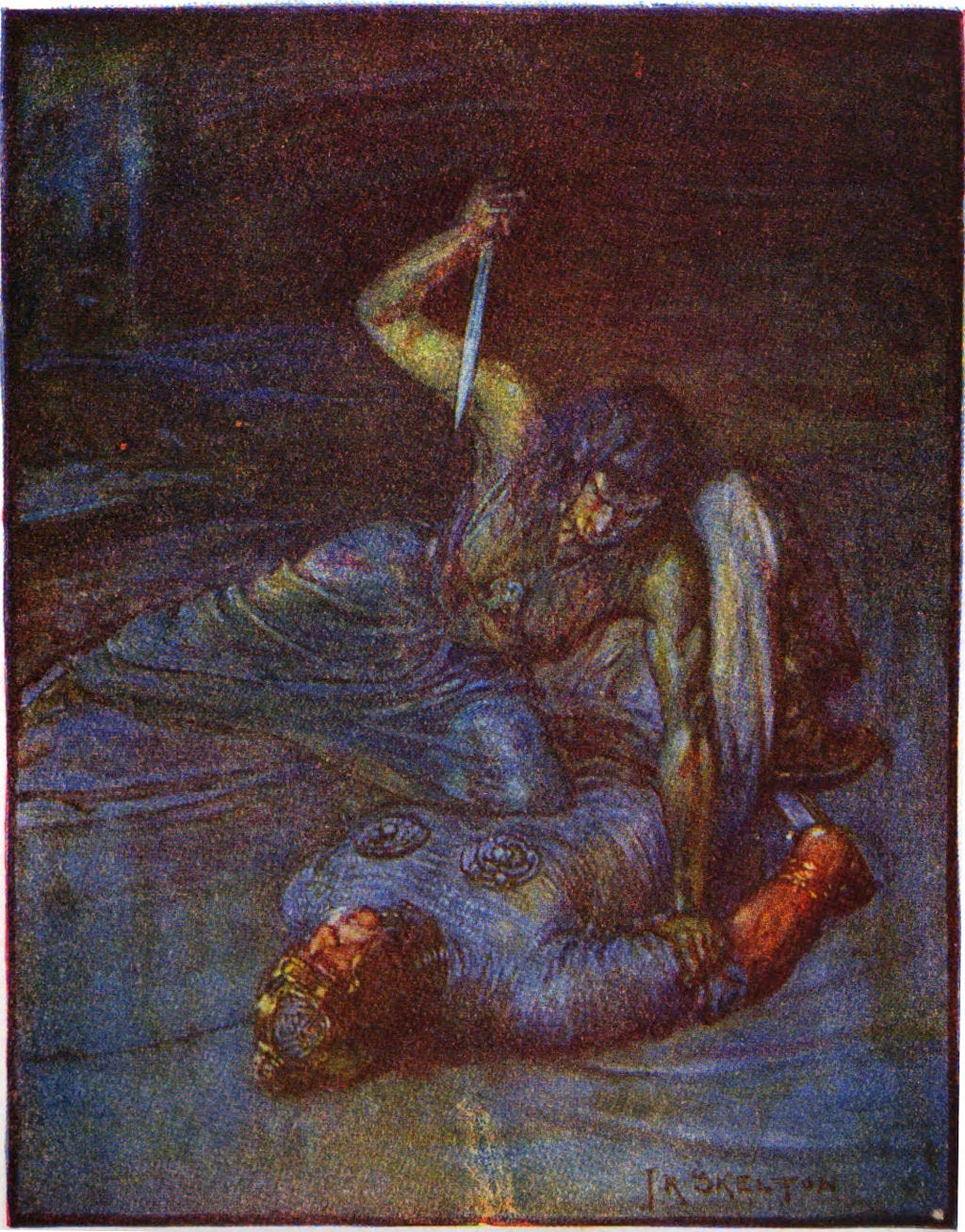
Grendelโ€™s mother tries to stab Beowulf. Illustration by J.R. Skelton, 1908.

While I would generally agree with this broad characterization of Grendelโ€™s mother, and there is no doubt that her actions mirror those of any avenging warrior in Beowulf, to erase her monstrosity seems to ignore at least some of the evidence. While I do not find her maternity at all indicative of abject horror (indeed quite the opposite as it is her identity as โ€œmotherโ€ that humanizes her in my view), certain terms used to describe her and indeed everything from her association as Caines cynn โ€œCainโ€™s kinโ€ (107; 1261-65) and the hellish descriptions of her lair suggest some measure of monstrosity embedded in her character. And for this Halloween, we will spend some time unpacking the nature of her monstrosity.

I would contend that the main reason scholars argue about Grendelโ€™s motherโ€™s monstrosity and characterization is because of her enigmatic design. As I point out in my dissertation, riddles encode Beowulf, and, in my opinion, employ riddling rhetorical strategies, especially imitation, equivocation, esotericism and paradox. These obfuscations help account for the many irregularities observed in the poem the scholars have scratched their heads over for more than a century and help explain why often the heroes looks like the monstersโ€”and the monsters like the heroes.  

Grendelโ€™s mother battles Beowulf. Illustration by John Howe, 2006. All rights reserved.

Because of the influence of riddling rhetorical strategies on Beowulf, turning to the Anglo-Latin enigmata tradition is an especially fruitful practice, especially in explorations of monstrosity in the poem. Indeed, monsterized riddles have long been a feature starting with the late classical enigmatist, Symphosius, who establishes the Anglo-Latin tradition, includes numerous riddles on wondrous creatures, such as the phoenix (Enigma 31). Similarly, Aldhelmโ€™s enigmata also feature numerous monsterized riddles, in some cases the solution is a wondrous creature (as with Symphosiusโ€™ paradoxical phoenix-riddle), in other cases the mundane is made monstrous through imitation, and the monsterization is another mechanism of obfuscation (as in Aldhelmโ€™s Enigma 97 solved nox). Even Boniface, whose riddles center on vices and virtues, monsterizes his vice-riddles in the mode of Prudentiusโ€™ Psychomachia, a popular classroom text in early medieval English which depicts vices as monsters in an allegorical epic.

Iraโ€™s sword shatters on Patientiaโ€™s helmet, then the enraged Ira dies by her own blade (c.900, Bern, Burgerbibliothek, Codex 264, p.79).

But what does this have to do with Grendelโ€™s monstrous mother? Letโ€™s start with her introduction and the complex portrait it paints:

รžรฆt gesyne wearรพ,
widcuรพ werum,   รพรฆtte wrecend รพa gyt

lifde รฆfter laรพum,   lange รพrage,
รฆfter guรฐceare:   Grendles modor.
Ides aglรฆcwif   yrmรพe gemunde,
se รพe wรฆteregesan   wunian scolde,
cealde streamas,   siรพรฐan Cain wearรฐ
to ecgbanan   angan breรพer,
fรฆderenmรฆge.   He รพa fag gewat,
morรพre gemearcod,   mandream fleon,
westen warode. 

โ€œThat became manifest, widely known to men, that an avenger still lived after the hostile one, for a long time, after war-grief: Grendelโ€™s mother. A lady, a fearsome woman remembered misery, he who must inhabit the terrible-waters, the cold streams because Cain became the edge-slayer to his only brother, kin of the same father. He then went hostile, marked by murder, fled the joys of men, inhabiting the wilderness.โ€

Beowulf, 1255-65.

The first term used to describe Grendelโ€™s mother emphasizes her desire for vengeance. The narrator names her a wrecend โ€œavengerโ€ (1256) โ€”an appropriate title considering her entire characterization is framed by revenge and feudingโ€”and her motive is thrice repeated almost verbatim and with language that could apply equally to avenging heroes in the poem (1276-78, 1339-1340, 1546). Moreover, Grendelโ€™s motherโ€™s is thrice described as wif โ€œwomanโ€ (1259, 1519, 2120,) and even twice as an ides โ€œladyโ€ (1259, 1351) establishing gender as one of the pillars of her characterization, alongside her roles as avenger and mother. Kinship ties are further emphasized when Grendelโ€™s mother is described as Grendles maga โ€œGrendelโ€™s female relativeโ€ (1391) and twice as Grendles mรฆg โ€œGrendelโ€™s kinsmanโ€ (2006, 2353), which account for her desire for revenge in upholding the warrior ethics and continuing the feud between the Danes and the Grendelkin.
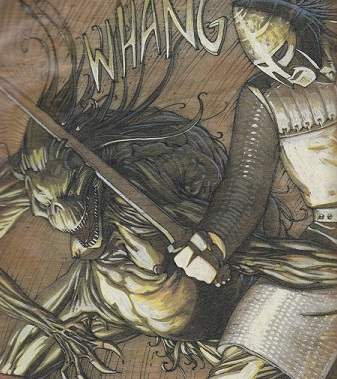
Beowulf fights Grendels mother Gareth Hinds
Beowulf fights Grendel’s mother. Illustration fromm Gareth Hinds graphic novel, Beowulf (2007). All rights reserved.

Moreover, like the monstrous vices in Prudentiusโ€™ Psychomachia and Bonifaceโ€™s Enigmata, the avengerโ€”Grendelโ€™s motherโ€”is clearly wondrous and monstrous in certain descriptions of her. She and her lake monsters are wรฆteregesa โ€œwater-terrorsโ€ (1260). Grendelโ€™s mother is called se broga โ€œthe terrorโ€ (1260), and together with her son, she is described as mihitig manscaรฐa โ€œman-slayerโ€ (1339), micle mearcstapa โ€œgreat marked-wandererโ€ (1348), dyrna gast โ€œsecret spiritโ€ (1357), รฆlwiht โ€œalien thingโ€ (1518), thrice as ellorgรฆst โ€œforeign spiritโ€ (1349, 1617, 1621) and even deofol โ€œdevilโ€ (1680). She is even described as a merewif mihtig โ€œmighty mermaidโ€ (1519), aglรฆcwif โ€œfearsome warrior womanโ€ (1259) or wif unhyre โ€œuntamed womanโ€ (2120), grundwyrgenne โ€œground wolfโ€ (1518) and twice is characterized with the compound a brimwulf โ€œsea-wolfโ€ (1506, 1599).

It is my contention that descriptions of Scyllaโ€”a classical monster, famously featured in the Odyssey and popular in Anglo-Latin literature contemporary with Beowulfโ€”likely influence the characterization of Grendelโ€™s mother, a riddle embedded in the poetic compounds used to describe her and in the depiction of her monstrous lair.

Scylla as a maiden with a kฤ“tos tail and dog heads sprouting from her body. Detail from a red-figure bell-crater in the Louvre, 450โ€“425 BC. This form of Scylla was prevalent in ancient depictions.

Scylla is a monstrous sea creature from Greek mythology, known for inhabiting a narrow strait opposite the whirlpool Charybdis. She often has multiple heads with each head bearing a set of sharp, ravenous teeth. Scylla’s body is a womanโ€™s often combining serpentine, aquatic and canine features. She emerges from a rocky cliffside and narrow passage where she lives. She preys on passing sailors, snatching them from ships with her many heads and her โ€œsea dogsโ€ which accompany her. Once a beautiful nymph, she becomes cursed and exiled.

Scylla is the riddle-subject of Aldhelmโ€™s Enigma 95 (solved Scilla) and is featured in his prose De uirginitate (X). Aldhelmโ€™s Enigma 95 describes Scylla as follows:

Ecce, molosorum nomen mihi fata dederunt
(Argolicae gentis sic promit lingua loquelis),
Ex quo me dirae fallebant carmina Circae,
Quae fontis liquidi maculabat flumina uerbis;
Femora cum cruribus, suras cum poplite bino
Abstulit immiscens crudelis uerba uirago.
Pignora nunc pauidi refereunt ululantia nautae,
Tonsis dum trudunt classes et caerula findunt.
Uastos uerrentes fluctus grassante procella,
Palmula qua remis succurrit panda per undas,
Auscultare procul quae latrant inguina circum.
Sic me pellexit dudum Titania proles,
Ut merito vivam salsis in fluctibus exul.

โ€œLook, the Fates gave me the name of dogsโ€”thus does the language of the Greeks render it in wordsโ€”ever since the incantations of dread Circe, who stained the waters of the flowing mountains with her words, deceived me. Weaving words, the cruel witch deprived me of thighs together with shins, and calves, together with knees. Terrified mariners relate that, as they impel their ships with oars and cleave the sea, sweeping along the mighty wave while the tempest rages, where the broad blade of howling offspring that bark about my loins. Thus the daughter Titan [scil. Circe] once tricked me, so that I should live as an exileโ€”deservedlyโ€”in the salty waves.โ€

Lapidge and Rossier, Aldhelm: The Poetic Works, 91.

In this riddle, solved Scylla (Scilla), Aldhelm emphasizes her canine connection, and gives a reference to her origin in Greek mythology and her transformation at the hands of the witch, Circe. There is also mention of the danger she poses to any who sail by her watery abode, alongside her โ€œhowling offspring that barkโ€ about her an further threaten wayward travelers.
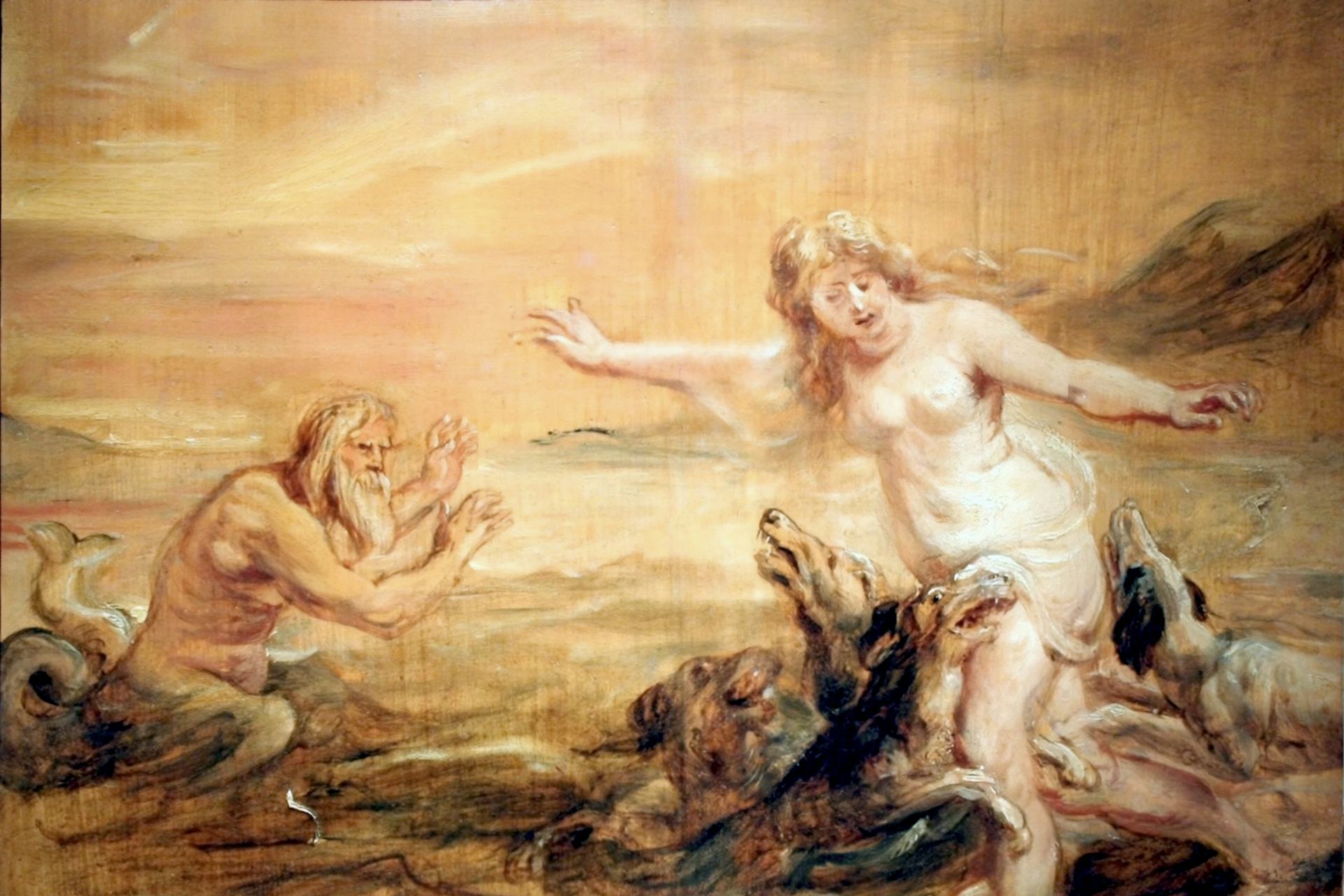
Scylla and Glaucus by Peter Paul Rubens (ca. 1636)
Scylla and Glaucus by Peter Paul Rubens (ca. 1636). Musรฉe Bonnat-Helleu.

Scylla also appears twice in the Liber monstrorum (I.14, II.19), where she is described in detail. This first mention from Liber monstrorum I.14 in the section on humaniod monsters is as follows:

Scylla monstrum nautis inimicissimum in eo freto quod Italiam et Siciliam interluit fuisse perhibetur capite quidem et pectore uirginali sicut sirenae, sed luporum uterum et caudas delfinorum habuit. Et hoc sirenarum et Scyllae distinguit naturam quod ipsae morifero carmine mauigantes decipiunt et illa per uim fortitudinis marinis succinta canibus miserorum fertur lacerasse naufragia.

โ€œIt is reckoned that Scylla has been the monster most hostile to sailors in that channel which washes between Italy and Sicily, having indeed the head and chest of a maiden (like the sirens), but the belly of a wolf and the tail of dolphins. And what distinguishes the nature of the sirens from Scylla is that they deceive seamen by their deadly song, whilst she with the strength of her force, girt about with sea-dogs, is said to have mangled the wrecks of the unfortunate .โ€

Orchard, Pride and Prodigies, 266-67.

This description emphasizes her superlative hostility [inimicissimum]โ€”similar to Grendelโ€™s motherโ€™s characterization as an aglรฆcwif โ€œfearsome warrior womanโ€ (1259) or wif unhyre โ€œuntamed womanโ€ (2120). Emphasis on the narrow channel where Scylla resides shifts to her hybrid representation with โ€œthe head and chest of a maiden (like sirens) but the belly of a wolf and the tail of a dolphinsโ€ (fuisse perhibetur capite quidem et pectore uirginali sicut sirenae, sed luporum uterum et caudas delfinorum habuit). This establishes Scylla as a woman-canine-marine creature, combining โ€œmaidenโ€ (virgo), โ€œwolfโ€ (lupus), and โ€œdolphinโ€ (delphinus) parts. Moreover, she is twice compared to the treacherous sirens, while explaining that unlike the sirens, who use song to ensnare their victims, Scylla uses force, violence and her mighty strength, with her โ€œsea-dogsโ€ (marinis canibus) to take down unfortunate sailors who enter her domain.

Scylla, relief sculpture on a pair of terracotta plaques with glass inlays, late 4th century BCE; in the Metropolitan Museum of Art, New York City. The Metropolitan Museum of Art, New York City, Sandra Brue Gift, 1998 (accession no. 1998.210.1, .2); www.metmuseum.org.

In the second section, centered on bestial monsters, there is an entry on the sea-beasts of Scylla. Liber monstrorum II.19 reads as follows:

fingunt quoque poetae inmari Tyrrheno ceruleos esse canes, qui posteriorem corporis partem cum piscibus habent commune. Ipsis quoque Scyllam ratem Ulixis lacerans marinis succincta canibus describitur.

โ€œthe poets also image that there are azure dogs in the Mediterranean, the hind parts of whose bodies they share with fish; also girt round with these same sea-dogs Scylla is described tearing apart the ship of Ulyssesโ€

Orchard, Pride and Prodigies, 266-67.

This entry focuses on the โ€œazure dogโ€ (ceruleos canes) or โ€œsea dogsโ€ (marinis canibus) of Scylla, which are described as featuring canine heads and legs, but โ€œthe hind parts of whose bodies they share with fishโ€ (qui posteriorem corporis partem cum piscibus habent commune) making them a canine-marine hybrid creature. Scylla is directly mentioned in connection with her accompanying sea-monsters, and the passage directly references the struggles of Odysseus [i.e. Ulysses] when he encounters Scylla on his epic journey home.
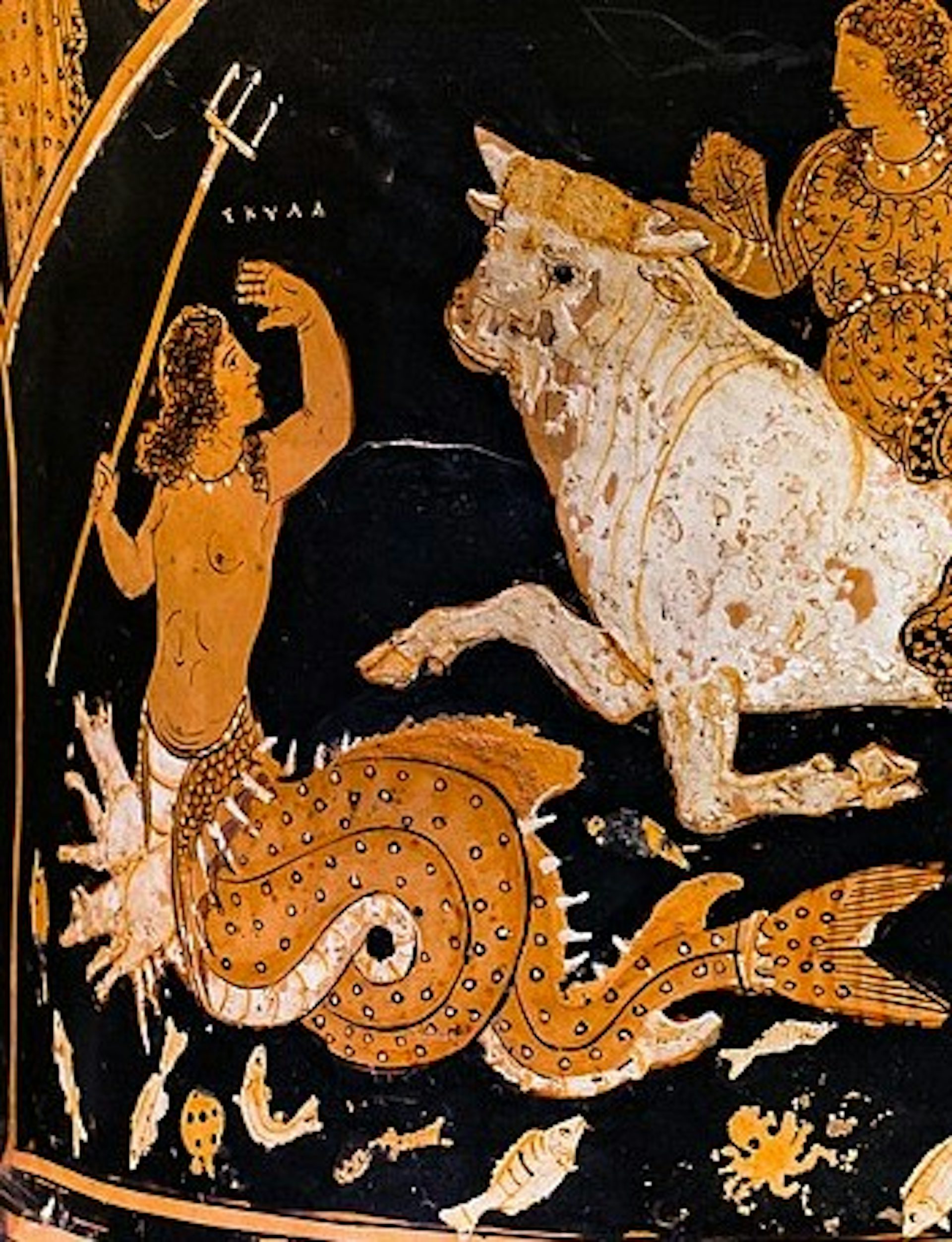
Asteas - Europa on the bull - Dionysos with satyrs and maenads and Pan - Montesarchio
Paestan red figure calyx-crater showing Scylla wielding a trident (ca. 350 BCE). Museo Archeologico Nazionale del Sannio Caudino, Montesarchio. 

The key features of Scyllaโ€™s narrow channel are present also in the monster-mere found in Beowulf which is the home and hall of the Grendelkin. Grendelโ€™s Motherโ€™s lair is described in the poem as follows:

Hie dygel lond
warigeaรฐ, wulfhleoรพu,   windige nรฆssas,
frecne fengelad,   รฐรฆr fyrgenstream
under nรฆssa genipu   niรพer gewiteรฐ,
flod under foldan
.

โ€œThey [Grendelkin] inhabit the secret land, the wolf-slopes, the windy narrows, the dangerous fen-path, where the mountain stream cascades downward under the cover of cliffs, the flood under the land.โ€

Beowulf, 1357-61.

This description emphasizes the dangerous narrows and the crafty cliffs surrounding the monstrous abode and in this way echoes Scyllaโ€™s watery domain. In this passage are numerous references to the steep and narrow geography, especially in descriptions of the wulfhleoรพu windige nรฆssas โ€œwolf-slopes (and) windy narrowsโ€ (1358), and fyrgenstream under nรฆssa genipu, โ€œa mountain river under the cover of cliffsโ€ (1359-60). As Beowulf enters the waves, he finds himself, like those caught by Scylla in the Odyssey, in a violent struggle for his life at the hands of a ferocious woman who pulls him to the depths of her haunted lake. The narrator explains how:

Bรฆr รพa seo brimwylf,   รพa heo to botme com,
hringa รพengel         to hofe sinum,
swa he ne mihte,         no he รพรฆs modig wรฆs,
wรฆpna gewealdan,   ac hine wundra รพรฆs fela
swencte on sunde,         sรฆdeor monig
hildetuxum         heresyrcan brรฆc,
ehton aglรฆcan.         รฐa se eorl ongeat
รพรฆt he in niรฐsele         nathwylcum wรฆs,
รพรฆr him nรฆnig wรฆter         wihte ne sceรพede,
ne him for hrofsele         hrinan ne mehte
fรฆrgripe flodes;         fyrleoht geseah,
blacne leoman,         beorhte scinan.
Ongeat รพa se goda         grundwyrgenne,
merewif mihtig .

โ€œWhen she came to the bottom, the sea-wolf bore the prince of rings to her hall, so he could not, no matter how brave he was, wield weapons, but so many wonders afflicted him while swimming, many a sea-beast poked the battle-armor with battle-tusks, harassed the fearsome assailant (Beowulf). Then the man perceived that he was in some kind of hostile-hall, where no water could harm them at all, nor could the sudden grasps of the flood touch them because of the roofed-hall.  He saw firelight, pale illumination brightly shining. Then the good one (Beowulf) perceived the bottom-wolf, the mighty sea-woman.”

Beowulf, 1506-1519.

Henry Justice Ford “Beowulf battles with Grendels Mother” (1899).

In reading this passage from the poem, we can observe numerous parallels between Grendelโ€™s mother and Scylla, which I believe suggests that the classical monster, frequently featured in Anglo-Latin texts, may have influenced the depiction and characterization of Grendlโ€™s mother. Just like with Scyllaโ€™s channel, the monster-mere in Beowulf includes sea-creatures that attack anyone who enters their watery lair. Both Scylla and Grendelโ€™s mother are ancient, cursed and exiled monsters, the former as a result of a witchโ€™s curse, the latter is prediluvian, cursed and marked as kin of Cain. Grendelโ€™s mother seems to travel with sea-beasts (nicoras) which resemble Scylla’s sea-dogs. Both Scylla and Grendelโ€™s mother are hybrid women monstersโ€”featuring both canine or lupine characteristics (as indicated by her description as brimwulf “sea-wolf” and grundwyrgenne “bottom-wolf”) characteristics and piscine or serpentine characteristics (as indicated by her description as merewif “mermaid”). And, both Scylla and Grendelโ€™s mom occupy a craggy narrow passage that is terrifying and dangerous for sailors or sea-men.

While I would not push so far as to contend that Grendelโ€™s mother is intended as a literal representation of Scylla, and while I agree with others who have observed her ethically complex characterization, it seems plausibleโ€”even probableโ€”that the famous Scylla could have influenced her enigmatic monsterization. At the very least, many counted among the learned audiences of Beowulf in early medieval England would likely have discerned the numerous and noteworthy parallels between these two monstrous women.

Richard Fahey, PhD
Medieval Institute
University of Notre Damme

Selected Bibliography

Acker, Paul. โ€œHorror and the Maternal in Beowulf.โ€ Publication of the Modern Language Association 121.3 (2006): 702-16.

Aldhelm. Aldhelm: The Poetic Works. Translated by Michael Lapidge and James L. Rosier. Dover, NH: D. S. Brewer, 1985.

โ€”. Aldhelm: The Prose Works. Translated by Michael Lapidge and Michael Herren. Cambridge, UK: D. S. Brewer, 1979.

Fahey, Richard. โ€œEnigmatic Design and Psychomachic Monstrosity in Beowulf.โ€ Dissertation: University of Notre Dame, 2020.

Hennequin, M. Wendy. โ€œWeโ€™ve Created a Monster: The Strange Case of Grendelโ€™s Mother.โ€ English Studies 89.5 (2008): 503-23.

Klaeberโ€™s Beowulf, 4th Edition. Edited by Robert D. Fulk, Robert E. Bjork and John D. Niles. Toronto, ON: University of Toronto Press, [reprint] 2009.

Kiernan, Kevin S. โ€œGrendel’s Heroic Mother.โ€ In Geardagum 6 (1984): 13-33.

Lockett, Leslie. โ€œThe Role of Grendelโ€™s Arm in Feud, Law, and the Narrative Strategy of Beowulf.โ€ In Latin Learning and English Lore: Studies in Anglo-Saxon Literature for Michael Lapidge (I), edited by Katherine Oโ€™Brien Oโ€™Keeffe and Andy Orchard, 368-88. Toronto, ON: University of Toronto Press, 2005.

Orchard, Andy. A Critical Companion to Beowulf. Cambridge, UK: D.S. Brewer, 2003.

โ€”. Pride and Prodigies: Studies in the Monsters of the Beowulf-Manuscript. Toronto, ON: University of Toronto Press, 1995.

Sayers, William. โ€œGrendelโ€™s Mother, Icelandic Gryla, and Irish Nechta Scene: Eviscerating Fear.โ€ Proceedings of the Harvard Celtic Colloquium 16 (1996): 256-68.
Gendering the Harpy: Mythology, Medievalism, and Macabre Femininity

I have a fascination with the strange and obscure, and if I find oddities and curiosities during my travels that intersect with my medieval interests, even better. On a recent trip to Italy, I encountered a creature from both Greek mythology and medieval bestiaries at one of the most wonderfully macabre sites Iโ€™ve explored.

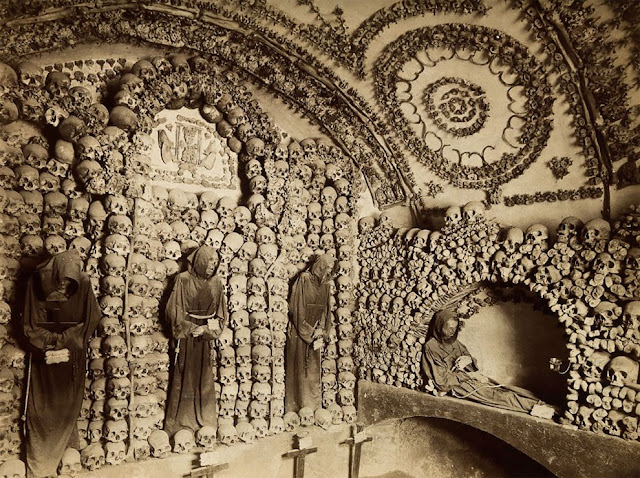
While on vacation in Rome this summer, I visited the Capuchin Crypt, an underground mausoleum containing an elaborate arrangement of human bones โ€“ lots and lots of bones. No one knows who designed the beautiful and haunting configurations comprised from the bones of approximately 3,700 bodies, presumably those belonging to Capuchin monks who sought refuge from religious persecution in France and perished while in Rome.

Unfortunately, photos are not allowed, and efforts to describe the intricacies and expanse of the design prove rather futile. Skulls and pelvic bones combine to create sculptures reminiscent of butterflies in the arches of doorways. Vertebrae dot and line the ceilings of the chambers like so many fresco tiles. Massive piles of assorted bones have been shaped into seats for carefully posed skeletons. Reviewing his experience, the Marquis de Sade rated the exhibit five stars by modern standards.

Inside one of the chambers of the Capuchin Crypt in Rome, Italy, courtesy of the Liturgical Arts Journal.

But the crypt is a 17th-century construction. Itโ€™s the museum that contains the medieval bits, and thatโ€™s where I noticed an early print book, dated to the 15th or 16th century, that clearly depicted a cockatrice and that the museum had identified as a harpy.[1] To be fair, the label included a question mark, indicating that the curator was unsure as to what kind of creature was on display.

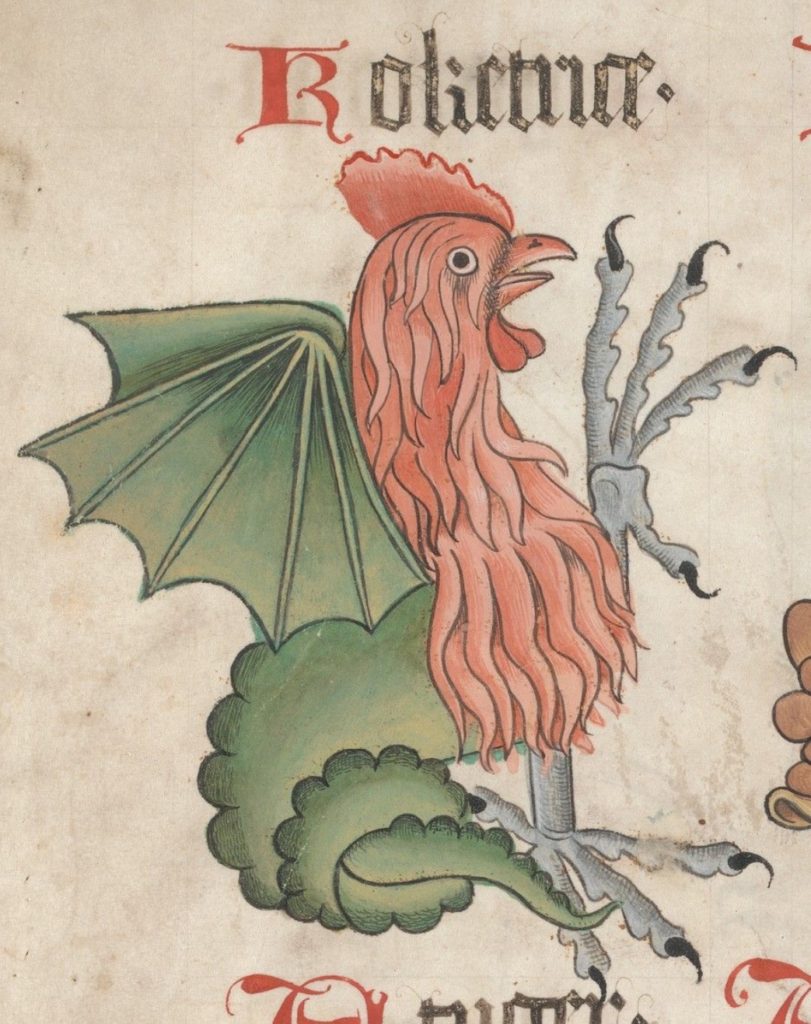
Far less familiar than the harpy, the cockatrice is a legendary creature with a dragonโ€™s body and a roosterโ€™s head. The beast was believed to be hatched from a roosterโ€™s egg incubated by either a serpent or a toad. Its first recorded mention in English appears in a Wycliffite bible dated 1382.[2]

Labeled as a koketrice in this medieval bestiary from England circa 1500, the creature combines a roosterโ€™s head and feet with a dragonโ€™s wings and tail. (Yale Center for British Art, Helmingham Herbal and Bestiary, folio 18v).

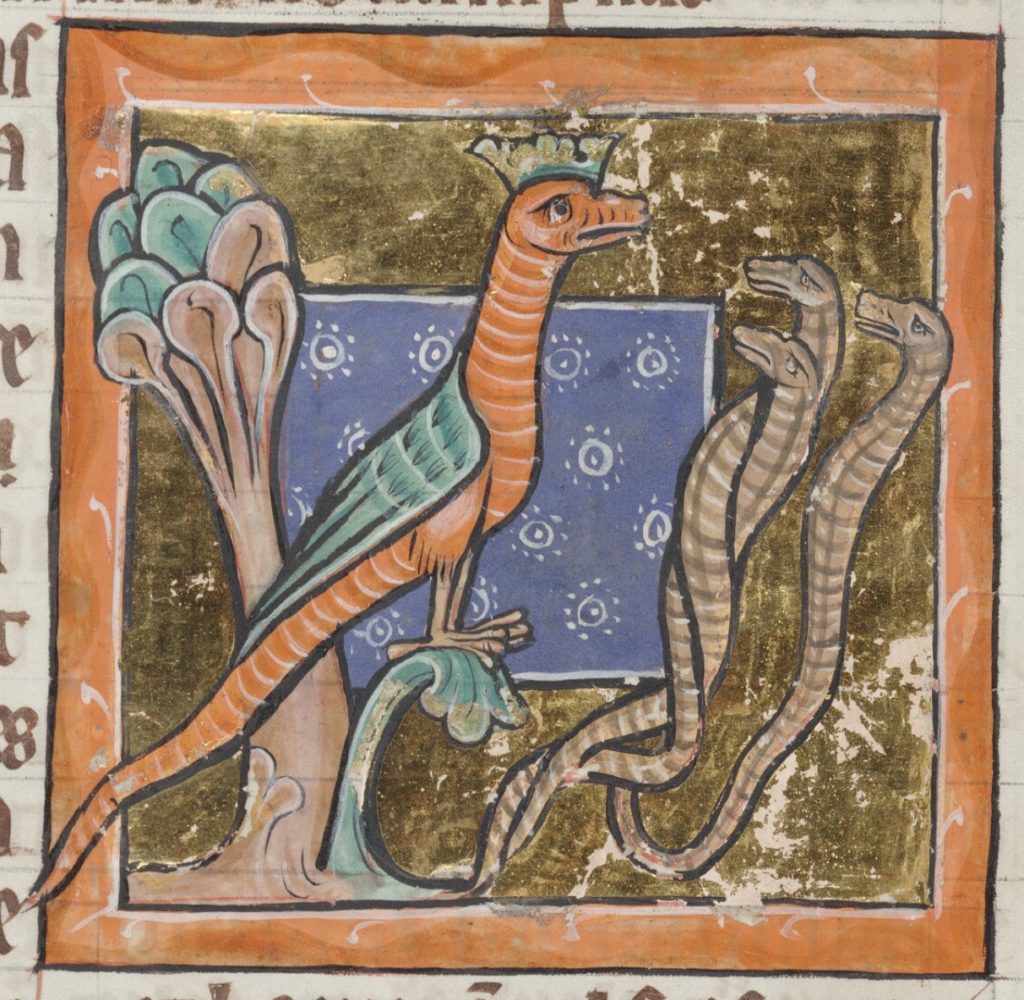
The cockatrice seems to have become synonymous with the basilisk in medieval bestiaries. [3] Most often, basilisks are depicted as a bird, typically a rooster, with a snakeโ€™s take. In some illustrations, the basilisk is all snake in terms of physical characteristics, though often with a crest reminiscent of a roosterโ€™s head. The mythologies of the cockatrice and basilisk also share similar elements. As with the basilisk, it is fatal for a person to look the cockatrice in the eyes. Both creaturesโ€™ breath can also cause death according to folklore.

This medieval bestiary dated 1225-50 and produced in England portrays the basilisk as the king of serpents with lesser snakes paying homage. The creature exhibits mostly serpent features but retains the wings, legs, and crown of a cock. (Bodleian Library, MS Bodley 764, folio 93v).

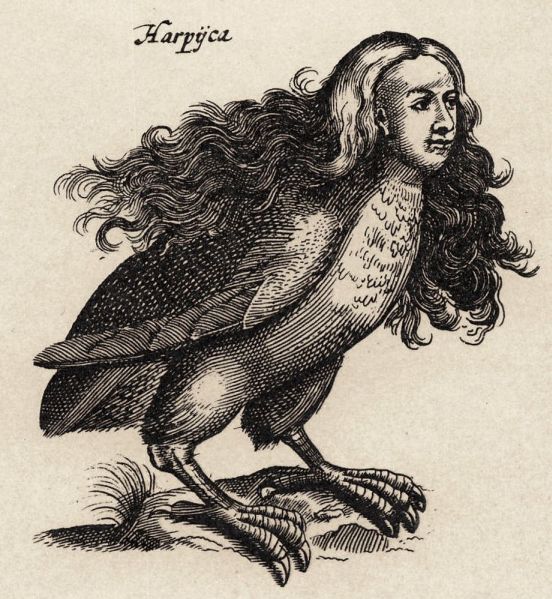
A harpy, in contrast to the cockatrice, has a birdโ€™s body with a human head and no serpent components. When I mentioned the mislabeling to the front desk staff, I was told that a historian had recently visited the museum and indicated the reverse but without additional explanation. I assured them that the rooster-headed serpent wasโ€”hands downโ€”a cockatrice. Harpies have bird bodies, human heads, and zero snake parts. As imperatively, harpies are depicted as female.

Illustration of a harpy from Ulisse Aldrovandiโ€™s Monstrorum Historia, Bologna, 1642, via World History Encyclopedia.

According to Greek mythology, harpyiai were winged female spirits thought to be embodied in sharp gusts of wind, and while certainly fearsome, they were not always so bestial. Known as the โ€œhounds of Zeus,โ€ the female entities were sent from Olympus to snatch people or objects from the earth. Sudden disappearances were, as a result, often attributed to the harpies.

In their earliest representations, harpies appeared as winged women, sometimes with the lower bodies of birds. They were vengeful creatures but not hideous in appearance. Writing between 750 and 650 BC, Hesiod describes harpies as winged maidens with beautiful hair, whom he praises for swiftness in flight that exceeds the speed of storms and birds. Homer, writing roughly around the same time, mentions a female harpy but says nothing derogatory about her looks.

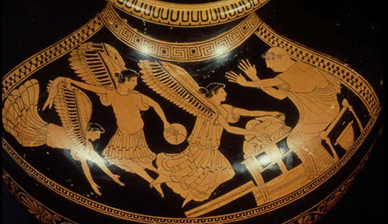
By the end of the classical period, harpies had become monstrous portraits of femininity. They were birds with the heads of maidens, their faces visibly hungry, and had long claws extending from their hands. In the writings of Aeschylus around 500 BC, they are described as disgusting creatures with weeping eyes and foul breath. Virgil, in his Aeneid dated 30-19 BC, refers to them as bird-bodied and female-faced with talons for hands, whose faces reflect insatiable hunger and whose droppings are notably vile. These grotesque portrayals of the harpyโ€”half woman, half monsterโ€”are the most well-known from classical mythology.

Harpies depicted as winged women take food from the table of the blind king Phineus on an Athenian vase from 480 BC housed at the J. Paul Getty Museum.

Interestingly, one mythographer did stick a roosterโ€™s head on the otherwise female body of a harpy. Writing in Rome during the 1st century AD, Hyginus describes harpies as having feathered bodies, wings, and cocksโ€™ heads and the arms, bellies, breasts, and genitals of a human woman.[4] Still, there are no serpent parts here to suggest that a medieval image of a cockatrice might instead be a harpy based on Hyginusโ€™s design.

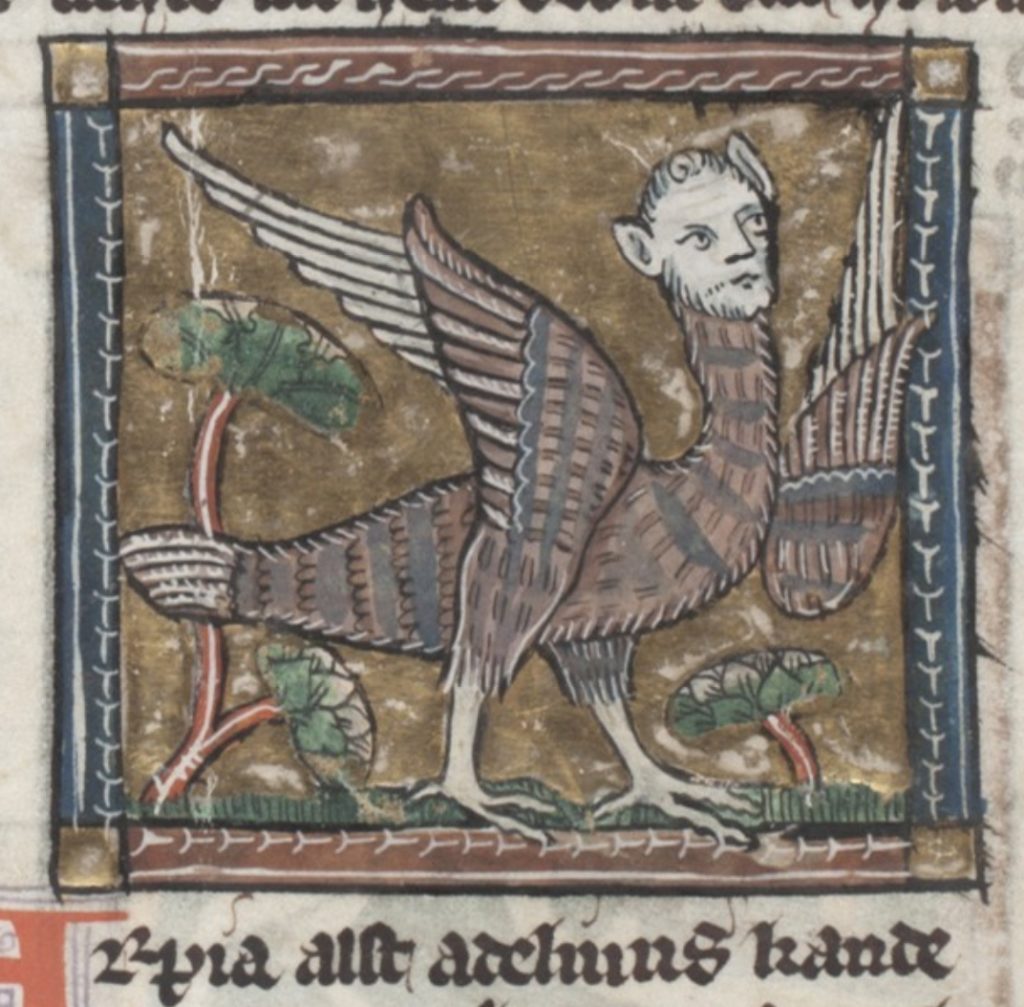
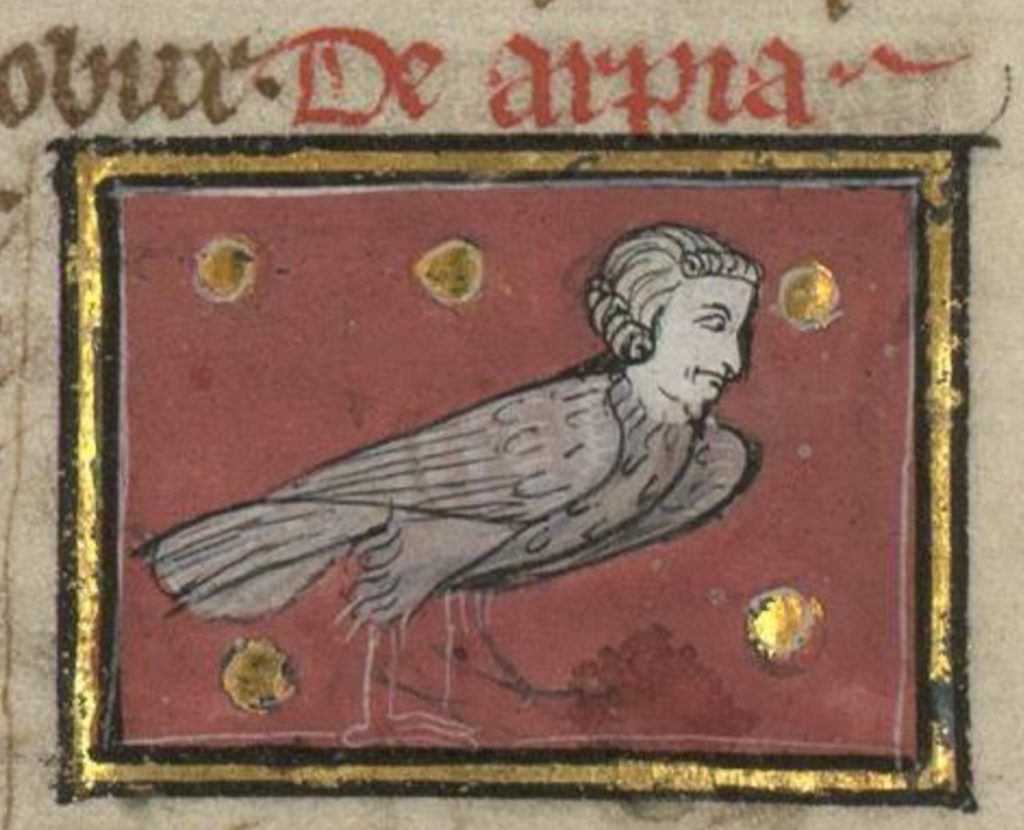
During the Middle Ages, harpies may not have been so distinctly gendered, at least in their encyclopedic cataloguing. Most representations in medieval bestiaries depict the creatures with bird bodies and female faces, but several manuscript illustrations appear androgynous and some even portray the harpy with a beard. The beard, however, may not be indicative of a male beast but instead emphasize the beastliness of the female creature.

Illumination of a harpy with facial feathers reminiscent of a beard from the medieval encyclopedia Der Naturen Bloeme, or The Flower of Nature, written in Middle Dutch and produced in Flanders circa 1350 (Koninklijke Bibliotheek, KA 16, folio 75r).

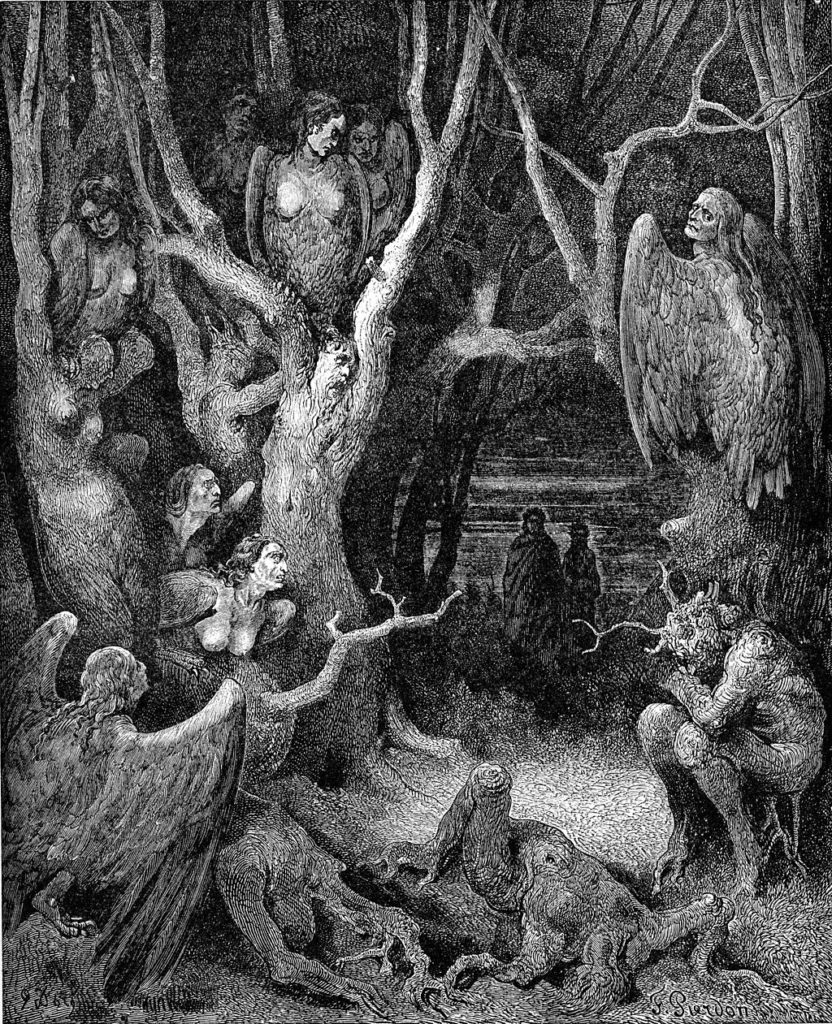
Furthermore, Ovidโ€™s retelling of the Jason story in his Metamorphoses specifically mentions the harpies having the faces of virgin women. Written in the 9th century, Ovidโ€™s collection of myths served as a source text for many medieval writers, including Dante Alighieri and Geoffrey Chaucer, and his treatment of the harpies suggests that their association with female monstrosity continued to resonate soundly during the period.

Engraving of the harpies in the Forest of the Suicides in reference to Dante Alighieriโ€™s Inferno by French printmaker Gustave Dorรฉ (1832-83).

Turning to the etymology of the term, the first recorded instance of harpy in English actually appears in Chaucerโ€™s Monkโ€™s Tale around 1405.[5] The creatures are not specifically gendered; they are simply mentioned among the monsters defeated by Hercules, at which point the text reads, โ€œHe Arpies slow, the crueel bryddes felleโ€ [โ€œHe slew the Harpies, the fierce cruel birdsโ€] (2100).[6] Yet one cannot help but see the feminine slippage in the spelling of โ€œbryd,โ€ meaning both โ€œbirdโ€ and โ€œbrideโ€ in Middle English.[7] Indeed, the term harpy adopts a derogatory connotation in writing by the mid- to late 15th century.[8] The term cockatrice, too, took on a negative meaning specifically with respect to women by the mid-16th century, at which point it referred to a prostitute or a sexually promiscuous woman.[9]

Illumination of a harpy with a female face from the medieval encyclopedia Liber de natura rerum, or Book on the Nature of Things, written in Latin and produced in France during the 13th century (Bibliothรฉque Municipale de Valenciennes, MS 320, folio 86r).

While itโ€™s possible that the harpy may have maintained some gender ambiguity during the medieval period, contemporary etymology and ideology has synonymized the harpy with femaleness but also, importantly, with power. The sheer number of times Hillary Clinton was called a โ€œharpyโ€ during her presidential campaign highlights how a powerful woman was characterized as not only threatening but also monstrous while pursuing a position historically deemed male domain.[10]

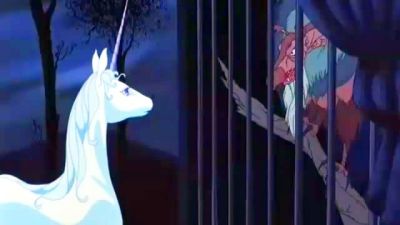
Harpies in medieval fantasy films are also perched at the intersection of femaleness and power, glorious in their might regardless of how monstrous their bodies may be. The Last Unicorn, a 1982 animated adaptation of Peter S. Beagleโ€™s 1968 novel, provides a poignant example. Captured by a traveling circus, the titular character finds herself caged across from a harpy, the only authentic creature of legend in the menagerie apart from the unicorn herself.

In a magnificently ominous scene, the audience hears the harpy before they see her. A low growl grows to a raspy screech as the harpy appears on screen. She appears more bird than human, but her grotesque body is blatantly female with three elongated breasts visible beneath her beard and boarโ€™s tusks. A knotted tree limb cracks from the strength of her talons, and her eyes glow red with rage when her captor approaches her cage. Once freed, she kills the old woman who boasted of keeping a harpy captive when no one else could.

In The Last Unicorn, the titular character recognizes the harpy as Celaeno, the same name given to one of the harpy sisters in the Greek story of Aeneas. The unicorn is freed from her cage under the cover of night, and she then proceeds to free her fellow immortal.

Considering the harpyโ€™s history, it seems a shame to mistake her for any other creature from Greek mythology or medieval bestiaries. She has been such a fraught representation of both femininity and monstrosity, but she has also endured as a symbol of female ferocity. Even as her beauty eroded over the centuries, her power has not waned, and her macabre femininity has never ceased to inspire fear.

Emily McLemore, Ph.D.
Alumni Contributor, Department of English


[1] Photos are prohibited in the museum, so I have no physical record of the image. I attempted to contact the Capuchin Museum regarding the object on display to acquire additional information, including the date and location of production, but received no response.

[2] โ€œCockatrice,โ€ n. Oxford English Dictionary.

[3] โ€œBasilisk,โ€ The Medieval Bestiary.

[4] Fabulae from The Myths of Hyginus, translated and edited by Mary Grant.

[5] โ€œHarpy,โ€ n., def. 1, Oxford English Dictionary.

[6] Geoffrey Chaucer, The Monkโ€™s Tale, The Canterbury Tales, Harvardโ€™s Geoffrey Chaucer Website.

[7] โ€œBridโ€ and โ€œBrid(e,โ€ n., Middle English Compendium, University of Michigan.

[8] โ€œHarpy,โ€ n., def. 2, Oxford English Dictionary.

[9] โ€œCockatrice,โ€ n. def. 3, Oxford English Dictionary.

[10] For more on Greek mythology, female monstrosity, and contemporary resonance, I recommend Jess Zimmernโ€™s Women and Other Monsters: Building a New Mythology (Beacon Press 2022).

Unearthing the Vampire: Succubi, Secrets, and Womenโ€™s Monstrosity

Earlier this month, the corpse of a woman with a protruding front tooth and a sickle positioned across her throat was discovered in a 17th-century cemetery near the village of Pien in south-eastern Poland. The sickle was meant to keep the body contained: should the deceased woman have attempted to rise from her grave, the blade would have promptly beheaded her. Coupled with the womanโ€™s prominent incisor, the placement of the sickle suggests that those who tended to her burial may have feared she was a vampire.

Professor Dariusz Poliล„ski from Nicholas Copernicus University observed, โ€œThe sickle was not laid flat but placed on the neck in such a way that if the deceased had tried to get up most likely the head would have been cut off or injured.โ€ Photo courtesy of Miroslaw Blicharski and Alexsander Poznan.

The woman was found with the remains of a silk head dressing, which indicates she was someone of high social status, as such a garment would have been an expensive commodity. Of course, this woman would be neither the first aristocrat nor the first woman to be suspected of vampirism.

In addition to the positioning of the sickle and her prominent incisor, a padlock was secured around the big toe of the womanโ€™s left foot, which may be meant to symbolize โ€œthe closing of a stage and the impossibility of returning,โ€ according to Poliล„ski. Photo courtesy of Miroslaw Blicharski and Alexsander Poznan.

Elizabeth Bรกthory was a Hungarian noblewoman and historyโ€™s most prolific female serial killer, who tortured and murdered as many as 650 girls and women between 1590 and 1610. Her association with vampirism manifests in the folklore that describes the countessโ€™s ritual of bathing in her virgin victimsโ€™ blood to retain her youthful beauty. Neither the number of victims nor her bathing activities are confirmed. Nevertheless, a servant girl testified that she saw the figure recorded in one of Bรกthoryโ€™s private books, and another witness stated that he had seen the countess covered in blood. Colloquially, she became known as the Bloody Countess and, more contemporarily, Lady Dracula. 

A copy of the only known portrait of Elizabeth Bรกthory, depicting the countess at age 25. The original painting from 1585 has been lost.

Vlad Dracul, the late medieval ruler more commonly known as Vlad the Impaler, derived his namesake from his preferred method of murdering his enemies: impalement, a particularly gruesome form of death where a wood or metal pole is inserted through the body either front to back, such as a stake might be driven through a vampireโ€™s chest, or vertically through the rectum or vagina. The prince purportedly enjoyed dining amongst his dying victims and dipping his bread into their blood.

Portrait of Vlad Dracul by an unknown artist, circa 1560. This painting, like the one of Elizabeth Bรกthory above, may be a copy.

As Draculโ€™s surname, which incidentally means dragon, and Transylvanian origins indicate, the intermittent ruler whose brutality spiraled into legend subsequently became a source of inspiration for Bram Stokerโ€™s Dracula character. Another source, Sheridan Le Fanuโ€™s Carmilla, not only preceded Dracula but also, conversely, rendered its vampire antagonist female. Moreover, the novella, set in Austria in the late 1800s, positions Carmilla as a clever seductress whose victims are predominantly male. Although Stokerโ€™s iconic novel all but synonymized the vampire with maleness, Le Fanuโ€™s character reflects the traditional association of vampiric tendencies with femaleness that preceded and pervaded the medieval period.

Depiction of Carmilla and her companion, Laura, whom the novella positions as both a friend and a romantic interest. The illustration, by D. H. Friston, accompanied Carmilla when it was first published as a serial in the literary magazine The Dark Blue between 1871 and 1872.

While sensational news specifically citing vampires did not appear in Britain or Europe until the 1700s, the veil of vampirism shrouded the female body during the medieval period and for centuries prior in many parts of the world. In ancient Mesopotamia, for example, the Assyrians feared a demon goddess known as Lamashtu, a name meaning โ€œshe who erases,โ€ who was said to steal infants and suck their blood. Lilith, first wife of Adam turned primordial demon, has a similar reputation. Some stories describe her as a creature who steals babies under the cover of darkness, but she also has sex with men in their dreams and spawns demon offspring with their seed. Lilithโ€™s legacy as a sexually wanton demon of the night seems fitting, as she was the woman who first cohabitated with man but refused subservience. More specifically, Lilith questioned why she should lie beneath her husband during sex, and her resistance reinscribed her as monstrous. She became a succubus, a demon in female form who, essentially, sucks the life from men.

Painting of Lilith produced by John Collier in 1887, which conveys her association with the devil and her sexual proclivity through the intimacy she shares with the snake that embraces her naked body.

In the late Middle Ages, the fear of womenโ€™s vampiric nature was embodied by the figure of the succubus and implied throughout the wildly popular treatise De secretis mulierum, or On the Secrets of Women. The misogynistic, pseudo-medical text posited women as polluted physiologically and prone to witchcraft; in turn, it laid the foundation for the 15th-century inquisitorial treatise Malleus maleficarum, or The Hammer of Witches. Witches were also believed to imbibe in blood, particularly when feasting on the bodies of infants.  

Unlike depictions of the incubus, who adopts a male form and engages in sex with willing women, the succubus stalks unconsenting men, often in their sleep. As medieval historian Dyan Elliott explains, โ€œOften a succubus is introduced into a tale so that the holy man can resist it.โ€[i] Involuntary nocturnal ejaculation served as evidence that a man had been preyed upon by a succubus whilst asleep. As the victim of a rapacious female entity who had extracted semen from his body without permission, the man was absolved of any sin stemming from sexual emission.

In her book Fallen Bodies, Dyan Elliott identifies the life of Saint Anthony as a quintessential depiction of a man who resists the succubus. Painting titled The Torment of Saint Anthony by Michaelango, circa 1487-88, depicts a demon with breasts and a perineal orifice that also functions as the mouth of a second face.

Semen was understood during the medieval period as a substance that was not only life-engendering through its role in conception but also life-sustaining in relation to the maintenance of menโ€™s health. In short, the preservation of semen was vital to the preservation of the male body. Sex, therefore, posed a danger to men, who could become โ€œdried outโ€ if they engaged in sexual activity too frequently. Women, however, were believed to draw strength from the male body during sex by absorbing its heat, as described in the Secrets.[ii] Sapped of both his semen and his own bodily heat, the man was physically drained by intercourse, and the woman ingested his life force. 

The Secrets heightens the vampiric qualities of the female body when it identifies a sign of conception as the feeling of the penis being โ€œsucked into the closure of the vagina,โ€[iii] emphasizing how the womanโ€™s sexual anatomy acts upon the male body to extract its fluids and does so, seemingly, of its own accord. One of the commentaries that frequently circulated with the text exacerbates this somewhat unsettling sentiment by ascribing desire directly to the female body when the writer states, โ€œThe womb sucks in the penis, for it is attracting the sperm because of the great desire it has.โ€[iv] This is not the only instance where the Secrets suggests that female bodies behave so deliberately. Another commentator explains how โ€œit often happens that a woman conceives if she is in a bath where a man has ejaculated because the vulva strongly attracts the sperm,โ€[v] whereby the language alludes to the agency possessed by the female body that appears inherently poised to entice and consume the essence of its male counterpart if only for the purposes of reproduction.     

Moreover, the Secrets infers that the vagina itself might bite the man during intercourse when the text warns its readers that women sometimes place iron inside their vaginas with the malicious intention of harming their sexual partner, who then โ€œsuffer[s] a large wound and serious infection of the penis.โ€[vi] The phrase vagina dentata was not coined until psychoanalyst Sigmund Freud connected it with his concept of castration anxiety circa 1900, but the idea of the โ€œtoothed vaginaโ€ effectively manifests much earlier in a medieval treatise that likens women to succubi who thirst for mortal men and threaten them with their monstrous appetite.

Written and directed by Mitchell Lichtenstein and produced by Joyce Pierpoline, Teeth is a 2007 comedy-horror film that draws upon the concept of the vagina dentata. The film was positively received by critics when it debuted at the Sundance Film Festival and provides a sharp commentary on consent and sexual violence, despite its poor performance at the box office. 

Although womenโ€™s relationship with the postmedieval vampire can only be implied in a document that predates the term, womenโ€™s correlation with monstrosity could not be clearer. The commentator takes pains to note at an odd point in the text that, โ€œaccording to Aristotle in the 16th book On Animals, woman is a failed male, that is, the matter that forms a human being will not result in a girl except when nature is impeded in her actions,โ€ so โ€œ[i]f a female results, this is because of certain factors hindering the disposition of matter, and thus is has been said that woman is not human, but a monster in nature.โ€[vii]

As for the female remains recently unearthed in Poland, the skeleton has been relocated to a university for further study. While this woman was not the first to be found buried in a way that suggests her contemporaries feared she might rise from the dead, the placement of the sickle across her throat was unique. She was also spared from mutilation intended to prevent a vampireโ€™s resurrection, which has been observed at other sites. Perhaps those who orchestrated her burial were being politely precautious. After all, if stories had instilled in them that a woman naturally desires to feed on men while she lives, how terrifying that hunger might be once her body was released from restraint by her death.

Emily McLemore, Ph.D.
Department of English
University of Notre Dame


[i] Dyan Elliott, Fallen Bodies, University of Pennsylvania Press (1999), 53.

[ii] Helen Rodnite Lemay, Womenโ€™s Secrets: A Translation of Pseudo-Albertus Magnusโ€™ De Secretis Mulierum with Commentaries, State University of New York Press (1992), 127.

[iii] Lemay, Womenโ€™s Secrets, 121.

[iv] Lemay, Womenโ€™s Secrets, 121.

[v] Lemay, Womenโ€™s Secrets, 66.

[vi] Lemay, Womenโ€™s Secrets, 88.

[vii] Lemay, Womenโ€™s Secrets, 106.