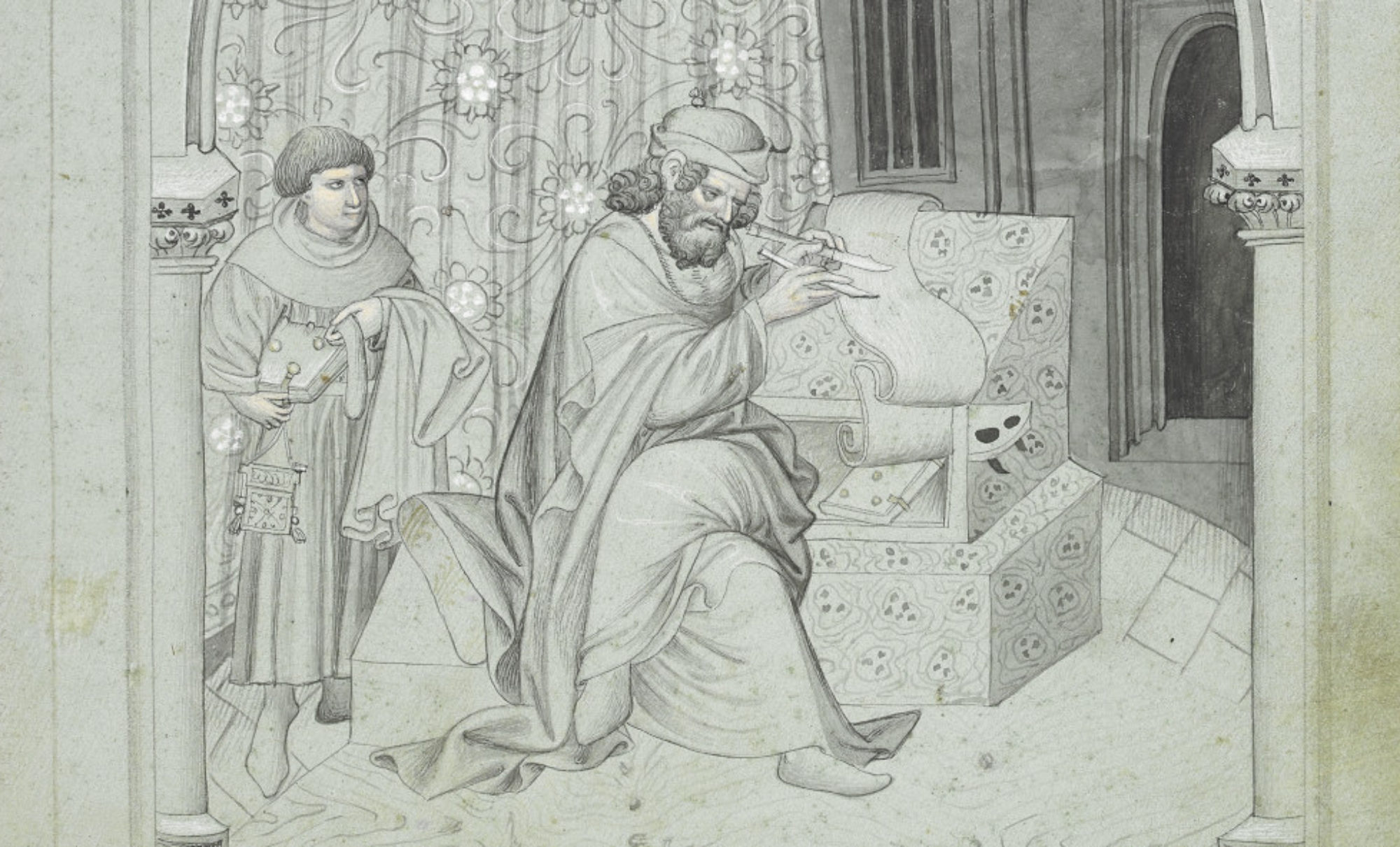
An Italian Itinerary for Dante Lovers: Florence (Part 1)

By PROPOLI87 – Own work, CC BY-SA 4.0, https://commons.wikimedia.org/w/index.php?curid=109894846

After exploring Rome, the next stop in Italy for a lover of Dante needs to be Florence, his birthplace and home until he was exiled for being a White Guelf in 1302. In Dante’s time, it was a flourishing cultural center at the intersection between ancient trade and pilgrim routes that connected the city to most of the known world. Pilgrims travelling from as far away as England might stop through Florence on their way to Rome, and to this day, the city is associated with a modern pilgrimage route that traces the steps of St. Francis of Assisi to Rome. This centrality not only fostered an immense cultural heritage, but it also positioned Florence at the center of a new European banking industry that made the florin (the coin of Florence) one of the standard currencies throughout Europe. To leave Florence, for Dante, must have felt like leaving not merely his world but the center of the known world itself.

Visitors to Florence today will find an abundance of Dante related things to do from understanding the history of the city at the Museo Storico Topografico Firenze Com’era, the origins of Dante the man at the Museo Casa di Dante, and the cenotaph of Dante in Santa Croce. In the early twentieth century, a team of historians and Dante scholars identified important locations in Florence for understanding the Commedia and marked these locations with white Carrera marble plaques, each containing quotations from Dante. With the aid of this website or Riedesser’s guidebook, Dante lovers can follow the path of the many places and people mentioned by Dante.

While Florence is full of many places for Dante lovers to visit, two particular places in Florence, the Uffizi and the Baptistery of St. John, contain essential pieces of art that help to illuminate some comments made in Purgatorio 11.93—95 given here in the Mandelbaum translation:

In painting Cimabue thought he held

the field, and now it’s Giotto they acclaim–

the former only keeps a shadowed fame.

Although Giotto was an exact contemporary of Dante, Cimabue was about fifteen years older than both of them and Florence’s most important 13th c. painter. Growing up, Cimabue would have been the “newest thing” for Dante and the Florentines, but as he ages, Dante will witness Giotto, who was only two years younger than him, rise to fame throughout Italy. Appreciating the way these two artists constantly tried to improve their art and compete with other artists is essential for understanding Dante’s own self-conception as a poet.

The Uffizi is one of the few museums in the world where it is possible to see the constant struggle that many artists have to achieve their own ideals and the way many artists, including both Cimabue and Giotto, return to the same subjects again and again in attempts to both imitate and out-do the other. This kind of collection allows viewers to see artistic development over time in the life of individual artists and not merely time periods.

Two particular examples of this stand out, paintings by Cimabue and his student, Giotto depicting the Virgin and Child Enthroned.
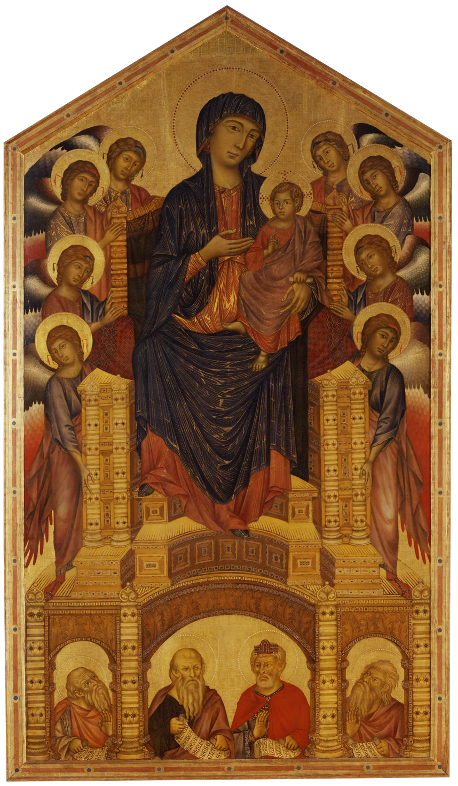
Cimabue, Virgin and Child Enthroned, and Prophets (Santa Trinita Maestà), Uffizi, 1290-1300, https://www.uffizi.it/en/artworks/virgin-and-child-enthroned-and-prophets-santa-trinita-maesta.

In his Santa Trinita Maestà,Cimabue takes a favorite subject of artists and approaches it in a fresh way. In Giorgio Vasari’s “Life of Cimabue,” he comments upon this piece, noting, “In that work, at great pains to respond to the fame already attributed to him, he showed more invention, and a fine approach to the disposition of Our Lady, who he shows with her Son in her arms, surrounded by many angels who venerate her in a field of gold.” This painting illustrates both Cimabue’s excellence in applying Byzantine techniques while also responding to the rising naturalism of his younger pupils, Duccio and Giotto. In his day, Cimabue was considered one of the best, and in this painting in particular, he demonstrates his constant attempts to grow in skill throughout his career, competing not only with himself but even with up and coming artists.

And yet, when this painting on a similar subject is placed alongside Giotto’s Ognissanti Maestà, the innovation of Cimabue begins to look old fashioned.
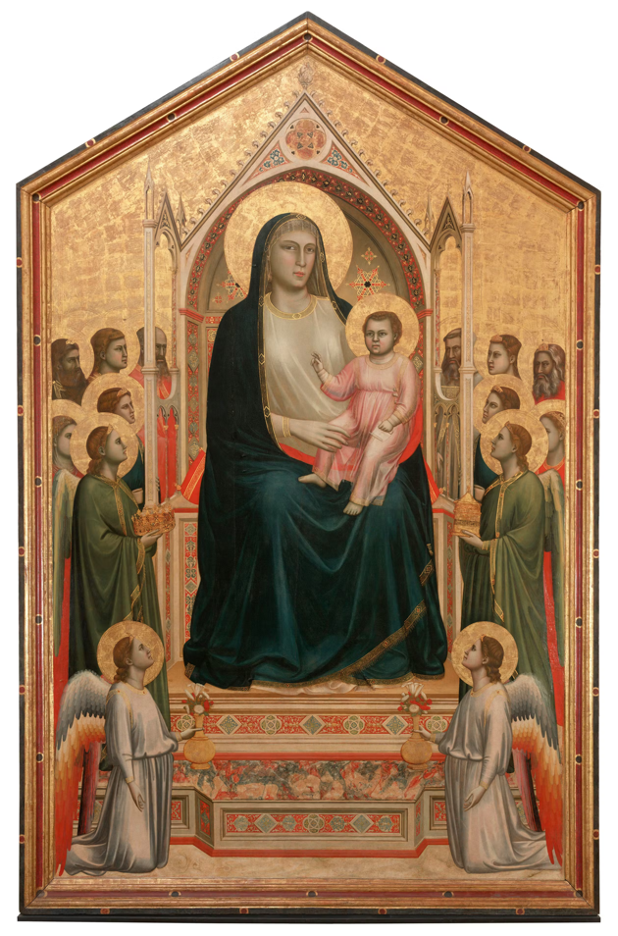
Giotto, Virgin and Child Enthroned, surrounded by angels and saints (Ognissanti Maestà), Uffizi, 1300-1305, https://www.uffizi.it/en/artworks/virgin-and-child-enthroned-surrounded-by-angels-and-saints-ognissanti-maesta.

Giotto manages to continue with the Byzantine use of damascene (gold decoration) while using chiaroscuro (light and shade) to create much more realistic faces. His figures also have a kind of weight and proportion to them that gives the viewer a sense that their bodies are much more realistic than Cimabue’s figures. He surrounds the thrown of the Madonna and child with a realistically proportioned tabernacle that is in a fashionable gothic architectural style employing different colors of marble. For years, Giotto’s painting hung in Ognissanti in Florence and became a model for artists working after him.

One thing that Dante will have to learn along his journey through Purgatorio is the flipside of artistic striving. Artists and poets of all sorts in Florence saw constant improvement as an inherent aspect of pursuing high craftsmanship, but inherently, this striving means that those who are great in their day will likely have those who come after them that will surpass them. A truly great artist will both strive to out-do what came before while also humbly recognizing that the fruits of that striving will have their day and pass away.

For Dante, however, the competition will not only be with other poets, but with craftsman of other sorts like the painters, Cimabue and Giotto. To see this more clearly, we will need to visit two other places, the Baptistery of St. John in Florence and the Scrovegni Chapel in Padua…

Lesley-Anne Dyer Williams is a Professor for Memoria College’s Masters of Arts in Great Books program and graduated with her doctorate from the University of Notre Dame’s Medieval Institute in 2012. She was also the founding director Liberal Arts Guild at LeTourneau University. Her research focuses upon twelfth-century Platonism and poetry, especially Thierry of Chartres and Bernard Silvestris.

Lesley-Anne Dyer Williams
Public Humanities Postdoctoral Fellow
Medieval Institute
University of Notre Dame

An Italian Itinerary for Understanding Dante’s Divine Comedy: Trajan’s Column in Rome

Long shot of a row of white statues

AI-generated content may be incorrect.Visitors to the Museum of Civilization in Rome can see plaster casts of the entirety of Trajan’s column. Photo by Notafly – Own work, CC BY-SA 3.0, https://commons.wikimedia.org/w/index.php?curid=4634304

I consider Italian art to be indispensable when teaching Dante. One way to think about the Divine Comedy is as a piece of Late Gothic/Early Renaissance art in poetry. Unfortunately for a classroom teacher, many of the pieces of art that can be most relevant for understanding him ought to be experienced in person because they are as spatial, and they are visual. These works of art do not fit neatly on a screen or piece of paper, and while a video can sometime be helpful in seeing details that are difficult to see in person, it cannot replicate the encompassing nature of the type of art produced in Italy during this time. So, grab a cappuccino (only if it is morning…if it is not, shame on you, espresso is the correct choice!), and plan your Dante-lover trip to Italy. While there are many guides to Italian travel, over the next few posts, I would like to focus here upon some specific pieces of art that Dante lovers ought to pay attention to. 

Most visits to Italy begin in Rome, and there are few things more indispensable to reading Dante than an appreciation for his love of the Roman Empire. The first stop is Trajan’s Column in Rome.

undefined

Trajan’s Column in Rome, Italy. Photo by Livioandronico2013. Creative Commons.

The emperor Trajan appears twice in the Commedia, once as a carved example of humility in the cornice of the Proud in Purgatorio 10.73-99 and again as one of the six chiefs of Justice in the Circle of Jupiter in Paradiso 20. While reading the Commedia the tendency is to think about Trajan as he is depicted in Voragine’s Golden Legend, as a man saved from hell by the prayers of Gregory the Great:

In the time that Trajan the emperor reigned, and on a time as he went toward a battle out of Rome, it happed that in his way as he should ride, a woman, a widow, came to him weeping and said I pray thee, sire, that thou avenge the death of one my son which innocently and without cause hath been slain. The emperor answered: If I come again from the battle whole and sound then I shall do justice for the death of thy son. Then said the widow: Sire, and if thou die in the battle who shall then avenge his death? And the emperor said: He that shall come after me. And the widow said: Is it not better that thou do to me justice and have the merit thereof of God than another have it for thee? Then had Trajan pity and descended from his horse and did justice in avenging the death of her son. On a time S. Gregory went by the market of Rome which is called the market of Trajan, and then he remembered of the justice and other good deeds of Trajan, and how he had been piteous and debonair, and was much sorrowful that he had been a paynim, and he turned to the church of S. Peter wailing for the horror of the miscreance of Trajan. Then answered a voice from God saying: I have now heard thy prayer, and have spared Trajan from the pain perpetual. By this, as some say, the pain perpetual due to Trajan as a miscreant was some deal taken away, but for all that was not he quit from the prison of hell, for the soul may well be in hell and feel there no pain by the mercy of God. 

The visitor to Trajan’s column, which stands in the forum (or market) of Trajan, may have a slightly different perspective. In Roman Art, Donald Strong points out that this column “sets out…to provide an epic version of the [Dacian] wars, with the Roman army under its great leader in the role of hero” (151). In other words, this column shows viewers what Trajan thought was important about his life, the wars he fought and the battles he won.

This monument to the glories of Trajan’s empire does not include the act of kindness remembered by Gregory when he visits the marketplace. To find an artistic engraving of these events of eternal importance, one has to look to the epic poetry of Dante himself:

At that I turned my face
And, looking beyond Mary, saw,
On the same side as he prompted me,
Another story set into the rock.
I went past Virgil and drew near so that my eyes might better take it in.
There, carved into the marble…
Depicted there was the glorious act
Of the Roman prince whose worth
Urged Gregory on to his great victory—
I speak of the emperor Trajan,
With the poor widow at his bridle, weeping,
Revealed in her state of grief
The soil all trampled by the thronging knights.
Above, the eagles fixed in gold
Seemed to flutter in the wind.
In their midst, one could almost hear the plea 
of that unhappy creature: ‘My lord, avenge
My murdered son for me. It is for him I grieve,’
And his answer: ‘Wait till I return,’
And she: ‘My lord,’ like one whose grief is urgent,
‘and if you don’t return?’ and his answer: 
‘He who will take my place will do it,’
And she: ‘What use to you is another’s goodness
If you are unmindful of your own?’
And he then: ‘Now take comfort, for I must discharge
My debt to you before I go to war.
Justice wills it and compassion bids me stay.’
He in whose sight nothing can be new
Wrought this speech made visible,
New to us because it is not found on the earth. (Purgatorio X.49-96; transl. Hollander)

Now, consider this: one of the iconic features of epic poetry is a figure of description known as ekphrasis, whereby a poet describes a work of art, like a painting or a statuary, in a way that competes with physical craftsman and shows that poetry is capable of doing more than a physical craft. For example, the shield of Achilles is described by Homer so that it has features that would be impossible in real life. (Think Harry Potter paintings.) Ekphrasis was one way that epic poets demonstrated that their craft had superior capabilities to that of other craftsmen.

A close-up of a book

AI-generated content may be incorrect.

MS Holkam, Misc. 48, p.75, Bodleian Library University of Oxford. https://digital.bodleian.ox.ac.uk/objects/10974934-30a5-4495-857e-255760e5c5ff/surfaces/ef18134f-8c01-4509-89e5-3f82de5ae6f2/

With this perspective in mind, it becomes clearer that Dante’s depictions of Trajan re-write the epic history that Trajan “wrote” for himself in Trajan’s column. In other words, Dante’s poetry competes with a physical piece of art by showing where Trajan’s true glory lay. Dante has imaged for us a “speech made visible” of Trajan’s act of true justice, carved by the divine artisan. Just as Jesus saw the poor woman give a mite to the temple when others marveled at the great riches donated by the wealthy, so Dante imagines the divine artist immortalizing an act that Trajan did not realize would be his most important. As you look at Trajan’s column in Rome, consider what it would take to make a better monument, so realistic that the figures move and make sound, on a subject matter that was higher than Trajan himself could imagine.

Lesley-Anne Dyer Williams is a Professor for Memoria College’s Masters of Arts in Great Books program and graduated with her doctorate from the University of Notre Dame’s Medieval Institute in 2012. She was also the founding director Liberal Arts Guild at LeTourneau University. Her research focuses upon twelfth-century Platonism and poetry, especially Thierry of Chartres and Bernard Silvestris.

Lesley-Anne Dyer Williams
Medieval Institute
University of Notre Dame


Further Reading
Strong, Donald. Roman Art. Yale University Press, 1995.